Tuesday, October 24, 2023

Podcast Tuesday: "Frankie and Joanie (SPOOKTACULAR EDITION)"

Erin Moran and Eddie Hartes on Happy Days.

Sometimes, I just can't help myself. When I realized that the 237th episode of our podcast, These Days Are Ours, was coming out a week before Halloween, I decided to turn it into our token "spooky" show, complete with references to The Shining (1980). After all, the number 237 plays a major role in that film. So you'll hear some creepy music and sound effects as we do an otherwise-normal episode of the show.

The timing on this is a little weird. Well, a lot weird. The episode we're reviewing this week is called "Kiss Me, Teach" and it's about Joanie (Erin Moran) becoming a student teacher at tough, graffiti-plagued Patton Vocational School. Patton essentially replaces Jefferson High in the final season of Happy Days. Both Fonzie (Henry Winkler) and Roger (Ted McGinley) work there. Marion (Marion Ross) and Howard (Tom Bosley) are understandably worried about Joanie working at Patton, and their fears are justified when a creepy student named Frankie (Eddie Hartes) becomes obsessed with her and even tries to sexually assault her.

So, yeah, this is one of Happy Days' infamous "very special episodes." And I turned it into a Halloween spooktacular. What is wrong with me? You can find out by clicking the play button below.

Wednesday, October 18, 2023

Ed Wood Wednesdays, week 167: John "Bunny" Breckinridge and the sex change that wasn't

Was Bunny Breckinridge really going to change his sex?

"Goodbye, penis!"
Bill Murray (left) says his famous line.

That's a line of dialogue viewers of Tim Burton's Ed Wood (1994) will likely remember. It's uttered loudly and publicly by Bill Murray as John Cabell "Bunny" Breckinridge (1903-1996), the foppish millionaire who was an unlikely member of Ed Wood's coterie and even played a prominent role in Plan 9 from Outer Space (1957). Why Murray chose to say those words in the exact cadence of Bea Arthur, I do not know. (But I'm glad he did.)

Some context may be needed for those who haven't seen the Burton film in a while. After the commercial failure of his directorial debut, Glen or Glenda (1953), Ed (Johnny Depp) is feeling down and decides to attend a wrestling match with his girlfriend Dolores Fuller (Sarah Jessica Parker) and Bunny.  Although Ed is initially unwilling to engage in conversation, Bunny excitedly tells Ed that Glenda has inspired him to get a sex change in Mexico. "It's something I've wanted to do for a long time. But it wasn't until I saw your movie that I realized I have to take action!" Ed is intrigued; Dolores is mortified.

Later in the film, however, Tor Johnson (George "The Animal" Steele) approaches Bunny during the wrap party for Bride of the Monster (1955) and asks him about the sex change. But a depressed Bunny tells him the sad story of what happened on the trip: "Mexico was a nightmare. We got into a car accident; he was killed. Our luggage was stolen. The surgeon turned out to be a quack." At the end of the film, a caption informs us: "Bunny Breckinridge, despite much talk, never actually had his sex change. He is currently living in New Jersey." Which he was, although at 91 he was too ill to do any publicity for Ed Wood.

The indomitable Chuck Harter recently sent me a cache of vintage news articles about this very subject, all from early May 1954, i.e. after Glenda but before Plan 9. You might remember Chuck as the reader who sent me the articles about Bunny's legal troubles a few weeks ago. And, once again, we'll go through these items one by one.

Tuesday, October 17, 2023

Podcast Tuesday: "Splash!" or "Mr. Cunningham Builds His Dream John"

Tom Bosley, Erin Moran, and Marion Ross on Happy Days.

Plumbing is funny. It just is. Especially when it breaks. The bathroom is already the least-dignified part of any home -- think of all the embarrassing things you do in there -- and when those toilets overflow or those pipes burst and water starts going everywhere, the hilarity increases exponentially. Comedians have known this for generations. That's why the Three Stooges did plumbing shorts with both Curly and Shemp.

It took television a while to be cool with plumbing-based humor. It was a big deal when a toilet was shown on Leave it to Beaver in the 1950s, even though it wasn't being used for its normal function. (I believe Wally and the Beav were keeping a turtle in a toilet tank.) In the 1970s, the Brady Bunch house had a single bathroom for six kids but no (visible) toilet. When she was a panelist on Match Game, Suzanne Somers claimed that she couldn't even say the word "toilet" on Three's Company. At the other end of the spectrum, All in the Family got a big laugh by letting the audience hear Archie Bunker flushing the upstairs john.

Like the Brady manse, the Cunningham house on Happy Days only had one bathroom, but it was the site of some memorable moments. I remember some heart-to-heart talks between Richie (Ron Howard) and Howard (Tom Bosley) taking place there, for instance. The bathroom is also a major location in the episode "The Cunningham Caper." But Happy Days didn't really engage in any full-on, Three Stooges-style "exploding plumbing" humor until the Season 11 episode "You Get What You Pay For" in which Howard finally decides to install a second bathroom in his 4,000-square-foot home.

And what a coincidence! That's the very episode we're covering this week on These Days Are Ours: A Happy Days Podcast.

Wednesday, October 11, 2023

Ed Wood Wednesdays: The Other Ed Wood, Jrs. (Guest Author: James Pontolillo)

Pictured here are Ed Wood, Ed Wood, Ed Wood, Ed Wood, Ed Wood, and Ed Wood. (Not pictured: Ed Wood.)

When searching for traces of our Eddie in archival records, the Wood-fan can be misled by published notices concerning more than a dozen other contemporaneous "Ed Wood, Jrs." that were roaming the American landscape. Three of these red herrings even had the unparalleled effrontery to be known as Edward D. Wood, Jr.! For the aid of fellow Wood researchers, I provide this abridged guide to the other juniors.

Tuesday, October 10, 2023

Podcast Tuesday: "Am I My Brother's Brother?"

Henry Winkler and Michael Holden on Happy Days.

As late as Season 11, the writers of Happy Days were not afraid to make major changes to the canon. I think TV shows were more casual about continuity in the 1980s than they are today. The December 1983 episode "Arthur, Arthur" makes two bold additions to the legend of Arthur "Fonzie" Fonzarelli (Henry Winkler). First, he has a long-lost brother named Artie (guest star Michael Holden). Second, their deadbeat father Vito is dead, having drowned while at sea. All this in one episode!

"Arthur, Arthur" is a follow-up to a Season 6 episode called "Christmas Time" in which Vito himself (played by '50s rocker Eddie Fontaine) appears unexpectedly at Fonzie's doorstep but never actually identifies himself. Throughout the entire series, Fonzie deals with severe abandonment issues stemming from the fact that Vito ran out on him when Fonzie was still a toddler. With the specter of death looming over Happy Days in 1983, it was necessary to give our favorite mechanic some sense of closure. Even if it means just learning Vito is dead.

This is a milestone episode, and we have a lot to say about it in the latest installment of These Days Are Ours: A Happy Days Podcast.

Wednesday, October 4, 2023

Ed Wood Wednesdays, week 166: The legal problems of John "Bunny" Breckinridge

Ed Wood fans know John "Bunny" Breckinridge from Plan 9.

John Cabell "Bunny" Breckinridge (1903-1996) only ever appeared in one movie, but sometimes, one is all it takes. As the haughty, aloof alien ruler in Ed Wood's Plan 9 from Outer Space (1957), Breckinridge is simply unforgettable, almost too good to be true. He is not just a flamboyantly gay man, but like the kind of over-the-top caricature of a gay man that you might see in a comedy sketch. And at the same time, his careful diction and quasi-regal manner suggest that he is a gentleman of considerable wealth and breeding. He gives off unmistakable "old money" vibes. 

For decades, viewers have watched Plan 9 and wondered how Bunny Breckinridge could possibly be real and how he could have ever wound up in such a low-budget science-fiction film. And while he's only a fleeting presence in Rudolph Grey's book Nightmare of Ecstasy (1992), he's a major character in the movie that resulted from it: Tim Burton's Ed Wood (1994), where he was portrayed by Saturday Night Live's Bill Murray. (My favorite Bunny line from that film: "Nix on the nelly without losing the naivete.")

I've long planned to explore the fascinating, complicated life of Mr. Breckinridge, but I've just never had enough time. It's a little intimidating to know that author Rod Woodard (some handle, huh?) has released a two-volume biography of the man. But recently, reader Chuck Harter sent me a passel of vintage newspaper clippings about Bunny that detail the actor's various legal problems. Let's go through some of them together and see what we can glean about this John Cabell Breckinridge.

Tuesday, October 3, 2023

Podcast Tuesday: "The Coach and the Roach"

Ted McGinley and Ken Osmond on Happy Days.

During its final season, Happy Days was getting trounced in the ratings just about every week.  The main problem was that the veteran sitcom was scheduled opposite NBC's The A-Team, which was siphoning off millions of young viewers. Making matters worse, though, was the fact that Happy Days followed the phenomenally unpopular Just Our Luck, a gimmicky sitcom about a wisecracking genie named Shabu (T.K. Carter) and his uninspiring master Keith (Richard Gilliland). To put it mildly, America was not interested in watching this embarrassing show. It was ratings Kryptonite.
 
These must have been gloomy times at ABC. Their once-proud Tuesday night lineup was falling apart quickly. Things got so bad that, by December 1983, the 8:00 Just Our Luck/Happy Days hour was getting beaten not only by The A-Team but even by CBS' now-forgotten legal drama The Mississippi. Yes, there was a time when Ralph Waite of The Waltons as a lawyer turned riverboat captain was a bigger draw than Fonzie (Henry Winkler). It was clear that Happy Days had overstayed its welcome.

Despite all that, the show's final, little-watched season has its share of hidden gems. In fact, overall, it's a marked improvement over the rather snoozy, underwhelming Season 10. I think the cast and crew knew Happy Days was on its last legs and decided to put a little extra effort into this final batch of stories. A good example of this is "Vocational Education," in which preppie dork Roger (Ted McGinley) becomes the principal of the rough-and-tumble George S. Patton Vocational School. This one is especially fun because of its guest stars, including Leave it to Beaver's Ken Osmond as a sleazy shop teacher and Back to the Future (1985) star Crispin Glover as a juvenile delinquent named Roach.

We have a lot to say about "Vocational Education," and you can hear all of it in the latest installment of These Days Are Ours: A Happy Days Podcast.

Wednesday, September 27, 2023

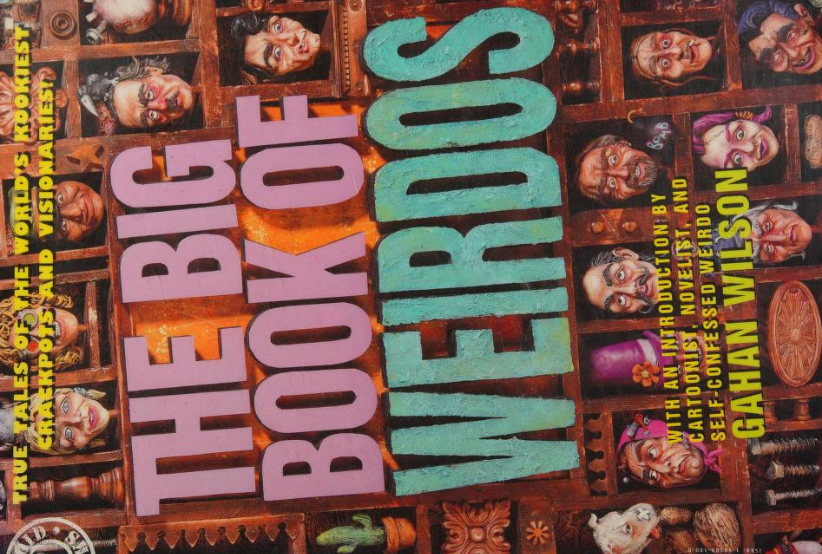
Ed Wood Wednesdays, week 165: The Big Book of Weirdos (1995)

Ed Wood is one of the "weirdos" profiled in this book.

"Weird" is one of the least desirable adjectives in the English language in 2023. File it alongside "problematic," "uncomfortable," and "toxic" among the labels you do not want placed on you. How did this happen? How did "weird" become such a pariah? 

Personally, I blame the downfall of that once-noble word on social media. The internet was supposed to expand our horizons, but it ended up doing the exact opposite. It narrowed them down to a little shiny black rectangle. Now that we can cultivate and curate a little world of our own interests and our own friends, we're more suspicious of (and hostile toward) the unknown. "Weird" basically now means "unfamiliar or unexpected in even the slightest way and therefore highly undesirable." Just be normal, says the world. Blend in.
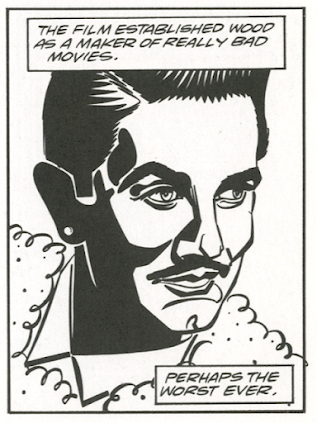
Excerpt from The Big Book of Weirdos.
That's not the way it was in the '90s. That decade was a great time—maybe the last great time—for quirkiness, individuality, and, yes, unapologetic weirdness. The song "The Dream of the '90s" from Portlandia sums up the mood of the era very well. Sample line from the video: "Remember in the '90s when they encouraged you to be weird? It was just an amazing time when people would go to see something like the Jim Rose Sideshow Circus and watch someone hang something from their penis."

This was also the golden age of "crate-digging," i.e. rummaging through the archives to find albums, movies, TV shows, and other artifacts from the past worth reviving. Back then, it was considered cool to be knowledgeable about our collective pop culture past, especially the offbeat and obscure stuff. Witness John Waters' Serial Mom (1994) in which some high school and college-age characters are fans of Bettie Page, Pee-wee Herman, Herschell Gordon Lewis, and even Chesty Morgan! Back then, Rhino Records and Something Weird Video were my lifelines!

Appropriately, the 1990s witnessed the second wave of Ed Wood fandom, which was more sympathetic to Eddie than the first wave in the 1980s had been. Instead of Harry and Michael Medved's snide The Golden Turkey Awards (1980), this was the decade of Nightmare of Ecstasy (1992), Tim Burton's Ed Wood (1994), and three major documentaries about him, plus various VHS and DVD reissues of his films. (Both Rhino and SWV handled Ed's movies.) Sure, we were still laughing at the cheapness, silliness, and oddness of Eddie's movies, but we were also celebrating him for his uniqueness.

Smack dab in the middle of the 1990s, DC Comics—yes, that DC Comics, home of Batman and Superman—released The Big Book of Weirdos (1995), a hefty, 224-page comics anthology consisting of mini biographies of 67 historical eccentrics. ("The world's most peculiar geniuses," according to the back cover.) These biographies, each about three to five pages in length, were all written by journalist and novelist Carl A. Posey. Each one was illustrated by a different, acclaimed comics artist, which gives the book a great deal of visual variety, similar to Harvey Pekar's American Splendor. 

The titular Weirdos have been sorted into various categories: tycoons, inventors, writers, etc. Ed Wood, Jr. is included in the chapter about artists and entertainers. This puts him in rarified company, alongside Andy Warhol, Salvador Dali, Vincent van Gogh, and others. Keep in mind, however, that inclusion in The Big Book of Weirdos is not necessarily an endorsement; Hitler is included in the chapter on autocrats and dictators, while Idi Amin is among the military men.

For the most part, though, this book is a celebration of its subjects, including Eddie. The three-page comic about his life hits the same basic bullet points as Ed Wood or most of the articles and documentaries about Eddie. Marine at Tarawa? Check. Wore bra and panties under his uniform? Check. Worked with an opium-addicted Bela Lugosi? Check. Worst director of all time? Check. You know the drill. I applaud Carl Posey for mentioning some deep cuts from Nightmare of Ecstasy, including references to the Hindenburg, the Ice Capades, and Eddie's alleged stint as a "carnival geek."
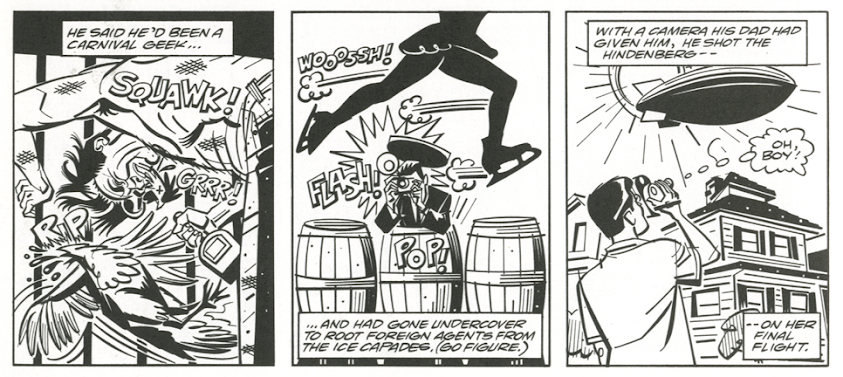
Some Woodian deep cuts from The Big Book of Weirdos.

The real draw here is the evocative, almost lurid artwork by the legendary Mitch O'Connell, who also drew the gorgeous cover for the recent Criswell biography. I'd describe Mitch's style as a cross between Daniel Clowes and R. Crumb, though he'd probably reject that description. Like his contemporary, Drew Friedman, O'Connell proves eerily adept at capturing the spirit of Ed Wood and his various oddball associates. In The Big Book of Weirdos, we get stylized portraits of not only Eddie and his wife Kathy but Tor Johnson, Joanna Lee, Captain DeZita, Criswell, Bela Lugosi, and even Texas Starr! I've talked about how Eddie's unproduced script Trial by Terror should be adapted into a graphic novel. Well, I can't imagine a better artist for the assignment than Mitch!

My favorite part of the mini-biography is its ending, and here I will have to give due credit to both Carl A. Posey and Mitch O'Connell. In the final panels, we see Kathy Wood seated on a couch, smoking a cigarette and reminiscing about the day Eddie died. Her dialogue comes directly from Nightmare of Ecstasy: "What do you suppose he saw in those last few moments? What do you suppose he saw?" This scene ends the story in a mysterious, haunting way, which I think Eddie himself might have appreciated. I also appreciated the various props and furnishings O'Connell has added to the scene, since they have a kitschy, early 1960s feel to them. On the wall behind Kathy, for instance, there is a painting of a sad-eyed puppy dog that looks like it could have been painted by Margaret Keane.

The good news is that The Big Book of Weirdos is available fairly cheap on the secondary market and is interesting from cover to cover. If you're of a mind to appreciate Ed Wood and his movies, you'll probably enjoy this entire book. I can definitely imagine taking this book along with me on a long trip. It's the kind of volume where you can flip to just about any page and find something worthwhile.