Wednesday, November 25, 2015

Ed Wood Wednesdays: The Wood Paperback Odyssey, Part Two by Greg Dziawer

This week, we delve into some 1960s paperbacks and determine whether or not Ed Wood was involved.

Sorry, folks, this isn't Ed's work.
There has been some lingering speculation that the obscure 1967 pulp novel Camera Action, though credited to one Dirk Malloy, was actually written by our very own Edward Davis Wood, Jr. under one of his many pen names. Eddie did write adult books during this era, but was this one of them? And if Ed didn't write this quaint and curious volume of forgotten lore, who did?

Well, to end the suspense quickly, Dirk Malloy wrote Camera Action. And that is a pseudonym, but not for Ed Wood. More on that later.

I bring all this up because in last week's installment of this series, we delved into the true authorship of Norman Bates' Male Wives, sometimes credibly claimed to be written by Ed Wood. There is reasonable circumstantial evidence to support this claim. Ed collaborated frequently with Male Wives' true author, Charles D. Anderson, when the two of them worked at Pendulum Publishing in Los Angeles in the late 1960s. Nevertheless, Ed Wood had no involvement with Male Wives. It is solely Anderson's work. Obviously, though, any connection to Eddie might make Male Wives or any such paperback more valuable on the secondary market.

In fact, in my various travels through the world of vintage paperbacks, I occasionally come across far more dubious claims that certain works supposedly involved Ed. As an Ed Wood fan myself and a researcher, that deeply irritates me. And before a spark becomes a fire, we should put it out. Not that these pathetic gambits by book sellers are always successful. Just because someone claims a book was written or cowritten by Ed Wood doesn't mean that buyers will believe it. For example, in the case of that last book, its "buy it now" price on Ebay remained at a mere $22 for months. Genuine Ed Wood paperbacks routinely sell in the hundreds.
A Leo Eaton/Ed Wood collaboration
from the T.K. Peters source.
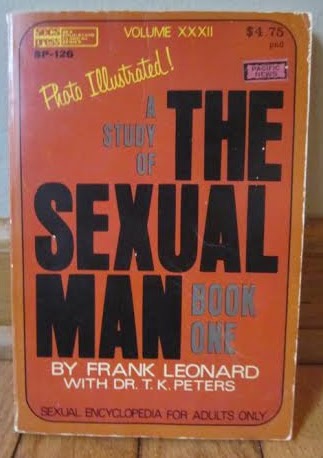
But even a blind squirrel occasionally finds a nut. I landed a copy of the super-rare A Study of the Sexual Man, Book One at Etsy for a mere $21.99 a couple weeks back, lucky that the seller had no idea what they had on their hands. This particular vendor didn't list Ed's name in the description of the item. Nor was there a mention of Pendulum or even of the book's credited coauthor Dr. T.K. Peters, even though that name is highly associated with Ed Wood.

I was about 30 pages deep into this seller's listings—I'd gotten there because I had found a non-Ed paperback from Pendulum and kept clicking with blind hope—when the title and the name T.K. Peters on the cover caught my eye. Without the relevant keywords ("Ed Wood," "Pendulum"), no one was going to find this thing.

Truth be told, few people were even looking for this book, and the seller isn't necessarily to blame. Although The Sexual Man, Book 2 is a known work by Ed Wood, information on its predecessor is rare to nonexistent. Almost. I found a listing for this book in the Library of Congress' invaluable Catalog of Copyright Entries Jul-Dec 1971. It is credited there solely to Leo Eaton, another of Ed's fellow staff writers at Pendulum, under his oft-used pseudonym of Frank Leonard. But I later learned that this book is listed on Ed's very own resume, which is as reliably accurate a document as Wood scholars and fans can find. By all indications, then, The Sexual Man, Book One was at least cowritten by Edward D. Wood, Jr. That makes this a very exciting discovery.

Here is an excerpt from the introduction to A Study of the Sexual Man, Book One, a passage signed, "Frank Leonard, Los Angeles, 1971":
As Madison Avenue and the advertisers jumped on the band-wagon, the confused and bewildered male looked around to find that all aspects of his nice, safe, male-dominated society were pandering the woman's sexuality. 
Very interesting. But I digress. Let's get back to discussing the book mentioned at the beginning of this article. Because Dirk Malloy's Camera Action will eventually sell and its listing will eventually disappear from the internet, let's document the details of the seller's claim.

A rare Midwood Triple.
The product for sale on Ebay is the adult paperback Camera Action, published in 1967 by Midwood, an East Coast publisher never known to have published any work directly connected to Ed Wood. Nevertheless, the seller optimistically opines: "I believe this is an original Ed Wood Jr. book! I attempted to find out online but found no list for his books written under pseudonyms."

I also "attempted" to "find out" the truth, though perhaps these terms mean something different to me than they do to the seller, who may have been looking for an article on Yahoo! Answers or something similar. Instead, I took the logical step of simply Googling the name "Dirk Malloy." Meanwhile, while there are numerous online lists of Ed Wood's known and suspected pen names, there is no definitive or 100% complete "list for his book s written under pseudonyms," so the seller has at least some amount of plausible deniability. (Hey, I'm being charitable.)

Otherwise, though, this Ebay user's story does not hold up. Dirk Malloy is easily identified as a pseudonym for the very prolific Hank Gross. As Dirk, Gross wrote dozens of sleazy paperbacks, most of which sound either like man's man fantasies or variations on Russ Meyer's softcore comedy The Immoral Mr. Teas. Camera Action seems to fall into the latter category. Hank Gross once had a promotional website of his own, but that web domain is currently for sale. A succinct portrait of Dirk Malloy can be found here. This excerpt makes him sound rather like the Most Interesting Man in the World from the Dos Equis commercials.
Dirk Malloy is a raconteur, a lover of the ladies, and a writer of books aimed especially at men with lusty and intellectual interests like his own. He is a third-degree black belt in aiki-jitsu, has traveled extensively, rides a Harley, explores both theoretical physics and the wacky stuff, drinks his scotch straight, loves a good belly laugh, and has tasted both victory and defeat in life and in love. In short, a complete man.
The only photo of Hank Gross/Dirk Malloy I could find.
In 2010, Gross/Malloy published many of his work as e-books, which are still available. His fanciful and eclectic bibliography includes everything from Celebrity Sex Scandals to Gourmet Cat Recipes to Raunchy Jokes for Guys to Jesus Plays the Catskills. A description of the latter:
In this sublime retelling of the story and teachings of Christ's life, Jesus himself takes the mike and tells it to a Borscht-belt crowd as a Jewish comic might. It's the New Testament as you've never heard it before! So here he is, ladies and germs, the King of Kings, the Lamb of God...let's give it up, folks, for JESUS!
His bio glosses over his work in adult paperbacks, though he reprinted some of these digitally as well. Personally, I am going to check out the reprint of 1967's The Dirtiest Dozen, a document of the meteoric rise of sex newspapers in the late '60s, covering Screw and its pretenders:
The male could grind his thighs against those of the heroine as much as he pleased, but he could not, under any circumstances, drop in on her cunt – not that it mattered, since she didn’t have one anyway. And of course, heaven help the publisher if, despite the obstacles of having neither a pud nor a place in which to put it, the hero had the temerity to actually shoot his load.
Oh, well. I thought my friends and I had made up the word "pud" in the fifth grade. I'll also be checking out Sexual Fetishism, which covers painfully neglected, harshly real territory, the description getting lost in parentheses:
Take a walk on the wild side with this breezily-written guide to sexual fetishes, from agalmatophilia (arousal by statues) to renifleurism (urine and underwear), to doraphila (fur fetish), including quotes from some of the estimated 50 million practicioners and a comprehensive glossary of over 700 fetishes you probably never heard of.
Many more astounding facts about Edward D. Wood, Jr. will come to light in future editions of this series. Potential articles include the following:
  • Reviews of The Sexual Man, Book One and Pendulum's Young Marrieds, a paperback from 1971
  • “Unknown” fellow staffers at Pendulum identified. 
  • "Down Shirlee Lane"
  • The story of Golden State News and its myriad magazine lines (Classic, Cougar and Gold Line Publications among them), the blueprint for Pendulum, where Ed's work still largely remains unidentified
  • "One Million A.C. Stephens," the first installment of the Wood Script Odyssey; and the epochal revealing of the real T.K. Peters

Sunday, November 22, 2015

Social Media Buzz: Another short story by Joe Blevins

"Eat your soul? Who, me?"

     After gently knocking twice, the dapper young man cracked open the door of his immediate supervisor's tastefully-appointed office and tentatively peered in.
     "Mr. Van Landingham?"
     The other man, fiftyish and conservative, did not rise to greet the young man but remained seated behind his desk as he said, "Come in, Korey. Have a seat, please."
     The young man entered the room, closed the door behind him, and respectfully sat down in a chair across the desk from his boss.
     "How do you think you've been doing in your role of Social Media Manager for the General Mills family of cereals?" said the older man.
     "Uh, good, I guess?"
     "Okay. Okay. Interesting. Now, one of your professional duties these last six months has been maintaining the Twitter account of Buzz the Bee, the cartoon mascot of our Honey Nut Cheerios brand. Is that correct?"
     "Uh, yes, it is."
     "All right. Now we're getting somewhere. Well, Korey, I took the liberty of printing out some of your recent tweets from that account. I have them right here. Do you mind if I read them out loud?"
     "Not at all."
     "Okay, here's one: 'Nothing like a bowl of Honey Nut Cheerios to start your morning right.' Now, normally, that would be a damned fine tweet, Korey, but you chose to end it with the hashtag '911WasAnInsideJob.' Can you explain that?"
     "Well, uh, Mr. Van Landingham..."
     "Please. It's Kevin."
     "Well, Kevin, it's not that I personally think 9-11 was an inside job. But, of course, the account is written from Buzz's point of view. It's what he thinks. He's a multi-faceted character."
     "Okay, fair enough. But how about this one? 'Bee happy. Bee healthy. Life begins at conception.'"
     "Well, children do make up a substantial portion of our customer base, Kevin. And if they're not carried to term, they're not going to be eating any of our delicious Honey Nut Cheerios, are they?"
     "Hmmm. I suppose not. But then, there was this tweet that contained only a photo of actress Neve Campbell topless in the 2007 film I Really Hate My Job."
     "What, specifically, is the issue with that one?"
     "The issue, specifically, is that it's a photo of actress Neve Campbell topless in the 2007 film I Really Hate My Job. We try to keep our social media content family-friendly, Korey."
     "Are you saying then, Kevin, that General Mills considers the female body to be inherently shameful, something to be hidden away from view?"
     "Well, no, not exactly. But..."
     "Haven't you heard of the Free the Nipple campaign, Roderick?"
     "Kevin."
     "Whatever. It's a vital, burgeoning movement in this country right now. Shouldn't General Motors..."
     "Mills."
     "...Mills be at the forefront of change for once? There's nothing wrong with breasts, Kevin. Breasts produce milk, and what goes better with cereal than milk?"
     "Yes, but did you have to post that same photo every hour on the hour during the Paris terrorist attacks? People were beginning to wonder if it was some kind of code. Now I have the NSA breathing down my neck."
     "People always fear what they don't understand, Kevin. That's what I'm up against every time I tweet something on behalf of Buzz the Bee. You don't know what kind of an awesome responsibility this is. While you're tucked away in this cozy little office of yours, I'm out there on the front lines! Right now, people are starving for the truth, and I'm there to feed it to them, 140 characters at a time. The new millennium needs its own Che Guevara, and why shouldn't it be a cartoon spokes-bee? The truth will out! Viva the Bee!"
     As the young man pumped his fist in the air and assumed a pose of hard-won victory, the older man reached into a desk drawer, pulled out a small blow gun, raised it to his mouth, and shot a dart directly into his subordinate's neck. The young man slumped over instantly. The older man paused, sighed, then picked up the landline phone on his desk.
     "Gladys? Have maintenance send a crew to my office immediately. We have another Code B to take care of. Say, how many more nephews do you think the CEO has left, anyway?"

Saturday, November 21, 2015

I tried to fix 'The Dinette Set,' and it defeated me.

(left) Julie Larson's original Dinette Set panel; (right) My "corrected" version.

Julie Larson's The Dinette Set, a single-panel cartoon feature, is somehow celebrating its 25th anniversary in 2015. It started in the Los Angeles Reader under the title Suburban Torture back in 1990 and became nationally syndicated under the name The Dinette Set seven years later. The feature's appeal and longevity baffle me. It's a domestic comedy focused on the adventures of two middle-aged sisters, Verla Darwin and Joy Penny, and their respective spouses and friends. It's supposed to be a gentle satire of middle class life, but it comes off as condescending and snide, and the characters are interchangeable and dull.

What really bugs me about The Dinette Set, though, is that it's a humor strip that doesn't know how to tell a joke properly. Each panel is saturated with unfunny, superfluous textual gags: T-shirt slogans, posters and signs, product labels, etc. All of this extraneous text is handwritten in the exact same style. Larson tries to distinguish each panel's primary, dialogue-based joke by writing it in larger letters, but the words push right up against the edges of the balloons, rendering them only semi-legible. The strip is a difficult-to-read eyesore.

Part of the reality of doing a syndicated newspaper comic is that each installment will contain a certain amount of clutter: the artist's signature, a date, a plug for the syndicate, and probably some mention of a promotional website, too. As distracting as these can be, they're a necessary evil. I firmly believe that jokes, at least when presented in the form of comic strips or cartoon panels, need a little breathing room. A certain amount of negative space helps. Charles Schulz, one of the masters of the form, used tons of negative space in Peanuts. But Julie Larson clutters up every square inch of her panels with unnecessary verbiage. Her jokes are suffocating. And they weren't too strong to begin with!

So I took a typical Dinette Set panel and tried to "fix" it. First, I eliminated as many props and background actors as I could without sacrificing the integrity of the scene, i.e. a baby shower with numerous guests and presents. I wanted to focus the reader's attention on the two primary characters, the ones who are actually talking to each other. I especially wanted to remove any distracting details around those characters' faces. When you're drawing a cartoon like this, you're like a director working with actors. I wanted to make sure their faces were the focal point of this scene. I also reduced the dialogue in size so that it had some air around it, while removing some redundant words in Mrs. Darwin's response. I didn't see any reason for both women to say the words "a Clapper for the baby's overhead light." Once was enough.

But my efforts were in vain. This stubborn Dinette Set panel was still pretty bad, even after my so-called "corrections." I think my version is a slight visual improvement, but the cartoon is still stifling and uninspired, and the joke still doesn't land the way it should. In desperation, I tried to convert this into a New Yorker-style cartoon with no word balloons and the dialogue rendered as a caption below the picture.


Nah. Still sucks.

Wednesday, November 18, 2015

Ed Wood Wednesdays: The Wood Paperback Odyssey, Part One by Greg Dziawer

Some latter-day reprints of Ed Wood's many, many, many paperback books.
The Barclay House key logo

A veritable cottage industry has arisen around the sale of rare Ed Wood books, artifacts, and memorabilia, and it's an increasingly pricey world. Let's say you have an erotic paperback from the 1970s and it has been suggested—or even implied—anywhere that Wood was its author. Your asking price has just increased tenfold. Naturally, what we as fans really want to do is whether Ed Wood really did have any involvement with this hypothetical paperback. 

As much as anyone, I feel a flush of excitement when I feel I have discovered a magazine article, short story, or pornographic loop that seems plausibly connected to Ed Wood. Call it hope. Call it enthusiasm. However, my reason eventually overtakes my impulsive emotion and reminds me of a Janus-faced truth: there are still tons of unidentified works by Ed.

For the sake of illustration, let's examine just one book, a racy-sounding paperback called Male Wives, and determine whether it is worth our while. And, in the spirit of Ed Wood, let's get at the unvarnished facts, the very haven of truth.

  • FACT: Male Wives was published by Barclay House of North Hollywood. It was released as Psycho-Sexual Study #7031 in 1969 and credited to the obvious pseudonym Norman Bates, a nod to Alfred Hitchcock's 1960 film Psycho.
  • FACT: Like Essex House, Barclay House was an imprint of Brandon House. All of these lines were marketed as sociological non-fiction in order to evade legal scrutiny. Also credited to Norman Bates, Teenage Pimp (1970)—complete with a delirious title and cover—was Barclay House Psycho-Sex Study #7096.
  • FACT: The Library of Congress' Catalog of Copyright Entries Jan-June 1969 lists Male Wives' author as Charles Anderson. Elsewhere in this same volume, the entry for Norman Bates reads as follows: "Bates, Norman, pseud. See Anderson, Charles."
  • FACT: Though not included in either Nightmare of Ecstasy or Muddled Mind, both of which contain extensive Ed Wood bibliographies, Male Wives is listed credibly and authoritatively in Boo-Hooray's video here. Boo-Hooray is a New York art gallery that hosted an exhibition called Ed Wood's Sleaze Paperbacks in late 2011. This is a result of Male Wives having been included in Cornell's extensive Ed Wood, Jr. collection, as listed here. The cover alone may be worth it!

(left) Teenage Pimp: Every boy's fantasy.
(right) Male Wives: Gay pulp fiction masquerading as hippie-era sociology.

You get the point. Apart from the Norman Bates titles, Ed Wood has no credits at Barclay House. In the 1970s, Charles D. Anderson held down dual roles as both editor and staff writer at Pendulum Publishing, Ed's most frequent employer. (Another writer, Leo Eaton, told me he was working at Pendulum's office on West Pico Blvd. until the spring of 1971, and Charles Anderson had not arrived yet. He must have gotten there shortly after Eaton's departure.)

Anderson is reputed to have said—in an interview I have yet to locate—that all of the "Norman Bates" credits were written solely by him. Beyond the books, that also includes a passel of short stories for various Pendulum magazine titles, all written during the same era when Ed Wood was an insanely prolific author for the company. And there is one known, verified collaboration between Anderson and Wood: the 1973 Edusex/Gallery book A Study of Fetishes and Fantasies, credited on its cover to Edward D. Wood, Jr. and Norman Bates and billed as a "sexual encyclopedia for adults only."

 Pendulum's Little Library imprint aped the look and feel of the popular Liverpool Library Press.

People: All going some-vere!
MORE THAN A FACT: Ed Wood did not write or even collaborate on Male Wives. For that matter, he had nothing to do with Teen-Sex Swapping, a 1970 Barclay House title, again credited to Norman Bates. Charles D. Anderson used another pseudonym taken from Psycho—Marion Crane—when he wrote Brother John and Sister Mercy for a Pendulum imprint called Little Library Press in 1972. Incidentally, Little Library Press had also published Ed Wood's own To Make a Homo in 1971.

Connections abound.

Another bit of enticing trivia, though not one meant to suggest Ed Wood's involvement: the 1974 book Satan, Demons & Dildoes (Barclay House #7406) uses a still from Orgy of the Dead. In the picture, redhead Colleen O'Brien cuddles up with a skeleton. The fact that Wood scripted Orgy of the Dead may make some people think that the book's credited author, Eugene Richards, is another of Ed's many pen names. Nope.

Caveat Emptor. Let the buyer be-vare.

Be-vare, take care. Be-vare....

In future editions of this series, there will be more information about Norman Bates/Charles Anderson, as well as Pendulum/Little Library Press. And we'll talk about some genuine Ed Wood paperbacks, too. Stay tuned!

Monday, November 16, 2015

My 21-year-old theory about 'Pulp Fiction'

You know any of them old jokes? No, but I know an old theory.

It's all about Travolta, man!
I don't know why this popped into my head today, but I started thinking about a theory of mine concerning the movie Pulp Fiction. This was an idea I started toying with back when the movie was new in 1994, and it never got any further than some primitive, now-obsolete Usenet discussion groups. In those bygone days, I was probably frequenting alt.fan.tarantino or something similar. I think this idea of mine found some traction there, but it probably only amounted to a single stranger saying it was "kind of interesting." That was enough for me back then. Likes and RTs hadn't been invented, so we had to make due with what was available.

Anyway, my theory was that Pulp Fiction, at least the parts concerning the Vincent Vega character, was a movie-length tribute to the career of star John Travolta. It starts with the character's name. Vincent was also the name of Travolta's character on Welcome Back, Kotter. The "Vega" part was simply an acknowledgement that Travolta was a superstar. The actor became famous through television but never did another recurring role on a series after Kotter. That's why Vincent claims never to watch television. He knows he's not on it anymore, so what's the point? And his offhand question to Jules, "What's a pilot?" is a punning acknowledgement of Travolta's own well-known love of aviation. The actor is a certified pilot with five aircraft and a private runway.

Synonymous with disco.
Okay, now we get into more specific nods to iconic Travolta roles. Uma Thurman's Mia Wallace actually calls Vincent "cowboy" at one point, obviously bringing Urban Cowboy to mind. Also, when she's trying to lead Vincent to the intercom in her home, Mia says "disco" when he finds it, referring to the genre of music with which Travolta became synonymous after Saturday Night Fever. Having Vincent and Mia win a dance contest, meanwhile, is another obvious Fever parallel. A less-obvious one is when Vincent's partner, Jules (Samuel L. Jackson), decides to give up being a criminal, which he refers to simply as "the life." This is analogous to a sub-plot from Fever in which Travolta's character, Tony Manero, has a brother who is leaving the priesthood. And where does Jules live? Inglewood, CA, a near-perfect sound-alike for Travolta's own home town of Englewood, NJ.

Pulp Fiction references Grease a few times, too. Not only do Mia and Vincent visit the 1950s nostalgia-themed eatery Jack Rabbit Slim's, which he calls "a wax museum with a pulse," but Vincent also says that he'll be "a fucking grease spot" if Mia overdoses while in his care. And then there is Mr. Vega's antagonistic relationship with boxer Butch Coolidge. To say the least, Butch and Vincent get along poorly throughout the entire movie. This, I suggest, is an in-joke referring to the fact that Bruce Willis provided the voice of the baby in Travolta's Look Who's Talking from 1989.

Anyway, that's my theory, which is mine. There's not much more to it than what I've already described in the paragraphs above. I just wanted to record it here for posterity. Thank you for indulging me.

Friday, November 13, 2015

The world is my BarcaLounger. I shall not want.

Men love to recline in their BarcaLoungers. Women like to stand next to BarcaLoungers.

No joke here. No clever insights. No navel-gazing critiques. Just a man and his BarcaLounger. There is, I think, no greater achievement of Western Civilization in the 20th century than the luxuriously-padded reclining chair. A BarcaLounger or a La-Z-Boy is the finest chair a man could hope for in this lifetime, certainly far superior to any king's throne. Have you ever seen a throne, like the ones on Game of Thrones? Not comfy. Some thrones are made of gold and bedecked with jewels. But gold and jewels do not caress the nether regions. The opposite, really. So give me a BarcaLonger any day. In fact, let's just look at some more vintage recliner ads, eh?

"Santa, it's been three days. Is everything all right at home?"

"Okay, Gretchen, you can sit in the special chair, too. When the men aren't using it."

"We need to talk about your drinking, Helen. It's awesome. Keep it up."

Would you believe Ted died 20 minutes ago? You would?

Wednesday, November 11, 2015

Pharus literally can't even right now

A few panels of Pharus in "action."

#winning
Pharus does not have time for your bullshit, okay? In addition to being a major star of the funny pages, he's also dying. Yes, because of us selfish surface dwellers and our rampant pollution, this poor little fish-boy is terminally ill, beyond all medical hope, a goner for sure. He should have an expiration date stamped on his clammy little forehead. And, to make matters worse, Spider-Man's half-crazy, half-stupid wife, Mary Jane, has recklessly decided to pick him up as if he were a big yellow football and just tote him around New York until she finds someplace to put him. That can't be good for him. What's she looking for? A night deposit box, maybe?

Okay, some backstory is necessary here. The current plot in the inaccurately-named newspaper comic strip The Amazing Spider-Man has Spidey duking it out with Prince Namor, the Sub-Mariner. It's tough to know whom to root against here, since they're both dicks. As readers of the strip know, Peter Parker is lazy, selfish, incompetent, and prone to terrible wisecracks. But Namor's no prize pig himself. He has the snooty, imperious manner and flowery diction of a would-be alien conqueror from a 1950s sci-fi movie. It doesn't help that he habitually wears some kind of shiny, quilted vest-thing over his bare, hairless chest, nor that he has the most jagged eyebrows and the sharpest widow's peak in the comics business.

But it is Pharus, the sick little Atlantean boy, who has truly captured the nation's heart since he was introduced by Stan Lee and Larry Lieber on October 26, 2015. Namor dragged him up to the surface, where he can sort of breathe with the aid of special pills for a short while, as tangible evidence of the terrible effect we are having on those who call the ocean their home. And America has been in the grip of Pharus-mania ever since then. His design seems somewhat inspired by Zan and Jayna, the Wonder Twins from The All New Super Friends Hour, except that Pharus is much less prone to tomfoolery, doesn't seem to have any super powers, and noticeably lacks a monkey sidekick. With those qualities, it's no wonder he's been such an immediate sensation.The character is a non-stop delight, whether he's begging to be let go:

Wasn't "Let Me Go (Surface Woman)" a Billy Ocean song from 1986?

Whining like a bitch:

Manhandled by Mr. and Mrs. Spider-Man.

Or just lying unconscious on his pitiful little stretcher:

Truthfully, this is 90% of what Pharus does.

And if you're still not convinced of the character's innate lovability, just feast your eyes on this little collage, which I humbly call Big Ol' Wall O' Pharus Faces, No. 1.

So. Much. Pharus. (And, yeah, he turns blue on the weekends. I know.)

A star, clearly, is born. Hollywood execs, get out your checkbooks now. This kid's going places.

Ed Wood Wednesdays: Greg Dziawer on 'Operation Redlight' (1969)

Real-life American GIs with Vietnamese prostitutes in Saigon, 1967.

Note to readers: Once again, this is the time of the week when I hand the reigns of Dead 2 Rights over to Greg Dziawer, who has graciously consented to continue the Ed Wood Wednesdays series for me. This week, Greg has been delving into one of the "missing-in-action" films on Ed Wood's screen-writing resume. Let me thank Greg again for the time and effort he has put into reviving this series. And now, without further ado, here's Greg. J.B.

A Descent into Operation Redlight

One of the most elusive titles in Ed Wood's filmography remains Operation Redlight, a film that has yet to turn up. Any reviews from its era have not survived into the internet era (or have eluded me). It was briefly mentioned here by Joe in a previous Ed Wood Wednesdays article, as part of a review of the Ed-scripted The Undergraduate, owing to both films being produced by the  same man, Jacques Descent. I recently contacted Mr. Descent and happily received a quick reply with plenty of fresh details:
Jacques "Jack" Descent
"I purchased the rights to Ed Wood's book called Mama's House, which I produced as Operation Redlight. Ed wrote the screenplay, and Donald Doyle directed, and of course it featured also Ed. It was a co-production with Marty, a friend that put up part of the financing. Marty was the owner of American Film Lab on La Brea Ave in Los Angeles and one of the conditions to obtaining part of the financing from Marty was that his film laboratory would process the dailies. 
The film was shot in 11 days with exteriors in Canoga Park and all interiors at the former house of Norma Talmadge in the Los Feliz Hills. This was definitely a low budget venture and the lab ran into a problem from the first day of production so the whole film was shot without ever seeing a daily. Eventually after the wrap party Marty informed me that all the exposed film was processed in one evening and because of problems and break down over 35% of the exposed film was ruined." 
A Bill Ward cartoon
Jack, as he signed this message to me, may be recollecting an original manuscript with that title. The also-elusive paperback was published by Tiger Books/Powell Publications the same year as the film was produced. Release information is yet unknown. In Nightmare of Ecstasy, it's identified as Mama's Diary. In Jack's own filmography and subsequently on the film's IMDb page, the only actor listed is Ed. 1969 was a busy year for the writer/thespian, including two additional adaptions of his screenplays in which he starred: The Photographer (aka Love Feast) and Misty (aka Nympho Cycler), commonly listed as from 1971 but likely shot in '69 and released in '70. The book summary in Nightmare sounds amazing, and at 224 pages this is one of the lengthiest – if not the lengthiest – of Ed's novels:
A popular sex novelist is “drafted” to run a chain of whorehouses in Vietnam. The characters are caricatures evoking the sex cartoons of Bill Ward. According to Kathy Wood, “Eddie treasured that book. It was something he did that he really liked and I liked it too...” Apparently, Wood wrote a screenplay of the book which was made into a movie Operation Redlight by Jacques Descent Productions. Wood was reportedly not entirely pleased with the results.
It's fascinating to imagine Ed playing the “popular sex novelist”, and a tribute to low-budget exploitation film-making that Vietnam was represented by southern California and the environs of a faded Hollywood star's mansion.

A 16 room/6 bath Venetian villa that Norma Talmadge shared with Buster Keaton's producer Joe Schenck, The Cedars, as it became known, makes quite the luxurious Vietnamese brothel! The property – in the hills overlooking Los Angeles – also appears in Billy Wilder's Sunset Blvd. (1950). More recently owned by fashion designer Sue Wong, the estate has housed Errol Flynn, Jimi Hendrix, Dennis Hopper (scenes from Easy Rider were shot there, and the wrap party was held there), Lou Reed, and Arthur Lee of the band Love through the years. Howard Hughes played the piano in the solarium, and Marilyn Monroe partied there. Bela Lugosi and Ralph Bellamy stayed there. And also Johnny Depp, as he was “channeling Ed Wood."

The Cedars today, its angels, saints, and lions restored.

If Ed was indeed "not entirely pleased with the results" he nonetheless curiously saw fit to supply Jack with another screenplay just a year or two later. The paycheck, understandably, was preeminent. In future Ed Wood Wednesdays, we'll hopefully have much more to share about  Operation Redlight and Jack Descent. Needless to say, we heartily thank Jack for sharing!