Showing posts with label comedy. Show all posts

Tuesday, December 2, 2025

Podcast Tuesday: "A Tyler Perry Movie for White People"

Lindsay Lohan and Dermot Mulroney in Georgia Rule.

Garry Marshall got his start in show business as a writer, working for sitcoms and variety shows and even crafting material for standup comedians like Phil Foster. He became known and established in the entertainment industry as a "comedy guy," which led to more work. When Garry started producing his own TV shows, including the sitcom Happy Days (1974-1984), he wanted to prove that he was more than just a joke machine. He could handle serious topics, too. That led to such Happy Days episodes as "Kiss Me, Teach" and "Such a Nice Girl," both of which deal with the subject of sexual assault.

Garry's urge to tell darker, more meaningful stories continued when he became a film director in the 1980s. As I've made my way through his filmography, I've seen him waver between the desire to entertain and the desire to educate. Young Doctors in Love (1982), Overboard (1987), and the two Princess Diaries movies (2001-2004) are mindless, cotton candy comedies, while Beaches (1988), The Other Sister (1999), and Nothing in Common (1986) tackle some weightier themes.

And then there is Georgia Rule (2007), a comedy-drama about an exceptionally tricky subject: child abuse. As is often the case with Garry's movies, this one has an incredible cast, led by Jane Fonda as the highly religious title character and Linsday Lohan (then at the height of her tabloid infamy) as her rebellious granddaughter. This week on These Days Are Ours: A Happy Days Podcast, we talk about this highly unusual movie and our strong reactions to it. Please do join us.

Sunday, July 27, 2025

REPOST: A day spent (vicariously) with Tom Lehrer

Mathematician turned singer-songwriter turned mathematician Tom Lehrer.

NOTE: Today, we received the sad news that singer, songwriter, and mathematician Tom Lehrer had died at the age of 97. In light of that, I would like to repost an article about Tom that I wrote back in 2012.
Tom Lehrer would scoff at the idea of being anyone's hero. This is part of the reason why he's one of mine.

A native New Yorker born way back in 1928 (one shudders to do the grim calculations here), Lehrer was a child prodigy who graduated magna cum laude from Harvard at the age of 19. Since that time, he has spent most of his career either teaching or lecturing about mathematics at some of America's finest academic institutions, including MIT and the University of California at Santa Cruz. He formally retired in 2001, but he's still listed at the Rate My Professors website with a student review as recent as 2005.

Latter-day Lehrer
What sets Tom Lehrer apart from other mathematicians, apart from his claim of inventing the Jell-O shot, is that he devoted much of his time in the 1950s and 1960s to writing and performing some of the darkest, funniest songs I've ever heard -- deceptively joyous musical theater-type ditties with droll, sardonic lyrics about such topics as sex ("I Got It From Agnes"), drugs ("The Old Dope Peddler"), violence ("The Masochism Tango"), religion ("The Vatican Rag"), death ("I Hold Your Hand in Mine") and war ("So Long, Mom") with a candor that set him far apart from both the singers and the comedians of that era. Today, comedians can joke openly about pornography, incest, cannibalism, bestiality, and necrophilia on prime time network television, but this wasn't true 60 years ago when Tom's records couldn't even be played on the radio during respectable hours.

As with much of the music that now clutters up my brain, the bizarre and sometimes brutal song stylings of Tom Lehrer first entered my life through The Dr. Demento Show. This was back in the 1990s, before the internet was any damned good, and it was difficult to come by information about Tom's life or career back then. I couldn't even find a picture of the guy! I knew instinctively, though, that he wore glasses. Somehow, that was obvious to me. His myopia was audible

Despite the apparent rudeness of his lyrics, Mr. Lehrer conducted himself with the utmost decorum onstage, using impeccable Ivy League diction, eclectic and impressive vocabulary, and carefully-curated grammar. On his records, he comes across as man far too smart to take life the least bit seriously. Lerher's musical career occurred during the Cold War when it seemed ever-more-likely that mankind would annihilate itself with increasingly-deadly weapons. This looming apocalypse is the topic of several Lehrer songs, and he treats it the way he treats all other subjects: with an air of detached amusement at the absurdity of it all.

Tom Lehrer's 1953 debut
Today, almost two decades after I first heard "Poisoning Pigeons in the Park," (the song that made me a fan) I spent some quality time listening to virtually every Tom Lehrer recording available to the public. That's not a great investment of time, honestly. There are roughly three hours of Lehrer audio in total, nearly all of it consisting of Tom singing solo and accompanying himself on piano. 

His musical output boils down to two brief studio albums (Songs by Tom Lehrer and More of Tom Lehrer), three live albums (Revisited [a.k.a. Tom Lehrer in Concert], An Evening Wasted With Tom Lehrer, and That Was the Week That Was), plus a handful of miscellaneous recordings. He recorded a handful of his most famous songs with a full orchestra, for instance, plus he did a few well-remembered educational songs (like "Silent E") for a PBS children's program called The Electric Company. There are a few good CD compilations out there of Lehrer's work, but buyers should know in advance that the same exact songs from the two studio albums are heard on his first two live LPs as well. And I mean, they're note-for-note the same. If you buy the boxed set with his "complete" recordings, be prepared to sit through the same songs two or even three times.

Sunday, October 20, 2024

The small indignities of being Freddy Krueger

R.I.P. Ernest Rutherford.

The character of Freddy Krueger (Robert Englund) started out as a serious threat in Wes Craven's horror classic A Nightmare on Elm Street (1984). In that film, Freddy is a vicious, hideously scarred killer who preys on suburban teenagers in the dream world. As the series progressed, however, Freddy became a pop culture sensation and, improbably, an icon to children and teens across America. The movies became campier in tone, and Freddy started cracking a lot more jokes between murders. Do you think he ever felt pressured to come up with clever one-liners and puns? I pondered that issue and turned it into the web comic above. Hope you enjoy.

Sunday, April 5, 2020

A Clown, for Christ's Sake: The curious career of Rev. Floyd T. Shaffer (UPDATED AGAIN!)

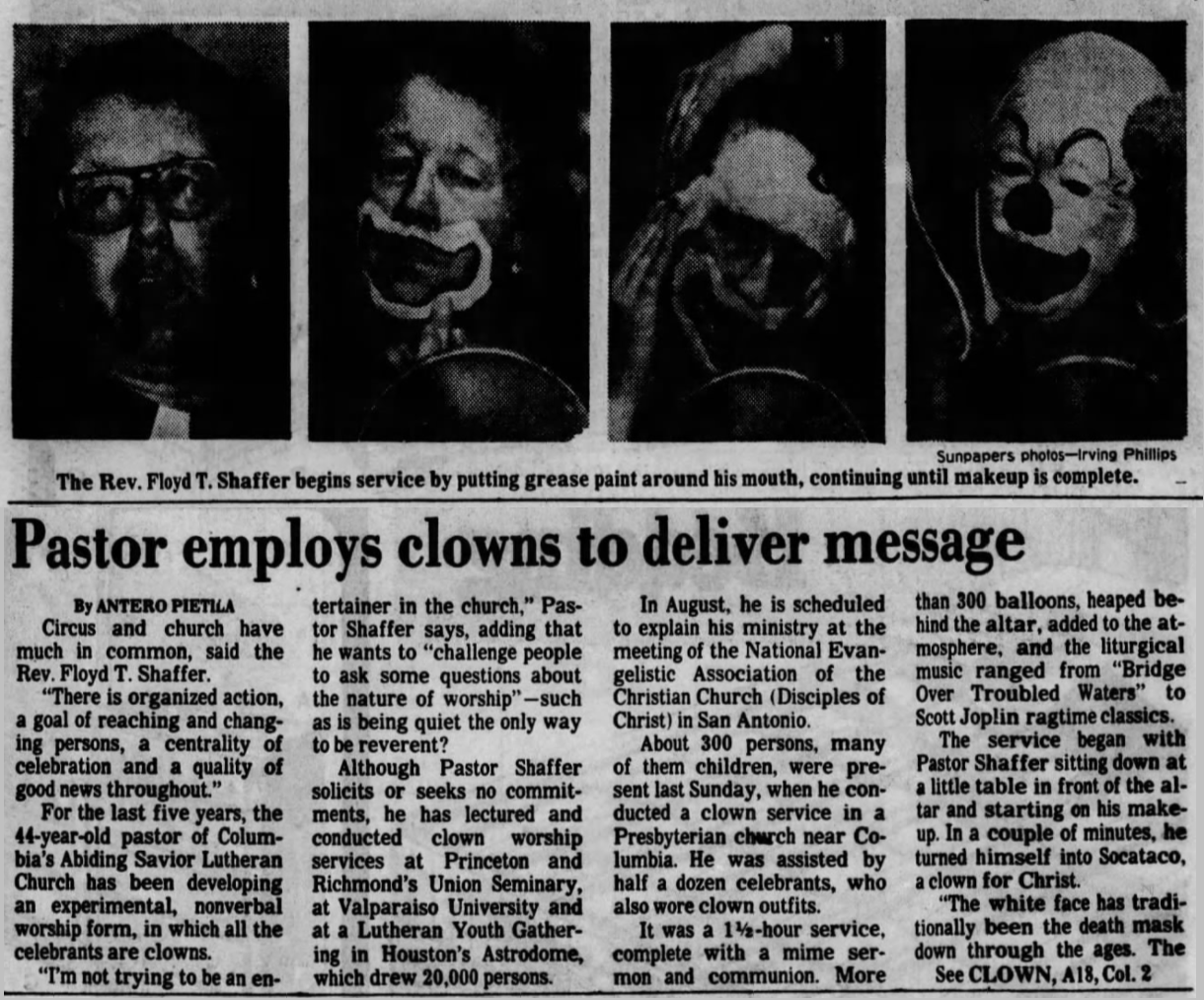
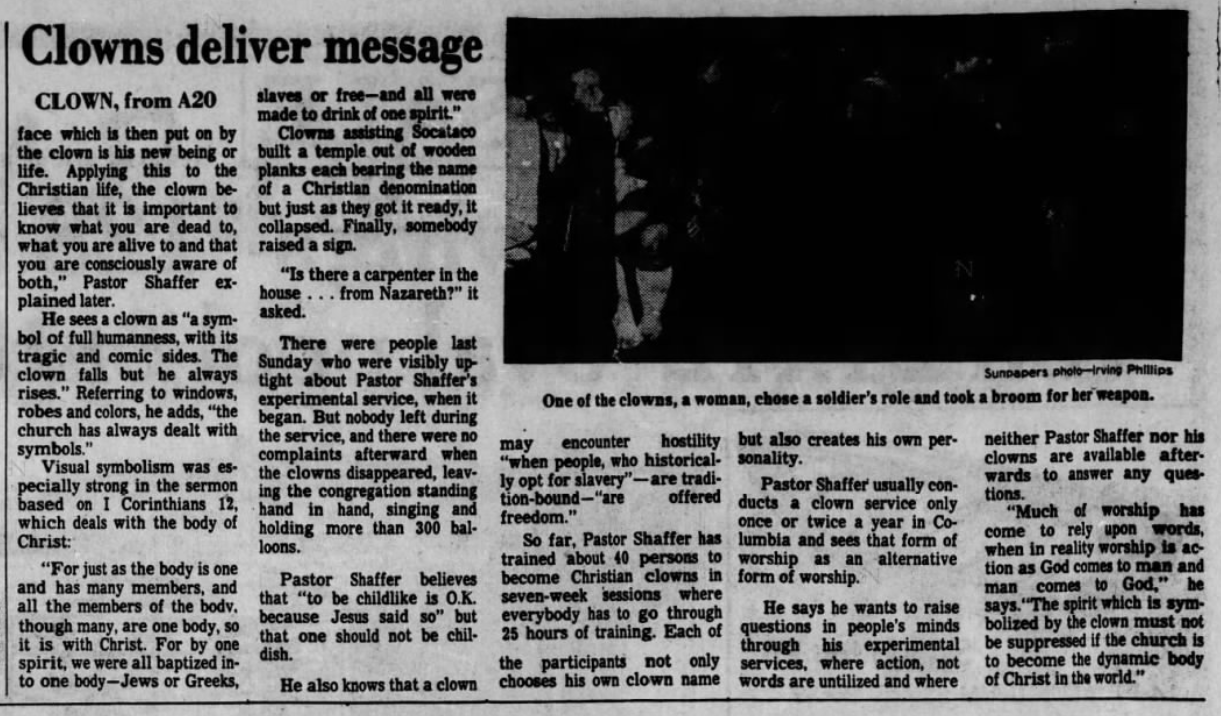
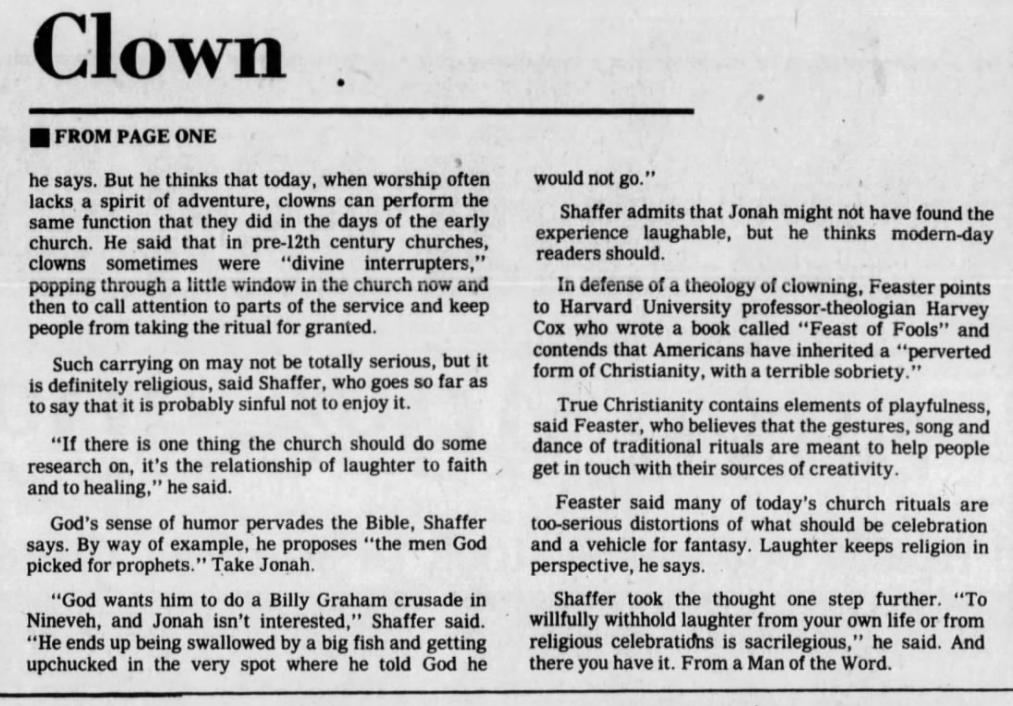
A tabloid article about Floyd Shaffer, the religious clown.

Floyd Shaffer's first book.
The Reverend Floyd T. Shaffer was looking for a new way to reach his congregation in 1969. How could he possibly get through to his practical, sensible flock during that tumultuous age of Vietnam, Woodstock, and Manson? The unlikely answer was by donning a fright wig, floppy shoes, and a round, red, rubber nose.

Though he may not have invented the form, Floyd Shaffer became, for a time, perhaps the most prominent and beloved proponent and practitioner of religious clowning in America. Born in 1930, the kindly and gentle Shaffer was a devout, deeply sincere Lutheran minister whose career trajectory took him from Michigan to Maryland to Ohio. In fact, Shaffer experienced his greatest period of productivity and prominence in the Buckeye State during the Reagan-Bush years. But to appreciate this man's story in full, we must travel back to the Age of Aquarius.

Destined to become a literal Holy Fool, Floyd Shaffer started upon his unusual path in the late 1960s in Columbia, Maryland, where he preached God's word at the still-existent Abiding Savior Lutheran Church. It was at Abiding Savior that Shaffer first introduced costumed clowning into his ministry and encouraged others to follow his example. According to fellow religious clown John Garrett, Floyd was aligning himself with a liturgical tradition stretching back to the Middle Ages, when so-called "holy interrupters" would lighten the mood of formal services with their comedic outbursts. Although a keen student of clowning history, Shaffer was more likely influenced by the counterculture of his own time. Clowning and mime were art forms beloved by hippies, who also had a penchant for face-painting and the donning of colorful, garish clothing. Back in 1969, a preacher dressed as a clown could almost be considered edgy or hip.

In those early years, Shaffer and his ilk were not always welcome among mainstream Christians. The soft-voiced pastor related to his followers the story of his disastrous appearance at a 1970s youth conference held at Houston's famed Astrodome. There, Shaffer and his fellow beneficent buffoons were regarded with extreme skepticism. Thinking the clowns were blasphemous, the other conference attendees derided and, in some cases, attacked Shaffer's troupe. Arlene Trapp, an original acolyte of Shaffer, recalled being "treated like Jesus, kicked at, hit, and mocked."

Still in all, Shaffer's tomfoolery-based evangelism must have yielded positive results in those early days, because he kept at it. In 1974, still based in Columbia, he founded Faith and Fantasy, a nondenominational clown ministry popular enough to have lasted into the 1990s, though its alumni remember it as a loosely-affiliated "non-organization" whose members were never keen on rules. During these years, determined to spread the message of Christ through the techniques of Emmett Kelly and Marcel Marceau, Shaffer and his followers performed their wordless, mime-based act at weekly Lutheran services and also visited numerous hospitals and nursing homes, where they found an appreciative, if captive, audience for their antics.

By 1981, having relocated to Ohio, Floyd Shaffer was well-known enough to attract the attention of the popular press. In August of that year, the black-and-white tabloid Weekly World News ran a profile of Shaffer with the headline "Preacher clowns for God to fill the pews." While essentially flattering to the clown minister, the article also described him as "wacky" and "bizarre."

The Christian Science Monitor followed suit in September with a slightly more dignified article by Stewart McBride headlined "Holy fools rush in." More wide-ranging than the Weekly World News piece, McBride's article looks at different examples of clown ministry from across the United States. In this context, rather than the isolated kook portrayed in the tabloid, Floyd Shaffer is part of a vital, burgeoning movement. The Monitor still recognized Shaffer as a pioneer, however, calling him "one of the first clergymen to perform a Sunday service in whiteface and clown costume" and declaring that "hundreds have followed in his suit of many colors."

The cover of the infamous video.
A few years after these articles introduced the Christian clown phenomenon to a national audience, Floyd Shaffer began writing a series of guidebooks about the topic dearest to his heart. If I Were a Clown and Clown Ministry appeared in 1984. Clown Ministry Skits for All Seasons followed in 1990. Of these, it is Clown Ministry that brought Shaffer a sort of late-blooming, ironic notoriety. The book was accompanied by a 92-minute instructional video that, decades later, was widely excerpted and mocked (shades of the unhappy Astrodome experience!) on video-sharing sites like eBaum's World, Daily Motion, and YouTube.

That was how I first became acquainted with Floyd Shaffer and Clown Ministry. In February 2011, comedians and avid thrift store scavengers Joe Pickett and Nick Prueher used clips from Shaffer's 1984 video in an episode of their web series, The Found Footage Show, which they originally produced for the A.V. Club website. They said they found the VHS tape at a church rummage sale. "This one was intended for budding Christian clowns who wanted to start their own clown ministry," explained Prueher. "I've never understood the connection between Christianity and clowning, and this video certainly didn't help." To which Pickett added: "Really, this video is the best argument against putting your grandparents into a nursing home."

For those whose curiosity has been piqued, the entire Clown Ministry video is now available for viewing on YouTube. In these 92 minutes, Floyd Shaffer walks us through the history and purpose of Christian clowning, demonstrates how to properly apply clown makeup, and even lets us tag along on a typical nursing home visit. It is this last aspect of the video that has attracted the most attention and ridicule over the years, as the elderly patients here seem bewildered and frightened, rather than delighted, by the antics of Shaffer and company.


Floyd Shaffer today
"The clown has no age," Shaffer optimistically told the Weekly World News in 1981. Mankind, however, is not immune from the ravages of time. Now 85 years old and comfortably retired since at least 2006, Floyd Shaffer has returned to his home state of Michigan, where he lives with his wife in Saginaw. The couple have two grown children. Though no longer clowning, Floyd Shaffer is still a loyal follower of the Lutheran faith.

The man's longstanding influence on the world of Christian clowning remains undeniable. In a September 2013 article on the World Clown Association website, Janet "Jellybean" Tucker recalled how seeing Shaffer changed her life; "It was in 1979 or 1980 at a Clown, Mime, Puppet, Dance Ministry Workshop in Oberlin, Ohio, and I saw Floyd Shaffer do a bit on feeding the hungry where his clown ate gobs of popcorn but offered it to a hungry person one kernel at a time. I began reading the Bible through different eyes and began to see the Bible characters as real people."

Obviously, despite the snickering of the internet, Shaffer's message got through to some viewers. As recently as April 2015, Christine Fontaine, a religious-minded mime in Northfield, Massachusetts, contacted Floyd by phone to seek his advice and counsel on how to proceed with her work. The two talked for an hour. As always, Floyd Shaffer remained committed to clowning for Christ.

UPDATE FOR 2020: Amazingly, some more vintage footage of Floyd Shaffer has surfaced! In addition to touring with their collection of offbeat videos, Joe Pickett and Nick Prueher also have a weekly YouTube series called VCR Party Live. In a recent "quarantine" edition of the show, the hosts interviewed film archivist Skip Elsheimer, who specializes in educational and industrial films. One of the clips Elsheimer showed during this visit depicts Floyd, both as himself and in costume, doing some Christian clowning.

After Pickett described the clip as "clown communion," Elsheimer responded: "That one, I can't remember. The title just suddenly left my brain. That one I got recently, and that one I have not shown online anywhere." He went on to say he didn't know where this film was originally shown. "I think this is too scary for Sunday school class." Pickett and Prueher note that the film is dour and that the clowns in it do not seem happy.

Floyd Shaffer appears as himself and as a clown in a newly-discovered film from the 1970s.

Scored with incongruous ragtime piano, the footage seems to date back to the 1970s when Shaffer was working with the Faith and Fantasy troupe in Columbia, Maryland. It may have been made as a record of what their performances were like back then. The movie begins with shots of a congregation in a mid-sized church. Floyd himself, with a full head of curly hair, enters the room in traditional vestments. A slight smile passes over Floyd's face as he stands behind the altar, and through the magic of editing, he transforms into a clown, complete with a red nose and a derby hat. The parishioners are understandably shocked and confused, though some kids giggle.

Floyd opens a gift box and retrieves a card that says FOR THE CONGREGATION. (This may be the title of the film.) The box also contains a pile of severe-looking nails. Shaffer takes one of these nails and hands it to another clown who has joined him at the front of the church. He presses it firmly into the second clown's palm, as if this is communion, and the nail is a wafer. He performs this same service for a third clown, and a title card reading "Communion" appears onscreen.

Floyd pulls a heavy wooden crucifix from a red box, then places bread and wine on the altar. After that, he fills a metal bowl with water from a jar. He takes the bowl over to a small group of clowns and has them place their hands in the water. They dry their hands. Shaffer then solemnly raises the loaf of bread and the wooden crucifix in front of him.  He places the bread on the cross as if the bread itself were Jesus being crucified, but then he breaks off a hunk of it from the bottom. Shaffer then mimes pouring invisible blood from the crucifix into a bottle already filled with wine. He and the other clowns silently, seriously eat the bread and drink the wine as the film fades to black.

The relevant portion of the video begins at about the 28:25 mark. Enjoy.


UPDATE FOR 2021: In my research on Shaffer's career, I found an elaborate article about him in the August 26, 1961 edition of the Fort Lauderdale News. Back then, he was serving as the pastor for Christ the King Lutheran Church. The article includes background details on Floyd's early life and a great picture of the man himself.

An article about Floyd's younger days.

And here's an article from the June 1, 1975 edition of The Baltimore Sun.

Baltimore Sun story about Floyd (part 1).
Baltimore Sun story about Floyd (part 2).

Wherever Floyd went, publicity followed. Here's a huge article from the June 10, 1981 edition of the St. Louis Post-Dispatch.

Floyd in St. Louis (part 1)

Floyd in St. Louis (part 2)

Monday, June 17, 2019

Here's the script for Albert Brooks' 'Comedy Minus One,' if you were looking for that (UPDATED!)

"Good evening, ladies and gentlemen!"

NOTE: The title track of comedian Albert Brooks' 1973 album Comedy Minus One is a unique interactive routine that actually requires that the listener read along with a script. Try as I might, I could not find that particular script anywhere else on the Internet. So what did I do? I typed the whole goddamned thing up myself and posted it to this blog, just on the off chance that someone, somewhere would want or need it. I'm also including the sound file, so you can play along at home. You're welcome. J.B.


Albert: Thank you... thank you... and good evening, ladies and gentlemen. I'm Albert.

You: And I'm You.

Albert: Wait a minute, how could you be me?

You: I didn't say I was you. I said I was me. (L)*

Albert: No, you didn't. I said I was Albert and you said you were me.

You: You've got it all wrong. You said, "I'm Albert," and I said, "I'm You." But I'm not talking about you. I'm talking about me. (L)

Albert: Now I'm confused.

You: Then stop calling yourself Albert. (L)

Albert: I think we should get on with this.

You: I agree. What are we going to do?

Albert: Well, if it's all right with you, I thought we would visit The Auto Mechanic. (A) Thank you very much. Bernie, a little visiting music please...

(MUSIC)

Albert:  Excuse me. I need some work done on my car.

You: Eight-fifty. (L)

Albert:  Eight-fifty? What's that?

You: You said "excuse me." I stopped work and looked up. Time is money. So whatever's wrong with your car, including the time you're using up right now, it's gonna cost you at least eight-fifty.

Albert: That's ridiculous!

You: That's nine dollars. (L)

Albert: Okay, okay. I get the point. You don't come cheap. Now can you repair this car or not?

You: Sure I can repair it. What seems to be the trouble?

Albert: There's a knocking in my engine.

You: It's probably a piston. Let him in. (L)

Albert: I'm not getting anywhere with you.

You: And I'm not getting anywhere with you either. Maybe it's our toothpaste! (L)

Albert: Oh brother.

You: Brother? I almost didn't recognize you! How's Mom? (L)

Albert: How's Mom... stop this! Can you please fix my engine?

You: Oh alright. Open the hood. I'll take a look.

Albert: Wonderful. (He opens hood.) There... it's open.

You: Oh boy, oh boy, oh boy! (L)

Albert: What does that mean?

You: That means I'm glad I'm fixing this thing instead of paying for it! (L)

Albert: Are you trying to say this is going to cost a lot of money?

You: Let's put it this way. Remember the nine dollars we talked about earlier?

Albert: Yes. So?

You: Well, we still have the nine and the two zeros, but I'm afraid the decimal point just passed away! (L)

Albert: This car has only seventeen thousand miles on it. Nothing could be that serious.

You: If you're so smart, why don't you fix it yourself?

Albert: Because I don't know anything about cars.

You: Nothing at all, huh?

Albert: No.

You: Oh boy, oh boy, oh boy. (L)(A)

Albert: Okay, that's it. I'll go elsewhere.

You: Look, mister, you don't have to go elsewhere. I was just pulling your leg.

Albert: If I wanted someone to pull my leg I would have gone to a chiropractor! (L)

(Hint to You: Let Albert have his laugh here.)

You: Now look who's doin' the jokes.

Albert: I have to get one laugh, don't I? (L)(A)

You: Okay... okay. Now, I"m gonna put this car up on the hoist and check it out thoroughly. If it's something minor, I'll fix it for free.

Albert: Well that sounds honest.

You: Maybe to you. To me, it's one the big lies of the century. (L) Now stand back as I raise it up. There she goes... going up... going up... there!  By the way, there is a slight "using of the hoist" fee. (L)

Albert: Using of the hoist? (L)

You: That's right. Each time I raise and lower a car it wears out my hoist just a little bit. I have to charge the customer accordingly.

Albert:  I don't believe it. You mean it actually costs money just to raise this car up?

You: No, it's raised for free. It only cost money if you lower it. (L) It's just ten dollars. (L)

Albert: This is highway robbery!

You: Wrong. This is garage robbery. (L)

Albert: Look, I don't have to stand for this.

You: I agree. You can sit on that hubcap in the corner. (L) Be careful, it's greasy! (L)

Albert: Here is ten dollars. Bring my car down. I'm through with you.

You: (Dramatic) Wait! Don't leave! I need this business, my life is in ruins!

Albert: Ruins? What are you talking about?

You: (Continued dramatic) I'll tell you what I'm talking about: I'm divorced, my son is in jail, my daughter was just kidnapped, I can't pay my bills, and my doctor says I may be dying!

Albert: My God! That's unbelievable.

You: You're right. Let me start over. (L) (Continue over this laugh) I may get divorced, my son should be in jail, my daughter wants to be kidnapped, my doctor...

Albert: Alright! Alright! Now stop with these jokes!

You: If I stop with these jokes this bit falls flat on its ass. (L)

("Face" can be used instead of "ass" if so desired.)

Albert: Please. Just fix my car. Please!

You: Okay. Let me look under here real quickly. (Looking  sounds) Hmmmm... Mmmmmmm... Hmmmm... Well I think I found the trouble.

Albert: What is it?

You: It seems that one of your pistons has pounded its way through the muffler. (L) You're gonna need some new pistons and a new muffler for starters. (L)

Albert: Just a minute! That's impossible!

You: I thought you said you didn't know anything about cars?

Albert: I know enough to know that the pistons and the muffler don't even come near each other.

You: That's fair enough. Let's take another look. (L) Well you were right. The muffler does seem okay. Do you know anything about the camshaft?

Albert: No.

You: We just found the trouble! (L)

Albert: You must think I'm a fool.

You: You're getting warmer! (L)

Albert: Well let me tell you a thing or two. It so happens that I don't have to stand here and...

Jessel: Excuse me... excuse me... are you the auto mechanic?

Albert: Ladies and gentlemen, Mr. Georgie Jessel! (A)

Jessel: Say, where's that applause coming from? I thought we were in a garage. (L) Listen, I need some work done on my car.

You: Eight-fifty. (L)

Jessel: Eight-fifty? Oh my God, I didn't realize it was so late! I gotta be somewhere at nine-thirty. Well, I'll see you later. (L)

Albert: No, no, Georgie, the mechanic wasn't giving you the time. That's a price.

Jessel: A price? For what?

You: You said "excuse me." I stopped work and looked up. Time is money. So whatever's wrong with your car, including the time you're using up right now, it's gonna cost you at least eight-fifty.

Jessel: That's ridiculous!

Albert & You: That's nine dollars. (L)(A)

Jessel: Now, look, I don't need this car restored. I just need some repair work. This car belonged to the great Al Jolson!

You: What seems to be the trouble with it?

Jessel: Well every time I stop at a light it gets down on one tire. (L) Of course I'm just kidding. But actually I don't know what's wrong wtih it. That's why I came here.

You: Does it make any funny noises?

Jessel: Who are you talking to?

You: I'm talking to you.

Jessel: Oh. I don't know if it makes funny noises. I mean these days, who can tell what's funny anyway! (L) Enough of this talk. Now I'll make you a deal. You fix my car, charge me almost nothing, and the next time that you're very, very sick you call me, and we'll talk about a eulogy for you. (L)

Albert:  I don't think you'd want this person to work on your car, Georgie. The prices are outrageous and the service stinks.

You: You'll pay for that!

Albert:  I have no doubt. (L)

Jessel: Well I don't need this then. I'm very big in many parts of the world, and anyway I can go to Earl Scheib and for twenty-nine dollars he'll paint over the whole problem! (L) Thanks very much, and I'll see you later. (A)

Albert:  Mr. George Jessel, ladies and gentlemen! Mr George Jessel! He was right in getting out of here, and I'm following his example. Now here's your nine dollars for your valuable time. Here's your ten dollar lowering fee. Put my car down, I'm finished with all this!

You: Put your car down, huh?

Albert: Yes, put it down!

You: Okay. Why I've seen better looking cars in a rodeo! (L) Why this car is so slow you could write "Hello from Hollywood" on the roof and mail it to a friend. (This gets very little reaction so you explain further.) They do that with turtles! (L)

Albert: You never stop, do you?

You: Only when the bit's over.

Albert:  Well in that case... good night ladies and gentlemen! (L)(A)

(MUSIC)

You: (To audience) Hey, you're beautiful!

Albert: You're a beautiful audience, thank you!

You: Thank you. (Very sincere) I'd like to take you all home with me.

*(L) & (A) denote Laughter & Applause


Thursday, November 15, 2018

Here are two stories I couldn't sell! Enjoy!

"Can't be a winner every time, hon." - Edith Massey

What can I say, folks? Every once in a while, even a seasoned professional writer like myself comes up with a loser. A flop. A stink bomb. A turkey. It happens. I'm sure even Jackie Collins had the occasional bad day. Not everything can be Hollywood Wives. And when it happens, you pick yourself up, dust yourself off, and move on. Jackie knew it. I know it.

Some of the stuff I write is purely for my own amusement, but most of it is written to reach an audience, either through this blog or through some online platform that actually pays me. But what is funny or interesting to me is not always funny or interesting to other people. I have learned that lesson many times in the past, and I will learn it many times in the future.

With that said, here are two articles I wrote in hopes of making a sale. Neither one sold, and since they were both time-sensitive, they are no longer relevant or salable. Past their expiration date, both of them. Still in all, I hope that you will either enjoy them or at least learn from my mistakes.

Saturday, October 28, 2017

Oh my god, I've been watching SNL wrong my whole life.

David Koechner and Mark McKinney as the Fops on Saturday Night Live

The cast of SNL in the early 1980s. Eddie Murphy in foreground.
My parents weren't lenient about everything, but they were very understanding about letting me stay up late and watch TV as long as I didn't have school the next day. In the summers during my elementary school years, for instance, I got to watch The Tonight Show Starring Johnny Carson and even Late Night With David Letterman. I had the same privilege on Friday nights during the school year, so it really bothered me that Dave's show originally only ran from Monday to Thursday, ceding its place on the NBC schedule to Friday Night Videos once a week. But I still saw plenty of after-hours talk shows back then. By junior high, I was already writing my own Top 10 lists. So thanks for that, Mom and Dad.

As near as I can figure, I must have started watching Saturday Night Live when I was 8 or 9. It was the early 1980s. Dick Ebersole was running the show then, and Eddie Murphy was the star attraction. I've been a faithful SNL viewer ever since, regardless of the show's quality. Whether it's good, bad, or (most likely) mediocre, I'm there for every new episode. I'll keep watching SNL until either it expires or I do.

So what? Well, I've come to realize that my way of watching SNL is actually all wrong and directly in opposition to the wishes of the show's creator, Lorne Michaels. Except on those rare nights when the cast and crew are firing on all cylinders, Saturday Night Live  can be a chore to watch. With commercials, it's 90 minutes long -- almost the length of a feature film -- and most weeks, you can feel every minute of that. The musical guests are often of little interest to me, so I wind up muting them. When the show isn't hosted by a comedian, the opening monologue is often torturous, too.

Even the sketches -- the jewels in the show's crown -- can be painful. We've all heard the stories about how cast members and writers compete ferociously to get their sketches on the air, and yet SNL often feels like it's desperately filling up time with any material it has available. Many sketches follow a pattern I call "ever-escalating variations." This means that the performers do different versions of the same basic joke over and over for five minutes, only making the central joke slightly more intense with each repetition. SNL studio audiences have become so familiar with this formula that, occasionally, they won't laugh at a joke until it's repeated. They're waiting for the pattern to emerge. Over four decades, essentially, the show has trained them how to watch sketches.

This problem is more noticeable in the sketches that involve recurring characters. From the Coneheads to Stefon, SNL has had many, many, many, many such characters over the years. They're the lifeblood of the series. And each of these characters generally has his or her own catchphrases and signature routines that become well-known to viewers. A classic SNL recurring character typically does the same exact things in the same exact order in each appearance. Even if you love the character, it can get a bit boring for the every-episode viewer like myself because you can predict exactly what this person is going to do well in advance.

But here is where I've been screwing up. Check out this 2013 interview with comedian Mark McKinney, who served as a writer on SNL in the 1980s and came back as a cast member in the 1990s. This guy knows what he's talking about from an insider's perspective. And here's what he says about Lorne Michaels and recurring characters:
"Lorne pointed out, and I think this is absolutely true, that even if you have big fans who are really into your show, they'll probably only see every second one. Or sometimes every third one. So that's the logic, at least on SNL I know, about why they sort of repeat characters."
So there you have it, folks. Straight from the source. I've been watching SNL incorrectly for decades. Lorne wants you to watch every second or third episode. Maybe you're not even supposed to watch all 90 minutes each week. I've noticed that, the Sunday after a new episode airs, there are highlight videos all over YouTube and the rest of the internet. And, generally, it's only two or three sketches that get any real attention out of any given show.

SNL usually is well-served by judicious editing, i.e. cutting away all the filler and getting to the handful of funny sketches. The earliest episodes of the show -- with Belushi, Aykroyd, etc. -- were just a little bit before my time, but I saw highlights from this era through a half-hour syndicated series (called, I believe, The Best of Saturday Night and masterminded by Lorne himself) that played both on a local affiliate and, later, on Nick at Nite. I loved it. It wasn't until years later that I finally saw full-length episodes with the original cast. I thought it would be even better, but I realized I greatly preferred the condensed half-hour editions. Even "classic" SNL had a lot of dead time.

The weird thing is, I probably won't change the way I watch SNL, even if it prevents me from fully enjoying the show. I'll still be there for every new episode, and I'll still watch from beginning to end each time. Sorry, Lorne.

Monday, July 3, 2017

But what if Louis C.K. were a cartoon lion? What then?

My biggest artistic challenge: giving a lion a goatee.

This was my bible.
Have you heard of the comic strip Animal Crackers? You can be forgiven for saying no. This particular newspaper feature, revolving around animals who act and talk like people, was originally created in 1967 by cartoonist Roger Bollen. It's carried on today by Fred Wagner. When I was growing up, our local paper, The Flint Journal, didn't carry Animal Crackers, so I never read it.

My only brush with Animal Crackers occurred when its protagonist, Lyle Lion, showed up in a book called Draw 50 Famous Cartoons by Lee J. Ames. That book was like a sacred text to me when I was eight or nine, and I dutifully followed Ames' instruction and drew my own wobbly, lopsided picture of Lyle Lion using ovals and cylinders, but I was never compelled to track down this comic strip.

I guess this would be Animal Crackers' 50th anniversary year, but it's not getting much media attention the way Sgt. Pepper is. Shown above is the installment of the strip for July 3, 2017. It's based around a tired mother-in-law joke that would have been dated in 1967. No wonder Animal Crackers hasn't captured the public's imagination in half a century of continuous content.

I decided that what Animal Crackers needed was a more modern approach to humor, so I rewrote Lyle Lion as if he were comedian Louis C.K. That's not so far-fetched. Louie played a dog in The Secret Life Of Pets, so why not a lion? And, besides, it's not like any kids read the newspaper funnies anymore. Why can't the humor be a little more grown up? Naturally, the profanity from C.K.'s act can't be included in a daily newspaper, but this just requires some tasteful pruning of certain offensive vowels (as shown above).

Here's one more example to illustrate the concept. I promise you, my version could have been an episode of the FX series Louie.

I tried a different approach to the goatee this time. What do you think?

Friday, January 6, 2017

A rant about celebrity impressions

King of the impressionists: Rich Little at the Laugh Factory.

Let me say right off the bat that I have always been fascinated with celebrity impressions and the people who do them. From a very young age, I always looked forward to seeing impressionists when they appeared on variety shows or talk shows. Johnny Carson and David Letterman booked a lot of celebrity mimics over the years, and I was grateful to them for that. Rich Little, Frank Gorshin, Fred Travalena -- these were my boyhood heroes. Sketch shows like SCTV, Saturday Night Live, and In Living Color were always good showcases for celebrity impressions, too, with people like Dana Carvey and Darrell Hammond specializing in aping the rich and famous.

It must be weird and a little lonely being a famous impressionist. No one cares about you. They just care about the characters you do. It's like being a ventriloquist: Your act requires you to all but suppress your own personality. Ever notice how, in most ventriloquism acts, the human always has a very bland personality, and the dummy gets all the jokes? It's the same way with mimics. When they aren't in character, they're the saddest, most boring people ever.

Anyway, celebrity impressions are alive and well in the age of YouTube. Lots and lots of people do them. But it's devolved into a parlor trick. People don't even bother coming up with funny things for celebrities to say and do. They just copy the voice and mannerisms, and that's it. Well, I say, that's not good enough. Here's a YouTube rant on the topic. It's not meant to be an attack on anyone in particular, despite that angry-sounding title.

Friday, December 2, 2016

Dave Foley, ladies and gentleman! Dave Foley!

Can you identify which skit this is based on?

On the train trip to Indiana for Thanksgiving last week, I started making a digital portrait of Dave Foley from Kids in the Hall. I don't know why. Just seemed like a thing to do. Since then, I've worked on it for a few minutes at a time here and there. Eventually, I realized I was never going to finish it. There's a whole background I was going to do that I didn't do. So here's the part I got finished. Enjoy. Or don't.

As a bonus, here's an unfinished portrait of one of Dave Foley's influences, Jack Benny. Why I chose this moment, some kind of press conference, to represent Benny, I don't remember. I do know that making all those little microphones was more trouble than it was worth.

Jack Benny takes questions from the press.

Friday, October 21, 2016

America could use another 'Mad Mad Mad Mad World'

Barrie Chase and Dick Shawn in Stanley Kramer's It's A Mad, Mad, Mad, Mad World (1963).

Sometimes, when I'm suffering from insomnia, I'll try to put myself to sleep by thinking about fantasy projects that I will never (and can never) possibly complete. Lately, I've been casting an imaginary, 21st century remake of Stanley Kramer's 1963 film, It's A Mad, Mad, Mad, Mad World. That epic, all-star comedy ran on TCM a few weeks ago, and for some reason, it caught my imagination like it never had before. Maybe it's because the title seems so true in 2016, or maybe because I can now relate to the middle-aged crankiness and desperation of the main characters. I've watched the movie all the way through about five or six times now, and I've been combing YouTube and Google for more information about it.

I don't know where this notion of mine came from. Maybe it's from this dodgy-looking IMDb entry for a supposed 2017 sequel. But I don't want to do a follow-up. I want to do a big-budget remake of the original, keeping the plot and characters mostly intact. I'd also keep the musical score by Ernest Gold intact, including the songs with lyrics by Mack David. I'd even set it in 1963, mainly because I prefer the clothes and cars of that time, plus I don't want the characters having access to Uber, smartphones, or GPS. The great thing is that, since most of the movie was set in the California desert, the original locations look pretty much the same today.


Milton Berle as J. Russell Finch
So who would be in my 2016 Mad World cast? The whole crux of this project is that I want to cast Louis CK as J. Russell Finch, the character played by Milton Berle in the original. Finch is a milquetoast, would-be entrepreneur who has suffered a nervous breakdown and is trying to soothe his nerves with a "relaxing" trip to Lake Mead with his wife Emmeline (Dorothy Provine) and his fearsome, always-complaining mother-in-law, Mrs. Marcus (Ethel Merman). That's before he and a bunch of greedy strangers get involved in a madcap treasure hunt for a dying gangster's stolen money. For the role of Algernon, the snooty Englishman that Finch encounters and with whom he forms a shaky partnership, I can only think of Ricky Gervais, with whom CK has worked several times. For Emmeline, who secretly dreams of running away to a convent, how about Amy Poehler?  For Mrs. Marcus... God, I don't know. Ethel Merman really owns that part. Maybe Meryl Streep could do something with it. Or Lily Tomlin or Susan Sarandon. Someone of that caliber. But for the role of Sylvester, Mrs. Marcus' whacked-out beach bum of a son (originally played by Dick Shawn), only one modern day actor will do: Will Ferrell. End of discussion. Non negotiable.

Arguably, the central character of Mad World is Captain Culpepper, a grizzled old lawman who has spent his life being an honest public servant and has nothing to show for it but a face full of wrinkles and a head full of white hair. It's Culpepper who is really orchestrating the whole film, using the treasure seekers to find the same money that he has been seeking without success for years. In the original, this top-billed character is played by an ailing, decrepit Spencer Tracy. For my version, I considered Clint Eastwood but decided instead that Nick Nolte would be perfect. For Culpepper's equally grizzled but less honest colleague Aloysius (originally William Demarest), maybe Billy Bob Thornton.

Some of the casting decisions were no-brainers. In the original, Mickey Rooney and Buddy Hackett play Dingy and Benji, a couple of hipster doofuses on their way to Las Vegas. Keegan Michael Key and Jordan Peele would knock these roles out of the park. Dingy and Benji spend most of the movie aboard a small private plane with a drunken sot of a pilot who passes out cold while making an old-fashioned in mid-flight. In the original, this character is played by Jim Backus, but we don't really have a modern equivalent of that actor. I think Bill Murray could handle the assignment.

Carell and Fey, together again.
In the 1963 film, Sid Caesar and Edie Adams play the Crumps, a dentist and his wife who join the treasure hunt but find themselves locked in a hardware store basement and have to do crazy, dangerous things to escape. This was another easy one for me. Steve Carell and Tina Fey. Hey, I liked Date Night. They could even reprise their roles from that movie if they wanted.

One role that really stumps me is that of Lennie Pike, the burly truck driver played by Jonathan Winters. Lennie is a true force of nature, famously destroying an entire gas station without assistance, and Winters gives one of the film's best performances. We have no modern day equivalent of that comedian. I could go in completely the opposite direction and hire Larry the Cable Guy, but that would turn off the critics and comedy purists alike. So no to that. Instead, I'll give John C. Reilly a shot at the part. But what about Otto Meyer, the conman who takes advantage of Pike? We don't have a modern day Phil Silvers either, but I'll give Steve Martin another try at it. Remember his Sgt. Bilko movie? No? Well, this will be like that, but less of it.

There is but one big piece missing: Who will play Smiler Grogan, the crime boss whose stolen money is at the heart of this story? In the original, this part went to the inimitable Jimmy Durante. For selfish reasons, I'm going to go in a very different direction and cast cult filmmaker John WatersIn addition to being a fine character actor in his own right, Waters could bring a lot of style and flair to this brief but memorable role.

I think that takes care of all the major parts. But the real fun of Mad World is spotting all the famous comedians in supporting and cameo roles. A list of comedians and actors I'd want to use includes (but is not limited to): Stephen Colbert, Jim Gaffigan, Sarah Silverman, the women of Broad City, Chris Rock, Dave Chappelle, Bill Hader, Amy Schumer, Bob Odenkirk and David Cross, Scharpling and Wurster, Christopher Guest (and members of his ensemble, like Eugene Levy and Catherine O'Hara), Neil Hamburger, Dana Snyder, Marc Maron, Kristen Schaal, Eugene Mirman, and H. Jon Benjamin.

Only a handful of cast members from the original movie survive. Carl Reiner, Jerry Lewis, and Barrie Chase are still around, so they should all get cameos. I know that I said I wanted to set the movie in 1963 and avoid modern technology, but for Lewis' scene, I'd bend the rules a little. In the original movie, Lewis plays a man who drives over Captain Culpepper's hat just for fun.


So in my version, Culpepper would again throw his hat out the window, but this time it would land on the sidewalk. Lewis would come by on a mobility scooter and run it over, cackling to himself.  Culpepper would see him and yell, "Hey, you! Yeah, you! Get back here!" At which point, Lewis would throw his scooter into reverse and run over the hat again, still cackling. Culpepper would then give up in disgust and return to work. But a few minutes later, there would be a callback to the joke when a uniformed officer (played by Patton Oswalt) returns the ruined hat to Culpepper. I don't think mobility scooters existed back in 1963, but I couldn't resist referencing the 1963 film this way.

Friday, May 20, 2016

Today's 'Snuffy Smith' needed some major renovations

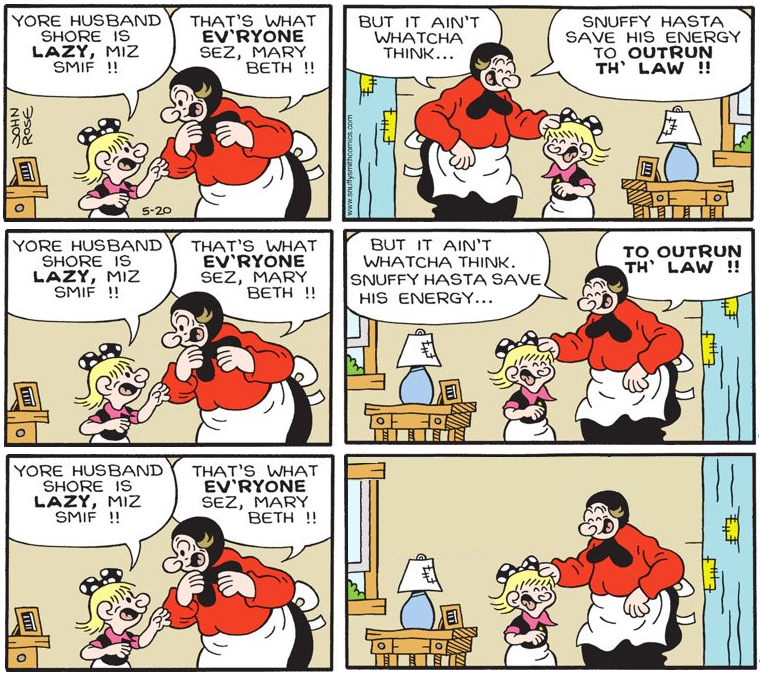
Take one, two, and three of today's Snuffy Smith.

When a comic has been running since 1919, as Barney Google And Snuffy Smith has, it's understandable that it will have an off day. Or month. Or decade. Or generation. But today's installment, which you can see at the top of this post, seemed to include a rookie mistake. I think our artist has gotten his left and his right confused. Assuming that big tan wall behind Mary Beth and Loweezy doesn't move, how does the end table with the framed picture jump from one side to the other? It makes no sense. I had to fix it. That's the comic you see in the middle row. I took the opportunity to spruce up the timing of the joke, too, having Loweezy pause after the word "energy" before delivering the punchline. It's the influence of Triumph the Insult Comic Dog, who always pauses before adding: "For me to poop on!" Anyway, I realized the punchline was lousy and the comic would work better without it. That's the comic you see in the bottom row, and it's the only one of the three to make me laugh.

P.S.  Here's a bonus Funky Winkerbean remix. Again, it helped tremendously to get rid of the punchline.

Also: Les farts loudly and pungently between the first and second panels.

Sunday, April 3, 2016

How 'SCTV' made the most of its celebrity impersonations

Dave Thomas (left) and Martin Short on SCTV.

One of the delusions under which Saturday Night Live continues to operate is that celebrity impressions are inherently funny on their own. On SNL, it's generally enough for cast members to look, talk, and dress like well-known public figures. Actually doing anything interesting with the impressions is secondary or tertiary at best. The show usually concocts some very contrived reason for its imitations, i.e. "What if [so-and-so] auditioned for Star Wars/James Bond/Back To The Future/whatever? Wouldn't that be wacky?" Sometimes, if they're really desperate, they'll throw together an all-star Family Feud sketch and just burn off a whole bunch of celebrity impressions at once.

The whole point seems to be recognition. We're supposed to watch in utter stupefaction and say, "Hey! That guy sounds just like that other guy! Amazing!" Never mind that celebrity impressions are so commonplace that YouTube has a seemingly endless supply of them or that the IT guy at your workplace probably does a halfway decent Christopher Walken.

SCTV did things a little differently. More so than SNL, SCTV was concerned with developing full personalities and lives for its recurring characters, rather than reducing them to a few easily identifiable tics and catchphrases. It's amazing, in retrospect, how much we learned about Bobby Bittman, Johnny LaRue, Edith Prickly, Guy Caballero, Lola Heatherton, and others.

And that thoroughness occasionally extended to the show's celebrity impersonations, at least the ones that made multiple appearances. It's not enough on SCTV to simply mimic another performer's way of talking; the show's best sketches make a study of the person's thinking and behaving as well.

The supreme example of this is Dave Thomas' Bob Hope impression. Bob wasn't locked into one sketch or format on SCTV, so he could pop up in all kinds of places. He might unexpectedly drop by during The Sammy Maudlin Show, casually ruining Bobby Bittman's set. Or he might be hosting a pro-am golfing tournament in the Middle East or mentoring Rick Moranis' nervous, adoring Woody Allen.

One of my favorite Hope skits from SCTV is a talk show parody called "Stars In One," which teams Thomas with Martin Short as probing interviewer Brock Linahan, a parody of genuine Canadian TV personality Brian Linehan. Like his real world counterpart, Short's character has an eerie talent for keeping his guests off-balance with a combination of flattery and acrimony, buttering them up one moment and undercutting them the next. In the sketch, there is palpable tension between Linahan and Hope, the latter an old-school showbiz lifer who barely speaks the same language as his verbose, wide-eyed inquisitor.

This sketch just floors me. It would be impossible to imagine on SNL. "Stars In One" never goes for an obvious punchline, though SCTV's trusty laugh track chortles away somewhere in the background. It's an honest-to-goodness character piece about two guys with very different ways of looking at the world. Is one right and the other wrong? Are they both right and wrong simultaneously? It's tough to pinpoint a favorite line here, but I'll nominate this beauty from Hope: "You know, you have a way of asking a question that makes you forget what it's about by the time you get to the end. When you stop talking, it's like walking to the edge of a cliff. I have no idea what you just asked."

What's amazing here is that Brock Linahan has managed to rattle Bob Hope a little with his ridiculously wordy query about the Vietnam War. Hope, understandably, wants to rely on glib one-liners, but Linahan is throwing his rhythm off. In just four minutes, the sketch manages to reveal Hope's philosophy about movies, comedy, politics, and more.

Friday, December 4, 2015

7 into 28 is 13: The politics of joke thievery

Bud Abbott screws his landlord out of the rent money with mathematical trickery.

How do jokes get started? Hell if I know, but back in the days of vaudeville, certain successful comedic routines got passed around a lot between different acts, with very little thought given as to attribution. I guess there was a lot of borrowing or just outright stealing in those days. Maybe there were turf wars over the "ownership" of certain bits. These were live performances, of course, and no one was recording them, so what was the harm ultimately? But then a strange thing happened to the entertainment biz. Two strange things, actually: film and television. Suddenly, performances were being immortalized and shown to audiences from coast to coast. And yet, those same hand-me-down vaudeville routines kept popping up on screens both big and small well into the 1950s and beyond. Hey, the material has to come from somewhere. There's a famous quote sometimes attributed to Larry Gelbart and sometimes to Bob Hope: "When vaudeville died, television was the box they put it in." Many decades later, a variation on that line wound up in a Family Guy episode: "Vaudeville's dead, and TV's the box they're gonna bury it in." So even the quote about vaudeville has some miles on it.

There is one routine in particular that shows up with remarkable persistence in old movies and TV shows, performed by a variety of comedians with very little variation in the basic premise or structure. Simply put, one character tries to convince another character that 28 divided by 7 is 13. The first character will "prove" this assertion in three ways: long division, multiplication, and addition. Always in that order. I guess the bit is most closely associated with Abbott and Costello, who went from vaudeville to film to television over the course of their long career. They certainly did this math routine a lot of times. Like this, for instance:


So Bud and Lou sure performed the hell out out of the "28" bit. But the routine was not their exclusive property by any stretch. Ron Ormond's 1951 film, Yes Sir, Mr. Bones is meant as a tribute to minstrel shows, which were already on their way out by then (for good reason). This is the movie from which Ed Wood's producers plundered the Cotton Watts and Chick routine he used in Jail Bait in 1954. Two of the other performers in the original Ormond film are Emmett Miller and Ches Davis, doing their version of the old "28" routine, though they don't get around to it until about two minutes into this clip.


Meanwhile, back on the farm, Percy Kilbride and Marjorie Main were doing this same routine in one of their low-budget Ma and Pa Kettle films at Universal. The only difference is that they use 25 and 14 instead of 28 and 13. But the joke is exactly the same, as is the order: division, then multiplication, then addition.


Remember all this before you ever accuse anyone of stealing a joke. Joke-stealing is a proud show business tradition. Comedy could barely exist without it. I mean, who came up with this mathematics routine? Abbott and Costello? Davis and Miller? Ma and Pa Kettle? Probably none of them!

Saturday, November 21, 2015

I tried to fix 'The Dinette Set,' and it defeated me.

(left) Julie Larson's original Dinette Set panel; (right) My "corrected" version.

Julie Larson's The Dinette Set, a single-panel cartoon feature, is somehow celebrating its 25th anniversary in 2015. It started in the Los Angeles Reader under the title Suburban Torture back in 1990 and became nationally syndicated under the name The Dinette Set seven years later. The feature's appeal and longevity baffle me. It's a domestic comedy focused on the adventures of two middle-aged sisters, Verla Darwin and Joy Penny, and their respective spouses and friends. It's supposed to be a gentle satire of middle class life, but it comes off as condescending and snide, and the characters are interchangeable and dull.

What really bugs me about The Dinette Set, though, is that it's a humor strip that doesn't know how to tell a joke properly. Each panel is saturated with unfunny, superfluous textual gags: T-shirt slogans, posters and signs, product labels, etc. All of this extraneous text is handwritten in the exact same style. Larson tries to distinguish each panel's primary, dialogue-based joke by writing it in larger letters, but the words push right up against the edges of the balloons, rendering them only semi-legible. The strip is a difficult-to-read eyesore.

Part of the reality of doing a syndicated newspaper comic is that each installment will contain a certain amount of clutter: the artist's signature, a date, a plug for the syndicate, and probably some mention of a promotional website, too. As distracting as these can be, they're a necessary evil. I firmly believe that jokes, at least when presented in the form of comic strips or cartoon panels, need a little breathing room. A certain amount of negative space helps. Charles Schulz, one of the masters of the form, used tons of negative space in Peanuts. But Julie Larson clutters up every square inch of her panels with unnecessary verbiage. Her jokes are suffocating. And they weren't too strong to begin with!

So I took a typical Dinette Set panel and tried to "fix" it. First, I eliminated as many props and background actors as I could without sacrificing the integrity of the scene, i.e. a baby shower with numerous guests and presents. I wanted to focus the reader's attention on the two primary characters, the ones who are actually talking to each other. I especially wanted to remove any distracting details around those characters' faces. When you're drawing a cartoon like this, you're like a director working with actors. I wanted to make sure their faces were the focal point of this scene. I also reduced the dialogue in size so that it had some air around it, while removing some redundant words in Mrs. Darwin's response. I didn't see any reason for both women to say the words "a Clapper for the baby's overhead light." Once was enough.

But my efforts were in vain. This stubborn Dinette Set panel was still pretty bad, even after my so-called "corrections." I think my version is a slight visual improvement, but the cartoon is still stifling and uninspired, and the joke still doesn't land the way it should. In desperation, I tried to convert this into a New Yorker-style cartoon with no word balloons and the dialogue rendered as a caption below the picture.


Nah. Still sucks.