Wednesday, May 29, 2019

Ed Wood Wednesdays, week 81: 'Angora Fever: The Collected Short Stories of Edward D. Wood, Jr.' (2019)

Essential reading for Ed Wood fans.

NOTE: This article concludes my coverage of Angora Fever: The Collected Short Stories of Edward D. Wood, Jr. (BearManor Bare, 2019).

Ed Wood as he looked in the early 1970s.
The November 10, 1990 episode of Saturday Night Live contains a sketch called "Game Challengers" in which a Native American man (played by host Jimmy Smits) has to compete on a game show to win back his own people's ancient artifacts. These items, by all rights, should have been his for the asking, yet he's forced to answer trivia questions about The Brady Bunch to reclaim them, one at a time.

If you can understand the cosmic injustice at the heart of that sketch, you can sympathize with what Bob Blackburn went through to compile Angora Fever: The Collected Short Stories of Edward D. Wood, Jr. (2019). Bob befriended Ed's widow, Kathy, late in her life and became co-heir of the Wood estate when she died in 2006. In recent years, he has labored to bring some of Eddie's neglected short stories from the 1970s back into print. This has meant scouring auction sites like Ebay for pricey and rare back issues of adult magazines that are nearly half a century old by now.

In 2014, Bob collected 33 of Ed Wood's Nixon-era stories into an indispensable volume called Blood Splatters Quickly. For fans, it was nothing short of a revelation. Though he's mostly remembered today as a filmmaker, Ed chiefly supported himself as a writer for the last 15 years of his life. He was stunningly, mind-bogglingly prolific in the early 1970s, so there's a substantial body of work to study here. While his motives for writing these stories were mercenary rather than purely artistic, Eddie nevertheless managed to infuse these sex-and-violence-drenched tales with his own passions and eccentricities. In fact, this is some of his wildest and most personal work ever. Freed from the technical limitations of low-budget movies, Ed really let his mind run wild.

The new book cover.
And now, five years after Blood Splatters Quickly, we have a second volume of Ed Wood short stories—one nearly twice as long as the first. (That tracks, as this was originally supposed to be divided into two volumes, one dirty and the other not quite as dirty.) Bob Blackburn has given this collection the very appropriate title Angora Fever. What a cornucopia this book is! What a menagerie! Those fans who are mainly familiar with Ed through his movies will find echoes of Glen or Glenda and Plan 9 from Outer Space in nearly every story, if not every page. Those who crave more information on Solaranite, for instance, are invited to check out "Invasion of the Sleeping Flesh" from 1972. Those more interested in cross-dressing, meanwhile, are directed to 1973's "A Piece of Class."  (How about those titles, by the way? Could Ed pick 'em or what?)

You also catch numerous glimpses of Eddie's own life in these stories. Ed Wood was a notorious alcoholic for decades, and the pages of Angora Fever are practically soaked in booze. His characters down martinis and Scotches as if they were water, and they're forever going to bars and cocktail lounges, largely to numb the pain of existence. Eddie also knew well what it was like to be broke in L.A., and many of his characters (a motley assortment of bums, hookers, and psychopaths) are in the same boat, living in vermin-infested hovels and warming canned foods over hotplates. After reading about Ed's later years in Nightmare of Ecstasy, these passages seem very true to life. Eddie was in hell, and he wanted to show his readers around the place.

Some authors create worlds readers wish they could visit themselves. Who among J.K. Rowling's fans has not dreamed of touring Hogwarts? Generations of readers have yearned to see Carroll's Wonderland, Baum's Oz, and Tolkien's Middle Earth for themselves. But no sane person would want to live in the world Ed Wood creates in his fiction, not even for a weekend. His stories take place in a harsh, comfortless realm of back alleys, basement apartments, and fleabag motels where you have a better-than-average chance of being tortured, sexually assaulted, or even totally dismembered—possibly all in one night if you're really unlucky. In the spectrum of pulp writers, Ed Wood was even grosser and grungier than Jim Thompson, and he makes guys like Raymond Chandler and Jim Cain seem positively genteel in comparison.

A typical story in this collection.
The 60 stories in Angora Fever reintroduced me to Ed Wood's highly idiosyncratic writing style. Eddie was not a careful, cautious, or contemplative author. No, he just typed like a maniac and let his crazed imagination guide his fingers. Naturally, then, all of Eddie's fears and fetishes are on vivid display in this book. He was truly fixated beyond all reason on death and its trappings, from silk-lined caskets to the maggots that feast on corpses. (Did you know maggots had a particular smell? Ed sure did.) Death was never far from Ed Wood's mind. He had a dread horror of growing old, too, which leads me to believe that his own demise at age 54 was not necessarily the tragedy we think it was.

Anyone who has seen Glen or Glenda knows that Ed was obsessed with women's clothing and anything feminine. That carries through Angora Fever as well. Pink seems to have been his favorite color. He can't get over sweaters or miniskirts. He loves feathers, fur, fluff, fuzz, angora, marabou, nylon, silk, and satin. And, naturally, he spends many passages describing women's bodies. He is particularly focused on breasts, though his characters seem divided on what to do with breasts. Some want to suck on them, while others want to cut them off.

One quirk of Eddie's that I hadn't truly noticed before this was his habit of describing people's body temperatures. The character Bob (William Bates) in Orgy of the Dead describes feeling a "cold chill all over" after surviving a car accident near a cemetery. Ed Wood's characters get these strange chilly sensations a lot in these stories in Angora Fever, but they're just as liable to experience sudden hot flashes. Sometimes, they'll go from feeling very hot to very cold in an instant. I'm not sure why Eddie was always writing about these temperature fluctuations, but they're a major motif in his work. Maybe he was having similar feelings in reality.

I'll close out my coverage of Angora Fever by spotlighting five stories that truly stood out to me as a reader.

5. "Once Upon a Gargoyle" - Just a very odd, darkly funny little episode with a gruesome climax. I've seen lots of sitcom episodes and sketches about suicidal people on window ledges, but I've never seen anything quite like this.

4. "The Rue Morgue Revisited" - A near-total break from Ed Wood's usual authorial style as he streamlines and customizes a classic detective tale by Edgar Allan Poe. This is almost like fan-fiction, and it shows another side to Ed Wood's writing career.

3. "Time, Space and the Ship" - I can't tell if this science-fiction story is incredibly progressive or incredibly regressive. Either way, Ed Wood has written a story about butch lesbians conquering outer space, and I'm just glad this exists. You think I'm kidding with that summary? Read for yourself!

2. "Captain Fellatio Hornblower" - One of the more memorable characters to spring from the typewriter of Edward D. Wood, Jr. is Ralph H. Hornblower, a clever and crafty lawyer with a very particular clientele. This could have been a TV series!

1. "Trade Secrets" - Like O. Henry, Ed Wood loved to have twist endings in his short stories, and I can't think of any more effective than this one. The unusual setting helps, too, as we are far removed from the gutter. There are many stories in Angora Fever I wish had been adapted for the screen, and this tops the list.

Honorable mentions: "Mice on a Cold Cellar Floor," "The Exterminator," "Witches of Amau Ra," "Dial-A-Vision," "Spokes of the Wheel," "Invasion of the Sleeping Flesh," "Exotic Loves of the Vampire," and the completely revolting "The Greeks Had a Word for It."

Tuesday, May 28, 2019

Ed Wood's ANGORA FEVER: "Cease to Exist" (1972)

What better way to close out this collection of stories?

NOTE: This article continues my coverage of Angora Fever: The Collected Short Stories of Edward D. Wood, Jr. (BearManor Bare, 2019).
Original layout for this story.

The story: "Cease to Exist," originally published in Horror Sex Tales (1972). Credited to "T.G. Denver."

Synopsis: An unnamed man is erotically obsessed with a pretty female coworker named Shirlee. He'd always wanted to ask her out, but he never went through with it. And now, it's too late because she's been brutally murdered by a psychopath. The unnamed man attends her funeral and then, overwhelmed with grief, goes to a cocktail lounge and gets very drunk. During a thunderstorm that night, he crashes his car into the gate of the cemetery and then staggers toward Shirlee's grave. His plan is to dig her up and finally have some "naked contact" with Shirlee. But when he does this, the true nature of their past relationship becomes apparent.

Wood trademarks
  • tight sweater (cf. "Florence of Arabia," "Like a Hole in the Head')
  • miniskirt (cf. "Super Who?," "Unfriendly Persuasion")
  • nipples (cf. "Gore in the Alley," "The Hazards of the Game")
  • office affairs (cf. "The Responsibility Game," The Cocktail Hostesses)
  • "broad" (cf. "The Loser")
  • graveyard (cf. "In the Stony Lonesome")
  • italicized sentences (cf. "Filth is the Name for a Tramp")
  • ellipses (cf. virtually every story in Angora Fever)
  • casket (cf. "Morbid Curiosity")
  • funeral (cf. "Morbid Curiosity")
  • Shirlee (an alternate spelling of Shirley, Wood's own drag name)
  • the color pink (cf. "2 X Double")
  • satin (cf. "Blood Drains Easily," "The Last Void")
  • cocktail lounge (cf. "Unfriendly Persuasion," "Never Fall Backwards")
  • maggots (cf. "Hitchhike to Hell," "Gore in the Alley")
  • a pair of gravediggers (cf. Plan 9 from Outer Space)
  • martinis (cf. "Unfriendly Persuasion," "Out of the Fog")
  • phrase "her dead body" (cf. Plan 9)
  • heavy drinking (a running theme in Ed's life as well as his fiction)
  • lightning and thunder (cf. Glen or Glenda, Plan 9)
  • character being beckoned by an otherworldly presence (cf. "Final Curtain")
  • "facts" (cf. "Captain Fellatio Hornblower" "The Fright Wigs," "Out of the Fog")
  • necrophilia (cf. "Invasion of the Sleeping Flesh")
  • tongue (cf. "The Responsibility Game")
  • "manhood" (cf. "The Greeks Had a Word for It")
  • car crash at a cemetery (cf. Orgy of the Dead)
  • talon-like fingers (cf. "Morbid Curiosity," Vampira in Plan 9)
  • angels (cf. "So Soon to be an Angel")
  • member" (cf. "A Taste for Blood," "Try, Try Again")

Excerpt: "She was dead and she was stuffed under the back seat of her car in the garage and the maggots were having a stinking feast… a stinking feast upon the lovely remains of Shirlee who had been so untouchable in life… so completely untouchable… as untouchable as the Angels."

Vampira: An icon whose image mixes sex and death.
Reflections: What qualities should the perfect Ed Wood story possess? That's a reasonable question to consider as we review the last of 60 such tales in Angora Fever. Between this collection, Blood Splatters Quickly, and a few other random sources, I've now made my way through about a hundred of Eddie's short stories, which is more than I've done for any other author. So I should have at least some idea of what sets his work apart from anyone else's.

As I see it, then, the ideal Ed Wood story should center around Eddie's three overlapping muses: Sex, Death, and Booze. It should take place in or near a cemetery. There should be thunder and lightning for atmosphere, plus detailed descriptions of women's clothing along the way. Someone in it should be named Shirley (or Shirlee). And, above all, it should be written in a feverish, impassioned style, complete with lots of ellipses and italics.

The above description fits "Cease to Exist." Although written under the pseudonym "T.G. Denver," this story exemplifies Ed Wood's writing in both its themes and its execution. While Eddie didn't go in for first-person perspective very often, he attempted as a writer to convey the thoughts and feelings of his protagonists through third-person narration. Ed's main characters tend to be people who are so overwhelmed by their fantasies, fixations, and obsessions that they can't think straight. That manifestly applies to the anonymous man in this story, a paranoid, murderous alcoholic with necrophiliac tendencies.

Maybe there is no "perfect" or "complete" Ed Wood story, i.e. one that contains all his major themes. For one thing, "Cease to Exist" lacks any cross-dressing or transgender elements whatsoever. The protagonist alternately lusts after and loathes Shirlee, but never does he express a desire to wear her sweater or skirt. And while Shirlee wears a satin dress and rests in a satin-lined box, we are denied any mention of angora or anything fluffy, fuzzy, or feathery. So "Cease to Exist" is not as tactile or sensual as other tales in this collection.

Or maybe that perfect Ed Wood story is out there and I just haven't found it yet.

P.S. When the unnamed man started digging up poor Shirlee, I could not help but think of "I Want My Baby Back," the tasteless 1965 novelty hit by Jimmy Cross. Incidentally, Jimmy died in Hollywood on October 8, 1978. Ed Wood survived him by just two months. Do you think Eddie ever heard this song?


Next: My closing thoughts on Angora Fever!

Monday, May 27, 2019

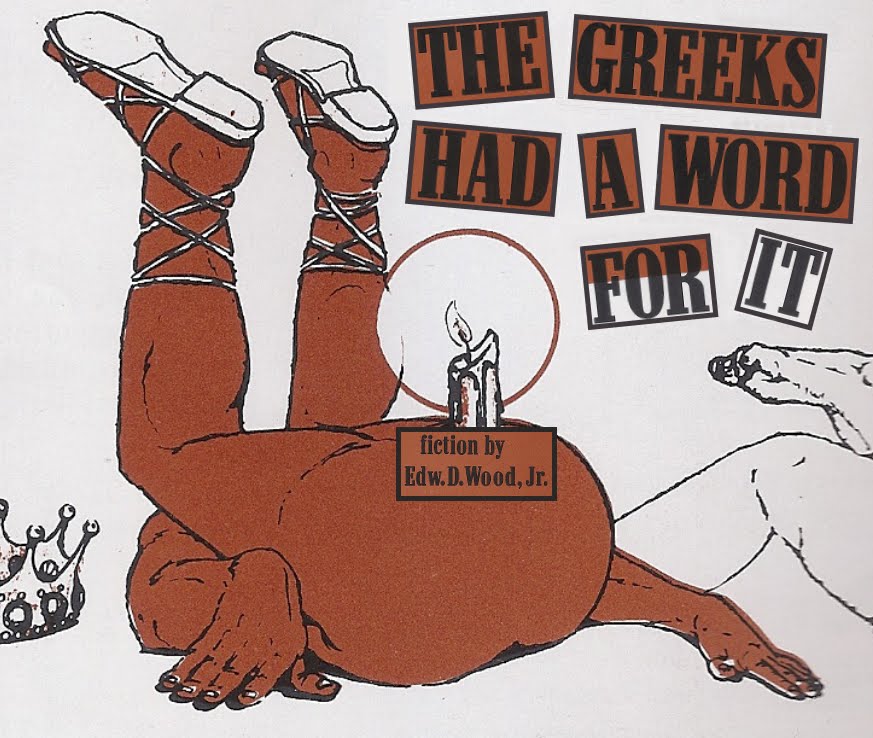
Ed Wood's ANGORA FEVER: "The Greeks Had a Word for It" (1973)

This doesn't actually happen in the story.

NOTE: This article continues my coverage of Angora Fever: The Collected Short Stories of Edward D. Wood, Jr. (BearManor Bare, 2019).
The bizarre artwork for this story.

The story: "The Greeks Had a Word for It," originally published in Menage, vol. 2, no. 1, June/July 1973.

Synopsis: Etile is a perverted and cruel ruler who enjoys torturing people and devising insane laws, especially regarding sex. He's outlawed adultery, sodomy, and masturbation (except for himself), and his favorite punishments include castration and pouring molten lead into people's anuses. Meanwhile, Etile's unsatisfied wife, Ledom, is having an affair with a handsome army captain named Ythgim, but they have to be careful or risk being tortured themselves. With the help of a physician, Etile has devised a strange and elaborate new torture that involves turning boys into girls without castrating them. He plans to use these feminized boys as sexual playthings for himself and his officers. But Ythgim and his men have a plan to stop Etile in this madness.

Wood trademarks: "Beat his meat" (cf. "A Piece of Class"); negligee (cf. "The Responsibility Game"); character names spelled backwards (cf. "Hellfire," pseudonym "Adkon Telmig" from One Million AC/DC); castration/emasculation (cf. "Blood Drains Easily"); mutilation of breasts (cf. "Breast of the Chicken," "The Rue Morgue Revisited"); "sex scene" (cf. "Florence of Arabia," "Tears on Her Pillow"); "manhood" meaning penis (cf. Necromania); gender reassignment (cf. Glen or Glenda).

Excerpt: "The Greeks like boys to be boys. They are my enemies therefore I could not have boys being boys. I would not do as they do. But being there is such pleasure in such an affair… it was not difficult for my physicians to show me the girl/boy… they will live with the handmaidens… and learn many tricks of their trade from them… they will be bathed in the warm waters and perfumed and powdered daily. They will be at the service of all my officers who have earned some reward from myself. It is better than dipping into the treasury, my treasury, every time."

Tales from the Crypt meets Caligula.
Reflections: How do you even start writing a story like "The Greeks Had a Word for It"? Where does an idea like this originate? I guess, at some fundamental level, this is a "what goes around comes around"-type parable in which a sinful and self-indulgent character, in this case the despotic Etile, gets exactly what's coming to him. As Shakespeare once put it, he is hoisted with his own petard.

Seemingly every episode of Tales from the Crypt (1989-96) was built on that basic framework. In a typical week, Crypt would introduce some selfish and immoral character -- usually played by a splashy guest star -- whose actions are motivated by lust, greed, ego, etc. That character would have a whale of a time for about the first two-thirds of the show, being cruel and arrogant and usually killing a few people along the way. But then, the tables would inevitably turn, and the character would get some deadly karmic comeuppance. The Crypt Keeper would make some ghoulish puns about what we'd just seen, and that would be it.

But Ed Wood takes this material to gruesome places even the Crypt Keeper never dreamed. Molten lead up the ass? Scalding wax poured on the vagina? Breasts, penises, and testicles cut off? And all at the behest of a mad ruler who doesn't even care if his victims have committed any crimes? ("I wish and invent a crime for them to be punished with," Etile casually says.) This is less Tales from the Crypt and more Caligula (1979). I don't really even understand Etile's sick plan for turning boys into girls, though it involves forced masturbation and nude horseback riding (?!) and could only have come from the imagination of Edward D. Wood, Jr. Who else but Eddie would have given the characters such backwards-running names as Ythgim and Nwodnus?

P.S. A few years ago, I reviewed a movie called The Greeks Had a Word for Them (1932). It has no obvious connection whatsoever to this story. But I wonder if Eddie was inspired by the title of this film or the hit play on which it was based?

Next: "Cease to Exist" (1972)

Thursday, May 23, 2019

Ed Wood's ANGORA FEVER: "One Delicious Moment" (1971)

Getting to know you... getting to know all about you.

NOTE: This article continues my coverage of Angora Fever: The Collected Short Stories of Edward D. Wood, Jr. (BearManor Bare, 2019).

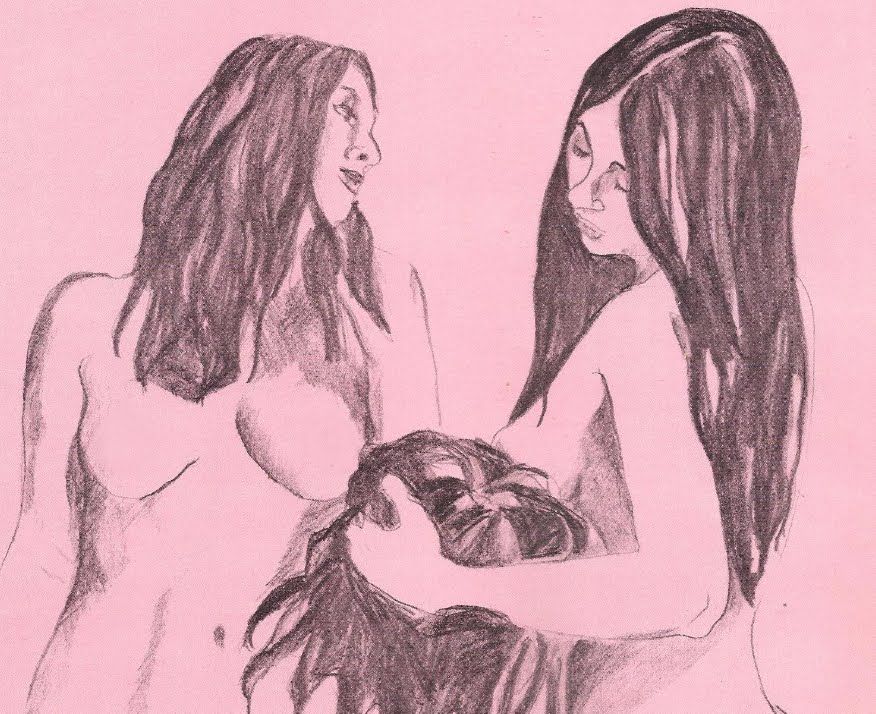
The full artwork for this story.
The story: "One Delicious Moment," originally published in Pussy Willow, vol. 3, no. 2, April/May 1971. No author listed.

Synopsis: Paula, a lesbian, is obsessed with a mysterious blonde who has been coming into her favorite gay bar for the past week. The woman just sits in a dark booth and doesn't say anything to anyone. Not usually a shy type, Paula has not figured out how to approach this beautiful lady. All she can do is fantasize about her. Finally, Paula works up the courage to approach the blonde. As it turns out, the mystery lady's name is Shirley and she's getting over a bad marriage to an unfaithful husband. What she needs is someone to teach her the ways of lesbian love. Paula is more than happy to oblige.

Wood trademarks: Yes, another character named Paula (cf. "Tears on Her Pillow"); martini (cf. "Insatiable," "Unfriendly Persuasion"); blonde (cf. "The Devil and the Deep Blue-Eyed Blonde"); nipples (cf. "Tears on Her Pillow"); tight sweater (cf. "Like a Hole in the Head"); "globes" as euphemism for breasts (cf. "Howl of the Werewolf"); "rivered" (cf. "Detailed in Blood"); tongue (a word Eddie uses 111 times in Angora Fever); Scotch and soda (cf. "Time, Space and the Ship," "Those Long Winter Nights"); "insatiable" (cf. "Insatiable," Necromania); nylon (cf. "A Piece of Class"); miniskirt (cf. "A Piece of Class"); "Good Christ" (cf. Fugitive Girls); cocktail lounge (cf. The Cocktail Hostesses); fur rug (cf. "Morbid Curiosity"); Shirley (cf. "Morbid Curiosity"); anti-men rant (cf. Drop Out Wife); "pubic region" (cf. "Gore in the Alley"); knitted clothing (cf. "Gore in the Alley," "Hooker by Choice," "Kiss the Pain Away").

Excerpt: "Paula could take it no longer. The trembling in her legs had turned to quick twitching movements. It wasn't unpleasant but the heat which caused the twitching shouted for release, and Paula knew only one way to achieve that release."

Reflections: "One Delicious Moment" must count as one of the nicer stories in the Ed Wood canon. Yes, there are the usual, lurid references to "sexually wet panties" and "pointed nipples." This is still an article in a pornographic magazine, let's not forget. But this isn't one of those Wood stories in which a naive young woman in distress is preyed upon by a predatory "bull-dyke" lesbian. Instead, everything that happens in this story is consensual and mutually enjoyable. As in most Ed Wood stories, there's a twist near the end, but it involves Shirley's past and why she's at this lesbian bar, and the only villain is Shirley's promiscuous ex-husband.

Moreover, the story's most ridiculous line -- "Would you make homosexual love to me?" -- is phrased in such a stilted way because Shirley is so inexperienced and has only been with men like her former spouse.

But speaking of that ex-husband, there's a passage in "One Delicious Moment" that surprised me, pleasantly so. Shirley mentions that her husband "fathered two children," and Paula's immediate response is, "Then you should be home with the kids." What Shirley meant is that her faithless husband had fathered children with other women, but what caught me off-guard is Paula's concern for the poor, defenseless tots. She'd been having incredibly explicit fantasies about this woman all week, but the moment she thinks that some kids might be neglected, her sense of familial responsibility comes into play.

Another surprise here is the depiction of alcohol consumption. Now, Eddie was a notorious drunk for the last few decades of his life, and "One Delicious Moment" is yet another story from Angora Fever set in a cocktail lounge. So the characters are downing martinis and Scotch and sodas as per usual. But none of the characters seem like alcoholics, and there aren't any passages about the "warm glow" they get from whiskey. Then, towards the end, Shirley even says, "I don't drink, you know. Only when I'm nervous. I'm not nervous anymore. Besides, I don’t want to miss a single moment of… of what we will do." So Eddie is acknowledging that alcohol can lessen rather than enhance a pleasurable experience. That's refreshing to read in an Ed Wood story.

Next: I'm taking Memorial Day weekend off. I'll be back to wrap up the last few stories in Angora Fever next Monday, starting with "The Greeks Had a Word for It" (1973).

Wednesday, May 22, 2019

Ed Wood's ANGORA FEVER: "Detailed in Blood" (1972)

This poor lady went to pieces.

NOTE: This article continues my coverage of Angora Fever: The Collected Short Stories of Edward D. Wood, Jr. (BearManor Bare, 2019).
The story's original artwork.

The story: "Detailed in Blood," originally published in Garter Girls, vol. 6, no. 2, May/June 1972.

Synopsis: A ghoulish fiend is digging up recently deceased women, cutting them up, and stealing their body parts until nearly nothing is left. This bold, shameless grave robber seems to be a medical professional, since his work is so precise. The cops on the case include Lt. Pat Crane and Sgt. Hendrix. The sergeant is convinced that the ghoul will tire of digging up dead bodies and start murdering his own victims. And, sure enough, that's what happens, starting with a streetwalker and a beautician. The victims all apparently knew the killer beforehand, which proves to be the break in the case. Crane and Hendrix converge on the home of the evil Dr. Hallicourt, but the doc has a few tricks up his sleeve.

Wood trademarks: Shirley (cf. Orgy of the Dead, Necromania, many stories in Angora Fever); the color pink (cf. "2 X Double"); funeral (cf. Crossroads of Laredo, Plan 9 from Outer Space); casket (cf. Necromania); "gory" (cf. "The Gory Details"); mutilation of breasts (cf. "The Rue Morgue Revisited"); total dismemberment of body (cf. "The Gory Details," "Scream Your Bloody Head Off"); cemeteries (cf. Plan 9, Orgy of the Dead); police procedural (cf. Bride of the Monster, Jail Bait, etc.); "fiend"(cf. Orgy of the Dead, Plan 9 from Outer Space); digging up bodies/robbing graves (cf. "The Gory Details"); ghoul (cf. Night of the Ghouls); "shithead" (cf. Nightmare of Ecstasy); necrophilia (cf. Necromania, Orgy of the Dead); prostitute (cf. "The Hooker," "Hooker by Choice"); italicizing sentences for emphasis (cf. "Filth is the Name for a Tramp"); maggots (cf. "The Fright Wigs"); "creeps" (cf. "Tears on Her Pillow"); character named Paula (cf. Plan 9); nylon (cf. "Try, Try Again"); draining blood (cf. "Blood Drains Easily"); Dracula (cf. Necromania, "Dracula Revisited"); "river" as a verb (cf. "A Piece of Class"); mention of Bela Lugosi (star of Glen or Glenda, Plan 9, and Bride of the Monster); woman tied to table in mad scientist's lab (cf. Bride of the Monster).

Excerpt: "The entire operation was an impossible task, but the pinions of the law were right in their figuring… the freak with the surgical knife wasn't going to be satisfied very long with the ready-made bodies. Decay set in much too swiftly… too easily. For his purpose he needed fresh bodies. The limbs which he could control. The vital organs which could be removed, even at times while the victim still lived."

Reflections: There's a point in Mel Brooks' The Producers (1967) when Max (Zero Mostel) and Leo (Gene Wilder) are making their way through piles of scripts looking for the worst play ever written. They've been at it for hours when Leo finally snaps. "Wait a minute!" he exclaims. "I've read this play! I'm reading plays I read this morning! I can't go on! It's too much!" Always prone to panic, he starts to fear that he and Max will never find the right play in all these seemingly identical, interchangeable scripts.

I've never had quite that reaction while reading the short stories of Edward D. Wood, Jr., but I have experienced some serious deja vu along the way. I wonder sometimes if I've read a story previously somewhere else or if Eddie just writes about a lot of the same topics in the same way over and over again. "Detailed in Blood," as it turns out, is a thin rewrite of "The Gory Details," a story that had been published just a few months earlier in 1972. Eddie was certainly... uh, cutting it close with this one, if you'll pardon a pun.

The plot here is nearly identical, beat for beat, and even the character names (Dr. Hallicourt, Lt. Pat Crane, Sgt. Hendrix) are the same. The killer dispatches his victims in the same way, too. In one case, he hides in the backseat of a woman's car; in another, he pushes a lady out a window. But Ed does make a few slight tweaks to the material, especially the ending. That was quite a surprise to me. I guess the cops in Eddie's stories don't always get their man. Or maybe this is one of those "To be continued..." cliffhanger situations.

The greatest thing about a story like "Detailed in Blood" is that it's the textual equivalent of an Ed Wood movie. Imagine if he'd kept making feature films like Bride of the Monster (1955) and Night of the Ghouls (1959) well into the 1970s, following the same basic templates but revving up the sex and violence to satisfy latter-day grindhouse audiences. "Detailed in Blood" would have made a great exploitation film in the Herschell Gordon Lewis vein. It could have played on a double bill with The Gore Gore Girls (1972).

Next: "One Delicious Moment" (1971)

Tuesday, May 21, 2019

Ed Wood's ANGORA FEVER: "A Piece of Class" (1973)

Ed wrote this one under his own name.

NOTE: This article continues my coverage of Angora Fever: The Collected Short Stories of Edward D. Wood, Jr. (BearManor Bare, 2019).

The story: "A Piece of Class," originally published in Boy Play Annual (1973).

A moment from Glenda.
Synopsis: Sally, 16, routinely spies on her brother Junior, 14, through a keyhole as he dresses in her clothes and masturbates in front of a mirror. One day, unable to withstand the tension any longer, she decides to confront him. At first, Junior thinks Sally wants him to stop wearing her things, but instead, Sally tells him she much prefers him as a girl and wants him to continue dressing up. She declares herself a lesbian and likes pretending that Junior is a girl. They enter a sexual relationship, and Sally promises that she'll work to earn money to buy Junior all the girly clothing he wants. But Junior has other ideas in mind...

Wood trademarks: Character called Sally (cf. "Blood Drains Easily," "Tears on Her Pillow"); character called Junior (what Ed Wood's own mother called him, cf. Nightmare of Ecstasy); nightie (cf. "Unfriendly Persuasion," "Like a Hole in the Head'); nylon (cf. "Florence of Arabia"); brother borrowing sister's clothing (cf. Glen or Glenda); cross-dressing (cf. "Blood Splatters Quickly"); female masturbation (cf. "Insatiable"); "beat his meat" (cf. "Pray for Rain"); angora (this time, blue angora socks -- a novelty -- plus the usual angora sweater); peeping (cf. the Swedish Erotica shorts, "Florence of Arabia");  feeling cold chills all over (cf. Orgy of the Dead); ejaculating in front of a mirror (cf. "Insatiable"); "finery" (cf. Glen or Glenda); character learning what lesbians are (cf. "Wanted: Belle Starr," "Tears on Her Pillow").

Excerpt: "She froze in a sexual paralysis at the sight. He was more beautiful than she had believed in her wildest dreams. She fought to keep her finger away from the crotch of her panties where her body heats had already started the hot sweat rivering down the inside of her thighs. She bit her lower lip to keep from crying out in her excitement."

Reflections: One of the more memorable quotes in Nightmare of Ecstasy: The Life and Art of Edward D. Wood, Jr. (1992) came from artist Phil Cambridge, who worked with Ed at Pendulum Publishing in the early 1970s. Apparently, even when he was writing for pornographic magazines, Eddie liked to reminisce about the movies he had made with Bela Lugosi in the 1950s, including Plan 9 from Outer Space (1959) and Glen or Glenda (1953). According to Phil, Ed Wood said, "If you want to know me, see Glen or Glenda. That's me. That's my story, no question."

Lillian Wood in Nightmare of Ecstasy.
As I've made my way through Angora Fever, I've learned again and again just how true that statement is. There are ideas and scenarios in Glenda that Eddie was still replaying in his mind 20 years later. Specifically, I'm referring to the scenes that deal with Glen's childhood and adolescence. You remember. Glen's mother "always wanted a girl" and tells her son, point blank, "You always did look much better as a girl than you do as a man." So Glen borrows his sister's dress and wins first prize at a Halloween party. "Then one day," Dr. Alton solemnly informs us, "it wasn't Halloween anymore." Glen is relaxing in the living room one afternoon in full drag when his prudish sister walks in on him unexpectedly and swoons from the shock.

"A Piece of Class" (another story donated by Greg Dziawer) is basically an incestuous, pornographic remake of the events described above. In this case, the mother and sister characters have been merged into one, and the sister actively encourages her brother's cross-dressing and eventual transformation into a woman. Surgery doesn't seem to be in Junior's future, however. Sally's plan is simply for them to go away to a place where Junior "can always live as a girl. With just the two of us knowing the truth." Meanwhile, Junior has plans of his own, ones that don't involve his sister... or any female.

One of the most-repeated anecdotes about Edward D. Wood, Jr. is that his mother, Lillian, wanted a daughter and dressed him as a girl when he was a child. In Nightmare of Ecstasy, Valda Hansen, Mona McKinnon, Scott Raye (another Pendulum staffer), and Kathy Wood all remember Eddie telling some version of that story. It turns up in Tim Burton's Ed Wood, too. "My mom wanted a girl," Johnny Depp tells Patricia Arquette, "so she used to dress me in girly clothing." Whether this ever really happened is dubious. Ed Wood was known for his tall tales, and even Kathy admits that she "never confronted" Lillian on the subject. But it's possible that Eddie told himself this story so often that even he started to believe it.

Next: "Detailed in Blood" (1972)

Monday, May 20, 2019

Ed Wood's ANGORA FEVER: "Tears on Her Pillow" (1971)

I see neither tears nor pillows in this picture.

NOTE: This article continues my coverage of Angora Fever: The Collected Short Stories of Edward D. Wood, Jr. (BearManor Bare, 2019).
Another issue of Lezo.

The story: "Tears on Her Pillow," originally published in Lezo, vol. 5, no. 4, November/December 1971. No author credited.

Synopsis: Because of her love of sex, poor Paula has earned an unwanted reputation as the easiest girl in school. If only there were some way for her to achieve orgasms without having to rely on men! One day, while walking home from school, Paula and her friend Sally have a very interesting conversation. According to Sally, there are girls called lesbians who have sex with other girls, bypassing men altogether. Paula is shocked but intrigued, especially when she finds out that pretty head cheerleader Jennie Partridge is a lesbian. Sally promises to teach Paula how women make love to each other and says that, someday, they can have a threesome with Jennie. Paula realizes her days of heartbreak at the hands of men are over.

Wood trademarks: Character named Paula (cf. Plan 9 from Outer Space, The Violent Years, Fugitive Girls); woman addicted to sex (cf. "Insatiable"); "sex scene" (cf. "Florence of Arabia," plus references to "making the scene" in "The Hazards of the Game" and "Unfriendly Persuasion"); anti-men rant (cf. "Kiss the Pain Away," "The Hooker," "Out of the Fog"); "soft nightie" (a twofer, since soft things and nighties are both Ed Wood trademarks); "creeps" (cf. "Dial-A-Vision"); character learning about lesbians for the first time (cf. "Wanted: Belle Starr"); tongue (cf. "Insatiable"); "snips and snails and puppy dog tails" (cf. Glen or Glenda); blonde (cf. "Hitchhike to Hell," "Florence of Arabia"); tight sweater (cf. "Florence of Arabia"); cross-dressing (cf. Glen or Glenda); trying someone on "for size" (cf. "Starve Hell," "The Devil and the Deep Blue-Eyed Blonde," "Filth is the Name for a Tramp," "Those Long Winter Nights," "Big Man-Little Man"); nipples (cf. "Trade Secrets"); mutilation of breast (cf. "The Rue Morgue Revisited," "Breast of the Chicken"); white angora (cf. "Baiting Millie"); orgasm described as explosion (cf. "Howl of the Werewolf"); pink clouds (cf. Devil Girls); miniskirt (cf. "Baiting Millie"); panties (cf. "Baiting Millie").

Excerpt: "I've been with her right in her own house, right in her own bedroom, and we both got into a couple of nighties and I got right down between her legs and she got right down between mine, and we made lesbian love together. What do you think of that?"

The full (censored) artwork for this story.
Reflections: During the course of this Angora Fever project, the catalog of "Wood Trademarks" has grown steadily as I've identified more of Eddie's pet phrases, fetishes, obsessions, and authorial quirks evident in these texts. There are just so many of them, and the list only keeps getting longer. Today, for instance, was the first time I decided to note Ed's repeated use of the expression "try [someone] on for size" after noticing it in several of these tales. Meanwhile, Eddie uses the color pink so often (it comes up 80 times in Angora Fever and 40 more in Blood Splatters Quickly) that I gave up even trying to keep track of those references. Just know that Ed Wood sure liked pink.

But there are certain aspects of Eddie's style that I can't boil down to identifiable tropes. Take this statement from "Tears on Her Pillow" as knowledgeable Sally is talking to naive Paula: "You sure are sex dumb." Now, Eddie has never used the term "sex dumb" before in Angora Fever, and he won't use it again. But, nevertheless, it's so typical of the way he writes. He loves to coin these terms that should exist but don't, and he generally does it by crudely juxtaposing two words. Someone who is ignorant about sex is "sex dumb." Makes sense, right?

There is a streak of misogyny running through many of Ed Wood's short stories, but "Tears on Her Pillow" is one of his more female-friendly works. At the story's beginning, he notes that women who enjoy sex are labeled as "whores," but no such epithet is applied to men. Why? It's a double standard. And his heroine, Paula, seems well on her way to a life of sexual fulfillment without shame or guilt by the end of this story.

The only troubling aspect of "Tears on Her Pillow" is the implication of violence, coercion, and psychotic jealousy in the lesbian community. For example, in describing her relationship with Jennie Partridge, Sally says, "I was going to lay with Julie Smith a couple of weeks ago and Jennie got so jealous she threatened to cut my nipples off if I did." Cut her nipples off? Damn, Ed! (And what is your thing about mutilating women's breasts, anyway?) Later in the story, Sally makes a veiled threat to Paula as they plan their first tryst:
It's all safe. I've done it there dozens of times. But you got to promise one thing. Once we get started you can't turn me down. I could get awfully angry if you turn me on, get me all heated up and then you back down. There’s nothing worse than the temper of a girl who has been turned on and got all sexually hot, then she is left cold on the bed… unsatisfied. You got to go through with it all the way. First I do it to you to show you how it’s done, then you do it for me.
In Ed Wood's world, the might-makes-right prison rules of Fugitive Girls (1974) apparently apply everywhere.

Next: "A Piece of Class" (1973)

Sunday, May 19, 2019

Ed Wood's ANGORA FEVER: "Insatiable" (1974)

She's gotta have it, I guess.

NOTE: This article continues my coverage of Angora Fever: The Collected Short Stories of Edward D. Wood, Jr. (BearManor Bare, 2019).
The full artwork for "Insatiable."

The story: "Insatiable," originally published in Cherry, vol. 3, no. 1, January/February 1974.

Synopsis: Shirley has been having an intensely sexual relationship with Jim for six months, but now he's out of town, and she's going crazy for male companionship. She thinks back to her short-lived fling with a rich but under-equipped man named Harry. After breaking off her three-week affair with Harry, she'd gone to a cocktail bar and met Jim. She knew immediately this was the man she'd been searching for all her life. Before Harry, Shirley had been with Bobby, who liked to wear her clothes and used to pull out during lovemaking so that he could watch himself climax in the mirror. As Shirley thinks back to Jim and her other lovers, she starts fixating on the number six. Why? She realizes that Jim is in jail for kicking her, and she is (apparently) in a hospital.

Wood trademarks: The word "insatiable (cf. "A Taste for Blood," "The Responsibility Game," "The Devil and the Deep Blue-Eyed Blonde," "The Movie Queen"); teaching someone to be insatiable (cf. Tanya and Carl in Necromania); panties (cf. "Mice on a Cold Cellar Floor"); sheer nylon (cf. Glen or Glenda); character named Shirley (cf. Necromania, Orgy of the Dead, many stories in Angora Fever); "fuzzy rug" and fur fetish (Ed has a well-documented love of fuzzy and furry items; the character Harry shares that love in this story); cocktail lounge (cf. The Cocktail Hostesses); "shot his load" (cf. "Florence of Arabia," "A Taste for Blood"); man failing to please a woman sexually (cf. The Snow Bunnies, Necromania); "worm" as euphemism for a flaccid penis (cf. "Florence of Arabia"); martini (cf. "Unfriendly Persuasion"); "fluffy" ("The Loser"); stockings (cf. "Spokes of the Wheel"); "jollies" (cf. "Never Up-Never In"); cross-dressing (cf. Glen or Glenda); nighties and negligees (cf. "Spokes of the Wheel"); tongue (cf. "Never Up-Never In"); "lovely" (cf. "Trade Secrets"); "little man in the boat" (cf. "Witches of Amau Ra").

Excerpt: "Cocktail bars! What a pleasant place to make a pickup… only she hadn't been out for a pickup that night… she'd only told Harry a few minutes before to get the hell out of her life and stay out of it, what a bore he had been, Harry and his high airs, his stacks of money, his fancy car, his fancy house, his fancy clothes, his fancy words, and his dinky peter."

An unrelated film from 1980.
Reflections: Yesterday, Ed Wood nearly defeated me with "Baiting Millie," a bewildering pseudo-"story" that was really one long, incoherent paragraph. Instead of normal sentences, it consisted of jumbled phrases connected by ellipses. At first, I thought "Insatiable" was a welcome return to simplicity and clarity. Sure, the ellipses were still there, but at least this was divided into manageable sentences and paragraphs. I soon realized my optimism was misplaced when "Insatiable" revealed itself to be just as confusing as "Baiting Millie." For one thing, the timeline keeps getting jumbled as Shirley's thoughts jump from one relationship to another. And then, about two-thirds of the way into the story, Eddie again gave up on organizing his work into sentences and paragraphs. The last few pages are presented as one long, baffling block of text, a la "Baiting Millie."

To be honest, I have no idea what's actually supposed to be happening at the end of "Insatiable." Clearly, Shirley is an unreliable narrator. Her mind is in a muddle, like a thick fog, and she can't make sense to herself sometimes. I thought she was sitting in a cocktail bar, apparently the same one where she'd met Jim, and thinking back on her past relationships. But maybe she's not? Maybe these are the thoughts of a woman who's been driven insane by sex? Or is she in the hospital because of the violence inflicted on her by Jim? Is this the real life? Is this just fantasy? No clue.

Throughout this Angora Fever project, I've discussed Ed Wood's various "modes" as an author. There's his torture porn mode, his uptown mode, his quasi-poetic mode, his down-and-dirty mode, etc. Well, I think I have to add another to the list: his stream-of-consciousness mode. This is when he taps into the psyche of a character and presents that person's thoughts verbatim, regardless of whether they make any narrative sense. If nothing else, "Insatiable" gives us some insight into Shirley's state of mind during what is obviously a fraught time in her life.

P.S. I knew that Insatiable was the title of an X-rated feature film starring Marilyn Chambers and Swedish Erotica graduate John Holmes, but that film didn't come out until 1980 and has no connection to this story whatsoever.

Next: "Tears on Her Pillow" (1971)