Showing posts with label Fred Olen Ray. Show all posts

Wednesday, April 24, 2024

Ed Wood Wednesdays, week 185: 'Beach Blanket Bloodbath' (1985) and the 'Sleazemania' series

The Sleazemania videos offered viewers a crash course in sex and sin.

Harry and Michael Medved's The Golden Turkey Awards brought Ed Wood unlikely posthumous fame in 1980, naming him the worst director of all time and Plan 9 from Outer Space (1957) the worst film, but that doesn't mean Ed's movies were instantly accessible to fans who wanted to watch them. In the early 1980s, you generally had to rely on revival houses and late night television to see Eddie's work. And even then, you weren't in control of which movies were being shown or when you could see them.

Fortunately, the home video revolution helped change that. VCRs brought a dizzying variety of entertainment into people's living rooms—not just recent blockbusters and Hollywood classics but all kinds of specialty titles, too. Pornography and horror famously flourished on VHS, but so did exercise videos, concert movies, vintage TV shows, and low-budget cult flicks that hadn't been widely seen in decades. This proved to be great news for Ed Wood fans. (Too bad Eddie himself wasn't around to enjoy it; his death in 1978 came at a terribly inconvenient time.) It really cannot be overstated how important VCRs were in bringing Eddie's movies to the masses in the pre-internet era.

One of Rhino's Sleazemania videos.
Leading the charge was Rhino Entertainment, a Los Angeles-based company that started in the 1970s as a quirky record label specializing in novelty songs and reissues. By the 1980s, they had branched out into the burgeoning home video market. By focusing on kitschy oddities from the past, Rhino proved a natural home for the work of Edward D. Wood, Jr. It was a marriage made in cult movie heaven—or trash movie hell, depending on your point of view.

Although far from the only home video distributor of Eddie's work in the 1980s and '90s, Rhino was arguably the most prominent. The company released its own editions of Plan 9, Bride of the Monster (1955), Night of the Ghouls (1959), Glen or Glenda (1953), Jail Bait (1954), Orgy of the Dead (1965), and The Violent Years (1956). Rhino even produced and distributed Ted Newsom's colorful documentary Ed Wood: Look Back in Angora (1994). As late as 2000, when DVD had replaced VHS as the home video format of choice, Rhino reissued Love Feast (1969) under the title Pretty Models All in a Row. A whole generation of fans, including me, got their first exposure to Ed Wood's movies through Rhino.

While we're talking about the subject of Rhino and Ed Wood, though, we should really discuss the original Sleazemania videos that the company released in 1985 and 1986. These strange, highly enjoyable tapes were compiled by the one and only Johnny Legend (1948-2026), aka Martin Marguiles, a rockabilly musician, pop culture historian, wrestling manager, and film producer who has played a significant role in popularizing the films of Edward D. Wood, Jr. and other low-budget directors, including Stephen C. Apostolof. 

With his Rasputin-like beard and flashy wardrobe, Legend is most famous for writing and producing "Pencil Neck Geek," a 1977 novelty song by wrestler "Classy" Freddie Blassie. Blassie and Legend also teamed up for the infamous pseudo-documentary My Breakfast with Blassie (1983), starring comedian Andy Kaufman and distributed by (you guessed it) Rhino Video.

The Sleazemania videos, each about an hour in length, consist of movie trailers for exploitation and sexploitation films from the 1930s to the '80s, supplemented with a few burlesque shorts and drive-in advertisements. If this sounds to you like the typical fare released by Seattle's Something Weird Video, you're right; much of this same exact footage turned up on SWV tapes and discs in the years to come, But back in 1985, SWV didn't even exist, nor did video-sharing sites like YouTube, so these trailers and other clips were not commonly available to the public. 

I'd balk at calling the Sleazemania videos "documentaries." Legend deliberately opted not to have any explanatory narration in these compilations, and the clips are not presented in any particular order, either chronological or thematic. The second entry in the series, Sleazemania Strikes Back (1985), uses the movies of Ed Wood as somewhat of a connecting thread, but even it feels like a jumble of random footage designed for pure sensory overload. In his liner notes for a 2009 DVD rerelease of the original trilogy, Legend explains his stylistic choices:
At the time (1985), there were only a handful of trailer compilations, usually specific to one genre like horror and hosted by the likes of John Carradine and Elvira. I decided on no talking heads, hosts or whatever, and went straight for the jugular, pure sleaze and exploitation. In the ensuing years, most of the classic titles appeared on labels like Rhino and Something Weird (Pin Down Girls, Curfew Breakers, Jailbait, etc.), and I premiered many of these myself on the various labels.
In other words, the Sleazemania videos are extremely bare bones, right down to their quaint, homemade-looking credit sequences. Johnny Legend lets the clips speak for themselves, which is a wise decision. The trailers tend to be fast-paced and action-packed, so no embellishment is needed. Sleazemania III: The Good, The Bad, and The Sleazy (1986) includes a tongue-in-cheek title sequence inspired by Rocky III (1983), but that's about as fancy as this series gets.

What can Ed Wood fanatics get from these Sleazemania videos? Probably not a great deal that they haven't seen elsewhere, but these compilations do provide some interesting context for this material. As you make your way through these compilations, you'll see trailers and clips from Ed's movies interspersed with trailers and clips from lots of other directors' movies. These filmmakers were Ed Wood's contemporaries, collaborators, and competitors, and they were going after the same dollars that he was. As idiosyncratic as Eddie's films may seem to us now, it's important to remember he spent his career following entertainment industry trends and trying to produce commercially viable work. In other words, he was trying to fit into the American film marketplace. Through Sleazemania, you'll get an idea of what that marketplace was.

Wednesday, April 3, 2024

Ed Wood Wednesdays, week 182: Fred Olen Ray's Deep Red (2023)

Director Fred Olen Ray has written an Ed Wood-inspired horror novel.

One of the reasons that Tim Burton agreed to direct Ed Wood (1994) was that he identified with the title character in a number of ways. Like Ed, Tim had received his share of brutal reviews, especially for his first couple of features, Pee-wee's Big Adventure (1985) and Beetlejuice (1988). More significantly, Ed had the privilege of working with his idol, Bela Lugosi, right before Bela's death in 1956. Tim could relate, having worked with Vincent Price on both the short film Vincent (1982) and the feature Edward Scissorhands (1990). (Price died in 1993.)

Ed Wood in 1978.
Something similar happened in late 1978 between Ed Wood and filmmaker Fred Olen Ray, only this time Ed got to be the industry veteran working with the up-and-comer. And Fred wasn't exactly an Ed Wood superfan, at least not at the time. Back then, Fred was 23 and embarking upon what would be a long-lasting, incredibly prolific career as a writer, director, and producer of low budget films of every description, from softcore to horror to Christmas and beyond. Ed, meanwhile, was on his last legs, mere months away from being evicted from his apartment and dying penniless.

Fred was eager to work with an industry veteran and was familiar with two of Ed's films, Bride of the Monster (1955) and Plan 9 from Outer Space (1957). Fred and Ed met through a mutual friend and began a brief collaboration. I'm not sure exactly how long the two knew each other, but it was long enough for Fred to interview Ed and for the two to hash out the plot for a feature film to be called Beach Blanket Bloodbath, a parody of William Asher's 1965 comedy Beach Blanket Bingo, starring Frankie Avalon and Annette Funicello. (That film must have really made an impression on people, since it also inspired the 1975 adult film Beach Blanket Bango starring Rene Bond.)

Fred Olen Ray paid Ed Wood $500 for his screenwriting services, and I am grimly certain that Ed spent the money on alcohol instead of food or rent. Eddie died at the age of 54 in December 1978, having never completed the script for Beach Blanket Bloodbath. Fred might have shrugged off the entire experience if Ed hadn't achieved remarkable posthumous success due to the publication of The Golden Turkey Awards by Harry and Michael Medved in 1980. So Fred began thinking of ways to salvage what he could from his $500 investment.

Circa 1984, Fred used the story he and Ed Wood had devised for a script called Blood Tide. That film never wound up being produced. However, in 1985, Ray used the sets and actors from his upcoming film Star Slammer (1986), to make a short promo for Beach Blanket Bloodbath as if it were a real, completed movie. (Apart from its title, the four-minute film bears almost no resemblance to Wood's story outline.) That promo was then edited into Johnny Legend's Sleazemania Strikes Back (1985) and has popped up here and there as a DVD extra.

Finally, in 2023, Fred used the Beach Blanket Bloodbath outline as the basis for a full-length horror novel called Deep Red. (No relation to the 1975 Dario Argento classic.) Fred is careful in his foreword to the novel to explain that "Ed Wood wrote not a single word" of it. Furthermore, the author makes "no representations as to its literary quality or entertainment value." Nevertheless, I believe that this book represents the best-possible version of the legendary Fred Olen Ray/Ed Wood collaboration that we are ever going to get. That is, unless Fred decides to turn Deep Red into a movie.

A B-movie in the form of a novel.
What we have here is a classic, sleazy drive-in monster movie in novel form. The plot revolves around a vengeful half-man, half-shark character that terrorizes a small Florida town called Pine Level in the summer of 1983. Over the years, I have sat through a great many cheaply-made creature features, and I can assure you that Deep Red contains all the best tropes of the genre. We have: a rugged hero, a sexy heroine, a town of suspicious locals, a mysterious laboratory, a gruff sheriff, a useless mayor, a mad scientist whose sinister experiments defy God, and a hapless creature who was once human. I don't think Fred and Ed missed a trick here. Even the novel's humid Florida setting was very familiar to me, since the Sunshine State became a haven of low-budget independent filmmakers in the 1960s and '70s. As I made my way through Deep Red, I thought of the underpaid actors sweating and squinting their way through Herschell Gordon Lewis' Florida-made movies.

In his foreword, Fred Olen Ray compares Deep Red to The Creature Walks Among Us (1956), the second and final sequel to The Creature from the Black Lagoon (1954). But I was also reminded of the middle film in that trilogy, Revenge of the Creature (1955), starring John Agar, particularly since Deep Red's protagonist, rookie police photographer Mike Reardon, stays in a neon-lit motel, just the way Agar does in Revenge.  But viewers who have seen Zaat (1971) or Sting of Death (1966) or The Horror of Party Beach (1964) will be reminded of those films while reading this book. 

Fred Olen Ray calls Deep Red a "novelization," and it truly feels like the textual equivalent of a movie. The pacing, for instance, is very B-movie-like, with long stretches of exposition between the more exciting monster attack scenes, sex scenes, and sex scenes that turn into monster attack scenes. From a lifetime of watching these movies, I knew there would be a moment in which the good guys examine some strange footprints and wonder what kind of creature could have made them. In fact, Deep Red was so reminiscent of other horror films, particularly the ones about fish monsters, that I actually started having false memories of seeing the damned thing on late night television, even though it was never produced! I could even imagine what kind of film stock would have been used on the project.

So is Deep Red nothing more than a repository of B-movie clichés? Not quite. What makes this novel stand out—and worthy of carrying Ed Wood's name on its cover—are its eccentricities. Fred Olen Ray does not skimp on the quirks here. For instance, the novel features a cute dog named Michelob who goes missing from the aforementioned laboratory. Now, viewers who have seen Revenge of the Creature will rightly fear the worst for this poor pooch. But I was unprepared for the animal's grotesque fate, which seemed like something out of Re-Animator (1985) or The Return of the Living Dead (1985), two of the wilder horror films of the mid-1980s. 

How I picture the shark monster.
And then there are the novel's villains, not just the pitiful shark monster himself but the wildly misguided scientists who accidentally created him. Chief among these is Dr. Sylvia Trent, who heads an initiative called the Triton Project. Our shark monster pal, once named Steven, is an unfortunate side effect of that project. Sylvia never meant to sic him on the world; it just sort of happened. But she doesn't seem the least bit morally concerned about it. She's a surly, arrogant lesbian carrying on an affair with her assistant, Gail. In one of the novel's boldest developments, Sylvia has even involved the story's heroine, an ex-Triton employee named Nicki, in a bizarre sexual blackmail scheme. In his foreword, Fred Olen Ray writes that "the two wicked, lesbian mad doctors are pure Ed Wood."

I thought I also caught a glimpse of Ed in the character of the kooky proprietor of the local filling station and bait shop. Newly arrived in town after having being banished from Miami for sexual indiscretions, cocky Mike Reardon gets his first clue that things are amiss in Pine Level when he stops at a run-down gas station and finds it seemingly abandoned and badly damaged by... something. He briefly chats up the place's owner and returns to the site later in the book to look for clues to the mystery. Longtime Ed Wood fans will see obvious parallels here with The Revenge of Dr. X (1970) and its own pivotal gas station scene. Eddie even played a similar character himself, Pops, in Steve Apostolof's Fugitive Girls (1974).

Reading Fred Olen Ray's Deep Red was a surprisingly satisfying and entertaining experience. The breeziest of breezy reads, it was over before I even realized it. While Fred is much better known as a filmmaker than a writer, his novel has the confident cadence of good genre fiction. Those looking for sex, violence, gore, and perversion will find them here. I'd be halfway interested in seeing this book made into an actual movie. Obviously, much of it would depend on the appearance of the shark monster. I kept picturing the thing as a character from Street Sharks (1994-1997). Fred claims he got as far as making a mask for the character back in the 1970s. I suppose the character might be CG (or at least CG-enhanced) these days. I wonder what they could do with little Michelob in a movie today?

Oh, the possibilities. 
Autographed copies of Deep Red may be purchased here. The novel is also available as an e-book.
P.S. If Deep Red is actually made into a movie, I have two requests: (1) Go back to the title of Beach Blanket Bloodbath. Deep Red is taken. (2) If it's set in 1983, lose the reference to a Bart Simpson beach towel. Bart wasn't around until 1987, and Simpsons merch like beach towels wouldn't hit shelves until 1990.

Wednesday, March 20, 2019

Ed Wood Wednesdays, week 80: A new edition of 'Married Too Young' (1962)

Artwork from the new DVD release of Married Too Young.
      
The new DVD release.
Married Too Young (1962) has long been one of the more neglected titles in Ed Wood's filmography, especially among his early, pre-porn movies. And, to be fair, it's not difficult to see why. Wood didn't actually direct the film, for example. That duty was performed by Ukrainian journeyman George Moskov. Ed doesn't receive screen credit for coauthoring the script either. Nathaniel  Tanchuck is the film's only official screenwriter, as confirmed by his daughter Heather. Some Wood fans may doubt that their hapless hero had anything to do with this production, even though Married Too Young is duly covered in Rob Craig's Ed Wood, Mad Genius (2009) and Andrew Rausch and Charles Pratt's The Cinematic Misadventures of Ed Wood (2015).

Back in 2014, I gave the film an exhaustive 4,800-word review, calling it "lugubrious" and "sluggish." I guess I wasn't much of a fan at the time. Maybe I was just disgruntled about overpaying for a grainy bootleg from The Video Beat. I already did a rundown of the film's plot and characters in that article, so if you have never seen Married Too Young, I suggest you start there instead of here.

Filmmaker Fred Olen Ray, who attempted to work with Ed Wood very late in the doomed director's life, obviously wants to bring new attention to Married Too Young and elevate this overlooked film to its rightful place in the Wood canon, alongside Plan 9 and Glen or Glenda. His company, Retromedia, has just issued a splashy new DVD release of Married Too Young, paired with The Violent Years on a disc called The Forgotten Ed Wood. In addition to a "23.98 progressive scan" of a widescreen 35mm print of the film, it also contains: trailers for both Married Too Young and The Sinister Urge; a complete copy of The Violent Years; and a pair of extremely brief but informative featurettes, "A Tale of Two Endings" and "Ed Wood and Married Too Young." (I'm guessing Ray himself narrates the former.)

This is a disc long in the making. Fred Olen Ray has been promising a Retromedia edition of Married Too Young since at least 2014, and there were supposedly plans for an official release of this film back in the 1990s, in the wake of Tim Burton's Ed Wood. But now, it's easily available on Amazon for a mere $9.66. If you're an Ed Wood fan with $10 burning a hole in your pocket, you could do worse.

Let's talk about those special features first. "Ed Wood and Married Too Young" lasts 30 seconds and consists of a letter dated August 25, 1994 from Dale Gasteiger of Headliner Entertainment Group to Greg Luce of Sinister Cinema. Gasteiger says that he and Roy Reid bought Ed Wood in "to finish writing [Married Too Young] for us." He contends that Wood's "contribution probably amounted to roughly 25% of the finished script." In their book, Rausch and Pratt quote Fred Olen Ray as saying he has even more documentation of Wood's authorship.

A letter from Dale Gasteiger concerning Ed Wood.

As for "A Tale of Two Endings," it's even more interesting. Previous to this, I had no idea there were alternate endings for Married Too Young. The narrator of the featurette explains:
"In the original 35mm cut negative of the movie, Tommy and his girlfriend go over the cliff in a stock shot. As you can see, the car turns over and shows its underside and then explodes. And it goes directly to the courtroom scene, where I'm sure everyone was amazed to find out that Tommy only hurt his arm and his girlfriend didn't get a scratch. Maybe because of TV or some complaints, later, another sequence was put in with a different stock shot. 
This time, the car does not flip over. It goes straight down, and it fades out before you can see it, and it's followed by a series of newspapers coming off of the presses explaining that somehow or another Tommy and actress Jana Lund somehow miraculously weren't killed in this crash. I'm not exactly sure why they did this, but I suspect it may have been for a television sale where they thought that perhaps there was no way that those kids could've lived through that and that people watching the movie would be upset and then incredibly surprised."
In terms of picture quality, this DVD is a major improvement from the previous edition. To illustrate that, I'll give you a few selected images from the Retromedia disc, and I'll intersperse those with corresponding screen grabs from the previous Video Beat version that I purchased in 2014.

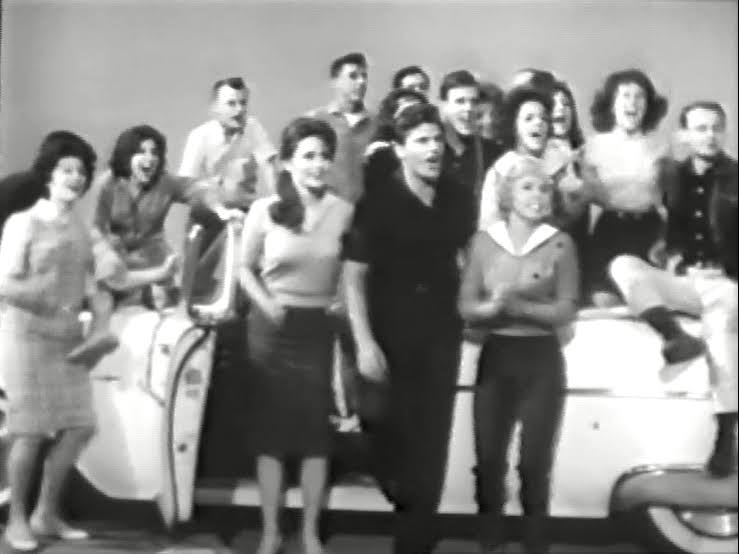
Here's a moment from the opening race, for instance. In the new DVD, you lose a little visual information at the top and bottom of the screen, like the ankles of the actors in the front row, but you gain some ground on the left and right sides. And details are much clearer now, too. Note, for instance, the girl in the plaid dress at the left side of the frame. Can you even tell her outfit is plaid in the second picture? The facial expressions of the spectators are distinct in the Retromedia version but not in the Video Beat version.


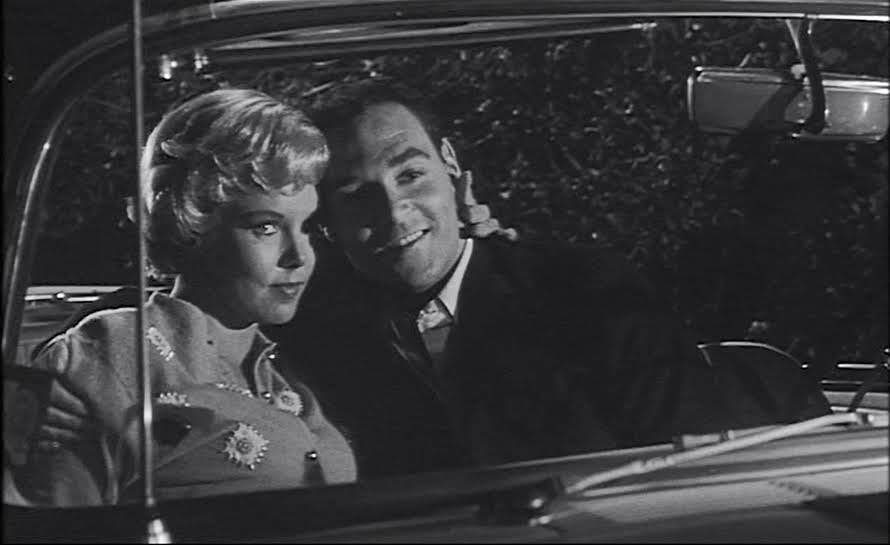
Here are the main characters, Tommy and Helen, on a date. This gives you an idea of what the film's night scenes are like. Notice the fanciful details on Helen's sweater. You can even make out Harold Lloyd, Jr.'s individual front teeth.


For contrast, here's an indoor scene involving Helen and her parents. The Retromedia version offers far greater detail: the clock, the father's jacket, the purse, etc. You can see there is extra visual information on the left and right sides of the screen as well. Check out the banister behind the father for an example. But the grainy Video Beat version has some extra headroom and legroom. Look at the gap between the purse and the bottom of the frame.


Finally, I'd like to show a moment from the dream sequence, since this is the part of the movie that so impressed author Rob Craig and is the most blatantly Wood-ian in tone. With its layering of images, this might be the scene that benefits the most from a crisp transfer.


There is at least one more significant difference between these two versions. In the Video Beat DVD, the opening credits declare that the film was "produced by Headliner Productions." That's it. No human producer is listed, just the company. In the Retromedia DVD, the credits say that Married Too Young was "produced by Nathaniel Tanchuck." Both versions credit Nat Tanchuck with the story and screenplay. So, while my bootleg copy of the film has largely been supplanted by this new disc, the Video Beat edition is not exactly obsolete.

It remains to be seen whether Retrovision's Forgotten Ed Wood disc will revive interest in Married Too Young. I certainly haven't seen much publicity for this release yet. I only found it by accident while searching for other Ed Wood releases on Amazon. The cleaner, sharper transfer certainly makes the movie more enjoyable to watch, and the letter from Headliner Entertainment should satisfy those who have questioned the film's authenticity.

But, still, I can't imagine this turgid, preachy movie ever becoming another cult classic on the order of Glen or Glenda or Plan 9 from Outer Space, and it lacks the inspired lunacy of such Wood-written films as Bride and the Beast and Orgy of the Dead. Those looking for an Ed Wood "youth in crisis" movie will probably gravitate to The Violent Years or The Sinister Urge instead. Ultimately, this is one for the completists out there. If that's you, this DVD is ready when you are.