Showing posts with label Phil Cambridge. Show all posts

Saturday, February 5, 2022

Ed Wood's When the Topic is Sex: "Lesbian-Involved Prostitution" (1971)

Good news: This article features some cool Phil Cambridge artwork. Bad news: The headline is misspelled.

NOTE: This article continues my coverage of Ed Wood's When the Topic is Sex (BearManor Media, 2021).

The article: "Lesbian-Involved Prostitution," aka "Lesbian-Involved Prostition." Originally published in Lesbo Lassies (Calga Publishing), vol. 3, no. 2, April/May 1971.

Excerpt: "Any number of local beer bars cater to the lesbian trade, and who is to say how many of the butch or the passive types are not in the professional trade? One looks much the same as any of the others. But it is a sure bet that many financial arrangements are met and the affairs are arranged with more than love interests at hand."

Ed's 1967 book on the subject.
Reflections: In the years following World War II, many Americans migrated out to the suburbs, believing that these areas would provide the perfect environment for their families—away from the filth and crime of the major cities but still close enough to civilization to enjoy all the modern conveniences. That was the plan, anyway. What they wound up with was a place that, according to many artists and writers, combined the worst aspects of both the country and the city. In art and literature, suburbia tends to be depicted as a place of stultifying boredom, cookie-cutter conformity, and empty materialism. For fun sometime, try Googling the phrase "quotes about suburbia." See how many positive ones you get.

Pornographers, meanwhile, looked at suburbia and saw an opportunity. All those people, many still in their 20s and 30s, with nothing of interest to do but watch television—why, they probably get up to some kinky stuff out there, just to pass the time. So we get movies like Herschell Gordon Lewis' Suburban Roulette (1968) and Steve Apostolof's Suburbia Confidential (1966). Under the pen name Emil Moreau, Ed Wood himself wrote a book called Suburbia Confidential in 1967, swiping the title directly from Steve's (similar but unrelated) movie.

And then there's "Lesbian-Involved Prostitution," an article in which Ed Wood tries to convince us that the American suburbs are being overrun by housewives-turned-lesbian-hookers. From his opening paragraph, he says he has the data to back up this outrageous claim:
If we are to believe recent surveys dealing with suburbia and the suburban areas, then we must necessarily believe many of the bored housewives have taken up prostitution, whether for extra money or for purposes other than financial. . . . And it is that many lean more to the lesbian practices of prostitution than to more conventional intercourse with the milkman or other tradesmen. For one reason it is much safer. There is no chance of getting caught "knocked up," and little chance for catching or carrying venereal diseases.
I guess, then, that you can't turn a ho into a housewife, but you can do just the opposite. That sounds like more fun anyway.

According to this article, when Americans left the cities for the suburbs in the 1940s and 1950s, they took the long-established practice of lesbian prostitution with them. Not that these women are exclusively homosexual, mind you. They'll take on all comers, men included, especially if there's money involved. But these women prefer encounters with their own gender. In "Lesbian-Involved Prostitution," Ed repeats his theory that women are driven to sapphism after being traumatized, abused, or simply disappointed by men.

Ed Wood also offers us a snapshot of the prostitution industry in general. With the widespread closing of brothels and bordellos after the war, hookers needed to find new ways of plying their trade. The result was what Ed refers to as "the Call Girl system" in which clients would call a service and arrange a "date" with a young lady in some agreed-upon location, probably a motel room or apartment. This new business model was quite convenient, as Eddie explains:
It's really nothing very new, having been around as long as the telephone, but never before on such a grand scale as the present-day services. Companionship, for whatever purpose, is as close as the nearest telephone . . . all it takes is the knowledge of certain telephone numbers. 
The strangest aspect of "Lesbian-Involved Prostitution" is when Eddie starts discussing stereotypes that we readers might have about these women.
One of the largest misconceptions of the lesbian prostitute has been that she necessarily is big of bone and rugged of features, more the truck driver type than the girl next door. She is pictured wearing a tweed suit with belted down trousers and the fedora hat cocked saucily over one eye along with the flat male shoes. She is to be gruff in manner and roll off the pornographic words like a drunken stevedore. . .
Uh, gee, Eddie, I think that might a stereotype that exists only in your mind and nowhere else in the world. I promise you, I was not thinking of tweed suits or saucily-cocked fedoras. And certainly, stevedores were far from my mind. The furthest, in fact.

Next: "The Strange Fascination of Lesbianism" (1972)

Sunday, January 2, 2022

Ed Wood's When the Topic is Sex: "Behind the Film Scene" (1972)

Phil Cambridge's clever, though hard-to-read logo for "Behind the Film Scene."

NOTE: This article continues my coverage of Ed Wood's When the Topic is Sex (BearManor Media, 2021).

The article: "Behind the Film Scene." Originally published in Blazing Films (Pendulum Publishing), vol. 6, no. 1, January/February 1972. Credited to Edward D. Wood, Jr.

Excerpt: "I doubt very much if today that my old, and very dear friend, Bela Lugosi could carry a picture unless all the ladies he bit in the neck were completely naked and had some kind of a lavish sex scene with the handsome hero beforehand. . . . Or the old gentleman himself became lecherous enough to remove her clothing behind a fence and make her before sucking her blood."

Reflections: This article is very much in the same spirit as "That's Show Biz." Again, Eddie is pontificating and free-associating about the many changes the movie industry has seen over the decades, particularly in regards to the depiction of onscreen sex and the increased demand for realism. What's different this time is that Eddie does mention a few specific film titles, including a few of his own. He talks about Crossroad Avenger (1953), Bride of the Monster (1955), Jail Bait (1954), Revenge of the Dead (1959), and even Take it Out in Trade (1970), which he calls his "first film in the nudie market."

A significant film, according to Ed.
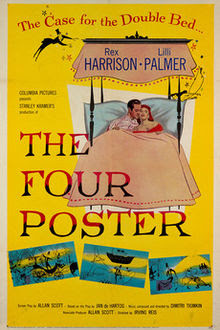
In fact, besides plugging his own movies, the only other title Ed directly references in this article is Irving Reis' The Four Poster (1952)a rather obscure comedy-drama starring Rex Harrison and Lilli Palmer. According to Ed, this movie was significant for its use of a double bed. Previous to this, thanks to the overly-strict Hays Code, directors could only show twin beds onscreen to maintain the fiction that husbands and wives slept separately. Oddly, that aspect of the movie seems to be forgotten today. To the extent that The Four Poster is remembered at all, it is for the animated sequences directed by John Hubley.

People who read a book like When the Topic is Sex probably became fans of Ed Wood through his movies, so they will relish the tidbits of information about those movies that Ed provides here. The director admits that, when he was first making films in the 1950s, he mistakenly thought that stars like Bela Lugosi and Tom Keene would be bigger box office draws than they actually were. He laments the end of the era when a big name on the marquee was enough to sell a movie. Wood further implies that, if Bela were alive in the 1970s, he'd have to make sexually-explicit movies in order to sell tickets. Perhaps it's for the best that this did not come to pass. 

Eddie's memory may have been a little shaky by 1972. In this article, he says that Bela Lugosi starred in Revenge of the Dead (Ed's preferred title for Night of the Ghouls), which is absolutely untrue. The role of Dr. Acula in that film was intended for Bela, but the great Hungarian actor was several years dead by the time the script went into production. Western baddie Kenne Duncan stepped into the role instead and gave one of his most memorable performances as a phony psychic medium who gets his much-deserved comeuppance.

Can we trust Eddie's story about how he was prevented by the censors from showing a gun with a silencer in Jail Bait? How about his recollection of hiring someone just to clean up the horse droppings on Crossroad Avenger? These could well be figments of Eddie's imagination. 

Honestly, it's difficult to summarize "Behind the Film Scene" because Eddie flits from one topic to another without a thought toward coherence. At one point, he discusses the so-called "sweater girls," i.e. the 1940s actresses like Lana Turner and Ann Sheridan who became notorious for their clingy, curve-enhancing cardigans and pullovers. According to Ed, the censors objected to the sweater girls, especially when their movies were shown to members of the military:
The Hays office decided the girls should no longer be dressed in the tight knitted garments because it turned so many of the boys in the service on. And that was one thing which shouldn't happen to them. After all they were in the business of battle. And if the powers that be gave them a little time off to see movies, they most certainly shouldn't see any girls sticking so far out in front. What would happen if they got turned on under such circumstances? Why there might be a whole generation of homosexuals who would come out of the war.
This is dubious reasoning, Eddie. I doubt that the Hays office thought Lana Turner was somehow going to turn a "whole generation" of soldiers into homosexuals. This seems like an out-there idea, even for Ed Wood. 

By the way, this article mentions an infamous blooper from The Red Skelton Hour involving a cow that defecates on the stage during a sketch. "Wonderful cow!" Red enthuses. "Not only does she give milk, but she gives Pet-Ritz pies." For the curious, this classic TV moment is available online. It comes from a 1960 episode entitled "Clem and the Beanstalk." As you might guess from the title, this is a parody of "Jack and the Beanstalk" featuring Red's dimwitted character, Clem Kadiddlehopper. Actor Jack Albertson also appears in the scene as a character named J.B. Throckmorton, which is the kind of name you'd give a businessman back then.


Next: "What Would We Have Done Without Them?" (1972)

Wednesday, June 15, 2016

Ed Wood Wednesdays: The Wood Collaborator Odyssey, Part Four by Greg Dziawer

A new variation on Glen or Glenda? perhaps: Artwork by Phil Cambridge.

"I asked him about angora, why not silk or satin? He said, 'There's nothing more sensual than angora.'"
-Phil Cambridge, Nightmare of Ecstasy

"And he wore those women's cuffs, and always an angora top, an angora sweater... He was always on the sauce... always."
-Ibid.
The art of Phil Cambridge adorned hundreds of splash pages for short stories and articles appearing in the Pendulum family of  adult magazines, including dozens by Ed Wood. This week, we're taking a closer look at some of Phil's work: his fine, flowing lines and evocative shading effortlessly painting somber moods. His work, as much as any of the artists at Pendulum, defined the look and feel of these mags. Ed was the go-to writer at the Pendulum office for the gay-themed mags. His stories and articles there among his most revealing and personal, and Phil contributed some of his most plaintive work in that milieu.

Note: Due to the nature of the artwork in this week's story, the images themselves will be posted to the Ed Wood Wednesdays Tumblr. They are, to one degree or another, NSFW. Proceed with caution.

  • A splash page image by Phil Cambridge for the uncredited article "Gay Power" from Gay Studs, vol. 1,  no. 2, 1969. 
  • "Blindfold" from The Boy Friends, vol. 2,  no. 1. Artwork by Phil Cambridge.
  • The Cambridge splash page for Ed's short story "I, Warlock." This story also appeared in Gay Guys Book 1 with an identical layout. A Libra Press publication circa 1971.