Showing posts with label Stephen Apostolof. Show all posts

Wednesday, October 8, 2025

Ed Wood Wednesdays, week 245: The Erotic World of A.C. Stephen (1999) [PART 3]

Director Steve Apostolof poses with actress Rene Bond, who starred in several of his movies.

It's taken me a while, I realize, but it's finally time to wrap up my look at the 1999 Something Weird compilation tape, The Erotic World of A.C. Stephen, gifted to me by reader Brendon Sibley. What can I say? There was just too much material in The Erotic World to cover in a single article. Or two articles. I spent five years working on a book about Stephen C. Apostolof, and there were things on this tape even I hadn't seen in my research.

Wednesday, October 1, 2025

Ed Wood Wednesdays, week 244: The Erotic World of A.C. Stephen (1999) [PART 2]

Steve Apostolof looks over a script, probably an erotic one.

So where were we?

Two weeks ago, I started discussing Something Weird Video's The Erotic World of A.C. Stephen (1999), a compilation of clips from the films of softcore director and frequent Ed Wood collaborator Stephen C. Apostolof (1928-2005). Reader Brendon Sibley sent me a copy of this rare tape, and I was happily making my way through its contents. When we left off, I was talking about Bachelor's Dream (1967), a very obscure short film that began life as some black-and-white test footage that was shot for Orgy of the Dead (1965).

But that was just the opening act! The Erotic World has so much more to offer. After Bachelor's Dream ends, we see some trailers for Steve's non-Ed Wood films: Office Love-In (1968), Motel Confidential (1969), Suburbia Confidential (1966), and College Girls (1968). These were nudity-filled, black-and-white exploitation flicks from Steve's "confidential" phase, when he was busy exposing the seamy side of average, everyday American life. Several of these films feature Steve's most-frequent leading man, Harvey Shain (aka Forman Shane), and his most-frequent leading lady, Marsha Jordan. 

Wednesday, September 17, 2025

Ed Wood Wednesdays, week 243: The Erotic World of A.C. Stephen (1999) [PART 1]

Steve Apostolof, aka A.C. Stephen, has his day in the sun.

"Find a penny, pick it up, and all day long you'll have good luck." Remember that one?

Ed Wood on a lucky penny.
Since pennies are worth so little today, you have two choices when you find one lying on the floor or the ground somewhere: pick it up or leave it be. Personally, I'm a penny picker-upper, and I think it's because of that little rhyme we all learned as children. It's somehow comforting to think that these essentially-worthless little coins might be good luck talismans. It redeems them somehow. Ennobles them.

Ed Wood is the lucky penny of directors, except he's a lucky penny that we keep discarding and rediscovering in an endless cycle. Most people look at Eddie and see only a talentless drunk who made cheap, bad movies—a one-cent piece not even worth picking up—but every once in a while, some observant passerby spots him and decides that, yes, it's worth the effort to reach down and retrieve him from the pavement.

Interest in Ed Wood remained high throughout the 1990s, and the spotlight on Ed was wide enough that it shone on some of Eddie's collaborators and contemporaries. Case in point: Stephen C. Apostolof aka A.C. Stephen (1928-2005), the Bulgarian-born softcore director with whom Ed made eight movies between 1965 and 1978. Ed served as a screenwriter, assistant director, and even occasional actor in Steve's movies. While Apostolof was understandably conflicted about being reduced to a supporting player in the Ed Wood saga, it's undeniable that Wood's notoriety brought Steve's movies back into public view for the first time in years.

At least two different companies, both quirky specialty labels, rereleased Apostolof's movies on home video back then. In Los Angeles, Rhino Home Video released its own edition of Orgy of the Dead (1965), plus three volumes called Saturday Night Sleazies (1990-1991). Meanwhile, up in Seattle, Something Weird Video launched its own series of Apostolof reissues. When I was doing my research for the book Dad Made Dirty Movies (2020), I frequently relied on those SWV editions of Steve's films, including Motel Confidential (1969) and The Divorcee (1969).

The tape I wanted.
But one particular item remained elusive: a 1999 compilation tape from Something Weird called The Erotic World of A.C. Stephen. This is a career-spanning compilation of various Apostolof clips from the 1960s and 1970s, including footage from several of the films Steve made with Ed Wood. Somehow, I've never managed to snag a copy of this tape, and it's become a pretty rare collector's item in the quarter-century since its release. After getting sniped at the last second during an Ebay auction, I gave up.

Fortunately, reader and Ed Wood superfan Brendon Sibley was kind enough to digitize his copy of The Erotic World and send it my way. As with the last film Brendon sent me, the faux-Italian pseudo-documentary Mondo Oscenità (1966), there is simply too much here to cover in one article. Instead, I will make this into a two-part series, perhaps three if necessary. I very much thank Brendon for making this material available to me.

The generous, 108-minute compilation begins with a true rarity: the short film Bachelor's Dream aka The Bachelor's Dreams (1967). Steve Apostolof made this 33-minute featurette so that it could be shown in front of his own movies on double feature bills. That way, he could control both halves of the program and get all the box office receipts instead of only half. What's interesting to Ed Wood fans is that Bachelor's Dream is built around some black-and-white test footage that was originally shot by Bob Wilson during pre-production on Orgy of the Dead. Steve merely dusted off this footage, shot some new wraparound footage (some of it in color) to go with it, and added a flimsy storyline to tie it all together. Voila! Instant movie!

Wednesday, May 14, 2025

Ed Wood Wednesdays, week 228: The 'Orgy of the Dead' novelization (1966)

Ed Wood turned his script for Orgy of the Dead into a novel.

"Merchandising! Merchandising! Where the real money from the movie is made!"
-Mel Brooks, Spaceballs (1987)
   
It used to be that, once a movie left theaters, it was basically gone. Unless it played on television or was screened at a revival house, you just couldn't see it. All that survived were people's faulty memories. VCRs changed that, obviously, but these marvelous machines didn't become common in American homes until the 1980s. Before that, people who wanted to revisit a movie had to rely on soundtrack albums and tie-in books.

Movie soundtracks started gaining popularity in the 1950s, thanks to the invention of the long-playing record in 1948, but novelizations have existed nearly as long as there have been feature films. Such books were even produced for silent films of the 1910s and 1920s! By the 1960s, novelizations were a regular part of a movie's marketing campaign and remained so for decades. The tie-in books and the movies they were based on had a symbiotic relationship; each raised interest in the other. Novelizations were so popular, in fact, that at least two of Ed Wood's novels, Raped in the Grass (1968) and Bye Bye Broadie (1968), falsely claimed to be based on motion pictures. To be clear, neither movie exists. 

Ed Wood's first genuine movie novelization came out in 1966. It was an adaptation of his own screenplay for Steve Apostolof's Orgy of the Dead (1965). This was perhaps the only full-length book to arise from Eddie's brief and largely unsuccessful association with Forrest J. Ackerman, founder of Famous Monsters of Filmland magazine. It was Ackerman who sold the book to Earl Kemp, editorial director at a San Diego publisher called Greenleaf Classics. The paperback has since become quite a collector's item, partially thanks to the painted cover art by artist Robert Bonfils (1922-2018). Unfortunately, to further illustrate the book, Ed Wood pilfered some photographs from Steve Apostolof's personal collection of stills. This contributed to the rift between Ed and Steve that persisted until the two reunited in 1972 for a new series of films.

The opening credits of Orgy of the Dead indicate, by the way, that the screenplay is based on Ed Wood's novel. This is not the case. By all accounts, Orgy started as a screenplay by Wood that was then purchased by Steve Apostolof and turned into a film. The novelization was only written after the release of the movie. In other words, the movie birthed the book, not the other way around. Perhaps Steve and Ed had already planned to release a book based on Orgy and they were trying to drum up interest in the novelization before it was published.

Now, if you've seen the movie Orgy of the Dead, you might be wondering how Eddie managed to get an entire novel out of it. After all, the plot is a bit sparse, and that's being charitable. A horror writer named Bob (William Bates) and his grumbling girlfriend Shirley (Pat Barrington) survive a car crash and stagger into an old, abandoned cemetery where they witness a strange trial presided over by a cloaked figure called the Emperor (Criswell) and his assistant, the Princess of Darkness (Fawn Silver). The Emperor and Princess sit in judgment over a procession of the recently deceased and decide what happens to their souls in the afterlife.

Wednesday, December 21, 2022

The 2022 Ed-Vent Calendar, Day 21: A few more pages from Ed Wood's The Hostesses (1973)

How similar is The Hostesses to The Cocktail Hostesses? We'll get to the bottom of this.

Once again, I'm leafing through some pages from Ed Wood's softcore script The Hostesses, which director-producer Stephen C. Apostolof filmed as The Cocktail Hostesses (1973). As you'll recall from yesterday's article, the film revolves around a young woman named Toni Rice (played by Rene Bond), an unhappy secretary who's having an affair with her skinflint married boss, Mr. Henderson (Norman Fields). At the behest of her friend Jackie (Terri Johnson), Toni quits this job and becomes a cocktail hostess and escort.

We now jump forward a little in the story. Toni is working at an Irish-themed bar alongside Jackie and another girl named Lorraine. (This copy of the script belongs to the actress playing Lorraine, by the way, which is why her lines are underlined.) 

Howard (Duane Paulsen), the bar's piano player, has $50 in his tip jar and offers it to Lorraine if she'll have sex with him after work. Lorraine begs off, saying she has to drive Jackie home. Howard has another suggestion: they can both have sex with him. Here's how that conversation goes:

Page 21 of The Hostesses.

Comparing this script page to the finished movie, we find that Jackie and Howard's conversation is almost identical to what Ed Wood has written. Howard even does that  dumb "double your pleasure" bit, a reference to the ad campaign for Wrigley's Doublemint gum. But, alas, Duane Paulsen skips one exceptionally corny line of Wood's dialogue: "I have enough lovin' for both of you." As before, Ed Wood has left the explicitness of the sex scene "to the discretion of the director." Steve Apostolof was strictly a softcore filmmaker, so he would not include graphic, unsimulated sex scenes in his movies.

Let's move on to page 29, where we find Lorraine consoling another waitress, Millie (Lynn Harris), who has recently been raped in the parking lot of the bar. Keep in mind that they're having this heart-to-heart conversation in the middle of a hotel room orgy, with a nude couple making out right behind them.

Page 29 of The Hostesses.

In The Cocktail Hostesses, the actresses do what's on the page, though they tinker with the wording just a little bit. For instance, Millie's line about the knife, "I should have had a knife like he did," becomes "Listen, I wish I had the knife he had" in the finished movie. Luckily, Ed Wood's speech about men being "bastards" survived intact to the final cut. Also, it should be noted that once the girls go to the bedroom for some privacy, they improvise some inconsequential chit-chat about the party and the drinks before resuming the scripted dialogue.

Another interesting line from Eddie's script: "There is no doubt but what LORRAINE is the aggressor." Revealing choice of words, no? That's how Ed Wood saw lesbian relationships, i.e. predator and prey. In the movie, however, this dynamic is not played up.

The Millie/Lorraine scene continues on page 30:

Page 30 of The Hostesses.

In this scene, Lorraine seduces Millie. Pay close attention to those handwritten notes in the margin, for here we finally get confirmation that Steve Apostolof freely encouraged his actresses to ad lib. The actress playing Lorraine has written in the lower right corner: "Scene to be played with extreme erotic ad-libs. Choice of words & language no barrier." I'd have to guess that this advice came directly from Steve Apostolof to his actresses. 

Generally, throughout this sequence, the two actresses read Eddie's lines but improvise some brief dialogue along the way, mostly as a way of filling up time. Other than that, page 30 of Ed's script has survived nicely.

This very same scene continues on page 31:

Page 31 of The Hostesses.

For this page, the main difference between the script and the movie is that, in the latter, there are several lengthy cutaways during Lorraine's two big speeches. (Those are the passages underlined in purple in the picture above.) After Lorraine says the part about "their own selfish pleasures" (ignoring the "little" from Ed's script), she improvises a few extra lines while undressing Millie. At that point, Steve Apostolof cuts to the living room, where all the other characters, including Toni and Jackie, are engaged in an orgy. There's an amusing moment when a character named Larry (played by Apostolof regular Harvey Shain) canoodles on a couch with the profoundly bosomy Candy Samples. Nice work if you can get it. 

Steve then cuts back to the bedroom with Millie and Lorraine, and the latter resumes her speech, starting with the part about "their little demands." After she says a couple more sentences, Steve goes back to the living room, then back again to Millie and Lorraine, who picks up with: "And there will always come a time when..." (Ed's script has this as "always be a time when...")

The final page I have from the script is page 41, which is the last page of this draft. What's happening here is that Toni has gone back to work for Henderson—not as his secretary but as his paid mistress. At her old salary, yet! Here's how Ed Wood has it in the script:

Page 41 (and the end) of The Hostesses.

Yet again, the actors (Rene Bond and Norman Fields) kind of dance around Eddie's dialogue. If you want to see exactly what Ed wrote, look at the picture above. As for the dialogue in the finished movie, I've transcribed it below:
TONI: And what did I make?

HENDERSON: Uh, it's hard for me to remember.

TONI: I remember!

HENDERSON: Now what's that got to do with anything?

TONI: Plenty. You can visit me every Friday. And you can pay me eighty-six dollars and ninety-one cents for that visit. And that, my dear cocksman, is our permanent arrangement.
Apostolof wisely ends the scene (and the movie) with the "permanent arrangement" line. As you can see in the picture above, Eddie's script had one more line from Toni: "Now start making love... lover..." That's the kind of line Ed would have used in one of his short stories or novels, but it's a little too flowery to say out loud. I never really considered it until now, but I guess this "arrangement" allows Toni to keep her cocktail waitress job. After all, her sex sessions with Henderson generally happen during the afternoon, and the bar doesn't get hopping until nighttime.

All in all, this was an interesting little experiment. It helped me understand how Eddie wrote, how Ed and Steve worked together, how Ed's scripts compare to the films made from them, and even how Steve treated his actors and actresses. Now if someone will only give me the $1,450 for the complete Hostesses screenplay.

Tuesday, December 20, 2022

The 2022 Ed-Vent Calendar, Day 20: Pages from Ed Wood's script for The Hostesses (1973)

A detail from the Cocktail Hostesses poster.

What are you even doing here? Don't you realize that, at this very moment, you could be buying a genuine vintage screenplay for The Cocktail Hostesses (1973) for a mere $1,450? Talk about a bargain! You remember The Cocktail Hostesses, right? The Ed Wood-written, Steve Apostolof-directed softcore film that's so widely beloved that it's never received a proper DVD release, not even as part of the Big Box of Wood collection? Right, that's the one. Your Christmas won't be complete without it!

Jokes aside, it's difficult for me to get terribly enthused about The Cocktail Hostesses, even though I coauthored an entire book about its director. Back in 2020, I said it was only my 35th favorite Ed Wood movie and my least favorite of the Wood-Apostolof collaborations. Why is that? Although I'm always glad to see the late, great Rene Bond in a leading role, The Cocktail Hostesses is so sleazy and sordid—not to mention marred by a totally gratuitous rape scene—that I find it too depressing to be much fun.

Still in all, if someone gifted me that $1,450 Cocktail Hostesses script, complete with handwritten notes by one of the actresses in the film, I'd probably die of happiness. There's no way in this world I could ever afford it. Luckily, some snapshots have been posted online. How about we take a look at them and see if we find anything interesting, huh? We'll start with the cover page.

The cover of The Hostesses.

Okay, right away we see that The Cocktail Hostesses was originally called just The Hostesses and its script was credited solely to Ed Wood. In the completed film's end credits, Steve Apostolof (as A.C. Stephen) is listed as the film's coauthor. (How much writing Steve actually did on this picture, I don't know. My guess is, not much apart from maybe giving Ed Wood a story outline.) Note, too, that the film has been given a production number: "Prod. #113."

This particular copy of the script seems to have belonged to someone named "Kriss Kross," who is playing the supporting role of Lorraine. In the finished film, this character is portrayed by model-actress Kathy Hilton (1947-2015). Kathy is known to have worked under various aliases, so perhaps "Kriss" is one of them. In any event, Steve Apostolof filmed The Cocktail Hostesses in October 1972. We can see that the dates written on this cover match up with the calendar. (October 22 was a Sunday that year.)

It looks like this actress has been asked to show up at a place identified only as "Reubans" at 3:00 in the morning. Apostolof's usual cinematographer, Robert Caramico, shot The Cocktail Hostesses under the name "R.C. Ruben," so perhaps this note refers to him. Also, I'm pretty sure our actresses has been asked to supply her own red party dress, presumably for the late night orgy scene.

Next is merely a title page:

The title page of The Hostesses.

Not much to say here, except it's amusing to me that a script for a low-budget softcore porn movie should have both a cover and a title page. Talk about formality! Note, too, that The Hostesses is listed as "An A. - A. PRODUCTIONS Presentation." This is the production company name Steve Apostolof used for both Drop Out Wife (1972) and The Cocktail Hostesses, though both were released under the SCA banner.

At last, we get to the good stuff, i.e. the first scene of the picture:  

Page 1 of The Hostesses.

What happens on this page is basically what happens in the finished movie. Young secretary Toni Rice (Rene Bond) makes love to her boss, Mr. Henderson (Norman Fields), in the latter's office. Once they finish, they start dressing and have a little conversation about their relationship.

In the final cut of the movie, Steve Apostolof adds an establishing shot of the office building that's not indicated in Ed's script. Also, while dressing, Rene Bone improvises an extra line to fill up the time: "Boy, it's been a long day!" (This ends up being the first line of the film, apart from some grunts during the sex scene.) Other than that, there's no real difference between page and stage, so to speak.

Twice on just this page, Eddie leaves some detail "to the discretion of the director." That was a common notation in his screenplays for Steve Apostolof, perhaps indicating the writer's level of respect for his director and patron. For one thing, Ed says that Steve can decide how much of Mr. Henderson's naked body to reveal. As it happens, actor Norman Fields (whom I don't think of as "ruggedly handsome") does appear fully frontally nude in the finished movie.

The scene continues:

Page 2 of The Hostesses.

Not much to note here. Rene Bond and Norman Fields deliver this dialogue pretty much as Ed Wood wrote it, though they make it a little more natural and conversational by changing a word here and there. The essential meaning is kept intact. They do skip the "until next Friday" part entirely, though.

We now jump forward a few pages in the script:

Page 5 of The Hostesses.

Toni is now bemoaning her fate to her friend Jackie (gap-toothed Terri Johnson). She's sick of earning just $86.91 a week to be "poked, probed, sodomized, and debauched." (Never the most accurate of typists, Ed misspells the last one as "debached.") Jackie tells her to ditch that office job and become a cocktail waitress/escort. 

Again, the actresses largely deliver what Ed Wood has written. But Rene Bond does give her own spin on the "sick and tired" rant. Here's what she says in the finished movie:
I'm sick and tired of it... and all for what? NOTHING, just nothing! Them with their wife and kids, and all I get out of it is a big zero. Being a secretary is rotten. I just get nothing out of it.
Terri Johnson's response is also a little different from what's on the page:
"I'd say it's about time. You keep screwin' with that boss of yours and for what? Absolutely nothing! You figure it this way. I made thirty dollars alone in tips last night. And afterwards, I had the most delightful time with an out-of-town buyer. He made me fifty dollars richer."
See what I mean? Compare those quotes to the script page, and you'll see that what they're saying is similar to what Eddie wrote but not exactly the same. Maybe Steve Apostolf gave his actors seem leeway when it came to dialogue. Maybe, if we want full-tilt, unfiltered Eddie, all of his screenplays are going to have to be published just as he typed them 50 years ago.

But this article has already gone too long. I'll be back tomorrow with a few more script pages and commentary from The Hostesses.

Sunday, December 4, 2022

The 2022 Ed-Vent Calendar, Day 4: Publicity stills from 'The Beach Bunnies' (1976)

Based on that spelling of "colour," I'd say this Betamax copy of The Beach Bunnies hails from England.

I've said it before, but depending on how you look at it, Stephen C. Apostolof's The Beach Bunnies (1976) could be considered Ed Wood's final film. After all, it's the last feature film based on one of Eddie's original scripts to go into production during his own lifetime. Wood and Apostolof would collaborate on one more film, the ill-fated jewel heist comedy Hot Ice (1978), but I'll be darned if I can figure out precisely what Eddie did on that one. (On at least one resume, he claimed to have written it, but Apostolof himself disputed that.)

My point is, despite being a sleazy seaside sex comedy with an unfortunate rape subplot, The Beach Bunnies is a milestone film in the Ed Wood canon. 

Anyway, while researching Dad Made Dirty Movies: The Erotic World of Stephen C. Apostolof, Jordan Todorov and I went through reams of photographs from Steve Apostolof's personal archives, including some rarely-seen B&W publicity stills from The Beach Bunnies. I thought, for the fourth day of the Ed-Vent Calendar, we'd go through them together.

Marland Proctor (lower right corner) admires the elusive Pink Bikini Girl.

One of the oddities of The Beach Bunnies is that it devotes a sizable amount of its climactic bonfire scene to a character who is never named nor even credited: a raven-haired lass I have dubbed Pink Bikini Girl. While the film's other characters are sorting out their romantic misunderstandings and wrapping up assorted subplots, director Steve Apostolof apparently gets bored with them and simply points his camera at this striking young lady as she dances sensually on the beach. It's a good decision. There's even a publicity still of this dancer, so Steve obviously wanted to use her image to market The Beach Bunnies.

Johnny Fain and Linda Gildersleeve in The Beach Bunnies.

The closest thing The Beach Bunnies had to a "star" in its cast was professional surfer Johnny Fain, charmingly billed as Johnny Aquaboy. His character, an overprivileged layabout named Dennis, romances one of the film's four main female characters, Sheila (Linda Gildersleeve). In the photo above, we see Johnny and Linda posing with Johnny's now-antiquated Kennedy longboard. Incidentally, Kennedy is a maker of custom surf equipment in the Woodland Hills neighborhood of Los Angeles. Their family-owned Ventura Boulevard store is still open as of 2022. 

A Japanese tourist (right) and his parasol-toting companion in The Beach Bunnies.

To the extent that The Beach Bunnies has a "main" storyline, it involves celebrity gossip reporter Elaine Street (Brenda Fogarty) as she relentlessly pursues movie star Rock Sanders (Marland Proctor) for a story. (She wants to confirm whether or not Rock is undergoing a sex change. Spoiler: he isn't.) Like Wile E. Coyote, Elaine tries one wacky ploy after another to get Rock's attention. One gambit involves wading into the ocean and pretending to be attacked by a shark, hoping that Rock will rescue her. Instead, it's an unnamed Japanese tourist who "saves" the day. Ed Wood and Steve Apostolof were not known for their subtlety when it came to humor. So the Japanese man has the obligatory giant camera dangling around his neck, while his companion carries one of those pleated parasols (properly known as Wagasa).

Wendy Cavanaugh, Mariwin Roberts, Brenda Fogarty, and Linda Gildersleeve.

Though the Elaine/Rock story takes up the most screen time, The Beach Bunnies is an ensemble comedy at heart. Set at a beach resort, the film focuses around four vacationing female friends: the aforementioned Elaine and Sheila, plus Bonnie (Wendy Cavanaugh) and Lorrie (Mariwin Roberts). Each lady gets her own, individual subplot, and all four of them meet up occasionally to discuss how things are going. Director Steve Apostolof may have been trying to cultivate a new repertory cast, since three of these ladies (Cavanaugh, Roberts, and Gildersleeve) returned for Hot Ice. Sadly, that turned out to be Steve's final film.

Thursday, December 1, 2022

The 2022 Ed-vent Calendar, Day 1: The Basketballers (1973)

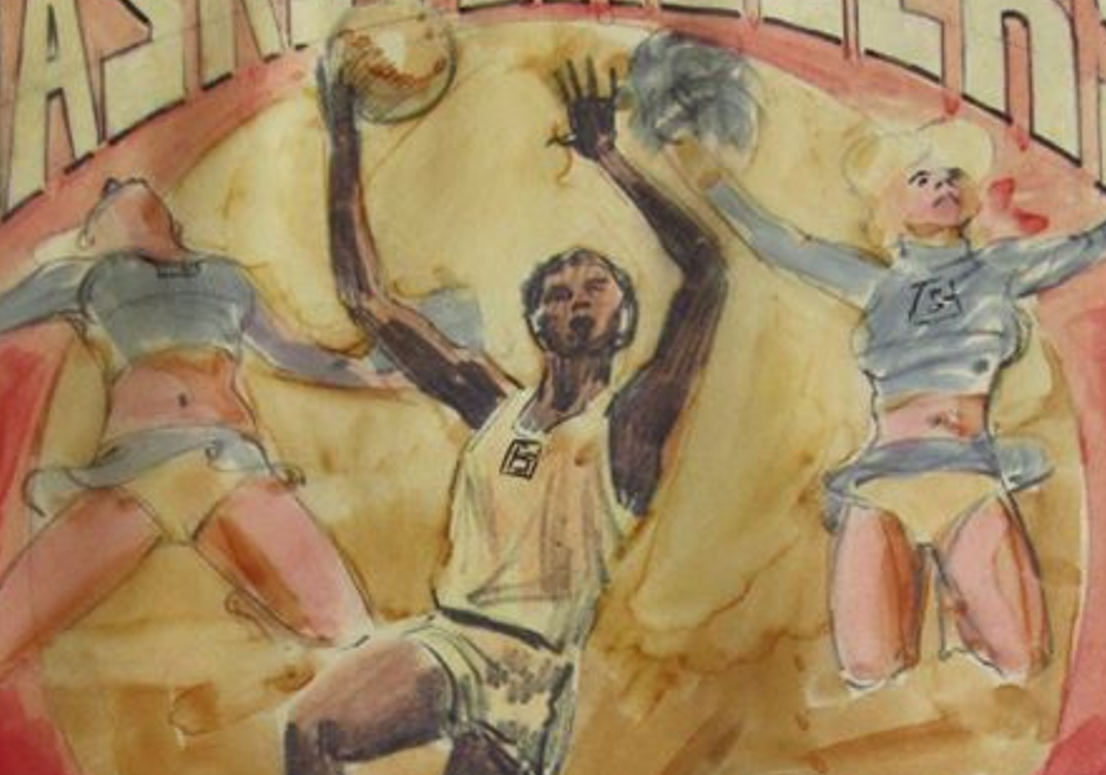
Mockup poster for an Ed Wood/Steve Apostolof film that never was.

It seems like every year, there are more and more of those specialized advent calendars based on different brands or franchises. You know the ones I mean. There's a Disney one, a Marvel one, a Mario one, etc. But there's never been an official Ed Wood advent calendar! It's an outrage! Isn't the director of Glen or Glenda (1953) as worthy of his own advent calendar as Harry Potter, Lego, or Pokemon? And yet, we Woodologists have been denied!

Well, this year, I'm setting out to change that with a series I call The 2022 Ed-vent Calendar. Each day in December until Christmas, I'll post a bite-sized article about some little aspect of Ed Wood's life or career. Nothing too serious, just a little Wood to get you through the hectic holiday season. Sound good? Then let's continue.

For Day 1, I'm choosing The Basketballers, an unproduced script Eddie wrote for his frequent collaborator, director Stephen C. Apostolof, in 1973. In Nightmare of Ecstasy (1992), Rudolph Grey describes the film thusly: "Unfilmed screenplay by Ed Wood and Stephen Apostolof involves sports, sex and drugs on a small town college campus." I wonder if the tone would have been similar to Apostolof's previous film, College Girls (1968)?

The Basketballers is one of several Wood/Apostolof projects that never went before the cameras, but this one must've gotten fairly far along in preproduction. In the Apostolof archives, now in the possession of the director's youngest son Chris, there exist at least two drafts of the screenplay: one from 1973, another from 1974. For the record, Ed Wood is the sole credited screenwriter on both drafts. Intriguingly, the second one carries the legend: "Property of Valentine Enterprises Inc., Hollywood, Calif." Was Valentine some production company that either Steve or Ed was trying to start?

Two drafts of The Basketballers.

Despite co-authoring an entire book about Stephen C. Apostolof—and have I mentioned that it makes a swell Christmas present?— I have never actually seen or read the screenplay for The Basketballers. Those pictures up there were taken by Bob Blackburn when he visited Chris Apostolof in Las Vegas a couple of years ago. Apparently, Steve's archives include a fair amount of Basketballers ephemera, including the contract Eddie signed with Apostolof Film Productions, Inc. to write the script on October 10, 1973. Coincidentally, that would have been Eddie's 49th birthday.

Ed Wood signed a contract to write The Basketballers on October 10, 1973.

Perhaps most intriguing of all is this mockup of a poster for The Basketballers. To me, it's clear that Steve fully intended to go into production on this script. Like all of the Apostolof films of this era, The Basketballers would have been released under the familiar SCA banner. Note that the poster also proclaims that the film will be in Eastman color. Up until the late 1960s, many low budget sex films (including a few of Apostolof's) were still in B&W. Meanwhile, those scantily-clad cheerleaders are highly suggestive of College Girls and may even have been modeled on Steve's leading lady, Marsha Jordan.

A rough draft for a Basketballers poster.

As further evidence of how serious Steve Apostolof was about The Basketballers, here's a trade paper ad for another Wood/Apostolof joint, Fugitive Girls (1974). This one proudly proclaims that The Basketballers, which now even has its own logo, is being prepared for a "June release." Since Fugitive Girls itself didn't come out until July 1974, Steve must have been looking forward to June 1975. As we now know, that didn't happen. But Steve and Ed weren't done yet! Their next collaboration, The Beach Bunnies, would come out in 1976.

This trade ad for Fugitive Girls mentions The Basketballers.

And that's it. That's Day 1 of The 2022 Ed-vent Calendar. I don't think the subsequent articles will be this long, but I wanted to kick off this series with something special. Hope you enjoyed it.

Wednesday, September 30, 2020

Ed Wood Wednesdays, week 108: 'Dad Made Dirty Movies: The Erotic World of Stephen C. Apostolof' (2020)

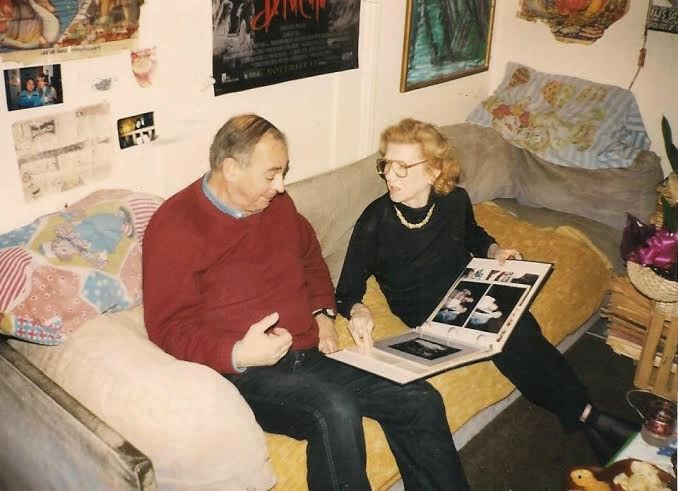
Stephen C. Apostolof, wearing his lucky white shoes, looks over a script.

How did Ed Wood do it? How did he churn out dozens and dozens of books, both fiction and nonfiction, in the span of a few short years? He made it look like child's play. I've just had my first and only book published, and it was one of the most arduous and time-consuming tasks of my entire life. Nearly five years lapsed between the day I agreed to sign on to the project and the day I finally held a physical copy of the book in my hands. Along the way, I thought I was going to lose my mind on more than one occasion. Now, however, Dad Made Dirty Movies: The Erotic World of Stephen C. Apostolof is a reality. It's available in paperback from McFarland Books. I hope you like it as much as I do, and I like this book a lot. For you e-book readers, it's also available in Kindle and Nook editions.

Our gorgeous book cover.
It all started so innocently. Back on January 26, 2016, Bulgarian journalist and filmmaker Jordan Todorov contacted me via Facebook Messenger, telling me he was very impressed with my lengthy, detailed reviews of the movies that Stephen C. Apostolof made in collaboration with Ed Wood in the 1960s and '70s, starting with Orgy of the Dead (1965) and ending with Hot Ice (1978). Naturally, such flattery is a good way to get my attention. He told me he had a "raw and unfinished" manuscript about Apostolof. I wished him good luck with it. Jordan then suggested I become his coauthor, and I responded with four of the most fateful words of my life: "I could do that."

The next five years would test those words severely. Could I do that? What followed were seemingly endless months of writing, rewriting, editing, and reediting. Jordan and I both spent many hours working on a shared Google Doc that was getting slower and slower to load as it bloated to a gargantuan length. Through this process, I felt like I lived Stephen C. Apostolof's life many times over, until I knew the major beats of his story better than I remembered my own life. During this time, Jordan and I exchanged dozens of direct messages and emails, and we spoke at great length by Skype on numerous occasions. These usually turned out to be sprawling, rambling conversations in which we'd start by discussing the book but usually branch out into innumerable other topics.

I should say that both Jordan and I are very opinionated people, and we were both passionate about making Dad Made Dirty Movies as good as it could be. There were times that I thought my coauthor was being unreasonable about some minor issue, and I'm sure he thought the same thing of me. Generally, though, we got along very well during this lengthy journey. If there's a sequel, I'd be proud and happy to work with him again.

There were some dark times along the path, to be certain. In the late summer of 2018, for example, my father was dying, and I was in no mood to talk about Apostolof, the book, or anything else. This led to one of the rare times when I lost my temper during a Skype call with Jordan. Another grim time was when Apostolof's oldest son Steve died in November 2017. The Apostolof children were always our greatest sources of information, and they've been nothing but kind and helpful in making this book a reality. Dad Made Dirty Movies wouldn't exist without them. I'm very sorry neither Steve nor my father lived to see this book.

Assembling a biography of Stephen C. Apostolof was like completing the Twelve Labors of Hercules. Everything from captioning the photographs to assembling the index was its own little challenge. At each stage, I felt like I was living Steve's life one more time. Jordan and I somewhat naively thought that, when we handed the manuscript over to the publisher, the journey was just about over. Nope. That was over a year ago, and it proved to be just the beginning of a new phase in the book's evolution. More work. More messages. More emails. More Skype calls.

But now the moment of truth has arrived. Dad Made Dirty Movies is a 316-page reality. I suppose this is really just the start of another adventure: marketing the book. I really don't know much about doing that, but I suppose I'll have to learn. In the meantime, here is a homemade commercial I produced for the book. If you haven't bought your copy yet, maybe this will change your mind.


And just for good measure, here's a 30-second music video for the book.


Dirty Made Dirty Movies can be ordered at AmazonBarnes and NobleIndieBoundBAM!BookworksMcFarlandWaterstonesIndigoKinokuniya, and other retailers.

Thursday, October 31, 2019

Major book announcement!

Director Stephen C. Apostolof and his children on the set.

For the last couple of years, Jordan Todorov and I have been working on a comprehensive, fully-illustrated biography of Bulgarian-born sexploitation director Stephen C. Apostolof (1928-2005), the man behind Orgy of the Dead, Fugitive Girls, and much more. Along the way, we've had the total cooperation of the Apostolof family and access to Stephen's personal archives. You may know Steve Apostolof from his collaborations with Ed Wood, but there's a lot more to the story than that.

And now, our book, Dad Made Dirty Movies: The Erotic World of Stephen C. Apostolof, is finally available for pre-order from McFarland. It's also available for pre-order from Amazon, and I especially hope you click that Amazon link because you'll see the promotional blurb I wrote for this book however many months ago. I must've been pretty hyped up on caffeine that day.

In all seriousness, this book has been a real labor of love for Jordan and for me, and we're very anxious for Dad Made Dirty Movies to reach bookstores and readers everywhere!

Dirty Made Dirty Movies can be ordered at AmazonBarnes and NobleIndieBoundBAM!BookworksMcFarlandWaterstonesIndigoKinokuniya, and other retailers.

Wednesday, January 21, 2015

Ed Wood Wednesdays, week 54: 'Edward Ford' (1978)

David Ward, the real-life inspiration for the greatest movie never made.

A gravedigger who meets a prince.
"I remember the end of L'Education sentimentale. Frédéric and his companion Deslauriers are looking back over their lives. Their final, favourite memory is of a visit to a brothel years before, when they were still schoolboys. They had planned the trip in detail, had their hair specially curled for the occasion, and had even stolen flowers for the girls. But when they got to the brothel, Frédéric lost his nerve, and they both ran away. Such was the best day of their lives. Isn't the most reliable form of pleasure, Flaubert implies, the pleasure of anticipation? Who needs to burst into fulfilment's desolate attic?"
-Julian Barnes, Flaubert's Parrot


"There's that story about the actor hired to play the gravedigger in Hamlet. Asked what the play was about, he replied, 'It's about this gravedigger, who meets a prince...'"
-Roger Ebert

About two-thirds of the way into Rudolph Grey's Nightmare of Ecstasy: The Life and Art of Edward D. Wood, Jr., there is an interesting little section called "Biographical Notes," which consists of brief descriptions of the many individuals whom Grey interviewed and quoted in order to assemble his unorthodox biography of an otherwise little-documented B-filmmaker. The roll call includes friends, relatives, neighbors, coworkers, and other marginal folks whose lives intersected in some way with that of Eddie Wood. Most of these personages only get a terse sentence or two. Maila "Vampira" Nurmi rates a little paragraph of her own.

In addition to the roughly 72 people named here specifically, Grey states that there are other contributors to Nightmare of Ecstasy "who wished to retain anonymity and whose names in the text were pseudonymous." One is tempted, then, to swipe Criswell's speech from Plan 9 from Outer Space and declare that Grey's book is based only on the secret testimony of the miserable souls who survived this terrifying ordeal. I can't say that all 72 of these people were miserable, necessarily, but there's a definite sense of melancholy that pervades the book.

Virtually all of Grey's interviewees are connected in some way with show business, yet very few (arguably none) of them are household names. I guess it depends on the household. In many cases, their biggest claim to fame is their connection, however tangential, to Edward D. Wood, Jr., the Patron Saint of Misplaced Optimism himself, a man held up by many as a paragon of failure. So certainly there are some unfulfilled dreams and unmet expectations behind the anecdotes in this book.

Lew Dockstader
One of the eyewitnesses to the slow-motion train wreck that was Eddie Wood's life is an actor named David Ward, who is quoted frequently throughout Nightmare of Ecstasy, especially in the sections related to Ed's booze-and-poverty-plagued final decade. Ward also appears as a talking head in such documentaries as The Haunted World of Edward D. Wood, Jr. and Dad Made Dirty Movies. In those films, he comes off as gentle, modest, and unassuming -- a polite, soft-spoken fellow who's just happy to share what he knows. 

David Ward's write-up in Grey's "Biographical Notes" is the kind that might catch the attention of someone casually flipping through the book, since weird details stick out from it like rusty nails. "DAVID WARD," it reads. "Stage, television and movie actor. 'My great-grandfather was Lew Dockstader, the minstrel. He gave Al Jolson a job.' A movie based on his life, Edward Ford, is in preparation." 

Leaving aside the nearly-irrelevant detail about his great-grandfather, whose stage name is misspelled as "Lou Doxstedder" in Grey's text, this ultrabrief biography raises some obvious questions. Why, for instance, should an actor whose highest-profile assignments were bit parts in films like Iron Eagle (1986) and The Limey (1999), be honored with a movie about his life? And why, furthermore, should that movie be called Edward Ford?

 None of this made sense to me until Bob Blackburn, co-heir of Ed Wood's estate, alerted me to the existence of one of the most unusual and, in certain circles, celebrated motion picture scripts never to reach the big screen. This is one of the most rewarding detours I've taken in my seemingly endless exploration of the life and career of Edward D. Wood, Jr., and I'm eager to share it with you today.

EDWARD FORD (1978)
 
The real-life Edward Ford, David Ward, reminiscing with Eddie's widow, Kathy Wood, in the 1990s.
Photo by Bob Blackburn. 

  
I. Those Pesky Preliminaries

Before we even begin upon the path that will take us into Edward Ford land, a strange and shadowy realm populated by wilder inhabitants than you'll find in any Star Wars sequel, I must point you in the direction of a wonderful article called "The Great American Unproduced Screenplay," which was written in November 2012 for Slate.com by Matthew Dessem. Can you promise me -- I mean, really promise me -- that you will go and read it? It's not a lengthy or difficult read at all, and it will make my job so much easier, because then I won't have to explain so much to you. Matthew Dessem provides a very thorough explanation of what this screenplay is, why it was written, and what significance it has for him as a work of American literature. Once you learn what Mr. Dessem has to say about Edward Ford, you can return to this article, and I'll tell you what I think of this whole screwy Ford phenomenon. Do we have a bargain? Good. Thank you. So off you go. I'll be right here, awaiting your return.

 
Screenwriter Lem Dobbs
Are you back? Good.

While Dessem's article obviously goes into much greater detail, the point is that Edward Ford is a famous unproduced screenplay, considered by many to be a masterpiece. It was written by Lem Dobbs, a successful and opinionated scripter whose credits include Romancing the Stone and The Limey, and dates back to the late 1970s when he was only 19. It is based on his friendship with actor David Ward, a lovably eccentric man who obsessed over movie trivia and tried for decades to break into films himself to no avail. In the 1980s and 1990s, Ward did find supporting roles in films like Iron Eagle, but none of that had happened when Edward Ford was first written. Okay, if you have gotten to this point in the article, you'll probably now want to read Lem Dobbs' screenplay for Edward Ford as well. Here's a link to that, too. 

I'm sorry to have to give you so much homework this time around, but sometimes that's just the nature of the beast. It couldn't be helped. Really, what I want to talk about this week is the what the Edward Ford script tells us about Edward D. Wood, Jr. and the subterranean showbiz world he inhabited in the 1960s and 1970s, but in order to get to that stuff, there was a lot of backstory about David Ward and Lem Dobbs that had already been covered brilliantly elsewhere by others. 

By now, you should have gathered that Edward Ford is not about Edward Wood, but Eddie -- or, rather, his barely-disguised semi-fictional counterpart, Harold "Harry" Blake -- is an important supporting character in the screenplay, sort of like how Robin Hood is a featured player rather than the star in Ivanhoe. In its own strange way, however, Edward Ford gives us a very insightful and surprisingly complete overview of Ed Wood's life, even though his counterpart character is shunted off to the margins of this screenplay.

II. Oh, All Right. Here's a Plot Summary

The framing story for Edward Ford takes place in Los Angeles in roughly the late 1970s and the early 1980s. It involves a young man, Luke Krantz, who tags along with his eccentric, forty-something companion, Edward Ford, as they go to movies or just drive around town. All the while, Edward and Luke quiz each other on movie trivia (they're both experts), and Luke asks Ed about his past adventures and says he's turning these strange anecdotes into a screenplay.

Ford is a cabbie by vocation and an actor by avocation, but he has long been unable to score the Screen Actors Guild (SAG) card he needs to start his movie career. Instead, he has existed at the very fringe of show business for decades, taking theater roles and occasionally working as a "waiver" (a far-background extra) in the movies whenever possible. Although Luke casually refers to Edward as "a nutcase," he also says the older man is his "best friend" in Los Angeles and genuinely seems to admire his honesty and stubbornness.

Luke starts recording Edward's stories, and it is through these conversations that we piece together Mr. Ford's curious biography.

The Edward Ford diet.
The Early Sixties. Having freshly arrived from Coventry, Delaware, factory worker and aspiring thespian Edward Ford habitually attends movies in LA's most run-down and dangerous theaters. He has very specific movie-going rules, only attending films that are at least 20 years old and then making meticulous records of actors and titles, which he keeps on typed file cards. And he only goes on Saturday nights. His diet consists of frozen TV dinners.

At his assembly line job, he meets Mitzi, a haggard-looking woman he alone finds attractive, and the two begin an awkward courtship. When he auditions for acting roles, he uses a very hammy and old-fashioned style that merely puzzles casting directors. Although she cannot understand his obsession with file cards, Mitzi agrees to marry Edward, and she moves into his shoddy little apartment with him. One day, by chance, Edward meets two of his all-time favorite B-movie actors, Lester Adams and Jed Dobie, both now has-beens who live in Edward's unfashionable neighborhood. Mitzi encourages her shy husband to strike up a friendship with Jed and Lester, thinking it will help his acting career. Through Lester, Edward meets low-budget filmmaker Harold Blake, a transvestite who throws wild parties attended by all sorts of cast-offs and lunatics.

Edward Ford becomes a cab driver, a profession that he is to hold for many years. His friendship with Jed and Lester continues, too, and he gets his first job as a "waiver" in a major Hollywood studio production. Edward also reconnects with two of his childhood friends from Coventry, both of whom have made their way out to the West Coast. Screenwriter Al Foster is a silver-tongued, bombastic man whose out-of-control drinking frequently gets him in trouble with the law. Artist Ben Krantz, on the other hand, is wealthy and successful. Unfortunately, Edward's relationship with Mitzi is in a downward spiral. She comes to resent the attention her husband lavishes on his precious file cards, and she deliberately tampers with the cards out of spite. One night, able to take no more, she scalds her husband with boiling water. This incident seems to end the Fords' marriage.

The real Lester Adams, Kenne Duncan
The Early Seventies. Edward, still a cab driver with no SAG card, hangs out a lot with Al Foster and Ben Krantz at Ben's place on Sunset. Ben, a widower, is teaching at UCLA and sleeping with his attractive female students. Ben's young son, Luke, begins to take an interest in Edward, the only person as movie-crazy as he is. Edward's brother, Billy Ford, has returned from a tour in Vietnam and gets romantically involved with the Krantz' au pair, Ilsa. Al is still writing and still drinking and has managed to hold onto a girlfriend, the terminally-depressed Carla.

Because he frequently has to travel as part of his art career, Ben depends upon Edward to look out for Luke. It's no burden, however, because the two are fast friends. Lester Adams and Jed Dobie, however, both die during this time period. Lester, whose death had been erroneously reported on TV a few years earlier, leaves Edward Ford his trademark black hat he wore as a villain in cowboy movies. Harold Blake attends Lester's funeral and waxes nostalgic about the old days.

Edward's acting career has led him to small theatrical productions, including religious plays. His old-fashioned and demonstrative acting style fits in better there. At nights, lonely without a "nice girl" to call his own, he spends his money on worn-out prostitutes. Billy Ford is luckier in love, as he marries Ilsa and moves away from Los Angeles. Edward, however, just keeps on driving his cab, day after day, year after year, always thinking that a successful acting career is just around the corner. As usual, he keeps attending movies regularly, and he stays in touch with Al, Luke, and Ben, with whom he loves to shoot the breeze.

Al, however, returns to Coventry, and Edward is somehow saddled with taking care of the disagreeable and phlegmatic Carla. A working man at heart, Edward Ford spends most of his time in the 1970s in his cab. One day, he is robbed, but the thief is gunned down by police. (This incident is written in a melodramatic style and may be partially a fantasy.)

Edward's Holy Grail: A SAG card
The Early Eighties. Very little has changed for Edward Ford. He's just a little older with thinner hair now, but his spartan lifestyle -- the file cards, the TV dinners, the fleabag apartment -- is unscathed. Luke remains as fascinated as ever by his older friend, with whom he (reluctantly) goes cruising for hookers. Harry Blake has died, penniless and forgotten, by this point. Edward and Luke pay a visit to Blake's widow, Patty, who seems to have been destroyed by her marriage.

Edward Ford's theatrical career has taken a strange turn: he portrays the token white villains in otherwise all-black productions. Mitzi has remarried, so Edward doesn't have to pay her alimony anymore. Still, Luke and Ben speculate about Edward Ford's financial situation, especially since his employer, the cab company, has gone out of business. He gets by somehow, they agree.

Harold Blake's movies are posthumously rediscovered by hip, young viewers who consider these old films to be campy and unintentionally funny. Luke and Edward attend a crowded Harold Blake retrospective, where Luke gets into the sarcastic spirit of the event while Edward is annoyed and offended by the mocking attitude of the spectators.

In happier news, however, Luke has finished his screenplay based on Edward Ford's life and says that Edward himself can have a role (though not the starring one) in this production, finally giving him a chance to earn his coveted SAG card. When the card itself finally arrives in the mail, Edward stares at it in silent awe. Al Foster, still a hopeless drinker, returns to Los Angeles, and Edward agrees to let his old friend stay on his couch. As optimistic as ever, Al claims he's "gonna make a million" this time around.

III. The Parts About Edward D. Wood, Jr.

The real life Harold Blake
As you can see from the preceding plot summary, the Ed Wood-inspired character of Harry Blake is a side dish in the Edward Ford buffet, not the main entree. But this is the weirdest thing: there's basically a complete biopic of Edward D. Wood, Jr. embedded within this script, which is ostensibly about someone else. And it's a damned good biopic, too, both funny and sad, simultaneously grotesque and nostalgic.

Screenwriter Lem Dobbs, the real-world equivalent of Edward Ford's Luke Krantz character, obviously did thorough research on this project. The depiction of Ed Wood -- apart from one extraneous detail -- is what I'd call tough but fair. It's far less romanticized than the Tim Burton biopic, and it is far less sparing in its depictions of Eddie's demons, including alcoholism and spousal abuse.

But the Edward Ford screenplay acknowledges the central tragedy of Ed Wood's life: he was simply the wrong guy in the wrong place at the wrong time. Maybe there is no historical or geographical setting in which Ed would have flourished, but ruthless, heartless Hollywood was a terrible setting for a bleary-eyed dreamer like him, especially during a transitional era when the old ways (meaning the studio system with its all-powerful executives and regularly-employed contract players) were crumbling and no one seemed to know where exactly the industry was heading.

But how much Ed Wood/Harold Blake is there in this screenplay, anyway? Well, as a public service, I've decided to break down all of the sequences involving this character.

(pp. 22-26) Harold first arrives on page 22, hosting a "lively and noisy" party at his home, "a bizarre kind of shack perched on a hillside." The screenplay unkindly describes Blake's guests as "human oddities... strictly grade-Z... the true underbelly of Hollywood society." Edward Ford and his wife Mitzi attend with Lester Adams, the Kenne Duncan-inspired character. Lester supposedly starred in "two or three westerns" directed by Blake, who says he is "trying to raise the finance" for his next picture. 
The character of Harold Blake, "a rather dapper man, though slightly pudgy, with a babyish sort of face," is first glimpsed in a bathroom, adjusting the black negligee beneath his otherwise-masculine clothing. 
Here is that one extraneous detail I warned you about: writer Lem Dobbs has Harold Blake shooting up heroin in this scene, which Ed Wood never did. He was a drunk, no question, but he had a lifelong disdain for drugs, especially illegal ones. 
During this raucous party sequence, we meet two other minor-yet-significant characters: actor Laird Breen, who gives Edward Ford some career advice, and Harold Blake's wife, Patty, described as "not an unattractive woman, actually." Patty, meanwhile, is inspired by Kathy Wood. 
As for Laird, my best guess is that he's supposed to be Lyle Talbot, an established actor who appeared in Plan 9, Glen or Glenda?, and Jail Bait for Ed Wood. 
(pp. 49-50) Lester Adams has really died this time, and Edward Ford attends his funeral. Harold Blake is on hand to deliver a eulogy: "His old pard Jed Dobie passed on almost exactly a year -- but I don't mourn for either of them. Because I know they're having a heckuva time -- riding the purple sage -- over that final sunset." 
In real life, Ed Wood did host a memorial service for the departed Kenne Duncan. From what I've read, it took place around a swimming pool, a colorful detail that failed to make it into this screenplay. 
(pp. 66-68) Edward Ford pays a visit on Harold Blake, who "has come way down in the world." Seemingly oblivious to the fact that company is present, Harold openly argues with his wife Patty, whose "looks are all but gone." Patty calls her husband "shithead," an epithet that shows up frequently in Nightmare of Ecstasy as well as in Ed Wood's own short stories from the era. At one point, their argument becomes physical. Typically passive, Edward Ford does not react at all to this. 
Fittingly, just like Ed Wood, the Harold Blake character has become a writer of pornographic paperback novels, including Bestial Virgins and Mother's Horny Sons. "I specialize in incest," Blake semi-brags. If the real Eddie Wood had any specialty in the smut racket, it was for stories about transvestites. I can't find any novels or short stories specifically about incest. But this sequence does an excellent job of describing what Ed Wood's life and marriage were like by the 1970s. 
One great detail: Blake is "wearing a dress, but hasn't shaved in a day or two." This quirk is substantiated by so many anecdotes about Ed Wood, including those by Ed De Priest and Stephen C. Apostolof.
(pp. 85-86) It's now the early 1980s, and Harold Blake has died. Luke Krantz tells Edward that he's found "an article here about that idiot director you knew -- the one who collected weirdos." Edward Ford bristles when the article refers to Blake as a "primitive." Luke expresses genuine curiosity about this departed director and wants "to see what he married." 
And so, with young Luke in tow, Edward Ford respectfully pays a visit to Patty Blake, "a destroyed old hag" who lives in a dog-shit-strewn, "bottom of the barrel" Hollywood apartment. There is a fuzzy black-and-white TV in one corner and garbage scattered everywhere. Patty is glad to see Edward. "This is a good guy," she says to Luke. The younger man is so taken aback by this scene that he's still thinking about it while having lunch with Edward Ford later in the day. 
(pp. 93-102) This is, by far, the longest and most complex sequence involving the Harry Blake character. Luke convinces Edward to attend a Harry Blake Film Festival at LA's famed Nuart Theatre. The event turns out to be way more crowded than Edward had anticipated and is attended by smart-alecky hipsters who are only there to mock the late Harry Blake. 
The festival is hosted by "two bearded types wearing glasses and 'Invaders' T-shirts." These guys, I guess, are supposed to be Harry and Michael Medved. They sarcastically describe Blake's films in pretentious, pseudo-intellectual language. Another guest at the festival is actor Laird Breen, who genially explains that Harold Blake "was proud of what he did... no matter how crappy it looked." 
The films on the bill, all cognates of real Ed Wood productions, are The She-Male (1956), Invaders From Planet Ten! (1958), and Bride of the Crocodile (year unknown). The special effects, dialogue, and acting are all held up for ridicule. 
To emphasize the horror of the situation, Lem Dobbs' screenplay intersperses scenes from Blake's movies with flashbacks to the last, desperate years of Blake's own life, during which he was constantly intoxicated, dead broke, and fighting with his wife. Luke gets into the spirit and starts laughing along with the hipsters, but Edward Ford is outraged and offended. 
Afterwards, Ford angrily explains to Luke that the two bearded men got their facts all wrong. Bela Lugosi's scenes for Plan Ten, for instance, were shot years before the rest of the picture, and Harold Blake was the star of The She-Male, not a mere bit player. Luke says he'll never watch another Harold Blake movie again.
So there you have it.

If Edward Ford were made into a two-hour movie, the parts about Harold Blake/Ed Wood might take up twenty minutes. And yet, within those twenty minutes, you'd have a pretty good overall portrait of how Eddie lived his life in Hollywood. Harold Blake's film career and writing career are both represented, and when Harold himself pops up every twenty pages or so, you get a series of vignettes that  reflect how this man's life deteriorates alarmingly over the course of two decades.

Just about all the facets of Ed Wood's personality are here: the cross-dresser, the cowboy, the dreamer, the dirtbag, the life of the party, the lush, etc. Only the war hero ex-Marine is absent. In this script, you see the man who smacked his wife around when he was soused, but you also see the man who befriended all the other oddballs in Tinsel Town and gave them work when no one else would. Edward Ford even takes time to dissect Ed Wood's strange, posthumous quasi-fame.

The people who exploited Ed's name and work are depicted as vultures, nibbling away at his corpse. We also get to meet fictionalized versions of some key people in Ed Wood's life, including the long-suffering Kathy Wood and the foul-mouthed, self-aggrandizing Kenne Duncan. The manner in which these characters are depicted in Lem Dobbs' screenplay is eerily close to their counterparts' portrayals in Nightmare of Ecstasy, right down to the way they talked. This helps lend Dobbs' script a sense of authenticity.

The only serious misstep, as I mentioned earlier, is the depiction of Harold Blake as a heroin junkie. It's the one detail that is blatantly fabricated, and it's practically first thing we learn about the character!

IV. What's My Take On All This?
"Drama depends on a story being about the most important thing that ever happened to this person."
-Lem Dobbs, author of Edward Ford
Terry Zwigoff, the ideal director for Edward Ford.

Ever since Bob Blackburn introduced me to Edward Ford, I have read through the script in its entirety at least five times straight through, as if it were a novel. I can imagine myself reading it a couple of times every year and discovering or rediscovering little details in it each time. It's that kind of work: an obvious labor of love positively teeming with baroque little details worth savoring again and again. Even if Edward Ford never passes in front of the cameras, it deserves to have a long life as the kind of screenplay people recommend to one another and pass around among themselves. That would be a very fitting destiny for it. 

Naturally, there has been a lot of speculation about this script becoming a "real" movie, and if that ever happens, I think the guy to do it is Terry Zwigoff. Terry's been one of several directors "attached" to Edward Ford, and tonally, it's rather close to the director's humorously dark, endlessly enigmatic documentary Crumb from 1994. 

Both Crumb and Edward Ford are about the insular, secretive world of obsessive, nostalgic nerds who are so tuned into their own private wavelengths that they seem to the rest of the world to be borderline autistic. Cartoonist Robert Crumb carefully files away his 78 RPM jazz and blues records with the same care that Edward Ford gives to his file cards of actors and movies. And both films fully explore the surprisingly diverse sex lives of their title subjects! 

As for who should play Edward, well, I couldn't help but picture him as looking and talking like a chemistry teacher I remember from high school, but I think Crispin Glover comes as close as anyone to embodying the Ford-ian spirit. The director may have to give Crispin a lot of sedatives though, as one of the hallmarks of the Edward Ford character is that his demeanor almost never changes.


Don Quixote and Sancho Panza.
In his write-up about Edward Ford, Matthew Dessem deems the script a classic of American literature and repeatedly compares it to F. Scott Fitzgerald's The Great Gatsby. A few paragraphs back, if you'll recall, I compared it to Sir Walter Scott's IvanhoeStructurally and thematically, however, Edward Ford bears a closer resemblance to Don Quixote than it does to Gatsby or Ivanhoe. Cervantes' famous, self-styled knight errant overdosed on books about chivalry, fashioned a crude suit of armor for himself out of household objects, and then set out for a series of disastrous adventures, trying in vain to recapture the spirit of an earlier, more romantic age, only to meet with bewilderment and scorn from the people of his own time. 

Edward Ford, likewise, overdosed on cheapie Westerns and gangster pictures made by notoriously cut-rate studios like Monogram and PRC and then decided to move to Hollywood in order to find work as a villain in these very kinds of movies, regardless of the fact that they were not being made anymore by the 1960s when he arrived. Like Don Quixote, Edward Ford is episodic, stringing together a series of tragicomic skits about its title character's ill-fated yet strangely noble sallies into an unforgiving world. 

Every Quixote needs his Sancho Panza, and in Edward Ford, the sidekick role is filled by young Luke Krantz, a friend's son who becomes a companion, unlikely soulmate, and (ultimately) biographer of the protagonist.

Sadly, the qualities that make the Edward Ford screenplay so great are the same ones that -- I am all but certain -- would make it a complete financial failure as a film. Critics and cinema geeks would love it, but I doubt that rank-and-file ticket-buyers would embrace it. To borrow a phrase from writer-director John Waters, Edward Ford would be one of those "films that get you punched in the mouth for recommending them to even your closest friends." 

Most viewers will wonder why the hero of Edward Ford isn't more "dynamic" or why the screenplay leaves out most of those crucial story beats we have come to expect from every single motion picture. Other than having Edward's SAG card as a MacGuffin, sort of like his own personal Holy Grail or Maltese Falcon, this story barely resembles a typical motion picture scenario. 

Even though I spent several paragraphs describing the "plot" of Edward Ford, this is not a story-driven screenplay at all. Most of it is about those in-between moments of life: waiting in line at the movies, hanging out with friends at a diner, watching your clothes get sloshed around at a laundromat. 

One of my favorite little details in the script, for instance, is a typically overlapping conversation between Al, Ben, and Edward in which they discuss the differences between the words "mongrel," "Mongol," and "mogul." What is actually accomplished here? Not much, except getting to know these three guys a little better and see how they interact with one another. 

That may not be enough for some people. In my research for this article, I came across this disheartening 2010 screenplay analysis of Edward Ford by a purported "expert" in the field. If you truly want to know why Lem Dobbs' script never got filmed and seems doomed to remain in limbo forever, I'd recommend reading this article and then the comments below it. Sad but true.


V. My Chat with the Real David Ward

The man himself.
In January 2015, through the kindly intercession of  Bob Blackburn, I was able to talk for about half an hour via telephone with David Ward, the actor who served as the real-life inspiration for Lem Dobbs' Edward Ford. Not only is the title character based on David, but the incidents in the script are all events taken from David's own life.

How close is the script to reality? Based on my conversation with Mr. Ward, I'd have to say it's pretty darned close -- much more accurate, in fact, than the script for Ed Wood, which freely embellishes upon the historical record. Edward Ford, on the other hand, is more like Dragnet. The story is true; only the names have been changed to protect the innocent. So David Ward became Edward Ford, Lem Dobbs became Luke Krantz, Kenne Duncan became Lester Adams, Ed Wood became Harold Blake, and so on.

Talking to David Ward is no easy trick, I can assure you. Now in his early 80s, he resides in a Los Angeles convalescent home. I spent the better part of a Saturday afternoon trying without success to reach his room. The phone would ring and ring, but no one answered. I think, in all, it took about eight hours before I finally connected with Mr. Ward. I don't want you to think that I sat by the phone all day, wearing my dialing finger down to a nub by calling over and over. I mean, I went grocery shopping and did laundry, too, that day. But every couple of hours, I'd try the number again. And good things, as we all know, come to those who wait. Eventually, I heard a deep, calm voice on the other end.

As it turns out, David Ward is a cheerful and cooperative man whose memory is still pretty sharp.. or sharp enough for my purposes anyway. My interviewing skills are worse than non-existent, so I mostly stuttered and stumbled my way through a vague, general conversation about Ward's life and the Edward Ford screenplay. Mostly what I wanted to know was, "Did all this stuff really happen?" And he confirmed it all, one seemingly impossible incident at a time.

I think, of all the stories in the screenplay, the one that shocked me the most was the one about David's (or Edward's) wife scalding him with hot water in a fit of pique. But it happened, along with all the other goofy goings on. The stories about Ed Wood I already knew to be true, and I was glad to learn that Lem Dobbs had gotten his facts right in this department.

We even talked about something that doesn't come up in Edward Ford: David's working relationship with Stephen C. Apostolof. Though these titles don't appear on his IMDb page, David was an extra in the nightclub scenes from The Cocktail Hostesses and Drop Out Wife, which were filmed simultaneously.

We talked, too, of Eddie's doomed film adaptation of To Kill a Saturday Night, which would have paired David Ward with John Carradine. (A real shame that one never came to fruition.)

Mostly, David seems to be proud of his longevity. He pointed out to me that he is probably one of the last people alive who knew Ed Wood personally. Ward specifically referred to the relatively recent deaths of such Wood associates as Paul Marco and Vampira. They're gone, but David Ward is still here.

I can't help but think of that scene from Citizen Kane in which Jerry Thomspon (William Alland), a reporter for News on the March, goes to interview one of Charles Foster Kane's business associates and friends, Mr. Bernstein (Everett Sloane), in hopes of finding out the meaning of Kane's last word, "Rosebud." Bernstein can't decipher "Rosebud," but he does act as a keeper of the flame for his departed friend. As Roger Ebert pointed out in his DVD commentary, Bernstein hangs a portrait of Kane over an actual hearth with a fire crackling away inside it.

In a way, that's David Ward's role in the Ed Wood saga. All these years later, he's still tending to that flame of remembrance, making sure it doesn't flicker out. At least not on his watch.