
 |
| A selection of posters, DVD/VHS covers, and handbills related to Brett Thompson's 1995 documentary. |
"This film is a true story. The screenplay is based on court testimony, sworn declarations, and hundreds of interviews conducted by the filmmakers. Some of the innocent characters' names have been changed in the interest of a larger truth. No one involved in the crimes received any form of financial compensation."
-prologue from John Waters' Serial Mom (1994)
 |
| Aleister Crowley |
Already an avid fornicator and the pseudonymous author of lewd poetry, Crowley was anxious by this point in his still-young life to delve into the world of genuine black magic, not mere play-acting, and thought that the Abramelin was his passport to a world of untapped power. The ceremony's dangerous and foreboding reputation, which was enough to keep the superstitious Scottish locals safely away from Boleskine, was likely a great enticement to the insatiable thrill-seeker, whose own religious upbringing was almost perversely pious.
But history records that Aleister Crowley abandoned the ritual before he had completed it. Why? As the late Colin Wilson testified in the 2002 made-for-TV documentary Masters of Darkness: Aleister Crowley - The Wickedest Man in the World: "He just couldn't be bothered to go on, because it really is pretty exhausting, you know, living on bread and water and getting up at 3:00 in the morning with invocations and all kinds of things. It's nothing as much as like being a monk, only harder. And so Crowley gave it up." England's most prolific and well-publicized sinner went on to other, presumably more entertaining forms of debauchery.
Edward Alexander Crowley died in 1947, the very year a young man named Edward Davis Wood, Jr. moved to Hollywood. Since July 2013, I have been rigorously documenting the life and career of Ed Wood. A year ago, I introduced Ed Wood Wednesdays with a brief essay summarizing my interest in the unusual director and his idiosyncratic films. I have since written 43 further installments, each one scrutinizing some particular aspect of Edward D. Wood, Jr's life and career.
This project has required me to spend many hours alone, hovering over a laptop computer, with only the endless drone of an electric fan to keep me company. In short, Ed Wood Wednesdays has become my personal Abramelin ritual, and its creation has been an arduous, almost monastic experience for me. But unlike the Abremlin, Ed Wood Wednesdays has no predetermined ending point. I have no idea when this series will be "finished."
 |
| Captain DeZita: A satyr? |
From his angora sweaters to his Imperial whiskey, Ed Wood was a man with an aura of sin and indulgence. He was determined to seek pleasure in life, even if his desires were at odds with societal norms or his own best interests. At his most respectable, Ed made extremely low-budget movies about tacky topics like "monsters, graves, [and] bodies," to quote Paul Marco in Plan 9 from Outer Space (1959).
At his least respectable, a mullet-sporting and booze-bloated Eddie Wood, clad in sweatpants and a sleeveless T-shirt, coaxed Ric Lutze to have sex in a century-old coffin on the set of the hardcore porno film Necromania (1971). Crowley himself might have admired that singularly-offensive moment and nodded with approval at Eddie's deliberate flaunting of taboos, particularly his brazen intermingling of sex and death.
It's worth pointing out that numerous people who knew Ed Wood have compared him to a satyr, a half-man/half-goat figure of ancient Greek lore associated with drunkenness and lust. The infrequently-used term satyriasis, the male equivalent of nymphomania, takes its name from these mythical woodland gods. It is interesting to note that the hairy, horned Devil (played by strip club booking agent Captain DeZita) who attends Ed Wood's dream wedding in Glen or Glenda (1953) physically resembles a satyr.
Aleister Crowley received a similarly animalistic appellation in his youth; his stern mother called him "the Beast," a nickname he later self-applied with bravado as an adult. England's popular press, however, referred to Crowley as "the Wickedest Man in the World," which seems only a short distance away from the label imposed by American critics upon Ed Wood, "the Worst Director of All Time." Both of these remarkable men suffered greatly for their excesses, and neither was a stranger to the "demons" of bankruptcy, failed marriages, and ill-health. The key difference is that Crowley reveled in his notorious reputation, while Wood longed for (bu never achieved) mainstream respectability.
And now, with the due diligence of a monk, I give you my thoughts on a highly unusual and artful mid-1990s documentary that seeks to put Edward D. Wood, Jr. into his proper historical context.
THE HAUNTED WORLD OF EDWARD D. WOOD, JR. (1995)
Alternate titles: The Haunted World of Ed Wood [informal title sometimes seen on the internet]; The Dark World of Edward D. Wood, Jr. [Venezuela], The Bizarre World of Edward D. Wood, Jr. [Italy]
Availability: The film is easily available for about $10 on a standalone DVD (Image Entertainment, 2002) or as part of the six-disc collection The Ed Wood Box (Image, 2004).
The backstory: Like many of Ed Wood's own movies, The Haunted World of Edward D. Wood, Jr. owes its existence to a series of quirky coincidences and arbitrary connections.
The unlikely acorn from which this oak grew was Crossroads of Laredo, the would-be Western that Ed Wood started but abandoned back in 1948. Wood's producing partner on the ill-fated oater was one Crawford John Thomas (1929-1998), a dashing fellow Eddie met during his days as a struggling stage actor in Los Angeles in the late 1940s. At the time, Thomas was flush with cash, thanks to a $2,000 inheritance that he was eager to spend. Thus was formed a doomed and short-lived enterprise called Wood-Thomas Productions.
While Wood went on to a lengthy and improbable career in motion pictures, one that stretched on for three decades, the moribund Crossroads marked the simultaneous beginning and end of C.J. Thomas' showbiz aspirations. A half-hour of grainy silent footage was all that Crawford's inheritance money had reaped, perhaps a pitiful monument to an expired dream but at least something tangible he could show to people. Many of Hollywood's thwarted aspirants don't wind up with any type of souvenir, let alone a movie connected to a prominent director with "name value."
Still in all, the unsatisfactory experience with Ed Wood on Crossroads of Laredo took a heavy toll on Crawford John Thomas, and he was bitter about the subject for a long, long while -- whole decades, in fact. He just couldn't shake it. It was like a toothache that wouldn't go away. Eventually, though, his mercurial ex-partner became a prominent laughingstock, and the scathing reviews earned by Ed Wood's movies became a sort of Novocaine to Thomas. The pain was eased, and he could find amusement in the whole silly saga.
By the 1990s, Thomas was a roofer and had been happily married to a woman named Pat for many years. And yet, the dream of finally completing and releasing Crossroads had never vanished from his mind. Perhaps, he felt, there was still time to shepherd the film to its well-earned destiny. A decades-old wrong could be righted.
The two men largely tasked with helping Thomas achieve this deferred dream were director Brett Thompson, an independent filmmaker whose Not Since Casanova (1988) had attracted some undeniably Wood-ian reviews, and neophyte producer Alan Doshna. Thomas and Doshna were members of the same church, and they both participated in the religious institution's Toastmasters-like public speaking group. Doshna must have been significantly impressed by Thomas' "icebreaker" presentation, during which the erstwhile film mogul spoke of his show business roots, including the fact that his father had been a dialogue coach to actor John Barrymore.
The first notable flowering of this church-based friendship was the 1992 documentary Flying Saucers Over Hollywood: The Plan 9 Companion, in which Thomas appeared as himself, giving testimony about his time with Ed Wood and in so doing introducing himself to many of Wood's fans. Doshna was among those receiving special thanks in the credits of Flying Saucers, presumably for acting as a consultant or contributor in some undefined capacity on the project.
Brett Thompson, meanwhile, met Thomas through a Pasadena attorney named Dan Hogue and visited Crawford and Pat at their home, where Crawford had an entire wall of his office decorated with stills from Crossroads of Laredo. Pat would later humorously recall that the ebullient and chatty Thompson was so enthusiastic about the project that he rather overstayed his welcome that night. But the director's interest in the still-unedited Crossroads was both strong and genuine, and C.J. Thomas happily placed the film in this new director's care.
Brett Thompson's original plan for Crossroads of Laredo was to edit the footage together into some semblance of continuity, add a musical soundtrack and narration, and augment this with perhaps "twenty minutes" of newly-shot interviews with people associated with Ed Wood. Thompson was as good as his word. Crossroads was eventually completed along these lines in 1995; its finished version contained an explanatory preamble by an ascot-wearing C.J. Thomas himself, accompanied by Dolores Fuller, Ed Wood's one-time girlfriend, muse, and leading lady, who also contributed several newly-written songs to the soundtrack. But that idea of adding "twenty minutes" of supplemental interview footage eventually grew into a separate, 112-minute feature film entitled The Haunted World of Edward D. Wood, Jr.
Thompson was surprisingly successful in corralling actors, friends, and technicians from Eddie's past, though there were some initial hiccups in this process. Thompson reports that many of these folks were hesitant about participating in The Haunted World because previous Wood-related endeavors, such as the Medved brothers' Golden Turkey Awards book in 1980, had made them the subject of scorn and ridicule.
The project's first significant "get" was Maila "Vampira" Nurmi, the classic horror hostess who had begrudgingly appeared as the Ghoul's Wife in Plan 9 from Outer Space during a late-1950s career slump after she'd lost her gig on Los Angeles television. Nurmi did not often speak to the press about her tarnished movie career, particularly the downmarket Plan 9, but Brett Thompson allayed her fears by treating her, quite literally, as royalty. In the finished film, Nurmi is seated upon a throne, carefully lit and wrapped in scarves, amid a lavish recreation of the set of her '50s TV series. Thompson even went so far as to hire a Vampira impersonator (current high school drama teacher Tomi Griffin) to don a form-fitting black shroud similar to the one Nurmi had worn four decades previously, including an impossible 16" waistline, and glide across the set for purely atmospheric purposes.
Aided and abetted by art director Gregg Lacy and cinematographer David J. Miller, Brett Thompson set out to make a highly stylized, visually attractive film that eschewed the "sensible" plain-jane, talking-head approach of most pop culture docs and instead aped the look of Hollywood's Technicolor triumphs of the past. Toward this end, the director was meticulous about the lighting, costumes, and set decorations of his film, even though it was non-fiction in nature. To put it in 1950s terms, this project was guided more by the aesthetic spirit of Douglas Sirk than that of Edward R. Murrow.
Rather than simply conveying information in a straightforward manner, as is the custom in most non-fiction films, Thompson sought to create evocative and eye-catching tableaux through all the tricks of the cinematic trade. This risky, unorthodox approach remains the most salient feature of The Haunted World, the one factor that sets it apart from other documentaries about Ed Wood. It is certainly unique to my experience as a moviegoer.
Whether or not you approve of the director's methods (critic Rob Craig does; Wood historian Philip R. Frey does not), one fact is inarguable: Brett Thompson's deliberately flattering, almost fawning portrayal of his subjects was crucial to the successful completion of The Haunted World of Edward D. Wood, Jr. Whatever educational merit the film may have, it certainly gathers a number of key players in the Ed Wood saga and presents them in a visually arresting way. As many of these people have since passed away, The Haunted World now serves as a kind of celluloid yearbook.
Once word of Thompson's deluxe treatment of Maila Nurmi began to spread, more and more of the so-called "Wood spooks" agreed to participate in the project. This word-of-mouth phenomenon is similar to what happened with Aris Iliopulos' I Woke Up Early the Day I Died, another '90s Ed Wood tribute film with an enthusiastic young director at its helm.
To justify the confidence that his "witnesses" (as they were termed in the film's closing credits) placed in him,Thompson went well out of his way to distinguish his interviewees from one another. He placed them in colorful costumes and photographed them with special props, sets, and lighting. C.J. Thomas, for instance, appears in a facsimile of the office he once shared with Ed Wood in the 1940s. (His widow Pat remembered that her husband kept the door of the set as a souvenir.) Actors Conrad Brooks and David Ward, both long-time friends of Ed, show up in dandified cowboy clothes. Brooks is even granted a fake cactus and a wooden fencepost against which to lean. Reverend Lynn Lemon, the real-life preacher who both appeared in and helped finance Plan 9 from Outer Space, appears to be bathed in heavenly light and has his wife, Velma, staring up at him in silent adoration as he speaks.
Dolores Fuller, whose scenes were filmed near her Las Vegas home, poses proudly in front of an oil portrait of herself from the early 1960s. Harry Thomas, Ed Wood's makeup man throughout the 1950s, is seated next a makeup table on a sound stage, just as you'd expect him to be. Bela Lugosi, Jr., a dead ringer for his dad and one of the few "witnesses" to speak out directly against Ed Wood in the film, is presented in a faux-Gothic milieu appropriate for the son of movie royalty, complete with a velvet curtain, an ornate candelabra, and a chambermaid at his service. This nonspeaking servant is also portrayed by Tomi Griffin, the Vampira impersonator, her dual role perhaps a sly nod to Una O'Connor in The Bride of Frankenstein.
Only a few interviewees -- among them actor Lyle Talbot (of Glen or Glenda? and Plan 9 fame), actress Loretta King (Bride of the Monster's ingenue), and director Joe Robertson (who turned Ed's Love Feast screenplay into a movie in 1969) -- are shot in the prosaic, head-and-shoulders manner we expect from documentaries. Deep-voiced actor Gregory Walcott, the hero of Plan 9 and another Wood skeptic, serves as a quasi-anchorman for the film and is depicted on a pedestal against a white backdrop, giving him a God-like authority.
Understandably, these witnesses tend to talk about themselves nearly as much as they talk about Ed Wood, and in fact there is very little revealed about Wood in The Haunted World that his fans won't already know. The same old anecdotes, including the one about Ed wearing a bra and panties under his uniform in WWII, are rehashed once again. For the true novices in the audience, there are also brief primers on such prominent Wood stock players as Criswell and Tor Johnson.
Among the revelations, culled both from the film itself and its DVD commentary track:
In all, Crawford John Thomas and Brett Thompson alike were quite pleased with the way The Haunted World turned out and were gratified by the film's warm reception from critics and fans. It got largely kind reviews and currently rates a very respectable 7.2 on the Internet Movie Database. Before the film found a cozy home on DVD, it played at film festivals both in the United States and Europe. The British Film Institute included it in their salute to Edward D. Wood, Jr., and Dolores Fuller took the film to Munich. Perhaps the highlight of The Haunted World's theatrical run was its premiere in Palm Springs, CA, an event which attracted Paul Marco, Vampira, Harry Thomas, Norma McCarty, and more.
It was, Thompson alleges, the largest reunion of "Ed Wood people" of all time. He may well be right. The event is lovingly documented on the DVD, and if you search around on the disc a little, you will find an adorable clip of Norma McCarty and Harry Thomas harmonizing on "Sweet Adeline." This has nothing whatsoever to do with Ed Wood, but I enjoyed it anyway.
One person not mentioned aloud in The Haunted World but appearing very prominently in its opening credits is Wade Williams. I talked about Mr. Williams before during my examination of Night of the Ghouls last September. (God, I was so young and naive back then.) In case you've forgotten, here's a brief refresher course on this pivotal and under-documented figure in the posthumous career of Edward D. Wood, Jr.
Born in 1942, Wade H. Williams III (not to be confused with the prolific character actor) is a wealthy film producer and exhibitor from Missouri who claims to own the rights to all of Ed Wood's feature films from the 1950s, including Plan 9 from Outer Space and Glen or Glenda, along with dozens of other low-budget science-fiction and horror movies of the era made by other directors.
While some (including Rob Craig) have praised Williams for preserving films which might have otherwise disappeared and become unavailable, others (including Ted Newsom) have criticized the distributor for overstepping his legal bounds and making false declarations of ownership of movies that are truly in the public domain. Mr. Williams' own court battles over these films have not always been favorable to him. Here, for instance, is an intriguing legal article about Williams' failed attempt to sue the makers of Good Morning America over the use of clips from Plan 9 and other movies in a story about UFOs.
Is Williams a cinematic savior or a cultural claim jumper? That is not for me to determine. However, I do feel that the absurd and false notion that Ed Wood only directed five films -- an utter canard dutifully repeated by Gregory Walcott in The Haunted World of Edward D. Wood, Jr. -- largely stems from Wade Williams' attempts to curate Eddie's film catalog and thus control Eddie's public image in the 1990s through DVD releases. Williams wants us to focus only on Ed's work from 1953 to 1959* because that's the era that best fits in with the version of Edward D. Wood, Jr. he wants to sell to the public, i.e. the kooky no-budget auteur with the fuzzy angora sweater and the old-timey director's megaphone.
The Haunted World can be interpreted, then, as Williams' most elaborate effort yet to control the narrative of Ed Wood's life. Wade H. Williams III can take his place in line among Ed Wood's many postmortem spin doctors, including Harry and Michael Medved (The Golden Turkey Awards); Rudolph Grey (Nightmare of Ecstasy); Rob Craig (Ed Wood, Mad Genius); Ted Newsom (Look Back in Angora and Big Box of Wood); and Tim Burton (Ed Wood). Each of these fellows, depending on his predilections and prejudices, gives us his own personal version of Ed Wood. Perhaps the closest we can come to a "real" or "true" Ed Wood is a composite of all the different versions of the director we have been given over the years.
The viewing experience: While watching The Haunted World of Edward D. Wood, Jr., I could not help but flash back to another oddball pop culture documentary, Turner Classic Movies' Memories of Oz (2001).
Ostensibly a factual retelling of the creation of MGM's beloved Technicolor musical The Wizard of Oz (1939), TCM's 30-minute special stands out from all the other Oz docs because of its numerous eccentricities. It's clear that the makers of Memories of Oz wanted this production to stand apart from others of its ilk, such as Jack Haley, Jr.'s reverential The Wonderful Wizard of Oz: Fifty Years of Magic (1990). While Haley's documentary is hosted by the venerable and wholesome Angela Lansbury, the most prominent celebrity guest in Memories of Oz is John Waters, director of such distinctly family-unfriendly fare as Pink Flamingos (1972) and Serial Mom (1994). Moreover, Memories displays an especially keen interest in film props, treating these objects with nearly as much care and attention as the human beings who had used them.
Without a doubt, however, the boldest decision made by the producers of Memories of Oz was to have the surviving Munchkins, by then octogenarians and nonagenarians, wear facsimiles of their whimsical, childlike costumes from the 1939 film. It is one thing to have the wizened Meinhardt Raabe, then 86, relate the story of ducklings who were accidentally dyed blue while swimming through the chemically-enhanced water on the Munchkinland set. It is something else to have him do so while wearing the ridiculously oversized, scroll-like hat he'd once donned as the Munchkin Coroner. Raabe could have been photographed while wearing a suit and tie, but someone in the chain of command at TCM felt that his anecdote would be more effective or memorable if he were wearing a costume as he told it. A producer who makes such a choice has, I would argue, left the world of "straight" documentaries and entered into the realm of surrealism.
This approach is not inherently "correct" or "incorrect." It does, however, suggest a level of authorial control that viewers may not expect from a documentary. That same sort of control, the palpable presence of a filmmaker who is micromanaging everything we see, is very much in evidence throughout The Haunted World -- and to a much greater extent than in the comparatively modest Memories of Oz. Viewers may not be comfortable with that degree of artifice in a non-fiction film. I personally was not bothered by it, since fakery is as central to the films of Ed Wood as it is to The Wizard of Oz. Movies paradoxically lie to us in order to convey certain truths.
Viewers should pay special attention to this film's title and adjust their expectations accordingly. This is not The Haunted Life of Edward D. Wood, Jr. Instead, it's The Haunted World of Edward D. Wood, Jr. There's a major difference between these two. The first (imaginary) title suggests a systematic or even scholarly biography of an individual filmmaker. The second (actual) title suggests a film that is more atmospheric and nostalgic than encyclopedic. And that's precisely what The Haunted World is.
Watching Brett Thompson's film is akin to taking a leisurely stroll through a curio shop. This is far from a definitive record of Ed Wood's existence on this earth, and it just barely serves as a historical overview of the man's film career. Instead, The Haunted World is more of a mood piece about Hollywood in the 1950s, as viewed through the filter of Ed Wood's career. At his comprehensive fan site, Ed Wood historian Philip R. Fry complains:
But is this film intended as "a full reflection" on Edward D. Wood, Jr.? On the DVD commentary track, director Brett Thompson makes it very clear that his main goal with this film was to document the times in which Eddie lived and worked. Through this movie, Thompson wanted to magically recapture a version of Hollywood that had vanished many years ago. It is the faded glamour of the Ed Wood story which attracted and compelled Thompson, more so than the movies Eddie made.
The director is obviously knowledgeable about the theaters, restaurants, studios, and nightclubs of the past and discusses 1950 architecture with gusto. He spends several minutes on the DVD talking about Googie's Coffee Shop, an influential and stylish Hollywood eatery where Vampira used to hang out with her pals James Dean and Marlon Brando, i.e. the "Googie crowd."
Some of Eddie's old haunts -- such as Quality Studios, where Plan 9 was made, and the offices of Wood-Thomas Productions -- are recreated in this movie in the form of lovely and intricate miniatures, handmade by art director Gregg Lacy. (I'd love to have one of these wondrous dioramas for my own Ed Wood collection!)
Throughout the commentary, Thompson uses phrases like "faux grandeur" and "fake patina" to describe his movie, which is so formal and old-fashioned that it includes an overture, something studio movies had stopped doing decades previously. While he's a marvelous archaeologist of the semi-recent past, Brett Thompson does not strike me as an Ed Wood trivia whiz of the highest order. He struggles to identify Bride of the Monster at one point, for example, and calls that film's octopus a "squid." Furthermore, he does not challenge Bela Lugosi, Jr.'s (totally false) assertion that Ed Wood had a son, and he seems not to know what Final Curtain even was.
Ed's post-Night of the Ghouls career, meaning everything from The Sinister Urge onward, does not interest Thompson in the least, and he seems uncomfortable even discussing it. One of the panel of pop culture historians recruited for the DVD commentary inquires near the end of the track, "I want to know, whatever happened to Ed Wood?" Keep in mind, this man has just watched an entire movie about Ed Wood when he says this.
Solely on the basis of screening The Haunted World of Edward D. Wood, Jr., a viewer would have very little idea about the arc of Ed Wood's career and life. Thompson shows us the covers of Killer in Drag and Devil Girls, but he does not explain what these books are or when Eddie wrote them. And this is the only allusion to Ed's writing career you'll find in this documentary! Wood's screenwriting gigs of the 1960s and 1970s go entirely unmentioned. Likewise, some behind-the-scenes footage from Orgy of the Dead is included but not labeled in any way, verbally or textually. Orgy's director Stephen C. Apostolof, a key player in Ed Wood's life, is prominently glimpsed here but is unfortunately left anonymous.
The Haunted World breezily skips over entire decades of Eddie's life and pays little heed to the man's nearly quarter-century marriage to Kathy Wood. Why? Because these things aren't part of the story that Brett Thompson wanted to tell with his movie. It's clear that the director of The Haunted World's true passion was for the long-gone Hollywood of the mid-20th-Century, and Ed Wood provided him with a way of covering that world in a way that would be interesting and involving to modern-day viewers. This is less a documentary than it is an exhibition.
Towards the end of The Haunted World, there is a long, wordless montage in which the lights are dimmed on each of the individual witnesses, leaving them in darkness. The impression I got from this is that these folks are items on display in a gallery somewhere, encased in glass, and the security guard has turned out the lights at the end of the day. To borrow a phrase from Pulp Fiction's Vincent Vega (John Travolta), The Haunted World of Edward D. Wood, Jr. is "a wax museum with a pulse."
It's worth pointing out that numerous people who knew Ed Wood have compared him to a satyr, a half-man/half-goat figure of ancient Greek lore associated with drunkenness and lust. The infrequently-used term satyriasis, the male equivalent of nymphomania, takes its name from these mythical woodland gods. It is interesting to note that the hairy, horned Devil (played by strip club booking agent Captain DeZita) who attends Ed Wood's dream wedding in Glen or Glenda (1953) physically resembles a satyr.
Aleister Crowley received a similarly animalistic appellation in his youth; his stern mother called him "the Beast," a nickname he later self-applied with bravado as an adult. England's popular press, however, referred to Crowley as "the Wickedest Man in the World," which seems only a short distance away from the label imposed by American critics upon Ed Wood, "the Worst Director of All Time." Both of these remarkable men suffered greatly for their excesses, and neither was a stranger to the "demons" of bankruptcy, failed marriages, and ill-health. The key difference is that Crowley reveled in his notorious reputation, while Wood longed for (bu never achieved) mainstream respectability.
And now, with the due diligence of a monk, I give you my thoughts on a highly unusual and artful mid-1990s documentary that seeks to put Edward D. Wood, Jr. into his proper historical context.
THE HAUNTED WORLD OF EDWARD D. WOOD, JR. (1995)
Alternate titles: The Haunted World of Ed Wood [informal title sometimes seen on the internet]; The Dark World of Edward D. Wood, Jr. [Venezuela], The Bizarre World of Edward D. Wood, Jr. [Italy]
Availability: The film is easily available for about $10 on a standalone DVD (Image Entertainment, 2002) or as part of the six-disc collection The Ed Wood Box (Image, 2004).
 |
| C.J. Thomas |
The unlikely acorn from which this oak grew was Crossroads of Laredo, the would-be Western that Ed Wood started but abandoned back in 1948. Wood's producing partner on the ill-fated oater was one Crawford John Thomas (1929-1998), a dashing fellow Eddie met during his days as a struggling stage actor in Los Angeles in the late 1940s. At the time, Thomas was flush with cash, thanks to a $2,000 inheritance that he was eager to spend. Thus was formed a doomed and short-lived enterprise called Wood-Thomas Productions.
While Wood went on to a lengthy and improbable career in motion pictures, one that stretched on for three decades, the moribund Crossroads marked the simultaneous beginning and end of C.J. Thomas' showbiz aspirations. A half-hour of grainy silent footage was all that Crawford's inheritance money had reaped, perhaps a pitiful monument to an expired dream but at least something tangible he could show to people. Many of Hollywood's thwarted aspirants don't wind up with any type of souvenir, let alone a movie connected to a prominent director with "name value."
Still in all, the unsatisfactory experience with Ed Wood on Crossroads of Laredo took a heavy toll on Crawford John Thomas, and he was bitter about the subject for a long, long while -- whole decades, in fact. He just couldn't shake it. It was like a toothache that wouldn't go away. Eventually, though, his mercurial ex-partner became a prominent laughingstock, and the scathing reviews earned by Ed Wood's movies became a sort of Novocaine to Thomas. The pain was eased, and he could find amusement in the whole silly saga.
By the 1990s, Thomas was a roofer and had been happily married to a woman named Pat for many years. And yet, the dream of finally completing and releasing Crossroads had never vanished from his mind. Perhaps, he felt, there was still time to shepherd the film to its well-earned destiny. A decades-old wrong could be righted.
The two men largely tasked with helping Thomas achieve this deferred dream were director Brett Thompson, an independent filmmaker whose Not Since Casanova (1988) had attracted some undeniably Wood-ian reviews, and neophyte producer Alan Doshna. Thomas and Doshna were members of the same church, and they both participated in the religious institution's Toastmasters-like public speaking group. Doshna must have been significantly impressed by Thomas' "icebreaker" presentation, during which the erstwhile film mogul spoke of his show business roots, including the fact that his father had been a dialogue coach to actor John Barrymore.
The first notable flowering of this church-based friendship was the 1992 documentary Flying Saucers Over Hollywood: The Plan 9 Companion, in which Thomas appeared as himself, giving testimony about his time with Ed Wood and in so doing introducing himself to many of Wood's fans. Doshna was among those receiving special thanks in the credits of Flying Saucers, presumably for acting as a consultant or contributor in some undefined capacity on the project.
Brett Thompson, meanwhile, met Thomas through a Pasadena attorney named Dan Hogue and visited Crawford and Pat at their home, where Crawford had an entire wall of his office decorated with stills from Crossroads of Laredo. Pat would later humorously recall that the ebullient and chatty Thompson was so enthusiastic about the project that he rather overstayed his welcome that night. But the director's interest in the still-unedited Crossroads was both strong and genuine, and C.J. Thomas happily placed the film in this new director's care.
 |
| Sufficiently impressed: Maila Nurmi |
Thompson was surprisingly successful in corralling actors, friends, and technicians from Eddie's past, though there were some initial hiccups in this process. Thompson reports that many of these folks were hesitant about participating in The Haunted World because previous Wood-related endeavors, such as the Medved brothers' Golden Turkey Awards book in 1980, had made them the subject of scorn and ridicule.
The project's first significant "get" was Maila "Vampira" Nurmi, the classic horror hostess who had begrudgingly appeared as the Ghoul's Wife in Plan 9 from Outer Space during a late-1950s career slump after she'd lost her gig on Los Angeles television. Nurmi did not often speak to the press about her tarnished movie career, particularly the downmarket Plan 9, but Brett Thompson allayed her fears by treating her, quite literally, as royalty. In the finished film, Nurmi is seated upon a throne, carefully lit and wrapped in scarves, amid a lavish recreation of the set of her '50s TV series. Thompson even went so far as to hire a Vampira impersonator (current high school drama teacher Tomi Griffin) to don a form-fitting black shroud similar to the one Nurmi had worn four decades previously, including an impossible 16" waistline, and glide across the set for purely atmospheric purposes.
Aided and abetted by art director Gregg Lacy and cinematographer David J. Miller, Brett Thompson set out to make a highly stylized, visually attractive film that eschewed the "sensible" plain-jane, talking-head approach of most pop culture docs and instead aped the look of Hollywood's Technicolor triumphs of the past. Toward this end, the director was meticulous about the lighting, costumes, and set decorations of his film, even though it was non-fiction in nature. To put it in 1950s terms, this project was guided more by the aesthetic spirit of Douglas Sirk than that of Edward R. Murrow.
Rather than simply conveying information in a straightforward manner, as is the custom in most non-fiction films, Thompson sought to create evocative and eye-catching tableaux through all the tricks of the cinematic trade. This risky, unorthodox approach remains the most salient feature of The Haunted World, the one factor that sets it apart from other documentaries about Ed Wood. It is certainly unique to my experience as a moviegoer.
 |
| Dolores Fuller, both in the flesh and in oil. |
Once word of Thompson's deluxe treatment of Maila Nurmi began to spread, more and more of the so-called "Wood spooks" agreed to participate in the project. This word-of-mouth phenomenon is similar to what happened with Aris Iliopulos' I Woke Up Early the Day I Died, another '90s Ed Wood tribute film with an enthusiastic young director at its helm.
To justify the confidence that his "witnesses" (as they were termed in the film's closing credits) placed in him,Thompson went well out of his way to distinguish his interviewees from one another. He placed them in colorful costumes and photographed them with special props, sets, and lighting. C.J. Thomas, for instance, appears in a facsimile of the office he once shared with Ed Wood in the 1940s. (His widow Pat remembered that her husband kept the door of the set as a souvenir.) Actors Conrad Brooks and David Ward, both long-time friends of Ed, show up in dandified cowboy clothes. Brooks is even granted a fake cactus and a wooden fencepost against which to lean. Reverend Lynn Lemon, the real-life preacher who both appeared in and helped finance Plan 9 from Outer Space, appears to be bathed in heavenly light and has his wife, Velma, staring up at him in silent adoration as he speaks.
Dolores Fuller, whose scenes were filmed near her Las Vegas home, poses proudly in front of an oil portrait of herself from the early 1960s. Harry Thomas, Ed Wood's makeup man throughout the 1950s, is seated next a makeup table on a sound stage, just as you'd expect him to be. Bela Lugosi, Jr., a dead ringer for his dad and one of the few "witnesses" to speak out directly against Ed Wood in the film, is presented in a faux-Gothic milieu appropriate for the son of movie royalty, complete with a velvet curtain, an ornate candelabra, and a chambermaid at his service. This nonspeaking servant is also portrayed by Tomi Griffin, the Vampira impersonator, her dual role perhaps a sly nod to Una O'Connor in The Bride of Frankenstein.
Only a few interviewees -- among them actor Lyle Talbot (of Glen or Glenda? and Plan 9 fame), actress Loretta King (Bride of the Monster's ingenue), and director Joe Robertson (who turned Ed's Love Feast screenplay into a movie in 1969) -- are shot in the prosaic, head-and-shoulders manner we expect from documentaries. Deep-voiced actor Gregory Walcott, the hero of Plan 9 and another Wood skeptic, serves as a quasi-anchorman for the film and is depicted on a pedestal against a white backdrop, giving him a God-like authority.
Understandably, these witnesses tend to talk about themselves nearly as much as they talk about Ed Wood, and in fact there is very little revealed about Wood in The Haunted World that his fans won't already know. The same old anecdotes, including the one about Ed wearing a bra and panties under his uniform in WWII, are rehashed once again. For the true novices in the audience, there are also brief primers on such prominent Wood stock players as Criswell and Tor Johnson.
Among the revelations, culled both from the film itself and its DVD commentary track:
 |
| Ed Wood, Sr. and Lillian Wood |
- We are treated to very rare photographs of Ed Wood as a child in Poughkeepsie, NY, and some vintage snapshots of his parents, Ed, Sr. and Lillian. Honestly, before revisiting The Haunted World, I had very little idea about what Ed's father truly looked like. The DVD is worth purchasing because it contains a storehouse of photographs and facsimiles of documents, including a letter that Ed wrote to his mother during the Second World War.
- Bela Lugosi, Jr. reads a reverent passage concerning his father from Ed Wood's unpublished autobiography. Apparently, such a manuscript exists and is in the possession of Lugosi, Jr. Though Bela's son speaks harshly of Ed Wood in The Haunted World, his attitude has noticeably softened by the time of the recording of the commentary track five years later. In the movie, Lugosi, Jr. calls Ed "a user and a loser" and says that the director exploited his father. In the commentary track, though, he describes Ed Wood as "energetic," "persistent," and "very respectful" of Lugosi, Sr. He also admits that Eddie "kept Dad working near the end of his career." Lugosi, Jr.'s own dealings with Ed Wood were fleeting. Sometime in the 1970s, the younger Lugosi was assembling a biography of his famous father and dispatched Robert Kramer to interview Eddie on tape. At a couple of points in The Haunted World, we get to hear some ultra-rare, low-fi excerpts of Wood speaking to Kramer about Bela. It would seem that Lugosi, Jr. has a storehouse of unreleased material related to Ed Wood, including a transcript of the Kramer interview.
- Maila Nurmi, captured in a delightfully naughty and gossipy mood, casually dishes about her affair with Ed Wood's idol, Orson Welles. The director of Citizen Kane gave her "the clap" (gonorrhea) and once complimented her on having a "magnificent carcass." As for the origins of her Vampira character, Nurmi is blunt. It was a direct ripoff of Charles Addams' famous character, Morticia. The gimmick of wearing a waist-cinching corset, which Nurmi picked up from BDSM magazines, was added to distinguish Vampira from Morticia. The actress also recalls her days as a dancer on Broadway and remembers being fired by Mae West, with whom she later reconciled through the intercession of Criswell, who was West's personal psychic and close friend.
 |
| Ed Wood directed a commercial for Pyequick. |
- A charming excerpt from a very early and primitive Ed Wood-directed TV commercial for a product called Pyequick from Betty Crocker is briefly seen in The Haunted World. Among the cast members of the commercial is Wood regular "Duke" Moore. A few seconds of the ad are shown in the main body of the film and a few more are included in the closing credits. As far as I know, this commercial has not appeared elsewhere.
- Crawford John Thomas was so shaken by the failure of Crossroads of Laredo that he considered suicide. (Shades of Phil Tucker, the hapless director of Robot Monster.) Thomas actually recites the "to be or not to be" soliloquy from Hamlet while recalling this aspect of his life. This, coupled with the detail about the wall of his house devoted to Crossroads of Laredo, also reminded me of Dickens' Miss Havesham.
- Dolores Fuller confirms that she was very uncomfortable with Ed Wood's tranvestism and that she was often embarrassed by his demonstrative, outlandish behavior. While she did eventually leave Eddie to pursue a successful career as a songwriter, penning tunes for Elvis Presley and Nat "King" Cole, she is far from the temperamental, selfish diva portrayed by Sarah Jessica Parker in Tim Burton's Ed Wood. In the commentary, Brett Thompson states that he wanted to give Fuller a chance to tell her side of the story. He also points out that she was the breadwinner in her relationship with Ed Wood and appeared on two national television series: Chevy Playhouse and Queen for a Day. In discussing her songwriting career, Fuller seems most proud of "Have a Happy," a tune she wrote for Elvis to sing in the movie Change of Habit (1969) and the philosophical, reflective "Someone to Tell it To," which was performed by Nat "King" Cole. Fuller recites the lyrics of the latter song towards the end of The Haunted World and is on the verge of tears throughout.
- Dolores was by no means perfect, however. Just as you see in Ed Wood, she was absolutely furious when Eddie gave the leading female role in Bride of the Monster to Loretta King under the mistaken impression that King would invest in the picture. For her part, King -- who met Brett Thompson through a Hollywood memorabilia dealer -- seems genuinely innocent and totally unaware of all these backstage machinations. And that weird urban legend about her never drinking water? A silly lie, says King. She doesn't know how that story got started.
- By far, the best moment in the King interview is an anecdote about how a jilted and jealous Dolores Fuller called her in the middle of the night and asked her how it felt to steal a part that rightfully belonged to someone else. King, a veritable babe in the woods, was dumbfounded by this. As far as she was concerned, she got the part fair and square through her agent. I was wondering how Brett Thompson got away with including this potentially libelous story in his film, but on the DVD commentary, he said that Dolores owned up to it.
- Ed Wood was sincerely religious, and he and Dolores made some elaborate 3D Christmas cards with Ed himself playing the role of Jesus. I'd seen a tiny, two-dimensional picture of Ed as Christ in Rudolph Grey's Nightmare of Ecstasy, but Brett Thompson includes multiple images of these cards with the red and blue outlines intact. If you watch this part of the film with traditional 3D glasses, the effect actually works! I was pleasantly surprised.
 |
| Firebrand: Billy Sunday |
- We all know that the Baptist church that funded Plan 9 from Outer Space hoped to used the profits to produce a biopic about evangelist Billy Sunday (1862-1935). The Haunted World contains newsreel footage from one of Sunday's sermons, and it's easy to see why the well-meaning Baptist parishioners thought that Sunday was a worthy subject for a motion picture. He's a very dynamic and demonstrative speaker. In fact, it would have been difficult for any actor to outdo the real man.
- Thompson could not get all of the surviving Plan 9 cast members to participate in The Haunted World. Bunny Breckenridge (the Ruler) was far too ill at the time. Dudley Manlove (Eros) was living somewhere "out in the desert" by then and couldn't be bothered. And Joanna Lee (Tanna) intentionally distanced herself from Plan 9 after becoming a successful screenwriter. She wouldn't come anywhere near The Haunted World. Additionally, bodybuilder Steve Reeves, one of the stars of Wood's Jail Bait, begged off because he was afraid of being mocked. It's worth noting that Reeves did agree to speak to Rudolph Grey for the book Nightmare of Ecstasy.
- For the most part, the interviewees were a joy to work with, says Thompson. Paul Marco, however, stuck around the studio to watch other people being filmed and took exception to what Gregory Walcott had to say. Marco also got into some sort of scuffle with Harry Thomas, which is hard to believe because Thomas is the easily the most forgiving and gentle person in the entire movie. The director even compares him to the title character from Forrest Gump. On his commentary track for Plan 9 from Outer Space included in The Big Box of Wood, filmmaker Ted Newsom alleges that Paul Marco was unbalanced and paranoid toward the end of his life. Perhaps that was the root of Marco's problems on the set of The Haunted World.
- While Kathy Wood is not interviewed and is barely mentioned during this movie, Eddie's first wife Norma McCarty is a full-fledged participant, as is her son Michael. Norma, a prim and sweet-faced grandmotherly type, says that she was scandalized by Eddie's drinking and cross-dressing. But she obviously felt no hatred or resentment toward the man because she stayed in contact with him after their marriage had failed miserably. Her role as flight attendant Edith in Plan 9 came after her divorce from Wood. Michael is more of a joke-cracking, knee-slapping wisenheimer who carries a ventriloquist's dummy with him for reasons that are not immediately apparent. It is only on the commentary track that we learn the doll was a gift from Ed Wood.
In all, Crawford John Thomas and Brett Thompson alike were quite pleased with the way The Haunted World turned out and were gratified by the film's warm reception from critics and fans. It got largely kind reviews and currently rates a very respectable 7.2 on the Internet Movie Database. Before the film found a cozy home on DVD, it played at film festivals both in the United States and Europe. The British Film Institute included it in their salute to Edward D. Wood, Jr., and Dolores Fuller took the film to Munich. Perhaps the highlight of The Haunted World's theatrical run was its premiere in Palm Springs, CA, an event which attracted Paul Marco, Vampira, Harry Thomas, Norma McCarty, and more.
It was, Thompson alleges, the largest reunion of "Ed Wood people" of all time. He may well be right. The event is lovingly documented on the DVD, and if you search around on the disc a little, you will find an adorable clip of Norma McCarty and Harry Thomas harmonizing on "Sweet Adeline." This has nothing whatsoever to do with Ed Wood, but I enjoyed it anyway.
 |
| Wade Williams gives his stamp of approval. |
Born in 1942, Wade H. Williams III (not to be confused with the prolific character actor) is a wealthy film producer and exhibitor from Missouri who claims to own the rights to all of Ed Wood's feature films from the 1950s, including Plan 9 from Outer Space and Glen or Glenda, along with dozens of other low-budget science-fiction and horror movies of the era made by other directors.
While some (including Rob Craig) have praised Williams for preserving films which might have otherwise disappeared and become unavailable, others (including Ted Newsom) have criticized the distributor for overstepping his legal bounds and making false declarations of ownership of movies that are truly in the public domain. Mr. Williams' own court battles over these films have not always been favorable to him. Here, for instance, is an intriguing legal article about Williams' failed attempt to sue the makers of Good Morning America over the use of clips from Plan 9 and other movies in a story about UFOs.
Is Williams a cinematic savior or a cultural claim jumper? That is not for me to determine. However, I do feel that the absurd and false notion that Ed Wood only directed five films -- an utter canard dutifully repeated by Gregory Walcott in The Haunted World of Edward D. Wood, Jr. -- largely stems from Wade Williams' attempts to curate Eddie's film catalog and thus control Eddie's public image in the 1990s through DVD releases. Williams wants us to focus only on Ed's work from 1953 to 1959* because that's the era that best fits in with the version of Edward D. Wood, Jr. he wants to sell to the public, i.e. the kooky no-budget auteur with the fuzzy angora sweater and the old-timey director's megaphone.
The Haunted World can be interpreted, then, as Williams' most elaborate effort yet to control the narrative of Ed Wood's life. Wade H. Williams III can take his place in line among Ed Wood's many postmortem spin doctors, including Harry and Michael Medved (The Golden Turkey Awards); Rudolph Grey (Nightmare of Ecstasy); Rob Craig (Ed Wood, Mad Genius); Ted Newsom (Look Back in Angora and Big Box of Wood); and Tim Burton (Ed Wood). Each of these fellows, depending on his predilections and prejudices, gives us his own personal version of Ed Wood. Perhaps the closest we can come to a "real" or "true" Ed Wood is a composite of all the different versions of the director we have been given over the years.
* A footnote here: the clips of Ed Wood's films provided by Wade Williams are unusually scratchy and have a weather-beaten appearance to them. Whether this was a deliberate choice by Brett Thompson, I do not know. Clearer, better prints of these films, especially Plan 9, are readily available to viewers. A bluish tint has also been added to many of these clips, but this effect is not consistent.
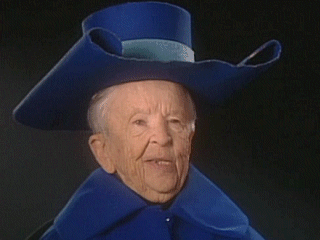 |
| Still the Coroner: Meinhardt Raabe at age 86. |
Ostensibly a factual retelling of the creation of MGM's beloved Technicolor musical The Wizard of Oz (1939), TCM's 30-minute special stands out from all the other Oz docs because of its numerous eccentricities. It's clear that the makers of Memories of Oz wanted this production to stand apart from others of its ilk, such as Jack Haley, Jr.'s reverential The Wonderful Wizard of Oz: Fifty Years of Magic (1990). While Haley's documentary is hosted by the venerable and wholesome Angela Lansbury, the most prominent celebrity guest in Memories of Oz is John Waters, director of such distinctly family-unfriendly fare as Pink Flamingos (1972) and Serial Mom (1994). Moreover, Memories displays an especially keen interest in film props, treating these objects with nearly as much care and attention as the human beings who had used them.
Without a doubt, however, the boldest decision made by the producers of Memories of Oz was to have the surviving Munchkins, by then octogenarians and nonagenarians, wear facsimiles of their whimsical, childlike costumes from the 1939 film. It is one thing to have the wizened Meinhardt Raabe, then 86, relate the story of ducklings who were accidentally dyed blue while swimming through the chemically-enhanced water on the Munchkinland set. It is something else to have him do so while wearing the ridiculously oversized, scroll-like hat he'd once donned as the Munchkin Coroner. Raabe could have been photographed while wearing a suit and tie, but someone in the chain of command at TCM felt that his anecdote would be more effective or memorable if he were wearing a costume as he told it. A producer who makes such a choice has, I would argue, left the world of "straight" documentaries and entered into the realm of surrealism.
This approach is not inherently "correct" or "incorrect." It does, however, suggest a level of authorial control that viewers may not expect from a documentary. That same sort of control, the palpable presence of a filmmaker who is micromanaging everything we see, is very much in evidence throughout The Haunted World -- and to a much greater extent than in the comparatively modest Memories of Oz. Viewers may not be comfortable with that degree of artifice in a non-fiction film. I personally was not bothered by it, since fakery is as central to the films of Ed Wood as it is to The Wizard of Oz. Movies paradoxically lie to us in order to convey certain truths.
Viewers should pay special attention to this film's title and adjust their expectations accordingly. This is not The Haunted Life of Edward D. Wood, Jr. Instead, it's The Haunted World of Edward D. Wood, Jr. There's a major difference between these two. The first (imaginary) title suggests a systematic or even scholarly biography of an individual filmmaker. The second (actual) title suggests a film that is more atmospheric and nostalgic than encyclopedic. And that's precisely what The Haunted World is.
Watching Brett Thompson's film is akin to taking a leisurely stroll through a curio shop. This is far from a definitive record of Ed Wood's existence on this earth, and it just barely serves as a historical overview of the man's film career. Instead, The Haunted World is more of a mood piece about Hollywood in the 1950s, as viewed through the filter of Ed Wood's career. At his comprehensive fan site, Ed Wood historian Philip R. Fry complains:
The focus is ... unrelentingly on Ed's classic period [of the 1950s]. Although there are shots of some of Ed's novels, and footage is shown from the filming of Orgy of the Dead, (the same footage used in [Ted Newsom's 1994 documentary] Look Back In Angora) there is very little said about [Ed Wood's] work after Plan 9. In fact, with the exception of small mentions of The Sinister Urge and Night of the Ghouls, the film completely ignores the whole of his output post Plan 9. While this approach is acceptable in something as specific as [the 1992 documentary] Flying Saucers [Over Hollywood: The Plan 9 Companion], it is shamefully shortsighted from a film that is supposed to be a full reflection on Ed.
 |
| Googie's Diner: an architectural landmark. |
The director is obviously knowledgeable about the theaters, restaurants, studios, and nightclubs of the past and discusses 1950 architecture with gusto. He spends several minutes on the DVD talking about Googie's Coffee Shop, an influential and stylish Hollywood eatery where Vampira used to hang out with her pals James Dean and Marlon Brando, i.e. the "Googie crowd."
Some of Eddie's old haunts -- such as Quality Studios, where Plan 9 was made, and the offices of Wood-Thomas Productions -- are recreated in this movie in the form of lovely and intricate miniatures, handmade by art director Gregg Lacy. (I'd love to have one of these wondrous dioramas for my own Ed Wood collection!)
Throughout the commentary, Thompson uses phrases like "faux grandeur" and "fake patina" to describe his movie, which is so formal and old-fashioned that it includes an overture, something studio movies had stopped doing decades previously. While he's a marvelous archaeologist of the semi-recent past, Brett Thompson does not strike me as an Ed Wood trivia whiz of the highest order. He struggles to identify Bride of the Monster at one point, for example, and calls that film's octopus a "squid." Furthermore, he does not challenge Bela Lugosi, Jr.'s (totally false) assertion that Ed Wood had a son, and he seems not to know what Final Curtain even was.
Ed's post-Night of the Ghouls career, meaning everything from The Sinister Urge onward, does not interest Thompson in the least, and he seems uncomfortable even discussing it. One of the panel of pop culture historians recruited for the DVD commentary inquires near the end of the track, "I want to know, whatever happened to Ed Wood?" Keep in mind, this man has just watched an entire movie about Ed Wood when he says this.
Solely on the basis of screening The Haunted World of Edward D. Wood, Jr., a viewer would have very little idea about the arc of Ed Wood's career and life. Thompson shows us the covers of Killer in Drag and Devil Girls, but he does not explain what these books are or when Eddie wrote them. And this is the only allusion to Ed's writing career you'll find in this documentary! Wood's screenwriting gigs of the 1960s and 1970s go entirely unmentioned. Likewise, some behind-the-scenes footage from Orgy of the Dead is included but not labeled in any way, verbally or textually. Orgy's director Stephen C. Apostolof, a key player in Ed Wood's life, is prominently glimpsed here but is unfortunately left anonymous.
The Haunted World breezily skips over entire decades of Eddie's life and pays little heed to the man's nearly quarter-century marriage to Kathy Wood. Why? Because these things aren't part of the story that Brett Thompson wanted to tell with his movie. It's clear that the director of The Haunted World's true passion was for the long-gone Hollywood of the mid-20th-Century, and Ed Wood provided him with a way of covering that world in a way that would be interesting and involving to modern-day viewers. This is less a documentary than it is an exhibition.
Towards the end of The Haunted World, there is a long, wordless montage in which the lights are dimmed on each of the individual witnesses, leaving them in darkness. The impression I got from this is that these folks are items on display in a gallery somewhere, encased in glass, and the security guard has turned out the lights at the end of the day. To borrow a phrase from Pulp Fiction's Vincent Vega (John Travolta), The Haunted World of Edward D. Wood, Jr. is "a wax museum with a pulse."
In two weeks: "I don't believe in thinking small, so I've got a whole slate of pictures for ya!" So said Johnny Depp when he portrayed Edward D. Wood, Jr. back in 1994. And, verily, Eddie had a "whole slate" of movies he desperately wanted to make during his lifetime but never got to because of little inconveniences like money. His graveyard of unfinished and abandoned projects is more cluttered than that of many directors.

What can we do to correct this injustice? Well, some filmmakers have taken it upon themselves to finish what Ed Wood started many decades ago. One prominent example is independent movie warrior Andre Perkowski, whose work I have already examined in a previous installment of this series. But I am too intrigued by another Perkowski title to let it slip by me. And that's why the next edition of Ed Wood Wednesdays will be devoted to (you guessed it) The Vampire's Tomb (2013).


