Showing posts with label college. Show all posts

Tuesday, September 22, 2020

Podcast Tuesday: "PKN, What Does It Mean?" or "You Dirty Frat!"

Tom Bosley and Ron Howard practice a fraternity chant as Henry Winkler looks on.

 The closest I ever got to fraternity life was watching the movie Animal House. Admittedly, that's not close. Frats never appealed to me in the slightest. I know that the Greek system has produced numerous presidents and captains of industry, but I wouldn't have lasted even a semester in one of those noisy, chaotic houses. How would I have ever gotten any reading or studying done? In fact, had I actually attended Faber College in 1962 alongside the Animal House characters, I would have hated both the snobbish Omegas and the loutish Deltas. Maybe that's why I'm neither a president nor a captain of industry today.

In contrast, Richie Cunningham (Ron Howard), the ostensible protagonist of Happy Days, is all too eager to join a fraternity in the Season 5 episode "Bye Bye, Blackball." Specifically, he wants to join Phi Kappa Nu, the same frat that his father Howard (Tom Bosley) once belonged to.  To win the approval of the sadistic, paddle-wielding upperclassmen, Richie endures all kinds of humiliating hazing rituals. To get into Phi Kappa Nu, he imitates an airplane, waddles like a duck, and even lets him get covered in feathers.

Unfortunately, the PKNs turn out to be elitist jerks who accept Richie while rejecting his friends Potsie (Anson Williams) and Ralph (Donny Most). This all leads to a dramatic showdown at Arnold's, the local teen hangout, in which Richie has to decide between his loyal pals from Jefferson High and his powerful new college companions. 

How does it all turn out? Find out in the latest installment of These Days Are Ours: A Happy Days Podcast.

Wednesday, June 19, 2019

Ed Wood Wednesdays, week 84: Ed Wood Goes to College (1974)

This week, let's put the "Ed" in "higher education."

"My school was the open road, pain and suffering my textbooks. My teachers? The gypsies and rapscallions I met along the way."
-Manny Coon

Anderson House in Washington, D.C.
There is no solid evidence to suggest that Edward D. Wood, Jr. earned any degree beyond his high school education. He likely never even finished the 12th grade. But the pre-Hollywood years of his life are still only sketchily documented at best, so it's entirely possible Ed continued his studies in some fashion after his 1942-46 stint in the military. In Rudolph Grey's Nightmare of Ecstasy, Wood's widow Kathy recalled: "He told me he went to Northwestern University in Chicago after he got out of the Marine Corps." Could this have been another of Ed's tall tales or did the director of Plan 9 from Outer Space (1959) really study at the prestigious institution?

Ed's business partner John Crawford Thomas alleged that Eddie studied writing at the Kingsmith School of the Creative Arts in Washington, D.C. and even typed the script for Crossroads of Laredo on official Kingsmith stationery. The address Thomas lists for the place—2118 Massachusetts Ave. NW—is that of the historic Anderson House, which since 1939 has been a museum and library run by the Society of the Cincinnati. Rudolph Grey's own timeline of Ed Wood's life states that in 1946, Ed studied "at Kings School of Dramatic Arts, Frank Lloyd Wright Institute, Washington, D.C." Note the subtle name change from Thomas' version of the story.

Whatever academic adventures Ed Wood may have had in his own life, higher education remained a sub-motif in his work from the 1950s to the 1970s. In Glen or Glenda (1953), for instance, Dolores Fuller's character, Barbara, is introduced as a college student with "only seven months to go" in her schooling. She is apparently studying psychology and has graduated by the end of the film, crowing, "My studies are through, college is concluded, and I'm free at last!" Not that all this education helps Barbara cope with the tricky issues of life. "The end of study is only the beginning of reality," she somberly declares. I've seen Glenda with college-age audiences, and this line tends to get appreciative howls from them.

In truth, by the way, Dolores Fuller only pursued her own education after leaving Ed Wood. In Nightmare of Ecstasy, she lists "going to college" as one of her proudest post-Wood accomplishments. Eddie, meanwhile, merely frequented a bar called the College Inn with actor Kenne Duncan and cinematographer Bill Thompson.

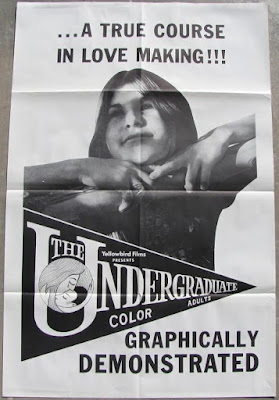
More college connections? Well, The Undergradute (1971), which Ed Wood wrote for producer Jacques Descent, takes place entirely on a college campus and consists of an explicit sex lecture given by an open-minded teacher (John Dullaghan) to his libidinous students. The Class Reunion (1972), one of Ed's many collaborations with producer-director Stephen C. Apostolof, centers around the horny alumni of "the old alma mater," who gather in a hotel for a weekend to screw, drink, and reminisce. Wood and Apostolof would have explored collegiate life further in two more films, The Basketballers and The Teachers, but neither of these scripts was ever produced.

And then there are the two collegiate-themed articles I'm covering this week, both of them from 1974. Technically, these fall under the category of non-fiction, but Ed's supposed "research" is so obviously fraudulent that I'd be willing to think of them as short stories. These are presented as true-to-life exposés, but they derive solely from the imagination of Ed Wood.
More collegiate adventures.
The stories:
  • "College Cherries," originally published in Fantastic Annual, January/February 1974. Credited to "Dick Trent." 
  • "College Interview," originally published in Cherry, vol. 3, no. 1, January/February 1974. Credited to "Ann Gora." Both of these articles were anthologized in Short Wood: Short Fiction by Edward D. Wood, Jr. (Ramble House, 2009).

Synopses:
  • "College Cherries" describes the sex lives of contemporary college students, particularly females. Girls are no longer concerned about protecting their virginity, so boys are therefore less reliant on prostitutes and homosexuality to fulfill their needs. Meanwhile, the innocent campus fads of old, such as goldfish-swallowing and panty raids, have been replaced by "pot-sex orgy parties." Girls are also much more sexually aggressive now, which is an improvement over the old days, when women entered into marriage with little to no sexual knowledge. College, the article concludes, is a time for people to experiment with as many sex partners as possible. When these young people get married, they'll know "what it's all about" in the bedroom.
  • "College Interview" presents itself as the testimony of a young woman called Dolores S., supposedly a student at "a major university." She does not believe that society will return to the puritanical ways of the past, when girls who got pregnant or even talked about sex openly were disowned by their families. Dolores says things are better now, when people can talk honestly about their sexual hang-ups. She says that sexual frustration drove people to insanity or alcoholism in the past. But no more! Dolores will do whatever she wants, including fellatio and lesbianism. Sex is out in the open, and it can't be "shoved back into the dark closet ever again."
   
Wood trademarks: "Missionary position" (again italicized, cf. "The Exterminator," "Never Look Back"); whorehouses (cf. "The Whorehouse Horror"); typing in ALL CAPS (cf. "Never Up—Never In"); phrase "what it's all about" (cf. Necromania); women's underwear (cf. Bloomer Girls); ellipses (cf. nearly all stories in Blood Splatters Quickly and Angora Fever); invention of the automobile and the airplane (cf. Glen or Glenda); disdain for puritanism (cf. Orgy of the Dead); the scourge of alcoholism (cf. Nightmare of Ecstasy); mention of the play The Blackguard (cf. The Blackguard Returns); character named Dolores (possible nod to Dolores Fuller); "medical men of science" (cf. Glen or Glenda).

Excerpts:
  • (from "College Cherries") "And of course the panty and brassiere raids of yesterday were mild events when considered with the demands of today. Simply stealing the undies isn't enough any longer. Now the boys demand getting into the places which the panties and the brassiere covered… and where the lipstick was once well painted. However there are still the collectors… such as the young fellow who brags about having more than a hundred panties in his locker… each taken from a girl he has laid… or had various forms of sex with."
  • (from "College Interview") "Now isn't it better that the whole thing is right out in the open? There certainly are fewer people going to the rubber room at the happy farm because of their sexual hang ups. Bedlam, the kookoo bin in England, might never have been necessary if the medical men and men of science started thinking with an open mind centuries ago. But they are a stubborn lot. They wanted all the knowledge so they could keep the rest of the people from finding out what a phony most of them were."
   
Dr. Alton in Glen or Glenda.
Reflections: Throughout the 1960s and 1970s, college campuses were seen as hotbeds of sexual experimentation, where students were living wild, libertine lifestyles, finally unshackled from the stifling morality of the past. Or at least that's the image of campus life consistently presented in pornography of the era. In a way, this makes sense. College kids are generally young, healthy, and of legal age. Plus, they're out on their own, living away from their parents for the first time. And students of the era were challenging social and political norms.

But the middle-aged men in the porno biz didn't really care about politics or society. They just wanted to drool over those attractive college kids having no-holds-barred, no-strings-attached sex. Sex without guilt! Sex without commitment! Sex with one partner after another!

It's interesting to me that these adult magazines had to disguise all this as supposed scientific research. Pseudo-documentary films like Glen or Glenda (1953) and The Undergraduate (1971) have been called "white coaters," since they attempt to present salacious or lewd material in a dry, educational manner. "College Cherries" and "College Interview" are the textual equivalent of "white coaters," since they're both written like news articles. In the former, Eddie even cites a bogus expert named Dr. Graham B. Balini, who insists that "Radcliffe girls think petting is dirty because it's teasing. They feel if you are going to do it, it's better just to have sexual intercourse.” Uh huh. Sure. Please do not ask for Dr. Balini's professional credentials.

It's difficult to suss out Ed Wood's true opinion of homosexuality in these articles. In "College Cherries," he writes: "Perhaps something very good has come from the sexual revolution on the campus however, because the incidents of male homosexuality has dropped considerably. When the girls were keeping the legs of their panties tight and the boys couldn’t find a whore or street girl they naturally turned to their own kind for their releases." Naturally, Ed.

In "College Interview," Dolores says that homosexuals will have no problem finding others of their kind on college campuses today, since everything is out in the open. Homosexuals existed in the past, too, "but whoever heard of homosexuality then except a few long bearded psychiatrists who turned out to be some kind of sex freak themselves?" I can't be sure, but I think Dolores is referring to Sigmund Freud here.

In all, "College Cherries" and "College Interview" are minor but interesting footnotes in the Ed Wood saga, mementos of a time when horny, aging men were obsessed with the sex lives of college students. For more nonsense in this same vein, be sure to check out College Girls (1968), a film by Stephen C. Apostolof. Neither Ed nor Steve knew a damned thing about youth culture or college life, but that didn't even slow them down!

Tuesday, July 1, 2014

One Song at a Time: "I Only Want You"

The Passions, a lesser-known but worthwhile doo-wop group.

The song: "I Only Want You"
Artist: The Passions
Released: 1960

Soundtrack to a college crush.
During all my years of schooling, an era of my life I tried to prolong indefinitely so as to avoid entry into the dreaded "real world," I only ever had one crush on a teacher. 

It was one of my college professors, a woman who taught courses on Spanish literature and culture. If you follow any particular major or minor long enough, you'll eventually have the same profs over and over again, and she was repeatedly one of mine. To maintain propriety, I'll avoid naming her or the institute of higher learning for which she still works. 

Let me cut you off at the pass by pointing out that she wasn't the busty, provocatively-dressed "Hot for Teacher"-type seductress you're likely picturing. No short skirts, plunging necklines, stilettos, or fishnet stockings here. Instead, this professor was a modest, sensibly-dressed brunette with a soft voice and a mildly nerdy vibe. I can never be sure why exactly I developed such a crush on her, but looking at her picture in the college's staff directory still makes my heart flutter to this day. 

Every crush needs a musical soundtrack, I feel, and for this one I chose classic doo-wop, in particular a track from 1960 called "I Only Want You" by The Passions. I discovered it on a Rhino Records compilation and loved it immediately, playing it over and over. AllMusic describes The Passions as "an above-average white doo-wop ensemble from Brooklyn." Apparently, they recorded for a few years, starting in the late 1950s, but never quite made it. 

This particular tune wasn't even one of their bigger hits, but it got my attention anyway. What was it that first caught my fancy? Was it the lopsided drum part, which emphasizes the second and fourth beats of each measure rather than the first and third, sounding like a pirate with a peg-leg running through a steel corridor? Maybe it was the descending pizzicato strings that "answer" the lead singer after every line of the verses? 

Probably it's just the unabashed erotic yearning of the lyrics, i.e. the fact that the guy in the song is just so consumed with lust for some young lady "every waking hour, every minute of the day." This poor dope can't even get a break when he falls asleep: "Even in my dreams, you are there it seems/I can always see your face." It reminds me of a line from Just Jaeckin's Emmanuelle (1974): "Real love is erection, not orgasm." That's the essence of "I Only Want You." It's the perfect combination of harmony and hard-on.

This is the second episode of this proposed series. I've changed the title from "Best Song Ever" to "One Song at a Time" to emphasize that this is basically an autobiography in the form of record reviews.

Friday, November 8, 2013

Mill Creek comedy classics, #63: "Zis Boom Bah" (1941)

"Cute, clever, and collegiate!": Zis Boom Bah was the Animal House of its day, I guess.

The flick: Zis Boom Bah (Monogram Pictures, 1941) [buy the set]

Current IMDb rating: 4.8

Director: William Nigh (A Bride for Henry)

Peter Loves Mary.
Actors of note:
  • Peter Lind Hayes (son of Grace Hayes; movies include The 5,000 Fingers of Dr. T)
  • Mary Healy (married to Peter Lind Hayes for 58 years; was also in The 5,000 Fingers of Dr. T; she and her husband had a sitcom together called Peter Loves Mary in 1960-1961)
  • Huntz Hall (one of the Bowery Boys/East Side Kids for 20 years; movies include Angels with Dirty Faces; is next to Bob Dylan on the Beatles' Sgt. Pepper album cover)
  • Benny Rubin (57-year career in film and TV includes everything from Citizen Kane to Kolchak: The Night Stalker; was a regular on TV's The Jack Benny Program; did some screenwriting and songwriting, too)
  • "Skeets" Gallagher (another former vaudevillian; lengthy film career included a role as the White Rabbit in the 1933 version of Alice in Wonderland)
  • Frank Elliott (A Funny Thing Happened on the Way to the Forum, Life with Father)

Benny Rubin
The gist of it: Successful singer Grace (Grace Hayes) is playing sold-out shows in New York, but she longs to be near her now-grown son, Peter (Peter Lind Hayes), whom she had given up many years earlier. Grace allowed Peter to be raised by his upper-class paternal grandfather, Mr. Kendrick (Elliott), in the hopes that the lad would grow up to be sophisticated and cultured, but instead he's become a spoiled, attention-seeking jerk. Worse yet, Kendrick is now almost broke, and Grace has to pick up the tab for Peter's education. As long as she's paying the bills, she wants to keep a close eye on her investment.

Grace and her assistant, Mary (Mary Healy), thus travel to Midwick College, the school her son now attends. Peter doesn't know Grace is his mother and is smart-alecky and rude to her when they meet, though he quickly takes a shine to Mary and blatantly hits on her. In order to set Peter straight, Grace cuts off his allowance. Suddenly without funds, Peter has to sell his car and get a job. Luckily for him, Grace buys the local malt shop where all the kids hang out, turns it into a nightclub, and hires Peter and all his friends (including Hall) to sing and dance there. It's a smash success, and even the malt shop's bewildered former owner, Nick (Rubin), gets in on the fun.

Meanwhile, in a subplot running through the whole movie, Grace romances the college's embattled president, Professor Warren (Gallagher), a sweet but befuddled old coot who is in danger of losing his job because the school's football team is so bad. Luckily, for reasons I didn't quite understand, the team miraculously improves and wins the conference.

Grace Hayes casts a pall over Zis Boom Bah.
My take: Sometimes, readers, you encounter a movie so perversely miscalculated that you have to wonder what its makers could possibly have been thinking. Such a film is Zis Boom Bah.

Never mind that Monogram Pictures obviously cut corners at every stage of production, resulting in a chintzy and unconvincing final product. Never mind that the jokes in the script were already old by 1941... and had never been funny to begin with. Never mind that the songs range from bland at best to utterly moronic at worst. Never mind that the college students in this movie all appear to be in their 40s. (According to the IMDb, at least one of them was.) Never mind that the romantic leads, real-life newlyweds Peter Lind Hayes and Mary Healy, generate no sparks whatsoever onscreen.

You can set all of these problems -- vexing though they are -- aside.

What I really want to know is this: if Monogram wanted to produce a light, fun musical-comedy set on a college campus, why would they choose to build it around an embittered, obviously depressed, middle-aged chanteuse like Grace Hayes? She was 46 at the time of this film but looks at least ten years older and acts at least twenty years older.

It's one thing for Hayes' character to show concern for the well-being of her son, but the actress brings an inappropriate heaviness to her scenes, moping and sulking as if she's in a tragedy rather than a comedy. This is Zis Boom Bah, Grace, not Death of a Salesman. Lighten up! She's in almost every scene, clad in funereal black outfits no less, and her performance is totally at odds with the rest of the production! Here you have Benny Rubin doing vaudeville-style "dialect" humor and Huntz Hall playing another wisecracking doofus, and Grace looks like she's about to slit her wrists at any moment.

This movie never had a chance of being any damned good, but it didn't have to be such a downer.

Is it funny: Well, that's a toughie. You see, this movie is kind of a miracle insofar as every single joke in it, right down to the smallest bit of comedic business, fails completely and embarrassingly. Peter Lind Hayes, for instance, gets a few minutes to do his impersonations of famous movie stars (Charles Laughton, Charles Boyer, etc.), and it plays like a dreadful amateur act that would have lasted about 20 seconds on The Gong Show unless the panelists were drunk enough to be in a very charitable mood.

But Hayes is not alone. Everybody gets a chance to fail at being funny in Zis Boom Bah. Benny Rubin's character, Nick, speaks broken English in a thick foreign accent and struggles to fill Grace's order for a gin sling. He laments: "Gin sling... it sound like a Chinaman." See? Not funny. Later on, Nick gets into a seemingly endless bit about seltzer water with another customer. End result: not funny. Huntz Hall sings a song about Army life, which apparently involves getting up very early and doing what you're told to do. Grand total: not funny. Grace mistakes Professor Warren for a gardener because the first time she sees him, he's working in a garden. Survey says: not funny. That's a lot of unfunny for one movie.

And yet, I laughed quite a bit during Zis Boom Bah. The movie is so pitiful, so misguided, so pathetic that I could not help myself. I was laughing at the film instead of with it, but a laugh's a laugh, right? The funniest thing in the movie is probably the gigantic, feathery hat that Grace Hayes wears during the opening sequence in New York. It must be seen to be appreciated.

That whole section of the film, played entirely straight, is a laugh riot. Grace's name appears on a Broadway marquee by use of a terrible, cheap-looking optical effect. Her performance itself consists of shots of the actress standing in front of a curtain intercut with stock footage of an audience in formal wear. She sings a few bars of a draggy, boring song, then sloughs off stage. The audience, of course, is thrilled by this. Maybe they're applauding her hat.

By the way, here is how to make a gin sling.

My grade: D+

P.S. - The character of Nick is obviously intended as an ethnic stereotype of some kind or another, but I could not pin down the nationality. Greek, I guess?

Monday, November 21, 2011

(today's zomby) AND MY LONGSTANDING GRUDGE AGAINST BILLY SQUIER!


So what do I have against Billy Squier? Simply this:

When I was in college, I had a roommate who was an unabashed Squier fan. In particular, he was enamored of Squier's biggest hit, "The Stroke," and would play it at a troubling volume at especially inconvenient times -- like early in the morning or after midnight on a school night. To this day, I can still remember the thunderous sound of "The Stroke" reverberating off the hopeless cinder-block walls of our dorm, and that memory still fills me with dread. Not one for confrontation, I passively enabled this unacceptable behavior. This same roommate was also quite fond of the television show Friends, and his enthusiasm was such that he would periodically inform me throughout the week how many days were left until the next new episode. ("Only two more days til Friends," he might say.) When the episodes themselves actually aired on Thursday nights, my roommate would watch them with the sound at a very low volume or turned off completely. He created his own soundtrack for the show by playing his stereo very loudly while commenting on the physical attributes of the actresses onscreen. Naturally, "The Stroke" was in heavy rotation during Friends.

If you would like to recreate my college dorm experience in the comfort of your own home, simply play the following two clips simultaneously. Mute the Friends clip and turn Billy Squier all the way up.