Showing posts with label Bela Lugosi. Show all posts

Wednesday, November 26, 2025

Ed Wood Wednesdays, week 252: Additional thoughts on Bela Lugosi's appearance in Plan 9

We know Bela Lugosi appears in Plan 9. But how did that footage get there?

As Americans prepare to travel and reunite with loved ones for the Thanksgiving holiday, I thought I'd share some feedback I received about last week's article. If you'll recall, I prepared an alternate cut of Ed Wood's notorious sci-fi/horror hybrid Plan 9 from Outer Space (1957) that only includes the silent footage of actor Bela Lugosi (1882-1956). The legendary Hungarian actor famously died before the movie was ever completed, and Plan 9 was somewhat deceptively marketed as his farewell performance. I challenged my readers to consider what they might have done with this footage if they'd been in Ed Wood's high-heeled shoes.

Wednesday, November 19, 2025

Ed Wood Wednesdays, week 251: The last footage of Bela Lugosi

A scowling Bela Lugosi made his last onscreen appearance in Plan 9.

It's one of the most famous anecdotes in the life of Edward D. Wood, Jr. It could even be the linchpin of the entire Wood saga, the source of much of Eddie's mystique. According to legend, the director took a few minutes of footage of a dead actor and built a whole movie around it—not just any movie, either, but an infamous movie! If you've seen the Tim Burton-directed biopic from 1994, it's a story you already know well. But how much of it is the truth? Let's talk about it.

"This is the acorn."
When legendary Hungarian actor Bela Lugosi died in August 1956 at the age of 73, director Ed Wood was devastated. Not only had he lost a good friend, he'd lost his leading man. Bela had starred in Glen or Glenda (1953) and Bride of the Monster (1955) for Eddie and was supposed to star in numerous upcoming Wood productions, like The Ghoul Goes West and The Vampire's Tomb. Now those plans were permanently canceled.

But Eddie had an ace up his sleeve: a reel of silent test footage he'd shot of Bela Lugosi shortly before the great man's death. Sure, it was only a few minutes of film and it didn't really tell much of a story, but Ed Wood still felt it could be the starting point for a feature-length motion picture. As Johnny Depp puts it in the Tim Burton film: "This is the acorn that will grow a great oak." Eddie's plan was to film a bunch of new scenes and extend Bela's role through the use of a carefully-disguised body double. 

The amazing thing is that Ed Wood actually carried out this seemingly insane plan. The result was a completely bonkers sci-fi/horror hybrid called Graverobbers from Outer Space, which premiered in Hollywood on March 15, 1957. It was later retitled Plan 9 from Outer Space and eventually gained a reputation as the worst movie ever made, thanks to coverage in various sci-fi/horror fan magazines and the book The Golden Turkey Awards (1980). It is, hands down, the most famous project Ed Wood was ever involved in.

Wednesday, March 5, 2025

Ed Wood Wednesdays, week 218: What motivates Bela Lugosi's character in Plan 9?

Never is a long time, as Bela Lugosi proves in Plan 9 from Outer Space (1957).

When I think about the movies I've seen the most times, a few titles come immediately to mind, including The Wizard of Oz (1939), Monty Python and the Holy Grail (1975), The Rocky Horror Picture Show (1975), This is Spinal Tap (1984), and The Big Lebowski (1998). Among Ed Wood's movies, however, the clear winner is Plan 9 from Outer Space aka Graverobbers from Outer Space (1957). I first sat through this notorious sci-fi horror chiller in October 1992 as part of a four-film Ed Wood marathon in Flint, Michigan. Since then, I've probably seen Plan 9 theatrically about a half-dozen more times. At home—through VHS, DVD, Blu-ray, and streaming—I've screened it dozens of times in whole or in part, often while doing research for this series.

In short, I've spent many hours of my life with this odd little film. And yet, all these decades later, it may still have things to teach me. I'll give you an example.

Critic Harry Medved, who helped give both Ed Wood and Plan 9 from Outer Space some measure of immortality with his book The Golden Turkey Awards (1980), recently devoted an episode of his PBS documentary series Locationland to the making of Plan 9. Among the filming sites Medved visited was 15129 Lakewood St. in the Sylmar neighborhood of Los Angeles. Back in the 1950s, this charming domicile was the residence of actor-wrestler Tor Johnson, who played Inspector Daniel Clay in the film. Johnson allowed Ed Wood to use the site as the home of Bela Lugosi's unnamed character, generally referred to as Old Man or Ghoul Man. In Plan 9, we see a grief-stricken Lugosi—still reeling from the death of his young wife (Vampira)—smelling the roses outside the house before wandering into traffic and getting run over.

"Confused by his great loss," intones narrator Criswell, "the old man left that home, never to return again."

Except Lugosi totally returns again just 23 minutes later, as proven by that aforementioned episode of Locationland. When Harry Medved visited the house in Sylmar, the owner graciously let him film the outside. But Medved and his guest, comedian and writer Dana Gould, wanted to film the back porch of the house as well, because this is where Ed Wood shot the scene in which Bela's character, having been resurrected from the grave as a zombie, enters his former home, now owned by pilot Jeff Trent (Gregory Walcott) and his wife Paula (Mona McKinnon). Jeff's away when Bela arrives, so Paula is all by herself and quite vulnerable when this strange figure suddenly appears in her bedroom.

Even though I've been watching Plan 9 for decades, it took Locationland to make me realize that the Trents are living in Lugosi's character's former home and must have moved into the place shortly after he died. Jeff's coworker, sassy stewardess Edie (Norma McCarty), comments that the house is too close to the local cemetery, "I tried to get you kids to not buy too near one of those things," she opines. "We get there soon enough as it is." She also says Jeff's house is "quiet alright, like a tomb." Jeff is rightfully concerned that the police keep showing up at the cemetery for unknown reasons. What exactly is going on there?

We soon find out what's happening at that cemetery, and it's more bizarre than we could have possibly guessed. Aliens from a faraway planet, represented by the arrogant Eros (Dudley Manlove) and the more pragmatic Tanna (Joanna Lee), are using their "electrode guns" to resurrect some recently deceased earthlings, including both Lugosi and Lugosi's wife. This is all part of a larger campaign to strike fear in the hearts of the human race and thus deter us from creating a weapon called "Solaronite" that will destroy the entire universe. Got all that? 

The aliens' plan is quite convoluted and doesn't come close to working. But they do manage to bring Lugosi back to "simulated life" for a short while. Once resurrected, he is more like a traditional obedient "voodoo zombie" rather than the cannibalistic, aggressive zombies we know from the George Romero films, starting with Night of the Living Dead (1968). Eros and Tanna can control the zombies to some extent, but Lugosi is apparently allowed to explore the world on his own for a while when he's revived. And where does he choose to go first? Right back to his old house.

Wednesday, January 1, 2025

Ed Wood Wednesdays, week 209: Ed and Bela ring in the new year

This kid knows how to have a good time, obviously.

Is New Year's Eve a big deal for you? It isn't for me. Neither is New Year's Day, though I'm happy to get some time off work for it. I've just never been big on celebrating the start of another year or lamenting the end of the previous one. Neither one means a thing to me.

Maybe it's because I don't drink. But you know who did? Edward D. Wood, Jr. I'm sure Eddie had a few eventful December 31sts along the way. Somehow, though, the holiday doesn't play a major role in his films or his writing as far as I can tell. The one major exception that comes to mind is an anecdote Ed included in his posthumously-published manifesto Hollywood Rat Race (1998). Today, I thought I'd share that anecdote in its entirety.

A little context: It's December 1953, and Eddie is trying to revive the career of his friend, actor Bela Lugosi. Putting the frail, 71-year-old actor in a play would be too demanding, Ed decides, so the best strategy will be for Bela to make personal appearances and meet his fans. But where? Well, I think I'll let Eddie take over the story from here.

Happy New Year, everybody!

Wednesday, October 9, 2024

Ed Wood's Warm Angora Wishes: "Appendix: The Correspondence of Ed Wood and Bela Lugosi"

Ed Wood was a man of letters. Many of them.
NOTE: This article concludes my coverage of Ed Wood's Warm Angora Wishes and Rubber Octopus Dreams (Arcane Shadows Press, 2024).
The story: "Appendix" by Frank Dello Stritto and Edward D. Wood, Jr.

Synopsis: Circa April 1973, author Frank Dello Stritto visited the Ackermansion, the Los Angeles home of Famous Monsters of Filmland editor Forrest J. Ackerman. While there, he found some old letters that had been written by Ed Wood in March 1954, most of them addressed to actor Bela Lugosi. Dello Stritto meticulously dictated them into a tape recorder, then transcribed the recordings when he got home to New Jersey. What follows are nine of those letters.

Edwin Schallert.
March 1, 1954: Ed is trying to secure work for Bela, who is headlining a revue at the Silver Slipper in Las Vegas. During a recent work trip to Vegas, Ed managed to run up a bill of $300, which amounts to over $3,000 in today's money. Bela is now obligated to pay most of this, with Ed contributing $48 of his own money. Ed disputes the bill and says it is very important to him that people know he is not trying to take advantage of Bela in any way, financially or otherwise. Eddie Fox, the publicity director for the Silver Slipper, is in Los Angeles to meet with a talent agent named Lou Sherrill. Ed says he will meet with Eddie Fox to discuss the matter personally, and he chastises Bela for mentioning the money dispute to Lou Sherrill. ("You could have come to me first.")

Meanwhile, Ed is convinced that the upcoming film The Bowery Boys Meet the Monsters (1954) will be "a hell of a lift" for Lugosi's career. He imagines the news stories it will generate, bringing attention to both Lugosi and the Silver Slipper. Furthermore, Ed says that Lou Sherrill has an idea for a new nightclub act starring Bela. Ed tells Bela that the actor's comeback is in full swing and that more triumphs lie ahead. As an example, Ed says he is talking to Los Angeles Times writer Edwin Schallert, who is planning a big article about Bela Lugosi. Schallert is headed to Vegas to review actor Howard Keel's show, and he will be swinging by the Silver Slipper to check out Bela's revue.

Ed warns Bela not to get taken by all the "sharpies" in Las Vegas. Ed says that, when he was there on business, he kept track of every expense he incurred. Bela should not pay for anything that Ed did not account for personally. He worries that he now looks bad in the eyes of Lou Sherrill. Ed stresses that Bela needs to tell Lou this was all a misunderstanding and that Ed is not a conman or a parasite.

Ed then returns to the subject of the Bowery Boys movie. Ed tells Bela not to worry about learning all the dialogue in the script. "We'll get it this time," he says. Ed claims to have a three-picture deal with Howco and declares that at least one of these films will be a star vehicle for Bela. According to Ed, horror films are enjoying newfound popularity at the moment; he points to some 3D films from Universal and Warner Bros. as examples. Bela's new film should fit right in. Eddie closes the letter by rehashing the matter of the $300 bill and emphasizing that he is being honest and scrupulous in his dealings with Bela.

March 5, 1954: Several days later, Ed responds to a "seven-point note" from Lugosi. Ed says that Schallert's story has not been printed yet. When it is, Ed will buy ten copies and send five to Lou Sherrill. Ed also thanks Bela for explaining the previous awkward situation to Lou via telegram. ("His attitude changed for the better almost immediately.")

Ed says that "the troubles on my picture [presumably 1954's Jail Bait] have ended," meaning that he will now be able to pay his previous debt to Bela. On the other hand, producer George Weiss says that Ed and Bela's previous film, Glen or Glenda (1953), has not turned a profit yet.  Ed is dubious of this, because Weiss has managed to pay off $1,000 in debts since it opened and Ed is owed 50% of the take. Ed further claims he has two more films in the works and thinks he can get Bela $5,000 for ten days of work. Ed will be producing Bela's movie for Monogram and will decide who gets paid what.

Ed mentions some press clippings that Bela has sent him. Ed says he forwarded these to Alex Gordon for preservation. Ed also congratulates Bela on extending his Vegas show another two weeks and says that it will not be difficult to line up some film work for the veteran actor now. He boasts that, between himself and Lou Sherrill, Bela now has "two good men on [his] side." Ed closes the letter by promising to write again soon. He also asks about some "collars" and some publicity photos.

Saturday, September 28, 2024

Ed Wood's Warm Angora Wishes: "Ed Wood and the Vampire"

Vampire! Vampire! Lemon! So close and yet...
NOTE: This article continues my coverage of Ed Wood's Warm Angora Wishes and Rubber Octopus Dreams (Arcane Shadows Press, 2024).
The story: "Ed Wood and the Vampire" by Danielle DeVor

Synopsis: It is 1955, and director Ed Wood is on a years-long quest to make a movie starring an actual vampire. He once thought actor Bela Lugosi made such a convincing onscreen Dracula because he was the genuine article, but Bela proved to be all too human. So Ed's quest continues. Ed's girlfriend Dolores says this is all a waste of time and storms out on him. Undeterred, Ed continues to make notes in his little green book. He's determined to keep track of every prominent actor to play Count Dracula in the hopes that one of them will be a genuine vampire.

A disappointment to Ed.
By 1958, a new actor from England named Christopher Lee is portraying the famous bloodsucker, so Eddie travels to Milwaukee to attend the premiere of Hammer's Horror of Dracula. Unfortunately, none of the actors from the film is in attendance that night. In New York, at a gala showing of the film, Eddie is unable to get anywhere near Christopher Lee, but he still determines that Lee is not a real vampire. Too healthy looking. Ed's wife Kathy also thinks this quest is foolish, but Eddie is more driven than ever.

In 1966, Eddie reluctantly attends a screening of Billy the Kid vs. Dracula to see John Carradine as the count. To his disappointment, the film is a "farce," and Carradine is clearly no vampire. The pickings get slim until 1974 when Jack Palance portrays Dracula in a made-for-TV movie. By this time, Eddie's personal fortunes have dwindled, forcing him to live in a "grimy" apartment. That same year, Ed Wood attends a screening of Blood for Dracula starring Udo Kier in the title role. This film, however, is mere pornography. Three years later, Louis Jourdan stars in another made-for-TV adaptation of the Bram Stoker novel. Despite the faithfulness to the source material, Eddie is far from convinced that Jourdan is a vampire.

The story ends in late 1978. Ed Wood has been evicted from his Yucca Street apartment. (His death goes unmentioned.) A disgruntled landlord throws Eddie's possessions into the trash, including that green notebook Ed had been keeping since the '50s. It is picked up by a genuine vampire who happens to be passing by.

Excerpt:
He'd looked for clues far and wide, and soon, there had been buzz about a new vampire on the block. One from England. As soon as he spied Christopher Lee, he had that feeling again. Could this be a real vampire hiding in plain sight? There was presence. Pizazz. Kathy thought he was nuts for travelling all the way to Milwaukee for the premiere, but he couldn't let this go.

Reflections: Some of the authors who contributed stories to Warm Angora Wishes are people I already knew well from the Ed Wood fan community, but many are writers I've never heard of until right now. One example of the latter is authoress Danielle DeVor, who has written numerous fantasy and horror novels, including some romances, but has been off my radar thus far. I'm not certain if she'd been an Ed Wood fan before this project or if the editor approached her because of her other, similarly-themed books.

Either way, DeVor brings a perspective to this material that I don't think I've seen from other authors. The Ed Wood in this story is not one I fully recognized, so it was almost like having a new character to play with. The story's chief conceit is that Eddie is seeking a real vampire in order to make a movie with him. Over the course of two decades, this quest takes over—and even defines—his life. He's like some Bizarro World version of Van Helsing who seeks to glorify, rather than kill, Dracula.

DeVor's Ed Wood seems to have a different set of aesthetic standards than the Ed I know. This one turns up his nose at Billy the Kid vs. Dracula (1966) and later scoffs at the idea of Western actor Jack Palance playing the character on TV. "What was this about cowboys and vampires?" DeVor writes. "This was some type of weird obsession with some people he didn't understand." In real life, Eddie was as obsessed with cowboy films as he was with horror films and famously tried and failed to get a Western/horror hybrid called The Ghoul Goes West made. And the idea of pairing Dracula with Billy the Kid is one I think would have appealed to Ed quite a bit.

Then, in 1974, Ed Wood attends a screening of Paul Morrissey's Blood for Dracula (1974)—which I assume was still being marketed as Andy Warhol's Dracula back then—and has this puzzling reaction:
He shouldn’t have wasted his time or the money. He didn’t expect to see a porn instead of a horror film. Not that he was against porn at all, but it surprised him. He’d never thought of meshing Dracula with pornography, but it would work. And it did, in an odd kind of way.
I've heard that the world has become more prudish in recent years, but I didn't think I'd see the day when Blood for Dracula was described as "porn." Yes, it has a few nude scenes and a smattering of simulated sex, but that accounts for a relatively small percentage of its run time. Is that what people think porn is nowadays? Anything with nudity or onscreen sex? Is Don't Look Now (1973) porn? How about Something Wild (1986) or Body Heat (1981)? How did TV series like True Blood (2008-2014) and Game of Thrones (2011-2019) sneak by us without getting labeled "porn"? They're both much more explicit than Morrissey's film. Besides, Ed Wood worked extensively in both softcore and hardcore pornography in the 1960s and '70s. By his standards, Blood for Dracula could be considered almost Victorian in its restraint. 

As for "meshing Dracula with pornography," that phrase neatly summarizes much of Ed's fiction. In his novels and short stories, he combined horror and erotica over and over again—often in ways that are much more graphic than Blood for Dracula. Ed Wood is so closely identified with erotic horror that the novel The Adult Version of Dracula (1970) has commonly been attributed to him. Whether the attribution is correct is a matter of debate, but Ed was the kind of writer who conceivably could have written such a book. Eddie even went out of his way to mention both Bela Lugosi and Dracula in his pornographic feature film Necromania (1971).

It's possible that the Ed Wood in this story is not the Ed Wood we know from history, just a fictional character with the same name and a vaguely similar career path. The one in this story doesn't seem to be a cross-dresser, nor is he a prolific writer. He makes films and hunts Dracula. That's it. In fact, DeVor's character spends more time chasing after vampires than he does making movies. Speaking of which, none of Eddie's films is named in this story, and neither Dolores nor Kathy is given a last name. While I assume they're Dolores Fuller and Kathy Wood, I can't say that with 100% certainty. 

The Ed Wood in this story seems to be on a downward career path and ends up being evicted from his Yucca St. apartment in the late '70s, all of which happened to the real Ed Wood. DeVor's Ed Wood also drinks a bit, but he's not a late-stage alcoholic shuffling down to the liquor store to cash his meager paycheck the way the real Eddie was. DeVor's character even drinks Wild Turkey, which probably would have been out of the real Ed Wood's price range. Compared to the real man with whom he shares a name, the Ed Wood of this story is living in luxury.

P.S. If this story appeals to you, I highly recommend this Cinemassacre video that compares all the screen versions of Bram Stoker's Dracula

Wednesday, August 21, 2024

Ed Wood's Warm Angora Wishes: "Plan One from Poughkeepsie"

Bela Lugosi and the Hindenburg both had an impact on Ed Wood's childhood.
NOTE: This article continues my coverage of Ed Wood's Warm Angora Wishes and Rubber Octopus Dreams (Arcane Shadows Press, 2024).
The story: "Plan One from Poughkeepsie" by Frank Dello Stritto

Synopsis: December 1936, Poughkeepsie, New York. Edward D. Wood, Jr., 12 years of age, skips school to attend a showing of The Invisible Ray starring Boris Karloff and Bela Lugosi. The truant officer catches him and reports him to his parents. Apparently, Eddie does this kind of thing frequently, much to his father's chagrin. Nevertheless, on Christmas Day, Eddie's parents give him his own 8mm movie camera, a Kodak Cine Special. Junior stores this treasured gift in the same closet where he keeps the dress that his mother gave him. 

A Bela Lugosi serial.
During that same Christmas break, Eddie sees the final chapter of a Bela Lugosi serial called Shadow of Chinatown (1936). The ending is a dud, but this is how the budding filmmaker learns about stock footage. He dreams of making a combination horror film and Western starring his idol, Buck Jones. Has anyone done that before, he wonders?

May 1937. Junior has been struggling to learn how to use his new camera, and some of his precious, expensive footage has been overexposed. But he does manage to film the Hindenburg as it flies overhead. Later, over the radio, he hears that the famed German airship has burst into flames. He makes sure to take good care of the film he shot.

December 1937. Eddie, now 13, watches another Lugosi serial called SOS Coast Guard at the local movie theater with his friends. The only part he likes is how Lugosi's villainous character is killed alongside his giant sidekick, Thorg. He also sees a newsreel about the Hindenburg and remembers the footage he has stashed away in his closet. He shows the film at school, where it makes a big hit with his classmates. This is the moment when he decides he wants to be a filmmaker when he grows up. Again, he carefully stashes the film in the closet at home alongside his favorite dress.

December 1939. Two years have passed, and Eddie is still watching Bela Lugosi serials. This time, it's The Phantom Creeps, with Bela as a mad scientist with a killer robot. Eddie is shocked and thrilled when the film uses a clip of the Hindenburg flying over what might be Poughkeepsie. Eddie is again impressed by the clever use of stock footage and vows to make his own movies someday.

Excerpt:
Junior and his friends sat in the theatre. He told them about an Amazing Story that he had just read. A mad doctor was trying to create a race of supermen. Then the boys ran through the plot of the serial whose first 11 chapters they had seen. The last chapter would start in a few moments. The houselights dimmed.
Reflections: It had never occurred to me to compare Ed Wood to Jean Shepherd, but "Plan One from Poughkeepsie" reads like an alternate universe version of A Christmas Story (1983). Imagine Ed Wood as Ralphie, pining for a Kodak Cine Special instead of a Red Ryder BB gun, with cantankerous but lovable Ed Wood, Sr. as the Old Man, Lillian Wood as Mrs. Parker, and Eddie's little brother Bill as Randy Parker. 

In this short story, much of which takes place at Christmas, young Eddie is inspired by the same things that inspire Ralphie: comic books, radio shows, and cowboy films. Since Ed Wood and Jean Shepherd were born just a few years apart (1924 and 1921, respectively), it stands to reason they had similar experiences growing up in America. I'd imagine, however, that if young Eddie got a fuzzy pink bunny suit for Christmas, he would secretly love it.

"Plan One from Poughkeepsie" is Frank Dello Stritto's imagining of what Ed Wood's childhood in 1930s Poughkeepsie was like. As the author admits in the story's prologue, he's really piecing this narrative together from the few scraps of information we have about Ed's adolescence. And since Eddie had such a tenuous relationship with reality, who knows how much of this actually happened? All we can do is guess. It's to Dello Stritto's credit that "Plan One" is plausible. It may or may not be accurate, but it seems like it could be. It has the ring of truth to it.

Wednesday, June 28, 2023

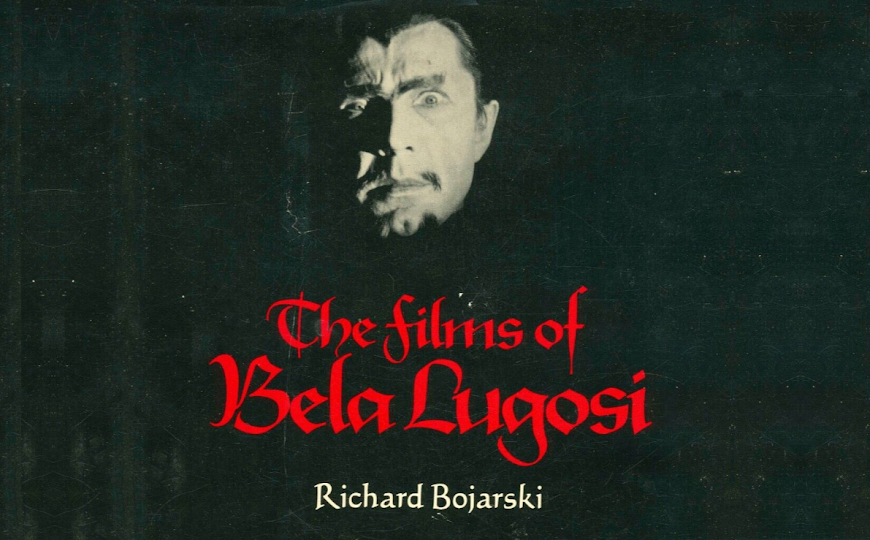
Ed Wood Wednesdays, week 156: The Films of Bela Lugosi (1980)

Toward the end of his life, Ed Wood contributed material to this book.

People may compare Ed Wood and his misfit cronies to the characters in Nathanael West's Hollywood-set novel The Day of the Locust (1939), but Eddie's life actually reminds me of another Nathanael West novel: A Cool Million (1934). That darkly comedic book tells the story of Lemuel Pitkin, an industrious young lad from Vermont who ventures from his quaint hometown of Ottsville into the wider world to seek his fortune. Not only does poor Lemuel not find his fortune, alas, he keeps losing body parts during his various misadventures. By the end of the book, he's missing his teeth, his scalp, his thumb, an eye, and a leg. But even then, Lemuel's brave, foolish optimism has not entirely left him. (And it probably should have.)

There's a certain hapless, Pitkin-esque quality to Ed Wood, who wound up a penniless, toothless, washed-up alcoholic living in one of the worst apartment buildings in Hollywood and yet still had big dreams for the future and fond memories of the past. Just check out this letter, excerpted in Nightmare of Ecstasy (1992), that Eddie wrote to author Richard Bojarski in March 1978, just nine months before Ed died:
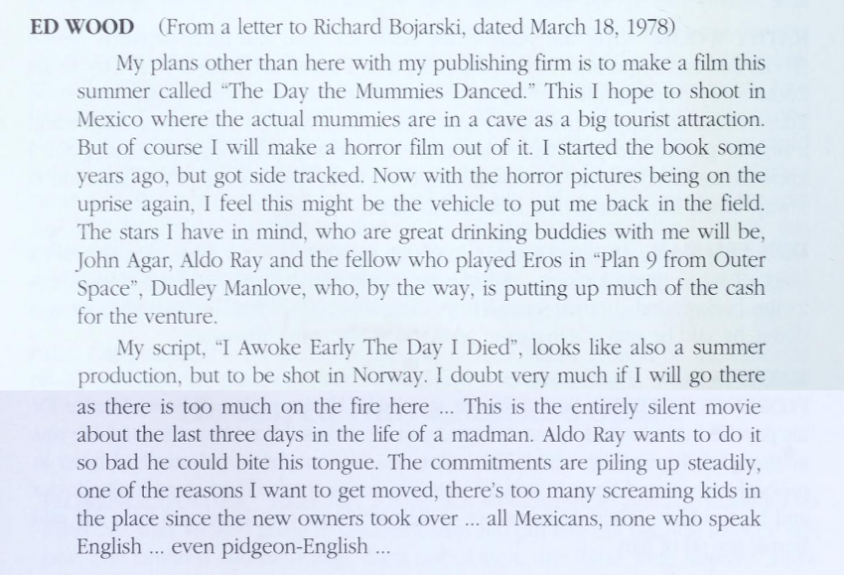
"Too much on the fire."

Breaks your heart, doesn't it? Ed's talking about productions in both Norway and Mexico, and he can't even pay his rent in good old Los Angeles. I Awoke Early did eventually get filmed, but not until Eddie was in his grave. The Day the Mummies Danced, meanwhile, is still waiting for its day in the sun.

Richard "Bojak" Bojarski (1934-2009) was a writer and cartoonist from New York who specialized in classic horror history. His work appeared in magazines like Castle of Frankenstein and The Monster Times, and he published at least two full-length books: The Films of Boris Karloff (1974) and its natural sequel, The Films of Bela Lugosi (aka The Complete Films of Bela Lugosi) (1980). Bojarski got into contact with Ed Wood while researching the latter. Nightmare of Ecstasy includes an amusing/alarming anecdote about the epic meeting of Bojarski and Wood.
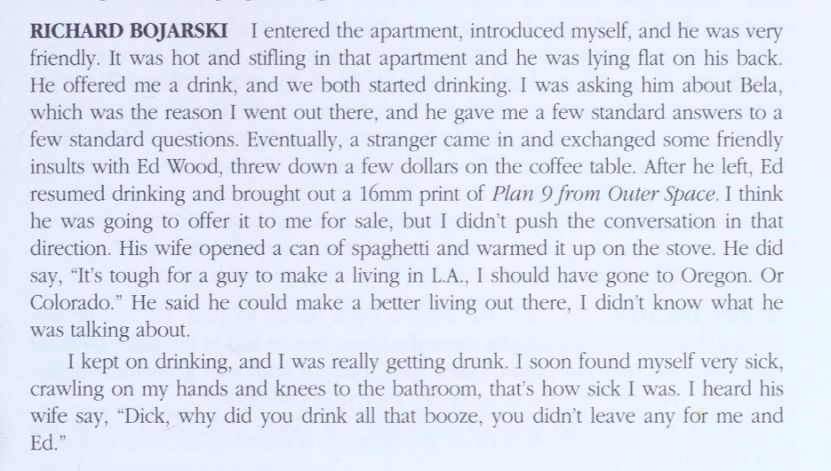
"I didn't know what he was talking about."

Sadly, Ed Wood did not live to see the publication of The Films of Bela Lugosi, which I'm sure he would've gotten a kick out of. Nevertheless, Bojarski graciously includes Ed's name in the acknowledgements at the front of the book. (Also thanked: Conrad Brooks, Paul Marco, Alex Gordon, and Mona McKinnon. Woodites aplenty!)

The book is not a biography of Bela Lugosi, per se, but it does include a 33-page biographical section—think of it as a sketch of Mr. Lugosi rather than a portrait—as well as an affectionate introduction by Lugosi's Mark of the Vampire (1934) costar, Caroll Borland. The main body of the book is an illustrated and annotated filmography, with each of Bela's films from Dracula (1931) to Plan 9 from Outer Space (1957) receiving a few pages apiece. For each movie, we get an assortment of B&W photographs, a rudimentary cast and crew list, quotes from reviews, and a few paragraphs of critical and historical commentary from Bojarski himself. (I'd have appreciated synopses of the films, but no dice.) For the sake of completeness, the author also includes an index of Bela Lugosi's pre-Dracula films, including those made in Germany and Hungary, as well as a list of Bela's many stage credits. All useful stuff, by the way.

The photographs in The Films of Bela Lugosi, including both publicity stills and behind-the-scenes shots, are excellent. Lugosi fans will want to own a copy of this book just to browse through it and see how their hero evolved over the decades. Wood fans will take note of a few photos in the biography, including one of Eddie and Bela posing in front of the Jail Bait (1954) poster and another of actors Tony McCoy and Loretta King visiting Bela in the hospital. Three Ed Wood films are included in the main body of the book—Glen or Glenda (1953), Bride of the Monster (1955), and Plan 9 from Outer Space (1957)—and each is nicely illustrated. I especially liked a shot of Bela on the Glenda set, flanked by Ed Wood, cameraman Bill Thompson, and producer George Weiss. And Eddie himself would have enjoyed the shot of Tor Johnson throttling pesky George Becwar in Bride of the Monster.

Is there any unique Ed Wood content in The Films of Bela Lugosi? A little, I'd say. A smidgen. We have to remember that this book was published over 40 years ago, well before the dawn of the internet, so it's amazing that Bojarski has his facts as accurate as they are. Bela's time with Ed is covered in the last two pages of the biography section of the book. Glenda and Bride are cited as examples of Lugosi working with "independent film producers" when he couldn't get work elsewhere. The book then briefly describes Bela's now-famous stay in rehab, including the fact that the premiere of Bride of the Monster served as a fundraiser for the actor's mounting hospital bills.

What's interesting is that Bojarski devotes a fair amount of coverage to the unmade Ed Wood script, The Ghoul Goes West. He tells us that the cast of Bride delivered the script for Ghoul to Bela when the latter was still in the hospital, and the horror-Western was to be the great actor's first role after his release. Unfortunately, says Bojarski, Gene Autry dropped out of the project "because of other commitments and backing dried up." Ed's authorship of The Ghoul Goes West is not mentioned here, nor is Ed referenced when Bojarski discusses the Las Vegas stage show The Bela Lugosi Revue. (Let me acknowledge here that Eddie's participation in that show is disputed by some.)

Eddie's name finally sneaks in during the third-to-last paragraph of the biography. Bojarski refers to Ed Wood as Bela Lugosi's friend and credits him as the director of Plan 9. He also says that Ed had further projects lined up for Bela, including Revenge of the Dead and The Vampire's Tomb, but that these plans were thwarted by Lugosi's death in 1956. Bojarski alleges that Lugosi died while reading the script for Final Curtain, but again he does not attribute this script to Ed Wood.

There are further interesting Woodian tidbits in the entries for Glenda, Bride, and Plan 9. The entry for Glenda, for instance, includes a humorous excerpt from the Los Angeles Herald Tribune's utterly bewildered review. (Sample quote: "Lugosi, the shrink, and an invisible omniscient narrator come together in a blend, or blenda.") In his own notes for the film, author Richard Bojarski reports that Lugosi's salary was $5,000 and says that Lugosi's role in Glenda was filmed at Jack Miles Studio in Los Angeles. Assessing the film critically, Bojarski says that it is an interesting look at transvestism and sex-change but acknowledges Glenda's "budget deficiencies" and "amateurish performances." As to Lugosi's role, Bojarski says the actor brings an "appropriate eeriness" to the film but complains that "his performance was weakened by awkwardly written dialogue." Funny, I can't remember Lugosi having any actual dialogue in the film, only monologues.

We then move on to Bride of the Monster. Bojarski quotes an article about the movie from something called the Independent Trade Review. This obscure publication must have disappeared into the ether entirely, since I can find no other articles from it. Anyway, their assessment of Bride is pretty standard stuff. (Sample quote: "Rest of cast tries hard despite cliché lines.") In his notes on the film, Bojarski alleges the project began with producer Alex Gordon under the title The Atomic Monster. Unable to raise money, Gordon handed the project over to Ed Wood, who "reworked" Gordon's script. Bojarski tells us that Lugosi earned only $1,000 for this film, which was shot at Ted Allen Studios and Centaur Studios. Bojarski also talks about the film's various titles and gives one I don't think I'd heard before: Monster of the Marshes.

The production of Bride is a big part of the Ed Wood legend, and Bojarski gives us many of the expected highlights, such as how Wood ran out of money midway through, how meat packer Donald McCoy and his son Tony took over the production, and how the film's octopus was borrowed from the John Wayne film Wake of the Red Witch (1948). If you've seen Ed Wood (1994), read Nightmare of Ecstasy, or sat through pretty much any Wood documentary, you've heard some version of this story. Again, though, keep in mind that The Films of Bela Lugosi came out in 1980, so this was all new information to most readers. What I found interesting about this section of the book is that Bojarski refers to Bride of the Monster as "Lugosi's last worthwhile performance" and calls it "an excellent example of an actor rising above his material." I wonder what Eddie would have thought of that, had he lived to 1980.

The annotated filmography ends with Plan 9 from Outer Space, which Bojarski lists as a 1959 release. I've gone back and forth on calling it a 1957 film and a 1959 film. (Currently, I say 1957.) As usual, Bojarski includes a quote from a vintage review, this time choosing one from the Motion Picture Herald. The Herald's critic must have been dozing through the picture, though, since he sees nothing to distinguish Plan 9 from the glut of late-1950s science-fiction flicks and calls Ed's screenplay "routine." Plan 9 is many things, but routine it is not. Bojarski apes this sentiment in his notes on Plan 9, blandly comparing it to Unidentified Flying Objects (1956) and Earth vs. The Flying Saucers (1956). (I've seen the latter but not the former. Maybe I should check it out.) As usual, what stands out here is Bojarski's assessment of Bela Lugosi's acting performance:
Lugosi was convincing as an elderly man mourning his dead wife before an open grave. The scenes of Lugosi stalking a cemetery in his Dracula costume as a corpse raised from the dead are deeply moving, especially as it was his last role.
I think this may be the only time I've ever heard any part of Plan 9 described as "deeply moving," but I must admit that Bojarski has a point.

Wednesday, May 24, 2023

Ed Wood Wednesdays, week 152: 'Lugosi: The Forgotten King' (1986)

Is this documentary worthy of being resurrected? Or should it stay buried?

Ladies and gentlemen, I have a confession to make. Even though Bela Lugosi (1882-1956) is a major player in the Ed Wood saga—and a big part of why Eddie even has a cult following in the first place—I have never done a deep dive into the great man's life and career. It's just too big a subject. While I've seen many of Bela's films, perhaps two dozen or so, I've never even cracked the spine of a full-length Lugosi biography. The only Lugosi book I've read cover to cover was Richard Bojarski's informative The Films of Bela Lugosi (1980).

A copy of the script with notes by
Forry Ackerman himself.
Frankly, there's so much Ed Wood history to explore that I've scarcely had time for poor Bela. We must remember that Bela's time with Ed Wood in the 1950s was but one brief chapter in the Hungarian actor's eventful and often tragic life, a sprawling saga that spans decades and continents. So many plays! So many movies! So many wives! So many drugs! Where to begin?

What I desperately need is the CliffsNotes version of the Bela Lugosi saga. As luck would have it, I recently learned of a somewhat neglected 1986 documentary called Lugosi: The Forgotten King. This film's compact 46-minute runtime suggests that it was meant to run on television as an hour-long special with commercials, though I can't tell if it ever did. Whatever audience it had, it seems to have garnered through home video. The Forgotten King's two credited directors, Mark Gilman, Jr. and Dave Stuckey, are known almost exclusively for their work on straight-to-video showbiz documentaries.

Lugosi: The Forgotten King is a humble affair, obviously produced on a low budget, but it is well worth viewing for fans of either Bela Lugosi or Ed Wood. The program's enthusiastic host and narrator is horror superfan Forrest J. "Forry" Ackerman (1916-2008), founder of Famous Monsters of Filmland magazine and Ed Wood's literary agent for a brief stint in the 1960s. (Once Eddie started writing for adult publisher Bernie Bloom, no such agent was required.) Ackerman performs his duties from the so-called Ackermansion, his famed Los Angeles home that served as a museum of sci-fi and horror memorabilia. Unfortunately, the video quality of The Forgotten King is so murky that you'd be hard pressed to identify any of the classic props behind Mr. Ackerman.

With just three-quarters of an hour to tell its story, The Forgotten King sprints through the highlights of Bela's life—his childhood in Hungary, his theatrical career, his breakthrough in Dracula (1931), his downward career trajectory due to typecasting, his battles with drug addiction, and finally his death at the age of 73. Most of this is told through the same old photographs and film trailers you've probably already seen many times if you've researched Bela at all. This material probably seemed a lot fresher in the pre-internet days of 1986.

Like many retellings of Bela Lugosi's life, The Forgotten King has to walk a tightrope. On the one hand, the film tells us repeatedly that Lugosi was unfairly pigeonholed as a horror actor and should have been allowed to play more comedic, dramatic, and even romantic roles to demonstrate his versatility. On the other hand, directors Gilman and Stuckey obviously knew what viewers wanted from a documentary like this: spooky stuff and plenty of it. Therefore, Lugosi's many horror films dominate this retrospective. Forrest J. Ackerman even says that Lugosi's "very name became synonymous with the mysterious, the monstrous, the macabre." This documentary proves that the typecasting of Bela Lugosi continued long after the man was dead.


Alex Gordon in The Forgotten King.
(Note the skull behind him.)
So if there's very little information about Bela Lugosi in The Forgotten King that you couldn't glean from simply reading the actor's Wikipedia page, why bother tracking down this film today? The answer is that it includes interviews with some very noteworthy folks. Actor Ralph Bellamy, who appeared with Bela in The Ghost of Frankenstein (1942), drops by to talk about the making of that film and share some insight into its director, Erle C. Kenton, who apparently directed with a megaphone bigger than Rudy Vallee's. Carroll Borland, Lugosi's costar in Mark of the Vampire (1935), comments favorably on Bela's sex appeal and says he should have been the next Ezio Pinza.

But most intriguing of all, The Forgotten King prominently features another key figure in the Ed Wood saga that I have largely neglected in this series: British film producer Alex Gordon (1922-2003). Dedicated Woodologists know Gordon for his contributions to the screenplays for Wood's Jail Bait (1954) and Bride of the Monster (1955). Alex also served as executive producer on The Lawless Rider (1954), a Johnny Carpenter Western that Eddie cowrote.

Somehow, in all these years of studying the life and career of Edward D. Wood, Jr., I had never even seen a picture of Alex Gordon, let alone any footage of the man. In The Forgotten King, Mr. Gordon is revealed as a stout, soft-spoken, well-mannered gentleman with kind eyes and splendid enunciation. His accent is neither American nor English but somewhere in between, and he comments fondly about Bela Lugosi's versatility and charm. Gordon also mentions that he originally met with Lugosi because the latter was interested in doing a touring version of Dracula onstage in England. 

One thing I did learn from this film was how England's temporary ban on horror films negatively affected Bela Lugosi's career. I wonder what Bela would have thought of England's "video nasty" scare in the 1980s. For that matter, what would Ed Wood have thought of it? I'll never understand how the same country that produced Hammer Studios could be so squeamish and prudish when it comes to the horror genre.

If you're wondering how much Ed Wood content there is in The Forgotten King, rest assured that there is plenty. Eddie himself had passed away by the time this documentary was made, so he "appears" only via a photograph, but Alex Gordon is there to represent him and talk about the projects that Wood and Gordon had planned for Bela, including Doctor Voodoo, The Vampire's Tomb, and The Phantom Ghoul. According to Gordon, these would-be projects gave Bela hope during his waning years when work was difficult to come by.

Elsewhere, The Forgotten King includes the entire trailer for Plan 9 from Outer Space (1957) and mentions the film's cult classic status, never alluding to its Golden Turkey Awards infamy. The documentary actually treats Ed Wood with a surprising—dare I say, refreshing—degree of respect and affection. The narration even repeats the old story (probably apocryphal) that Bela Lugosi died while reading the script for Wood's Final Curtain. Forrest J. Ackerman neglects to mention Glen or Glenda (1953), but he does have this to say about the Wood/Lugosi relationship:
In 1953, Lugosi joined forces with young exploitation film director Ed Wood to make what would be his last films. The legendary Wood was chiefly responsible for keeping Lugosi working during his lowest ebb and remained a trusted friend to the end.
I think Ed would have been very happy with that.

PLEASE NOTE: In 2017, Mark Gilman released another documentary called Lugosi: The Forgotten King of Horror. Running an hour and 20 minutes, it can be described as an expanded version of the 1986 film. Perhaps someday, I will review it, too. In the meantime, if you want to see the longer version of the documentary, it is freely available from Tubi.

Wednesday, April 26, 2023

Ed Wood Wednesdays, week 149: Delving (once again) into the Huffman Files

What sort of nonsense has Rob sent me now?

What can I say, folks? Between work and some other extracurricular obligations, I have simply not had much time for Ed Wood lately. I know that's become a tired refrain in 2023, but it also happens to be true. Hopefully, in the not too distant future, Eddie will crawl his way back up to the top of my to-do pile. But it hasn't happened yet.

That's okay, though, because an utter madman named Rob Huffman keeps sending me Ed Wood-related detritus. Every couple of days, I'll check my email and see he's sent me even more stuff. Remember just last month when he sent in that 1954 photograph of Ed Wood, Dolores Fuller, Bela Lugosi, Devila (whom Ed was planning to turn into the next Vampira), and LaTanya? Well, this week, he's found  another copy of that same picture. "A little cleaner than the newspaper clipping," he says. "I have no idea of its origin." Here it is for your perusal.

(l to r) Bela Lugosi, Dolores Fuller, LaTanya, Devila, Ed Wood.

Rob also sent this photo, obviously taken at the same event. Note Bela's outfit, Ed's outfit, the Jail Bait (1954) poster in the background, and the mess of photographs on the table. I honestly have no idea who the third man is, but I bet you know and will tell me as soon as this article goes live.

Ed Wood and Bela Lugosi at some kind of publicity event in 1954.

Rob has sent me even more stuff, but that's literally all I have time for right now. Even as I type this sentence, other obligations beckon to me. 

Saturday, December 24, 2022

The 2022 Ed-Vent Calendar, Day 24: With every Christmas card I write...

One of Ed Wood's Christmas cards, with Ed himself as Jesus.

Thanks in large part to Rudolph Grey's Nightmare of Ecstasy (1992), Ed Wood's homemade Christmas cards from the early '50s have taken on something of a mythical status among his fans. On page 34 of the book, Grey includes three vintage photographs: two glamour shots of actress Dolores Fuller in an angora sweater and one picture of Ed himself, incongruously dressed as Jesus Christ, complete with a long-haired wig and a glued-on beard. The caption is equally intriguing: "Ed Wood's 3-D Christmas Card, featuring Ed as the Jewish carpenter."

It turns out that this amazing image is part of a series of Christmas cards that Ed had printed when he was dating Dolores, circa Glen or Glenda (1953) and Jail Bait (1954). The actress talks about those cards on page 33: "We made up a 3-D Christmas card where I was the Virgin Mary. We had some children around. Ed wanted to recreate the nativity scene. We sent those Christmas cards out with 3-D glasses. Ed played Jesus Christ."

Philip Chamberlin, who eventually married Dolores Fuller, adds this: "In a way, the Christmas cards are kind of a parable. He was, no doubt, a martyr for his art."

A few pages later, actor John Andrews—the source of many of Nightmare's most colorful (and disputed) anecdotes—talks about how Eddie was sharing an apartment with his early creative partner, Alex Gordon. "I think they were the original odd couple," Andrews muses. Anyway, Alex got scared off by the wild drag parties Eddie was always throwing and moved out. Here, I'll just let John tell the story from there:

John Andrews talks about Ed Wood selling Christmas cards.

Bob Hope shills for Stereo Realist.
Pretty wild stuff, huh? First off, the fact that this anecdote is taking place in December brings to mind that dreadful December in 1978 when Ed and his wife Kathy were evicted from their Yucca Flats apartment. That was often a rough month for him, which may be why there are so few Christmas references in Ed's work.

I've always assumed that the cards Eddie was selling were the same ones he'd made with Dolores Fuller, so maybe he made them for commercial rather than strictly personal reasons. Also, if John Andrews can be believed, this is how Ed Wood supposedly met actor Tom Tyler, who appeared in Eddie's Crossroad Avenger (1953) near the very end of his life. 

In her 2009 autobiography A Fuller Life: Hollywood, Ed Wood and Me, Dolores Fuller gives us some more details about the history of those cards:
There are those who scoff at the idea that Eddie was in any sense a creative artist, but during my years with him, I was surprised almost daily by his creativity. One example that comes to mind is the series of five 1954 Christmas cards he created. I had been a 3-D enthusiast for many years and had my own "Stereo Realist" camera, made by Kodak, but discontinued in the early 1960's. It was a time when 3-D was enjoying one of its periodic fads, so we decided to go all out and make a series of tableau-like 3-D cards. 
The shoot was done at my two-bedroom Burbank home where Eddie and I lived with my father. The series of 3-D shots for the cards utilized our entire "family" and ranged thematically from a naughty shot of me in an abbreviated Santa costume for a card inscribed "... the night before Christmas," through a card with my father as "Santa Claus" toting a big toy-stuffed sack and son Darrell reaching excitedly for one of them, to a nativity scene in the stable with friends as the three wise men, Eddie as Joseph and myself as the Holy Mother, to a stunning shot of Eddie as a mature, bearded Jesus, arms outstretched in supplication and the inscription "...lo, I am with you always..."
That passage gives us a lot of details about when, where, and how those cards were made. The Stereo Realist was the most popular stereo camera of its era, but it was actually made by the David White Company and lasted until 1971. If Dolores is correct that these cards were made in 1954, that shoots my theory to hell because Tom Tyler died of a heart attack in May of that year. Could it be that this story actually happened in 1953?

And what about the other cards that Dolores mentioned, like the one with her as Mary or the one with her as a sexy Santa? Blessedly, some of these did survive into the 21st century. Circa 2002, an Ebay user named Toddhackett sold a set of the cards for an undisclosed price. Thanks to that auction, we have some some images of what the cards looked like. 

Ed and Dolores pose for Christmas cards circa 1954.

Back in 2015, Ed Wood scholar Philip R. Fry, the man behind this very useful website, posted to Facebook a list of the cards in this series and what each one contained.

  • 3D Card Co., No. 501: "...lo, I am with you always..." This is the one with Ed Wood as Jesus with his arms outstretched.
  • 3D Card Co., No. 502: "...come to the stable..." This one is the nativity scene with the three wise men in the upper left corner.
  • 3D Card Co., No. 503: "...blessed is she..." This is the one with Dolores as Mary and Ed Wood as Joseph.
  • 3D Card Co., No. 504: This still-missing card is presumably the one with Dolores' father as Santa Claus. No images of it have surfaced yet.
  • 3D Card Co., No. 505: "...the night before Christmas..." This is the one with Dolores in her "abbreviated" Santa costume.

Perhaps the 3D Card Co. was the company that manufactured these five cards. Or it was some short-lived venture that Ed Wood launched specifically for this project. Either way, I can find no other reference to such a firm existing in the 1950s. What we've been looking at so far, by the way, have been the interiors of the cards. The exteriors are pretty generic: the words "Season's Greetings" printed in green on a plain white background. I'm guessing that the printer would allow you to customize the insides of the cards, but the outsides were standard. I'm just glad that Ed Wood got to work his beloved ellipses into these cards at the beginning and end of every caption.

One last question: do any of the 3D effects actually work? Well, yes. Sort of. I have some red-blue glasses lying around, so I decided to give it a whirl. Card 501, the one of Ed as Jesus, works best. Those hands genuinely look like they're reaching out. I suppose Card 503, with Ed as Joseph and Dolores as Mary, works okay, too, since Joseph does look like he's closer to us than his wife. There's not much to say about Cards 502 and 505. Perhaps there's a bit of depth to these images... if you squint. 

And that's the story of Ed Wood's legendary 3D Christmas cards featuring himself as Jesus Christ. Before we leave this topic, I'd like to remind you that Ed's idol, friend, and star Bela Lugosi was himself cast as Christ in a 1909 passion play.  Thanks to that production, we have numerous incredible images of Count Dracula as the Lamb of God, some of them quite similar to Eddie's Christmas card.

Yes, that's Bela Lugosi as Jesus Christ.

Isn't the internet wonderful sometimes? Merry Christmas to one and all.

Wednesday, September 21, 2022

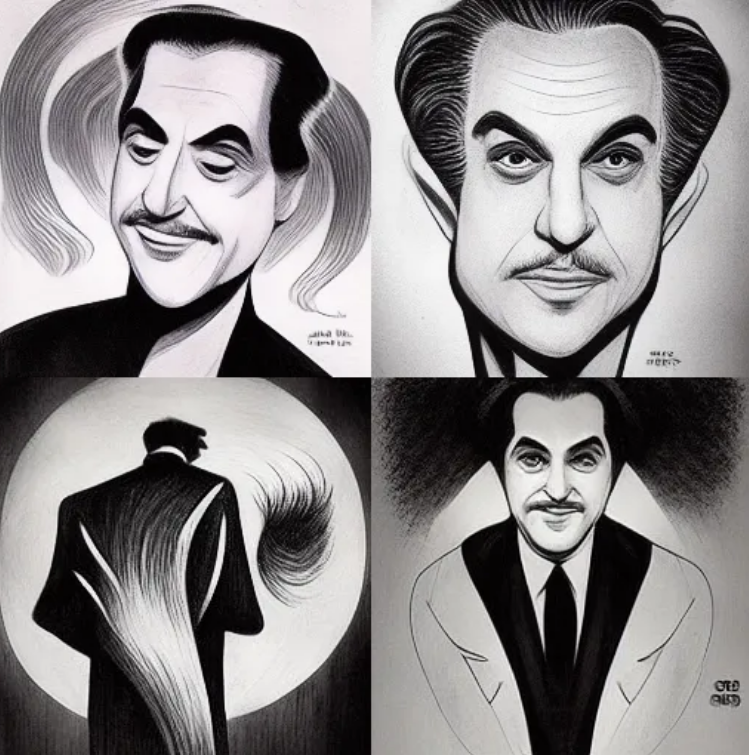
Ed Wood Wednesdays, week 135: Let's create some Ed Wood fan art with AI

An image that unites Wood, Spielberg, and Kubrick.

If you've been conscious for the last year or so, you've probably seen a lot of art (or "art," depending on your point of view) that has been created (or "created") by artificial intelligence or AI. Look, I'm not here to debate the ethics of AI or even define what is and isn't art. I'm here to take this awe-inspiring and terrifying newish technology and apply it to Edward D. Wood, Jr. 

I've done this kind of thing before. Back in 2019, I ran some screenshots from Jail Bait through a colorization app. In 2020, I used a site called Preference Revealer to rank my favorite and least favorite Ed Wood movies. Now it's 2022 and AI art is the hot thing, so let's do some of that... with Ed Wood.

I chose a service called Midjourney to do this project. Why? Because I'd seen it in this video by a YouTuber called Mighty Jabba and thought the results looked cool. Very quickly, though, I realized I was in over my head. I don't know a damn thing about how to generate AI art. My first prompt was: "Ed Wood as drawn by Al Hirschfeld." (I assume you know who Al was.) Here are the results:

Prompt #1: "Ed Wood as drawn by Al Hirschfeld"

I'd say that falls somewhere between success and failure. It's not Hirschfeld, but it's not not Hirschfeld either. My second attempt at a prompt was: "Ed Wood made out of Legos." Here's how that turned out:

Prompt #2: "Ed Wood made of Legos."

I don't know what's happening with the top left image, but the other three are at least in the ballpark. I then went on to Wood's repertory players. Folks, I tried and tried to get Midjourney to generate some Tor Johnson fan art, but that stupid computer had no idea who Tor was. None of the artwork even came close. So I ditched Tor in favor of Vampira. More specifically, I tried "Vampira on the beach at night." Even Midjourney knew who Vampira was, and it dutifully belched up these lovely images:

Prompt #3: "Vampira on the beach at night."

What else? What else? Oh yeah. I tried "Elderly Bela Lugosi in the style of the French impressionists." 

Prompt #4: "Elderly Bela Lugosi in the style of the French impressionists."

And I brought it all home with one last, simple prompt: "Ed Wood and Bela Lugosi holding hands."

Prompt #5: "Ed Wood and Bela Lugosi holding hands."

At that point, I realized I had enough for a single blog post and ended my experiment. How did I do? Good? Bad? Indifferent? You probably think you could do better, and I agree. In fact, I urge you to go do just that. There are plenty of AI art sites out there. Make your own stuff. Or, more accurately, get a computer to make stuff for you. You don't have to use Midjourney. Are we at the beginning of a new era in creativity or is this just some dumb internet fad that'll fade in a year? Time will tell.

Wednesday, July 27, 2022

Ed Wood Wednesdays, week 134: 'Plan 9 from Outer Space: The Original Uncensored and Uncut Screenplay' (1990)

This quaint and curious volume was published in 1990, two years before Nightmare of Ecstasy.

When I reviewed Joe Robertson's hodgepodge sex documentary Love Making U.S.A. (1971) last year, I described it as "an itch begging to be scratched." In other words, I'd known about this rather obscure movie for years, and I ignored it until I just couldn't ignore it any longer. My curiosity as an Ed Wood fan got the better of me. I had to know what this thing was like, so I finally downloaded it (legally) and watched it. Ultimately, I was glad I did. Lovemaking is far from a masterpiece, and its Wood content is minimal (just a few fleeting seconds of borrowed footage), but the film is an intriguing souvenir of its era.

Well, this week, I'm scratching another itch. I'm not exactly sure where or when I first learned of a 1990 book from Malibu Graphics called Plan 9 from Outer Space: The Original Uncensored and Uncut Screenplay, but I've known of it for a while now. I briefly discussed it in 2020 while reviewing another version of the Plan 9 script. Here's what I said at the time:
Supposedly, though, this volume merely contains a transcript of the film, prepared well after the movie's original release. I've never bothered with it, since there's a fairly decent Plan 9 transcript available online. For free, I might add.
Was I content to leave it there? Obviously not. "Supposedly" just isn't good enough for a true Ed Wood acolyte. I had to buy a copy of this thing and see it for myself, just so I could be completely confident what it contained.

The book that finally arrived from an Amazon seller was a surprise to me in many ways. For one thing, it was much smaller and skinnier than I had expected. I thought this would be one of those chunky, clunky 8.5 x 11 paperbacks that was mostly stills or screengrabs from the movie. Wrong. Instead, it's a slim, modest 6.5 x 10 volume—much closer in size and heft to a comic book. In fact, Malibu Graphics was a relatively-short lived (1986-1994) comics publisher best known for Men in Black. Around the time of this Plan 9 screenplay book, Malibu also published a Plan 9 graphic novel by John Wooley.

The screenplay book is about 100 pages long, and nearly all of that is text. Oh, there are a few pictures along the way—the same Plan 9 publicity stills that Ed Wood fans have seen many times before—but this is not by any means a scene-by-scene graphic representation of the movie. Content-wise, this book is what it claims to be on the front cover: Edward D. Wood, Jr.'s circa 1957 screenplay for Plan 9 from Outer Space. It is not a transcript of the finished film. Not even close. In fact, it is extremely similar to that typewritten script I reviewed back in 2020, though with a few significant differences along the way.

When I reviewed the typewritten Plan 9 script two years ago, I wrote these prophetic words in the final paragraph: 
Look, there's no way to detail every single minute change between the screenplay and the released version of the movie without this article being crushingly long and boring.
Well, you know what? Let's be crushingly long and boring today! I'm going to make a point-by-point comparison between the Malibu Graphics screenplay book and the finished film of Plan 9 from Outer Space. Occasionally, when necessary, I will reference the typewritten script as well. For our purposes, the Malibu Graphics screenplay book will simply be called "the book" or "the script." When I specifically want to mention the typed script, I will say so.