Showing posts with label the 1990s. Show all posts

Sunday, September 21, 2025

My Month of Bowie, day 21: 'Earthling' (1997)

And David Bowie surveyed his kingdom. And he was pleased.

The album: Earthling (Virgin, 1997)

Don't turn around!
My thoughts: Boom-BAP-ba-doom-a-doom-BAP! Boom-BAP-ba-doom-a-doom-BAP! Remember when that sound was everywhere? For a while in the 1990s, it seemed like every other song you heard on the radio or on MTV began with those same overcaffeinated drums. Jungle music, they called it. Or drum and bass. Were those the same thing? I forget. Whatever you call it, David Bowie was certainly paying attention in 1997, because the boom-bap-a-doom drums are all over his twenty-first studio album, Earthling. The whole thing sounds like an episode of The Powerpuff Girls. (That show debuted the very next year.)

You could accuse Bowie of merely following some late '90s musical fads on Earthling, and you wouldn't be wrong, necessarily. But I think you'd also be missing out on one of the most fun records he'd done since Let's Dance (1983). Goddamn, even that was 14 years old by the time Earthling came out. How time does fly. This is another one of those albums where I think it actually pays to be a Bowie novice rather than a Bowie expert. Uncultured dumdum that I am, I can appreciate the sci-fi sugar rush of these nine songs. Lyrically, Bowie is pouty and pessimistic as usual—always a rain cloud, this guy—but the music isn't lugubrious or morose in the slightest. It's propulsive.

The one song I already knew from Earthling was the album's penultimate track: "I'm Afraid of Americans." Bowie cowrote this doomy, paranoid ditty with Brian Eno, and it might be one of his very last songs to have a life outside of the album it originally came on. Part of the reason for that is because the single version was remixed by Bowie acolyte Trent Reznor. But I think "I'm Afraid of Americans" stands on its own as one of David's catchiest and most purposeful songs of the entire decade. It's one of the rare times in the '90s that David Bowie sounded like a man on a mission, the way he did in the '70s.

But I was entertained by Earthling all the way through, even if those aforementioned drums do tend to become repetitive over the course of nine songs. I'd never describe this LP as "pretty," but there are some exquisite barbershop harmonies on "Looking for Satellites" that my ears appreciated. Elsewhere, on Outside's final song, "Law (Earthlings on Fire)," there's a repeated, spoken refrain: "I don't want knowledge, I want certainty." A reasonable conclusion, I'd say. The first time I heard this song, however, I thought he was saying, "I don't want knowledge, I want succotash." I think I like my line better.

Next: Hours (1999)

Thursday, September 18, 2025

My Month of Bowie, day 18: 'Black Tie White Noise' (1993)

In 1993, David Bowie released his first solo album in six years.

The album: Black Tie White Noise (Savage, 1993)

Guess who's back, back again?
My thoughts: After a couple of critical duds in a row, namely Tonight (1984) and Never Let Me Down (1987), David Bowie evidently thought it was time for a change. Had he gotten soft in middle age? Lost his edge? Lost his way? Audiences and critics were wondering if the Thin White Duke still had anything left to say to us, so many years after that first communique from Major Tom.

Before he'd been marketed (successfully) as a solo artist, David Bowie was a member of numerous, short-lived rock groups: The Kon-Rads, The King Bees, The Mannish Boys, etc., etc. Maybe getting back to his roots would do the trick. So his next major endeavor was forming a noisy new four-piece ensemble, Tin Machine, and recording two albums with them, as well as touring. I'm somewhat curious about this material, but I'm skipping it for now. After all, this series is called My Month of Bowie, and if I included absolutely everything in the man's discography, it would take significantly longer than a month. Hell, David's live albums alone number in the double digits, including at least one he made with Tin Machine!

The point is, David needed some time to recharge his batteries. Tin Machine allowed him to do that. In 1993, six long years after Never Let Me Down, he felt it was time to come back with a new solo album on a new label. And he even reunited with Nile Rodgers, the producer of Let's Dance (1983), i.e. the last Bowie album people had actually enjoyed. I keep seeing the 1980s described as a period of "low creativity" for Bowie. I don't find that to be true. He was still creating things, but his ideas were getting buried in cheesy '80s production. It happened to plenty of artists back then.

So does Black Tie White Noise right the ship? Yes and no. In the main, I suppose it's more pleasing to the ears than Tonight and Never Let Me Down, but I still sense a lack of purpose on much of this LP, especially the back half. Black Tie sounds extremely optional to me, while Bowie's very best music sounded mandatory. It just so happened that I listened to this album the same day I saw Spinal Tap II: The End Continues (2025). There's a scene in that film in which David St. Hubbins (Michael McKean) proudly declares that he won a "Holdie" award for recording the best on-hold music. Well, I think a few of the tracks on Black Tie White Noise would have put David Bowie in contention for a "Holdie" of his very own.

What's there to talk about here? Black Tie is Bowie's first solo album of the grunge era, but you'd hardly guess it. Instead of digging Soundgarden and Nirvana, it sounds like Bowie had been listening to a lot of Lisa Stansfield before recording his eighteenth album. Remember that Stansfield made her name with a Barry White-style song called "All Around the World." She took Barry's signature soulful sound of the '70s and updated it with new jack swing production elements. It's conceivable to me that David Bowie heard that song and thought, "Yes, that's what I'd like for my album." You can especially hear this on the title track of Black Tie White Noise, featuring the silky smooth vocals of R&B loverman Al B. Sure.

Look, there's nothing exceptionally wrong with Black Tie White Noise. It's just that there's nothing exceptionally right with it either. It's an hour of competent pop. If George Michael had put out this exact same album in 1993, no one would have batted an eye. To me, a new Bowie album should be an occasion for copious eye-batting. But it's all so goddamned tasteful and well-mannered. In retrospect, Bowie was giving us some clues with the album's title. "Black tie" is what a wealthy man would wear to a formal event, and "white noise" is that pleasant drone people use to fall asleep. Put those together and you have this album.

P.S. I had a rare technical problem in putting together this review. When I originally went looking for this album, I inadvertently found a disc of Black Tie outtakes and remixes and somehow thought that was the actual record! So I listened to it and thought, "This was Bowie's comeback album?!" I didn't see how that could be possible. So I dug a little deeper and found the real LP. Whoops! (By the way, unless you're a completist superfan, don't bother with the extras for this album. They're not worth much.) This setback may have soured me somewhat on the album, so keep that in mind as you read my review.

Next: The Buddha of Suburbia (1993)

Friday, June 16, 2017

TMBG: Postcards from the edge (UPDATED!)

John Linnell and John Flansburgh of TMBG before they became ubiquitous.

TMBG's debut album from 1986.
This will seem completely ridiculous to anyone in 2017, but it used to be kind of difficult to get information about your favorite bands. Like, really difficult. Especially if your musical tastes were even slightly outside the mainstream. In the mid-1980s, for instance, my favorite band in the whole wide world was They Might Be Giants (TMBG), the pioneering New York nerd rock combo originally consisting of John Linnell and John Flansburgh. (The group's lineup would ultimately grow as its sound evolved.) At the time, apart from reviews of the group's albums, the press paid little to no attention to this band. TMBG wasn't serious enough for Rolling Stone -- a publication then in the thrall of earnest, message-driven bands like U2 and R.E.M. -- and not quite cool enough for, say, Spin. (Though the latter did publish a few fleeting features about the group. Thanks, Spin.)

That would all have been okay, but there wasn't really any internet to speak of back then either. By the early-to-mid-1990s, there were some primitive Usenet newsgroups, and TMBG fans used to congregate there somewhat. But in 1986? Zilch. Nothing. Diddly squat. You had to rely on newspapers, magazines, and television for your information. If those outlets didn't choose to cover They Might Be Giants, you were out of luck.

And so, oddball bands had to get the word out themselves using the slowest, most unreliable medium known to man: the United States mail. I can proudly say I was on TMBG's first-ever mailing list, eventually known as the TMBG Info Club. I was even proud that my fan club number, #36, was so low. From the mid-1980s to roughly the late-'90s, when the internet finally supplanted the postal system, I regularly received newsletters, postcards, and catalogs from the group. For some reason, I saved pretty much all of it, probably thinking that it might one day be used in a book about the history of They Might Be Giants. Now that information about TMBG is plentiful on the internet, however, I don't think my humble little collection has much historical relevance. The Rock & Roll Hall of Fame hasn't exactly been beating down my door.

Nevertheless, I'd like to share at least a few postcards from my rather vast collection of TMBG-related ephemera. Enjoy.

Ad for the "Hotel Detective" single and video. (1988)

"Ana Ng" inspired this whimsical card. (1988)

Promotion for "Santa's Beard" from Lincoln. (1988)

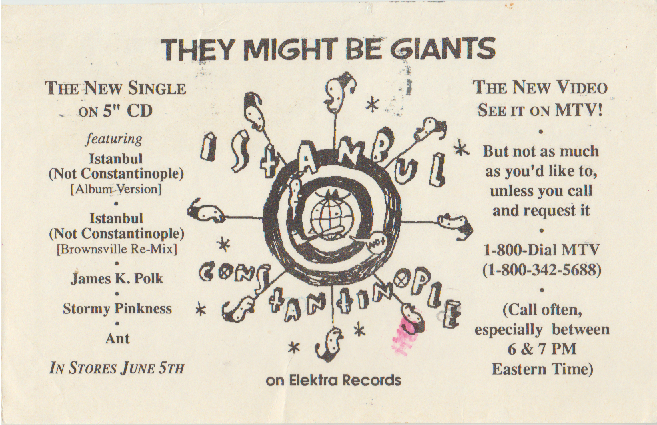
Promo for "Istanbul (Not Constantinople)." Note the mention of 1-800-Dial MTV. (1990)

Naturally, Apollo 18 got its own postcard. (1992)

"The Statue Got Me High" was the lead single from Apollo 18. (1992)

A new album meant a new tour. Note the expanding lineup. (1992)

Promoting the Back To Skull EP. (1994)

TMBG was the first major act to record for eMusic. (1999)

Long Tall Weekend was TMBG's groundbreaking digital-only album. (1999)

One of the last TMBG postcards was this one for Working Undercover For The Man. (2000)

And, seriously, if you're ever doing that book about the history of They Might Be Giants, drop me a line. I have so much more of this junk. Not just postcards but all kinds of stuff. Remember when you could buy an official TMBG fez for $20? Good times. Wish I'd bought one.