Showing posts with label the 1980s. Show all posts

Wednesday, July 15, 2026

Ed Wood Wednesdays, week 282: 'Edward D. Wood, Jr.: A Man and His Films' (1981) [PART 1]

A remarkable fan creation from the early 1980s.

We may think we want to travel back in time, but we probably wouldn't like the past very much once we got there. For one thing, we're so reliant on modern-day technology that it would be incredibly frustrating to be without it for any extended length of time. I can remember how cumbersome research used to be when I was in school. To write just one term paper on the Old English poet Cynewulf, for example, I had to check out a whole stack of books from the college library. Today, all that precious Cynewulf knowledge would be at my fingertips whenever I wanted it.

This entire series of articles about Edward Davis Wood, Jr. (1924-1978) would not be remotely possible without the internet and the ability to access decades of video, audio, and text instantly. I marvel at the work of writers who did their research during the low-tech, pre-internet days. How did they do it? More than a decade before Rudolph Grey's Nightmare of Ecstasy (1992), a couple of dedicated Wood fans in California named Randy Simon and Harold Benjamin assembled and self-published a chapbook about their favorite director called Edward D. Wood, Jr.: A Man and His Films (1981). Though crude by today's standards—the pictures are xeroxed, the text is typewritten—it remains a priceless souvenir of early '80s fan culture and a remarkable example of Wood scholarship.

This 32-page guidebook to Ed Wood's film career declares itself "a publication of The Edward D. Wood Jr. Film Appreciation Society." So what the hell is that? Did the EDWJFAS do anything else besides this? Well, maybe. In an article from the September 8, 1981 issue of The Soho News, film critic Jonathan Rosenbaum mentions the EDWJFAS in his dual review of Ferdinando Baldi's 3D Western Comin' at Ya! (1981) and Gus Trikonis' rowdy comedy Take This Job and Shove It (1981). He says that the organization has formed "recently" and "produced a marathon screening and monograph." The writer suggests that audiences are sick of middlebrow mainstream fare such as Kramer vs. Kramer (1979) and are taking solace in pure trash. Rosenbaum is in favor of this.

Wednesday, September 17, 2025

My Month of Bowie, day 17: 'Never Let Me Down' (1987)

David Bowie may, in fact, have let some people down with this album.

The album: Never Let Me Down (EMI America, 1987)

Even the album cover is busy.
My take: Never Let Me Down is the first David Bowie album I was acutely aware of. All of his LPs from Station to Station (1976) to Tonight (1984) were released during my lifetime, but I would have been too young to take notice of them when they were new. By 1987, however, I was an adolescent whose family had basic cable. MTV was my life. I was probably even reading Rolling Stone (or at least skimming through it at the newsstand) by that point. So, yeah, when one of the biggest rock stars in the world put out a brand new, heavily-hyped album, I heard all about it.

I even knew that Never Let Me Down, while a commercial success, was not a critically well-received album. (The same could be said of Tonight.) Nevertheless, for the purposes of this project, I approached it with an open mind and no expectations. Or at least I tried to. It's becoming more and more difficult to remain unbiased as this project goes along, especially now that I have sixteen previous albums to compare this one to.

Never Let Me Down finds Bowie still firmly ensconced in his "mall pop" era. Like other legacy acts of his generation, he was obviously struggling to update his sound for the '80s while still remaining true to himself. You can hear that same struggle in the Reagan-era music of Paul McCartney, The Rolling Stones, and other rock veterans. After two listens to Never Let Me Down, I'd say that David Bowie hadn't totally lost the knack as a songwriter or even as a singer, but he'd sure lost the knack as a record-maker. This guy released some of the most sonically-satisfying LPs of the 1970s, but Never is drowning in all of the worst musical ideas of the 1980s. At least he sounds more awake on this one than he did on Tonight.

To be fair, I cannot listen to the album the way it was intended in 1987. If you want to fully appreciate Never Let Me Down, you have to buy it on cassette from a Sam Goody, Record Town, or Tape World, then play it on a hot pink boombox with crappy speakers while applying copious amounts of hairspray and eye makeup. Under those circumstances, songs like "Beat of Your Drum" and "New York's in Love" would probably make a lot more sense. Most of the tracks on Never would also blend in perfectly on the soundtrack for a Steve Guttenberg action-comedy.

When you call an album Never Let Me Down, you're all but inviting critics to take potshots at you. Which they did. And I'm sure a few reviewers noted that, on this album, Bowie literally went from singing about "Heroes" to singing about "Zeroes." But "Zeroes" is a textbook example of a song that would have been much more engaging if Bowie had just recorded it in the early-to-mid-1970s. Only the cheeseball '80s arrangement lets it down (pardon the expression). Throughout this entire album, there are frequent guitar solos by David's longtime friend, Peter Frampton. I was ambivalent toward them. I could appreciate Frampton's skill as a musician, but these solos make a lot of the tracks on Never sound alike. Imagine the Miami Vice theme playing on an endless loop.

So what's salvageable here? Well, the album's first two tracks ("Day-In Day-Out" and "Time Will Crawl") are energetic and catchy, even if they both slightly outstay their welcome. The album's title track has a wistful, Lennon-esque quality, again nearly snuffed out by the overproduction. And then there's "Glass Spider," which starts with wonderfully pretentious spoken narration about some kind of giant spiderlike creature that goes stomping around China, devouring victims and turning their skeletons into keepsakes. Lord only knows what this all means, but we haven't had anything like it on a Bowie record since Diamond Dogs (1974). It's entertaining enough, but I couldn't help but think of Nigel Tufnel introducing "Stonehenge." ("In ancient times, hundreds of years before the dawn of history...")

I should mention that, in support of this very album, David Bowie embarked upon the incredibly ambitious and gloriously silly Glass Spider Tour, which featured (among other things) a gigantic spider looming over the stage. Critics huffed, but plenty of tickets were sold. I've looked at some of the footage, and it's mind-boggling. This show deserves an article of its own, but I simply don't have room for it in this project. Maybe somewhere down the line, I'll cover it.

For David Bowie, following this album and the tour, it was time to regroup and refocus. He spent the next few years with his side project, Tin Machine, before reemerging with a new studio album. Bowie went six years between solo records, an unprecedented gap for him. What on earth would a David Bowie album sound like in a post-Nevermind (1991) world? We're about to investigate that very question.

Next: Black Tie White Noise (1993)

Monday, September 15, 2025

My Month of Bowie, day 15: 'Let's Dance' (1983)

In 1983, David Bowie wanted his MTV, and the feeling was mutual.

The album: Let's Dance (EMI America, 1983)

Bowie's gonna fly now.
My thoughts: You'd probably guess that legacy artists of the 1960s and 1970s had a tough time of it in the 1980s. In short order, the basic cable network MTV drastically changed the music industry, making instant superstars out of flashily-dressed young synth rockers with teased hair and heavy makeup. Suddenly, the music video was the format of choice, emphasizing style and image over substance. Surely, then, the decade would belong to the Adam Ants and Boy Georges of the world. The obsolete rock and pop acts who had dominated the charts in previous decades would be sidelined to make room for these brash upstarts.

And yet, look at what actually happened in the 1980s. Bruce Springsteen and Michael Jackson, both well established by the time Reagan took office, reached unprecedented heights of popularity in the new decade. Pop tunesmiths like Billy Joel, Elton John, and Paul McCartney didn't disappear from the charts either. Potential '70s dinosaurs like Yes, Genesis, Chicago, and Heart overhauled their sound to better suit the times. Legacy acts like Steve Winwood, The Moody Blues, and especially Aerosmith staged impressive comebacks. Nostalgia-themed films like Back to the Future (1985), Stand by Me (1986), Dirty Dancing (1987), and La Bamba (1987) kept classic rock alive on radio and TV.

In short, the past didn't go away. It was everywhere!

So David Bowie, still only in his 30s, had a better-than-average shot at making it big in the 1980s. Reinvention was his thing. He was more than photogenic enough to be a music video star. And he'd been incorporating electronic elements into his music for years. The cover of his first MTV-era album, Let's Dance, showed the singer as a prizefighter. Clearly, this was a fight he'd been training for. And he had a new producer in his corner: Chic's Nile Rodgers, who drew inspiration from his own (plentiful) hit records, particularly "Good Times."

One curious thing about Let's Dance is that it contains three inescapable hits that I heard dozens of times in the '80s—"Modern Love," "China Girl," and "Let's Dance"—and those are the first three songs on the album. Back to back to back, baby! I heard these tracks so many times as a youth that it's difficult to "review" them now. It's like trying to review your old yearbooks or your family vacation photos. I suppose I still like all of them in 2025, though my feelings are all tied up with complicated mixed emotions about my childhood. 

Sunday, September 14, 2025

My Month of Bowie, day 14: 'Scary Monsters' (1980)

Why did David Bowie never play a scary clown in a horror movie?

The album: Scary Monsters (RCA, 1980)

Send in the clowns?
My thoughts: I went into Scary Monsters knowing it was David Bowie's attempt to make a more commercial album after the artistic experimentation of Low (1977), "Heroes" (1977), and Lodger (1979). So I braced myself for a more disciplined, less eccentric Bowie this time around. And what did I get when I pressed play? A Japanese woman yelling at me about god knows what.

That woman is Michi Hirota, Bowie's Japanese instructor at the time. What she's yelling is a translation of the lyrics of the opening track, "It's No Game." When David himself decides to join the song already in progress, his vocals are tense and strained, with a lot of little yips and yelps like David Byrne used to do. In fact, I'd say Scary Monsters is Bowie's second consecutive album, following Lodger, that sounds like an honorary Talking Heads record. I'm not sure if he was following their lead or they were following his. Looking at the timeline of various Bowie and Heads releases, I'd say they reached many of the same conclusions independently. Is it a mere coincidence that the 'Heads released an album called Little Creatures (1985) five years after Bowie released Scary Monsters?

This LP was supposed to be David's return to the pop mainstream. So is this album poppier and more radio-friendly than its predecessors? I guess so. David was a deeply weird guy drawing on many disparate musical influences, so this is about as "normal" as he was capable of being in 1980. Scary Monsters was never going to be another Off the Wall (1979), though I imagine David probably liked that album an awful lot. 

Which brings me to another point. About halfway through listening to Scary Monsters, a thought occurred to me: David Bowie skipped disco. I mean, he just completely sidestepped it. While John Travolta was getting down to "Stayin' Alive," Bowie was off in Berlin, listening to krautrock and trying to kick his drug habit. Certainly, other British rockers of Bowie's generation—Mick, Paul, Rod, Freddie, Elton—flirted with disco to some extent. But David's time was taken up by working with Iggy Pop and Brian Eno. By the time he recorded Scary Monsters, the disco era was already ending.

An album is only as strong as its songs, and Scary Monsters has another batch of good 'uns. I'd say the most memorable ones here are the quasi-fascistic "Fashion," the spooky title track, and the mournful "Ashes to Ashes," which acts as a sort of sequel to "Space Oddity" and gives us an update on poor old Major Tom. If you were wondering whether "Oddity" was about an astronaut or just some guy doing a lot of drugs, well, "Ashes" makes it clear: Major Tom's a junkie. Or maybe he became one after leaving the space program, I don't know.

When you listen to an artist's entire recorded repertoire in one month, you really don't have time to appreciate the subtle nuances of each individual album, let alone each individual song. When these albums were first released in the '70s and '80s, there were months or even years in between them. If you were a Bowie fanatic, you could live with an album like Scary Monsters for a good, long time and really familiarize yourself with its contents—not just the singles but the deep cuts, too—before the next one came out. 

I don't really have that luxury. I can only get a vague sense of the surroundings and move on. Based on that, I can't really say that Scary Monsters is an immediate favorite of mine. But maybe, if I spent more time with this album, the songs would burrow their way into my brain and take up residence there.

P.S. Since this was David Bowie's first album of the 1980s, I was going to write about how he had to reinvent himself, his music, and his image for the new decade. But that's not really applicable to Scary Monsters. The '80s hadn't quite become "THE EIGHTIES!" yet, at least not as we remember that decade. In particular, a certain American cable network hadn't started broadcasting. So we'll save that discussion for David's next album. Rest assured, a change is gonna come.

Next: Let's Dance (1983)

Tuesday, May 27, 2025

Podcast Tuesday: "Stockholm Syndrome: The Romantic Comedy!"

Kurt Russell and Goldie Hawn in Overboard.

Boy, were we obsessed with money in the 1980s! It was all we ever thought about, apart from sex, drugs, leg warmers, video games, and the music of Adam Ant. 

Admittedly, we humans have been obsessed with money ever since it was invented about five-thousand years ago, but our fixation on the topic hit a new high during the Reagan-Bush years. Or a new low, depending on your point of view. Either way, the subject dominated popular culture across all media in the '80s. On the radio, we'd hear "Money for Nothing," "Big Time," "Opportunities (Let's Make Lots of Money)," and "Material Girl." On television, we'd tune into capitalist fantasies like Dallas, Dynasty, Diff'rent Strokes, Silver Spoons, and Lifestyles of the Rich and Famous. These shows taught us that, with enough cash in your bank account, you could live as you please and make your most vulgar consumerist dreams come true. And we bought into it!

But the movies outdid them all! Year after year, Hollywood gave us silly, over-the-top comedies about the extremely wealthy, often showcasing how they reacted to being around the extremely unwealthy.  Just off the top of my head, I remember Arthur (1981), Annie (1982), Trading Places (1983), Brewster's Millions (1985), Ruthless People (1986), Down and Out in Beverly Hills (1986), Big Business (1988), Coming to America (1988), and more. This was a time when it seemed like the characters in film comedies always had maids and butlers.

Somewhere in all this mess was Garry Marshall's fourth feature film, Overboard (1987) starring Goldie Hawn as a spoiled rich woman who loses her memory and Kurt Russell as an earthy carpenter who takes advantage of that situation. Edward Herrmann, Katherine Helmond, and Roddy McDowell come along for the ride. Have you already guessed that this is the film we're covering this week on These Days Are Ours: A Happy Days Podcast? Well, it is. You can hear what we thought of Overboard by clicking the play button below.

Tuesday, September 6, 2022

Podcast Tuesday: "The Immigrant Song(s)"

Scott Baio and Erin Moran on Happy Days.

The eighth season of Happy Days was not a disaster. That, in and of itself, is a minor miracle. Most lighthearted family sitcoms of this caliber would be running on fumes after 160+ episodes. Besides, two of the show's stars, Ron Howard and Don Most, had left the cast when their contracts expired, and even the writers seemed to be tiring of the nostalgia gimmick that had originally driven the series. But ABC and creator Garry Marshall were determined to keep the saga of the wholesome Cunningham family of Milwaukee, Wisconsin going. And keep it going they did. For the (strike-shortened) 1980-81 season, Happy Days did decent if not spectacular Nielsen numbers, and the overall quality of the show did not plummet precipitously.

When I look back on the 22 episodes that constitute Season 8 of Happy Days, I see a few real gems, a couple of well-intended misfires, and the usual assortment of middling efforts. That's very typical for this show. Yes, Ron Howard and Don Most are sorely missed, and Anson Williams and Lynda Goodfriend seem stranded with little to do, but Ted McGinley and especially Cathy Silvers make welcome additions to the cast. I'm not sure about the new gang of quasi-Sweathogs (including Denis Mandel and Harris Kal) who now attend Jefferson High, but they're growing on me, week by week.

Happy Days ended its eighth season on ABC with a truly oddball episode called "American Musical." As the title suggests, this is a full-fledged musical with lots of singing, dancing, and costume changes. The subject is immigration, a topic that would be handled very differently today. At the time, Neil Diamond was rocketing up the charts with his patriotic, pro-immigration anthem "America." ("Everywhere around the world/They're coming to America/Everywhere that flag's unfurled/They're coming to America!") I guess Happy Days got caught up in the spirit. Reagan had just been inaugurated. It was a very optimistic time.

What did we think of "American Musical"? Find out by listening to the latest installment of These Days Are Ours: A Happy Days Podcast.

Tuesday, July 19, 2022

Podcast Tuesday: "A Pain in the Butt"

Anson Williams, Henry Winkler, and Scott Baio on Happy Days.

The TV landscape changed noticeably in the early-to-mid-1980s. The sitcoms that had dominated the '70s slowly started to fall out of favor in the new decade, nudged aside by splashy prime time soaps and high-octane action shows. It seems that viewers wanted thrills, not chuckles, during the Reagan era. (At least during Ron's first term. By the end of the '80s, sitcoms were back in a big way.)

One of the biggest series of the era was CBS' oil industry drama, Dallas. When that show's main character, unscrupulous wheeler dealer J.R. Ewing (Larry Hagman), was shot by a would-be assailant in March 1980, it became a worldwide obsession -- the subject of headlines, water cooler conversations, and at least a thousand jokes. Everyone was asking the same question: "Who shot J.R.?" The attention helped Dallas become the #1 show on television, a spot Happy Days had occupied just a few years previously.

How did Happy Days respond to this paradigm shift in the television business? By and large, it didn't. The show never tried to compete with the new breed of prime time series. It remained very much a traditional sitcom, complete with corny punchlines and tidy morals. But that's not to say the producers were oblivious to what was happening in their industry. Take the March 1981 episode "Fonzie Gets Shot" as an example. The plot revolves around Fonzie (Henry Winkler) suffering an accidental gunshot wound to his buttocks. While the story is played entirely for laughs, not drama, the episode must have been at least partially inspired by the "Who shot J.R.?" phenomenon.

But does this make for a good half hour of television? And, more importantly, who shot Arthur Fonzarelli? Find out when you listen to the latest installment of These Days Are Ours: A Happy Days Podcast

Friday, June 16, 2017

TMBG: Postcards from the edge (UPDATED!)

John Linnell and John Flansburgh of TMBG before they became ubiquitous.

TMBG's debut album from 1986.
This will seem completely ridiculous to anyone in 2017, but it used to be kind of difficult to get information about your favorite bands. Like, really difficult. Especially if your musical tastes were even slightly outside the mainstream. In the mid-1980s, for instance, my favorite band in the whole wide world was They Might Be Giants (TMBG), the pioneering New York nerd rock combo originally consisting of John Linnell and John Flansburgh. (The group's lineup would ultimately grow as its sound evolved.) At the time, apart from reviews of the group's albums, the press paid little to no attention to this band. TMBG wasn't serious enough for Rolling Stone -- a publication then in the thrall of earnest, message-driven bands like U2 and R.E.M. -- and not quite cool enough for, say, Spin. (Though the latter did publish a few fleeting features about the group. Thanks, Spin.)

That would all have been okay, but there wasn't really any internet to speak of back then either. By the early-to-mid-1990s, there were some primitive Usenet newsgroups, and TMBG fans used to congregate there somewhat. But in 1986? Zilch. Nothing. Diddly squat. You had to rely on newspapers, magazines, and television for your information. If those outlets didn't choose to cover They Might Be Giants, you were out of luck.

And so, oddball bands had to get the word out themselves using the slowest, most unreliable medium known to man: the United States mail. I can proudly say I was on TMBG's first-ever mailing list, eventually known as the TMBG Info Club. I was even proud that my fan club number, #36, was so low. From the mid-1980s to roughly the late-'90s, when the internet finally supplanted the postal system, I regularly received newsletters, postcards, and catalogs from the group. For some reason, I saved pretty much all of it, probably thinking that it might one day be used in a book about the history of They Might Be Giants. Now that information about TMBG is plentiful on the internet, however, I don't think my humble little collection has much historical relevance. The Rock & Roll Hall of Fame hasn't exactly been beating down my door.

Nevertheless, I'd like to share at least a few postcards from my rather vast collection of TMBG-related ephemera. Enjoy.

Ad for the "Hotel Detective" single and video. (1988)

"Ana Ng" inspired this whimsical card. (1988)

Promotion for "Santa's Beard" from Lincoln. (1988)

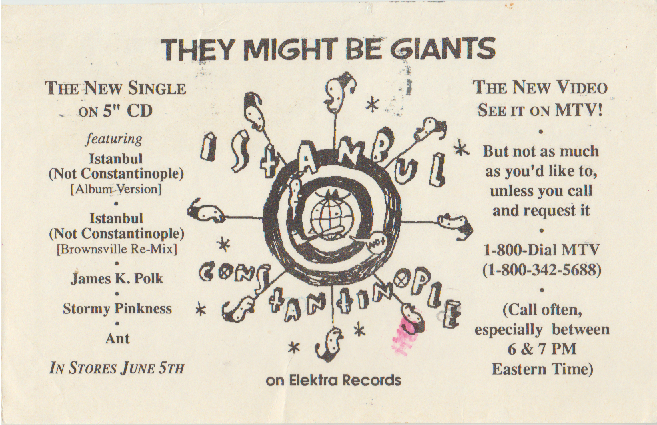
Promo for "Istanbul (Not Constantinople)." Note the mention of 1-800-Dial MTV. (1990)

Naturally, Apollo 18 got its own postcard. (1992)

"The Statue Got Me High" was the lead single from Apollo 18. (1992)

A new album meant a new tour. Note the expanding lineup. (1992)

Promoting the Back To Skull EP. (1994)

TMBG was the first major act to record for eMusic. (1999)

Long Tall Weekend was TMBG's groundbreaking digital-only album. (1999)

One of the last TMBG postcards was this one for Working Undercover For The Man. (2000)

And, seriously, if you're ever doing that book about the history of They Might Be Giants, drop me a line. I have so much more of this junk. Not just postcards but all kinds of stuff. Remember when you could buy an official TMBG fez for $20? Good times. Wish I'd bought one.

Monday, December 21, 2015

Did Frank Zappa somehow predict Mötley Crüe?

Frank Zappa (black tux, yellow shirt) on the cover of his Tinseltown Rebellion album.

The infamous glam metal outfit Mötley Crüe formed in 1981, the same year Frank Zappa released his mostly-live Tinseltown Rebellion album. Why is that significant? Well, the title track of Zappa's LP is a screed against the shallow, image-conscious music scene in Los Angeles. Two genres, punk and new wave, are mentioned specifically in the harsh, satirical lyrics. The song is about how musicians in L.A. were more concerned with how they looked than how they sounded, leading to a glut of crappy, amateurish music. According to "Tinseltown Rebellion," the bars and clubs in Hollywood were being besieged in the early 1980s by "record company pricks" looking for flash-in-the-pan acts to exploit and then most likely abandon after "a week or two perhaps," and there were plenty of young musicians lining up to be exploited in this way.

In his lengthy Zappa-analyzing book, The Negative Dialetics of Poodle Play, author and punk loyalist Ben Watson takes Frank to task for unfairly and inaccurately portraying punk rock here. Real punkers, he insist, did not use cocaine, as Frank alleged in "Tinseltown Rebellion." Sure, the arena rockers of the 1970s snorted plenty of the stuff, but punk was rebelling against all that. Besides, Watson argues, punk rockers couldn't have even afforded coke if they'd wanted it back then. It was an expensive drug, and punk was commercially negligible in those days. I might argue that Zappa also mentions new wave, a slicker, more commercial genre that rose from punk. Certainly by 1981, some new wavers were selling enough records, tickets, and T-shirts to afford cocaine. Whether they did or not, I don't know. But they could have if they'd wanted to, is my point.

Maybe Frank Zappa was just using the terms "punk" and "new wave" because those were the only labels available to him at the time to describe a kind of music that was cropping up in Los Angeles in the 1980s. I mentioned at the start of this article that Mötley Crüe formed in '81. They were, of course, a fixture of the Los Angeles club scene in the 1980s, but I don't think anyone would describe them as punk or new wave. Not by a long shot. Instead, they were part of a movement now known as "glam metal" or "hair metal," a subgenre that definitely did regrettably emphasize image at the expense of music. Zappa would not have known who Mötley Crüe were when he wrote "Tinseltown Rebellion," but that's nevertheless the band that comes to my mind when I hear this song. Take a listen.


Mötley Crüe at the Whisky.
So now we get into specific references in the lyrics. The song starts: "From Madame Wong's to Starwood to the Whisky on the Strip, you can hear the crashing, blasting strum of bands that come to be real hip." Okay, I can't find any documentation that the Crue ever played Madame Wong's, an establishment that catered to punk acts, but they were famous for their appearances at both Starwood and the Whisky A Go Go. So two out of three ain't bad. Here's another line from the song: "So off they go to S.I.R. to learn some stupid riffs and practice all their poses in between their powder sniffs." That's Studio Instrument Rentals, a famous rehearsal space in Los Angeles. When you go to S.I.R.'s website, one of the first things you'll see is a paragraph about the company's history: "Artists including Miley Cyrus, Queen Latifah, Snoop Dogg, Katy Perry, Jane’s Addiction, KISS, Mötley Crüe, Green Day, No Doubt, Maroon 5 and Mariah Carey all call SIR home." So another reference checks out.

And what about those "powder sniffs?" Well, Mötley Crüe is justly famous for its love of chemical intoxicants. Even the cover of their official autobiography, The Dirt, is designed to look like a Jack Daniels label. The band is most closely associated with alcohol and heroin, but they did their share of cocaine, too. In my research, I even found a cute little story about lead singer Vince Neil buying a baggie of cocaine that turned out to be baby powder. The unnamed band in the song plays music that is "real dumb" and "somewhat insincere." Check and check. (Though the Crue's masterpiece, "Girls, Girls, Girls," is probably very close to their hearts.) Zappa also mentions "leather groups and plastic groups and groups that look real queer." The Crue certainly wore plenty of leather, and their over-the-top stage makeup gave them an androgynous appearance. So, once again, the song fits them very well. Zappa did not accurately predict the Crue's longevity, however. While there probably were plenty of flash-in-the-pan groups on the glam metal scene in Los Angeles, Mötley Crüe stayed popular for decades, only recently retiring.

Again, let me emphasize that "Tinseltown Rebellion" is not about Mötley Crüe. It couldn't have been. When Frank Zappa wrote it, the band was just starting out. But what the song manages to do very well is predict where the Los Angeles music scene was heading in the 1980s. Mötley Crüe simply exemplified that era better than just about any other band.

Wednesday, January 11, 2012

As it turns out, pills are not candy.


Thanks to the good folks at the Long Island Regional Poison Control Center, here's a fun little PSA from 1983 featuring a vocal quartet comprised of singing pills. I wonder if this is what went on in Judy Garland's head all the time.

And in case some of those lyrics sound awfully familiar even though you didn't grow up in or near Long Island during the 1980s: