Saturday, September 29, 2012

10 more grotesque pictures of "Spitting Image" puppets!

Another hideous Spitting Image group shot

Your nightmares begin here. Yesterday, I posted a group of photos of puppets from England's gone-but-not-forgotten satirical TV series, Spitting Image. Guess what, folks? Those were the cute ones. Today, I'm bringing you the rest of the pics, and it's here where we venture into some very dark territory indeed. Sadly, many of these photos are too big to be reproduced at a decent size on this blog, so I've had to shrink them. Consider yourself lucky. These are some very unpleasant puppets. Keep in mind, my original scans of these images are absolutely huge, so I've viewed them in excruciating detail. I will warn you: the image of Whoopi Goldberg's face floating in what appears to be a bowl of milk is not something to approach lightly.

Princess Di and Fergie

Dustin Hoffman, Robert De Niro, and Meryl Streep


Laurence Olivier and John Gielgud


Mikhail Gorbachev

Cyndi Lauper

Madonna

Michael Jackson

Mike Tyson

Tina Turner

Whoopi Goldberg

Friday, September 28, 2012

A gallery of grotesque celebrity puppets from "Spitting Image" (1987)

A group shot of royal puppets from Spitting Image

England's bizarre satirical puppet show Spitting Image ran for an astonishing 132 episodes on ITV from 1984-1996. With its extremely topical parodies of politics and show business, the program was something like our Saturday Night Live... only with a much nastier edge and with all the celebrity parts being played by foam and latex doppelgangers of the rich and famous. These three-dimensional, often unflattering caricatures became the show's trademark. Although the original British series never quite caught on in the States, the puppets did have a brief window of notoriety in America thanks to their appearance in the "Land of Confusion" video by Genesis in 1986 and a few prime time network specials. Although America's interest in the show was short-lived, the fad did manage to produce at least one souvenir book. 

In 1987, Harcourt Brace Jonavich published Spitting Images, a collection of photographic portraits of some of the puppets, with accompanying text by National Lampoon's Sean Kelly. In the interest of preserving pop culture history, I have decided to scan some of the better ones. The captions are directly from the book. The photos are by John Lawrence Jones

Bette Midler: America's Happiest Camper

Bruce Springsteen: For unto Us a Savior is Born in the U.S.A.

Johnny Carson: He Do Re-run-run-run, He Do Re-run-run

Bill Cosby: Call Him a Doctor? Okay. He's a Doctor.

Clint Eastwood: Dirty Harry Says, "Have an Ice Cream. Or Else!"

Jack Nicholson: Not Invited? But I'm Always Invited!

Mick Jagger: Rolling Stone Youth Formula: Removes Lines, Wrinkles, Moss!

Muammar Al-Qaddafi: Radical Sheik

Leonard Nimoy: To Be Spock or Not To Be Spock? That Is the Question.

Pee-wee Herman: Disney Just Drew Mickey Mouse. Pee-wee Is Mickey Mouse!

Prince Charles: The Dunce and Future King

Richard Pryor: A Blazing Talent Gone to the Dogs

Queen Elizabeth: A Scepter is Haunting Europe

Ronald & Nancy Reagan: What Did the President Know and When Did She Know It?

Sylvester Stallone: All He Wants Is for His Country to Love Him As Much As He Does

Barbara Streisand: The Biggest Star So Far (By a Nose)

Margaret Thatcher: A Tory Party Animal - A Minister in Her Prime

Woody Allen & Mia Farrow: Hanna and Her Sisters Meet the Brothers Karamazov

If you enjoyed this article, here's the sequel.


Sunday, September 23, 2012

Koko, a Talking Gorilla (1978)

 
Penny Patterson and Koko in 1978


NOTE:
Over at her movie review blog, Deadly Doll's House of Horror Nonsense, my dear friend Emily Intavia is devoting the month of September to the theme of Animals Doing Human Stuff. She asked me if I might want to write something about this topic, and I decided it would finally give me the excuse to write about a 1970s documentary I might not otherwise cover on this blog. Enjoy.
We really want animals to be human, don't we? We talk to them and sometimes pretend that they are talking back to us. We give them names. We dress them up in "people clothes." We ascribe all kinds of emotions to them. In fables, comics, and cartoons, we routinely use animals as full-fledged stand-ins for people, generally rendering them in humanoid form in the process. (Does Mickey Mouse look or behave like any actual mouse you've ever seen?) Comics historian Don Markstein once traced this literary tradition of "funny animals" back to the fables of Aesop. But how much are animals like us really? How "human" can we make them? And should we be doing this at all?

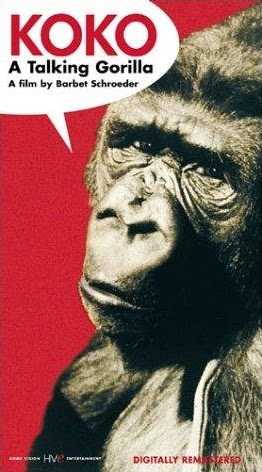
Poster for Koko, a Talking Gorilla
These are among the questions considered in Barbet Schroeder's involving yet not entirely satisfying 1978 documentary entitled Koko, a Talking Gorilla, which focuses on the controversial and possibly groundbreaking work of Dr. Francine "Penny" Patterson, who supposedly taught American Sign Language (ASL) to Koko, a female gorilla born in captivity. More has been written about Penny and Koko over the last 40 years than I could ever hope to relate to you. If you're interested in the saga of this remarkable gorilla and her adoptive "mother," this essay provides a good overview.

The gist of it is this: Koko was born in the San Francisco Zoo in 1971 but was sickly as an infant. She was placed in the care of Penny Patterson, a grad student then in her mid-20s. Instead of returning Koko to the zoo, Patterson decided to use Koko as the center of an unprecedented, decades-long language experiment which continues to this day under the auspices of an organization called the Gorilla Foundation. Patterson now alleges that Koko has a vocabulary of roughly 2,000 words and can respond to spoken English as well, but these claims are not universally accepted in the scientific community. Oh, and in 2005, there was a very strange sexual harassment suit filed against Patterson by disgruntled ex-employees of the Gorilla Foundation who claim they were pressured to expose their breasts to Koko in order to satisfy the gorilla's "nipple fetish." I'm not making this stuff up.

I'm not sure how valid this experiment has been, but I can tell you that I found Penny Patterson to be an absolutely mesmerizing character, much more fascinating in her own way than Koko. Flawlessly pretty with long, blonde, wavy hair and smooth, doll-like features, Patterson absolutely does not look like the kind of woman you'd imagine catching a gorilla's urine in a cup (straight from the source, no less). But there she is, on camera, cheerfully doing just that. Director Schroeder also narrates the documentary and makes a point of the fact that Patterson has no children of her own, never takes vacations, and must be with Koko every morning and evening. He never explains why the doctor has to be there every time the gorilla wakes up or goes to bed, but he seems impressed by her dedication to the project. By the end of the film, Schroeder has given up all illusions of neutrality and is openly endorsing Patterson's work.

One wonders how Werner Herzog might have handled this same assignment. If nothing else, Koko, a Talking Gorilla might make an interesting companion piece to Herzog's much-less-sentimental Grizzly Man. The other film I was thinking about while watching this documentary, of course, was King Kong. In every cinematic iteration of that story, Kong has become enamored of a human woman. And all of these women (Fay Wray, Jessica Lange, Naomi Watts) have been blondes, just like Patterson.

Penny and Koko in the early days
In fairness to Schroeder, it's easy to fall under Patterson's spell. She's sweet-natured and enthusiastic, and how can you not love a woman who blithely cruises past used car lots and fast food restaurants with a giant gorilla in the passenger seat of her car? A great deal of the film is devoted simply to showing Patterson and Koko spending quality time together, and they do seem to have a genuine mother-daughter bond.

This is a 1970s PBS-style documentary, so there are also occasional minutes of screen time devoted to earnest scientists talking in a rather dry fashion directly to the camera about the language capabilities of various primates. These are "groovy," Jimmy Carter-era scientists, though, and they have beards, turtlenecks, and Prince Valiant haircuts, so you know that they're not some uptight squares, man. The only real opposition to Patterson the film presents is a brief interview with a zoo owner who believes Koko should be back in a zoo environment and not raised as a pseudo-human child by a (possibly) crazy lady. Even this gregarious man, though, knows his opinions will not be popular with viewers and sadly acknowledges he will likely come off as a villain in Schroeder's film. And besides, we don't want to see some boring dudes yakking away at the camera. We want to see Penny teaching Koko to wear makeup! Or Penny dressing Koko in a red sweater! Or Penny and Koko just wrestling around on the floor!

Can Koko really use sign language and understand spoken English? Eh, it's debatable. She does seem to be able to make a few unmistakable signs (she's got "toothpaste" down pat), and she seems to be able to identify pictures of various animals in a book after Penny reads their names aloud. But through all of this, it takes a lot of coaching from the pretty young doctor. A lot of times throughout the film -- and in the other, later documentaries about Koko -- we only really know what the gorilla is thinking because Penny tells us. Certainly, some of the project's success exists only in Patterson's mind. How much, I don't exactly know. There's an interesting scene in this film when Koko starts to misbehave and Penny has to chase after her. The doctor seems a little rattled and says the word "cut." Is that some kind of command to the gorilla, or is she telling Schroeder to turn off his camera?

All in all, Koko, a Talking Gorilla (which was actually given a Criterion DVD release a few years back) is definitely worth 85 minutes of your time. It's not as emotionally satisfying as a Herzog documentary might be under the same circumstances, but it nevertheless provides valuable insight... not so much into gorillas but into human beings and our desire to see ourselves reflected in the animal kingdom.

Saturday, September 22, 2012

Vivian Stanshall (1943-1995)

Vivian Stanshall, a.k.a. The Ginger Geezer

If I could give you but one piece of advice this fine September day, ladies and gentlemen, it would be to explore the life and work of Mr. Vivian Stanshall, an eccentric yet brilliant British comedian and musician perhaps best work for his days leading an anarchic 1960s musical collective called the Bonzo Dog (Doo-Dah) Band. 

I first heard of the Bonzos through their personal and professional associations with The Beatles and Monty Python, and my curiosity ultimately led me to track down a greatest hits album by the Bonzos. Before buying it, I'd only actually heard one of the ex-Bonzos, Neil Innes, performing a solo version of the group's lone hit single, "I'm the Urban Spaceman," in the film Monty Python at the Hollywood Bowl. I'd never heard any of their studio recordings and had not experienced in any way the work of Mr. Stanshall. 

Friends, I was stunned by what I heard on that greatest hits disc. Here was a man with the wild, surrealist humor of Python but with the dapper, distinguished manner of a true English gentleman. "Finally," I thought, "an old-money aristocrat has started a rock band! It's about time!"

I can't begin to summarize what Vivian did, but I can give a sample of his work. Here's an Elvis-inspired tune from his days wih the Bonzos, entitled "Canyons of Your Mind":

"Newly Wed" by the Orchids (Parrot Records, 1955)


Frank Zappa's favorite record. I've heard it dozens of times, and it never gets old. Hope you enjoy. BONUS: Try and figure out exactly what's happening in this song. I've never been able to.

Sunday, August 26, 2012

More Funday Sunnies

Artwork from Crankshaft; dialogue by me.

Artwork from Mark Trail; dialogue by me

making gifs
George Stover: Not just an actor but a fine dancer as well!
making gifs

Friday, August 17, 2012

Terrible writing advice from some washed-up old bastard

T. Texas Tenafly, author of Write, Goddamn You!

T. Texas Tenafly is, if nothing else, one of our most persistent authors. Despite a noticeable lack of public interest or critical acclaim, he has completed a novel every year since 1952. Through harassment and bullying techniques many loan sharks would envy, the author has even persuaded several reputable publishers to print and market some of these little-demanded works. Among these are such novels as The Gelded Gifthorse, They Dared Call Him Turncoat, and Elysium on a Tramp Steamer. Total sales number in the dozens. Now rapidly approaching his 80th year, Mr. Tenafly is getting set to publish his first-ever non-fiction book, a guide for aspiring authors entitled Write, Goddamn You! A Seasoned Pro Shows You How It's Done, Little Missy

Inspired by a BuzzFeed article, I recently asked Tex to give the readers of this blog (all none of you) a few basic pointers about the writing game. At first he was reluctant, but a bottle of Old Grand-Dad sealed the deal. Here, then, is a list of terrible, terrible pointers from this utterly irrelevant writer. Heed them at your peril.

1. Identify your favorite character and remove him (her/it/etc.) from the manuscript entirely. Replace this character with one towards whom you are indifferent.
2. Name all your characters "Steve." No exceptions. Can you think of a better name than Steve? No, you can't. 
3. Whenever you have your characters speaking, they should be silent. When they are silent, they should be speaking. 
4. You can never go wrong with a story about a spearfishing expedition. It was as true 50 years ago as it is today! 
5. Writer's block, schmiter's block! What, you never heard of a Xerox machine?
6. The more you like a paragraph, the worse it probably is. Edit the hell out of your manuscript, carefully weeding out the phrases you actually enjoy, until you loathe every last passage in it. Only then will it be fit for publication. 
7. Get that word count up, bucko! Remember: the longer your book is, the better a weapon it'll be when it's printed. 
8. Writing is a three-way battle between God, the Devil, and Al Roker going on 24-7 in the author's brain. Or maybe that's just a side effect of the medicine I've been taking. Who knows?
9. No writer should be without a bottle of Old Grand-Dad. It won't help you get any writing done, but you won't give a damn either. Speaking of which, where is that bottle you promised me? 
10. What do you mean I already drank it? This is some bull$#!+, I tell ya!
And there you have it, folks. Ten surefire pointers guaranteed to prevent you from wasting years of your life on a writing career. Don't thank me now. Thank me when you've moved out of your parents' house and find a job at an investment firm.

Wednesday, August 15, 2012

The best dream I ever had

Ike and Tina Turner: Reunited in dreamland

Ike and Tina's imaginary tobacco farm
I'm a reporter for Rolling Stone, and I am sent to interview Ike and Tina Turner. Ike, somehow, is still alive and well. Tina is as beautifully-preserved as you might imagine her to be. In fact, in their golden years, Ike and Tina have put aside their differences and remarried and are now tobacco farmers in Georgia. I visit them at their farm, and the mood is very tranquil and happy. I know dreams are supposed to be in black-and-white, but this one has a very definite color scheme. Everything looks like a faded photograph. If you've ever seen the movie O Brother, Where Art Thou?, you have a good idea of what it looks like at the Turner tobacco farm. They serve me dinner. It's good,hearty Southern cuisine. Afterwards, we sit out on the porch at sundown. Ike picks up an old, nearly-worn-out guitar and begins strumming the cords to, you guessed it, "Proud Mary." He begins singing, and his voice is as deep and strong as ever. After a few bars, Tina joins in and sounds exactly like you want her to sound. They do the whole song in the "nice and easy" style you hear at the beginning of the recording. There is no horn section here, naturally, so they can't really do the "nice and rough" part. I'm the only audience member, and I applaud when the song is done. Ike says he and Tina never perform in public anymore but still sing a little around the house. I thank them for their hospitality, get in my car and head to my next destination.

The dream continues.

Sonny & Cher: Destined for each other.
I am now driving on a desert highway in one of the Western states, possibly Arizona. My destination? A roadside convenience store now run by Sonny and Cher, who have also remarried. Sonny, like Ike, has somehow escaped death but does not seem to be doing as well as Ike. He seems troubled and serious, while Cher seems pleasant but distracted. The Bonos' store is very isolated in a desolate landscape, and everything here looks like a scene from No Country for Old Men. (Yes, I realize that both halves of this dream look like Coen Brothers movies.) Business is slow. Sonny works the register and keeps the books. Cher stocks the shelves, tidies up a bit, and chats up the few customers who come in. They live in a little house further back on the same piece of property. The store and the house, in fact, are the only two structures visible for miles around. (NOTE: I am almost positive this detail was inspired by The Texas Chainsaw Massacre, in which Leatherface's brother also operates a nearby gas station/barbecue pit.) After S&C shut down the store for the day (total receipts being less than $10), they take me back to the house. It's a mess. Dishes are piled up in the sink, and there are old magazines and newspapers stacked everywhere. They must have about 10 cats, and the animals move about the house with impunity. It is as much their home as the Bonos'. Cher staggers off to do whatever she does, and Sonny starts to confide in me. He's scared to death of Cher. If she forgets to take her pills, she "goes crazy." I notice that there are pill bottles strategically located throughout the home, presumably so Sonny can reach them and give them to Cher whenever he has to. But Sonny lives this way because he truly loves Cher and wants to take care of her.

I cannot tell you more because it's at this point that I wake up.