Showing posts with label the Beatles. Show all posts

Sunday, January 24, 2016

Can You Take Me Back: A look at an intriguing Beatles song snippet

John Lennon and Paul McCartney in 1968.

In September 1968, Paul McCartney couldn't have gone back where he came from even if he'd wanted to. For one thing, his band, The Beatles, was in the middle of recording the double-LP popularly known as The White Album at Abbey Road Studios in London. But something even bigger—or at least affecting a greater number of peoplewas happening in England at the time.  The country was in the midst of torrential rains that made travel into and out of London difficult to impossible.

The south of England was especially hard hit. London was isolated by rainwater, an island within an island. Liverpool might as well have been ten million miles away: The roads and rails leading out of London were briefly closed that month. Though they claimed no lives, the dismal rains of that month have garnered the title of "The Great Flood of 1968."

An example of the 1968 flooding in England.
Dreary English weather seeps into the Beatles' catalog now and again. They had a whole song called "Rain." (Sample lyrics: "When the rain comes, they run and hide their heads. They might as well be dead when the rain comes.") On Sgt. Pepper's Lonely Hearts Club Band, Paul sang of "fixing a hole where the rain gets in and stops my mind from wandering." And John's "I Am the Walrus" wittily devotes its bridge to the British gloom: "Sitting in an English garden, waiting for the sun. If the sun don't come, you get a tan from standing in the English rain." From songs like "Good Day Sunshine" and "Here Comes the Sun," one senses that The Beatles were grateful for every precious ray of sunlight they could get in England.

The historical records indicate that the Great Flood peaked on September 16, 1968, a Monday, when Paul McCartney, John Lennon, and Ringo Starr convened at Abbey Road's famed Studio Two for an after-hours White Album session. George Harrison's absence that day has gone unexplained, but the three assembled musicians recorded 67 takes of a new McCartney composition called "I Will." Why this simple, sparse pop tune required so many takes remains a mystery, but Paul was still fiddling with the lyrics well into the night.

Actually, the session didn't even start until 7:00pm. It concluded at 3:00am. So it was a typical workingman's eight-hour day; it was just a weird eight hours. This being his own composition, Paul handled lead vocals as well as the acoustic guitar parts and some "vocal bass." John and Ringo split the percussion duties—the latter on bongos, the former on maracas and cymbals. Some Beatle discographies imply that this was a Paul-only, completely solo recording, but this does not appear to have been the case. At the tail end of the session, John got the idea to briefly parody "The Fool on the Hill" by overdubbing a few seconds of a recorder (probably played by Paul) onto his self-referential "Glass Onion." Otherwise, "I Will" was the only real accomplishment of the evening.

It was Paul's nature to improvise little song snippets between takes, and this particular session yielded several such examples. "Los Paranoias" was a staple of bootlegs long before being officially released on Anthology 3. Paul also took a stab at something called "The Way You Look Tonight," a slight but sweet variation on the Jerome Kern standard, as filtered through "I Will." Nice stuff, really. But the real keeper of the night was an off-the-cuff number called "Can You Take Me Back?" The entire improvisation, in its uncut form, runs two minutes. About 30 seconds near the end were eventually included on The White Album, linking "Cry Baby Cry" with "Revolution 9." The full recording is worth your time, though.

The complete recording demonstrates that John and Ringo were obviously and audibly present for the session, with John even shouting out a lyrical prompt ("Are you happy here, honey?") to Paul, who runs with it. There even emerges something of a vague narrative: a woman, having been unhappily transplanted from her birthplace to a new location, is pleading with her husband or lover to take her back home.

The song seems to have its roots in American blues music. The characters in the song could be migrant workers who moved out West during the Great Depression to escape the dust storms that ravaged the plains in the 1930s, only to find California inhospitable to newcomers. Paul plays both the man and the woman, but the latter dominates, thus explaining Paul's high-pitched voice. But there is no indication that her wish will come true; she seems to be hopelessly stranded in this purgatory or limbo. Her famous question goes unanswered.

Musically, the song reminds me a lot of a Depression-era blues number called "Can I Do It For You?" by Memphis Minnie and Kansas Joe. It, too, is structured as a dialogue between a plaintive man and an inconsolable woman. The Memphis Minnie recording dates back to 1930, but it was revived and retitled in 1965 as "Hey Gyp (Dig The Slowness)" by Donovan, a countryman of The Beatles. "Hey Gyp" was first released as a B-side but was promoted to the status of A-side the very next year. Another group of English rockers, Eric Burdon and the Animals, covered "Hey Gyp" in 1966. So Paul McCartney would definitely have been aware of the song in some form. Who knows? He may have heard the original recording somewhere.

Britain was in the grip of a full-on blues revival in the mid-to-late-1960s. The phenomenon of white Englishmen copying African-American music became so prevalent by 1968 that The Bonzo Dog Band recorded a satirical song called "Can Blue Men Sing The Whites?" in spiteful response. The de facto face of the British blues scene, Eric Clapton, contributed a guitar solo to another White Album track, George's "While My Guitar Gently Weeps," while John's "Yer Blues" is either his contribution to or his parody of the Brit blues subgenre.

"Can You Take Me Back?" is less obvious or overt than that. The British blues scene was dominated by strident electric guitars, while Paul's song is humble and acoustic, hearkening back to the lean, spare blues sound of the 1930s, as heard on the recordings of Skip James, Memphis Minnie, and others.

Another factor setting Paul's song apart is that it is based on the pentatonic or five-tone scale. You can play the melody just using the black keys of a piano keyboard. Ebony and ebony living together in perfect harmony. For reasons I can't quite explain, five-tone songs have a mysterious quality to them. What is it about those five wonderful notes that makes them sound so good together? Maybe a musicologist could reduce it down to an equation. In any event, the result is both haunting and haunted, memorable enough to have been sampled by Danger Mouse on his remix treatment of Jay-Z's "My 1st Song" from 2004's The Grey Album.

"Can You Take Me Back?" is one of those great little accidents in The Beatles' catalog, a track so modest and brief it doesn't even warrant being listed on the LP sleeve, yet as memorable as any of the full-length compositions surrounding it. I can remember first hearing The White Album via a third-generation dubbed cassette and thinking that I was hearing something secretive and magical in those 28 seconds of music, as if Paul McCartney had hidden this little song snippet deep within the recesses of the album for me to find.

Listening to it now, I imagine The Beatles slogging away through another endless recording session, trying to keep the creative juices flowing as the rain outside refuses to yield. Stuck inside these four walls, sent inside forever. Never seeing no one nice again. Can you take me back, my honey, can you take me back? Back to where I once belonged?

Sunday, October 18, 2015

The first 'Wizard of Oz' soundtrack album was neither a soundtrack nor an album. Discuss.

This artwork is from a later reissue of the 1940 Decca sides.

When MGM's The Wizard of Oz was first released in 1939, it did not actually get a proper soundtrack album for a darned good reason: such things were not technically possible at the time. The long-playing or LP record capable of holding several songs per side was not introduced until 1948 by Columbia. The crucial format change made the modern concept of the album possible, more or less. Before this innovation, a vinyl record only had enough storage space for about one song per side. If a label wanted to group a whole slew of songs together, it would package several individual 78 RPM discs together in a book-like binding. These collections were called "albums" because of their resemblance to photo albums. That's where the term originates. Decades later, in 1979, the innovative post-punk band Public Image Ltd. sort of revived this concept with its sophomore album, Metal Box, which was originally released in the form of three separate 12" discs packaged in metal film canisters.

Decca's Wizard of Oz cast album from 1940
When John Lydon and his cronies did this in the late 1970s, it was an attention-grabbing stunt. But back in the early 1940s, it was the industry standard for so-called "albums" to consist of several short-playing discs bundled together. Interestingly, such a marvelously clunky release counts as the first-ever attempt to compile an official Wizard of Oz soundtrack. Decca Records, the label that a few decades hence would infamously turn down The Beatles, released what it called an "Original Cast Album" for the lush MGM musical, though the only cast member of the film involved with the project was Judy Garland, who provided vocals for two tracks, "Over the Rainbow" and  "The Jitterbug," the latter of which was notoriously deleted from the film.

To add further authenticity to the Decca recordings, the vocal arrangements were done by Ken Darby, who also worked on the film, and Oz songwriter Harold Arlen portrayed the Scarecrow on at least one track. The orchestra, meanwhile, was led by Victor Young, a multi-talented, Chicago-born violinist, composer, and conductor who worked on such films as Shane, For Whom the Bell Tolls, The Paleface, and many others. Decca's Oz album, which has been dubbed a "pre-soundtrack" even though it came out after the movie, contained eight tracks spread out over four discs, plus a six-page foldout brochure and stills and photos explaining the plot of the film. From the photos I've seen, it's a pretty deluxe package and a neat souvenir. For a mere $12,500, you can own Judy Garland's personal copy, if you so desire.

A reissue of the Decca material.
Now that the actual recordings used in the MGM film are commonplace and easily available, complete with outtakes, alternate versions, and Herbert Stothart's score, the 1940 Decca recordings have fallen out of favor and are no longer in print. The two tracks with vocals by Judy Garland are available as part of a compilation called Over the Rainbow: The Decca Singles,  while the other six songs are sadly neglected these days. 

But Decca's Oz material had a healthy afterlife for about four decades, being reissued time and time again by the label, sometimes paired with Decca's versions of the songs from the 1940 Walt Disney production, Pinocchio. A few of those Pinocchio tracks, incidentally, feature vocals by Cliff "Ukulele Ike" Edwards, who voiced Jiminy Cricket in the animated film. Apparently, Decca's strategy back then was: get at least one real person from the movie, preferably the one whose voice would be hardest to imitate. The most recent iteration of the Decca album came out in 1980. Since then, nothing. This material is not commercially available in 2015, except as a collectible on Ebay.

Happily, this little slice of Wizard of Oz history has not entirely vanished from the Internet. All eight tracks are available on YouTube to those who go looking. What's especially interesting about these recordings, apart from the participation of Garland, Darby, and Arlen, is that many of the tracks feature newly-composed introductions. Just as in the movie, the songwriting credit on the album only goes to Harold Arlen and E.Y. "Yip" Harburg. Perhaps the original composers wrote these new sections themselves. It's certainly possible. Additionally, there are segments of "Muchkinland" on the album that are sung rather than spoken as they are in the film. In those cases, the melodies match those from the demo recordings made by Arlen and Harburg during preproduction on Oz. That suggests to me that perhaps the songwriting duo was more heavily involved in the Decca sessions and may well have written those new intros. In any event, it's a nice little footnote to movie and music history.

Sunday, July 5, 2015

Blah, blah, blah, Mark Trail, something, something...

Aw, man, you couldn't burn Old Wave or Back to the Egg instead?

I was looking through old files on my hard drive, and I found a little Mark Trail remix that I hadn't put up on the blog yet. So here's that. You're welcome... or I apologize, depending on your reaction. That doesn't seem like enough for a post, so here's a Marvin parody, too:

It's funny 'cause he's abandoning his wife and infant child.

And here's a Judge Parker, too:

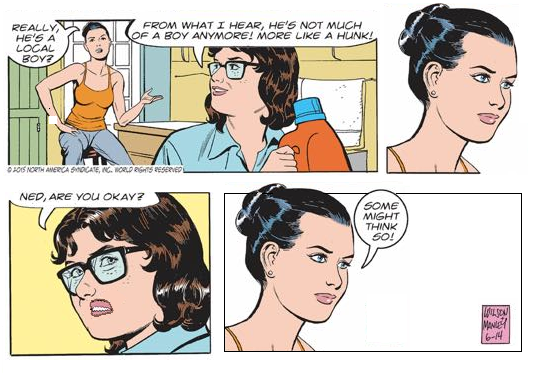
I just liked the haunted look on Ned's face.

Finally, here's a Marvin/Funky Winkerbean crossover, since I know you were all waiting for that.

Well, at least she didn't miss those leaves.

Wednesday, January 7, 2015

Saturday Morning Fever: A field guide to cartoon shows based on pop groups (updated)

The Beatles in (crudely) animated form.

You can score gold and platinum records. You can fill huge stadiums and arenas. You can win Grammys. You can have fan clubs with millions of dues-paying members. You might even get your own movie. But in the pop music business, you haven't truly made it until you get your very own Saturday morning cartoon show.

Or at least that's the way it used to be.

The era of the pop music-based cartoon show seems to be behind us now. But from the mid-1960s to the early 1990s, it persisted as one of the weirdest sub-sub-genres of animation on television. Until 1965, there had never been a cartoon show based on real, living human beings. But that all changed with an enterprising producer named Al Brodax who got the bright idea to base a cartoon show on a certain British rock 'n' roll combo. And it is with that very combo that we begin our journey into Toontown.

The Beatles

The show: The Beatles (1965-1967)

The premise: The Fab Four travel around, playing concerts and getting into zany, slapstick-heavy adventures replete with non-sequitir sight gags and pseudo-Marx Brothers banter. This will be the template for virtually every pop music cartoon show to follow. (Hammerman is the only major exception.) This was, as I've already mentioned, new territory as far as cartoons were concerned, so Brodax and his crew were figuring it out as they went along. 

One major issue was characterization. How do you differentiate between these guys when they wear matching suits and all have the same hairdo? The characters' faces are actually pretty well-drawn and serve as recognizable portraits of John, Paul, George and Ringo. And the show's two main voice actors do a fairly good job of creating four discernible voices. Writing-wise, it is Ringo who is singled out from the other three as the designated "wacky" one, the unpredictable goofball who is most likely to be the catalyst for plots and who serves as both the instigator and recipient of most of the punchlines. He's the Kramer of the show, in other words. 

Even though it's often corny and was clearly produced under a strict budget, The Beatles is still a lot of fun. The plots are generally based around the Beatles' songs, and there are a lot of proto-music videos in which the lyrics are literally acted out. Here, as in all future pop music cartoons, this involves many scenes of the group members running around frantically.

Did they do their own voices: Oh, no. No, no, no. Lance Percival did the voices of Paul and Ringo, while voice acting legend Paul Frees was John and George. The only time you'll hear the real Beatles is during the songs, all of which come directly from pre-existing albums and singles. The group recorded no new music for this series. Al Brodax later produced a Beatles animated feature, Yellow Submarine (1968), in which the real-life Fabs made a brief cameo at the very end and did contribute new songs to the soundtrack, but again their cartoon counterparts were voiced by actors.

Sidekicks: First, an explanation of this category. In subsequent shows of this nature, the pop stars will often be saddled with sidekicks, such as "cute" kids or talking animals or both. For one episode of The Beatles, "I Call Your Name," Ringo has a pet frog named Bartholomew (voiced by Paul Frees). And occasionally, the Fabs have a veddy, veddy proper British chauffeur named James who drives them from place to place. But, for the most part, the Beatles are allowed to carry this show all by themselves, with Ringo serving as a sort of mascot. Interestingly, the character of "Jeremy the Nowhere Man" does serve as their sidekick in the Yellow Submarine movie. Maybe that set the precedent for the pop star cartoons which followed.

Rating: 4 out of 5


The Jackson Five

The show: Jackson 5ive (1971-1972)

The premise: The Jacksons are five kids from Gary, Indiana who get discovered (accidentally) by Diana Ross and subsequently become big recording stars, making hits and touring the nation. As with The Beatles, one member of the group is singled out as having the most vibrant personality and the greatest likelihood of getting into madcap hijinks. In the case of Jackson 5ive, a series produced by Rankin Bass (a company best known today for its many Christmas specials), it's clearly the brash young Michael in the spotlight while Tito, Marlin, Jermaine, and Jackie all seem like interchangeable clones of one another. After a pilot which outlines their quick, relatively painless ascent to stardom, the rest of the episodes focus on typical cartoon schtick in various settings. 

Or maybe not so typical. Some of the episodes have such downright surreal log lines as "Michael is kidnapped by a monkey who forces him to play the bongos." There's even a parody of Kurosawa's Rashomon entitled "Rasho-Jackson." The show's utter goofiness and the exuberance of the J5's early music make this show surprisingly watchable, despite the low-budget animation and the relentless chortling of the laugh track.

Did they do their own voices: Nope. Just a bunch of actors, with Paul Frees doing various supporting and background characters. The confident, assured speaking voice of the "Michael Jackson" character on this show is extremely different from the timid, effeminate whisper the real Michael Jackson had. But MJ got his chance to voice an animated character in the "Stark Raving Dad" episode of The Simpsons twenty years after this series. And the Jacksons did contribute at least one dynamite piece of "new" music to this series: the lightning-paced theme song which serves as a mash-up of some of the group's greatest hits.

Sidekicks: Michael has a pet pink snake named Rosie (who sets the plot of the pilot in motion) and a pair of mice named "Ray" and "Charles" who live in his front pocket. Ray and Charles actually serve as the focal point for one entire episode, "Ray & Charles: Superstars." Amazingly, this cartoon came out a year before "Ben," Michael's #1 hit ballad about the love between a boy and a rat.

Rating: 3 out of 5


The Osmonds

The show: The Osmonds (1972-1974)

The premise: The key to the Osmonds' success in the 1970s was simple -- copy everything the Jackson Five did. Their signature hit, "One Bad Apple" (which serves as the theme song of this show), is as close to musical plagiarism as you can legally get. So a year after the Jackson brothers did a Rankin-Bass cartoon show, the Osmonds did the exact same thing in the exact same way. And, yes, Paul Frees is along for the ride. 

Like the Beatles and Jacksons before them, the Osmonds travel around, play music, and get into shenanigans. They have their own yellow "psychedelic" plane, clearly modeled on the Beatles' Yellow Submarine, and they travel to various parts of the world. Unfortunately, the depiction of non-white characters on the show is not too terribly progressive. I first found out about this show over a decade ago when I discovered a VHS bargain bin with compilation tapes entitled "The Osmonds in China" and "The Osmonds in Spain." For whatever reason, these episodes are filled with embarrassing ethnic stereotypes that probably seemed completely normal at the time. 

In terms of characterization, only Donny Osmond and Little Jimmy Osmond get any personality traits. Donny is girl-crazy and the irrepressible Little Jimmy, the only tow-haired member of the clan, is the official "wacky" one constantly spouting malaprops and getting into mischief. Meanwhile, Allan, Jay, Wayne, and Merrill are treated like the "other brothers" on Jackson 5ive, meaning they all look and act alike. As you'd expect from a show about the Osmonds, everyone has huge white teeth.

Did they do their own voices: Yes! The Osmonds one-upped the Jacksons in this department. Actually, one of the few real points of interest here is the way the Osmonds deliver their lines. They were already seasoned showbiz professionals by this point, but they clearly weren't actors. Actually, their lack of finesse adds to the charm of this otherwise-regrettable series.

Sidekicks: Little Jimmy himself serves as a kind of mascot to the group, but the real sidekick role is filled by a dog named Fuji (voiced by, yes, Paul Frees). I guess Fuji is supposed to be Japanese because he speaks with a heavy faux Asian accent.

Rating: 2 out of 5


New Kids on the Block


The show: New Kids on the Block (1990-1991)

The premise: Basically a sitcom-ized version the New Kids' real life. NKOTB are teenage pop stars with legions of teenage female fans. They travel around the country in a tour bus under the watchful eye of their manager and try to sneak out and have fun whenever possible. Joey is the youngest and the only one still in school, but otherwise there seems to be very little attempt at differentiating the various Kids. Their main comedic foil is a burly bodyguard who essentially serves as the Sgt. Schultz to their Hogan's Heroes. The plots tend to be pretty thin and are interrupted from time to time for little skits or parodies. And whenever there's a lull, the editor will just splice in a second or two of the real-life New Kids either dancing or talking to the camera. Think The Monkees as filtered through Saved by the Bell and you're on the right track.

Did they do their own voices: Nope. The New Kids appear as themselves in live-action intros, but (supposedly for legal reasons) their cartoon doppelgangers are played by professional actors. The juxtaposition is jarring. The real Kids have very heavy (but genuine) Boston accents, while their ink-and-paint counterparts sound like the Bowery Boys in a 1940s B-movie.

Sidekicks: The New Kids have a grumpy manager, Mr. Scott, and a grumpy bodyguard hilariously named Biscuit. Biscuit's grumpy dog, Nico, is the closest the show has to a cute animal sidekick. (Not close at all.) None of these characters add anything of value to the show.

Rating: 1.5 out of 5


Kid 'n Play


The show: Kid 'n Play (1990-1991)

The premise: A squeaky clean G-rated adaptation of the raunchy teen comedy House Party, which I remember as being awesome but which I haven't seen in over a decade. In this series, as in that beloved movie, Kid 'n Play are high school students who enjoy rapping and dancing at parties. They clown around a little and try to impress girls. That's about it. At least in KNP's other failed TV show, they got to be detectives. Very little seems to be happening in this series. It's a bad sign when Kid's famous high-top fade hairstyle is wilder in real life than it is in the cartoon. Man, I should really watch House Party again. Funny stuff. Funny, funny stuff.

Did they do their own voices: Nope. The real guys, Christopher "Kid" Reid and Christopher "Play" Martin, did live-action introductions to the cartoons, but voice actors took over from there. One of these voice guys, Brian Stokes Mitchell, also filled in as Danny on the New Kids cartoon show. Coincidence? Cree Summer is in the voice cast, too, for all you Drawn Together fans.

Sidekicks: The duo have a dog who has a mohawk and sunglasses and can drive a van. He can't talk, though, at least not as far as I could tell from the existing clips. If the dog had a name, I didn't catch it.

Rating: 2 out of 5


M.C. Hammer

The show: Hammerman (1991)

The premise: Actually kind of convoluted. At heart, this is a Superman/Clark Kent-type deal. Mild-mannered Stanley works at a rec center in "Oaktown," but when he dons a pair of magical dancing shoes, he becomes the superpowered Hammerman, who fights crime and rescues people from various other calamities. But the shoes, you see, were given to him by an "old Motown dude" named Gramps who traveled around the world with his granddaughter Jody in an epic quest to find someone worthy of such a gift. The theme song helpfully explains this mythology in detail. The series itself is actually not bad by the low standards of the genre. It's preachier than The Osmonds or The Jackson 5ive, which sought only to entertain rather than educate, but it's also a little more inventive than those shows, with a funky look based on "old school" graffiti and lots of absurdist quasi-Warner Brothers humor. It's not entertaining or funny enough to merit sticking around too long, but it's not the complete embarrassment I expected.

Did he do his own voice: The IMDb says he did, but the cartoon Hammerman doesn't sound much like the M.C. Hammer we all know and love. The real deal definitely appears in live action wraparound segments, though, so Hammer fans get their money's worth from this show.

Sidekicks: Oh, brother, does Hammerman have sidekicks! Way, way too many. In addition to Gramps and Jody, there are the rec center kids, two female backup singers who pop up unexpectedly to comment on the plot, a big goofy dude named Showbiz, and a really random white dude with a keytar. And since Hammerman's shoes have eyes and can talk, they qualify as sidekicks, too. The sidekicks are so numerous that they threaten to crowd Stanley/Hammer out of his own show.

Rating: 2.5 out of 5

BONUS CLIP!

Black Sabbath


The show: The Black Sabbath Show (supposedly from 1974; actually 2001)

The premise: The members of Black Sabbath travel around the world, playing concerts and getting in adventures. Tony and Geezer are the normal ones. Ozzy is the wacky one (see also: Ringo Starr, Michael Jackson, Little Jimmy Osmond). And Bill drinks constantly and speaks in gibberish, which the others can apparently understand. Oh, and they have a dog, too. Unlike the cartoon Osmonds, Ozzy and the boys apparently can't afford a private plane and instead travel by commercial jet. 

This was a sketch from Robert Smigel's tragically short-lived TV Funhouse series (from the "Caveman Day" episode), and it manages to cram in virtually every trope of the "pop star cartoon show" genre, right down to the little details like the opening credits and the transitions between scenes, not to mention the more-than-vaguely-racist "world travel" gimmick. Smigel and crew really did their homework. The stiff animation, the laugh track... it's all perfect! Let us give thanks and praise to the segment's director, John Schnall, producer Frank Drucker, and writers Tommy Blacha, Greg Cohen, and Dino Stamatopolous, whom you may remember from Mr. Show with Bob and David or from Community, where he played "Starburns."

Did they do their own voices? Uh... nope.

Sidekicks: An English sheepdog named Doom Doom.

Rating: 5 out of 5

Saturday, September 28, 2013

Ravi Shankar and George Harrison: Their obscure, late-career masterpiece

Two friends, captured decades apart: Ravi Shankar and George Harrison

I have written of my atheism on this blog several times in the past, but I wouldn't want people to get the impression that I think I have the universe figured out or that I'm not awed by nature. On the contrary, I am sometimes overwhelmed by the beauty and complexity of this world and of what lies beyond it. 

Some of my favorite art has been created in service of religions to which I do not subscribe, and sometimes this very art -- particularly music -- makes me wish that I were a believer, too. That's the experience I had when listening to the little-known album Chants of India (1997). 

I didn't go out looking for this album. I'd never heard of it until I (more or less) accidentally found it through a YouTube search, and even then I didn't know exactly what it was. I just wanted some relaxing music to listen to while I worked, and I prefer longer videos because they're more practical for such purposes. (I didn't want to go looking for new clips every four or five minutes.) I saw a YouTube video of something called Chants of India that ran for 1 hour and 3 minutes, so I clicked on it and went to work. Soon, however, I began to notice how truly beautiful this music was and stopped what I was doing to investigate.

As it happens, Chants of India was recorded by world-renowned sitarist Ravi Shankar (1920-2012), the most famous Indian musician of the last century. A great deal of his popularity outside India was due to the fact that his music was strongly advocated by the Beatles, particularly George Harrison. Shankar and Harrison formed a long-time friendship, and the two organized the famed Concert for Bangladesh in 1971. Over a quarter-century later, George produced and sang on Shankar's Chants of India LP. 

Despite the participation of a Beatle, the album is not currently in print as far as I can tell. At the time of this album's appearance, George had not put out a studio album under his own name in ten years; he died only four years after Chants of India's under-the-radar release. Shankar would live another 15 years, but Chants was his last major professional collaboration with the ex-Beatle. Why it's not instantly available on iTunes in 2013 is beyond me. Still in all, one track in particular stands out: "Prabhujee," a devotional hymn whose lyrics translate as:
Oh Master, show some compassion to me. 
Please come and dwell in my heart.
Because without you, it is painfully lonely.
Fill this empty pot with the nectar of love.
I do not know any Tantra, Mantra or ritualistic worship.
I know and believe only in you.
I have been searching for you all over all the world.
Please come and hold my hand now.
When I first heard the song, I didn't know any of that because the lyrics are all in Hindi. I didn't even know who had recorded it. My thoughts during that first listen were of a traveler who had spanned a great distance, crossing a vast ocean, and had arrived safely at the shore. I felt that this journey was a metaphor for life itself and that the shore was the afterlife or one's ultimate destiny. 

Knowing that George's own life was nearly over when this was recorded gives the song a special significance, as does the line about hand-holding, since it beautifully (if unintentionally) echoes the Beatles' "I Want to Hold Your Hand" and gives that up-tempo Lennon-McCartney rock number an unexpected religious significance. 

I was also struck by the fact that "Prabhujee," while not tied to any particular era in music, was so similar to the music being made by contemporary bands. Specifically, the song combines the slow, sweeping grandeur of Sigur Ros with the keen melodicism of Arcade Fire. In fact, if I were describing this song to someone who'd never heard it (as I am doing now), I would say, "Imagine Sigur Ros covering an Arcade Fire ballad and stretching it waaaaaaaay out."

Here is the song that so impressed me. I hope it impresses you as well.

Monday, June 24, 2013

Joe's Record Collection: Lots of artists try to cash in on Beatlemania

Not quite the Beatles: The Rutles are among the artists featured on Rhino's Beatlesongs!

I N T R O D U C T I O N

When I was a teenager, I could spend hours simply listening to music. Every day after school, I'd head up to my room, put on my oversized, padded headphones and turn on my trusty six-disc CD changer (which I still have), then lie on my bed or sit Indian-style on the floor and just commune with the sounds coming through those wires. Other than maybe looking at the album cover or glancing at the liner notes, there was no visual component to this activity whatsoever. As often as not, I'd have my eyes closed. There was no physical component either. I didn't dance to these songs, not even when they were clearly recorded for that specific purpose. The Disco Years, Vol 1 would command the same rapt, serious attention as Sgt.Pepper or Beethoven's Ninth. At most, I might sway a bit in time to the rhythm and involuntarily mouth the words along with the singer.

Music wasn't the accompaniment to some other activity back then. It was the activity. What else could I possibly have needed that the songs themselves weren't already providing?

Today, a couple of decades removed from adolescence, I would say that I listen to as much music as ever. Maybe more. I love my iPod -- and I use that verb unashamedly -- because it allows me to take my entire, unwieldy music collection with me wherever I go, a concept that would have boggled my 16-year-old mind in the days when I had milk crates and filing cabinets full of carefully alphabetized jewel boxes taking up copious floorspace in my cluttered teenage bedroom. Now, thanks to Steve Jobs and his minions, I can listen to Big Joe Turner at the supermarket or Shonen Knife on the jogging path or Sigur Ros at the office. (Trust me, the Icelandic band's grandiose yet soothing music is perfect for cubicle drones.) If I want to dial up Exile on Main Street on a commuter train or Gladys Knight and the Pips' Greatest Hits in a motel room, I can... and frequently do. I can't even remember the last time I bought a physical copy of an album. The first thing I generally do with an LP once I download it from Amazon or iTunes is sync it to my iPod and evaluate the songs as I take a stroll around the neighborhood.

Pioneer PL-990: My savior?
All this is fine, but I kind of miss the days when listening to music was a standalone activity. So that's what I'm trying to regain, one album at a time, with this new recurring feature on the Dead 2 Rights blog. Over the years, without even really trying, I've accumulated quite a few vinyl records in a whole variety of genres, spanning several decades . Some I purchased at second-hand shops and garage sales. Some were given to me by relatives. And some... well, some I just seem to have acquired through a weird form of osmosis.

The great thing about vinyl, at least for the purposes of a project like this, is that it's decidedly not portable. I can't take my turntable to the burger joint across the street or to the park down the block. If I'm going to listen to these records, I'll be very literally tethered via my headphone cord to an appliance, a Pioneer PL-990, which is not going anywhere. That's what this is all about. I don't have any illusions about magically regaining my teenage mindset. Even if that were possible, I wouldn't want it. Too many years have gone by. My brain doesn't work that way anymore. But I do want to take a few moments to slow down, tune out the rest of the world, and really listen to an album from one end to the other. Will it be worth it? I guess I'll find out as I go along. Either way, I hope you'll accompany me.

And now, here's the first entry in the series....

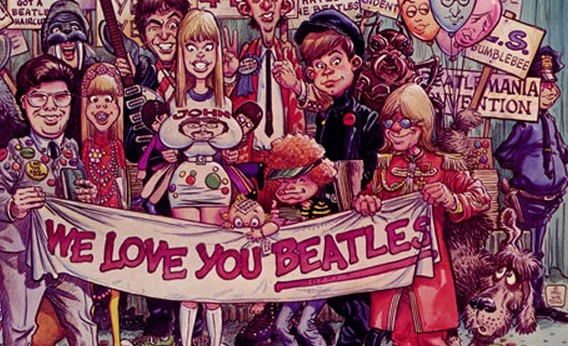
Assassin Mark David Chapman (left) makes an unwelcome appearance on the cover of Beatlesongs!

The record: Beatlesongs! The Best of the Beatles Novelty Records (Rhino Records, 1982 - RNLP 803)

Artist(s): Various, including the Rutles, Casey Kasem, Wild Man Fischer, Allan Sherman, and the comedy team of Peter Cook & Dudley Moore

Rhino Records' Beatlesongs!
History: Rhino Records started out as an actual record store on Westwood Boulevard in Los Angeles, founded in 1973 by the eccentric Richard Foos, but they began distributing their own records just five years later. Their first release was "Go to Rhino Records" (1978) by the notorious "Wild Man" Fischer, a schizophrenic ex-Zappa protege who'd been hanging out at the LA shop. Rhino Records issued a few punk and novelty singles after that, but their real forte turned out to be high-quality reissues of classic rock, soul, pop, and jazz records, and they became one of the top labels for such releases in the 1980s and 1990s.

In particular, Rhino became famous for its often quirky and clever compilation albums with distinctive packaging and well-researched liner notes. One early example was 1982's Beatlesongs! The Best of Beatles Novelty Records, a various artist LP with tracks about (but not by) the Beatles. Most of these are comedy songs released during the first wave of Beatlemania in America, circa 1964, but some are tracks recorded well after the group's demise. Unfortunately, the album was quickly taken off store shelves because of its deliberately tasteless cover illustration by William Stout, who depicted John Lennon's assassin, Mark David Chapman, as one of the attendees of a fictional "Beatlemania Convention."

I bought this in the 1990s at a real Beatles convention from a vendor who swore to me it would become a collector's item. It hasn't. But it still contains some interesting pop culture debris, mostly ephemeral records that were designed to have a very brief shelf-life. Rhino, meanwhile, was absorbed into Warner Music Group in 2009 and has largely been supplanted in the offbeat nostalgia biz by Shout! Factory.

All Music Guide says: 2.5 stars. "Unfortunately, the selections are not as representative as they might have been and occasionally venture into irrelevant territory." - Greg Adams [link]

Was it a hit: No, but "We Love You Beatles" by the Carefrees crawled up to #39 back in February 1964.

Choice excerpt from the liner notes: Musicologist Ken Barnes summarizes the "low comedy role" played by topical novelty records ("idol worship or idle wordplay, sycophancy or sicker fancies") and gives us background details on the artists, e.g. "Wild Man Fischer was so affected by the Beatles (his favorite group at the time) film Yellow Submarine, that he was moved to write 'I'm the Meany' after one of the cartoon characters. Wild Man says his new favorite group is the Go-Go's." The liner notes also contain an explanatory letter from Dudley Moore (by then a major movie star) to one of this album's producers, Harold Bronson. Moore says that "The L.S. Bumble Bee" was made quickly to capitalize on the druggy notoriety of "Lucy in the Sky with Diamonds" but musically was inspired more by the Beach Boys and the Supremes. "The only thing I can remember about the recording session," Moore writes, "was that Peter Cook had practically lost his voice when we were doing it, and found it very hard to put any tone into it."

Beatles label-mate Donna Lynn.
The listening experience: Quick and fulfilling. These twelve tracks are all brief, mostly in the two-or -three-minute range, and the songs tend to be upbeat and catchy, so listening to Beatlesongs! is a breeze. I must've listened to this record a lot in the '90s because I still knew the words to most of the songs by heart. Side One is fairly sedate stuff.

It starts with "The Invasion," a break-in record by Bill Buchanan and Howard Greenfield. Break-in records, for the uninitiated, are spoken-word comedy bits that are structured like news reports and employ cleverly-edited snippets of popular songs in an early, primitive form of sampling. Buchanan helped start this novelty sub-genre with his former partner, Dickie Goodman, back in the '50s with "The Flying Saucer (Parts 1 and 2)." "The Invasion" is a virtual replay of that record, only with the Beatles in place of aliens from outer space. "AMERICA, THIS IS THE END!" cries one panicked observer over the sound of an air raid siren.

Next up is something quite a bit more reverent: "Hold My Hand" by the Rutles, a late-1970s Beatles parody originally created by Eric Idle (of Monty Python) and Neil Innes (of the Bonzo Dog Band) for their British TV series, Rutland Weekend Television and later featured on SNL and their own feature-length NBC special. "Hold My Hand" is not a comedy number, per se, but rather a loving pastiche of the Beatles' early 1960s sound.

The Carefrees are up next with "We Love You Beatles," a song of devotion with a melody swiped from Bye Bye Birdie and sung with almost militaristic fervor.

Forgotten pop princess Donna Lynn, who recorded on the same American label (Capitol Records) as the Beatles, sings the goofy lament "My Boyfriend Got a Beatle Haircut," one of the rare records in which Beatlemania threatens to take a guy away from a girl, instead of the other way around. (On Side Two, the genders are reversed.)

Side One's craziest record -- by far -- is Casey Kasem's "Letter from Elaina," in which, over an instrumental rendition of  "And I Love Her,"  the famed DJ reads, with great sensitivy and gravitas, a missive from a hysterical female groupie who managed to get by security long enough to hug George for several seconds before he could break away, say, "Hi, bird," and drive away in a limo. ("My girlfriends were -- and are -- very envious," she boasts.) What's amazing about this record is how little actually occurs in the story and how much meaning Casey gives it with his tender tone of voice:


Side One ends with "Beatlemania," an instrumental mish-mash of the group's early hits, by Jack Nitzsche, the famed arranger and film composer, who throws in a bit of "Needles and Pins" -- a hit he cowrote with Sonny Bono -- for good measure. Apart from "Hold My Hand," every track on this side comes from the original 1960s heyday of Beatlemania.

Rhino Records mascot Larry "Wild Man" Fischer
On Side Two, things get a bit crazier. Kicking things off is "Beatle Rap," a "Rapper's Delight"-style novelty tune credited to a one-off group called The Qworymen (a play on John and Paul's pre-Beatle band, The Quarrymen) and apparently recorded exclusively for Rhino. Though the rapping is elementary by today's standards and the Beatle impressions are a bit shaky, this record is a blast for knowledgeable Beatlemaniacs, jam-packed with references -- some quite obscure -- to the Beatles and their careers, including the solo years. (The fake "Paul" mentions his then-recent drug bust.) Musically, it's built around the riff from "Day Tripper," but if you listen through headphones, you'll hear nods to "The Inner Light," "Strawberry Fields Forever," and "I Should Have Known Better." My favorite aside, from "John": "Anybody wanna buy some lithos?"

Cook and Moore are up next with their deliberately twee, pseudo-psychedelic pop song about a consciousness-expanding bumblebee. It's hard to believe that this song has been frequently been passed off as a "real" Beatles song and has turned up on Beatle bootlegs for years. It sounds nothing like them.

Next, Rhino Records' unofficial mascot, Wild Man Fischer, delivers the most out-there, avant-garde track on the whole compilation: his unhinged, off-key a cappella rant "I'm the Meany," which contains the line "She told me she was pregnant, so I hit her in the stomach!"

After that, Allan Sherman's "Pop Hates the Beatles," a parody of "Pop Goes the Weasel" complete with orchestral backing, sounds positively genteel. Sherman brings his usual Borscht Belt crankiness to the topic of the Beatles. The song is actually sung from the point of view of an exasperated father whose daughter is a confirmed Beatlemaniac. The live audience on this record, obviously composed of moms and dads of Sherman's generation, laugh appreciatively. Beatlesongs! ends with two quickie cash-in records from 1964 (or thereabouts).

The album's closer, "The Beetle" by hit songwriter Gary Usher, is an opportunistic attempt to create a new dance craze based very loosely on the Fabs.

It's cute enough, I suppose, but I got much more of a kick out of "Letter to the Beatles" by the Four Preps, a clean-cut 1950s pop quartet, i.e. the type of group largely made obsolete by the British Invasion. Perhaps fueled by jealousy, they released a musical lament about a poor guy whose best gal dumps him when she becomes obsessed with the Beatles and -- after receiving numerous unsatisfactory responses to her fan letters -- finally breaks down and agrees to purchase all the merchandise the group wants to sell her. Even if you love the Beatles so much that you're offended by this song, you have to admit that the chorus of "A Letter to the Beatles" is damned catchy. I think this tune is as worthy as any of closing this article, so I'll leave you with it. Enjoy.


Overall grade: B

Sunday, December 9, 2012

I promised myself I'd do a post someday about the band Cruella de Ville...

Cruella de Ville during their frustratingly brief 1980s career

A rare Cruella 12" single
This is me keeping a promise to myself.

I want this blog to be a force for good in the universe, and there can be no greater good than to let you readers know about an incredible Irish quartet called Cruella de Ville that existed only from 1982 to 1984 and released a grand total of eight songs, plus a handful of remakes and remixes. You can listen to their entire recorded output during a single lunch break. Wikipedia labels their music as "post-punk" and "goth rock," I guess those labels are accurate enough, but they make the band sound angry or gloomy, which it most definitely isn't... or wasn't.

I first heard their music on radio's The Dr. Demento Show back in the 1990s. In those days, I was a regular reader of a Usenet group called rec.music.dementia, where the show's playlists were regularly posted in advance. When I saw a song called "Those Two Dreadful Children" credited to Cruella de Ville, I assumed it had something to do with the 1961 Disney movie 101 Dalmatians, which features a villainess named Cruella de Vil, voiced by Betty Lou Gerson. Although that character did inspire the band's name, Cruella de Ville has no connection to Disney or the film. In fact, their music was unlike anything I'd ever heard. I was instantly hooked.

If I were trying to sell you on the music of Cruella de Ville, I'd describe it as what would happen if Wednesday and Pugsley Addams took over the band Queen. That about covers it. In fact, the band really was founded by a brother-and-sister pair, Colum and Philomena Muinzer, and did take a lot of musical cues from Queen, especially that group's guitarist, Brian May.

For a while, it looked like the band might make it. Cruella released a string of 7" and 12" singles in the UK, including a few on the Beatles' old label, EMI, but widespread commercial success was not forthcoming, and Cruella dissolved before even recording a debut album. The good news is that fans have collected and cherished those rare Cruella de Ville records for 30+ years now, and they've aged like fine wine. These songs are almost unreasonably fun. Here, take a listen to the group's best-known tune.


If you weren't blown away by "Those Two Dreadful Children," then you and I would have very little in common. That's the song that originally got me hooked on Cruella. After I heard that on The Dr. Demento Show, I knew I had to hear more... and what I found was almost too good to be true!

Here's another favorite of mine, a track called "Drunken Uncle John." This song especially resonates with me, because there actually was a "drunken Uncle John" in my own family, and his behavior was not too far off from what is described in the lyrics. Cruella even filmed a video for this one. Take a gander, won't you?


And that wasn't their only video, either! Check out this one for the insanely catchy "Gypsy Girl."


Cruella de Ville also made a few appearances on British television. Here they are performing another classic, an absurd and politically anti-correct little concoction called "Hong Kong Swing," whose lyrics seem to be a jumble of Japanese and Chinese terms strung together into tongue-twisting rhymes.


I wish I could say that there were lots more Cruella de Ville tracks to play for you, but there simply aren't. The band broke up, and the musicians went on to other, more sensible pursuits. You've already heard about half the band's entire catalog at this point, I'm afraid. But I hope you've enjoyed what you've heard. If you're the least bit curious for more of this group, I can provide some helpful links.
That's pretty much it. And now, I've fulfilled that promise to myself. Good for me.


Saturday, November 24, 2012

The Shaggs: The only true "teenage" music I've ever heard

The Shaggs: (from l to r) Betty, Helen, and Dot Wiggin

One of the great ironies/injustices of popular culture is that the music specifically marketed to teenagers is getting progressively more polished and "perfect" with each advance in technology, while the teenagers themselves remain -- as always -- bumpy, lurching, and awkward. There's an odd disconnect between the relentlessly smoothed-out, robotic, studio-crafted pop being released by a group like One Direction and the messy, utterly human vulnerability of that group's fans. Teenage music bears no resemblance whatsoever to teenage life. A yawning chasm exists between the two.

Mick: Handsomely un-handsome
This gap is nothing new, exactly. Past teen idols, like Frank Sinatra and Elvis Presley,  must have seemed superhuman to their fans, too. But Frank and Elvis both exuded a raw, quite human sexuality that largely eludes today's teen pop stars, who are "sexy" only in quotation marks and present a only a sanitized abstraction of carnal appeal to their fans, without any of that messy fluid exchange ruining it.

It's interesting that, during the 1960s, the British Invasion allowed a new type of entertainer to capture the teenage imagination. The Beatles and The Rolling Stones were not conventionally handsome in the Sinatra/Presley tradition. They had big noses, big lips, bad teeth, and cheekbones that jutted in at odd angles. I was just watching a documentary about the Stones last night called Crossfire Hurricane, and it was fascinating to see the Stones in their 1960s prime via newsreel footage. They looked sort of gawky and malformed, with carelessly floppy hair and sallow complexions, and yet they were driving their female fans into a state of erotic frenzy. At last, the weirdos had won! 

But it didn't last. The 1970s brought a new generation of generically handsome, neutered teenage idols (David Cassidy, Bobby Sherman, Donny Osmond) who set the precedent for those to come. And now, I guess, we have Justin Bieber, the platonic ideal of the safe, boring, utterly harmless pop star, a kind of life-sized Ken doll for the girls of Young America to play with for a few years. Kind of a pity.

All of this brings me back to the topic of the Shaggs.

I couldn't possibly tell you the entire saga of this astonishing all-female 1960s singing group composed of sisters from a working class New Hampshire family. You'll have to rely on this quirky but affectionate New Yorker article by Susan Orlean for the details. Here's an overview: in 1968, a Fremont, NH mill worker named Austin Wiggin decided to fulfill the deathbed prophecy of his mother, who proclaimed that Austin's then-teenage daughters would be famous. Austin pulled the girls out of school and forced them to become a rock band, even though the girls had no musical inclination whatsoever and definitely did not want to become performers.

Only one of the daughters, Dot, had any enthusiasm whatsoever for her dad's dream, so she was elected to be lead singer and songwriter of the resulting group, dubbed The Shaggs in honor of the Wiggin sisters' shaggy hairdos (and supposedly, the shagginess of the family dog). Despite their total lack of aptitude and success, The Shaggs soldiered on for 7 years, playing local gigs for audiences who either tolerated them politely or heckled them outright. The band finally ended in 1975 when Austin died, and the Wiggin girls -- no longer kids by then -- went on to lead very ordinary, non-musical lives.
 
The Shaggs' lone, infamous LP
Before the group's sad, drawn-out death, however, The Shaggs recorded and (barely) released one extraordinary album: 1969's Philosophy of the World. Though only a handful of copies were originally pressed, the utterly strange LP went on to become a cult favorite with avant garde rock musicians (including Frank Zappa and NRBQ) and influential critics who discovered it years after it was recorded. The album has been reprinted several times over the years and has also been released on CD and MP3.

For completists, there's even a collection of Shaggs rarities, live recordings, and outtakes called The Shaggs Own Thing, plus a hip indie-label tribute album called Better Than the Beatles. Even better, the strange, vaguely sad story of the Shaggs was the basis for a charming off-Broadway show, The Shaggs: Philosophy of the World, which I have seen and enjoyed. The musical tours quite a bit, and I was fortunate to catch it at Chicago's Lookinglass Theater a few years back.

But what about the original music itself? What's it like to listen to The Shaggs? Many listeners find it torturous, verging on unlistenable. For three demure New Hampshire girls, The Shaggs make a powerful racket, clanging away at their out-of-tune instruments with abandon. In particular, drummer Helen Wiggin seems to be in a world all her own. Throughout the album, there are lots of what music teachers would call "wrong notes," and the three ladies cannot seem to agree on a collective tempo, key, or time signature. Susan Orlean was right when she described their melodies as "squashed and bent." The album sounds like it was left out in the sun on a hot day and melted.

If Philosophy of the World weren't from 1969, you'd guess it to be some kind of primitive punk music, but the rawness of the music is at odds with the sweet simplicity of the lyrics. The Shaggs sing about looking for a lost cat ("My Pal Foot Foot"), the importance of obeying one's parents ("Who Are Parents?"), praising Jesus ("We Have a Savior"), and how nice it is to have a radio ("My Companion"). Austin Wiggin seems like he was a dictatorial parent who did everything in his power to keep the world away from his girls and vice-versa, so maybe the transistor radio was one of Dot Wiggin's few links to the outside world. Another recurring theme on the album is the foolishness of straying too far from one's home. "Little Sports Car" ends with Dot and her sisters singing, "I learned my lesson never to roam, never to roam, never to roam."

The late, great Crow's Nest in Crest Hill, IL
The main appeal of Philosophy of the World, to me, is that it provides a rare glimpse into the brain of a genuine teenager, without the interference of grown-up producers or executives. It's like an adolescent's diary brought to musical life, and for once the lurching, awkward bumpiness of the music matches the emotions of the singer. Nowhere is this more true than on the album's title cut, which is the first Shaggs song I ever heard.

"Philosophy of the World" was included on a 2000 compilation of so-called "outsider music" I purchased at a great, now-defunct record store called the Crow's Nest near my home in Joliet, IL. As I drove home from the Crow's Nest, I popped the disc into my car's CD player, and that song came blaring out of the speakers. I was entranced. I was hooked. I knew I had to get every last bit of Shaggs music out there. Fortunately or unfortunately, there's not much. Once you own Philosophy of the World and The Shaggs Own Thing (both of which have been combined onto a single CD simply called The Shaggs), there's not much to get, other than the tribute album. Although many people would struggle to get through even a single Shaggs song, I've listened to their entire catalog many times -- and none more so than this track:


P.S. - The rarities compilation is well worth checking out, too. It contains some later studio recordings by the group, some of which demonstrate that the Wiggins had been indeed practicing their instruments at least a little. One song in particular I love is "You're Something Special to Me," which contains a lyric that summarizes my own mindset: "Please don't speak unkind words to me. That would make me unhappy." Very simple, of course, but very true as well. If "Philosophy" was too much for you, maybe this will be more your speed.


Saturday, November 3, 2012

Dealing with my inner Jenna Maroney (Or: Do I have to be hospitalized again to get my readership numbers back up?)

Yes, Jenna Maroney is part of my psyche. Not that I'm proud of it.
 
One of things I'll miss most about 30 Rock when it goes off the air after this final season is the opportunity to watch Jane Krakowski portray Jenna Maroney, the staggeringly mercurial actress, singer, and comedienne whose life is a constant, desperate quest for fame, money, and (above all) attention. These tendencies lead Jenna to make all kinds of terrible decisions, and the unfortunate people in her life have to adjust their own lives to accommodate her. In a weird way, though, I can identify with this woman's problems. You see, readers, I sort of am Jenna Maroney.

Not the complete picture.
Yes, yes, I'm also a scared little turtle hiding in his cozy turtle shell. Let's say that's 70% of me. The other 30% craves the spotlight and demands attention and praise. The 70% and the 30% do not get along well, let me tell you. You may have gotten the impression from this blog that I am this meek, passive guy who's been trampled on by the rhinoceros of life. To an extent, that's true. 

But there's also an egotistical, spotlight-hogging side of me, too. As relatives and coworkers can tell you, I can be a real terror. I have a swift temper (or at least I did have one before the meds), and I've had to fight the frequent urge to lash out verbally at people or make withering critical comments to them, especially when they don't acknowledge my supposed "genius." Meanwhile, one part of me wants to hide away from the world, but the other part can't tolerate being anonymous and ignored. That's a regular issue for me at work. We're a busy, often hectic, deadline-centric place, and people don't always have time to give me the attention I want. I hope I'm learning to deal with that a little better day by day.

The "Wayne Kotke" persona I played on Mail Order Zombie has been a great way for me to be both an ostrich and a peacock at the same time. He exists in podcast and blog form only (under a fake name, no less), but he still allows me the opportunity to show off what a creative and talented guy I think I am. I sometimes wonder if this whole "depression/anxiety" thing has been a sick, elaborate scheme to get attention. Last Tuesday, the first hospital I visited parked me in an observation room wearing only a paper-thin gown for many hours, and I had lots of time to think about my situation. "Am I faking this whole thing?" I wondered. I mean, I've known about the anxiety-filled nights, the terrible waves of fear and sadness which have taken possession of my body, and the relatively empty life of underachieving and isolation. But still, the whole "faking it for attention" theory had some credibility.

Let me confess that I am fixated on the readership numbers for this very blog. If you've explored the front page at all, you've seen that little counter which lists the number of total pageviews. That's a quick way for me to see how D2R is doing, but I also spend an unhealthy amount of time obsessively going over the stats for individual days and individual articles, even though nobody but me even remotely cares about them. One weird side effect of my decision to blog about my depression and recovery is that it temporarily drove traffic to this blog. But over the past few days, I've seen the numbers drop back down to their usual level and I've seriously asked myself, "Do I have to be effing hospitalized again to get people to pay attention?"

Jenna Maroney just might do such a thing.

Saturday, September 22, 2012

Vivian Stanshall (1943-1995)

Vivian Stanshall, a.k.a. The Ginger Geezer

If I could give you but one piece of advice this fine September day, ladies and gentlemen, it would be to explore the life and work of Mr. Vivian Stanshall, an eccentric yet brilliant British comedian and musician perhaps best work for his days leading an anarchic 1960s musical collective called the Bonzo Dog (Doo-Dah) Band. 

I first heard of the Bonzos through their personal and professional associations with The Beatles and Monty Python, and my curiosity ultimately led me to track down a greatest hits album by the Bonzos. Before buying it, I'd only actually heard one of the ex-Bonzos, Neil Innes, performing a solo version of the group's lone hit single, "I'm the Urban Spaceman," in the film Monty Python at the Hollywood Bowl. I'd never heard any of their studio recordings and had not experienced in any way the work of Mr. Stanshall. 

Friends, I was stunned by what I heard on that greatest hits disc. Here was a man with the wild, surrealist humor of Python but with the dapper, distinguished manner of a true English gentleman. "Finally," I thought, "an old-money aristocrat has started a rock band! It's about time!"

I can't begin to summarize what Vivian did, but I can give a sample of his work. Here's an Elvis-inspired tune from his days wih the Bonzos, entitled "Canyons of Your Mind":