Showing posts with label best stuff. Show all posts

Wednesday, March 13, 2024

The strange but true saga of the 'What's My Line' intruder (updated for 2025)

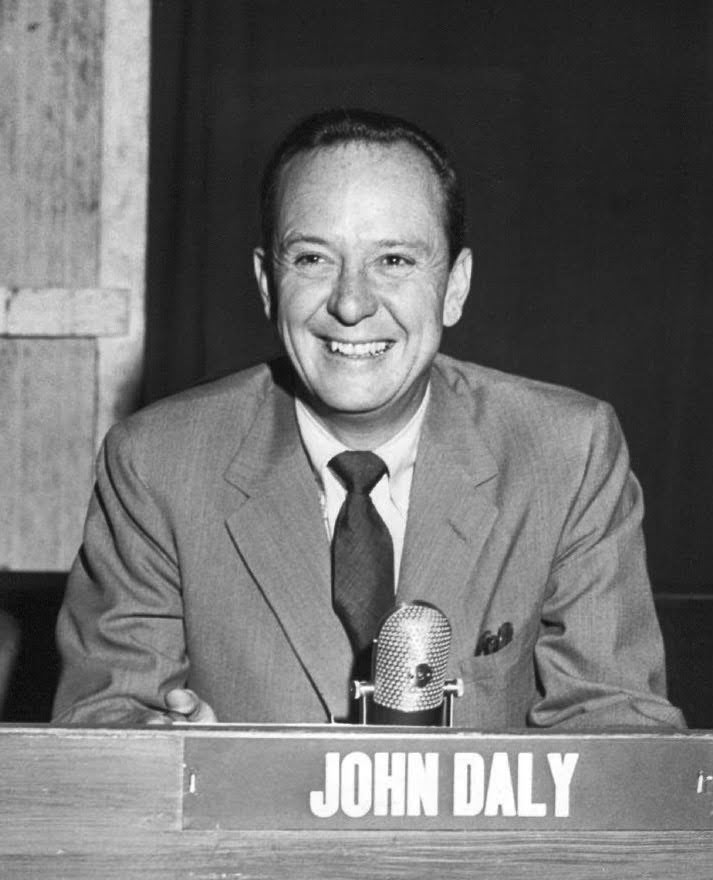
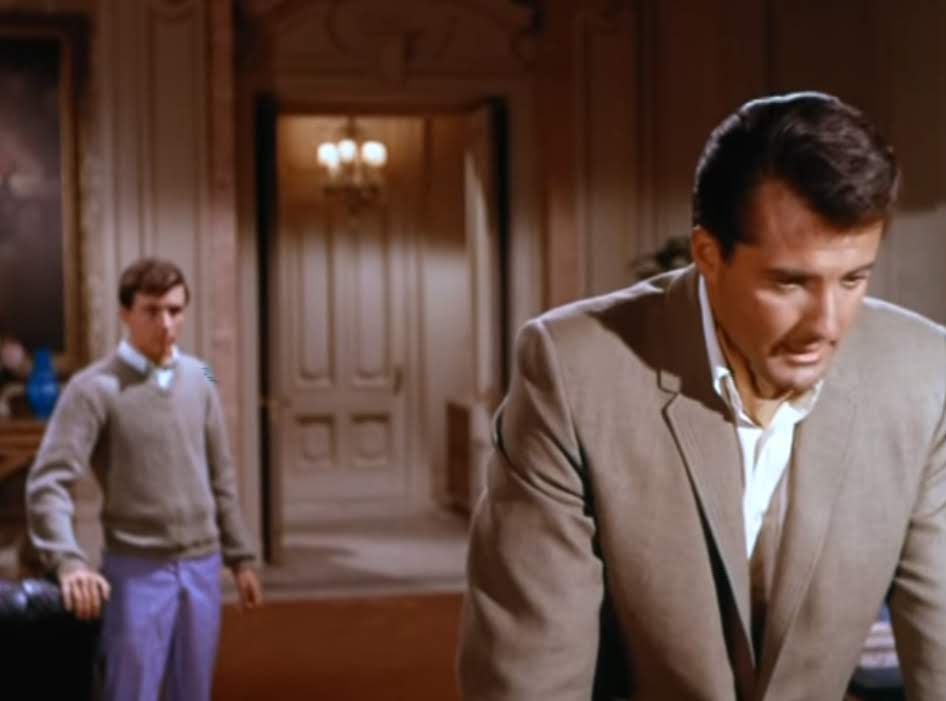
This pleasant young man somehow wandered onto the set of What's My Line.

Game show host John Charles Daly
The appeal of live television has always been the possibility that something might go seriously wrong on the air in front of an audience of millions. Much of what we see on TV is carefully planned, rehearsed, and edited before it ever reaches us. It's no wonder, then, that we hunger for a little chaos amid all that control. Let's face it, this is the main justification for Saturday Night Live's continued existence. The long-running comedy-variety series could easily be pretaped, but it would lose its sense of danger and spontaneity.

We hunger for an element of risk in our entertainment. I can't help but think about Dave Chappelle's stand-up routine in which he discusses the infamous night in 2003 when magician Roy Horn was attacked by a tiger during a show in Las Vegas. "That's why we really go to the tiger show, right?" Chappelle says to the audience. "You don't go to see somebody be safe with tigers."

These days, pretaped shows are the norm and live broadcasts are considered special events. This was not so in the earliest days of the medium in the 1940s, when virtually everything on TV went out over the airwaves as it was being made and relatively little was saved for posterity via crude kinescopes. A major change arrived in 1951, when Lucille Ball and Desi Arnaz had the foresight to film their sitcom I Love Lucy on 35mm stock, thus ensuring the episodes would be preserved for future reruns.

Over the course of the 1950s, videotape technology improved and became more common in the industry, allowing shows to be shot in advance and edited. This was seen as a potential breakthrough for the medium. On his 1957 record "Tele-Vee-Shun," satirist (and stubborn TV skeptic) Stan Freberg begrudgingly admitted that "videotape may help somewhat." Freberg himself had been a puppeteer on the children's show Time for Beany (1949-1955) and had learned about the hazards of live television when he'd burned his hand during a sketch involving a clown. On a DVD commentary, Freberg recalled that the clown puppet made "a fast exit" from the scene after catching on fire.

By the 1960s, many shows were being filmed or taped in advance, but the venerable panel show What's My Line (1950-1967) was still being broadcast live every week from the CBS studio in New York City. Produced by Mark Goodson and Bill Todman, What's My Line is the kind of stately, old-fashioned program that seems inconceivable to modern day audiences. The premise is very simple. The host introduces a contestant with an unusual occupation, and then four celebrity panelists—generally culled from the theater and publishing worlds—try to determine that occupation (or "line") via a series of yes/no questions. ("Do you work with animals?") The contestant's goal is to stump the panel for as long as possible.

For me, the highlight of each What's My Line episode is the appearance of a celebrity "mystery guest." During this round, the panelists wear blindfolds and attempt to guess the identity of the famous person, again through yes/no questions. ("Are you known for your work in the theater?") This is an exceedingly polite and genteel program, making it truly seem like a relic from a bygone age. The show's stuffiness is now, at least to me, its chief selling point.

Sunday, April 5, 2020

A Clown, for Christ's Sake: The curious career of Rev. Floyd T. Shaffer (UPDATED AGAIN!)

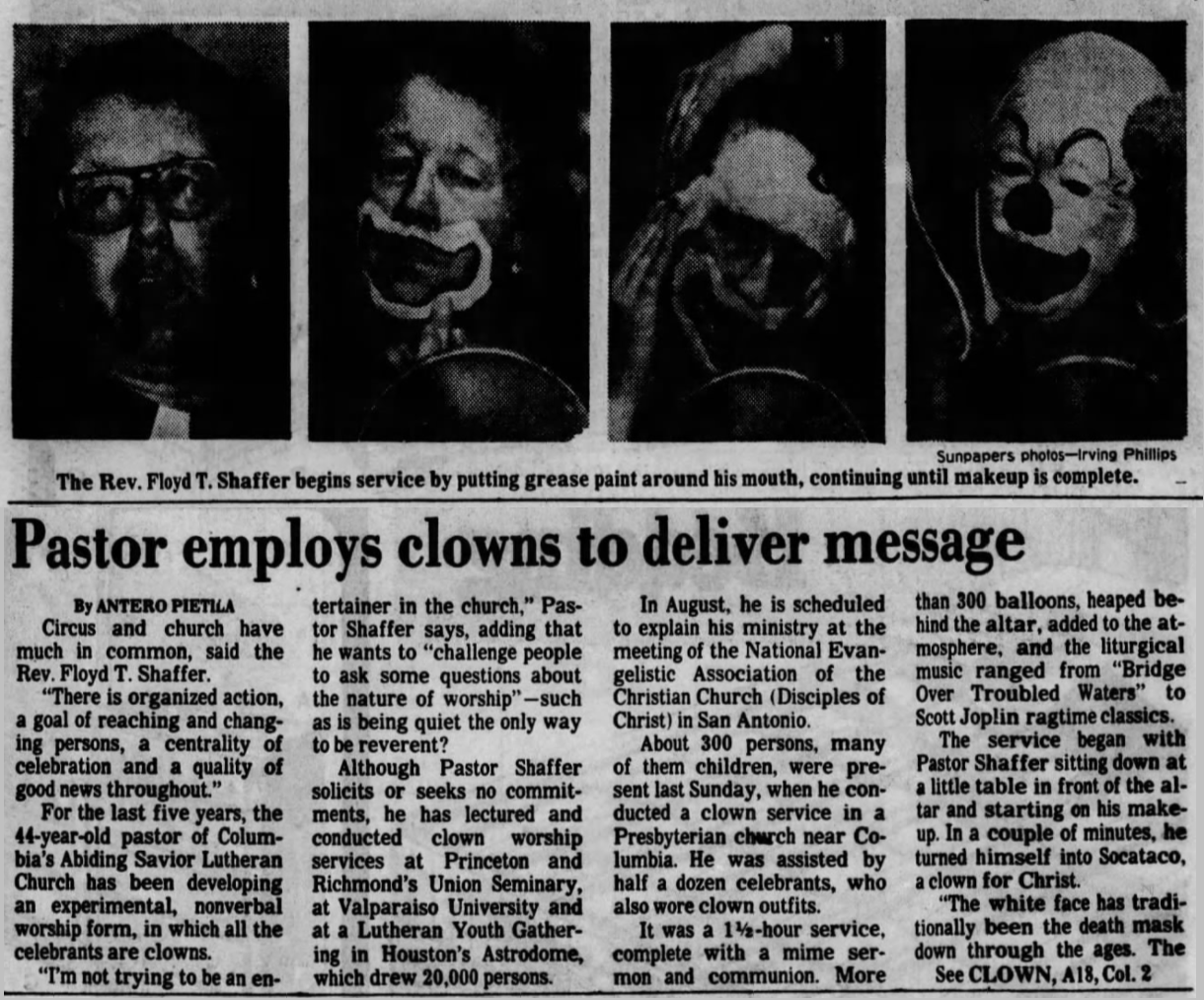
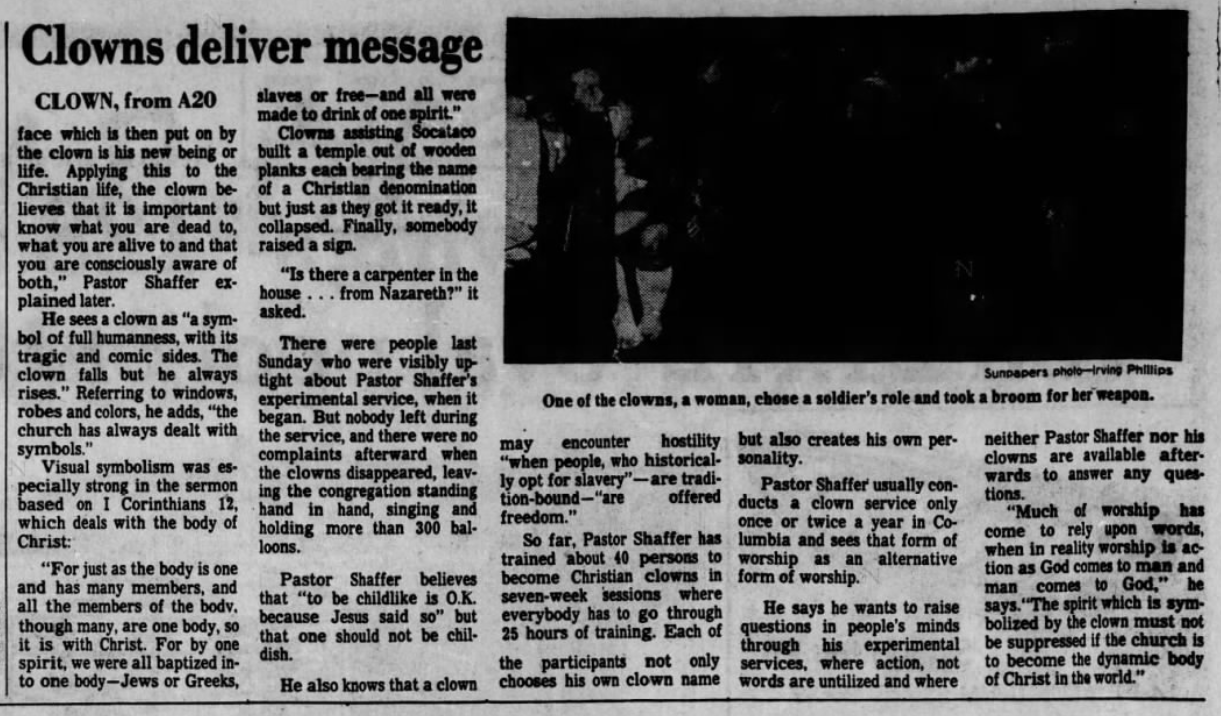
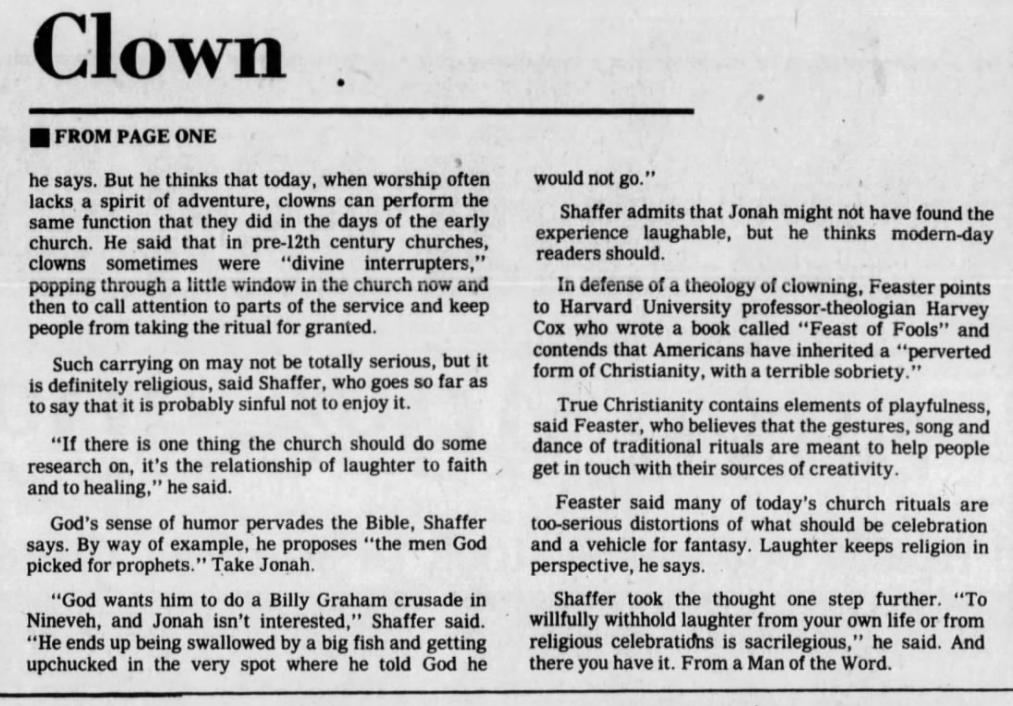
A tabloid article about Floyd Shaffer, the religious clown.

Floyd Shaffer's first book.
The Reverend Floyd T. Shaffer was looking for a new way to reach his congregation in 1969. How could he possibly get through to his practical, sensible flock during that tumultuous age of Vietnam, Woodstock, and Manson? The unlikely answer was by donning a fright wig, floppy shoes, and a round, red, rubber nose.

Though he may not have invented the form, Floyd Shaffer became, for a time, perhaps the most prominent and beloved proponent and practitioner of religious clowning in America. Born in 1930, the kindly and gentle Shaffer was a devout, deeply sincere Lutheran minister whose career trajectory took him from Michigan to Maryland to Ohio. In fact, Shaffer experienced his greatest period of productivity and prominence in the Buckeye State during the Reagan-Bush years. But to appreciate this man's story in full, we must travel back to the Age of Aquarius.

Destined to become a literal Holy Fool, Floyd Shaffer started upon his unusual path in the late 1960s in Columbia, Maryland, where he preached God's word at the still-existent Abiding Savior Lutheran Church. It was at Abiding Savior that Shaffer first introduced costumed clowning into his ministry and encouraged others to follow his example. According to fellow religious clown John Garrett, Floyd was aligning himself with a liturgical tradition stretching back to the Middle Ages, when so-called "holy interrupters" would lighten the mood of formal services with their comedic outbursts. Although a keen student of clowning history, Shaffer was more likely influenced by the counterculture of his own time. Clowning and mime were art forms beloved by hippies, who also had a penchant for face-painting and the donning of colorful, garish clothing. Back in 1969, a preacher dressed as a clown could almost be considered edgy or hip.

In those early years, Shaffer and his ilk were not always welcome among mainstream Christians. The soft-voiced pastor related to his followers the story of his disastrous appearance at a 1970s youth conference held at Houston's famed Astrodome. There, Shaffer and his fellow beneficent buffoons were regarded with extreme skepticism. Thinking the clowns were blasphemous, the other conference attendees derided and, in some cases, attacked Shaffer's troupe. Arlene Trapp, an original acolyte of Shaffer, recalled being "treated like Jesus, kicked at, hit, and mocked."

Still in all, Shaffer's tomfoolery-based evangelism must have yielded positive results in those early days, because he kept at it. In 1974, still based in Columbia, he founded Faith and Fantasy, a nondenominational clown ministry popular enough to have lasted into the 1990s, though its alumni remember it as a loosely-affiliated "non-organization" whose members were never keen on rules. During these years, determined to spread the message of Christ through the techniques of Emmett Kelly and Marcel Marceau, Shaffer and his followers performed their wordless, mime-based act at weekly Lutheran services and also visited numerous hospitals and nursing homes, where they found an appreciative, if captive, audience for their antics.

By 1981, having relocated to Ohio, Floyd Shaffer was well-known enough to attract the attention of the popular press. In August of that year, the black-and-white tabloid Weekly World News ran a profile of Shaffer with the headline "Preacher clowns for God to fill the pews." While essentially flattering to the clown minister, the article also described him as "wacky" and "bizarre."

The Christian Science Monitor followed suit in September with a slightly more dignified article by Stewart McBride headlined "Holy fools rush in." More wide-ranging than the Weekly World News piece, McBride's article looks at different examples of clown ministry from across the United States. In this context, rather than the isolated kook portrayed in the tabloid, Floyd Shaffer is part of a vital, burgeoning movement. The Monitor still recognized Shaffer as a pioneer, however, calling him "one of the first clergymen to perform a Sunday service in whiteface and clown costume" and declaring that "hundreds have followed in his suit of many colors."

The cover of the infamous video.
A few years after these articles introduced the Christian clown phenomenon to a national audience, Floyd Shaffer began writing a series of guidebooks about the topic dearest to his heart. If I Were a Clown and Clown Ministry appeared in 1984. Clown Ministry Skits for All Seasons followed in 1990. Of these, it is Clown Ministry that brought Shaffer a sort of late-blooming, ironic notoriety. The book was accompanied by a 92-minute instructional video that, decades later, was widely excerpted and mocked (shades of the unhappy Astrodome experience!) on video-sharing sites like eBaum's World, Daily Motion, and YouTube.

That was how I first became acquainted with Floyd Shaffer and Clown Ministry. In February 2011, comedians and avid thrift store scavengers Joe Pickett and Nick Prueher used clips from Shaffer's 1984 video in an episode of their web series, The Found Footage Show, which they originally produced for the A.V. Club website. They said they found the VHS tape at a church rummage sale. "This one was intended for budding Christian clowns who wanted to start their own clown ministry," explained Prueher. "I've never understood the connection between Christianity and clowning, and this video certainly didn't help." To which Pickett added: "Really, this video is the best argument against putting your grandparents into a nursing home."

For those whose curiosity has been piqued, the entire Clown Ministry video is now available for viewing on YouTube. In these 92 minutes, Floyd Shaffer walks us through the history and purpose of Christian clowning, demonstrates how to properly apply clown makeup, and even lets us tag along on a typical nursing home visit. It is this last aspect of the video that has attracted the most attention and ridicule over the years, as the elderly patients here seem bewildered and frightened, rather than delighted, by the antics of Shaffer and company.


Floyd Shaffer today
"The clown has no age," Shaffer optimistically told the Weekly World News in 1981. Mankind, however, is not immune from the ravages of time. Now 85 years old and comfortably retired since at least 2006, Floyd Shaffer has returned to his home state of Michigan, where he lives with his wife in Saginaw. The couple have two grown children. Though no longer clowning, Floyd Shaffer is still a loyal follower of the Lutheran faith.

The man's longstanding influence on the world of Christian clowning remains undeniable. In a September 2013 article on the World Clown Association website, Janet "Jellybean" Tucker recalled how seeing Shaffer changed her life; "It was in 1979 or 1980 at a Clown, Mime, Puppet, Dance Ministry Workshop in Oberlin, Ohio, and I saw Floyd Shaffer do a bit on feeding the hungry where his clown ate gobs of popcorn but offered it to a hungry person one kernel at a time. I began reading the Bible through different eyes and began to see the Bible characters as real people."

Obviously, despite the snickering of the internet, Shaffer's message got through to some viewers. As recently as April 2015, Christine Fontaine, a religious-minded mime in Northfield, Massachusetts, contacted Floyd by phone to seek his advice and counsel on how to proceed with her work. The two talked for an hour. As always, Floyd Shaffer remained committed to clowning for Christ.

UPDATE FOR 2020: Amazingly, some more vintage footage of Floyd Shaffer has surfaced! In addition to touring with their collection of offbeat videos, Joe Pickett and Nick Prueher also have a weekly YouTube series called VCR Party Live. In a recent "quarantine" edition of the show, the hosts interviewed film archivist Skip Elsheimer, who specializes in educational and industrial films. One of the clips Elsheimer showed during this visit depicts Floyd, both as himself and in costume, doing some Christian clowning.

After Pickett described the clip as "clown communion," Elsheimer responded: "That one, I can't remember. The title just suddenly left my brain. That one I got recently, and that one I have not shown online anywhere." He went on to say he didn't know where this film was originally shown. "I think this is too scary for Sunday school class." Pickett and Prueher note that the film is dour and that the clowns in it do not seem happy.

Floyd Shaffer appears as himself and as a clown in a newly-discovered film from the 1970s.

Scored with incongruous ragtime piano, the footage seems to date back to the 1970s when Shaffer was working with the Faith and Fantasy troupe in Columbia, Maryland. It may have been made as a record of what their performances were like back then. The movie begins with shots of a congregation in a mid-sized church. Floyd himself, with a full head of curly hair, enters the room in traditional vestments. A slight smile passes over Floyd's face as he stands behind the altar, and through the magic of editing, he transforms into a clown, complete with a red nose and a derby hat. The parishioners are understandably shocked and confused, though some kids giggle.

Floyd opens a gift box and retrieves a card that says FOR THE CONGREGATION. (This may be the title of the film.) The box also contains a pile of severe-looking nails. Shaffer takes one of these nails and hands it to another clown who has joined him at the front of the church. He presses it firmly into the second clown's palm, as if this is communion, and the nail is a wafer. He performs this same service for a third clown, and a title card reading "Communion" appears onscreen.

Floyd pulls a heavy wooden crucifix from a red box, then places bread and wine on the altar. After that, he fills a metal bowl with water from a jar. He takes the bowl over to a small group of clowns and has them place their hands in the water. They dry their hands. Shaffer then solemnly raises the loaf of bread and the wooden crucifix in front of him.  He places the bread on the cross as if the bread itself were Jesus being crucified, but then he breaks off a hunk of it from the bottom. Shaffer then mimes pouring invisible blood from the crucifix into a bottle already filled with wine. He and the other clowns silently, seriously eat the bread and drink the wine as the film fades to black.

The relevant portion of the video begins at about the 28:25 mark. Enjoy.


UPDATE FOR 2021: In my research on Shaffer's career, I found an elaborate article about him in the August 26, 1961 edition of the Fort Lauderdale News. Back then, he was serving as the pastor for Christ the King Lutheran Church. The article includes background details on Floyd's early life and a great picture of the man himself.

An article about Floyd's younger days.

And here's an article from the June 1, 1975 edition of The Baltimore Sun.

Baltimore Sun story about Floyd (part 1).
Baltimore Sun story about Floyd (part 2).

Wherever Floyd went, publicity followed. Here's a huge article from the June 10, 1981 edition of the St. Louis Post-Dispatch.

Floyd in St. Louis (part 1)

Floyd in St. Louis (part 2)

Tuesday, January 29, 2019

'Happy Days' memories: An interview with actor Richard Kuller

Richard Kuller on Happy Days in 1974; inset: Richard as he looks today.

The "R.O.T.C." episode of Happy Days
Recently, it has been my great pleasure to co-host a podcast called These Days Are Ours, devoted to the nostalgic 1974-84 sitcom Happy Days starring Henry Winkler and Ron Howard as fun-loving teens in 1950s Milwaukee. Each Tuesday, my cohost and I review another episode of the classic show, thoroughly breaking down the plot, themes, and characters. Here's our latest installment.

Along the way, I've been doing some research into Happy Days, learning how it was made and delving into the careers of the people who made it happen. That includes the many fine actors who guest starred on the series, lending to their talents to an episode or two before moving on. This week, I had the privilege of conducting an online interview with one such performer, Richard Kuller, who appeared in the episodes "R.O.T.C." and "Kiss Me Sickly" in 1974 and 1975, respectively. Richard's other TV and film credits include CPO Sharkey, Copacabana, and Danger Team. He currently teaches theater and dance in California.

Here is our conversation. Richard was very cooperative in answering my nerdy questions about Happy Days, for which I am very grateful.

Had you heard of or watched Happy Days before appearing on it? I ask because the show was fairly new then. 
Yes. I had also done children’s theater in New York before that, with Henry Winkler. 
My guess is that the marching scenes in "R.O.T.C." were filmed away from the Paramount lot, probably at a college or high school with a football stadium. Do you remember where this was? 
It was at a high school, but I don’t remember which one. Those were real ROTC classes marching on the field. Henry was not called that day, although he did appear in the episode. 
Director Jerry Paris
Any particular memories of the cast or director Jerry Paris?

He was a very funny man, and he razzed me, since it was my first time on the show. He told me it was a tradition that I was to pay him a dollar. I thought he was joking and didn’t pay him. He confronted me on the field in front of everyone and demanded my lunch money, which was a few bucks. I pulled the envelope out of my uniform, and the money fell on the ground. He picked it up and plucked out a dollar. snapped it between his hands, and put it in his pocket. I never knew if this was a real tradition or he was just singling me out.
 
How did you come to audition for Happy Days? Did you audition for a lot of shows? 
I had a very good commercial agent and was doing well with him. I think one of the casting agents (they didn’t call them casting directors then) for the commercials got me into a reading for Happy Days, but I don’t remember the reading. I was doing a lot of theater at the time, but not getting many opportunities to read for television shows. 
Did you get recognized after appearing on the show? 
Only by friends who already knew me. That didn’t surprise me. I wore glasses and a big cap In that episode. 
Did you get residuals for your episode? 
I still get a couple of bucks every year. 
Did Happy Days help you land a part on CPO Sharkey? Maybe because the producers had already seen you in a military-type comedy?  
No, that was just another recommendation through my commercial agent. I came into that pilot after the cast was already in rehearsal and had bonded. I never did anymore after the pilot. 
You appeared on Happy Days again the very next year. Was that a good experience?  
It was not. My alarm clock failed and I was late for the call. This is a terrible no no. Different director [George Tyne], and he was pissed. When I arrived his only acknowledgment was, "Do you understand your jokes?" I said yes and was thrown into the scene. I didn’t blame him, but his attitude was he just wanted to get the scene done. I remember that Ron Howard, whom I had helped with his marching in the ROTC episode, was friendly. He was always a gentleman. Henry was Fonzie through and through and simply did not want to let me into that bathroom. When I saw the episode, I thought the tension in the situation actually worked well for the scene. 
Did you have any real-life experience with ROTC?  
No. I was able to pick up the marching because I am a dancer, and dancers are trained to pick up steps. 
Are there are any current projects you'd like to promote?  
I have been a teacher of theater and dance at two community colleges for the last 17 years. In that time I have not sought any acting work. In the spring I am directing and choreographing a production of You’re a Good Man, Charlie Brown at Glendale Community college in California.  
Thanks for answering all these questions. I know it's a lot at once. 
That's OK. It was fun to reminisce. 
And thank you for your time. 
You're welcome.

Saturday, September 1, 2018

Revisiting the 1966 'Batman': What have I learned?

Batman was everywhere in 1966, including the cover of Mad.

A favorite from the cathode ray tube era.
This Saturday night, the nostalgia-based cable channel Me-TV airs its weekly hour-long Batman block for the last time. The network likes to turn over its schedule every now and again, and they've already cycled through the entire 120-episode run of the series. I suppose if I really need my Bat-fix from now on, I could just break down and buy that boxed set of the complete series.

But Me-TV's weekly airings of the 1966-68 Batman were a great way to watch the episodes at a reasonable pace. With a show as stylized and intense as this, two episodes a week are about all I could handle. Any more would be like trying to eat my own body weight in cotton candy. Besides, since the show was airing across the country, it was an opportunity to comment on each episode via Twitter in real time and commune with other Bat-fans. I'll miss that.

I wasn't alive when Batman originally aired, but I definitely saw the reruns on Channel 20, an independent UHF station in the Flint, Michigan area. Channel 20 was one of my main sources of entertainment and enlightenment during my formative years. It's where I saw The Abbott & Costello Show, The Three Stooges, The Adventures of Superman, and Lost In Space. (Coincidentally, Lost in Space will be occupying Batman's old time slot on Me-TV.)

While I had definitely seen episodes of Batman since then—I vaguely remember the show airing on FX or some other, similar basic cable network—I hadn't revisited the series in any kind of systematic way since my early childhood. But now, thanks to Me-TV, I've seen all the episodes a few times over. And here are my thoughts as an adult.

1. Batman is a Zen master. Robin is a hothead.

Peter Deyell and Lyle Waggoner.
Think just anyone could slip into some tights and be the World's Greatest Detective? Think again, citizen.

Batman would have been a very different series if producer William Dozier had gone with the other finalists for the roles of Bruce Wayne and Dick Grayson. Respectively, Lyle Waggoner and Peter Deyell screen tested for these parts. The contrast between this Dynamic Duo and the familiar team of Adam West and Burt Ward is stark. Waggoner's take on the Caped Crusader is stolid, humorless, and utterly lacking in self-awareness. Isn't that how West played him, too? Well, yeah, but West brought a whole level of stylized humor to the part that Waggoner's interpretation totally lacked.

In the 1999 documentary Hollywood Screen Tests, Dozier's assistant Charles B. Fitzsimmons puts it best: "Adam and Burt were, in our opinion, absolutely perfect. Lyle could have performed it. Peter could have performed it. But it would not have been what it became with Adam."

Outside of Batman, Adam West was at home in purely comedic roles, like the delusional title character on the Conan O'Brien-scripted Lookwell or as the daffy, childlike mayor of Quahog on Family Guy. And then there was his classic appearance in the "Mr. Plow" episode of The Simpsons. His version of Bruce Wayne/Batman is one of the great pop culture creations of the 1960s, a man so totally caught up in his dream of protecting Gotham while dressed up as a bat that he doesn't realize it's ridiculous. Adam West seems to exist almost in a dream state on Batman, detached from reality even when he's supposedly relaxing at stately Wayne Manor. The actor all but croons his dialogue, and his dramatic... pauses, flowery phrasing, and over-pronounced diction might even put William Shatner to shame.

Robin, meanwhile, is often thought of as a wide-eyed, squeaky-voiced innocent, constantly in slack-jawed amazement at the events unfolding around him. ("Holy _____!" is his famous catchphrase.) And that was exactly how Peter Deyell played the part. But that's not how Burt Ward plays it. His Robin is a snarling pit bull whom Batman has to keep on a (figurative) leash. And, yes, I realize the animal metaphors are getting scrambled here. The point is, when Robin threatens to fly off the handle, it's Batman who has to keep him in check. Notice how often Burt Ward punches the inside of his palm when his character is upset. His growly voice is even deeper than Batman's!

Adam West's Batman is a true Zen master, almost eerily calm and reserved. Whereas Robin tends to act on instinct, Batman is contemplative and cool, often thinking three steps ahead of the week's villain. One of my favorite aspects of this version of the character is that he's a true believer in rehabilitation. He honestly believes his enemies can mend their ways, and he wants to see them become productive citizens. Unfortunately, he doesn't get much support from the higher-ups, as we'll soon see.

2. Yes, Commissioner Gordon and Chief O'Hara are useless. But so is every official in Gotham, which is why the city needs Batman so badly.

A pair of do-nothings.
It's a well-known trope of the '60s Batman series that Commissioner Gordon and Chief O'Hara are two past-their-prime do-nothings who spend most of their time shooting the breeze in Gordon's office. Meanwhile, the thousands of uniformed Gotham City policemen largely stay offstage. Whenever there's even the merest inkling of trouble, Commissioner Gordon is quick to call Batman on that fancy red phone he keeps under a glass dome like a freshly prepared pheasant.

But Gordon and O'Hara aren't the only screen doors on the submarine that is Gotham. Warden Crichton, who heads the Gotham City Penitentiary, is a weak, namby-pamby bumbler who has no idea how to keep the likes of Joker or Penguin under control. Prison escapes are incredibly common and incredibly brazen. Joker dips out during a baseball game in the rec yard. Shame's accomplices breach the walls of the penitentiary with an honest-to-goodness tank.

It would seem that, in the Batman '66 universe, the entire government consists of spineless bureaucrats who bow to the merest pressure. Take Mayor Linseed, for example. In "Nora Clavicle and the Ladies' Crime Club," he actually fires Commissioner Gordon at the behest of his wife, when the latter threatens to stop cooking and cleaning for him. That's it. That's all it takes. No mind control. No hostages. Just a tiny amount of nagging. If Mayor Linseed had been able to withstand that, an entire episode's worth of trouble could have been avoided.

Oh, and by the way...

3. Gotham is totally New York.

Mayor Linseed and Mayor Lindsay.
Not much to say here. While Marvel's characters tend to live in real-life places like Los Angeles, DC's characters often hail from made-up locales like Metropolis. And Metropolis, we all know, is DC's stand-in for New York City. But what does that make Gotham? Chicago? Christopher Nolan must have thought so, since he filmed The Dark Knight there. (He actually shot the Joker's bank robbery in an abandoned post office right across from the building where I was working at the time.) In Zack Snyder's Batman v Superman: Dawn of Justice, Gotham and Metropolis seem to be right next to each other on the map. Go figure.

But if Batman '66 is to be believed, Gotham is definitely New York City. Which makes sense, since "Gotham" is supposedly a nickname for New York. On this show, Gotham is governed by the weak-willed, glad-handing Mayor Linseed. This character is clearly named after John Lindsay, who was mayor of New York from 1966 to 1973. Lindsay, in fact, is both younger and more handsome than Linseed. Usually, it goes the other way in popular culture. And whatever state Gotham is in, its governor is named Stonefellow, a nod to Nelson Rockefeller, the real governor of New York State from 1959 to 1973.

That's all the evidence I need. Gotham is New York. I guess Metropolis must be Pittsburgh or something.

4. In this version, Batman is largely the protector of Gotham's wealthy elite.

A rich guy protecting other rich guys?
The Batman franchise has gone through many, many incarnations since 1939, some more serious, some less so. But one theme has remained remarkably consistent. If the rich people in Gotham are going to have some kind of fancy-schmancy fundraiser or pretentious art opening or whatever, one of the city's supercriminals is going to show up and cause chaos, partly for material gain and partly for the satisfaction of doing it. That happens again and again on Batman '66.

But maybe that kind of thing happens too often on the show. It seems like this Batman spends all his time at jewelry stores, furriers, high-end galleries, ritzy restaurants, and musty mansions. The villains on this show are forever trying to snag expensive trinkets like diamonds or rare books, and Batman is right there to punch them in the jaw. Sure, he'll come to the aid of the rank-and-file of Gotham, too, but that's usually only when a villain is attempting some city-wide scheme like poisoning the water supply. (What is it with bad guys and water supplies?) For the most part, Batman is like an unpaid, extremely violent security guard for Gotham's wealthy elite.

There's a classic scenario that I associate with the Batman mythos. Picture this. An average citizen of Gotham, perhaps an older, gray-haired lady, is walking along one of the city's lonely back streets at night, just trying to get home. Suddenly, this citizen is accosted by a snarling thief wielding a knife. It looks like the old lady is about to get robbed at the very least. But then, seemingly out of nowhere, a bat-shaped shadow appears from overhead. It's Batman! Our hero wastes no time, first disarming the thief and then knocking him out with a well-placed right hook to the jaw.

Stuff like that almost never happens on the 1966 Batman, and I have to wonder why. This version of the character is a little too uptown for his own good.

5. There's never been a hotter TV couple than Batman and Catwoman (or, more specifically, Adam West and Julie Newmar).

The ideal Mrs. Batman: Catwoman.
Long before such "will they or won't they" couples as Sam and Diane on Cheers or Dave and Maddie on Moonlighting, there was Bruce and Selina on Batman.

To my mind, there has never been a more intriguing romantic pairing than Batman and Catwoman on the 1966 Batman. The chemistry between Adam West and Julie Newmar is undeniable. It helps that no one has ever looked as good in the skin-tight Catwoman costume as Newmar. I could rhapsodize about the way she wears her belt! (In short, very low on her hips.)

Newmar's Catwoman is a flirty, clearly well-educated society girl who seemingly commits elaborate crimes just to get Batman's attention and alleviate her own boredom. She's clearly smart enough to make money in any number of legitimate ways. And it would be easy enough to sink her cat claws into some wealthy nitwit and drain his bank account. But she doesn't want any wealthy nitwit, not even Bruce Wayne. She wants Batman.

He wants her, too, but only if she can mend her ways and become a law-abiding citizen. That's the thing keeping them apart: their very natures. She could no more become a rule-following square than he could become a cat-burgling crook. Neither one can change, and so at the end of a caper, they have to part ways. It's almost tragic. He's a Montague; she's a Capulet.

One of my favorite running gags on the show, by the way, is Catwoman's complete and utter contempt for Robin. It's series canon that Robin is somehow too young to appreciate the opposite sex, so he doesn't understand why Catwoman holds such appeal for Batman. Catwoman, for her part, is bored and irritated by the Boy Wonder, whom she sees as an irksome impediment to her plans. I don't think she'd ever actually kill Batman, but she'd gladly push Robin off the side of a building without a second thought.

6. Alfred is incredibly underpaid and just all around awesome.

Give this man a raise!
Alfred Pennyworth, butler to millionaire playboy Bruce Wayne, is a major part of just about any version of the Batman saga, and the 1966 series is no exception. In fact, this may be the most integral Alfred yet! This dapper, well-spoken majordomo (played beautifully by Universal contract player Alan Napier) raised Bruce Wayne single-handedly after the little rich boy's parents were killed, and now he manages the sprawling Wayne Manor without apparent help. I've never seen any other servants on Batman; maybe they're restricted to certain parts of the house, a la Beauty and the Beast.

Alfred knows all about Bruce's secret life as Batman, and he's perfectly at home in the Batcave (which he apparently accesses by elevator). And he doesn't just know about it; he actively participates in the crime-fighting enterprise. I mean, he's not literally out there punching bad guys every week, but he'll run risky errands for his boss all over town, sometimes getting himself kidnapped for his troubles. If the need arises, he'll even don the Bat-suit himself and impersonate the Caped Crusader, especially when it's necessary for Batman and Bruce Wayne to be in the same place at the same time.

That's a huge part of what makes Alfred so vital to the operation. He's instrumental in maintaining the Batman/Bruce Wayne illusion. Our hero's life is so complicated, so full of duplicity, that Alfred may be the only other person on earth who can keep it all straight. He's never fazed, this guy. "I'm sorry. Master Wayne is indisposed at the moment." "I'm afraid you just missed Batman, Commissioner Gordon." He even manages to tolerate Aunt Harriet and keep her from snooping around in Bruce Wayne's library. Whatever this guy's making, it's not enough.

One more great aspect of Alfred's character on this series is his relationship with Barbara Gordon/Batgirl. So let's discuss her next, shall we?

7. Batgirl was a great addition to the series, and you doubters can just shut your filthy mouths right now.

Batgirl: Oh, she's a worthy addition all right!
Like the third season of the original Star Trek, Season 3 of Batman takes a lot of heat from fans. and not without reason. ABC had obviously cut the budget by then, so there were fewer elaborate death traps for the Dynamic Duo and fewer full-scale Bat-fights. The writers, too, were grasping for ideas, so they wound up recycling plots from Seasons 1 and 2 or relying on increasingly far-fetched gimmicks. Even Adam West and Burt Ward seem a little checked-out during certain Season 3 episodes. Due to some contractual snag, Frank Gorshin's Riddler doesn't appear during this cycle of episodes. (John Astin briefly fills in for him.)

Nevertheless, I'll say the latter-day episodes are enjoyable, in sort of the same way that lesser-quality pizza is still pizza. The basic elements of the show—the Batmobile, the Neil Hefti theme song, the onscreen sound effects, the extremely arch dialogue, William Dozier's hyperbolic narration ("What's this?!")—are all still there. One of my favorite episodes, "Surf's Up! Joker's Under!," is from Season 3, and that one episode continues to inspire its own merchandise!

The best reason to watch Season 3, though, is definitely Batgirl. As played by former ballet dancer Yvonne Craig, she is a well-needed shot of adrenaline for the series. Whether as Batgirl or as mild-mannered librarian Barbara Gordon, daughter to the police commissioner, she's tough, sexy, and a total charmer, not to mention a fashion icon. She also gets her own cool theme song, co-written by Stan Freberg collaborator Billy May! What's not to like? I even enjoy her interactions with her pet bird, Charlie. Some might try to lump Batgirl in with such tacked-on TV characters as Cousin Oliver from The Brady Bunch or Scrappy-Doo from Scooby-Doo. Those people are misguided, to put it mildly.

One of my favorite aspects of the Batgirl character is that Alfred knows her secret identity and acts as her confidant and assistant. I could 100% see a Batgirl spinoff working, but I would have set the whole thing in England. Just come up with some reason for Barbara Gordon and Alfred Pennyworth to move to the UK, then have them be an Avengers-like duo, DC's answer to Emma Peel and John Steed. I'd have watched the hell out of that.

8. Sure, I have ideas for villains I'd like to have seen. Don't you?

My pick for Poison Ivy: Edy Williams.
Let's face it. When it comes to Batman baddies, there are the big four—Joker, Penguin, Riddler, and Catwoman—and then there's everyone else. But even here there are strata. Echelons of respectability, if you will. Foes like Mr. Freeze, Clock King, and Mad Hatter were all imported directly from the pages of DC Comics. Others, like Egghead, King Tut, and Bookworm, were created especially for the TV show but were well-received enough by fans to be accepted into the Bat-canon, eventually making appearances in the comic books and getting their own action figures.

When I was a kid tuning into Batman on Channel 20, I was always hoping for one of the big four. (Little wonder that the 1966 Batman theatrical movie includes all of them.) But I learned to appreciate some of the others, too, especially Otto Preminger's fussy, ill-tempered Mr. Freeze. (Perhaps as a result of growing up in Michigan, I was always interested in coldness-based heroes and villains, including Captain Cold and Killer Frost.) During my Batman re-watch, I've become a fan of Roddy McDowall's persnickety, leather-suited Bookworm and Cliff Robertson's befuddled cowboy Shame.

But I can't help wondering why some classic Batman villains from the comics never made it to the small screen. The seductive Poison Ivy debuted in June 1966, just in time to be immortalized on the series, but it never happened. This would have been a perfect role for perennial man-eater extraordinaire Edy Williams. Edy actually appeared on Batman a few times, but never in this part. A pity.

And what about Two-Face, arguably the most famous of the Bat-foes never to make it on the series? Edward G. Robinson might have knocked this out of the park, and it's not unreasonable to think that he'd do it, because he did guest star as himself on Batman once. (He and Batman discussed art!) But if they couldn't get Edward G. Robinson, the obvious choice would have been George Raft, the tough guy actor famous for habitually flipping a coin. How did this never happen?

Scarecrow, too, might have made a decent Batman character. The producers clearly loved using colored smoke bombs on the show, so Scarecrow's "fear gas" would be a natural. And I think Ray Walston, then probably best known for My Favorite Martian, would have done very well with this part. Ra'as al Ghul debuted just a wee bit late (1971) for this show, but I can definitely see Robert Goulet in this part.

To me, though, the biggest missed opportunity in Batman history was that they never got Jackie Gleason to play a villain. He would have been great at it, wearing tacky plaid suits, smoking cigars, and barking orders at henchmen. Jackie's Honeymooners costar Art Carney was tragically miscast as the pseudo-Shakespearean baddie Archer in a Batman two-parter that doesn't really work at all, But Carney would have made a great dim-witted sidekick to a Gleason villain. I'd have had Gleason play some kind of billiards-themed bad guy, spoofing his image from The Hustler (1961). The Pool Shark or Gotham City Fats or something like that. It would have made for some great visuals. Imagine the Dynamic Duo strapped to a giant billiard ball, about to be knocked into the ocean by a pool cue the size of a battering ram. Fortunately, our heroes are able to escape at the last second while Gleason and Carney have one of their trademark arguments. ("Will you get on with it?!")

As you can see, I've put a lot of thought into the 1966 Batman series. Probably too much. It might be a good thing that Me-TV is changing its schedule.

Wednesday, August 22, 2018

Ed Wood Wednesdays, week 69: The hero's journey of 'Ed Wood' (1994)

If the hero has a thousand faces, does one of those faces belong to Ed Wood?

"A man doesn't live his life in three acts." That's what Scott Alexander and Larry Karaszewski wrote in their introduction to the published screenplay of Ed Wood (1994), the Tim Burton-directed biopic of filmmaker Edward D. Wood, Jr. And it's true. People's real lives don't fit the familiar template of movies, television, and theater.

And so, the writer of a biopic must take the existing facts of a person's life and arrange them into that familiar three-act structure in order to create a satisfying narrative for the audience. This generally involves cherry picking certain events that fit the plot, rearranging the timeline significantly, deleting any facts that are irrelevant to the central story arc, and even flat out inventing scenes and characters that have no basis in fact whatsoever. To a certain extent, Alexander and Karaszewski did all of these things in crafting the screenplay for Ed Wood.

But this article is not about grading Ed Wood on its historical accuracy. Instead, I'd like to examine the framework upon which the film's story is built.

MAPPING ED'S CHAOTIC LIFE

Ed Wood and Bela Lugosi together in 1953.
Though its exact timeline is hazy at best, Ed Wood mainly takes place over the course of about four years in the early-to-mid-1950s—let's say 1953 to 1957—when Ed (Johnny Depp) was making low budget exploitation movies with aging, ailing Hungarian film star Bela Lugosi (Martin Landau). Ed was at the beginning of his film career; Bela was at the end of his. Three famous/infamous films emerged from this unlikely creative partnership: Glen or Glenda (1953), Bride of the Monster (1955), and Plan 9 from Outer Space (1957/1959). Burton's biopic concentrates exclusively on those three films, skipping over non-Lugosi projects like Jail Bait (1954) and The Violent Years (1956).

In that introduction, Alexander and Karaszewski further explain how they turned Rudolph Grey's patchwork biography, Nightmare of Ecstasy:The Life and Art of Edward D. Wood, Jr. (1992), into a manageable, coherent screen story. "As we examined the Ed/Bela relationship, an obvious three-act structure popped out. Page 10, they meet. End of act one, Ed makes his first film, using Bela's name. Act two, they struggle. End of act two, Bela dies. Act three, Ed has to figure out how to keep going, though Bela is gone."

After revisiting Burton's finished film and making my own outline of its major events, I'll agree that Ed Wood basically follows that "obvious three-act structure" the screenwriters have described, though I'd say the death of Bela Lugosi falls about midway through act three, not at the end of act two. In fact, I'd call Bela's death the third act twist.

As I see it, each of the film's three acts—and they're about equal in running time—is devoted to the making of a specific movie. The first act is about Glen or Glenda and ends with Ed and his cast and crew completing principal photography on that film. The second act is about Bride of the Atom (aka Bride of the Monster) and ends with the wrap party at the meat packing plant, during which Eddie's longtime girlfriend Dolores Fuller (Sarah Jessica Parker) leaves him in a rage. Act three deals with the making of Plan 9 from Outer Space, and the crisis is not how Ed keeps going without Lugosi but rather how he keeps going without Dolores.

CAMPBELL'S SOUP

Campbell's seminal work.
My main motivation for writing this analysis of Ed Wood was to compare the movie to the so-called "hero's journey" or monomyth as outlined by literature professor Joseph Campbell in The Hero with a Thousand Faces (1949). In this landmark study, the author examines heroic myths throughout history and finds certain common thematic elements that have transcended time and distance. In particular, Campbell divides the hero's journey into three main sections or acts: Departure, Initiation, and Return. Along the way, there are 17 distinct episodes, beginning with the "Call to Adventure" and concluding with the "Freedom to Live."

Campbell was neither the first nor the last scholar to identify and list the characteristics of mythology, and his findings have met with some skepticism from academics in the intervening years. Some critics have found his categories too vague or unhelpful. Nevertheless, Campbell's book remains a popular starting point for examining heroic stories. One major point in Campbell's favor is that George Lucas' mega-popular Star Wars (1977) was heavily influenced and shaped by The Hero with a Thousand Faces.

I highly doubt that Scott Alexander and Larry Karaszewski were thinking of Joseph Campbell or the hero's journey when they were crafting the screenplay of Ed Wood. Nevertheless, the script they created bears a strong resemblance to the hero's journey. And, believe it or not, there are story elements common to both Ed Wood and Star Wars.

ACT I: ED'S DEPARTURE INTO THE CINEMATIC UNKNOWN

In this part of the story, says Campbell, the hero is first depicted living a normal life before receiving some vital information that disrupts his routine. At the beginning of Ed Wood, Eddie's life consists of staging plays with his friends by night and working as a gofer at Universal Studios by day. An early scene has poor Eddie schlepping palm trees from one end of the backlot to the other, all while taking abuse from cranky Mr. Kravitz (Biff Yeager). Eddie's Call to Adventure arrives when he learns that producer George Weiss (Mike Starr) is making a movie based on the Christine Jorgensen story. This is the information that disrupts Ed Wood's life forever. From this point on, Ed is an aspiring filmmaker, regardless of the consequences to his personal life or finances.

According to Campbell, the next step in the journey is the Refusal of the Call, when the hero initially refuses to take action due to insecurity or other obligations. In Ed Wood, we see that Ed has numerous moments of self-doubt. "What if I just don't got it?" he asks Dolores. Essentially, then, Ed has already refused the call before he even gets it! Ed has another "refusal of the call" scene in the second act, when Mr. Feldman (Stanley DeSantis) at Warner Bros. calls Glen or Glenda the worst movie he ever saw. Ed's response is to go home and sulk. Dolores has to cheer him up.

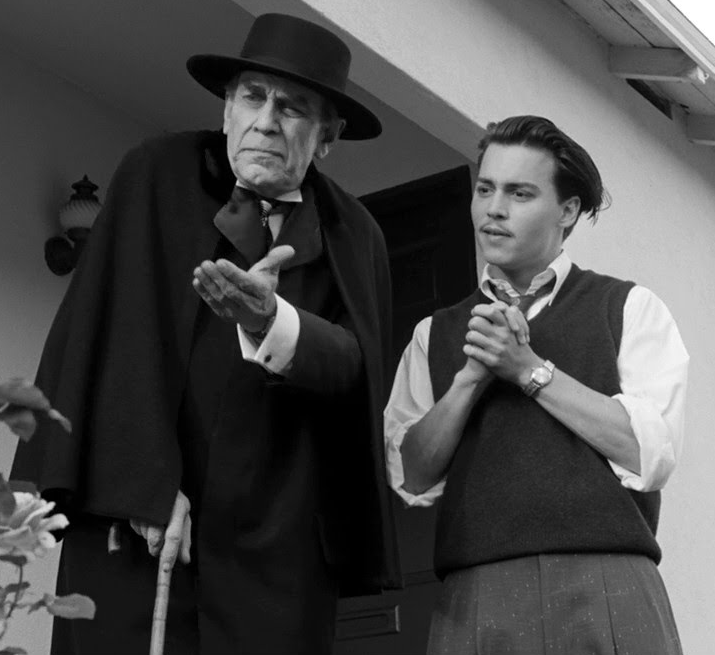
The mentor and his protegee: Bela and Ed.
Another important step in the hero's journey is Meeting the Mentor. That's when the protagonist, having fully committed to the quest, encounters a supernatural guide or helper. In Ed Wood, this is clearly Bela Lugosi. Bela may be a mere human—and an enfeebled one at that—but there is some mystical aura around him. The first time we see him, trying out coffins at the Hollywood Mortuary, he seems capable of rising from the dead. And when he and Eddie watch Vampira (Lisa Marie) on TV, Bela seems to cast a spell on the horror hostess from afar. ("How do you do that?" asks an astonished Eddie.)

Campbell also points out that the mentor frequently gives the hero a talisman or artifact that will help him later in his quest. In Ed Wood, it's the silent footage of Bela that Eddie will use in Plan 9 from Outer Space. Eddie doesn't receive the magical talisman until the third act, but it does help him complete his ultimate quest.

Eddie has a second, lesser mentor in the unnamed Old Crusty Man (Carmen Filpi) who works at Universal with him. In act one, this old man—apparently a projectionist—shows Eddie some stock footage. Eddie will later use that same stock footage in Glen or Glenda, Bride of the Monster, and Plan 9 from Outer Space. Ed's friendship with the projectionist both presages and parallels Ed's friendship with Bela.

The next episodes in the traditional hero's journey have the protagonist Crossing the First Threshold and then venturing into the Belly of the Whale. For Campbell, crossing the threshold means leaving the old, safe world behind and entering a new, dangerous world where the rules are unknown. In Eddie's story, this is the world of low-budget filmmaking. Ed crosses the first threshold when he starts shooting Glen or Glenda. Even this is a trial. On the initial day of shooting, he and his aggrieved crew have to run from the cops because they don't have a permit.

Campbell asserts that the hero has to undergo a metamorphosis during the first act of the story and may encounter a minor setback along the way. And that's exactly what happens in Ed Wood. At the beginning of the movie, Ed attempts to hide his transvestism from Dolores. He is nervous when Dolores says she is missing her favorite sweater, for instance. But in order to get Glen or Glenda made, Ed has to be more open about his cross dressing. He reveals his secret first to George and then to Dolores. This is his "belly of the whale" moment.

There is a pivotal scene in which Dolores finally reads Eddie's autobiographical script for Glen or Glenda. While she is busy reading in one room, Ed changes into women's clothing in another. When Dolores exits the bedroom, she sees her boyfriend in full drag for the first time. This is Eddie's metamorphosis. As Campbell predicted, it presents a minor setback: Dolores cringes at Ed's transvestism. But he convinces her to make the movie despite her qualms. They continue to argue on the set, but Ed completes the movie anyway.

And so act one ends with Eddie (temporarily) in triumph.

ACT II: ED'S INITIATION 

Gottlieb's book.
My favorite description of the three-act structure is one I first encountered in Carl Gottlieb's behind-the-scenes book The 'Jaws' Log (1975). "In Act One," Gottlieb writes, "you get a guy up in a tree. In Act Two, you throw rocks at him. In Act Three, you get him down again." So the middle of a story is when the author throws rocks (i.e. problems or obstacles) at the hero. And that's what happens to Eddie in the middle passages of Ed Wood. It's one hassle after another for him as he struggles to get Bride of the Atom/Bride of the Monster completed.

Likewise, Joseph Campbell talks about the hero's Road of Trials. The hero undergoes a battery of tests and often fails them. But these failures are crucial to the character's ultimate transformation. He learns from his mistakes and becomes better. Incidentally, these tests often occur in threes.

Eddie already started venturing down the Road of Trials in act one. In dealing with the cantankerous George Weiss, Eddie proves his strength, endurance, and cunning. Fittingly, Ed has three major face-to-face showdowns (plus a couple of telephone calls) with George. When they first meet, George rejects him for being inexperienced. Then, Ed returns with the promise of delivering Bela Lugosi, a recognizable star, to the production. He thus gets the job. Finally, Ed and George argue about the film's title, script, and overall content. Despite George's objections, Eddie turns Glen or Glenda into a personal passion project.

Eddie's initiation continues in act two. After his rejection by Mr. Feldman, Ed almost gives up on his dream of directing movies. But then he embarks upon a new adventure: raising the money for Bride of the Atom. Again there are three separate tests, two of which Eddie fails. There's a fundraiser at the Brown Derby that garners no money. There's a second fundraiser at the Derby that goes even worse. And, finally, Eddie has a successful meeting with Old Man McCoy (Rance Howard), and the movie is thus financed.

Loretta King: Ed Wood's temptress?
Campbell next identifies two steps he calls The Meeting with the Goddess and The Woman as Temptress. The closest thing this film has to a goddess figure is Kathy O'Hara (Patricia Arquette), the sweet-natured, accepting woman who will become Eddie's wife. In my outline of Ed Wood, however, Eddie and Kathy don't meet until the third act. It is significant, however, that they meet when Ed is at a pretty low ebb in his life. While Bela endures the horrible agony of morphine withdrawal at the hospital, Ed waits nervously in the lobby. Kathy, who represents the life force, is visiting her father at the same hospital. Winning Kathy's love is a major victory for Ed in the latter stages of the film.

In her own way, Dolores is a goddess figure, too. The first time we see her, in fact, she is portraying an angel in Eddie's play-within-a-movie The Casual Company, and she offers two soldiers a bird of peace. And it is Dolores' idea for Eddie to become an independent filmmaker and raise the money for Bride of the Atom himself.

Who is our Temptress? One obvious answer is actress Loretta King (Juliet Landau), whom Eddie meets in a bar. Eddie does not seem to desire Loretta sexually; he just thinks she has money that he can use to make his movie. Arguably the sleaziest thing Eddie does in Ed Wood is give the prime role of reporter Janet Lawton in Bride of the Atom to Loretta rather than to his faithful girlfriend Dolores. Eddie is generally loyal to those close to him, and this is the one time he willfully betrays someone in his inner circle for money.

But the Temptress does not always have to be a woman or even a human being. It could be anything that lures the hero away from his true path or calling. I believe that, for Ed Wood, that was alcohol. Eddie's drinking problem is downplayed in the script and further downplayed in the finished film, but it remains a significant motif in Ed Wood nevertheless. And, yes, there are three major scenes—one per act—in which Ed goes to a bar to drink alone and forget his troubles. The first occurs after his unsuccessful meeting with George Weiss. The second occurs after a failed fundraiser at the Brown Derby. And the third occurs when Eddie storms off the set of Plan 9 in an artistic fit.

We move on now to what Joseph Campbell calls the Atonement with the Father. Here, smack dab in the middle of the story, the protagonist must confront the person who holds the ultimate power in his life. Often, this is a father or father figure. So who holds the power in Eddie's life? The answer is likely Bela Lugosi, since Ed pins all of his own career hopes on his connection to Bela. The atonement phase calls for the hero to undergo an initiation at the hands of the father. And, in a sense, this does occur between Ed and Bela. In addition to the scene in which these two men watch Vampira together, there are two separate scenes in which a desperate and drug-addled Bela summons Ed to his home in the middle of the night.

Ed emerges from both of these sad and scary meetings with a newfound resolve to help Bela in whatever way he can. The first time, Ed's strategy is to find Bela some work, so Ed meets with Mr. Feldman at Warner Bros. in order to land a motion picture contract. The second time, Ed's strategy is to check Bela into rehab for his morphine addiction.

ACT III: ED "DIES" AND IS "RESURRECTED"

Ed receives guidance from Orson Welles.
The third act of Ed Wood is a series of peaks and valleys for the title character, ultimately ending in triumph. Eddie begins the final stage of the movie in one of his glum moods. Bride is complete, but Dolores has left him and Vampira won't go out with him. Worse yet, his mentor and hero Bela Lugosi is at an all-time low, suicidal and hopelessly addicted to morphine. But Ed's life will soon turn around when he meets Kathy Everett O'Hara, his eventual wife.

During this stage of his life, Eddie will also make the movie for which he is best known: Plan 9 from Outer Space. But before making his signature movie, Ed will lose both his mentor and (briefly) his will to make movies at all. Weary of battling with Plan 9's bossy Baptist investors, Ed nearly gives up on the project and on himself.

In the Ed Wood screenplay book, Alexander and Karaszewski talk about building the film's final act around Plan 9. It would not have been their first choice. "In a perfect world," they write, "Glen or Glenda would have been Ed Wood's final film—the man cranks out numerous silly monster movies, before learning his lesson, turning to personal honest film-making, and creating his autobiographical valedictory masterpiece. But unfortunately, Glen or Glenda came first. So we had to turn Plan 9 from Outer Space into a climax." They do this by: (1) turning the well-meaning Baptists into villains, and (2) inventing a completely wild third act fantasy scene we will discuss anon.

Joseph Campbell talks about the hero reaching his Apotheosis, a point of revelation at which he receives the knowledge that will help him complete the most difficult part of the journey. After storming off the Plan 9 set in full drag, Ed has his moment of clarity at the Musso & Frank Grill, where he downs Imperial whiskey in an attempt to numb himself into a stupor. It is at this point he meets his hero Orson Welles (Vincent D'Onofrio), who just happens to be there that afternoon. The screenwriters dub this the script's "one major fib." (I'd say there are others. But, again, that's not what this article is about.)

After explaining his own woes in making Touch of Evil and his aborted Don Quixote, Orson gives Ed a necessary pep talk about how, even with all the hassles, "visions are worth fighting for." Newly invigorated, Ed returns to the shabby set of Plan 9 and finishes the picture. This is, in Campbell's terms, the Ultimate Boon. It's the culmination of the hero's quest. Earlier in the film, Eddie said he would make "the ultimate Ed Wood movie, no compromises," and now he's done it!

Ed crosses the return threshold. 
There is a definite moment in Burton's film that corresponds to Campbell's Crossing of the Return Threshold. This is the point at which the hero takes the wisdom he has attained and applies it to his own life. For Eddie, the wisdom came from that inspirational talk with Orson Welles, and he begins to apply it the second he steps into Quality Studios, where Plan 9 is being filmed. "You can't compromise an artist's vision," he tells the Baptists. He later adds, "This movie's gonna be famous! But only if you shut up and let me do it my way!"

It is here that Ed Wood begins to stray somewhat from the template of The Hero with a Thousand Faces. Or maybe I'm just interpreting Campbell incorrectly; I'm not a scholar of mythology in any way. Still in all, I don't see anything like a Refusal of the Return in this movie. According to Campbell, that's the point at which the hero has attained the Ultimate Boon yet is reluctant to share it with his fellow man. Whether the boon is Plan 9 itself or just the magical Lugosi footage ("the acorn that will grow a great oak"), Ed is always eager to share it. He has that moment of self-doubt in the third act, but after his meeting with Orson Welles, he quickly returns to the studio.

Campbell also discusses an episode he terms The Magic Flight, in which the hero has to make a daring escape with the boon because it is an object jealously guarded by the gods. Again, nothing like that happens during the making of Plan 9 in the third act of Ed Wood. But it does make a pretty good description of the sequence late in the second act when Ed steals a rubber octopus from a warehouse at Republic Studios in order to complete Bride of the Monster. Ed assembles a small crew to assist him with this daring heist, including two of his most bizarre and memorable actors: TV psychic Criswell (Jeffrey Jones) and wrestler Tor Johnson (George "The Animal" Steele). Tor and Cris are interesting sidekicks for Eddie because they seem to come directly from mythology: one a giant, the other a seer or oracle.

Ed Wood and five of his magnificent seven.
Alexander and Karaszewski talk about how Ed assembles "his Magnificent Seven" as the story progresses, i.e. the oddballs and misfits with whom he makes his most famous movies. Not only will these folks give memorable performances, they'll help him in whatever way they can off the set as well. This includes the aforementioned octopus heist and a sequence in Act Three in which the Plan 9 actors all allow themselves to be baptized in a swimming pool at the behest of the Baptists. Campbell has accounted for this with an aspect of the hero's journey he calls the Rescue from Without. Essentially, this means that the hero needs guides or helpers during his quest. And Eddie needs all the help he can get. In Act Three, for instance, he and his pals, including Kathy and Bela, attend a showing of Bride of the Monster that devolves into a riot. While Eddie helps shepherd his friends through the angry crowd, it is Kathy who bravely throws herself in front of a passing taxi to secure their escape.

What is left for our hero to do? He's left his old life behind, embarked upon an exciting but dangerous new one, met with his mentor, survived numerous tests, and finally achieved his goal. Well, Campbell says that the epic hero must now become the Master of Two Worlds, meaning that he has achieved a balance between the material and the spiritual. Now, as anyone with a passing knowledge of Ed Wood's real life can tell you, this man never really mastered any world, let alone two at a time. He floundered as an artist and as a human being. Even Ed Wood's closing narration admits that Eddie "kept struggling in Hollywood, but mainstream success eluded him."

But at the end of Burton's biopic, Eddie does seem to have achieved a balance between his career and his personal life. As he exits the Plan 9 premiere on a rainy night, completely contented, he proposes marriage to Kathy, and the two drive toward Las Vegas. Campbell says that our hero has now attained the Freedom to Live, meaning he no longer fears death and can live for the moment without ruing past mistakes or dreading future calamities. This describes Ed perfectly. His decision to drive to Vegas with Kathy, for instance, is completely spontaneous. Never mind that he's still broke or that it's pouring rain. "It'll probably stop by the time we get to the desert," Ed optimistically tells Kathy. "Heck, it'll probably stop by the time we get around the corner. Let's go." That is freedom to live in its purest form.

CODA: WHAT'S THAT YOU SAID ABOUT STAR WARS?

Luke's humdrum life on Tatooine.
Earlier in this article, I said that Ed Wood shared plot points with Star Wars, arguably the most famous film to follow the monomyth template as described by Joseph Campbell in The Hero of a Thousand Faces. Obviously, these two films are nothing alike in terms of tone or appearance. But there are vague parallels, especially if you think of Eddie as the equivalent of Luke Skywalker (Mark Hamill). At the start of Star Wars, Luke leads a dull existence, living and working on the Tatooine "moisture farm" of his aunt and uncle. His day-to-day life is a bit like Eddie's at Universal Studios. Luke and Ed are both young men doing mundane, thankless chores while dreaming of something bigger and wondering if they're up for the challenge.

Ed and Luke both embark upon exciting quests, but even before they get started, they consult with wizened old gurus. For Luke, it's Obi-Wan "Ben" Kenobi (Sir Alec Guinness); for Ed, it's Bela Lugosi. Bela, like Obi-Wan, is far removed from his glory days. "Now, no one gives two fucks for Bela," he tells Ed. "I haven't worked in four years. This business, this town, it chews you up, then spits you out. I'm just an ex-bogeyman." Compare that to Obi-Wan's wistful line from Star Wars: "Obi-Wan. Now that's a name I've not heard in a long time." More dignified, sure, but a similar sentiment. Note, too, that neither Obi-Wan nor Bela survives the journey, but Luke and Ed keep their memories alive.

Luke Skywalker has to assemble a team of colorful misfits, including two bickering droids, an orphaned princess, an inarticulate Wookiee, and a hotshot smuggler, in order to complete his mission of blowing up the enemies' space station, the Death Star. Ed's goal, making a handful of B-movies, is more modest, but he assembles his own team of misfits for the job. How appropriate that Luke meets two pivotal members of his team, Han (Harrison Ford) and Chewie (Peter Mayhew), at a bar. Eddie spends a lot of time in bars, too, and probably would not be out of place at the Mos Eisley cantina.

Star Wars famously ends with its cadre of heroes, including Luke, receiving medals for bravery in front of an appreciative audience of Rebel soldiers, officers, and pilots who have gathered in a large hall. Ed Wood gives its hero and his friends a big, official ceremony in the form of a lavish (and totally fictional) premiere for Plan 9 from Outer Space at the Pantages Theatre in Hollywood. Burton, like George Lucas before him, makes sure to get closeups of his main characters basking in the glory of the moment.

That's really the beauty of the hero's journey. If you back far enough away from any given story, you see how it resembles so many others. Even films as wildly dissimilar as Star Wars and Ed Wood can start to look like first cousins.

BONUS: In writing this article, I prepared a complete outline of Ed Wood (1994). You can read through that entire document here.