 |
| From top to bottom: the original version of the joke; my version. |

Sunday, July 21, 2013
Rewriting today's "Wizard of Id" comic
Mill Creek comedy classics #40: "Road to Bali" (1952)
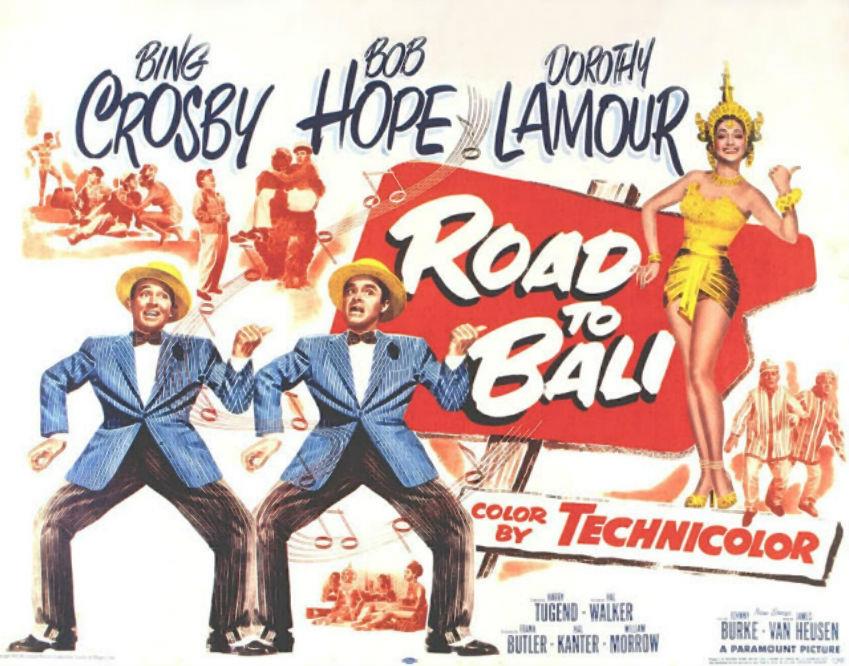 |
| Bing Crosby, Bob Hope, and Dorothy Lamour hit the road for the next to last time in Road to Bali. |
The flick: Road to Bali (Paramount Pictures, 1952) [buy the set]
Current IMDb rating: 6.6
Director: Hal Walker (Road to Utopia, directed a string of early 1950s Martin & Lewis vehicles, including At War with the Army, Sailor Beware, That's My Boy, and My Friend Irma Goes West)
 |
| Caricature of Bing, Dorothy and Bob by Al Hirschfeld |
- Bing Crosby (massively popular singer-actor known to fans as "Der Bingle" or "The Old Groaner"; starred in High Society, Holiday Inn, much more; Oscar winner for Going My Way; nominated twice more; his recording of "White Christmas" has sold about 100 million copies)
- Bob Hope (actor-comedian who is arguably one of the most successful and famous entertainers of the last century; starred in The Ghost Breakers, The Paleface, My Favorite Brunette, etc.; hosted the Oscars fourteen times; made dozens of TV specials for NBC from the '60s to the '80s; renowned the world over for his work with the USO)
- Dorothy Lamour (appeared in all seven Road movies with Bing and Bob; also appeared in Creepshow 2, Donovan's Reef, etc.)
- Murvyn Vye (Pickup on South Street)
- Peter Coe (House of Frankenstein, The Ten Commandments)
- Ralph Moody (Hitchcock's Strangers on a Train, Billy Wilder's Ace in the Hole, much more; did a lot of Dragnet episodes and other Jack Webb-produced shows)
- Leon Askin (The Robe, The Maltese Bippy, Airplane II: The Sequel; Gen. Burkhalter on the Bing Crosby-produced TV series Hogan's Heroes)
Other notables: There are cameo appearances by Dean Martin, Jerry Lewis, Jane Russell, and Humphrey Bogart, plus Bing's brother, Bob (a popular swing bandleader in his own right) and Carolyn Jones (Morticia on TV's The Addams Family), Costumes are by Edith Head. Songs are by Jimmy Van Heusen and Johnny Burke.
 |
| Dorothy Lamour: Sarong... and yet so right. |
The treasure they're supposed to uncover is guarded by a giant killer squid who has sent many men to watery graves. Blissfully unaware of this, they travel with Ken Arok to a small, exotic island on the way to Bali where they are given the royal treatment and meet lovely Princess Lala (Lamour), with whom they both fall in love. Despite Lala's warnings, George and Harold go on the diving expedition, recover the treasure, and survive the squid, too, but Ken Arok tries to kill them to recover the gold and jewels they've found. George, Harold, and Lala escape on a boat bound for Bali, and a humorously contentious love triangle quickly arises as George and Harold compete for Lala's affections.
This romantic rivalry continues even after their boat capsizes and the three are stranded on a seemingly deserted island... only to find themselves in the clutches of Ken Arok, who arranges for Lala to marry the villainous King Ramayana (Askin) and for George and Harold to marry each other! Luckily, the volcano god disapproves of same-sex marriages and starts spewing lava everywhere. George, Harold, and Lala manage to escape, and the love triangle story is resolved in a way I'd rather not spoil since it's one of the movie's comedic high points.
 |
| Director Hal Walker with the Road to Bali cast. |
The boys had been cranking out a Road picture every few years since 1940 to great success, but they were both pushing 50 at this point* and the public's interest in the team must have been waning just a bit. The series' previous entry, Road to Rio, was released on Christmas day in 1947 and became the #1 grossing film of 1948. Looking over the Top 10 for 1952, however, I don't see Road to Bali at all. I do see a solo Bob Hope vehicle (Son of Paleface), plus -- even higher on the list -- Sailor Beware, a comedy that had the same director (journeyman Hal Walker) but featured the newer, younger, hipper team of Martin and Lewis, who pay their respects to Bing and Bob by making a brief cameo in Bali.
Hope and Crosby gave it one last shot a full decade later in 1962 with Road to Hong Kong, but the ship had definitely sailed by then. They remained friends all their lives and, of course, had tremendously successful solo careers of their own. For the most part, the two men moved to television, becoming eternal "guest stars" on talk shows, variety shows, and specials. They were venerable elder statesmen from the 1950s onward and would remain so for the rest of their lives, with their reputations only slightly tarnished by support of the unpopular Vietnam War (in Bob's case) or accusations of child abuse (in Bing's case).
We tend to think of them now as as middle-aged men on a golf course somewhere in Palm Beach. Road to Bali, however, is a reminder that Der Bingle and Old Ski Nose were once actually kind of cool and irreverent. Today's film comedians are expected to make in-jokes, break the fourth wall, and generally treat the plot with as little respect as possible. That air of ironic detachment comes in large part from Bob Hope. And in the good-natured ball-busting that goes on constantly between Hope and Crosby throughout this film, we can see the beginnings of the male camaraderie on display in modern-day films like This is the End and the Hangover trilogy. I can remember a Rolling Stone interview in which David Letterman, the king of irony, expressed his admiration for Hope's early work and lamented the fact that his comedic ancestor went on to be the symbol of everything old-fashioned and unhip in comedy. As Road to Bali shows, it's a bum rap.
Another, secondary reason I was looking forward to this movie was simply because of a longstanding interest in the island of Bali. A dark, surreal 1954 Woody Woodpecker cartoon called Alley to Bali made an enormous impact on me as a kid, and years later I discovered a 1957 Patience and Prudence B-side called "Very Nice is Bali Bali" that makes a convincing case for the province. Technically, I don't think the characters in this movie ever quite get to Bali proper, though Dorothy Lamour does wear a headdress similar to one from the Woody Woodpecker cartoon.
* A near-constant running joke in this film is how much older Bing Crosby is than Bob Hope. In truth, they were born in the same month, May 1903, just a few weeks apart.
 |
| Bandleader Fred Waring in his heyday. |
Is it funny: Sure, for the most part. Personally, I'd say the film hovers between "fairly funny" to "pretty funny" for the entire running time and has several sequences in which it rises to the level of "quite funny indeed," largely thanks to Bob Hope. The plot of Road to Bali is extremely shaky, and the film is best when Hope and Crosby simply ignore it and crack wise, directing their zingers at each other or straight to the audience.
My absolute favorite parts, in fact, are the ones in which Hope completely abandons the narrative and talks directly to the camera, as when he tells us that Crosby is about to sing and that we should use this opportunity to get some popcorn. And he's right, too: Bing's song, a romantic ballad to Lamour, is rather dull. The musical numbers, by and large, drag the film down.
The series was a bit past its prime and the dreaded "sequel-itis" had started to set in, but Bing and Bob were obviously having a blast making this thing, and some of the fun is contagious. Since this was the sixth film in the series, the actors could have a little fun with the conventions of the Road movies. One particular tradition of these films, for instance, was the famous "pat-a-cake" routine in which our two heroes would play the children's clapping game as a pretense for punching out the bad guys. In this movie, the bad guys are wise to 'em and duck out of the way, so Bing and Bob knock each other out instead. The meta-humor reaches its zenith during the finale, when Bob tries desperately to keep the movie from ending and resorts to pushing the words "THE END" off the screen.
Many of the jokes in the script are topical, and not all of them have worn well. In 1952, for instance, you couldn't go wrong with a Fred Waring joke. In 2013, you can only go wrong with a Fred Waring joke. And even though guys in mangy gorilla suits are one of my favorite comedy conventions, I'd have to say that Road to Bali really doesn't bring anything new to the field of gorilla-based comedy.
On the other hand, the film does bring something new and highly disturbing to chimpanzee-based comedy. There's a very weird, unappetizing flashback scene involving a chimp with Bob Hope's face. Forewarned is forearmed, reader.
 |
| A chimpanzee in a hideous Bob Hope mask. Now that's comedy! |
My grade: B+

Wednesday, July 17, 2013
Ed Wood Wednesdays, week 2: 'Glen or Glenda' (1953)/'Jail Bait' (1954)
 |
| Two faces have I: Ed Wood's first two features revolve around duality and surgical modification of the body. |
 |
| Bela Lugosi, Dolores Fuller, and Ed Wood. |
Meanwhile, Eddie had also been trying to make it in TV. A brief made-for-television drama called The Sun Was Setting had reached local airwaves in late 1951, but it did not lead to a regular series and didn't make much of an impact beyond the Los Angeles city limits. A second attempt at breaking into the TV market, a proposed western series called Crossroad Avenger starring faded screen cowboy Tom Keene, had not generated any interest among the major networks either.
In fact, Ed's steadiest work during these years had come as a stage actor, including a long run in a play called The Blackguard Returns at the Gateway Theater. He also toiled in the story department at Universal, where he worked his way up to the rank of "night production coordinator," typing up call sheets for productions that would be filming on the lot the next morning.
But these were not fruitless years for the decorated ex-Marine. Ed's natural charisma made him popular with the ladies, and his ability to schmooze (today, we'd call it "networking") allowed him to make key professional and personal relationships that would affect the course of his life and career. Far from being a hindrance, Ed's longstanding habit of cross-dressing -- deeply rooted since childhood (supposedly) -- had become the center of his social life, including rumored parties with such major movie stars as Danny Kaye and Tony Curtis.
What's more, during the years between 1952 and 1954, Edward D. Wood, Jr. met many of the actors, producers, and crew members who would contribute significantly to his most famous films, the cinematic works upon which his reputation is largely built. Some of these folks were on the way up. Some were on the way out. Some were just along for the ride. A few, including George Weiss, Bill Thompson, Dolores Fuller, Conrad Brooks, and Bela Lugosi, would eventually become characters in Tim Burton's Ed Wood (1994).
A major turning point in Wood's career was his first theatrically-released feature, a would-be exploitation flick that was supposed to capitalize on some recent sensational headlines. Instead, it wound up being the most personal statement of Eddie's entire film career.
GLEN OR GLENDA (1953)
 |
| The Devil attends the wedding of Barbara and Glen in this dream sequence from Glen or Glenda? |
Alternate titles: Behind Locked Doors (working title), Transvestite, He or She?, I Changed My Sex, I Led Two Lives, etc.
Availability: A censored, abbreviated print of the film appears in such boxed sets as The Worst of Ed Wood (Image Entertainment, 2000) and The Ed Wood Box (Image Entertainment, 2004) and has also fallen into the public domain.
For this project, I consulted two different versions of the film: a longer, uncensored VHS print from the Deluxe Ed Wood Angora Box Set (Rhino Video, 1996) [buy it] and a newly computer-colorized version from 2012 by Legend Films. Legend Films was very gracious in sending me a review copy of this new DVD, and I am happy to let you know you can purchase Glen or Glenda? in color for only $9.95 right here.
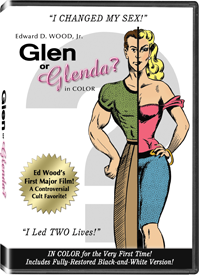 |
| Legend's new DVD of the film. |
As I've rewatched Ed Wood's 1950s films, I can't help but notice how many truly striking shots they contain. There is a dark, brooding, mysterious quality to the images that presages the work of David Lynch, and I think much of that was due to Bill Thompson. Thompson is also the man who introduced Ed Wood to B-movie mogul George Weiss, a meeting that resulted in Ed's debut feature, Glen or Glenda.
As anyone who has seen Tim Burton's film already knows, Weiss had wanted to capitalize on a then-recent scandal, the male-to-female sexual reassignment surgery of Christine Jorgensen, and crank out a quickie biopic from his tiny independent studio, Screen Classics. After Jorgensen refused to grant anyone, let alone a penny-ante producer like Weiss, the rights to her life, the producer simply decided to go forward with a fictionalized version of the events and hired Wood on the recommendation of Thompson, little knowing that the budding auteur would use the film as an opportunity to explore his own personal cross-dressing issues.
The cast of Glen or Glenda is, unsurprisingly, filled with actors from past and future Wood-related productions. Along with the aforementioned Henry Bederski (a pudgy, bald character actor who pops up in multiple scenes), the attentive viewer will find Lyle Talbot, Timothy Farrell, and Conrad Brooks. More importantly, this is the film that introduces two key players in the Ed Wood saga: Bela Lugosi and Dolores Fuller.
The former was the renowned Hungarian-born star of Universal's Dracula (1931), a role that both launched him to superstardom and typecast him as a "bogeyman" for the rest of his life. Lugosi's strong association with the famous vampire, compounded by the actor's heavy accent, erratic temper, and longtime drug addiction, had caused his career to suffer throughout the 1940s. He went from making major studio films to appearing in low-budget "poverty row" productions, and even these had largely dried up by the early 1950s. George Weiss was able to hire Lugosi for a mere $1000, largely to give the otherwise-disreputable movie some "name value."
Aspiring actress and model Dolores Fuller, on the other hand, was a wife and mother of two who divorced her husband to be with Ed Wood, whom she'd met at a casting call. They were soon living together, and their real-life relationship would be the basis for many of the scenes in the film.
And at the very center of it all is an astonishing performance by Wood himself, credited as "Daniel Davis," the first in a series of professional aliases he would use throughout his career. Perhaps because he was playing a character based very closely on himself, Ed Wood gave the performance of his life as the hero, a troubled man who doesn't want to admit to his fiancee that he is a cross-dresser.
 |
| A moody moment from the dream sequence. |
Glenda is something different altogether: part horror (Lugosi appears as a Dracula-esque mad scientist in a lab filled with skulls and test tubes), part documentary (Talbot and Farrell play "respectable" members of the community who discuss the issues in a dry, factual way as if they were in an educational film), part soap opera (Wood and Fuller share talky, melodramatic scenes in prosaic locations such as a kitchen and a living room), and part stream-of-consciousness surrealism (symbolic stock footage of a buffalo stampede, a lengthy and bizarre dream sequence).
I found that when I watched this movie at the age of 37, I no longer laughed the way I did when I was 17. Instead, apart from a few scattered guffaws, I became truly involved in the story, thanks largely to Wood's sympathetic performance. And I marveled at the audacious, one-of-a-kind oddness of it all. George Weiss famously padded the movie with several minutes of racy "girly show" footage directed by schlockmeister W. Merle Connell for an entirely different production, inter-cutting it with reaction shots from Wood and Lugosi to justify it being part of the movie. Rather than feeling like a diversion or a distraction from the main feature, the Connell footage (including a husband-and-wife bondage team) only adds to its transportive, dreamy nature.
There are various edits floating around out there, but the most complete I've seen is the VHS version Rhino put out in the 1990s. The version you're more likely to see today, while made from a fairly decent print, lacks a few important moments. The words "god" and "sex" have been clumsily excised a few times, and Timothy Farrell's doctor is no longer allowed to say he "doesn't think" a transvestite deserved to die.
Worse yet, one of the film's most peculiar sequences -- constructed by Wood entirely out of stock footage of highway traffic and a foundry, plus some dubbed-in dialogue by two unseen factory workers, "Jack" and "Joe" -- loses its semi-shocking punchline, in which one of the workers suddenly starts talking in a woman's voice. The biggest omission is an entire sequence in which an unnamed man (played by Conrad Brooks) rebuffs the advances of a homosexual but then unwittingly lights the cigarette of a cross-dresser. Apart from the Rhino tape, I have not seen this material elsewhere.
The new Legend Films DVD is made from the shortened, censored print available elsewhere, but what it lacks in completeness, it makes up for in visual panache. Quite simply, this is the best-looking, best-sounding version of Glen or Glenda I have ever seen. As is customary of this company's products, the DVD contains the standard B&W edition of the film as well as the colorized print. Apart from a newly-created trailer (not the vintage 1950s trailer that appears on the Rhino and Image versions), the Legend DVD has no extra features to speak of.
The disc's entire reason for existence is to present the colorized version of Glen or Glenda, and that alone makes it well worth purchasing. What the colorization gives us is a whole world of detail that might go unnoticed in the B&W film: the sinister bric-a-brac in Lugosi's lab, the books behind Timothy Farrell's desk, the items on Glen/Glenda's vanity, plus the cars, clothes, and businesses visible in both the stock footage of crowds and the "stolen" outdoor shots of Wood-as-Glenda on the street, staring longingly into a store window. The colorization is very detail oriented. I couldn't help but notice the reflections in the store windows, for instance. (Hey, there's a paint shop across the street from that woman's clothing store! Who knew?)
Given Ed Wood's heavy use of cross-fading and superimposition, this could not have been an easy film to colorize. There are certain moments on the Legend DVD that actually caused me to gasp. By all means, if you want to have a DVD of Glen or Glenda? in your collection, make it this one. By the way, Wood-ian scholars will want to take note of a moment during the dream sequence in which Barbara (Fuller) emerges from the shadows with her arms outstretched. It is a clear precursor to Vampira in 1959's Plan 9 from Outer Space.
While the oddness of Glen or Glenda made it difficult to market, George Weiss managed to sell it to various territories in the United States under a bewildering variety of titles (see the list above), and the film played in China, Argentina, France, and Belgium, among (presumably) others. Ed's next film would be rather more conventional but would still contain a great deal of the director's trademark surrealism and absurdity.
JAIL BAIT (1954)
 |
| A lobby card for Ed Wood's feverish film noir, Jail Bait. Note Theodora Thurman in her jammies on the left. |
Alternate titles: Jailbait, The Hidden Face
Availability: Like Glen or Glenda?, this public domain film is available in the Image Entertainment boxed sets, The Worst of Ed Wood and The Ed Wood Box. For this project, the DVD version I watched was from Big Box of Wood (S'More Entertainment, 2010) [buy it]. I also screened a VHS edition called Jail Bait: Director's Cut! (Rhino Video, 1995) [buy it].
 |
| Cotton Watts, one of the last blackface performers. |
Wood and Gordon's initial collaboration was a film noir-style crime thriller originally called The Hidden Face. That title, which referred to the script's highly unlikely plastic surgery gimmick, was abandoned in favor of the intentionally misleading Jail Bait. The salacious term is used only once during the film -- in a line of dialogue clearly dubbed in after the fact -- and supposedly refers to an unlicensed gun. Yeah, right.
Several cast members from Glen or Glenda reappear here, and there are living room and kitchen sets that look very much like those from the previous film as well. Lyle Talbot plays another cop. Dolores Fuller is once again the romantic lead. Timothy Farrell, interestingly, has switched sides. A respected and caring physician in the last film, he's a ruthless and grouchy small-time crook named Vic Brady here. Vic's favorite expression seems to be "shut up," which he says several times per scene.
The role of plastic surgeon Dr. Boris Gregor, despite that infamous first name, was intended for Bela Lugosi, but when Lugosi was unavailable, it went to veteran British actor Herbert Rawlinson, who was quite literally dying of lung cancer while he made this film and expired the night after completing his last scenes.
Notables in the cast include bodybuilder Steve Reeves, a former Mr. Universe just a few years away from hitting the big time as the title character in Hercules (1958), and gorgeous singer/model/TV weather girl Theodora Thurman, making her one and only film appearance as a sexy but misguided gun moll who is inexplicably loyal to the sleazy, foul-tempered Vic Brady. Fans should keep an eye out for brunette Mona McKinnon, who would play Paula Trent in Plan 9 from Outer Space.
Ed Wood also "appropriated" two elements from films by director Ron Ormond. The film's much-noticed and very distracting score comes from Ormond's Mesa of Lost Women and was composed by Hoyt Curtin (here misspelled "Kurtain"), who was Hanna-Barbera's house composer for decades, penning theme music and underscore cues for dozens upon dozens of TV cartoons. Meanwhile, a lengthy and very offensive blackface routine was lifted from Ormond's Yes, Sir, Mr. Bones! (This is obvious padding; the only connection to the rest of the movie is that two characters rob the theater where this show is supposedly taking place.) This act was performed by Cotton Watts and his wife Chick. Even by 1954 standards, Watts' act was woefully behind the times, but it unintentionally gives the film extra historical resonance.
In the Rhino cut of the film, which has yet to make it to DVD, the blackface footage is removed and is replaced by a rather blurry burlesque routine film shot at "Les Folles, Los Angeles." Curiously, there seems to be no audio for this rather tame, nudity-free striptease routine, so some of the music from Cotton Watts' blackface act, including audience laughter, is recycled.
 |
| A far-fetched but memorable plot point in Jail Bait. |
This is a world without comfort, without rest, without hope. It has the same stifling, depressing, deflating quality as Ed Wood's previous The Sun Was Setting. The film takes place in the shadowy underworld of crime and violence, but Ed's knowledge of that world seems to have come entirely from dime novels and B-movies, plus maybe some comic books and radio shows.
I kept thinking how kid-like it all was, reminiscent of children playing "cops and robbers" in the back yard. Vic Brady is the kind of tough-talking gangster a 12-year-old might dream up. Similarly, even though he's supposed to be a world-renowned plastic surgeon, Herbert Rawlinson has the medical vocabulary of a middle schooler. ("Do you know I had to completely remodel that man's face? It was strenuous and very, very complicated. Plastic surgery at times seems to me to be very, very complicated.")
The plot, for the first two-thirds or so, is a relatively unremarkable crime-and-consequences tale about a botched robbery. Then? Well, I don't want to spoil too much in case you haven't seen the film yet, but it goes off on a very odd, unbelievable tangent that is probably the film's major source of fascination for modern-day viewers.
In brief: a doctor is forced to perform plastic surgery at gunpoint. As far-fetched as I find this development, I'm almost positive I saw something similar happen on an episode of Nip/Tuck, not to mention John Waters' Desperate Living (1977). At least in those last two examples, the surgery takes place in a hospital. Wood sets his scenario in the living room of an ordinary apartment... and there's not a stray drop of blood anywhere when it's done.
Wood scholars will want to note the script's attempts to psychoanalyze the Don Gregor character, possibly Ed's surrogate in the film. Glen or Glenda made a similar effort to diagnose its title character. Ed might have had some "mommy issues" or "daddy issues" or both that he was working through in his scripts. Alcohol, too, is becoming a recurrent theme in his films. The bad guy in Crossroads of Laredo spent all his time at the bar, and the characters in Jail Bait -- good, bad, and indifferent -- are always boozing it up, too.
Next week: Ed tries to capture the zeitgeist with Bride of the Monster (1955) and The Violent Years (1956).
Monday, July 15, 2013
Mill Creek comedy classics #39: "Riding on Air" (1937)
 |
| This poster perhaps overemphasizes the role of the cute dog in Riding on Air. |
The flick: Riding on Air (RKO Radio Pictures, 1937) [buy the set]
Current IMDb rating: 5.3
Director: Edward Sedgwick (uncredited director on the 1925 Lon Chaney version of The Phantom of the Opera; directed Buster Keaton's The Cameraman; discovered Lucille Ball)
Actors of note:
- Joe E. Brown (popular film comedian of the '30s and '40s, famed for wide smile; played the "nobody's perfect" millionaire from Some Like It Hot; appeared in It's a Mad Mad Mad Mad World, Around the World in Eighty Days, much more; turned down the chance to play for the New York Yankees to pursue showbiz; one of only two civilians awarded the Bronze Star in WWII)
- Guy Kibbee (Mr. Smith Goes to Washington, Fort Apache)
- Florence Rice (The Marx Brothers' At the Circus; frequent cinematic "love interest" of the 1930s and early '40s)
- Vinton Hayworth (Kubrick's Spartacus, Hitchcock's Saboteur; many TV shows including Dragnet and Gunsmoke; recurring character on Green Acres and I Dream of Jeannie)
- Anthony Nace (Holiday Inn)
- Harlan Briggs (W.C. Fields' The Bank Dick)
 |
| Bigmouth Joe E. Brown |
Meanwhile, to prove his value as a reporter, Elmer tries to crack a murder case tied to a perfume smuggling ring. Once the town finds out Waddington is a crook, they figure Elmer was behind the whole thing and form a lynch mob to track him down. But Elmer's up in a biplane, exchanging gunfire with the perfume smugglers in a high-flying, death-defying action climax! (Well, actually, there's another high-flying, death-defying action climax after that.)
My take: The summary you just read describes what I think happened during Riding on Air. Coherence is not one of the movie's strong suits. There's a lot more I could have mentioned, like how incompetent Elmer somehow becomes a correspondent for the Chicago Daily Star and enrages his editor by inadvertently bringing important news photos to reporters from a rival newspaper. (He thinks he's transporting an injured dog to a veterinary surgeon, hence the cute little pooch on the movie poster.)
Pretty much the whole point of this movie is that Joe E. Brown's wacky antics are always driving the people around him batty, so you need a few Edgar Kennedy types in the cast to sputter and fume and throw things in disgust. Edgar himself's not here, so those roles are filled by Elmer's editor, his father's girlfriend, and even the gangsters. Brown remains willfully clueless throughout. Elmer Lane, who apparently started as a character in a series of stories in the Saturday Evening Post, is the eternal optimist, always cheerful and confident even when he shouldn't be. Brown, with his extra-wide, almost Joker-like smile, is perfect for the part.
Riding on Air is not an ensemble comedy. It is clearly and unambiguously a vehicle for Brown. The actor's most famous role -- the daffy, libidinous, possibly bisexual millionaire Osgood Fielding III in Billy Wilder's acclaimed Some Like it Hot (1959), in which Brown delivers the famous closing line -- came near the end of his film career, well after his heyday. In contrast, Riding on Air was made when the actor was at the peak of his popularity.
Pretty much the whole point of this movie is that Joe E. Brown's wacky antics are always driving the people around him batty, so you need a few Edgar Kennedy types in the cast to sputter and fume and throw things in disgust. Edgar himself's not here, so those roles are filled by Elmer's editor, his father's girlfriend, and even the gangsters. Brown remains willfully clueless throughout. Elmer Lane, who apparently started as a character in a series of stories in the Saturday Evening Post, is the eternal optimist, always cheerful and confident even when he shouldn't be. Brown, with his extra-wide, almost Joker-like smile, is perfect for the part.
Riding on Air is not an ensemble comedy. It is clearly and unambiguously a vehicle for Brown. The actor's most famous role -- the daffy, libidinous, possibly bisexual millionaire Osgood Fielding III in Billy Wilder's acclaimed Some Like it Hot (1959), in which Brown delivers the famous closing line -- came near the end of his film career, well after his heyday. In contrast, Riding on Air was made when the actor was at the peak of his popularity.
 |
| Joe E. Brown's supreme screen moment in 1959. |
It's a bit difficult to judge him as a comedian on the basis of this one flick, though, as the script is not especially strong. The movie gives him so-so comic setups, as when he seems to be the only person working at the Chronicle one afternoon and keeps transferring a single customer's call to different desks, while he runs around the room and answers the absent employees' phones in various voices, giving the impression that there's a whole staff present. I think it's an excuse for Brown to try out different accents and intonations, but nothing of great comedic value comes from it.
From a modern perspective, possibly the most interesting aspect of this film is that the plot, such as it is, revolves around unmanned airplanes that can be controlled remotely. Today, the use of such planes (which we now call "drones") is extremely controversial. Back in 1937, though, it probably just seemed like science-fiction.
Is it funny: Sorry, but I didn't laugh that often. A couple of gags made me smile a bit. For instance, I liked when Elmer was gazing into a bookshop and peered through the big capital O's in the word "BOOKS" stenciled on the window. Later, when Elmer and Betty are not speaking to each other, there's a scene in which they talk through an intermediary even though they're a few feet apart and can obviously hear each other perfectly. ("Tell ____ I said ______!") I've seen that routine done on any number of sitcoms, and it didn't especially make me laugh here, but it has a funny payoff towards the end when Elmer's in real trouble and thinks Betty's still giving him the silent treatment. ("Ain't she speaking to me yet?")
My grade: B-
P.S. - This movie was blessedly free of racial stereotypes. Nothing even close here.
From a modern perspective, possibly the most interesting aspect of this film is that the plot, such as it is, revolves around unmanned airplanes that can be controlled remotely. Today, the use of such planes (which we now call "drones") is extremely controversial. Back in 1937, though, it probably just seemed like science-fiction.
Is it funny: Sorry, but I didn't laugh that often. A couple of gags made me smile a bit. For instance, I liked when Elmer was gazing into a bookshop and peered through the big capital O's in the word "BOOKS" stenciled on the window. Later, when Elmer and Betty are not speaking to each other, there's a scene in which they talk through an intermediary even though they're a few feet apart and can obviously hear each other perfectly. ("Tell ____ I said ______!") I've seen that routine done on any number of sitcoms, and it didn't especially make me laugh here, but it has a funny payoff towards the end when Elmer's in real trouble and thinks Betty's still giving him the silent treatment. ("Ain't she speaking to me yet?")
My grade: B-
P.S. - This movie was blessedly free of racial stereotypes. Nothing even close here.
Saturday, July 13, 2013
Mill Creek comedy classics #38: "The Rage of Paris" (1938)
 |
| This beautiful poster makes me sad PhotoShop was ever invented. |
The flick: The Rage of Paris (Universal, 1938) [buy the set]
Current IMDb rating: 6.7
Director: Henry Koster (The Inspector General)
Actors of note: Danielle Darrieux (The Earrings of Madame de..., Persepolis, 8 Women; extremely long-lived French actress of stage and screen with credits as recent as 2010; has played Catherine Deneuve's mother five times) , Douglas Fairbanks, Jr. (Gunga Din, Little Caesar; son of screen legend Douglas Fairbanks), Mischa Auer (Hollywood's favorite "Mad Russian"; appeared in You Can't Take It With You, My Man Godfrey, Hellzapoppin', etc.), Louis Hayward (And Then There Were None; was married to Ida Lupino and romantically involved with Noel Coward), Helen Broderick (Top Hat, Swing Time), Charles Lane (Nothing Sacred, The Milky Way)
 |
| Deceitful dame Danielle Darrieux |
A sympathetic older tenant, world-weary Gloria (Broderick), hatches a plan. She knows a waiter named Mike (Auer) who works at a fancy hotel and happens to have $2000 saved up for a restaurant of his own. Gloria convinces Mike to spend the $2000 on Nicole instead. With new (rented) outfits and a ritzy hotel suite, she can pass herself off as a French socialite, "the rage of Paris," just long enough to land a rich husband she can divorce quickly. Then, she, Gloria, and Mike will split the money. Before long, Nicole lands a prospect, nice but gullible Bill (Hayward). Trouble is, Bill's best friend is one Jim Trevor, who knows all about Nicole and threatens to tell Bill the truth unless Nicole does so herself. From there on, it's a battle of wits and wills between Jim and Nicole.
Things come to a boil when Jim more or less kidnaps Nicole after her engagement party and takes her to his remote cabin, where they continue to argue but also begin to realize they were made for each other.
My take: Gosh all hemlock, there must not have been enough movie plots to go around in the 1930s. I'm not even halfway through this Mill Creek collection, and this is already the second movie in which a penniless young woman tries to pass herself off as rich so that she can marry a guy who really is rich. And I thought it was weird that there should be two comedies about truck hijacking. It seems like in every romantic comedy in this set, at least one of the leads is trying to "pull a fast one" on somebody else, pretending to be something he or she isn't or misrepresenting himself or herself in some way. Maybe that's really how people got together in the '30s. I don't know. If you have any grandparents or great-grandparents still alive from that era, why not ask them about it? "Hey, Gramps, who did you pretend to be when you were dating Grandma? An oil millionaire, a European nobleman, a prizefighter? What?"
Movies like The Rage of Paris show you how class conscious people were in the 1930s and how stratified society was at the time. Nowadays, some rich trust-fund case like Bill could marry someone like Nicole just because she was hot as hell. (And, boy, is she!) Back then, though, Nicole had to have a "nice" (meaning "rich") family before she could marry someone else rich. So I guess the wealthy were only marrying each other back then, which might explain some inbreeding that seems to have taken place among the upper class. In this flick, no foolin', Bill actually says to Jim that his family would have "disowned" him if he'd married Nicole. And he's so happy when he says that!
(By the way, did you know the same thing happened to Dagwood Bumstead in the comic strip Blondie? His rich family disowned him when he married "common" Blondie Boopadoop. He was kicked down to the middle class, and he's stayed there for 80 years!)
The Rage of Paris also gives you an idea of what women were looking for in a man back then. Like a lot of guys in these movies, Jim Trevor has shiny, slicked-down hair and a thin mustache. He wears suits everywhere he goes and treats Nicole in a more-than-slightly condescending manner, as if she were a misbehaving child. I don't know if women today would find him all that appealing. The best news here is that this is a Universal movie and thus has higher-than-average production values, plus that neat-looking logo and heroic theme music. There are even a few strikingly pretty compositions in this film, as when Jim and Nicole have dinner in front of a picture window with the city skyline visible outside.
 |
| Mischa Auer: An elongated Peter Lorre? |
Oh, and she's weak, too. There's a very long, drawn-out comedy sequence in which Nicole can't get her window open, so she asks Jim for help, and he immediately opens it, only to have it fall back down the second he leaves the room. Jim and Nicole cycle through this a few times before Nicole herself gets pinned under the falling window, leading to a scene in which Jim gives her an alcohol rubdown... with French alcohol.
The movie clearly had great faith in the comedic talents of Mischa Auer, who kind of reminded me of a stretched-out Peter Lorre, but nothing he did in this film really caught my fancy. Well, I take that back. There's one scene in a fancy hotel, the Savoy Grand (which has the coolest-looking room numbers ever), where Mike's boss catches him fraternizing/scheming with Gloria, and he tries to play it off like he was testing one of the chairs in her room for softness. Eventually all three of them are bouncing up and down on various chairs.
The Rage of Paris had the bad luck of coming up in the rotation the same day I finally got around to watching the Jonah Hill/Channing Tatum remake of 21 Jump Street. That film, particularly a chase scene in which Hill (for perfectly explainable reasons) is dressed as Peter Pan, made me laugh so hard I had tears in my eyes. Maybe I was lightheaded or something. But after that, The Rage of Paris -- and wouldn't it have been cool if the movie had been about angry Parisians? -- was fairly weak. Sorry.
My grade: B
P.S. - Movies of this vintage work overtime to put racist jokes in the script even when they're completely unnecessary. Audiences must have demanded it back then. In this film, Jim threatens to have his four businessman friends come over and start singing "Mammy" (the song Al Jolson famously sang in blackface) unless Nicole confesses.
Friday, July 12, 2013
Mill Creek comedy classics #37: "The Perils of Pauline" (1947)
 |
| Perils of Pauline: You know you've made it when you get your own funnybook! Congrats, Betty Hutton! |
The flick: The Perils of Pauline (Paramount, 1947) [buy the set]
Current IMDb rating: 6.6
Director: George Marshall (Destry Rides Again; directed "Railroad" segment of How the West Was Won; episodes of TV's Daniel Boone and The Odd Couple)
 |
| Billy De Wolfe |
- Betty Hutton (brassy, oft-divorced "blond bombshell" singer/actress of the 1940s and '50s; The Greatest Show on Earth; title role in Annie Get Your Gun; had own TV show in 1959-1960)
- John Lund (High Society, A Foreign Affair)
- Billy De Wolfe (popular vaudeville and burlesque clown; voiced the Professor in TV's Frosty the Snowman)
- Constance Collier (Hitchcock's Rope, D.W. Griffith's Intolerance: Love's Struggle Throughout the Ages)
- Frank Faylen (Dobie's dad on The Many Loves of Dobie Gillis; appeared in It's a Wonderful Life, Gone with the Wind, The Grapes of Wrath, and more)
- Chester Conklin (a Keystone Kop; appeared in Chaplin's Modern Times and The Great Dictator; considered himself one of the four greatest pioneers of movie comedy alongside Chaplin, Fatty Arbuckle, and Mabel Normand)
- James Finlayson (the "d'oh!" guy from All Over Town)
- "Slapsie Maxie" Rosenbloom (Nothing Sacred)
- Ray Walker (Goodbye Love)
- Tom Dugan (Palooka)
Other notables:
- The gowns were designed by Edith Head, the most famous and honored costume designer in film history (eight Oscars, 400+ credits). Edith inspired the "Edna Mode" character in The Incredibles and the song "She Thinks She's Edith Head" by They Might Be Giants.
- The songs for this movie were written by Frank Loesser, the tunesmith behind Guys & Dolls, How to Succeed in Business Without Really Trying, and "Baby, It's Cold Outside."
f |
| Perils of Pauline sheet music. |
Some time later, Julia gets an undignified walk-on part in the newfangled "moving pictures," but it's tagalong Pearl who becomes the star when her fearlessness and natural charisma are noticed by director "Mac" McGuire (Demarest). Pearl becomes the heroine of a serialized adventure story called The Perils of Pauline, doing her own dangerous stunts, and finds jobs for old friends Julia and Timmy in the cast. Michael, meanwhile, has been reduced to a carnival barker. Pearl invites him to become her leading man in the Pauline movies. He accepts, though he considers the movies beneath him and longs to return to the stage. Eventually, after a misadventure in a runaway hot air balloon, Pearl and Michael admit their love for each other and are engaged. But Michael can't stand being a second banana in such a lowly enterprise, and he leaves a heartbroken Pearl to return to acting. His theatrical career soars, while Pearl's popularity wanes as the old-fashioned "serials" fall out of favor with the American public.
Pearl moves to Paris, where they love her stage act and her films, too. Michael follows her, but mere hours before they are supposed to reunite, Pearl is gravely injured during a performance and is seemingly paralyzed from the waist down. Ignoring the orders of her doctors, she meets up with Michael, and they reaffirm their love for one another and agree to marry.
 |
| The real Pearl White. |
A great deal of the melodrama is wholly manufactured for the screenplay. There were no real-world counterparts of the characters played by Billy De Wolfe or Constance Collier, and the original Perils of Pauline was directed not by a brash American like the one William Demarest portrays here, but by Frenchman Louis J. Gasnier, the auteur behind Reefer Madness. Pearl White's second husband, Wallace McCutcheon, Jr., was an actor and a war hero like John Lund's "Michael Farrington" character in this film. But Pearl and Wallace's marriage lasted only two years, and the despondent man killed himself after their divorce. Pearl did move to Paris after her screen career cooled off, but there she suffered a nervous breakdown and cirrhosis of the liver, not the spectacular on-stage accident we see in this film. She'd been dead of alcoholism less than a decade when this fanciful screen biography appeared. Some of my favorite films, including Amadeus and Ed Wood, are based on real people but take enormous liberties with the facts.
I suppose my main problem with this film is that it betrays Pearl White but doesn't come up with a better, more satisfying narrative of her life. Flawed as she was, Pearl was quite the pioneer when it comes to women in film, and it took a lot of guts to do the stunts she did. (The injuries she suffered led to the fatal alcoholism later in life.) But the whole point of this movie is that Pearl ultimately learns to be dependent upon a man, Michael, who has treated her shabbily for years. And we're supposed to feel good about that? By the end, Michael is literally carrying the helpless Pearl in his arms, while she agrees with him what a lousy actress she's always been. Does her character ever recover and learn to walk again? Who knows? Who cares? She's got a man to haul her around, so I guess she doesn't need working legs.
To be blunt, both Michael and Pearl are silly, unsympathetic characters. He's a pretentious, peevish, jealous snob with all the charm of a pile of wet laundry. What does Pearl see in this guy? Why do her supposed "friends" keep nudging her toward him? Pearl has major problems of her own. Whenever she's given any kind of criticism, she immediately wilts, crumples her face all up, and becomes weepy and whiny. But she has the attention span of a mayfly and can go from "completely despondent" to "absolutely elated" in mere seconds. Her naive "golly gee willikers" enthusiasm was a bit much, too. I didn't buy it. Meanwhile, Frank Loesser's songs are clever and pleasant, but they're not on a par with his best work. By the way, Pearl White's first husband was an actor, too. His name was Victor Sutherland, and he lived to the age of 79. His last recorded role? Guest starring on (I should have known) The Betty Hutton Show.
 |
| Billy De Wolfe as Professor Hinkle. |
Similarly, Billy De Wolfe was a familiar comic actor for decades but never quite made it in movies because his voice and mannerisms were simply too "big" for the screen. Little wonder that his most famous role was in an animated special. Hutton and De Wolfe have some nice moments together, as when Timmy gives Pearl lessons in diction like a downmarket Henry Higgins and Eliza Doolittle. However, I can't honestly say I laughed all that much at their antics. The one character, surprisingly, who made me laugh a few times was "Mac," the reckless, self-centered film director who seems to feed on chaos and calamity. All this guy cares about is movies. When World War I breaks out, all "Mac" cares about is how it's going to affect the plot of his next picture. That made me chuckle.
My grade: B
P.S. - Oh, golly, is this film rife with racial stereotypes. For one production with the Farrington Players, Pearl portrays a mammy, complete with blackface and "Negro" dialect, while "Dixie" plays on the soundtrack . This goes on for several minutes of screen time. The only actual black people in The Perils of Pauline are either extras in a cheap "jungle" flick or maids. The world was very different just a few decades ago, folks.
Wednesday, July 10, 2013
Ed Wood Wednesdays, week 1: The Early Years (1948-1953)
 |
| Ed appears in one of his own commercials, circa 1949. |
When Edward D. Wood, Jr. arrived in Hollywood in 1947 at the age of 23, he'd already had plenty of life experience. Or at least he said he did. The ambitious young man claimed to have seen heavy combat action in World War II and been decorated for gallantry in action, though his actual military record suggests otherwise. (In truth, his duties were mostly of a clerical nature.) Eddie also boasted that he'd traveled with a freak show as a "half-man, half-woman" and studied the dramatic arts at the prestigious Frank Lloyd Wright Institute in Washington, D.C. None of that has ever been confirmed either.
It's difficult to know what is true and untrue when discussing the early life of Ed Wood. He took an active role in cultivating his own myth, and even his widow Kathy described him as a consummate "bullshitter."
The son of a mailman and a jewelry buyer, Ed was born into a middle class family in Poughkeepsie, NY on October 10, 1924. His mostly unremarkable childhood was changed forever when his father gave him a movie camera for his eleventh birthday. Eddie also claimed that his penchant for dressing in drag stemmed from his childhood. Supposedly, his mother Lillian would dress him as in girls' clothes as a peculiar form of punishment throughout his formative years. This is yet another unsubstantiated story in the legend of Ed Wood.
The camera fueled Eddie's obsession with cinema that had begun with his viewing of Dracula starring Bela Lugosi in 1931. The cross-dressing, meanwhile, became a lifelong habit for Ed and a major theme in his work as both a director and writer. One could argue that the fetishizing of all things feminine -- not only women's clothing, but their hair, makeup, jewelry, movement, physiognomy and physical contours -- is the defining characteristic of Ed's films and novels. While a few of Ed's characters dealt with the issue of transvestism directly (e.g. Glen in 1953's Glen or Glenda?), many more had an obsession with "feathers, furs, and fluff," to borrow a phrase from Ed's script for Orgy of the Dead (1965).
 |
| Ed Wood's birthplace, 115 Franklin Street in Poughkeepsie, NY. |
Patriotic and hungry for action, Ed joined the Marines at the age of 17 in 1942, America's first full year as a belligerent in the Second World War. He was finally discharged in 1946.
The war had not extinguished the romantic, movie-loving side of Ed Wood's personality. Far from it. He was still an enthusiastic "idea man" and a handsome, dapper young gentleman in the Errol Flynn tradition when he made the trip west to California to pursue his show business aspirations in the late '40s. With no connections whatsoever in Hollywood, Ed began his new life as a stage actor. Within a year, he had made two very important professional associations: one with Monogram Pictures cameraman Ray Flin, who would become the first major cinematographer of Ed's career, and the other with fellow actor John Crawford Thomas, with whom Ed briefly formed a production company.
It is with Flin and Thomas that Ed made his first film in Hollywood (he'd made home movies as a child, but nothing of significance), so it is there we begin our journey into the filmography of Edward D. Wood, Jr.
CROSSROADS OF LAREDO (1948)
 |
| Don Nagel as Tex in Crossroads of Laredo (1948). Ruth McCabe comforts him. |
Alternate title: The Streets of Laredo
Availability: The Haunted World of World of Edward D. Wood, Jr. (Image DVD, 1996) [buy it]
The backstory: As a child, Ed was especially interested in cowboy movies and attended them regularly, so it is natural that his first attempt at filmmaking would be in the western genre. Ed wrote, directed, co-produced, and acted in this feature, but it would never be completed or released in his lifetime. Ed shot the film without sync sound and, according to all participants, got every bit of footage he needed to tell the story. He intended to add, according to Rudolph Grey's book, "cowboy ballads and sparse dubbed dialogue" on the soundtrack, but this was never carried out. Stories differ as to why. Actor Chuck La Berge, who played the Sheriff in the film, claimed that producer and financier John Crawford Thomas was "nutty as a fruitcake" and "on dope" at the time. Thomas says that he simply ran out of money (which embarrassed his family) and that Ed just left the fledgling production company without even saying goodbye.
Though Eddie was proud of Crossroads and would speak of it often to friends and associates, this film would not see the light of day for nearly half a century. In 1996, the "completed" Crossroads of Laredo, assembled into its final form by Thomas, finally surfaced as a special feature on the DVD of a documentary about Ed. To the existing silent footage, Thomas added a credits sequence, an introduction featuring himself and Dolores Fuller, Ed's longtime girlfriend and occasional star, plus a new soundtrack with a few sound effects, narration by country singer Cliffie Stone (who died just two years later) and a few songs written by Fuller and sung by the eccentric Elvis Aaron Presley, Jr., who claims to be the illegitimate child of Elvis Presley.
 |
| An effective image: Tex's death. |
Viewers will probably be most interested in the participation of two actors who would become regular members of Ed Wood's repertory company. The hero, Lem, is played by Duke Moore, who would turn up in five more Wood films, with very prominent roles in Plan 9 from Outer Space, Final Curtain, and Night of the Ghouls. Nagel would return in Jail Bait, Bride of the Monster, and more. Unlike Moore, Nagel actually got acting jobs outside of Ed Wood's films, appearing on episodes of The Bob Newhart Show and The Rockford Files.
The basic plot revolves around a conflict between Moore and Nagel's characters. Nagel is Tex, a murderous thief who marries sweet Barbara (Ruth McCabe) and has a child with her but then ignores her and spends all his time boozing and womanizing at the saloon. Moore is Lem, the honest man who truly loves Barbara and despises Tex. Lem kills Tex in a gunfight, then must go into hiding. He boldly appears at Tex's funeral and is taken into custody. Just as he's about to be hanged, a witness corroborates Lem's story that Tex drew his gun first, and Lem and Barbara walk into the sunset together.
Clumsy as the film is, there are one or two effective shots. I liked, for instance, an image of the dying Tex on a makeshift stretcher fashioned from a wooden door, and there is a nice moment near the end when Barbara stands alone and is silhouetted against the western skyline.
While the musical soundtrack is well-intended and a sweet attempt by Fuller to pay tribute to Ed Wood, the electric guitars and synthesizers are all wrong for a 1948 production, as is the Las Vegas crooning style of Presley, Jr. These songs should have been performed in a traditional cowboy style with only acoustic guitar as accompaniment. It is perhaps significant that the character name "Barbara" would be reused in Wood's 1953 feature debut, Glen or Glenda?, and that part would be played by Dolores Fuller herself.
Undeterred by the failure of Crossroads of Laredo, Ed Wood returned to the stage until his next screen venture and the next stop on our tour...
THE STORY-AD FILMS (1949)
Availability: YouTube [link]
The backstory: Not much is known about Ed Wood's advertising career, but Rudolph Grey's book does contain a September 18, 1949 article from a Poughkeepsie newspaper about it. The piece claims:
Edward D. Wood, Jr., former resident of Poughkeepsie, has just completed negotiations with Rene Lenoir of Switzerland, Robert Ganon, photographer of the Nazi war trials and Jack Ganon, sound technician, for the incorporation of 'Story-Ad Films,' in Hollywood, Calif. Mr. Wood, the quarter owner of the new firm, is the writer and director of all films produced by the establishment. He previously has done custom work for such national sponsors as the Dudley Steel Corp., The Aluminum Body Works, and the Crosley automobile manufacturers.Given Ed Wood's reputation as a notorious "bullshitter" (in the words of his own wife, Kathy), it's impossible to know how much of that story is true. But at least four commercials do exist from this era. You'll notice that they conspicuously avoid mentioning any actual brand names.
The viewing experience: These are a lot of fun -- eccentric, inventive, and naive in the best Wood tradition. Wood has made tremendous technical advances from the Crossroads of Laredo days, though the dialogue and acting are stilted in that strange way of seemingly all Ed's projects. True to the name of the company, these commercials tell miniature stories, and each has its own title. There are four little vignettes: Surprise (for used cars), Treasure and Curves (jewelry), The Bestest (footwear), and Magic Man (men's clothing).
The last is the most intriguing, as it features Wood himself in the role of a dapper magician, clearly having fun with the role. But there are amusing little details in all of them. Note that the bride-to-be in the first film is named Babs, a variation on Barbara. Treasure and Curves has a band of all-female pirates, led by the brash "Captain Kitty." And then there's The Bestest, yet another western with yet another Tex. In this one, though, instead of fighting over a girl, the two cowboys ditch the girl and go off to the shoe store together! By the way, I recognized some of the stock music in the background as having also been used by the great radio comedy team of Bob & Ray during their many soap opera parodies of the 1950s and 1960s.
The success or failure of Story-Ad Films is undocumented. I'm guessing it was a flop, since Ed's next big project would be a brief made-for-TV drama two years later....
THE SUN WAS SETTING (1951)
Alternate title: The Sun Also Sets
Availability: YouTube [link]
The backstory: Wood wrote and directed this 13-minute piece at KTTV Studios at the corner of Sunset and Van Ness in Los Angeles during the week of December 17, 1951. Ray Flin returned as cinematographer. The cast included Phyllis Coates, soon to portray Lois Lane on TV's The Adventures of Superman, in a supporting role. The lead was played by Angela Stevens, actress and sometimes model of the 1950s and early 1960s, who went on to play minor roles in two iconic films, From Here to Eternity and The Wild One (both 1953) and even appeared in one of my favorite Three Stooges shorts, He Cooked His Goose.
For serious Wood-oligsts, though, the most important cast member is ultra-bland Tom Keene, billed here as "Richard Powers," a former second-tier movie cowboy who had changed his name when his western career fizzled out. Wood, a fan of Tom's, would later have the actor revert to his old name and appear as the star of Crossroad Avenger and as a supporting player in Plan 9 from Outer Space. By the way, Ed Wood fans will instantly recognize the stock music which plays over the opening credits from its use in Glen or Glenda? That music has become so synonymous with Wood that Howard Shore even incorporated it into his marvelous score for Ed Wood (1994).
 |
| A much sexier Angela Stevens. |
The Sun is Setting is talky and slow-paced, sort of like the soap operas of that period, and the mood is very dispiriting and joyless. In short, this isn't much fun. June seems perfectly healthy, and the idea that this woman needs to be confined to her apartment at all times seems silly. The sets and costumes, to me, were completely inappropriate for the plot. Turn off the sound, and you'd never even know that June was sick. Those looking for quirky Wood-ian touches will want to take note of a couple of intense closeups of Angela Stevens which are rather awkwardly edited into the film and disrupt the continuity. Vintage photos reveal that Angela Stevens was quite the dish back in the 1950s, but she's given a frumpy hairdo and outfit here which spoil her appearance. Darn.
For the rest of his Hollywood career, Ed would be most closely associated with feature films. But he did make one more attempt at launching a television western...
CROSSROAD AVENGER (1953)
 |
| Ed Wood (center) poses with the cast of Crossroad Avenger. |
Availability: Big Box of Wood (S'More Entertainment DVD boxed set, 2010) [buy it]
 |
| Nine-fingered Harvey B. Dunn |
According to Nightmare of Ecstasy, Ed Wood maintained that this pilot "was passed up in favor of Wild Bill Hickok with Guy Madison." While this can't be confirmed (par for the course with Ed Wood), what is unmistakable is that Crossroad Avenger is a virtual Rosetta Stone for the rest of Ed Wood's 1950s films. Here, you will find many members of Ed's stock company: stalwart character actor Lyle Talbot; D-list western baddie Kenne Duncan; seedy, withered actor-stuntman Bud Osborne; rotund, jovial Harvey B. Dunn (who had one finger missing on his left hand), and the aforementioned Don Nagel. For the role of a deputy, Wood was able to recruit another one of his cowboy icons, Tom Tyler, who was nearing the end of a 30-year-plus career.
The viewing experience: Although Keene is altogether too vanilla to be the center of attention in a weekly TV series, Crossroad Avenger is a pleasant diversion. I'm not sure why Ed Wood thought this would make for a thrilling series, but Keene's character, the Tucson Kid, works for an insurance company and makes inquiries (with his gun) when a claim seems suspicious. Somehow The Lone Insurance Investigator doesn't quite have the right ring to it. In this installment, Keene rides into a town where a saloon has burned down under fishy circumstances. He almost immediately finds himself framed for murder by Lyle Talbot's character, who perpetrated the original insurance fraud.
Our hero just barely escapes hanging, which doesn't say much for the legal system of the time. Lots of people are gunned down in these 25 busy minutes, including Dunn as a friendly but loopy "desert rat" who might have made an interesting sidekick to Keene if this had been picked up, but eventually the Tucson Kid's job is done and he can ride off to the next assignment. Competently made but not outstanding, Crossroad Avenger has plenty of violence but very little of the trademark Ed Wood insanity. Completists and cowboy fans are urged to give it a watch, though.
And that does it for this survey of Ed Wood's earliest years in Hollywood. Join us here next week for coverage of Ed's first two features: Glen or Glenda? (1953) and Jail Bait (1954).
Subscribe to:
Posts (Atom)