Thursday, December 25, 2014

And so that was Christmas, and what did I do?

Remember that quote from Fight Club comparing Christmas trees to sex crime victims?

This song is judging me.
"Happy Xmas (War Is Over)" by John Lennon and Yoko Ono is one of those songs that has always gotten on my bad side. When I was a kid, I was just annoyed by the fact that it was draggy and sanctimonious and not in that bouncy, upbeat Frosty/Rudolph sweet spot I preferred. I tend not to like slow, serious, or sad songs about Christmas. Not now, not then.

In  my younger days, I wasn't even that keen on "Silent Night," a song I associated with the temporary and unwanted cessation of Yuletide cheer. "Silent Night" was something I had to sing in church, looking serious while pretending I wasn't thinking about what Transformers and Masters of the Universe toys I was (hopefully) going to get. (And let's be honest: the "round yon virgin" part is uncomfortable, right?) Though it wasn't actually a hymn, "Happy Xmas" had that same effect on me. That song is basically a radio station's way of saying, "Okay, stop having fun for the next few minutes and start thinking about poverty and injustice instead of gingerbread."

Nowadays, the John Lennon song bothers me for another reason. It's those goddamned judgmental opening lines: "And so this is Christmas/And what have you done?/Another year over/And a new one just begun." At a certain point in your life, you hear those lines and think, "Oh, jesus, what have I actually done this year? Pretty much two things: jack and shit. That song hates me." I mean, I went to work and paid my bills and wrote many, many, many paragraphs about Ed Wood on this blog. That was pretty much it. Sorry, starving children of pretty much everywhere. Better luck next year, downtrodden and oppressed peoples of the world. If you were counting on Joe Blevins to come to your rescue this year... well, he didn't do it. Dang me, dang me, they oughta take a rope and hang me.

And John Lennon and his preachy little song are looking down on me right now, tsk-tsking my laziness and overall indifference. Pretty much the only fun I can have with "Happy Xmas (War Is Over)" is substituting the lyrics from "On Top of Spaghetti." They fit perfectly with the melody. Try it yourself sometime.

Anyway, some other notes about the Christmas that was:
  • Christmas may be over, but the holiday experience definitely is not. I've got another whole day with the fam, then the wondrous gauntlet of travel awaits me. One train, then another, then a cab. (And that's if everything goes according to plan.) It's a whole thing. I'm writing this post from a cheap, crummy motel somewhere in Indiana, far from anyplace I've ever called home. My furniture misses me.
  • Yes, it is wonderful to see my father, my sister, my niece, and my nephews. I love them dearly. But it is also wonderful not to see these people for a few months at a time. I love my privacy and solitude dearly as well. Sometimes, I actually get caught up in the spirit of the holidays and think, "You know, I should've gotten married or something. Maybe had kids. Gotten a real job, bought a real house, and lived a real life, like a grown up instead of an eternal adolescent." It passes, usually around the middle of the second day with the aforementioned "fam." Then I realize that the life I'm living now is the life I was meant to live. This is the best I can do.
  • What's there to do in this part of the world? Not much, my friends. Not much. My dad and I took in a movie, and it was exactly the film I wanted to see today: Big Eyes. I may write a review of it. Then again, I may not. I'm capricious. For now, let me say that I liked it and would recommend it. This is a story I've been waiting years to see on the big screen, and I'm pleased with the way it was handled. If you're worried that it might be too "Tim Burton-y," let me put your mind at ease. Even Danny Elfman's score -- lighter and jazzier than usual -- is not typical of the Burton canon.
  • I checked in with the Christmas Story marathon a few times, catching a few minutes here and a few minutes there. My goal each year is to see the whole movie, just not in order. The timing didn't work out this year, though. I saw Ralphie go down the slide at Higbee's twice and beat up Scut Farkus at least once, but I never saw Flick stick his tongue to that flagpole. At least not this year.
  • How was your Christmas? Good? That's super. Me, I'm just kind of relieved it's over. Aren't you? We survived, people. We made it out.

Sunday, December 21, 2014

One song at a time: '26 Miles (Santa Catalina)'

A vintage postcard for California's "island of romance."

I'm bad at winter. I'll admit it.

Today is the winter solstice, and that fact depresses the ever-loving hell out of me. I've lived in the Midwest all my life: the first two-thirds in Michigan, the last third here in Illinois. The total time I've spent outside the Midwest adds up to maybe a month, a month and a half at the most.

And yet I've never gotten used to the climate here. I feel like the misfit polar bear in that joke Reese Witherspoon told on Saturday Night Live once. Winter and I are simply incompatible.

Driving in snow and/or ice is highly stressful for me. I swear, each car trip in such weather takes a year off my life. As a pedestrian, I've slipped and fallen -- badly -- at least once each winter for as far back as I can remember.

My body absolutely turns traitor during the cold weather months. I get windburned so easily, and my body is always covered with various painful rashes and blisters during the winter, oftentimes in embarrassing and hard-to-reach areas. Before I even leave home in the morning, I have to slather sticky, oily Vaseline on my legs and torso. Yuck. Sinuses? Forget about it. You've heard of Can't Stop the Music? Well, this is Can't Stop the Mucous.

Furthermore, that old reliable seasonal affective disorder kicks in hard sometime during January, and I spend several consecutive months cooped up indoors, gorging on snack food and getting next to zero exercise. No doubt about it, winter takes a serious toll on your humble blogger. Each year, I fantasize about living somewhere more habitable, but I cannot imagine the circumstances under which that might happen.

The Four Preps in their element.
As you might expect, I take refuge from winter in fantasy. Music helps me do that sometimes. I'm always a sucker for songs about warm-sounding, far-away places.

One of my favorite examples of such a song is the delightful but somewhat forgotten 1957 smash, "26 Miles (Santa Catalina)" by the Four Preps. I found this song in a really roundabout way. Albert Brooks briefly parodied "26 Miles" as part of his "Rewriting the National Anthem" bit from the 1970s. That routine is included on Albert's 1973 LP, Comedy Minus One, and I found the title of the original song credited in the liner notes.

The Four Preps were one of those well-scrubbed pop vocal groups that flourished in the mid-to-late 1950s, alongside the Ames Brothers, the Lettermen, the Four Aces, the Four Freshmen, the Four Lads, and the Crew Cuts. Acts like these were a gentler, more polite alternative to the raucous rock, R&B, and doo wop sounds of the era. The British Invasion finally made these non-rock acts obsolete in the 1960s, and now it's a chapter of music history we mostly try to pretend never happened.

I actually like this stuff, even though it's possibly the squarest, corniest, whitest, and least cool music to hit the charts in the last sixty years. (The Crew Cuts in particular were infamous for taking R&B songs originally by black artists and doing sanitized white cover versions.) Perhaps the definitive spoof of this type of music was found on SCTV with its 5 Neat Guys commercials, which showed a quintet of sad, middle-aged men squeezing into their old sweaters from the 1950s and crooning about egg salad sandwiches and other hopelessly Caucasian topics.

The Four Preps were one of the more innovative of these groups, and "26 Miles (Santa Catalina)" is actually a little gem of a pop tune whose influence on Brian Wilson of The Beach Boys is immediately apparent at first listen. The Los Angeles Times not long ago ran a great, informative article about how the song came to be. Among other tidbits, you'll learn that one of the Four Preps was TV producer Glen A. Larson (of Battlestar Galactica and Knight Rider fame), who just passed away in November 2014.

What's key about the song is that it was written by someone who had never actually been to Santa Catalina Island off the coast of California. The song, then, is the guy's dream of what the island must be like. He imagines it as a lush tropical paradise just crawling with beautiful, available women.

And he never actually gets to the island during the song either. It's so close -- just twenty-six miles away -- and yet he can't get there. "So near, yet far," as the lyrics go. That's exactly how I feel during the winter sometimes. I think "26 Miles" will be in heavy rotation for me until next May or so.

Wednesday, December 17, 2014

Ed Wood Wednesdays, week 52: 'Blood Splatters Quickly: The Collected Stories of Edward D. Wood, Jr.' (2014)

Blood Splatters Quickly offers readers new insight into the mind of Edward D. Wood, Jr.

NOTE: This article concludes my ongoing coverage of Blood Splatters Quickly: The Collected Stories of Edward D. Wood, Jr.

The "angora edition" of Ed's book.
O. Henry of the damned. Washington Irving of the down and out. Edgar Allan Poe gone to hell. That was Edward Davis Wood, Jr. as a short story writer, a career he doggedly pursued in the last, debt-ridden decade of his abbreviated and disappointment plagued life. His much-maligned, ultra-low-budget movie career already in the doldrums by the end of the 1950s, Eddie (barely) kept body and soul together as a writer for hire in the 1960s and 1970s, using his verdant imagination and formidable typing skills to churn out a seemingly inexhaustible supply of scripts for anyone willing to give him a few bucks for his troubles. Generally, though not always, the check-writers were men in the pornography business. The smut industry was by then clearing important legal hurdles and closing in on acceptability if not respectability after decades of legal and social suppression.

In the 1960s, putting his own directing dreams and attendant pride temporarily on the shelf, Ed wrote screenplays for such outside-the-mainstream filmmakers as Boris Petroff (Shotgun Wedding), Stephen C. Apostolof (Orgy of the Dead), Jacques Descent (Operation Redlight), Don Davis (Gunrunners), and surfer-boy-turned-smut-kingpin Ed DePriest (One Million AC/DC). These may not have been the kinds of movies Ed Wood truly wanted to make, nor was he even at the helm of them, but such relatively paltry assignments allowed him to stay at least tangentially connected to the movie industry he so loved. He came to Hollywood to make films, after all, and was determined to do so, whatever the circumstances. Something always trumps nothing, does it not?

During that same dismal decade of diminishing returns, Ed Wood also broke into the adult paperback market, starting in 1963 with his wildly eccentric yet also highly personal crime novel Killer in Drag (aka Black Lace Drag). That marvelously unhinged book set the template for the rest of Eddie's writing career: he'd give his editors and readers the sex and violence they demanded, at least usually, but not at the expense of his own particular fears, fetishes, obsessions, and quirks.

Under his own name, as well as a whole rainbow of pseudonyms like "Dick Trent" and "N.V. Jason," Eddie would produce dozens upon dozens of cheap, salacious softcover books, both fiction and non-fiction, for the rest of his life. One such volume, a 1966 tie-in novelization of Orgy of the Dead (published by Greenleaf Classics), was unique in that it incorporated a few of Eddie's previously-unpublished short stories, including "The Night the Banshee Cried" and "The Day the Mummy Returned."

By the late 1960s, Ed Wood was a busy if underpaid staff writer for Bernie Bloom's Pendulum Publishing, contributing truly oddball short stories to the company's many, many pornographic magazines (including Belly Button, Party Time, and Young Beavers). While a few of Ed's full-length novels staggered back into print in the 1990s, during a wave of nostalgia brought on by Tim Burton's 1994 biopic Ed Wood, those short stories went largely unseen and unread for decades.

Excerpt from my notes.
This year, Hollywood resident Bob Blackburn, co-heir of Ed Wood's estate, helped to change all of that by arranging with New York's O/R Books to publish Blood Splatters Quickly: The Collected Stories of Edward D. Wood, Jr., an anthology with thirty-three of Eddie's short stories dating from 1969 to 1975. The vast majority of these were originally published by the late Bernie Bloom in the magazines he produced through his Pendulum, Calga, and Gallery imprints, all of which operated out of the same office on West Pico Boulevard in Los Angeles.

Since October 29 of this year, I have been very thoroughly reviewing the contents of this newly-published volume, story by story, starting with Bob's own affectionate introduction and then covering each individual title, from the Tales of the Crypt-esque curtain raiser "Scream Your Bloody Head Off" to the haunted and haunting "Final Curtain," which was adapted from the script of an unsuccessful TV pilot Ed had written in the 1950s.

Having studied and analyzed this material for over a month, I can truthfully say I have garnered a great deal of new insight into the so-called "muddled mind" of Edward D. Wood, Jr. This isn't a case of "forget everything you thought you knew about Ed Wood." No, the stories here build on themes and ideas already present in his previously-known film scripts and novels, as well as mirroring certain events in his own life, including his experience as a Marine in World War II and his long, slow descent into alcoholism.

Rather, reading Blood Splatters Quickly, is like watching an artist take a very basic line drawing and add a lot of shading and cross-hatching to it so that the picture becomes more vivid and complex. If nothing else, Eddie's stories offer a more direct pipeline between author and audience than any movie ever could. Ed Wood may have thought he was put on this earth to direct movies, just like his idol Orson Welles, but perhaps his true purpose was to write.

On the page, Eddie could really expound upon his pet themes and launch into qausi-poetic, pseudo-philosophical diatribes to a greater extent than he could even in his famously disorganized screenplays. In fact, my desire to keep track of all of these threads was what led me to write about these stories individually rather than collectively. I started taking a yellow legal pad with me on the train to work so I could take notes on each story, carefully marking down each appearance of an angora sweater and every reference to such prime Wood motifs as thunder, lightning, and snakes. I knew that if I just wrote one big "Ed Wood Wednesdays" article about Blood Splatters Quickly, those kinds of details would get lost in the mix. A one-story-at-a-time approach was the only viable option.

So what did I learn about Ed Wood from these forty-year-old magazine articles, whose main purpose at the time of their original publication was to fill up pages between pictures of naked women (or, in the case of Bernie Bloom's gay-themed magazines like Boy Friends and Boy Play, pictures of naked men)? Plenty. Here are some general conclusions I can draw about Ed Wood based on the stories in Blood Splatters Quickly:

The keywords of Blood Splatters.
CONCLUSION #1: Cross dressing was no mere hobby for Ed.

In Ed Wood, Mad Genius, critic Rob Craig accuses Wood biographer Rudolph Grey of sensationalizing Eddie's transvestism in the book Nightmare of Ecstasy: The Life and Art of Edward D. Wood, Jr. In interviews, Ed's widow, the late Kathy Wood, occasionally tried to downplay her husband's penchant for feminine attire. 

In truth, it would be nearly impossible to overstate Ed Wood's nearly all-consuming monomania for women's clothing, particularly bras, panties, nightgowns, and negligees. There is scarcely a story in Blood Splatters Quickly which does not pause to describe the outfits worn either by women or by cross-dressing men, like the tortured antihero of the title tale, who dons his murdered sister's outfits with the desperation of a heroin junkie craving his next fix. 

What also emerges from the pages of Blood Splatters Quickly is Ed's preference for anything soft and feminine, from a heavy emphasis on the color pink (his favorite) to numerous mentions of such sensual materials as angora, marabou, satin, and silk. So pervasive were these thoughts that Eddie even took pains to point out how plush the interiors of the coffins in his stories were.

CONCLUSION #2: Ed was really feeling the impact of his years when he wrote these stories. 

I took the liberty of doing a keyword density analysis of the text of Blood Splatters Quickly to see which terms Eddie used most often in his writing. Words like "hell," "night," "eyes," and "body" all placed high on the list, but the #1 keyword in the book was "time," which popped up on 252 separate occasions. A half-dead Bela Lugosi had waxed poetic about "the endless reaches of time" in Glen or Glenda? back in 1953, and it's interesting and instructive to see how the years had weighed upon Eddie by the time he wrote these stories roughly 20 years later. 

Ed would have been his late forties and early fifties when these articles first appeared, but decades of alcoholism and poverty had taken a heavy toll on both his body and his mind. Many of the best stories in this collection, appropriately, are about middle-aged men like himself: hard drinkers trapped in a purgatory of disappointment and defeat. See: "To Kill a Saturday Night," "Just One Question," "Pray for Rain," etc.

CONCLUSION #3: Alcohol was never far from Ed Wood's mind. 

Critic Rob Craig also accused Rudolph Grey of paying too much morbid attention to Ed Wood's alcoholism throughout Nightmare of Ecstasy. Again, though, I feel that this charge is unwarranted because alcoholism is the central fact of Edward Davis Wood, Jr.'s life and career. How could its importance in Ed's story possibly be exaggerated? Alcohol influenced seemingly everything Eddie did as an artist and as a man. The nostril-stinging stench of rotgut whiskey clings stubbornly to these stories. 

Saloons, bars, liquor stores, and cocktail lounges are among Eddie's favorite settings, and the consumption of alcohol is the favorite activity of his characters, eclipsing even sex and murder. This ranges from mere social drinking ("The Autograph") to more worrisome intoxication ("To Kill a Saturday Night"), plus the age-old tradition of men gathering in some communal location to swap stories and bond over booze ("Craps," "Epitaph for the Village Drunk"). And from his descriptive passages, it's clear that Ed was concerned about the long-term effects alcoholism can have on the body. Not that there's any mention of quitting here, mind you.

CONCLUSION #4: Ed was experiencing a lot of domestic turmoil in the 1970s. 

One thing which is rare to find in Ed Wood's work is the positive depiction of a heterosexual couple, i.e. a man and a woman who not only share a physical attraction but who also enjoy each other's company and get along well together. Even in 1953's optimistic Glen or Glenda?, in which the central couple (Ed Wood and Dolores Fuller) does eventually find domestic bliss after many tribulations, there is the "divorce court" montage and the cautionary tale of poor Johnny (Charles Crafts) whose shrewish wife leaves him after catching him in drag. 

By 1965, Eddie had seemingly lost all hope for domestic accord. His script for Orgy of the Dead has the central hetero couple (William Bates and Pat Barrington) squabbling with each other from the very first scene onward, only achieving an uneasy peace in the last five minutes. In real life, Eddie's own marriage to Kathy Wood was famously tumultuous, and hair-raising anecdotes about their volcanic arguments pepper the back half of Nightmare of Ecstasy

Appropriately, then, Blood Splatters Quickly is filled with stories of domestic discord and domestic abuse, even murder in the case of "Scream Your Bloody Head Off." When wives and live-in girlfriends aren't nagging the men in their lives ("Just One Question"), they're being used as human punching bags, as in the truly upsetting "2 X Double." Living with Eddie could not have been easy.

CONCLUSION #5: Ed was as obsessed with death as he was with booze or angora. 

Of course, murder is a common plot device in horror and crime fiction alike, and Ed Wood assayed both genres as a writer. It's not surprising, then, that his stories are dripping with death. But Eddie's death fetish -- and, believe me, "fetish" is the appropriate word -- goes way beyond what you'd expect from the author of grisly pulp fiction. This is clearly a man who spent far too much time brooding over his own demise and speculating about what happens to us after we expire.

He explores the topic from all angles, from the poetic ("The Night the Banshee Cried") to the practical ("Into My Grave"). Ed knew all too well what happened to bodies buried in the ground, and he devotes many paragraphs to descriptions of rotting, stinking flesh and well-fed maggots. But he was also concerned with loftier issues, like what happens to our souls after we die and how we'll be remembered by those left behind. Stories like "Craps" and "Epitaph for the Village Drunk" read like preemptive auto-obituaries. Beyond this, Eddie was clearly fixated on all the trappings that surround death, fawning over them with the care and attention of a rabid baseball card collector. This lifelong Dracula superfan could positively fawn over gravediggers, cemeteries, tombstones, undertakers, and caskets. 

Sex and death frequently overlap in Ed Wood's short stories.

Necrophilia is another key theme running through Blood Splatters Quickly, with sex and death hopelessly intertwined like knotted-up shoelaces in many of these stories. The protagonist of "In the Stony Lonesome" takes his dates to the graveyard, while the titular bordello of "The Whorehouse Horror" is conveniently cemetery-adjacent. These stories make explicit the necrophilia implicit in films like Plan 9 from Outer Space.

CONCLUSION #6: For a writer of pornography, eroticism was not Ed's specialty. 

I don't know what the man's business practices were, and I assume he paid poor Eddie a pittance, but publisher Bernie Bloom must be commended for the amount of creative freedom he gave Ed Wood. Bloom's magazines were so-called "stroke books," intended as aids to masturbation, yet the stories Eddie turned in to him were often grotesquely anti-erotic. 

Off the top of my head, I can only think of a handful of stories from Blood Splatters Quickly in which the sex is consensual, mutually enjoyable, and free from violence and horror. The two stories which come the closest to being "sexy" are both about the erotic awakening of female characters. There's "Taking Off," in which a bored small-town girl discovers her parents and neighbors having an orgy, and "Sex Star," in which an unsatisfied housewife finds fulfillment as a porno actress. At least these women seem to be having fun. 

Otherwise, Blood Splatters Quickly is a sexual chamber of horrors, from the disease-ridden hookers in "The Whorehouse Horror" to the crude, repulsive, and obese lesbian bar owner in "Calamity Jane Loves Hosenose Kate Loves Cattle Anne." Ed writes frequently about women in the sex trade, including strippers ("Flowers for Flame LeMarr") and prostitutes ("Private Girl"), but his point is usually how harshly women age in these professions and how cruel and insensitive men can be toward them. 

Meanwhile, Ed's most positive depiction of a homosexual tryst occurs in "The Autograph," but it's difficult to imagine readers deriving any real sexual stimulation from that story, since it begins with a lengthy anecdote about flatulence.

Lesbianism in "Calamity Jane."
CONCLUSION #7: Ed's feelings toward homosexuality were tough to figure. 

I would love to tell you that Ed Wood was decades ahead of his time in depicting gay and lesbian characters and that Blood Splatters Quickly is a milestone in LGBT literature. Uh, nope and nope. 

"I, Warlock" depicts some kind of sinister, supernatural gay-recruitment ring with Satan himself in charge. "Superfruit" and "Missionary (Position) Impossible" culminate with silly punchlines based on derogatory slang terms for gay men. The aforementioned lesbian bar owner "Hosenose Kate" is truly repellent and unsanitary. Like his latter-day movies, Ed Wood's short stories are populated by limp-wristed sissies and tough-talking bull-dykes. 

And yet, despite all this, I'm not ready to call Ed Wood a homophobe or gay basher. One consistent theme in his stories is that there are gay men and women who are comfortable with their sexual identities and just want to be afforded the same treatment as anyone else. "Hosenose Kate" feels no shame about her sexual preference, nor does the gay cowboy actor in "The Autograph." And even in "Missionary (Position) Impossible," the story's one gay character at least seems to be happy with his life, while the prudish hetero missionaries are revealed as fools. 

Look, I'm not nominating Ed for any GLAAD awards here. But taking both the tenor of the times (consider the man who was in the White House in the early 1970s) and Ed's own political conservatism into account, the stories in Blood Splatters Quickly are remarkably open-minded and forgiving when it comes to homosexuality. Besides, you know that old excuse, "Some of my best friends are gay?" Well, it manifestly applies to the social circle of Ed Wood. Two words, people: Bunny Breckenridge.

I suppose I cannot end an article of this nature without giving you my picks for the best stories to be found in Blood Splatters Quickly. This is a tough task, as Eddie was extremely varied as a writer, and the stories in this collection run the gamut from wild, outrageous camp to truly well-observed fiction. But after some careful consideration, here are five particular favorites:
5. "Breasts of the Chicken" 
4. "The Gory Details" 
3. "Pray for Rain" 
2. "Scene of the Crime" 
1. "To Kill a Saturday Night"
Honorable mentions: "Blood Splatters Quickly," "Craps," "Never a Stupid Reflection," "Just One Question," "Calamity Jane Loves Hosenose Kate Loves Cattle Anne," "Epitaph for the Village Drunk," and "Scream Your Bloody Head Off."

NEXT: My long-delayed review of the movie The Young Marrieds (1971)

Sunday, December 7, 2014

In retrospect, 'Fat Albert and the Cosby Kids' was kind of a messed-up show

The cast of Fat Albert and the Cosby Kids. Note Mushmouth in the lower left hand corner.

Bill Cosby on Picture Pages.
Bill Cosby, serial rapist. Try as I might, I cannot get my mind to connect those first two words with the second two words. It would be like "Bob Newhart, secret Klansman" or "Steve Martin, puppy killer." It just doesn't seem possible.

Not that I'm saying Bill Cosby is innocent, mind you. False accusations of rape are extremely rare, statistically speaking. They happen, sure, just not very often. For twenty or more separate accusations against the same man to be false would be a mathematical near-impossibility. The law of averages suggests that the unthinkable is true.

And yet... Bill Cosby!

For people my age (and I was born in the mid-1970s), this man has been an integral component of American life. Long before The Cosby Show simultaneously revitalized both the sitcom form and the NBC network in the 1980s, I was already a fan of the Cos thanks to his long-running CBS animated series, Fat Albert and the Cosby Kids, and his educational Picture Pages segments on Captain Kangaroo. He was as much a part of my childhood as Kermit the Frog or Popeye the Sailor Man. How could this man be a serial rapist, a monster who drugged and sexually assaulted women for decades without facing any consequences? That's something I'll never understand.

In the wake of renewed interest in the nightmarish allegations against Mr. Cosby, numerous commentators have pointed out that many, many other celebrities -- almost exclusively male -- have been accused of similarly horrendous things without receiving any real punishment. They've essentially been given a so-called "free pass" from the public. Respected figures like Sean Penn, Bill Murray, and John Lennon have all done things that would get average nobodies thrown in prison.

Some celebrities actually have been thrown in prison for things they've done, and still the public doesn't seem to care. I may never comprehend why it was okay for Mike Tyson to appear in The Hangover, but it was not okay for Mel Gibson to be in The Hangover Part II. Now, Mike's on the Cartoon Network, and Mel's in showbiz Siberia. Go figure.

So many of the actors, athletes, politicians, and musicians we admire have terrible deeds in their pasts. Cosby is hardly alone in that respect. What's going on here? Are these guys all Jekyll/Hyde types with dual personalities? I don't think so. Regrettably, I think that the same basic drive that makes certain men want to achieve greatness (in sports or politics or music or whatever) also makes them act out in violent, aggressive ways. I wish that weren't true, but I think there's too much evidence to deny it.

In any case, I've been scouring YouTube in the last few weeks, looking at clips of Bill Cosby's past work -- interviews, stand-up, sitcoms, cartoons, etc. I don't know why, exactly. Maybe I was hunting for any hint of his latent deviancy and cruelty. At first, I was watching this footage in numb silence, with Bill's warm, relatable humor just bouncing off me like rocks hitting aluminum siding.

Eventually, I returned to episodes of Fat Albert and the Cosby Kids, which was my "gateway drug" to Cosby, so to speak. Now, please understand that I was a major Fat Albert fan as a kid. I even had the show's 1981 spinoff album, Creativity. To this day, I can recite all the words to the theme song without effort.

So what's the show like to watch in 2014? Well, it's odd. Fat Albert already stood out from the other Saturday morning cartoon shows of the 1970s and 1980s, most of which were rooted firmly in fantasy. In contrast, not only were many of the characters on Fat Albert based on real, live people (including Bill himself and his brother, Russell), but the setting for the show was a realistically-depicted, lower middle-class urban neighborhood in Philadelphia with its own share of real-world problems, including crime and racism.

With the possible exception of Hanna Barbera's Super Globetrotters, Fat Albert was the only prominent kids' cartoon show from that era with an all-black cast. But Fat Albert wasn't about a group of professional basketball players with super powers; it centered instead on the lives of a group of decidedly non-super-powered adolescents whose athletic skills are questionable at best. With the exception of some physics-defying slapstick, the events depicted on Fat Albert could actually happen. Very early episodes of the series have an animal mascot, a non-speaking but still distinctly humanized duck named Cluck, but this fantasy character soon vanished from the show.

Most Saturday morning shows get broader and wackier as they go along; Fat Albert started small and stayed small. The only supernatural element of the show occurs when Fat Albert and his friends gather in their junkyard clubhouse to watch the TV adventures of a superhero called the Brown Hornet, but this is firmly established as a show-within-a-show. In other words, pure fantasy. The Brown Hornet never interacts with the gang. To do so would be a major violation of the show's internal rules.

For all this structural, plot-and-setting-based commitment to reality, Fat Albert and the Cosby Kids is noticeably cartoon-y and unrealistically exaggerated in the depiction of several of its core characters. Albert's massive girth and boisterous "Hey hey hey!" catchphrase help make him instantly appealing to kids, sort of like a black, teenage Fred Flintstone.

When latter-day comedians attempt to parody Fat Albert, they generally zero in on the main character's weight and the real-world health problems his tonnage would cause. See MADtv and Family Guy, both of which renamed the title character "Morbidly Obese Albert." In its "Fat Abbot" parody, meanwhile, South Park gave the familiar cartoon character a foul mouth and a violent temper, while also working in a joke about the character's weight. But Albert is actually the most nuanced, complex character on the original show, regardless of his absurdly round belly and much-imitated gravelly voice. It's the other characters in his gang who are potentially problematic for modern viewers.

After revisiting a number of episodes of this series, I'm now convinced that one of the reasons Fat Albert eats so much is to deal with the stress of being, quite possibly, the only sane, intelligent, and responsible member of his circle of friends. The other members of "the gang" are always in danger of giving into temptation and might seemingly lapse into a life of crime or at least juvenile delinquency were it not for Fat Albert's guidance, which they inevitably ignore at the beginning of each episode. It's a wonder he doesn't give up on these "jive turkeys." In both appearance and demeanor, they are often quite unflattering, verging on stereotypes.

Within the junkyard gang, Fat Albert's most frequent foil is Rudy, an arrogant, vain, insensitive liar. (And, yes, it's disconcerting that the character shares his name with that of the youngest Huxtable on The Cosby Show.) I'm not sure why Rudy wasn't banished from the gang years ago, since the other boys seem to be constantly annoyed at his boasting, his lame jokes, and his general buffoonery and dishonesty. At least Rudy seems to possess some shred of intelligence.

At least three of Fat Albert's other friends -- Weird Harold, Mushmouth, and the tellingly-named Dumb Donald -- are defined by their lack of common sense. Harold, who seems no weirder than anyone else in the gang, is simply a garden variety klutz with no outstanding personality traits. Donald, who has the word "dumb" right in his name and seems to be fine with that, is the boy with the iconic pink hat pulled down halfway over his face, giving the unfortunate impression that he is deliberately hiding behind a mask for some shady purpose. This character also has a high, screechy voice provided by show's white producer, Lou Scheimer.

And then there is Mushmouth. Slow-witted and almost unintelligible, this young man looks like a Civil War-era racist caricature of an African-American with his drooping, oversized lips, heavy-lidded eyes, and buck teeth. His clothes are equally ridiculous. Although Bill Cosby has often chastised other African Americans for wearing their pants too loose, the characters on Fat Albert often wear ill-fitting clothes, and Mushmouth is the most egregious such offender. His shirt does not actually reach his waist, leaving his belly exposed. His pants are held up with what looks like a rope or an extension cord, as if he were a country bumpkin who knew no better.

In a recent interview with Rolling Stone, Chris Rock cited Cosby as an influence, particularly the Bill Cosby Himself concert film, and understandably expressed sadness and regret over the numerous rape allegations now facing the 77-year-old legend. However, a different picture emerges from the fascinating 1989 mini-documentary Who is Chris Rock?, which includes footage of the comedian when he was still a young up-and-comer. Back then, Rock's act included a combative bit about Cosby and Fat Albert:
"I'm not the biggest fan of Bill Cosby, 'cause Bill Cosby created Fat Albert and the Cosby Kids, the most degrading, most racist cartoon I've ever seen in my life. Actually had a guy walking around with a damned hat pulled over his head. Okay? Another guy going, 'Wee-buh goo-buh dee-buh muh-buh duh-buh!' 'Hey hey hey! I'm illiterate!'"
In an interview from that same documentary, a still-seething Rock clarifies his on-stage comments:
"I hated that, man, 'cause, like I said, I went to a white school, and kids would tease me about that. Everybody expects a black guy to talk so ignorant, man. Little white kids going, 'Gee-buh doe-buh dee-buh dee-buh!' Get out of my face, man!"
A model sheet for Mushmouth
So there is at least anecdotal evidence that the depiction of characters like Mushmouth and Dumb Donald helped perpetuate racial stereotypes in the minds of young, impressionable white viewers, which in turned caused shame and resentment for young African-Americans. There is very little which is positive or inspiring about these characters.

In one of Fat Albert's best-known episodes, "Take Two, They're Small," which focuses on the evils of shoplifting, there is an attempt to wring laughter from the fact that Mushmouth's uncle is in prison for theft. (The joke is that he stole something small: a diamond ring.) The situation gets worse when one views the model sheet for the character, which is incredibly insulting and degrading. Here is how the creators of Fat Albert described the character of Mushmouth in their own promotional materials:
"His clothing matches his habits. Both defy understanding. Slow...deliberate... He and Dumb Donald run a dead heat - last! He aims to please, but he's a bad shot. He never volunteers to help anyone and goes to great lengths to avoid physical exertion, and yet, despite all this, he enjoys living and good fortune smiles on him. His suggestions are usually dumb but the gang gives them much consideration - before ignoring them! If Mushmouth is used, it must be used with great discretion lest it result in offending or making fun of those with speech defects..."
Yikes. How interesting that Cosby and Scheimer sensed that the character was potentially offensive but felt that the most controversial aspect of Mushmouth would be his speech impediment, rather than the fact that he "never volunteers to help anyone and goes to great lengths of avoid physical exertion." This image of a shiftless, lazy young African-American fits right in with the worst, most hateful stereotypes of previous centuries.

"But," you might be saying, "Mushmouth is just a cartoon character! He's supposed to be silly! Hey, Donald Duck and Yosemite Sam aren't such great role models either!" And it's true. They aren't. But neither do Donald Duck or Yosemite Sam live in a realistically-depicted world, nor do they routinely deal with pertinent, real-life issues like, say, shoplifting.

Fat Albert and the Cosby Kids remains an interesting time capsule of the clothing, slang, and music of the 1970s, but some of the show's supporting characters seem better suited to the 1870s.

SNL is so original sometimes I could just puke

Is a good joke worth repeating? SNL sure seems to think so.

Here is a scene from Family Guy's Star Wars parody, "Blue Harvest," which aired on Fox over seven years ago.
Princess Leia (as portrayed by Lois Griffin) stands in a corridor facing R2D2 (as portrayed by Cleveland Brown). 
LEIA: (plaintively) Help me, Obi Wan Kenobi. You're my only hope. (crouching down) Okay, now what do I click? 
R2D2: Click 'Preferences.' 
She presses a button on R2D2's control panel. 
LEIA: Okay, I clicked 'Preferences.' 
R2D2: Now go to 'Default Media Browser.'
LEIA: Okay. There's a little hourglass and it's, it's not letting me do anything. It, it says, "Buffering." What is that? 
R2D2: Just give it a minute. 
LEIA: (testily) Well, all I'm trying to do is make an MPEG! 
R2D2: All I'm trying to do is tell you to wait a minute! 
LEIA: (backing off) Okay, relax. 
R2D2: Now click 'Import Video File.' 
LEIA: All right. (She presses another button on R2D2.) It's, it's telling me I have to download Real Player 7. 
R2D2: You know what? I'll just bring it to him myself.

And here's a scene from a Star Wars parody which aired on NBC's Saturday Night Live just last night:

Princess Leia (Bobby Moynihan in drag) stands in a corridor, opposite R2D2. She crouches down and tentatively pushes a button on the droid's control panel. It beeps. She puts on a pair of reading glasses, which had been dangling from her neck, and presses further buttons. She looks frustrated. 
LEIA: (softly, to herself) This is the menu. I don't want the menu. I want to record. 
She stands upright again and yells to someone off camera. 
LEIA: Hey, Han! How do you work this friggin' thing? 
The droid beeps again. She slaps it. A blinking red "12:00" display appears on the machine's control panel. Leia gives up.

Same basic gag, no? As she did in the classic 1977 film, Princess Leia wants to use R2D2 to record a video message. But in both these parodies, she runs into the kinds of technical snags and snafus associated with modern-day computers. The Family Guy version is more specific, with its references to buffering and Real Player, while SNL goes the generic route. Saturday Night Live gets away with this kind of bullshit on a regular basis. Normally, though, they filch their jokes from the Internet or cable. It's relatively rare for them to so blatantly copy another network comedy show like this. I guess they figured Family Guy was small enough potatoes to get away with it. But as far as the rest of the world is concerned, a comedy idea isn't "real" until SNL does it. There might be two dozen or more fake Wes Anderson trailers floating around on YouTube, Vimeo, and Funny or Die for months, but when Saturday Night Live does one, it's a big deal for some reason. It's good to be the king. (I stole that line from Mel Brooks, by the way.)

Thursday, December 4, 2014

Ed Wood's BLOOD SPLATTERS QUICKLY: 'Final Curtain' (1971)

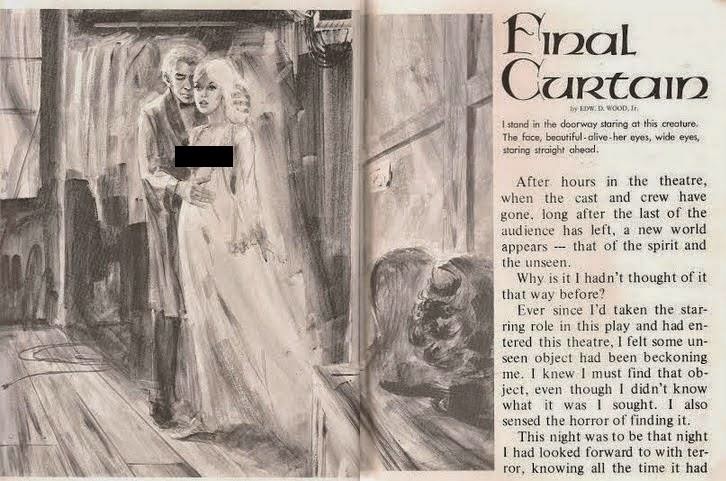
An actor caresses a blonde-haired vampire dummy in Ed Wood's "Final Curtain."

NOTE: This article is part of my ongoing coverage of Blood Splatters Quickly: The Collected Stories of Edward D. Wood, Jr.

Fresh from the pages of Belly Button!
The story: "Final Curtain," originally published in Belly Button magazine, Vol. 2, No. 2., July/August 1971, Calga Publishers. [Note: Philip R. Frey contends that the story appeared in Belly Button's February 1971 issue.]

Synopsis: After the closing night of his play, an actor wanders around an otherwise-empty and darkened theater, convinced that he is supposed to find some object. At first, his travels take him from his dressing room to the now-deserted stage. All the while, he is seized by eerie hallucinations and senses the presence of the spirits of those long deceased. Every trivial detail he encounters-- the empty theater seats, some burned-out guide lamps, the yowling of a cat -- takes on sinister significance in the man's paranoid imagination. He ascends a staircase to an upper story, where there is a hallway of evenly-spaced storage and rehearsal rooms. In one, he encounters a blonde-wigged female vampire mannequin, which he swears comes to life briefly and smiles at him! He backs out of the room and continues exploring, finally coming to a room where he finds what he had been seeking all along: a big black casket. He climbs inside and closes the lid.

Wood trademarks: Preoccupation with death (cf. this collection's "Into My Grave"); the theater (an important part of Ed Wood's early history); vampires (cf. this collection's "Dracula Revisited"); rambling supernatural monologue (cf. this collection's "I, Warlock," "Dracula Revisted," "The Night the Banshee Cried"); protagonist plagued by spirits and screaming sounds (cf. "Dracula," "Banshee"); quasi-poetic formatting with numerous line breaks (cf. many of the stories in this collection, including "Hellfire," plus the aforementioned monologues); heavy use of ellipses; resurrection of the dead (literal this time, as spirits); a preference for blondes (the "vampire dummy" has blonde hair); character compelled to climb into a coffin (cf. Necromania, "Come Inn"); fetishization of women's clothing (our narrator takes time to appreciate the mannequin's silk dress); fondness for soft fabrics (the casket is also velvet-lined); the "other things.. pleasant things" monologue (recycled as a speech for Criswell in the script for Orgy of the Dead); and one last reference to snakes (a metal railing is compared to "a cold, slimy snake").

Excerpt: "I leave the comforting lights of my dressing room and move to stand on the dark, empty stage. I look out over the blackened auditorium. The seats in front are as I have seen them night after night while acting my lines on this side of the footlights. But now, empty, they appear like squatty little fat men standing row on row, like soldiers in battle formation."

Reflections: More needs to be written about Ed Wood's mid-to-late-1940s theatrical career, which seems to have had a considerable, course-altering effect on his life. Unsurprisingly, the details of this phase of his career are scarce, and the sketchy information one can find in books like Rudolph Grey's Nightmare of Ecstasy is incomplete and often contradictory. What's (generally) agreed-upon is this: in 1946, having been honorably discharged from the Marines, Edward D. Wood, Jr. studied at the King-Smith School of the Creative Arts in Washington, D.C., where he may have received instruction from revered dancer and choreographer Martha Graham (1894-1991), a figure he is said to have admired greatly.

When he moved out to Hollywood the next year, Ed's first professional experiences were not in film but on the stage, acting in his own autobiographical play The Casual Company and portraying a sheriff in a show called The Blackguard Returns, as well as appearing in other, as-yet-unspecified theatrical productions. Chuck La Berge, an actor who appeared with Ed in The Casual Company, recalled to Rudolph Grey: "In the theater, we had a bad night, we'd all sit around and share a bottle of gin. We'd get drunk, and Ed would tell us all this weird stuff." Oh, to have been a fly on that wall, huh?

Duke Moore in "Final Curtain."
Those late, lonely nights in the theater were the inspiration for "Final Curtain," a story that should already be familiar to readers of this blog, as it was the basis for an unsuccessful yet quintessentially Wood-ian television pilot in 1957. Though Ed's would-be anthology series was a non-starter, this material hardly went to waste. Footage from that doomed pilot was shoehorned into Night of the Ghouls in 1959, and a chunk of text from the script was airlifted into Orgy of the Dead in 1965. Finally, in 1971, Eddie reformatted "Final Curtain" as a short story and sold it to Bernie Bloom, who used it to pad out one of his many photo-heavy stroke books.

Judging from the rather lavish illustration accompanying "Final Curtain" in the pages of Belly Button, Bernie gave this particular piece the royal treatment, despite its utter lack of eroticism. Perhaps he sensed how dear this monologue was to Eddie. In its transition from the screen back to the page, the text of "Final Curtain" does not seem to have changed much. Generally, the TV version is wordier than the magazine version, perhaps in an effort to better match Dudley Manlove's over-emotive voice-over narration with the silent footage of actor Duke Moore wandering around an empty building. But generally, the two incarnations of "Final Curtain" match each other, image for image and idea for idea. I won't say "plot point for plot point," because "Final Curtain" is more of a mood piece than it is a traditional narrative. As such, its natural home is on the page rather than the screen, so I'm glad Eddie recycled this one as a short story. Not much actually happens here, which becomes more obvious in the filmed version.

In any format, "Final Curtain" offers further evidence that Edward D. Wood, Jr. spent an inordinate amount of his life fantasizing about death, his own in particular. Wherever you are now, Eddie, I hope you're resting in peace.

Next: My closing thoughts on Blood Splatters Quickly

Wednesday, December 3, 2014

Ed Wood's BLOOD SPLATTERS QUICKLY: 'The Whorehouse Horror: A Touch of Terror' (1972)

Ed goes back the the whore shack in this beautifully-illustrated Gothic tale.

NOTE: This article is part of my ongoing coverage of Blood Splatters Quickly: The Collected Stories of Edward D. Wood, Jr.

The story: "The Whorehouse Horror: A Touch of Terror," originally published in Ecstasy, Vol. 4, No. 1, February/March 1972, Pendulum. Also appeared in Garter magazine, January 1, 1974, Gallery.

Synopsis: Prostitute Sandra Livingston is getting a little too old to be a call girl, and the dangerous life of the streetwalker doesn't appeal to her either, so she's looking for a whorehouse. Unfortunately, those are getting tougher to find. By chance, she goes into a dive bar and encounters a creepy pimp nicknamed Mousy, who says that he'll drive her out to just such an establishment. She agrees but is suspicious when the house of ill repute turns out to be a spooky mansion next to a graveyard. Despite her reservations, she goes in anyway and meets the ancient but friendly-seeming madam. 

Sandra soon finds that she is being held prisoner in the house and that escape is impossible. Only then does the madam reveal the bordello's terrible secret: all the girls are intentionally given venereal diseases which they will then pass on to their clients, who in turn have been sent unawares to the house by their revenge-seeking enemies. Girls who disobey or become too sickly wind up in the graveyard next door.

Wood trademarks: Whorehouse (cf. Take It Out In Trade); relationship between prostitute and pimp (cf. this collection's "Private Girl"); alcohol and bars (Sandra and Mousy meet in a dive bar, where Sandra drinks martinis); graveyard (cf. this collection's "Into My Grave," "In the Stony Lonesome"); juxtaposition of sex and death (cf. "Stony Lonesome," Orgy of the Dead); extremely illegal and perverse business in remote location (cf. this collection's "Breasts of the Chicken"); reference to Bela Lugosi and Boris Karloff horror films (cf. this collection's "The Gory Details"); woman aging in the sex trade (cf. this collection's "Flowers for Flame LeMarr," "Private Girl"); venereal disease (cf. this collection's "Craps," "To Kill a Saturday Night"); use of color pink (the madam wears a "faded pink velvet wrapper"); marabou (angora-like fabric often cited by Ed).

Excerpt: "The sweat had begun to pour from her forehead, even though there was a chill in the air. She felt strongly that she needed a drink. She also felt that she would catch syph or worse if she ventured into the dives she found along the street. But then she knew alcohol was a sterilizer. It probably couldn't hurt her any... especially if she demanded a clean glass."

Reflections: Where does he come up with this stuff? As I mentioned before in this series, Eddie's horror stories tend to have some nasty twist at about the four-fifths mark, and he's come up with some doozies in this collection: an incestuous transvestite alcoholic amnesiac killer, a mad dentist who sells organs on the black market, and a gourmet restaurant for cannibals with a breast fetish. "The Whorehouse Horror" may be the weirdest of them all. 

Try as I may, I cannot quite wrap my brain around this bordello's business model, which somehow combines white slavery with germ warfare. Of my many, many questions about this arrangement, my greatest might be: aren't the johns suspicious of anything? After all, they're instructed to go to a spooky old house right out of Scooby-Doo or The Addams Family, simply to enjoy a free-of-charge session with a prostitute. (The johns don't pay for the service; their enemies are the ones footing the bill.) I guess horny guys are willing to overlook just about anything. All I can think of is Valerie Solanas' scathingly satirical and often dead-on S.C.U.M. Manifesto (1967). It contains a passage that, in retrospect, applies to many of Ed Wood's male characters:
"Eaten up with guilt, shame, fears and insecurities and obtaining, if he's lucky, a barely perceptible physical feeling, the male is, nonetheless, obsessed with screwing; he'll swim through a river of snot, wade nostril-deep through a mile of vomit, if he thinks there'll be a friendly pussy awaiting him. He'll screw a woman he despises, any snaggle-toothed hag, and furthermore, pay for the opportunity. Why? Relieving physical tension isn't the answer, as masturbation suffices for that. It's not ego satisfaction; that doesn't explain screwing corpses and babies."
I've also been thinking about why Ed Wood writes about prostitution so often. There are only hints of this obsession in his movies (e.g. Colleen O'Brien as the eternally doomed streetwalker in 1965's Orgy of the Dead), but it dominates his short stories. Ready for some fan theory spinning? I think Eddie identified with prostitutes because he basically had to sell himself for increasingly paltry sums of money throughout the 1960s and 1970s. 

It wasn't Ed's goal in life to become a writer of pornography or a director of X-rated films, just like most little girls probably don't dream of growing up to be a hooker someday. That's just the way things worked out for him. Life in Hollywood also aged Ed Wood severely, and I think he saw a parallel to that in the lives of prostitutes. This story's Sandra Livingston wants to work in a "house of ill repute" because she could last there until her late forties, as long as she wears enough makeup. I need hardly tell you that Ed Wood was about 48 years old when this story was published. Wonder how thick his makeup was by then.

Next (and last): "Final Curtain" (1971) 

Tuesday, December 2, 2014

Ed Wood's BLOOD SPLATTERS QUICKLY: 'Pray for Rain' (1972)

The men of Wet Hound Fork, AZ endure a drought in Ed Wood's "Pray for Rain."

NOTE: This article is part of my ongoing coverage of Blood Splatters Quickly: The Collected Stories of Edward D. Wood, Jr.

"12 Pages of Tactile Color"
The story: "Pray for Rain," originally published in Skin & Bones magazine, Vol. 4, No. 1, February/March 1972, Calga Publishing. According to Bob Blackburn, this story also appeared in Lusty Lovers, year and other publication data unknown.

Synopsis: The small Arizona community of Wet Hound Fork (population: 200) is in the midst of a months-long drought, and the situation is starting to get desperate. Water, money, food, and booze are all in short supply. The town's wives have taken control of what little money is left, so they can buy the precious, trucked-in food and water their families need.

Only on Saturdays do the menfolk gather at the local saloon to slowly sip their drinks and complain about the lack of rain. During one such bull session, an old-timer recalls the droughts of the 1930s and suggests a remedy to the current problem: the people of Wet Hound Fork should pool their money and hire an Indian Rainmaker*

As expected, this idea is met with ridicule and skepticism, but the men still discuss the old-timer's plan in detail. They point out that the Great Depression-era Rainmaker must be long dead by now. The old man says there's another who's still living named Chief War Eagle. The men also say that the Indians on the reservation are suffering the exact same drought and are living on government assistance. The old timer suggests that a Rainmaker  might somehow help Wet Hound Fork receive some federal aid as well or even help get God's attention. The men fall silent at this point as they continue to pray for rain, unaware of the sound of thunder in the distance.
*Throughout "Pray for Rain," the word Rainmaker is consistently capitalized and italicized.
Wood trademarks: Western setting (cf. this collection's "Calamity Jane Loves Hosenose Kate Loves Cattle Anne"); men gathering around to drink and talk (cf. this collection's "Epitaph for the Village Drunk," "Craps," "To Kill a Saturday Night"); conversation dominated by talkative old-timer (cf. "Craps"); domineering women (cf. this collection's "Just One Question"); alcohol (no particular type is named, but the social ritual of drinking is key to this story); bars (like "Calamity Jane," this story is set in a saloon); thunder (a well-known Ed Wood motif in films and literature alike); the phrase "Then one day, like now, it just ain't there no more." (compare to Glen or Glenda?'s "Then one day, it wasn't Halloween any longer."); the existential ennui of small town life (cf. this collection's "Taking Off," "To Kill a Saturday Night"); lack of money (a subject with which Ed was all too familiar).

Excerpt: "Folks get to takin' water as always being right there. They just never think about water as never being around no more. We get to taking it for granted. We get to thinking that the water won't never run out. that is if we think about water at all. When you get to takin' things for granted you just don't think about it no more."

Reflections: "Pray for Rain" is the kind of story that makes me love Edward D. Wood, Jr. Here, Eddie's task was to yet again fill a few pages in one of Bernie Bloom's sleazy skin magazines, the type of publication people definitely weren't buying for the articles, and somehow Eddie produced a miniature tragicomic masterpiece that manages to be funny and sad and thoughtful all at once. 

People tend to stereotype Ed as a clown: a delusional dreamer with ambition but no common sense or talent, totally oblivious to his own faults and failings. The stories in Blood Splatters Quickly show how drastically oversimplified and unfair that image is. Sure, there are gaudy, lurid, and ridiculous stories in this collection, tales glutted with purple prose and highly improbable plot twists. The title story is an excellent example of that. 

But Eddie had a whole other side to his personality: a philosophical, slightly sardonic side that emerges in stories like "Pray for Rain" and its thematic first cousins, "Craps" and "To Kill a Saturday Night." Maybe his dark sense of humor came from his years of alcoholism and career setbacks. Without having to deal with cameras and actors and props and sets and the million-and-one other hassles of low budget filmmaking, Eddie could express himself through his writing in ways that were bold, vivid, shocking, witty, and even graceful.

When Ed Wood dealt with fantastic subjects (vampires or warlocks, for instance), he was apt to let his fevered imagination get the best of him, and the result was extravagant camp. When he tried to capture the language of particular social groups that were essentially foreign to him (slang-slinging teenagers or underworld gangsters, for instance), his grasp of the lingo was often clumsy and ham-handed, and the result was unintended comedy. 

Eddie's words rang the truest when he wrote about characters like himself: hard-drinking, middle-aged men who have been flattened by life and who have very few options still available to them. When he did these kinds of down-to-earth stories, he tended to ditch the flowery, highfalutin language of his pseudo-Gothic horror tales (like, say, "Dracula Revisited") and write in a style that was more economical and spare, yet still left ample room for evocative background details and realistic scene-setting.

These stories feel very personal, almost biographical. In "Pray for Rain," the relationship between the garrulous old storyteller and the scoffing, skeptical, younger men is very similar to the relationship Eddie really had with the other writers at Pendulum Publishing. The men of Wet Hound Fork laugh at their elder's talk of Rainmakers in the 1930s, just as the young bucks at Pendulum snorted at Eddie's anecdotes about working with Bela Lugosi in the 1950s. 

It's not difficult to see the drought in "Pray for Rain" as a metaphor for the brutal, seemingly endless dry spell in Ed Wood's own show business career. The sound of a phone not ringing can be downright deafening in Hollywood, and Eddie's phone wasn't ringing very often by the early 1970s. That is, when he could even afford to maintain a working phone line. Speaking of phones, Eddie gives his readers a perfect little image of futility and desolation in this descriptive passage about the lack of telephones in Wet Hound Fork:
There was no electrical refrigeration units in the small town... no electricity of any kind except for the single telephone in the General Store. Some months ago Hank Kleper tried to get one installed at his single pump gas station, but the expense was too great, then when the drought set in he and the telephone company both felt it wasn't worthwhile. Another telephone in the town of two hundred wasn't necessary at the time.
In other words: no phone, no lights, no motorcars, not a single luxury. Though it doesn't call attention to itself, that passage is, in its own modest way, nearly as bleak and discouraging as anything to be found in Camus' The Plague.

Next: "The Whorehouse Horror: A Touch of Terror" (1972)