Showing posts with label Final Curtain. Show all posts

Monday, August 12, 2024

Ed Wood's Warm Angora Wishes: "Final Curtain Revisited"

An actor battles a vampire in "Final Curtain Revisited."
NOTE: This article continues my coverage of Ed Wood's Warm Angora Wishes and Rubber Octopus Dreams (Arcane Shadows Press, 2024).
The story: "Final Curtain Revisited" by Douglas Gibson

Synopsis: A brief prologue explains that Final Curtain (1957) was an unsold TV pilot written and directed by Ed Wood. In this short film, a character identified only as the Actor wanders around the dark, spooky Dome Theatre at night after having played a vampire onstage there earlier in the evening. He becomes increasingly paranoid and is mysteriously drawn to something on the second floor. The object beckoning him turns out to be a coffin. Resigned to his fate, the actor climbs inside.

Valda Hansen as the Banshee.
The sequel picks up several years later. The Actor still dwells in the Dome Theatre, long after the events of the first story. He lies in his coffin in a storage room on the second floor, invisible to the (living) actors and crew members who work in the building each day. Every few years, the Actor is resurrected so that he can steer someone toward a peaceful afterlife and spare them great agony. No one can see or hear him, but he can directly influence people's behavior nevertheless.

The Actor's eternal nemesis is the Vampire, an alluring female who dwells in a room down the hall. She, too, is unable to leave the Dome. One night, the Actor rises from his coffin and finds that the Vampire is tearing apart the body of a recently-deceased theater critic. Unfortunately, he cannot do anything to prevent this. The Actor strolls around the theater, even visiting his old dressing room. He also sees the Banshee, a young blonde woman who had pretended to be a ghost when she was alive. In death, she is a restless soul who is cursed to wander the earth forever.

Eventually, the Actor realizes why he has been awakened from his years-long sleep. He needs to save the soul of a stagehand who is on the threshold of death. This young man, though not evil, had yearned for fame and glory but had been denied these things during his life. Now, this doomed man seems inextricably drawn to the Vampire. Knowing he is breaking the rules, the Actor enters the room of the Vampire and protects the stagehand from her. The Vampire slashes the Actor’s throat. The stagehand dies peacefully, and the badly-injured Actor collapses on a mattress, unable to reach his own coffin.

Excerpt
The hall produced chaotic sounds that presumed Grand Guignol-like horrors. Snarling, choking sounds, like a wolf man descending on a young lovely. More howls of agony, followed by poundings on the wall. Perhaps a maniac driving nails into his torture victim? The Actor strained to repress these feelings, thoughts. Were they repressed memories of past awakenings, or just his still-lively imagination? How many souls existed there?
Reflections: M. Night Shyamalan's The Sixth Sense (1999) turns 25 this year, so I’ll assume that anyone who wants to see this film has already done so by now. Besides, its twist ending must be one of the worst-kept "secrets" in movie history. I've long felt that this extremely successful film (which Ed Wood would have loved, incidentally) could have been the pilot for a fascinating weekly television series. 

Willis and Osment in The Sixth Sense.
To recap, The Sixth Sense concerns Malcolm (Bruce Willis), a psychologist who slowly comes to realize that he is deceased, and Cole, a troubled young boy with a rare ability to see and talk to ghosts. Together, they are able to bring solace to tormented souls who have unfinished business on earth. They only do a little of this in the movie, coming to the aid of a female child ghost named Kyra (Mischa Barton) who has been poisoned by her mother, but I figured they could keep doing it week after week. After all, there must be plenty of unhappy ghosts out there who need Malcolm and Cole's help.

"Final Curtain Revisited" has some of the flavor of the Sixth Sense TV show I was envisioning. It takes Duke Moore's character from Final Curtain and turns him into a kind of Mr. Fix-It of the afterlife. By the rules of this fictional universe, though, the Actor has to remain at the Dome Theatre, so his services aren't needed very often. In the story, even he doesn't know why it's the stagehand's turn to die. It just is.

Maybe if the Actor branched out beyond the walls of the Dome Theatre, he could assist other souls in want. The Banshee in this short story seems to have free reign, at least to some extent, but she does not take advantage of this opportunity. She exists only to suffer. The author compares her to Jacob Marley from A Christmas Carol (1843), but at least Marley does one productive thing with his afterlife.

Frankly, it never would have occurred to me to expand on the story of Final Curtain, nor to tie it into the story of Night of the Ghouls (1959) and the unreleased The Night the Banshee Cried (1957). But author Douglas Gibson has done a nice job of recreating the spooky atmosphere of the original film. He does not replicate Ed Wood's writing style because I believe doing so would be impossible. Wood takes great leaps into the absurd and implausible, and he is not cautious in his use of language. In comparison, Gibson's writing is more restrained and even tasteful. If there's such a thing as a polite take on Ed Wood, this is it.

Wednesday, September 6, 2023

Ed Wood Wednesdays: Jean Stevens in White and Black (Guest Author: James Pontolillo)

Ed Wood gave us two sides of actress Jean Stevens.

In his magnum opus Plan 9 from Outer Space (1957), writer-director-producer Edward D. Wood, Jr. summoned an iconic femme fatale – TV horror hostess Vampira as the striking Vampire Girl – to haunt men for decades to come. Plan 9’s cult status and the fervor directed toward Vampira have caused Ed’s other femme fatales to be largely overlooked. 

Two of his lesser-regarded films – Final Curtain (1957) and Night of the Ghouls (1959) – feature a [White] Vampire and a Black Ghost, respectively. Each role was played by the same little-known actress who managed to exude a mysterious, foreboding air of eroticism not unlike that of Vampira herself. A large measure of credit must be given to the cinematographer, William C. Thompson, whose knack for capturing feminine beauty in crisp, moody black-and-white mirrored the timeless Universal horror classics of the 1930s and 1940s. The young actress in question, Jean Stevens, was no newcomer as far as Ed was concerned. He had known her since his earliest days in Hollywood.

Wednesday, August 23, 2023

Ed Wood Wednesdays: A 'Final Curtain' Call? (Guest Author: James Pontolillo)

Duke Moore stars in Ed Wood's Final Curtain.

Following a well-established trend of sci-fi, suspense and supernatural anthology series on television begun in the late-1940s (more than a dozen programs including The Clock [1949], Alfred Hitchcock Presents [1955], and Strange Stories [1956]), Ed Wood, Jr. proposed his own anthology series entitled Portraits of Terror. Only one episode was produced, a 22-minute pilot called Final Curtain that was shot silent with music, narration and sound effects added in post-production. See Blevins (2013), as well as Rausch and Pratt (2015) for plot synopses and additional details. To date, there has been only a limited discussion concerning the Final Curtain filming locations and an incomplete presentation of identifying photographs. My goal is to better document this obscure piece of Wood-work.

Wednesday, March 11, 2015

Ed Wood Wednesdays, week 57: The Auction of Lot #3026 (UPDATED!)

This suitcase full of Ed Wood's shattered hopes and dreams can be yours.

"Oedipa settled back, to await the crying of lot 49."
-Thomas Pynchon

"Auction houses run a rigged game. They know exactly how many people will be bidding on a work and exactly who they are."
-Jerry Saltz

I've done some dumb things in my time, citizens. Made a lot of mistakesprofessionally, personally, romantically, financially, you name it. But this week, dear readers, I was tempted to do perhaps the stupidest thing I have ever done in my time on this planet: drop a good chunk of my life savings on some battered old suitcases and yellowing pieces of paper, simply because these trinkets once belonged to Edward Davis Wood, Jr.

Let me explain.

A few months ago, well into doing this project, I finally got the bright idea to sign up for a Google Alert on Ed Wood so that I'd get regular updates in my e-mail inbox whenever something Wood-related popped up in the news. Now, that probably seems like a no-brainer to you, but there is no such thing as a "no-brainer" in my world. Even something as simple as this was a "some-brainer" for me. It took about a year or so before that particular neuron finally fired in my brain.

So, anyway, these last few months, Google has been dutifully sending me Ed Wood stories, sometimes about the man himself and other times just about the 1994 biopic that bears his name. For example, when that film's director, Tm Burton, reunited with screenwriters Scott Alexander and Larry Karaszewski on another quirky biopic, Big Eyes, I received a slew of links about it. That's to be expected.

Google has also been telling me a lot about the recent Plan 9 remake, so much so that now I feel vaguely obligated to review it. (I kind of don't want to. I'd be perfectly content to let that particular sleeping dog lie, you know?) And when a theatrical troupe in Las Vegas turned Glen or Glenda? into a stage show, well, I heard all about that, too.

None of this has been too terribly earth-shattering or paradigm-shifting, even though this kind of news is most welcome. Last week, however, I had an e-mail alert with a headline that shook me to my core: "Director Ed Wood's belongings up for sale."  Quoth (the weirdly British-seeming, yet American-named) Hollywood.com:
A Plan 9 program.
A collection of director Ed Wood's belongings will be auctioned off later this month (Mar15). More than 200 items which once belonged to the iconic moviemaker are up for sale, including a briefcase containing photographs from his 1959 movie Plan 9 from Outer Space, a page from a notebook featuring Wood's notes on sexual terminology, and a programme from one of his first plays. The briefcase is the most expensive item in the collection with a starting bid of $2,500 (£1,600) while the signed programme is up for $300 (£190). Items from Wood's personal Hollywood memorabilia collection are also up for sale including actress Greta Garbo's 1938 immigration card and an array of candid backstage pictures from various movie shoots. The Hollywood Lifetime Collection Auction is to be held in Cambridge, Massachusetts on 19 March (15).
Now, how could I pass up something like that? (Garbo's green card? Are you shitting me?) Obviously, this required some further investigation.

A quick search for "Hollywood Lifetime Collection Auction" led me to this: a tantalizing, blow-by-blow description of  Lot #3026 - Ed Wood's Personal Collection on a site called RR Auction. Now, you might be wondering, how did Ed Wood even have a "personal collection," seeing as how he kept getting evicted from different residences and was thus forced to throw most of his precious mementos away?

Unsurprisingly, the answer was provided by superfan Bob Blackburn, the fellow who befriended Kathy Wood in her final years and became the co-keeper of the Ed Wood flame, so to speak, after her death. On the Ed Wood Facebook group, Bob recently explained: "I actually own the one suitcase that Ed and Kathy had when they were evicted from their Yucca St. apartment in December of 1978, which is identical to one that is included in this lot. The one I have, Kathy had kept the manuscript for Hollywood Rat Race in and the script for I Woke Up Early The Day I Died." Sounds like a choice item.

But what about the suitcase being auctioned off in 2015? Bob again: "This was from the Bekins Storage up on Lankershim [Blvd. in North Hollywood]. They put their stuff there at one time, and it got sold off. There's stories that some of the film canisters that Ed had were also in that unit." 

So there you have it, folks. Decades before Storage Wars, Ed and Kathy Wood put some belongings into a storage unit and then just couldn't keep up with the payments, so their possessions became somebody else's possessions. And now, that stuff is available to the highest bidder, which could be you, dear reader.

According to the official site for the Ed Wood sale, these rare items come from the James Collings Collection. Based on his official bio, Collings, who passed away in 2012, seems like an interesting character in his own right: an obsessive, hippie-ish memorabilia collector, numismatist, and autograph hound who met his wife in a 12-step program. (For hoarders, one wonders?) From what I can glean, it's Jimmy's widow, Merlyn, who's authorizing this auction. According to the bio, she "seamlessly embraced her husband's insatiable lifestyle." Meaning, I guess, she enabled his addiction while he was alive and now wants to make bank on all that junk he accumulated over the years. Good for her. I don't blame her a bit.

So what have we got here? Let's go over some of  the juicier items in detail:
Ed Wood's briefcase
  • For many, the main item of interest in this sale is a light-brown, cowhide-leather, Rexbilt briefcase that was personally owned and used by Edward D. Wood, Jr. If the photo can be trusted, there's even a fading "EDW" monogram in the lower-right-hand corner. This is a fantastic-looking item. I can imagine Eddie toting this around with him when he went to meetings with potential publishers or backers. Gotta look the part, after all. Accessories make the man. "Anybody carrying that kind of briefcase must know what he's talking about! How much do you need, Mr. Wood? One million? Two million? Is cash all right? You certainly have room for it in that magnificent briefcase of yours!"
  • Then, there are two further pieces of luggage the auctioneers are describing as "trunks," which maybe makes them sound bigger than they are. You can see one of them at the top of this article. These are boxy, suitcase-sized jobs, one of which was manufactured by "Travelgard Vancouver Trunk & Bag Ltd." That company, which dates back to the 1930s, seems to be long gone today. Pity. I can't help but think back to a 1996 Simpsons episode entitled "Bart the Fink" in which a cash-strapped Krusty the Clown has to auction off his possessions. One item in particular is "a handmade leather suitcase carried by the Krustofski family upon their arrival at Ellis Island in 1902. A priceless heirloom and historic piece of Krustyana." It goes for a whopping 40 cents to Marge Simpson's chain-smoking sister, Selma, who buys the cherished keepsake just to soak her feet in it. 
  • There's a whole mess of Plan 9 promotional items, including a few pressbooks, stills, and behind-the-scenes photos, complete with (apparently unheeded) suggestions for alterations by Ed Wood himself, who wanted Bela Lugosi posthumously added to a cast portrait along with "smoke" and "special effects." Touchingly, one of these items bears a dedication to Wood's longtime cinematographer, William C. Thompson, "the cameraman who made it all possible!!"
  • I'm guessing that the 1965 autographed glossy photo of Ed Wood "on a film set with his camera in the background and a script in his lap" derives from the production of Orgy of the Dead, given the year and the fact that it's signed "To Steve, My friend a thousand times over." Who could that be but Orgy director Steve Apostolof?
A program from The Casual Company.
  • For me, maybe the most interesting item in the entire auction is a program from The Casual Company, the autobiographical, WWII-set play Ed wrote, directed, and costarred in after moving to Hollywood in 1947. I've said before that Eddie's 1940s theatrical career has not been properly documented, and this ultra-rare document helps to fill in some gaps there. It reveals, for instance, that the show was performed by a troupe called "the Sad Sacks," which included Ed himself and future Night of the Ghouls producer and Atomic Productions co-founder, Maj. J.C. Foxworthy. Moreover, the show is much less serious than it is depicted as being in Tim Burton's Ed Wood. The cover describes it as "A Farce in Three Acts," and the characters have such Beetle Bailey-worthy names as "Pfc Elbo Joints," "Pfc Jim Nastics," "Pfc Lemmy A. Dime," "Ilene Sideways," and "Mary Widow." Eddie gave himself the rather-more-dignified-sounding role of "Corporal Anthony," while his buddy Foxworthy played "Capt. J. Sleepingwell Gutter." Make of that what you will. Unlike what Burton's movie says, by the way, the cast and crew does not include such Wood regulars as Dolores Fuller, Conrad Brooks, Paul Marco, or Bunny Breckenridge. Eddie likely hadn't even met those people yet.
  • You've gotta have some Tor Johnson stuff in this auction to make it official. Luckily, there are three Tor-autographed photos here, including one from 1961 in which the Super Swedish Angel refers to Ed Wood as "my favorite producer." The auction people warn bidders that "all signatures are extremely faded, with poor contrast," but they also point out that "Johnson played iconic roles in Wood’s most notorious films and represents an exceedingly rare horror autograph." Take 'em or leave 'em, folks.
  • The only item that competes with the Casual Company program for sheer Wood-ian intrigue is a "lined notebook page of Wood's typed and handwritten notes on sexual terminology." In the 1960s and 1970s, in addition to writing novels and short stories, Wood also wrote (often under pseudonyms) many, many, many volumes of non-fiction, usually sexual and salacious in nature. (Bloodiest Sex Crimes of History is a good example.) Although such works were pure hokum with no scientific validity, Eddie took these publisher-mandated assignments rather seriously. From his earnest entry on aphrodisiacs: "Spanish Fly is probably the most talked of aphrodisiac, but it is actually a diuretic." Good to know. Furthermore, such supposed love potions as absinthe "are merely intoxicants." And that's something about which Eddie was truly an expert.
  • In a strange coincidence, the auction also includes "a magazine layout for Wood's short story 'Howl of the Werewolf,' framed to an overall size of 22 x 28." In case you're just joining us, I devoted the entirety of the previous Ed Wood Wednesdays to that particular story of a lusty lycanthrope and his most-unfortunate female victim, a stressed-out secretary who should never have vacationed in the woods during werewolf season. As such, I can attest that the unsigned artwork accompanying the story is quite eye-catching. And now, here it is, coming up for auction. Small world, am I right?
On the set of The Sun Was Setting.
And there's more, too. Much more.

Lot #3026 includes stills, press clippings, lobby cards, and publicity photos related to Jail Bait (aka The Hidden Face), The Sinister Urge, The Bride and the Beast, Crossroad Avenger, Bride of the Monster, and Fugitive Girls, among others. Basically, this is the exact stuff to which I have devoted the last two years of my life. If you could fit the last twenty-four months of my existence into two steamer trunks and a suitcase, it would look like this. What really surprises me is that there are even some items connected to obscure or semi-forgotten Wood projects, like The Lawless Rider, Final Curtain, and The Sun Was Setting. That's some Ph.D-level, Advanced Wood-ian Studies material there, folks. Who knew that publicity photos from these productions even existed anymore?

The auction people, by the way, want us to know that Lot #3026 is "accompanied by several letters of provenance from notable figures, including Maila Nurmi (Vampira), Wood's biographer Rudolph Grey, David Ward, and Dennis Phelps." Not being familiar with the memorabilia biz, I'll admit that I did not immediately know what a "letter of provenance" is. Based on my limited understanding of the subject matter, though, I'll surmise that it's basically a letter attesting to the authenticity of an item.

The bidding on Lot #3026 begins on March 12, 2015. That's tomorrow, if you're reading this article the day it goes out. It continues for a week. The minimum opening bid, as you already know, is $2500. Yes, I will be bidding on this.  Don't worry. I have no chance of winning. Bob Blackburn says that the final price should be in the $30,000 range. That's a little rich for my blood. Hell, that's a lot rich for my blood. Thirty-thousand smackeroos. That's a chunk of change.

I can't help but shake my head at the bitter irony of this. After all, this entire auction is possible because Ed Wood was so profoundly broke he couldn't afford his North Hollywood storage unit anymore. If Eddie were around today, there's no way he hope to buy back his old suitcases full of faded memories. There's no way I can buy them back, either, but I'm going to make a token effort nonetheless. For loyalty's sake.

A taste of Lot #3027, the second best thing in the auction.
Incidentally, if there's no way you can possibly afford Lot #3026, there are a number of less expensive items that are being auctioned off separately and that may be in your (and my) price range, including vintage one-sheets for Glen or Glenda? (under the title I Led 2 Lives), Plan 9, Bride and the Beast, The Sinister Urge, Jail Bait, and a collection of eleven of Eddie's sexploitation films (including Love Feast, Beach Bunnies, Drop Out Wife, and others). The minimum bids on these are generally $200 apiece, though Plan 9 is starting at $300, presumably because it's Ed's most famous creation.

Additionally, there are some Plan 9 and Bride of the Monster lobby cards up for bids, too, plus three of Vampira's excellent self portraits (in black and white with red accents). RR Auction is also including under the "Ed Wood" category some titles that have only a little bit to do with Eddie, including Mesa of Lost Women, The Unearthly, and Beast of Yucca Flats.

By far, the most interesting item other than the already-legendary Lot #3026, however, is #3027 Signed Ed Wood Program and Script. Starting bid: $300. What you get here is a program for The Blackguard Returns, a 1949 play in which Ed portrayed a sheriff, and a script for 1959's Night of the Ghouls. Why these items should be paired, I do not know, but they are accompanied by a "four-page scrapbook" from actor Don Nagel, who was a regular in Wood's films during the 1950s.

The auction is shaping up to be the single biggest Ed Wood-related story of 2015, just as the release of Blood Splatters Quickly and the new DVDs from Alpha Blue Archives and After Hours Cinema were the most important developments of 2014. As evidence, I point you to this excited article by John W. Barry from Ed Wood's hometown paper, the Poughkeepsie Journal. It includes some exultant comments by RR Auction's vice president, Bobby Livingston, who says that the sale offers "a peek into who Ed Wood was" and calls the auction "one of the most incredible things I've ever seen." Local Ed Wood fans are also interviewed in Barry's article, including Joe Mendillo, who is part of the effort to raise $30,000 to build a statue of Edward D. Wood, Jr. in Poughkeepsie. He sees the auction as a good thing. "The more enthusiasm," states Mendillo, "the more likely Poughkeepsie will get its statue."

It's understandable that some of Ed Wood's fans were hoping that the auction would remain fairly obscure. Fewer bidders mean lower prices, after all. But it now appears that the toothpaste is well out of the tube on this one.

Get your checkbooks ready.

Thursday, December 4, 2014

Ed Wood's BLOOD SPLATTERS QUICKLY: 'Final Curtain' (1971)

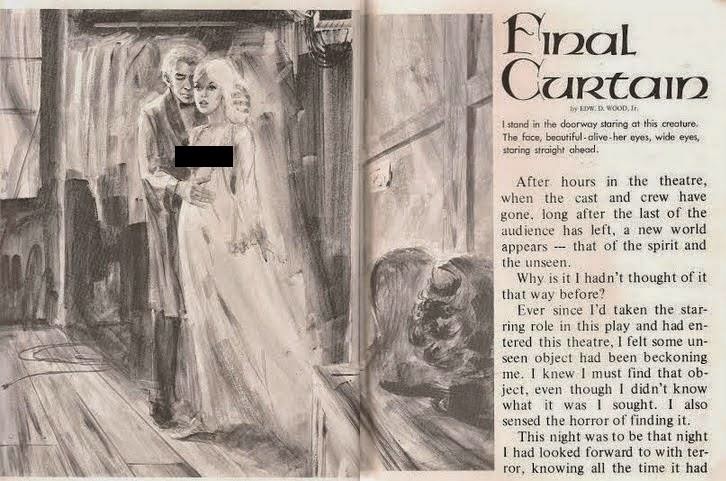
An actor caresses a blonde-haired vampire dummy in Ed Wood's "Final Curtain."

NOTE: This article is part of my ongoing coverage of Blood Splatters Quickly: The Collected Stories of Edward D. Wood, Jr.

Fresh from the pages of Belly Button!
The story: "Final Curtain," originally published in Belly Button magazine, Vol. 2, No. 2., July/August 1971, Calga Publishers. [Note: Philip R. Frey contends that the story appeared in Belly Button's February 1971 issue.]

Synopsis: After the closing night of his play, an actor wanders around an otherwise-empty and darkened theater, convinced that he is supposed to find some object. At first, his travels take him from his dressing room to the now-deserted stage. All the while, he is seized by eerie hallucinations and senses the presence of the spirits of those long deceased. Every trivial detail he encounters-- the empty theater seats, some burned-out guide lamps, the yowling of a cat -- takes on sinister significance in the man's paranoid imagination. He ascends a staircase to an upper story, where there is a hallway of evenly-spaced storage and rehearsal rooms. In one, he encounters a blonde-wigged female vampire mannequin, which he swears comes to life briefly and smiles at him! He backs out of the room and continues exploring, finally coming to a room where he finds what he had been seeking all along: a big black casket. He climbs inside and closes the lid.

Wood trademarks: Preoccupation with death (cf. this collection's "Into My Grave"); the theater (an important part of Ed Wood's early history); vampires (cf. this collection's "Dracula Revisited"); rambling supernatural monologue (cf. this collection's "I, Warlock," "Dracula Revisted," "The Night the Banshee Cried"); protagonist plagued by spirits and screaming sounds (cf. "Dracula," "Banshee"); quasi-poetic formatting with numerous line breaks (cf. many of the stories in this collection, including "Hellfire," plus the aforementioned monologues); heavy use of ellipses; resurrection of the dead (literal this time, as spirits); a preference for blondes (the "vampire dummy" has blonde hair); character compelled to climb into a coffin (cf. Necromania, "Come Inn"); fetishization of women's clothing (our narrator takes time to appreciate the mannequin's silk dress); fondness for soft fabrics (the casket is also velvet-lined); the "other things.. pleasant things" monologue (recycled as a speech for Criswell in the script for Orgy of the Dead); and one last reference to snakes (a metal railing is compared to "a cold, slimy snake").

Excerpt: "I leave the comforting lights of my dressing room and move to stand on the dark, empty stage. I look out over the blackened auditorium. The seats in front are as I have seen them night after night while acting my lines on this side of the footlights. But now, empty, they appear like squatty little fat men standing row on row, like soldiers in battle formation."

Reflections: More needs to be written about Ed Wood's mid-to-late-1940s theatrical career, which seems to have had a considerable, course-altering effect on his life. Unsurprisingly, the details of this phase of his career are scarce, and the sketchy information one can find in books like Rudolph Grey's Nightmare of Ecstasy is incomplete and often contradictory. What's (generally) agreed-upon is this: in 1946, having been honorably discharged from the Marines, Edward D. Wood, Jr. studied at the King-Smith School of the Creative Arts in Washington, D.C., where he may have received instruction from revered dancer and choreographer Martha Graham (1894-1991), a figure he is said to have admired greatly.

When he moved out to Hollywood the next year, Ed's first professional experiences were not in film but on the stage, acting in his own autobiographical play The Casual Company and portraying a sheriff in a show called The Blackguard Returns, as well as appearing in other, as-yet-unspecified theatrical productions. Chuck La Berge, an actor who appeared with Ed in The Casual Company, recalled to Rudolph Grey: "In the theater, we had a bad night, we'd all sit around and share a bottle of gin. We'd get drunk, and Ed would tell us all this weird stuff." Oh, to have been a fly on that wall, huh?

Duke Moore in "Final Curtain."
Those late, lonely nights in the theater were the inspiration for "Final Curtain," a story that should already be familiar to readers of this blog, as it was the basis for an unsuccessful yet quintessentially Wood-ian television pilot in 1957. Though Ed's would-be anthology series was a non-starter, this material hardly went to waste. Footage from that doomed pilot was shoehorned into Night of the Ghouls in 1959, and a chunk of text from the script was airlifted into Orgy of the Dead in 1965. Finally, in 1971, Eddie reformatted "Final Curtain" as a short story and sold it to Bernie Bloom, who used it to pad out one of his many photo-heavy stroke books.

Judging from the rather lavish illustration accompanying "Final Curtain" in the pages of Belly Button, Bernie gave this particular piece the royal treatment, despite its utter lack of eroticism. Perhaps he sensed how dear this monologue was to Eddie. In its transition from the screen back to the page, the text of "Final Curtain" does not seem to have changed much. Generally, the TV version is wordier than the magazine version, perhaps in an effort to better match Dudley Manlove's over-emotive voice-over narration with the silent footage of actor Duke Moore wandering around an empty building. But generally, the two incarnations of "Final Curtain" match each other, image for image and idea for idea. I won't say "plot point for plot point," because "Final Curtain" is more of a mood piece than it is a traditional narrative. As such, its natural home is on the page rather than the screen, so I'm glad Eddie recycled this one as a short story. Not much actually happens here, which becomes more obvious in the filmed version.

In any format, "Final Curtain" offers further evidence that Edward D. Wood, Jr. spent an inordinate amount of his life fantasizing about death, his own in particular. Wherever you are now, Eddie, I hope you're resting in peace.

Next: My closing thoughts on Blood Splatters Quickly

Wednesday, September 17, 2014

Ed Wood Wednesdays, week 48: 'Rudolph Grey Presents: Short Films, Home Movies, and Other Miscellanea' (2014)

Manhattan's Anthology Film Archives.

Well, folks, I guess there is going to be an "Ed Wood Wednesdays" column this week after all, but it's not the typical sort of heavily-researched, carefully-constructed piece I usually do for this series. Instead, while the memories were still semi-fresh in my brain, I wanted to record some thoughts and feelings about attending the penultimate night of The 10th Dimension: Edward D. Wood, Jr., a week-long retrospective currently running at Manhattan's Anthology Film Archives (AFA). The AFA is not your typical movie theater. Instead, it's a nonprofit center for the preservation and exhibition of offbeat and rare films.

As its name suggests, in addition to holding screenings, the AFA is also a vast storehouse of films and videos, preserving these artifacts for future audiences. This year, in addition to a slew of other programs, the center decided to honor the work of Edward D. Wood, Jr. They've shown films both famous (Plan 9 from Outer Space) and obscure (Nympho Cycler) from Ed's entire career, with selections from the 1950s, 1960s, and 1970s. Tonight, Wednesday, September 17, was a very special show -- the linchpin of the entire festival, in fact -- because it was an assortment of rarities hosted by Rudolph Grey, author of Nightmare of Ecstasy: The Life and Art of Edward D. Wood, Jr. (1992).

In order to give this article some semblance of structure, I'll break down my reflections by sub-topics.

I. ANTHOLOGY FILM ARCHIVES itself

The Internet was a good friend to me this time around.  Though the Comfort Inn where I'm staying is not exactly a five-star luxury resort, it is within easy walking distance of the AFA. So thank you, Internet, for finding this place and suggesting it to me. And special thanks to Google for providing easy-to-follow walking directions, even though I somehow managed to get lost several times on the way there and the way back because I have no innate sense of direction. You know that inner compass that most people seem to have? Mine was removed surgically at birth. New York City doesn't give you much help either, by having "1st Street" cross "1st Avenue" and "2nd Street" intersect with "2nd Avenue." I had to traverse all four of these similarly-named arteries to get from my hotel to the Archives.

I actually passed the AFA a few times because, with its red brick exterior, it looked more like a church or a school than a cinematheque. In fact, according to Wikipedia (which is never wrong about these things), the building used to be a courthouse before the film archivists moved in during the late 1970s.

This gives you an idea of what the
AFA's screening rooms are like.
Once inside the building, I noticed how humble and unprepossessing the lobby was: just a small waiting area and a lonely ticket booth with a bearded, horn-rimmed glasses-wearing dude inside. The biggest thrill for me, at least initially, was seeing that they had the New York Times article that mentions me displayed at poster size in the lobby. I mentioned this to Mr. Beard-O, and he just kind of shrugged and said, "Cool." He told me he hadn't bothered to read it and didn't really know which poster I was referring to. What can you say to that? It takes the wind out of your sails a bit, certainly.

I was getting a "semi-amateurish, mom-and-pop" kinda vibe from the Archives, but I could see traces of professionalism there as well. They show movies on at least two screens, for instance. One theater was located up a couple of flights of stairs, while another was on the ground floor. Every Wednesday seems to be devoted to showing the work of new filmmakers. I got there in plenty of time to see this week's chosen newbie: Shawn Batey's hour-long documentary, Changing Face of Harlem. The crowd was polite but very sparse. Unperturbed, Ms. Batey herself was there to introduce and explain the movie, which chronicles the rise and decline of Harlem, along with the gentrification that threatens to dilute the neighborhood's identity and drive away poor and middle-class African-Americans. Batey said she'd been working on the modest but provocative documentary for about 14 years now. The screens at the AFA have an aspect ratio of 1.33:1, but they are large, and the picture and sound quality are both quite good. Provided they promote the screenings themselves, young directors might well consider the New Filmmakers night at the AFA as a viable showcase for their work.

But this was all happening upstairs. Downstairs was where the real fun was brewing. A decent-sized crowd turned out for the program I'd come there that evening to see -- Rudolph Grey Presents: Short Films, Home Movies, and Other Miscellanea. There were enough spectators on hand to fill up the ground floor theater at the AFA. Let us now venture into the dank, humid depths of that exhibition.


II. RUDOLPH GREY, host/curator 

Rudolph Grey as he appears in Dad Made Dirty Movies.
I'd never met Rudolph Grey, musician and author, before this. But I'd certainly read his book, Nightmare of Ecstasy, countless times and seen him in documentaries like Jordan Todorov's Dad Made Dirty Movies (2012). So I recognized him instantly. I'd describe him to you as a combination of Tom Waits, a 1940s film noir detective, and mid-1980s Bob Dylan. Giving off an air of jaded, world-weary cool, he seems to hide behind his fuzzy hair, scraggly beard, and crumpled posture. But he's not imposing or intimidating in any way. He looked benign enough, so I thought to myself, "What are the odds that I'm ever going to be in the same room as this guy again? I have to say something."

This turned out to be a miscalculation. When I walked into the AFA screening room, Grey was seated in the first row, puffing on an e-cigarette and resembling a new millennium Philip Marlowe or Sam Spade. I approached him with a smile on my face, told him how many times I'd read his book, and then stumbled through some semi-coherent explanation of who I was and what "Ed Wood Wednesdays" was all about. He was anything but interested and gave me the dreaded Queen Victoria "we are not amused" look. So I backed off, humbled, and went dejectedly back to my seat. Whoops.

Despite this initial setback, Rudy's presentation was funny and informative nevertheless. This is a man who has clearly done his homework (hundreds of interviews, he claims), and once you get him started talking about a topic that interests him, he can be downright effusive. But he can become taciturn or inscrutable at a second's notice, too.

The evening was co-hosted by a film historian somehow connected with the Anthology Film Archives -- a well-spoken, professorial, middle-aged guy with a neatly-trimmed beard and rimless glasses. (His name eludes me. Sorry.) I got the impression that he and Rudy were friends or at least had some history together. Generally, he asked open-ended questions, and Rudy either answered them or tried to answer them. You could tell, though, that the professorial guy had to do a little work to coax the answers out of Rudy, and there were a few times when the proceedings threatened to grind to a halt. Odd conversational hiccups abounded, you might say. 

Rudolph Grey doesn't say reassuring things like "yes" or "definitely." Speaking with a heavy New York accent, somewhat reminiscent of Peter Falk as Lt. Colombo, he's more likely to cut you off with "sure" (his favorite expression) or "right" or "of course" and then not say anything else after that unless you give him more prompting. (A typical exchange might go: "Is your apartment full of tapes from old interviews?" "Sure.")

Still in all, the conversation was chock full of valuable information for the aspiring Wood-ologist. Some highlights:

  • Rudolph Grey first became aware of Ed Wood in the early 1960s when Plan 9 from Outer Space and (later) Bride of the Monster started airing on local television in New York. But back then, he had no idea about the man behind the movies. "It was just a name to me."
  • Grey believes that Eddie's reputation as "the worst director of all time" started in the 1960s with such horror magazines as Forrest J. Ackerman's Famous Monsters of Filmland and Castle of Frankenstein, which would run stills from Eddie's movies like Plan 9 with derogatory captions. Despite this, Eddie considered Ackerman a friend. These film magazines, aimed at what Grey called "nerds," were where the "bad movie" cult around Ed really began.
  • Harry and Michael Medved's Golden Turkey Awards book brought Ed a lot of negative postmortem publicity and made Grey's work difficult in the early 1980s when he began his research into Wood's career. Nobody connected to Ed wanted to talk to Rudolph Grey because they didn't trust him or didn't understand his motives. Kathy Wood, Ed's widow, was especially hesitant to talk to Grey but eventually relented. 
Richard Bojarski's book.
  • Ed died, Grey said, just as Glen or Glenda? was catching on in a few cities as a cult movie. "Bad timing," he concluded. Grey didn't realize that, during the late 1970s, he could have just looked up Ed's name in the Los Angeles telephone directory and found him that way. By December 1978, Ed was dead, and it was too late. Rudolph Grey never got the chance to meet or interview Edward D. Wood, Jr. One author who did was Richard Bojarski, who talked to Wood in 1977 as part of the research for his own book, The Films of Bela Lugosi (1980). Bojarski generously shared his archival material with Grey. I believe some the taped interviews that Bojarski did are excerpted in the movie The Haunted World of Edward D. Wood, Jr. 
  • Grey bristles at the term "oral history," even though that's what Nightmare of Ecstasy really is. He says he chose the format of the book -- which consists of a string of quotes from Wood's friends and associates with very little commentary from Grey himself -- because writing a straight prose biography had not worked and, besides, he wanted to preserve the speech cadences of the people he interviewed. He modeled Nightmare of Ecstasy after Jean Stein's Edie: An American Biography (1982), a book about Warhol superstar Edie Sedgwick.
  • One of Rudy's first big accomplishments in his research was landing an interview with Ed's mother, Lillian Wood. Grey speculates that Lillian did not really understand what her son's life or career were like. When Grey showed her a picture of Bela Lugosi, for instance, she said, "Oh, I know him!" Wood also had a sibling, a brother, who was always jealous of Eddie and didn't want to talk about him. In deference to Lillian, Rudy left the brother alone.
  • Vampira, he says, started out as something of a snob. But he talked to her for hours anyway, and eventually she admitted that she had misjudged Ed Wood.
  • Since the initial publication of Nightmare of Ecstasy, most of the interview subjects have died. The plus side to this, Grey contends, is that he can now publish an updated, expanded version of the book with anecdotes that would have given people heart attacks back in '92. Pressed for an example, Grey mentioned a blabbermouth starlet who claimed to have been Ed Wood's lover.
  • The material being shown in this evening's presentation came from a group of films discovered at Los Angeles yard sale several years ago. Some Wood-related documents were also found at this sale. It was quite an extraordinary cache of Wood memorabilia. And speaking of those precious artifacts, let's get to them now.

III. THE FILMS


Tonight's program consisted of : two complete television productions, Final Curtain (1957) and The Sun Was Setting (1951), plus an extremely rare outtake reel from The Sun Was Setting with dialogue that didn't make it to the finished version; the generic but lovable Story-Ad television commercials (1949); about 15-20 minutes worth of Ed Wood's personal home movies; and finally the hysterical, Wood-narrated trailer for Fugitive Girls (1974). I have already done thorough write-ups on most of this material, so please follow the links to the appropriate articles to read my thoughts on these.

It was tremendously satisfying seeing all of these rare movies on a big screen with an audience. People came to this evening for a variety of reasons. Along with the die-hard Wood-ologists, including your humble narrator, there were those who simply wanted to watch something "weird" or "campy" or "so bad it's good." I even heard a few people behind me talking about other Wood films they'd seen and speculating that Crossroad Avenger (1953) must have been either written or edited by someone else because it wasn't offbeat enough to be Eddie's work. I refrained from correcting them on this point, but the truth is that not everything Eddie did was like Glen or Glenda? or Plan 9 from Outer Space.

One thing I learned from this evening, however, is that Edward D. Wood, Jr.'s work inspires laughter to this day. That's just a fact of life. Even though you may not want to mock or belittle Eddie, it is difficult to keep a straight face throughout the entire running time of Final Curtain, in which Dudley Manlove's apoplectic and absurdly flowery narration is juxtaposed with shots of bulldog-faced Duke Moore pretending to be bug-eyed with fear. The film moves so incredibly slowly, with Moore obsessing over each little detail in the darkened theater where the entire story takes place -- the lights, the windows, the seats, the stairs, the railing, the hallway -- all to compensate for the fact that virtually nothing is happening onscreen.

The same is true for The Sun Was Setting with its hambone acting and soap opera dialogue. The essential premise -- that the heroine, who seems perfectly fine, even vigorous, is so delicate that going nightclubbing in "the Village" for an hour would kill her -- is so stilted and unbelievable that the audience cannot help but giggle a little.

The berserk trailer for Fugitive Girls may have been the biggest hit of the night, with its nonstop barrage of shameless ultraviolence and hopelessly square references to "flower children" and "lesbians." Ed Wood's own narration contains a truly staggering number of sensational adjectives. The descriptive words just keep coming without mercy! Eddie must have written his copy with a thesaurus by his side!


IV. AFTERTHOUGHTS

Ed Wood at home.
On a more reflective note, the home movies are an incredible find. I'd seen some of this material before, but nothing like what was shown tonight. It was mostly from celebrations and holidays -- a string of birthdays and Christmases, all in the warm California sun. Along with the expected shots of Ed and Kathy Wood, you get glimpses of Valda Hansen, Kenne Duncan, Duke Moore, David Ward, and Tom Keene, along with many other unidentifiable folks -- friends and neighbors, most likely. There are many minutes of footage of Ed Wood in drag, both "camping it up" at parties and trying on various dresses, girdles, and sweaters at home.

Grey said that these films were probably made for Eddie's own private amusement and that the late director probably would not have wanted them included in a retrospective of his work. But here we were, watching them in New York City in 2014. Initial laughter gave way to awed fascination. These home movies give the modern viewer some insight into the private life of the Woods and show that the couple indeed had some happy times before those tragic last years of theirs. One recurring motif, for instance, is dogs and the happiness they bring to the lives of humans. The Woods and their friends were seemingly all "dog people," judging by these movies. Above all, they loved to see dogs imitate human behavior, whether that meant hopping around on their hind legs or eating birthday cake with a fork.

Everyone's smiling and laughing in these silent movies. Most of the time, they appear drunk, and they probably were. But there's something melancholic about them, too, because they seem like relics of a world that has passed away and cannot be recovered. Once again, I am reminded of Roger Ebert's so-called "8mm omen," which states that movies that begin with old home movies are rarely about happy lives. Ain't it the truth, brother?

Wednesday, July 31, 2013

Ed Wood Wednesdays, week 4: "Final Curtain" (1957)/"The Bride and the Beast" (1958)

Duke Moore in Ed Wood's unsold pilot, Final Curtain.

Bela Lugosi died on August 16, 1956, and with him died Edward D. Wood, Jr.'s one connection with (faded) movie royalty. Bela had memorably toplined two of Ed's first three feature films as a director, playing variations on his "grouchy mad scientist" persona in both Glen or Glenda? (1953) and Bride of the Monster (1955). Beyond that, the two had become off-screen friends and had collaborated on a number of non-film projects, including a Dracula-themed Las Vegas revue in 1953 (featuring famed stripper Lily St. Cyr) and an unsuccessful "testimonial benefit" on Lugosi's behalf (featuring Maila "Vampira" Nurmi, then a local television celebrity).

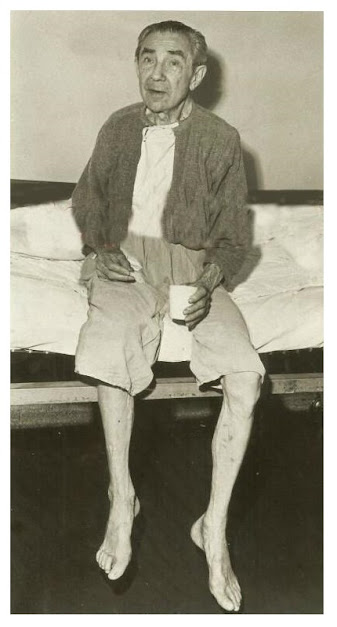
A skeletal Bela Lugosi in rehab.
In April 1955 and June 1956, on either side of Bela's famous stint in rehab, Ed shot the silent footage of Lugosi which he would eventually incorporate into his most famous film, Plan 9 from Outer Space (1959). In many ways, however, the death of the great Hungarian actor marked the beginning of Ed Wood's long, slow decline in Hollywood. His directing career, apart from a brief return in the early 1970s, would not survive past the Eisenhower era.

For most of the rest of his tenure in Hollywood, Ed Wood's fate was to be a writer-for-hire, living off the charity of friends and professional associates and often working under assumed names while his out-of-control alcoholism wreaked havoc on his body and his mind. Wood had never been a businessman, and much of the money he earned from his scripts likely went towards the purchase of alcohol. If he had truly been a "user" or an "exploiter," as some of his latter-day critics have claimed, it was certainly not reflected in his bankbook or standard of living. If there is one point on which all of Ed's friends, relatives, and professional associates agree, it's that the man never seemed to have two dimes to rub together.

The truly sad, squalid years of Ed's life were still down the road a piece in 1957, though. He was only 33 years old then and as determined as ever to make a go of it in Tinseltown. Ideas were never in short supply. Ed seemingly always had half a dozen scripts lying around and ideas for countless more on the back burner. This would remain true until the day he died.

Wood's long-time relationship with Dolores Fuller had imploded the year before, possibly because of Ed's casting of Loretta King as the lead in Bride of the Monster, but more likely because Dolores understandably wanted to better herself in life by getting an education and a career of her own. Ed's very brief "rebound" marriage in October 1955 to actress Norma McCarty (known to Wood fans as stewardess Edith from the infamous "Albuquerque ball" scene in Plan 9) proved a disaster when the puritanical bride was appalled by Ed's cross-dressing and heavy drinking and fled in disgust from him. The marriage was annulled after just a few months.

But Ed's May 1956 marriage to Kathy O'Hara, a sweet-natured and non-judgmental young woman he'd met a year earlier, proved to be a (rare) wise decision on Ed's behalf, and the union lasted the rest of his life, despite many incredibly rocky patches. It's quite possible that this stable relationship had given him a new sense of optimism, even in the wake of his #1 star's death. Several projects intended for Bela Lugosi were simply retooled for other actors in the Ed Wood repertory company. And among these, perhaps the most fascinating is an unsold television pilot produced in 1957 but not widely seen in its intended form for many decades after that.

FINAL CURTAIN (1957)


Alternate titles: Portraits of Terror: Final Curtain.

Availability: YouTube [link]. After being rediscovered by Paul Marco's great-nephew, Jason Insalaco, Final Curtain started playing film festivals in 2012, including Cult Movie Mania's Screaming Cinema Series and Slamdance, but has had no commercial release of which I am aware.

The proposed opening scroll for Portraits of Terror.

The backstory: While his feature films are what brought him his posthumous fame, television remained the white whale Edward D. Wood, Jr. pursued without notable success for decades. Those of you who have been following this project already know about The Sun Was Setting and Crossroad Avenger. Wood did manage to get some low-profile directing work in local television in the 1950s and 1960s, including everything from sports to commercials to a few episodes of a show featuring the controversial, outspoken Los Angeles mayor Sam Yorty, plus a handful of made-for-television films which have mysteriously gone missing and perhaps were never preserved.

For dedicated Wood-ologists, the most significant of Ed's television credits was his work on Criswell Predicts (1953), featuring a well-spoken but extremely dubious "psychic" named Jeron Criswell King, who would go on to be an important member of Ed's acting troupe and, like many Wood regulars, an off-screen buddy as well. According to artist and writer Don Fellman, Ed Wood even tried to sell a script to The Beverly Hillbillies in the mid-1960s but claimed it was "rejected at the last minute," whatever that means.

Ed's real goal was to launch a weekly network series. His negative experience of trying to sell Crossroad Avenger had perhaps soured him on the western genre, so his second major attempt in this arena was a proposed suspense anthology series (pre-Twilight Zone, but post-Alfred Hitchcock Presents) entitled Portraits of Terror. Only one pilot episode was ever produced, a 22-minute short called Final Curtain. The opening credits tell us optimistically that the series would contain "Original Stories and Screenplays Written, Produced and Directed by Edward D. Wood, Jr."

With Bela obviously unavailable for the pilot, the central role of an unnamed actor suffering a nervous breakdown in an empty theater went to the ever-reliable Duke Moore, the bulldog-faced supporting player whose association with Wood stretched all the way back to the doomed Crossroads of Laredo project in 1948. Incidentally, Ed Wood always maintained that Bela Lugosi was reading the script for this TV pilot when he died. (Is that really a boast?)

MST3K stalwart Anthony Cardoza

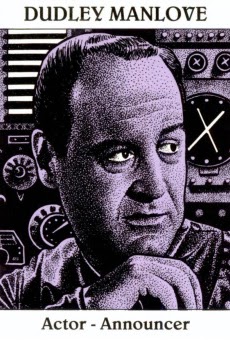
Filmed silently, Final Curtain was augmented by a soundtrack consisting of stock music (supervised by Gordon Zahler, who would use some of the same cues for Plan 9), plus a few sparse sound effects and, most importantly, hysterical first-person narration by Dudley Manlove, well known to Wood fans as the pompous alien Eros in Plan 9. William C. Thompson once again provided the distinctive chiaroscuro camerawork, lending the short film an almost expressionistic feel with its extreme contrasts between light and shadow.

Of particular interest are two of the film's four credited producers: Thomas R. Mason and Tony Cardoza, Jr. Cardoza, of course, is a name familiar to all MST3K viewers as a producer/actor in three of Coleman Francis's films (Night Train to Mundo Fine, The Skydivers, and The Beast of Yucca Flats, the last of which starred Tor Johnson) plus a dismal Ross Hagen biker film called The Hellcats. Mason, better known as "Doctor Tom," was Kathy Wood's chiropractor and would make significant and bizarre contributions to three more Ed Wood-related productions, including the one at the bottom of this article, The Bride and the Beast.

While Portraits of Terror obviously never became an ongoing series, the material from Final Curtain did not exactly go to waste. Footage from it was shoehorned into Night of the Ghouls (1959), Ed's sequel to Bride of the Monster, while the opening scroll was recited on camera, slightly reworded, by Criswell in both Night of the Ghouls and Orgy of the Dead (1965). Criswell's voice-over in Orgy, in fact, borrows quite heavily from Dudley Manlove's narration in Final Curtain.

It took 55 years, however, before Final Curtain would ever be screened as it was originally intended. After years of searching, Paul Marco's great-nephew, Jason Insalaco, finally managed to locate a print of the film from a Los Angeles memorabilia collector and turned over the footage to a friend of his, Jonathan Harris, who restored it. Today, at last, the film is easily accessible to Ed Wood's fans and admirers.

The viewing experience: Astonishing. Final Curtain is a film which, without exception, all those who are interested in Ed Wood should see. It's a major find. Seemingly all of Ed's pet themes and motifs are present here. The film is bookended by stock footage of thunder and lightning, which will remind viewers of Plan 9, Glenda, and many more Wood-related productions. The setting of a theater after closing hours seems to be a carryover from Jail Bait. Phrases like "a night of pleasure" and "the endless reaches of time" recur in other Wood scripts. And Duke Moore, like many Wood heroes before and after, takes a moment to admire the sensual quality of a woman's outfit, fondling the fabric with fetishistic glee.

But more important is the film's wildly free-associative, stream-of-conscious nature. Though vaguely presented as a horror story, the nature of which might be supernatural or merely psychological (my guess is the latter), Final Curtain is akin to Glen or Glenda? in not belonging to any particular genre or storytelling tradition in my experience. To put it more bluntly, this is some weird, weird stuff. Virtually nothing happens in these 22 minutes whatsoever. Duke Moore is a tuxedo-clad thespian who hangs around in a rather run-down, shabby-looking theater after the closing performance of his latest play, which was apparently a vampire story. The one set still standing looks more rural than gothic, however.

Alone in the dimly lit building, Moore becomes paranoid and starts hearing and seeing things which don't seem to be there. Moore's performance is entirely in pantomime. On the soundtrack, an extremely over-emotive Dudley Manlove gasps and howls his way through a berserk, nonsensical monologue, as florid and delirious as anything Ed Wood ever wrote. A sample quote, as Moore surveys the theater: "The seats out front are as I have seen them night after night while doing my lines on this side of the footlights. Empty, they appear like squatty little fat men standing row on row, like soldiers in formation!"

Literally all the viewer sees during Final Curtain are reaction shots of Duke Moore (not exactly the most expressive performer in the world) interspersed with cutaways to an unremarkable-looking theater. Some shots, in fact, are repeated over and over: a dressing room, a spotlight, a window, etc. And yet Dudley Manlove sounds like he's narrating War of the Worlds or watching the Hindenburg go up in flames. The disconnection between what we're seeing and what we're hearing makes Final Curtain a most unusual cinematic experience.

Moore becomes convinced that he's supposed to find something in this theater, and his search eventually takes him upstairs. There, in one room, he encounters a blonde-wigged mannequin (played by Jenny Stevens aka Jeannie Stevens) which may or may not come to life. Manlove's narration informs us that this mannequin was a cast member in Moore's play, which may offer a clue as to why that show has closed. In another (again, very ordinary-looking) room, our doomed protagonist does at last reach the object of his quest.

 I will not divulge what he finds in that room, but I will tell you that the ending of Final Curtain presages that of Necromania (1971), which is perhaps Ed Wood's last film as a writer-director.

While Portraits in Terror proved to be another dead end, one of Ed Wood's gonzo scripts did see daylight during this same period. And even though Ed himself wasn't in the director's chair, the resulting film was unquestionably his work. Which brings us to....

THE BRIDE AND THE BEAST (1958)

The poster for 1958's The Bride and the Beast features a suspiciously mannish bride.

"Before, I was a poor stone apology. Today, I am two separate gorillas."
-Vivian Stanshall (1969)

Alternate title: Queen of the Gorillas

Availability: A very nice widescreen transfer of The Bride and the Beast is available as the top half of a double bill with Harry L. Fraser's The White Gorilla (1945) on a single DVD, teasingly titled Positively No Refunds Double Feature (VCI Video, 2007). [buy it]  Both films have commentary tracks hosted by film historians Tom Weaver and Bob Burns. Bride's commentary also features two of the film's cast members, female lead Charlotte Austin and bit player Slick Slavin.

Lovely and talented Charlotte Austin
The backstory: Louis Weiss (1890-1963) had been producing low-budget independent films since the 1920s, including such jungle-themed films as The Revenge of Tarzan (1920), Jungle Menace (1937), and The White Gorilla (1945). With his brothers, Max and Adolph, Louis formed at least half a dozen production companies over the next few decades. Louis's son, Adrian (1918-2001), got into the family business in the mid-1930s, starting as a production manager and assistant director. By the early 1950s, the Weiss family's empire was fading a bit. Their film production had slowed down to a crawl, and their television series, Craig Kennedy, Criminologist had only lasted 26 weeks in 1952. At least the series had given son Adrian his first chance to direct.

In 1956, the Weisses announced to Variety their plans to get back into the feature film game with a script called Queen of the Gorillas, to be directed by Adrian and adapted from his own story. What Adrian had going for him were two things: (1) a desire to capitalize on the "Bridey Murphy" case, which had brought the subject of past-life regression to the public's attention, and (2) access to a lot of stock footage of animals in the wild, including shots taken from Man-Eater of Kumaon (1948) starring Sabu the Jungle Boy.

The task of building a script around this existing footage fell to Edward D. Wood, Jr., who in typical fashion made the project very much his own, delivering to the Weisses an outlandish and highly contrived script which essentially amounts to a love story between a beautiful young woman and a gorilla. Wood's own personal fetish for angora and other "fur-like fabrics" such as marabou became a major element of the plot.

Although she found the script utterly ridiculous, gorgeous actress Charlotte Austin, whose resume includes How to Marry a Millionaire (1953) and Monkey Business (1952), took the leading role in order to make a payment on her house. (This would prove to be Austin's penultimate film role. After Frankenstein 1970 (1958), she did a smattering of TV work and then gave up on the business entirely and opened an antiques shop.)

The male lead was played by Kentucky-born Lance Fuller, another actor well known to MST3K viewers because of his roles in This Island Earth (1955) and The She-Creature (1956). Fuller worked steadily in film and television from the mid-1940s to the late 1950s, but his career slowed down in the 1960s and came to a halt altogether in the 1970s when his health would no longer allow him to continue. He died in poverty and near-obscurity in 2001, having lived a life nearly as tragic as Ed Wood's. The Bride and the Beast, however, captured him during his 1950s heyday, and he even dated leading lady Charlotte Austin for a while.

The all-important role of the gorilla -- two separate gorillas, if you want to get technical about it -- was played by Steve Calvert, a protegee of Ray "Crash" Corrigan. In those days, portraying gorillas was its own specialized career in Hollywood. Pseudo-gorillas were expected to provide their own suits and know how to mimic the mannerisms and movements of the animals already.

Astonishingly, the original music for this film was written by none other than Les Baxter, a composer and bandleader who'd had a #1 hit single in 1956 with "The Poor People of Paris."

Make-up man Harry Thomas at work.

While none of the cast of The Bride and the Beast are members of the usual Wood repertory company, there are a few of Ed's associates in the crew. It's likely, for instance, that the connection between Ed Wood and the Weiss family was assistant director Harry L. Fraser, who had made films for Louis Weiss in the past and was also a buddy of Ed's. Fraser was a B-movie veteran whose titles included Chained for Life (1952), a vehicle for conjoined twins Violet and Daisy Hilton of Freaks fame.

 Even more interestingly, the makeup man for this film was Harry Thomas, a Wood regular whom I've thus far neglected to mention in this project, even though he's one of the characters portrayed in Ed Wood (1994), where's he's played by Leonard Termo. Harry toiled on Glen or Glenda?, Plan 9, and  Jail Bait and was a delightful presence in a couple of Ed Wood documentaries before his death in 1996. Harry worked solidly as a makeup artist through the 1950s and 1960s, mainly on science-fiction and horror films, including Roger Corman's The Little Shop of Horrors (1960).

And while I'm at it, let me point out that one other member of Ed Wood's inner circle contributed to The Bride and the Beast. Chiropractor Tom Mason -- yes, the man who unconvincingly doubled Bela Lugosi in Plan 9 and who ponied up some of the dough for Final Curtain -- was Ed's unofficial technical advisor on the film's hypnotism scenes. Mason was himself a hypnotist so skilled at his craft that he could allegedly put Kathy Wood in a trance over the phone!

Obviously, a script about past-life regression would require a hypnotism scene, and Ed Wood knew exactly whom to call for advice.

Charlotte Austin says she felt like a bumblebee in this sweater.

The viewing experience: Fascinating, then frustrating, then fascinating again. The Bride and the Beast begins, as usual, with stock footage of lightning and thunder. In short order, we're introduced to a young couple, big game hunter Dan* (Lance Fuller) and his new bride Laura (Charlotte Austin), a lovey-dovey couple in the tradition of Dick and Janet from Bride of the Monster, Jeff and Paula from Plan 9, and Bob and Shirley from Orgy of the Dead.

On their wedding night, Dan takes Laura to his estate, where he happens to keep a gorilla named Spanky in a cage in the basement! Laura, who has always had a strange affinity with animals and who typically wears very fuzzy sweaters of angora or marabou, seems to bond with Spanky, a fact which makes Dan uncomfortable.

That night, while Dan and Laura sleep in separate beds, Spanky breaks out of his cage, goes upstairs to the the bedroom, and rips Laura's nightgown off. (We see nothing, by the way. The moderately more risque "European version" of the scene is glimpsed in the film's trailer.) Dan shoots poor Spanky, who staggers out of the boudoir, falls over a railing and dies. Seemingly unconcerned with the fact that there's a dead gorilla in his living room, Dan goes back to bed. Laura tries to sleep, but she's all hot and bothered by visions of her past.

The next day, Dan brings in a doctor, ludicrously named Carl Reiner (and played very stiffly by William Justine), who hypnotizes Laura and discovers that Dan's new wife had been the queen of the gorillas in a past existence. Dr. Reiner advises Dan against taking Laura on a honeymoon safari to Africa, but Dan is insistent.

Once they get there, the movie slows down for quite a while so that Adrian Weiss can use up all his stock footage of animals in the jungle. Occasionally, he'll include a shot of Lance Fuller holding a gun to remind us that this is supposed to be a hunting expedition. Unfortunately, a great deal of the stock footage depicts tigers rather than African wildlife, so Wood's script has to include a ludicrous subplot about how two tigers have escaped from an Indian cargo ship and have developed a taste for human blood after attacking a few unlucky natives!

Dull,  ill-fated actor Lance Fuller
The hunting subplot and tiger subplot are in the film to eat up screen time and serve no greater thematic purpose. Weiss matches the stock footage to his own footage somewhat more convincingly than Ed did in Bride of the Monster, but if anything, that makes the middle of the movie even less interesting. Moreover, modern audiences are apt to be appalled by the prospect of a great white hunter coming to Africa to collect trophies by hunting zebras, giraffes, and other creatures who were just minding their own business. On the commentary track, even Charlotte Austin expresses dismay over this aspect of the film.

Dead-eyed, monotone-voiced Lance Fuller, meanwhile, is simply not that compelling as a leading man. MST3K, in fact, devoted an entire host segment to mocking Fuller's complete lack of charisma in The She-Creature, and he's even less appealing here. A part like this -- a pompous, arrogant, man's man who treats everyone around him with a slight air of condescension -- practically screams out for John Agar. (It's not out of the question; though they never worked together, Ed Wood and John Agar's social circles did overlap, and there are photos of the two men together.)

More distressingly, the middle of the movie keeps Charlotte Austin -- who gives a helluva performance, by the way -- on the sidelines for far too long. The movie finally returns to its original theme with a wonderfully sordid and ridiculous climax in which Laura is taken prisoner by the gorillas (their lair is actually the famed Bronson Canyon) and then must make a decision: do I choose my human husband or do I live among the gorillas? I will not spoil the conclusion, except to say that Dan's final conversation with Dr. Carl Reiner had me howling with laughter and applauding the screen. If anything can top Harvey B. Dunn's legendary "He tampered in God's domain" from Bride of the Monster, it's the last line of The Bride and the Beast.

 Though hampered by a saggy, draggy middle section, The Bride and the Beast begins and ends with such bravado and audacity that the film is an absolutely essential addition to the Ed Wood canon. Had Ed directed this himself, I think it would rank alongside Plan 9 and Glenda in popularity.

*Strangely, Dan and Laura's last name is given as "Fuller" in the film. Whether this is a reference to Lance Fuller's own real-life moniker or perhaps a nod to Ed's ex-girlfriend Dolores Fuller is unknown.

NEXT WEEK: In addition to his film and television work, Edward D. Wood, Jr. also had a side career as an author from 1963 to 1978, producing at least 22 novels and countless short stories, using his own name whenever possible. Join me here next Wednesday when this project takes a break from Ed's film career and examines his literary career with a review of his debut novel, Killer in Drag (1963).