Showing posts with label Joe's Record Collection. Show all posts

Monday, June 17, 2019

Here's the script for Albert Brooks' 'Comedy Minus One,' if you were looking for that (UPDATED!)

"Good evening, ladies and gentlemen!"

NOTE: The title track of comedian Albert Brooks' 1973 album Comedy Minus One is a unique interactive routine that actually requires that the listener read along with a script. Try as I might, I could not find that particular script anywhere else on the Internet. So what did I do? I typed the whole goddamned thing up myself and posted it to this blog, just on the off chance that someone, somewhere would want or need it. I'm also including the sound file, so you can play along at home. You're welcome. J.B.


Albert: Thank you... thank you... and good evening, ladies and gentlemen. I'm Albert.

You: And I'm You.

Albert: Wait a minute, how could you be me?

You: I didn't say I was you. I said I was me. (L)*

Albert: No, you didn't. I said I was Albert and you said you were me.

You: You've got it all wrong. You said, "I'm Albert," and I said, "I'm You." But I'm not talking about you. I'm talking about me. (L)

Albert: Now I'm confused.

You: Then stop calling yourself Albert. (L)

Albert: I think we should get on with this.

You: I agree. What are we going to do?

Albert: Well, if it's all right with you, I thought we would visit The Auto Mechanic. (A) Thank you very much. Bernie, a little visiting music please...

(MUSIC)

Albert:  Excuse me. I need some work done on my car.

You: Eight-fifty. (L)

Albert:  Eight-fifty? What's that?

You: You said "excuse me." I stopped work and looked up. Time is money. So whatever's wrong with your car, including the time you're using up right now, it's gonna cost you at least eight-fifty.

Albert: That's ridiculous!

You: That's nine dollars. (L)

Albert: Okay, okay. I get the point. You don't come cheap. Now can you repair this car or not?

You: Sure I can repair it. What seems to be the trouble?

Albert: There's a knocking in my engine.

You: It's probably a piston. Let him in. (L)

Albert: I'm not getting anywhere with you.

You: And I'm not getting anywhere with you either. Maybe it's our toothpaste! (L)

Albert: Oh brother.

You: Brother? I almost didn't recognize you! How's Mom? (L)

Albert: How's Mom... stop this! Can you please fix my engine?

You: Oh alright. Open the hood. I'll take a look.

Albert: Wonderful. (He opens hood.) There... it's open.

You: Oh boy, oh boy, oh boy! (L)

Albert: What does that mean?

You: That means I'm glad I'm fixing this thing instead of paying for it! (L)

Albert: Are you trying to say this is going to cost a lot of money?

You: Let's put it this way. Remember the nine dollars we talked about earlier?

Albert: Yes. So?

You: Well, we still have the nine and the two zeros, but I'm afraid the decimal point just passed away! (L)

Albert: This car has only seventeen thousand miles on it. Nothing could be that serious.

You: If you're so smart, why don't you fix it yourself?

Albert: Because I don't know anything about cars.

You: Nothing at all, huh?

Albert: No.

You: Oh boy, oh boy, oh boy. (L)(A)

Albert: Okay, that's it. I'll go elsewhere.

You: Look, mister, you don't have to go elsewhere. I was just pulling your leg.

Albert: If I wanted someone to pull my leg I would have gone to a chiropractor! (L)

(Hint to You: Let Albert have his laugh here.)

You: Now look who's doin' the jokes.

Albert: I have to get one laugh, don't I? (L)(A)

You: Okay... okay. Now, I"m gonna put this car up on the hoist and check it out thoroughly. If it's something minor, I'll fix it for free.

Albert: Well that sounds honest.

You: Maybe to you. To me, it's one the big lies of the century. (L) Now stand back as I raise it up. There she goes... going up... going up... there!  By the way, there is a slight "using of the hoist" fee. (L)

Albert: Using of the hoist? (L)

You: That's right. Each time I raise and lower a car it wears out my hoist just a little bit. I have to charge the customer accordingly.

Albert:  I don't believe it. You mean it actually costs money just to raise this car up?

You: No, it's raised for free. It only cost money if you lower it. (L) It's just ten dollars. (L)

Albert: This is highway robbery!

You: Wrong. This is garage robbery. (L)

Albert: Look, I don't have to stand for this.

You: I agree. You can sit on that hubcap in the corner. (L) Be careful, it's greasy! (L)

Albert: Here is ten dollars. Bring my car down. I'm through with you.

You: (Dramatic) Wait! Don't leave! I need this business, my life is in ruins!

Albert: Ruins? What are you talking about?

You: (Continued dramatic) I'll tell you what I'm talking about: I'm divorced, my son is in jail, my daughter was just kidnapped, I can't pay my bills, and my doctor says I may be dying!

Albert: My God! That's unbelievable.

You: You're right. Let me start over. (L) (Continue over this laugh) I may get divorced, my son should be in jail, my daughter wants to be kidnapped, my doctor...

Albert: Alright! Alright! Now stop with these jokes!

You: If I stop with these jokes this bit falls flat on its ass. (L)

("Face" can be used instead of "ass" if so desired.)

Albert: Please. Just fix my car. Please!

You: Okay. Let me look under here real quickly. (Looking  sounds) Hmmmm... Mmmmmmm... Hmmmm... Well I think I found the trouble.

Albert: What is it?

You: It seems that one of your pistons has pounded its way through the muffler. (L) You're gonna need some new pistons and a new muffler for starters. (L)

Albert: Just a minute! That's impossible!

You: I thought you said you didn't know anything about cars?

Albert: I know enough to know that the pistons and the muffler don't even come near each other.

You: That's fair enough. Let's take another look. (L) Well you were right. The muffler does seem okay. Do you know anything about the camshaft?

Albert: No.

You: We just found the trouble! (L)

Albert: You must think I'm a fool.

You: You're getting warmer! (L)

Albert: Well let me tell you a thing or two. It so happens that I don't have to stand here and...

Jessel: Excuse me... excuse me... are you the auto mechanic?

Albert: Ladies and gentlemen, Mr. Georgie Jessel! (A)

Jessel: Say, where's that applause coming from? I thought we were in a garage. (L) Listen, I need some work done on my car.

You: Eight-fifty. (L)

Jessel: Eight-fifty? Oh my God, I didn't realize it was so late! I gotta be somewhere at nine-thirty. Well, I'll see you later. (L)

Albert: No, no, Georgie, the mechanic wasn't giving you the time. That's a price.

Jessel: A price? For what?

You: You said "excuse me." I stopped work and looked up. Time is money. So whatever's wrong with your car, including the time you're using up right now, it's gonna cost you at least eight-fifty.

Jessel: That's ridiculous!

Albert & You: That's nine dollars. (L)(A)

Jessel: Now, look, I don't need this car restored. I just need some repair work. This car belonged to the great Al Jolson!

You: What seems to be the trouble with it?

Jessel: Well every time I stop at a light it gets down on one tire. (L) Of course I'm just kidding. But actually I don't know what's wrong wtih it. That's why I came here.

You: Does it make any funny noises?

Jessel: Who are you talking to?

You: I'm talking to you.

Jessel: Oh. I don't know if it makes funny noises. I mean these days, who can tell what's funny anyway! (L) Enough of this talk. Now I'll make you a deal. You fix my car, charge me almost nothing, and the next time that you're very, very sick you call me, and we'll talk about a eulogy for you. (L)

Albert:  I don't think you'd want this person to work on your car, Georgie. The prices are outrageous and the service stinks.

You: You'll pay for that!

Albert:  I have no doubt. (L)

Jessel: Well I don't need this then. I'm very big in many parts of the world, and anyway I can go to Earl Scheib and for twenty-nine dollars he'll paint over the whole problem! (L) Thanks very much, and I'll see you later. (A)

Albert:  Mr. George Jessel, ladies and gentlemen! Mr George Jessel! He was right in getting out of here, and I'm following his example. Now here's your nine dollars for your valuable time. Here's your ten dollar lowering fee. Put my car down, I'm finished with all this!

You: Put your car down, huh?

Albert: Yes, put it down!

You: Okay. Why I've seen better looking cars in a rodeo! (L) Why this car is so slow you could write "Hello from Hollywood" on the roof and mail it to a friend. (This gets very little reaction so you explain further.) They do that with turtles! (L)

Albert: You never stop, do you?

You: Only when the bit's over.

Albert:  Well in that case... good night ladies and gentlemen! (L)(A)

(MUSIC)

You: (To audience) Hey, you're beautiful!

Albert: You're a beautiful audience, thank you!

You: Thank you. (Very sincere) I'd like to take you all home with me.

*(L) & (A) denote Laughter & Applause


Thursday, June 8, 2017

Revisiting Monty Python's cautious first album

The wacky Monty Python boys early in their career, minus Terry Gilliam.
 
Python's semi-forgotten 1970 debut album.
Though its origins were in television, Monty Python quickly became a multimedia phenomenon. The British comedy troupe produced numerous films, stage shows, books, and albums between 1969 and 1983. If the 2000 documentary From Spam To Sperm: Monty Python's Greatest Hits is to be believed, the boys were never too keen on making the records, with only Michael Palin (my vote for Python's all-time MVP) possessing the necessary patience for it.

And yet, despite this utter lack of enthusiasm, Monty Python managed to create a string of inventive and funny LPs, including Another Monty Python Record (1971), Monty Python's Previous Record (1972), Matching Tie And Handkerchief (1973), and The Album Of The Soundtrack Of The Trailer Of The Film Of Monty Python And The Holy Grail (1975). All keepers. I'll even vouch for Python's little-loved Contractual Obligation Album (1980). These albums, which generally combine new and repurposed material, can be enjoyed at full length, but 1988's double-disc The Final Ripoff is a good distillation of their audio-only work. In that aforementioned 2000 documentary, Steve Martin confesses that he originally thought Python was a recording act before he saw their TV show or films.

The group's 1970 debut album, simply titled Monty Python's Flying Circus, is a decidedly modest affair, released purely as a promotion for the eponymous BBC series. The material on it comes directly from the TV show, with almost nothing prepared especially for the album. The reason it was not included in The Instant Monty Python CD Collection (1994) or a subsequent series of reissues is that Monty Python does not own this album. The BBC retains the rights to it, nearly half a century later.

The 1989 book The First 200 Years Of Monty Python by Kim "Howard" Johnson indicates that the 1970 album is simply audio taken from the TV show. So I was initially not very interested in it, but I bought a used copy on vinyl anyway. It turns out that the LP was actually recorded live at the Camden People's Theatre in London. So why does it have a laugh track? Well, the audience was not terribly lively that night, Whoops.

Ian MacNaughton, madman.
The now largely forgotten album was produced by Ian MacNaughton (1925-2002), who directed most of the episodes of Flying Circus on the BBC, as well as Python's debut feature, And Now For Something Completely Different (1971). He also wrote the surprisingly straight-laced, joke-free liner notes, briefly explaining how the troupe and the show came into existence. Like And Now..., this album appears to be a collection of "greatest hits," designed mainly to introduce Python to newcomers.

Is the damned thing any good? Surprisingly, yes. The audience may have been sitting on its collective hands, but the Python boys really do their best to sell this familiar material anyway. The troupe members had plenty of stage experience by this point, going back to their days at Oxford and Cambridge, and seem comfortable in front of a crowd. John Cleese, especially, seems energetic and displays great range, playing everything from a shy, hesitant young man ("The Mouse Problem") to a bombastic drill sergeant ("Self-Defense"). Palin, too, is in fine form, belting out "The Lumberjack Song" as if he'd been performing it for years. Keep in mind: The now-famous bit was still new back then.

The track names are not particularly helpful. The sketch widely known as "Crunchy Frog" is here called "Trade Description Act." Cleese's infamous "Albatross" routine is merely "The Cinema." And there are tracks called "Television Interviews," "Interviews," "and "More Television Interviews." The first is about an otherwise unremarkable man (Palin) with three buttocks. The second is about filmmaker Sir Edward Ross (Graham Champan, misidentified here as "Grahame"), who doesn't like being called "Eddie baby" or "pussycat." And the third is about that poor, harried composer Arthur "Two Sheds" Jackson (Terry Jones), whose nickname has overshadowed his music.

In its studio albums, Python would get better at creating comedy that works without a visual component, strictly through dialogue, sound effects, and music. (No wonder the Contractual Obligation Album was so heavy on songs.) They hadn't really learned how to do that as of this debut album, though. High-concept sketches like "Flying Sheep," "The Visitors," "The North Minehead By-Election," "The Mouse Problem," and "Self-Defense" do lose a bit of impact here when deprived of pictures, and Cleese's explanatory narration in "The Barber" seems like an afterthought. And a supposed "stereo demonstration" by Graham Chapman's Colonel -- one of the few bits prepared especially for this LP -- is spoiled because the album is presented in monaural sound.

And yet, despite these misgivings, the Monty Python's Flying Circus album has a definite, crude charm to it. If Python was comedy's answer to The Beatles, this was its own Please Please Me, i.e. a chance to hear a soon-to-be-legendary group at the cusp of its success.

Wednesday, July 22, 2015

I own 'Brothers in Arms' by Dire Straits because of some lady in a swimming pool

Believe it or not, it has to do with this woman.

Years ago, and we're talking decades here, my mother and father got me a whole stack of books they'd found in a remainder bin,  One of them was this collection of funny and unusual vintage photos from Life magazine. Now, Life has been kind of a mini-obsession with me for a long time. Not the magazine's sad final years of dwindling sales and cultural irrelevance, of course. No, I mean the mag's heyday as a weekly publication, right up to the early 1970s, when it was such an easily-identifiable piece of Americana that even MAD spoofed it. When I was in college -- and I realize how nerdy this will sound -- I spent many hours poring over old Life magazine back issues, which the library had bound in volumes. I was especially transfixed by the photos, but I read the articles, too. I can remember being really psyched to find the issue which contained an article actually written by Frank Zappa called "The Oracle Has It All Psyched Out." To me, issues of Life were much more interesting decades later than they probably had been when they were brand new.

So I usually read before I go to bed, and one night I decided to browse through the aforementioned volume of funny Life photos. One of them was a 1962 black-and-white snapshot of a girl swimmer in what looked like an Olympic-sized pool. She was spitting water like a fountain, and the water in the pool caused a distortion which made it appear that her head had come loose from her body. I noticed a weird detail in the picture, though: a big crucifix on the wall behind her. For some reason, I decided that this was a swim meet at a Catholic high school or college. I was brought up Catholic, so maybe that had something to do with it. With a little Google-fu, I found a site which identified the girl as Kathy Flicker and the locale as Princeton University's Dillon Gym.

Anyway, I was looking at this book before bed, and it made its way into my dreams. I had a very vivid dream in which I was competing in a swim meet at a Catholic high school. In reality, I can swim, but I have never even come close to competing in a swim meet. But, still, that's what was happening in this dream. Before the competition started, I noticed that all the other competitors had these special little slippers that they put on over their feet. I didn't have a pair, and I started to get nervous. Then I really freaked out when the race started, and my competitors were all able to walk on water with their special slippers. I tried it, and I sank to the bottom. And all through this experience, the song "Walk of Life" by Dire Straits was playing in the background. I could still hear it when I was underwater, except it was a bit muted and distant.

The next day -- maybe the first thing, since it was a Saturday -- I drove to a second-hand CD store and bought a copy of Brothers In Arms by Dire Straits, specifically to get the song "Walk of Life." And it's still in my collection to this day. I don't know if I've even played the other songs on it, except for maybe "Money for Nothing." I've told a version of this story to all the therapists I've ever had, and by my count, I'm on my fourth one of those.


Sunday, December 21, 2014

One song at a time: '26 Miles (Santa Catalina)'

A vintage postcard for California's "island of romance."

I'm bad at winter. I'll admit it.

Today is the winter solstice, and that fact depresses the ever-loving hell out of me. I've lived in the Midwest all my life: the first two-thirds in Michigan, the last third here in Illinois. The total time I've spent outside the Midwest adds up to maybe a month, a month and a half at the most.

And yet I've never gotten used to the climate here. I feel like the misfit polar bear in that joke Reese Witherspoon told on Saturday Night Live once. Winter and I are simply incompatible.

Driving in snow and/or ice is highly stressful for me. I swear, each car trip in such weather takes a year off my life. As a pedestrian, I've slipped and fallen -- badly -- at least once each winter for as far back as I can remember.

My body absolutely turns traitor during the cold weather months. I get windburned so easily, and my body is always covered with various painful rashes and blisters during the winter, oftentimes in embarrassing and hard-to-reach areas. Before I even leave home in the morning, I have to slather sticky, oily Vaseline on my legs and torso. Yuck. Sinuses? Forget about it. You've heard of Can't Stop the Music? Well, this is Can't Stop the Mucous.

Furthermore, that old reliable seasonal affective disorder kicks in hard sometime during January, and I spend several consecutive months cooped up indoors, gorging on snack food and getting next to zero exercise. No doubt about it, winter takes a serious toll on your humble blogger. Each year, I fantasize about living somewhere more habitable, but I cannot imagine the circumstances under which that might happen.

The Four Preps in their element.
As you might expect, I take refuge from winter in fantasy. Music helps me do that sometimes. I'm always a sucker for songs about warm-sounding, far-away places.

One of my favorite examples of such a song is the delightful but somewhat forgotten 1957 smash, "26 Miles (Santa Catalina)" by the Four Preps. I found this song in a really roundabout way. Albert Brooks briefly parodied "26 Miles" as part of his "Rewriting the National Anthem" bit from the 1970s. That routine is included on Albert's 1973 LP, Comedy Minus One, and I found the title of the original song credited in the liner notes.

The Four Preps were one of those well-scrubbed pop vocal groups that flourished in the mid-to-late 1950s, alongside the Ames Brothers, the Lettermen, the Four Aces, the Four Freshmen, the Four Lads, and the Crew Cuts. Acts like these were a gentler, more polite alternative to the raucous rock, R&B, and doo wop sounds of the era. The British Invasion finally made these non-rock acts obsolete in the 1960s, and now it's a chapter of music history we mostly try to pretend never happened.

I actually like this stuff, even though it's possibly the squarest, corniest, whitest, and least cool music to hit the charts in the last sixty years. (The Crew Cuts in particular were infamous for taking R&B songs originally by black artists and doing sanitized white cover versions.) Perhaps the definitive spoof of this type of music was found on SCTV with its 5 Neat Guys commercials, which showed a quintet of sad, middle-aged men squeezing into their old sweaters from the 1950s and crooning about egg salad sandwiches and other hopelessly Caucasian topics.

The Four Preps were one of the more innovative of these groups, and "26 Miles (Santa Catalina)" is actually a little gem of a pop tune whose influence on Brian Wilson of The Beach Boys is immediately apparent at first listen. The Los Angeles Times not long ago ran a great, informative article about how the song came to be. Among other tidbits, you'll learn that one of the Four Preps was TV producer Glen A. Larson (of Battlestar Galactica and Knight Rider fame), who just passed away in November 2014.

What's key about the song is that it was written by someone who had never actually been to Santa Catalina Island off the coast of California. The song, then, is the guy's dream of what the island must be like. He imagines it as a lush tropical paradise just crawling with beautiful, available women.

And he never actually gets to the island during the song either. It's so close -- just twenty-six miles away -- and yet he can't get there. "So near, yet far," as the lyrics go. That's exactly how I feel during the winter sometimes. I think "26 Miles" will be in heavy rotation for me until next May or so.

Saturday, October 18, 2014

I hereby declare a Dead 2 Rights dance party! RIGHT THIS SECOND!

These people are either dancing or reenacting their favorite lightsaber duels.

"Johnny Thunder is best live performer I've ever seen."
-Bob Dylan 

You know what you need in your life? The Muse Terpsichore. For those of you not up on the fruitier aspects of mythology, that's D-A-N-C-E. That's right. You need to boogie down, get your groove on, burn baby burn, disco inferno, etc. That's why I'm officially declaring a Dead 2 Rights dance party right this second. I don't give a damn where you are -- car, work, your own colonoscopy! You're gonna dance! Dance, I say! 

And, here, I've already selected the song for you to dance to. It's "Loop De Loop" by Johnny Thunder from 1963. That's Thunder, singular, not to be confused with the late punk musician Johnny Thunders, who died in 1991. Johnny Thunder, singular, is still alive. He's 82 and presumably retired now, but he's still out there somewhere. 

I discovered this track back in the '90s in a used record shop, where it was on the B-side of a reissue 45 of "Sugar Sugar" by the Archies. As much as I dug that Archies tune, I dug "Loop de Loop" even more. It's got kind of a Jackie Wilson/early James Brown thing going on, except that it's based on a children's playground chant and sounds like it was recorded in an echo chamber with an all-Munchkin backing band. Check it out:


Saturday, June 29, 2013

Joe's Record Collection: Frampton comes apart

Don't hate me because I'm beautiful: Peter Frampton at his mid-1970s peak.

Peter Frampton's I'm in You.
The record: I'm in You (A&M, 1977 - SP 4704)

The artist: Peter Frampton

History: It doesn't happen much (or ever) these days, but back in the 1970s, a live album could really turn an artist's career around. It happened for KISS with Alive! in 1975, and it happened in an even bigger way that very next year for journeyman rocker Peter Frampton with the similarly-titled Frampton Comes Alive!

Born in 1950 in Beckenham, England, Peter Frampton had made something of a name for himself as a singer and guitarist in such bands as the Herd, which he joined at age 16, Humble Pie, and Frampton's Camel, and he'd done some prominent session work for George Harrison, Harry Nilsson, and others. He signed with A&M as a solo act in 1972 and released a handful of studio LPs to middling sales, until an album simply called Frampton staggered up to #32 in May 1975 and went gold.

In January 1976, A&M released the singer's first live album, Frampton Comes Alive!, which was recorded at San Francisco's famed Winterland. FM stations took a liking to it, and the LP caught fire. By February 1976, it was the #1 album in the country. In all, it logged ten weeks at the top of charts and sold ten million copies.

Great news, right? Well, yes and no.

The live album made Peter Frampton a household name and brought him to a much larger audience than he'd ever known before, but a hit that big brings with it a certain amount of backlash. To say the least, the stakes were awfully high when Peter and his band returned to the studio to make the follow-up. Though his commercial triumph had been a long time coming, Peter Frampton was an out-of-nowhere sensation to many listeners.

Critics and other rockers were also rankled by Frampton's "pretty boy" image: the flowing blond locks, the delicate facial features, the bare chest -- all of which were prominently featured on the cover of I'm in You. It seemed like everyone was waiting for his star to fall.

Alanis Morissette: The Frampton of the '90s.
I'm in You, while not an outright flop, was the beginning of Peter Frampton's commercial decline and the start of his status as a pop culture punchline. That trend would be greatly accelerated the next year when the singer made the ill-advised decision to co-star with the Bee Gees in the Robert Stigwood-produced mega-flop Sgt. Pepper's Lonely Hearts Club Band, a movie musical based on the Beatles' 1967 concept album.

In 1979, Peter's last year as a hit-maker, Frank Zappa released his most successful album ever, Sheik Yerbouti, whose opening track, "I Have Been in You," was a direct swipe at the title track from Frampton's record. In his failure to top Frampton Comes Alive!, Peter Frampton might seem similar to Michael Jackson, who was haunted by Thriller for the rest of his life. But Jackson scored major hit albums before and after that career milestone.

To me, the Peter Frampton story is analogous to that of Alanis Morissette. A former child star, Alanis had been a pop singer for a few years in the early 1990s, with two albums that had been successful in her native Canada before she released Jagged Little Pill (1995), the worldwide #1 smash that ultimately sold 33 million copies. That album was Alanis' Frampton Comes Alive! and inspired a similar backlash. Its follow-up, Supposed Former Infatuation Junkie (1998), was her I'm in You -- the pretty successful sequel that still felt like a commercial disappointment and signaled a popular decline.

Ultimately, both Peter Frampton and Alanis Morissette adopted the old philosophy of "if you can't beat 'em, join 'em" and simply revisited their past triumphs. In 2005, Alanis released an acoustic remake of Jagged Little Pill and managed to sell 300,000 copies. In 1995, the very year of Alanis Morissette's greatest popularity, Peter Frampton finally released Frampton Comes Alive! II. A deluxe, 25th anniversary edition of the original would come out six years later. Their chart-busting days are over, but both Peter and Alanis have endured as touring acts whose fans still turn out, albeit in smaller numbers.

All Music Guide says: Four stars. "A surprisingly laid-back album steeped in lyricism and craftsmanship, particularly in the use of overdubs on even the harder rocking numbers." - Bruce Eder [link]

Was it a hit: Yes, but not the success Frampton and his label were hoping for. It peaked at #2 on the album charts, was certified platinum, and landed three singles on the charts -- the title track (which also hit #2), "Signed, Sealed, Delivered (I'm Yours)" (#18), and "Tried to Love" (#41). By most standards, that would be cause for celebration, but after Frampton Comes Alive!, it was a letdown. After one more modest hit album and single in 1979, Peter never reached the Top 40 on either chart again. What went up had come down.

Cameron Crowe
Choice excerpt from the liner notes: Rolling Stone's Cameron Crowe, years away from directing Jerry Maguire and Almost Famous (and, uh, We Bought a Zoo), acknowledges that Peter had a daunting task ahead of him when recording the follow-up to Frampton Comes Alive!, but the critic assures us that "Frampton has risen to the challenge of his incredible success with authority. From sweeping acoustic melodies (played in part on his idol Django Reinhardt's original acoustic guitar) to all-out electrical virtuosity. There is a new vibrancy about this music."

The album's fancy inner sleeve contains further liner notes from Peter himself. He dedicates the album "to all of You" for"the confidence" you've given him, but he still sounds a little nervous. "I was bubbling with ideas and trying not to compete with myself," he writes. "Even so, subconsciously there was an underlying pressure to 'out do' the last album." Underlying Pressure might have been an excellent alternate title for this LP.

Frank Zappa: "I'm in you!"
The listening experience: Not nearly as painful as I'd feared. I'm not a Peter Frampton fan; this album was one I got from (I think) my aunt and uncle's collection. Before this, my knowledge of Frampton was pretty much limited to the misbegotten Sgt. Pepper movie. That notorious flop holds a grim fascination for me; I own the DVD, the soundtrack on CD and vinyl, and the tie-in paperback book. I also knew Frampton from his guest appearance on The Simpsons, where he gamely mocked his image as a rock dinosaur, and Frank Zappa's scathing parody.

Onstage, Zappa would preface "I Have Been in You" with a monologue about Peter's exploits with teenage groupies, and the phrase "I'm in you," always uttered in a taunting, cartoonish voice, became a running joke in Zappa's show. After that, I feared I'm in You would be a wussy, pseudo-rock embarrassment. It's not that at all. Well, it is that just a little in spots (the title track), but I'm in You definitely didn't deserve to be a career-killer.

Bruce Eder was right; this is a laid-back album, as mellow as lime Jell-O. Frampton was under the gun when he made this LP, but you can't hear it in the songs, which mainly just plod along quite amiably. A few go on too long, particularly an eight-minute slog called "Won't You Be My Friend," but that's to be expected of a 1970s rock album.

Eder was right about the "craftsmanship" part, too. I'm in You is one slick endeavor. Frampton and his band have a tight, cohesive sound, and the production work -- by Frampton himself -- is very professional. I'm in You has a rich, satisfying sound I found very gratifying. As Michael Parks said in Kill Bill, Vol. 1, "Well, a sure and steady hand did this. This ain't no squirrelly amateur."

Frampton's singing is a lot like his guitar playing: strong, supple, melodic, and kind of anonymous. His songs, too, are pleasant and tuneful, but for the most part, they soon fade from memory. One track in particular, "St. Thomas (Don't You Know How I Feel)," seemingly takes its inspiration from two of the most famous songs from Frampton Comes Alive!: the title from "Do You Feel Like We Do" and the melody from "Baby I Love Your Way."

On Side Two, Frampton calls in the cavalry. Mick Jagger makes an uncredited but unmistakable cameo on "Tried to Love." (Frampton thanks "Mick" in the liner notes but doesn't give a last name.) And then Stevie Wonder lays down one of his intricate harmonica parts on "Rocky's Hot Club," one of I'm in You's catchiest songs.

The album closes with a double shot of very credible Motown covers: "(I'm a) Road Runner" and "Signed, Sealed, Delivered (I'm Yours)." There are no real stinkers on this LP, no major missteps; all it needs is a sense of urgency or a strong reason to exist. Frankly, a live audience might have provided just that.

What probably doomed this album more than anything else, though, was its terrible cover: Peter in a coquettish "seductive" pose, wearing shiny pink pants and an unbuttoned blouse with lace cuffs. Coupled with the implied sexual boast (masquerading as sensitivity) of the album's title, that cover would be enough to kill anyone's career.

Overall grade: B

Friday, June 28, 2013

Joe's Record Collection: Stan Freberg takes dead aim at the entire Top 40

Comic, actor, writer, singer, puppeteer and ad man: Stan Freberg has done it all.

The record: A Child's Garden of Freberg (Capitol Records, 1957 - T-777)

The artist: Stan Freberg

A Child's Garden of Freberg
History: The California-born son of a Baptist minister, Stan Freberg (1926-2015) is one of America's great satirists. Though I certainly don't agree with all his opinions, there are moments when I think he should be added to Mount Rushmore. He was a voice actor for Disney and Looney Tunes (the latter most prominently in 1957's Three Little Bops) and a regular on one of the first successful television series ever, the groundbreaking puppet show, Beany and Cecil (he was Cecil the Seasick Sea Serpent). Beyond that, Stan more or less invented the "funny commercial" with a series of distinctive print, radio, and television ads that employed a humorous, "soft sell" approach. Freberg credits his success in the advertising game -- where he was employed for decades -- to his contempt for "real" commercials.

Stan also had the good and bad fortune to be, in his words, "the last of the network radio comedians" with a short-lived but influential series of his own, CBS's The Stan Freberg Show, which lasted all of 15 weeks in 1957. (America had long since moved on to television by then.) For about ten years in the middle of the last century, Stan Freberg was also a Capitol Records recording artist with a string of hit singles, often employing the talents of cartoon legends June Foray (aka Rocky the Flying Squirrel) and Daws Butler (aka Yogi Bear) in elaborate sketches that lampooned popular culture, usually television or music. A Child's Garden of Freberg, whose title is a spoof of Robert Louis Stevenson's A Child's Garden of Verses, is Capitol's belated attempt to gather Freberg's hits (and a few B-sides) into a single compilation.

Four years later, still recording for Capitol, the comedian did reach the Top 40 with his unprecedented, massively-ambitious concept album Stan Freberg Presents the United States of America Volume One: The Early Years. (Volume Two didn't come out until 1996.) Freberg headed back to Madison Avenue to pay the bills, but his records had a second life thanks to radio's The Dr. Demento Show, where a new generation of listeners, including "Weird Al" Yankovic, heard them.

All Music Guide says: Five stars. "A Child's Garden of Freberg remains an excellent overview of Freberg's early years and is well worth the purchase, if you can find it." - Sean Carruthers [link]

Was it a hit: The album doesn't seem to have been one, no, but most of the songs on it reached the charts. In fact, "St. George and the Dragonet" hit #1 in October 1953 and stayed there five weeks. "C'est si Bon" peaked at #13 in January 1954. "Try" topped out at #15 in April 1952. "Heartbreak Hotel" got as far as #79 in July 1956. "The Yellow Rose of Texas" rose to #16 in October 1955. "John and Marsha," Stan's first hit, climbed to #21 in February 1951. "That's My Boy" landed at #30 in August 1951. "Rock Island Line" missed the charts here but was a #36 hit in England in July 1956. "Sh-Boom" was a success in America and England, hitting #14 here and #15 there. All told, Stan had 16 chart hits over a nine-year period (1951-1960). Not a bad track record for a comedian.

Choice excerpt from the liner notes: Already an ace copywriter, Stan composed his own liner notes in the form of an essay called "To Those Persons Fingering This Album in the Record Shop and Wondering Whether to Buy Bach Fugues Instead." He makes wisecracks about the album ("Hey, you guys, here's a forty-minute wad of Freberg. Take it or leave it."), thanks his collaborators, pointing out that orchestra leader Billy May wears a "great, flapping Hawaiian shirt" when he conducts, and boasts a little about his record sales ("The good fairies must have come in the night and bought all those records.") and his international success. ("To my amazement, people of other countries, while at times comprehending only 50% of the real satire, laugh as loudly as  Americans," he says.) Most interestingly, he reaffirms his hatred of rock & roll ("a musical trend that I personally loathe") and gives a definition and a heartfelt defense of satire, quoting fiercely conservative Li'l Abner cartoonist Al Capp  ("a man who has influenced me a lot") in the process. "The fifth freedom," according to Capp, "is the freedom to laugh at ourselves."

An odd couple; Daws Butler and Stan Freberg.
The listening experience: Impressive, though I've heard most of these songs a hundred times at least. In fact, I already owned most of the tracks on A Child's Garden of Freberg, but I purchased it for the handful of rarities and the Freberg essay on the back cover. It's still a very entertaining and funny record. Unsurprisingly, it starts with Freberg's all-time biggest hit, "St. George and the Dragonet," one of only two spoken-word pieces on the LP. (The rest are songs.) "Sgt. George" is a Dragnet parody with Stan as a Joe Friday-type, humorless, monotone knight who arrests a dragon for "devouring maidens out of season" and interviews witnesses, including Butler (who imitates Jerry Lewis) and Foray, with Jack Webb's usual brand of dull, bureaucratic professionalism and barely-concealed contempt. Particularly corny jokes, a Freberg trademark, are punctuated with the famous four-note Dragnet theme.  ("How ya gonna catch him?" "I thought you'd never ask. With a dragon net." DUN DA DUN DUN!)

Most of the other songs on the album are parodies of popular songs of the era. Unlike Allan Sherman and "Weird Al" Yankovic, though, Freberg's method of parody is not to change the lyrics of the original song but to exaggerate and distort their most outstanding qualities. Generally, these parodies are little musical skits in which a singer is trying to record a hit record but keeps being interrupted by pesky background singers, disobedient musicians, and skeptical executives. The first of these on the album, a spoof of Eartha Kitt's "C'est si Bon," is a modest example of the form. With a breathy faux-French voice, Freberg himself plays Ms. Kitt, whose detached coolness is put to the test by a chorus who won't wait for the "cotton pickin' signal" to come in at the desired moment.

Elsewhere on Side One, Freberg plays a petulant, pouting Elvis Presley whose attempts to lay down "Heartbreak Hotel" are sabotaged by ripped jeans, an uncooperative guitar, and an out-of-control echo effect. On Side Two, Freberg laces into Mitch Miller's bombastic (and massively popular) version of "The Yellow Rose of Texas." Though Miller himself was a New Yorker, Freberg portrays him like a Civil War-era Kentucky colonel who struggles in vain to suppress a "smart-alecky Yankee snare drummer" who tries to hog the spotlight. Freberg also has some fun with the so-called "skiffle" craze (basically, British folk music) with his version of Lonnie Donnegan's "Rock Island Line." Poor Lonnie can barely get a word in edgewise due to the frequent interruptions of an impatient record business honcho (Peter Leeds) who objects to the nonsensical lyrics, the singer's imprecise diction, and what he sees as an unnecessarily long intro.

"Try," a reworking of "Cry" by Johnnie Ray, is one of the few Freberg songs that does change the lyrics of the original. Giving a wildly exaggerated, ridiculously emotional performance, Stan sends up Johnnie Ray's weepy, melodramatic style with a song that extols the virtues of misery. ("You, too, can be unhappy if you tuh-ryyyyyyyyyyy!")

The enemies: Elvis Presley as Marlon Bando.
Freberg's most vicious parodies are of the new teenage music that had taken the pop charts by storm. A lifelong fan of jazz, swing, and big band music, Stan Freberg utterly despised rock & roll, which he considered crude, repetitive, and moronic. Instead of just dismissing it as just another fad, though, Stan truly deconstructs the music and finds out what makes it tick. In doing so, he is the first true rock satirist, beating Frank Zappa to the punch by a decade.

Even though I adore the primitive, early rock of the 1950s and completely disagree with Freberg about the merits of the music, I still get a kick out of Stan's intricate and inventive parodies of the genre. In his version of the Platters' "The Great Pretender," a beatnik piano player (Freberg) resents having to play the same chords over and over throughout the whole song and keeps trying to turn the rock ballad into a jazz number, driving the frantic lead singer (also Freberg) to distraction. "You play that 'clink clink clink' jazz or you don't get paid!" he threatens. Instead of raising moral objections to rock & roll, like so many other cultural critics of the 1950s, Freberg raises musical objections and uses this record to state his case as plainly as possible.

The album's last song, "Sh-Boom," is a takeoff on an R&B number by the Chords (not the sanitized white version by the Crew Cuts). Here, Stan equates the rise of rock music to the concurrent rise of "method acting" that was then making its presence felt in Hollywood. The lead singer on this track is Marlon Brando's Stanley Kowalski, as imitated by the comedian. The faux Brando insists on mumbling his way through the song, occasionally interrupted by a shrieking Stella. The song builds in intensity as "Stanley" works himself into a lather, and the background music morphs into a mash-up of "The Campbells Are Coming" and the Dragnet theme, bringing A Child's Garden of Freberg full circle.

Two more tracks on the album are pastiches of the rock style: an incoherent 12-bar blues song called "Widescreen Mama" and a moronic medley called "Rock Around Stephen Foster." On these songs, Freberg exaggerates the distorted guitar and saxophone sounds of the music he "personally loathes" and, in doing so, ironically creates two excellent rock records in the process. If he didn't hate the music so much, he could have made a fortune cranking it out. One special side effect of Freberg's rock parodies is that they are loaded with references to once familiar, now mostly forgotten public figures, including Carrie Jacobs-Bond, Nick Lukas, Hunter Hancock, Hugo Winterhalter, and Gayelord Hauser. In all, about half of this album is devoted to spoofing rock music -- more than half if you expand the definition to include Lonnie Donnegan and Johnnie Ray.


There are a couple of oddball tracks on A Child's Garden of Freberg that deserve mention, too. "John and Marsha" is a two-character soap opera with a pair of lovers (both played by Stan) saying each other's names over and over in various tones of voice while sappy "romantic" music plays in the background. This famous bit, simple but ingenious, was referenced by Bugs Bunny, imitated by John and Yoko, and even resurrected on Mad Men. The lushly-orchestrated "That's My Boy" is a song in which a proud papa boasts about his son, who sounds like a violent and destructive brat. "He'll talk to you in words just as plain," Freberg brags. "See how clear he says 'derail the train?'" This track is a reminder that the supposed innocence of children is merely a figment of adult imaginations. This was South Park half a century early.

Overall grade: (what else?) A*

*Don't worry. I'll eventually do some albums I hate in this series, too.

Thursday, June 27, 2013

Joe's Record Collection: The Beastie Boys and De La Soul were on the cutting edge of nostalgia, if that's possible

In 1989, the Beastie Boys and De La Soul took hip hop someplace it hadn't been before -- the past.

The records: Love American Style EP (Capitol Records/Beastie Boys Records), 1989 - V-15483); Buddy & Ghetto Thang (Tommy Boy, 1989 - TB  943)

The artist(s): The Beastie Boys; De La Soul

Love American Style EP
History: The Beastie Boys were coming off an incredible high in 1989 when they recorded Paul's Boutique, their sophomore release on Capitol Records. Their first full-length rap LP, Licensed to Ill (1986), had been a mammoth #1 hit in America, selling nine million copies and becoming the first rap album ever to top the Billboard charts.

After half a decade as a punk and experimental band, the Beasties were now among the most popular acts in the country. The key to their success had been following the lead of Run-D.M.C., who had combined rap with heavy-metal-style guitars on singles like "Rock Box" (1984), "King of Rock" (1985), and their genre-bending Aerosmith collaboration "Walk This Way" (1986). The Beasties took this even further with the party-hearty frat anthem "Fight for Your Right," a Top 10 smash closer in spirit to mid-1980s hair metal like Motley Crue than hip hop.

Their album, too, relied heavily on rock and metal samples, particularly Led Zeppelin, in addition to the funk and soul songs that normally provided the foundation on rap records. The first sound listeners heard on Side One of Licensed to Ill, in fact, was John  Bonham's pounding drum intro from the Zeppelin classic "When the Levee Breaks."

Commercial expectations were high for the follow-up album, but the Beastie Boys were not interested in repeating Licensed to Ill. Instead, Paul's Boutique was a heady, densely-layered sound collage, its lyrics jam-packed with arcane cultural references and in-jokes. The Beasties announced their new direction with the Adam Bernstein-directed video for "Hey Ladies," the first single from the album. Gone were the sneakers, jeans, and ballcaps of the "Fight for Your Right" era. In their place were vintage 1970s leisure suits and platform shoes. They'd ditched "rock & roll" image and sound, too. "Hey Ladies" was built around a sample from "Machine Gun," a 1974 funk single by the Commodores.

Initial commercial reaction to Paul's Boutique was underwhelming, and the commercial triumph of Licensed to Ill was never to be repeated, but the quirky 1989 LP had a long shelf life, eventually becoming widely acknowledged as a modern classic. Instead of burning out quickly as a one-joke fad, the Beasties enjoyed two more decades of productivity and success, and their second album was the first step in that new direction.

Their Love American Style EP, characteristically named for a campy early 1970s TV series, is an interesting artifact from the Paul's Boutique era, when the Beasties were paradoxically looking forward by looking back. Nostalgia for the 1970s was still a fairly novel concept at the time. The decade had not yet been strip-mined for parody and imitation quite yet.


Buddy & Ghetto Thang
Meanwhile, that very same year, a Long Island hip hop trio called De La Soul was offering the American public something radically different than anything it had ever seen from a black hip hop act.

Rap had its gangsters (N.W.A., Ice-T), its politicized crusaders (Public Enemy, KRS-One), and its braggarts (LL Cool J, Big Daddy Kane), but it didn't have whimsical, nerdy pacifists like Posdnuos, Trugoy the Dove, and P.A. Mase. That is, until De La Soul's debut LP, 3 Feet High and Rising, came out in 1989. The fact that the album took its name from a Johnny Cash lyric was indicative of just how different it was from everything else in hip hop at the time.

The press was quick to label De La Soul as hippies and their music as "hippie hop," but the group bristled at this snap judgment and said so in their first hit single, "Me, Myself, and I."

Like the Paul's Boutique-era Beastie Boys, De La Soul's sound was rooted in the wacky, tacky 1970s more than the dippy, trippy 1960s anyway. For example, "Me, Myself, and I" was built around a groove from "(Not Just) Knee Deep," a 1979 track by Funkadelic from their Uncle Jam Wants You album. The album's first song, "The Magic Number" was a take-off on "Three is a Magic Number," a 1973 educational tune from the animated Schoolhouse Rock! series. And "Eye Know" borrowed heavily from "Peg," a 1977 Steely Dan number.

In short, the trio raided their parents' record collections in search of soundbites with no regard for the usual "rules" of hip hop.

This wasn't the only way they broke the mold either. While hip hop is famous for its "beefs" -- often-violent rivalries between acts (think Biggie vs. Tupac) -- De La Soul joined like-minded rappers Queen Latifah, the Jungle Brothers, Monie Love, and A Tribe Called Quest in a mutually-supportive collective called the Native Tongues. Several members of the Native Tongues, in fact, guest star in the extended remixes which appear on Buddy & Ghetto Thang, a maxi-single release of two standout tracks from 3 Feet High.

The record stores at my local mall, the Genesee Valley, didn't carry vinyl EPs, so I purchased both the De La Soul and Beastie Boys records during one of my family's occasional visits to Detroit's Greektown district, which at that time had some slightly hipper, more eclectic disc boutiques. At the time, it blew my mind that these groups were issuing alternate, remixed versions of their songs that weren't included on the regular albums. "What will they think of next?" I wondered. This was before pop culture became one big remix, of course.

All Music Guide says:
(Beasties) Three stars. No full review. [link];
(De La Soul) No review, just a generic listing. [link]

Was it a hit:
(Beasties) Tough to say. "Hey Ladies" hit #36 in America and charted in Germany, the Netherlands, and New Zealand as well. But according to this discography, the extended play single was only released as Love American Style in "several territories." The EP did reach #76 in England, so it was a minor hit in at least one country.

 (De La Soul) Nope. The Buddy & Ghetto Thang maxi-single does not appear to have charted anywhere. But "Buddy" did appear as the B-side to "The Magic Number," which hit #18 on the R&B charts, #27 on the club charts, and soared all the way to #7 in England.

Choice excerpt from the liner notes:
(Beasties) Love American Style EP has no notes to speak of, but the credits on the back cover list Adam Yauch's alter ego Nathaniel Hornblower as the photographer and Ricky Powell (memorably name-checked in the Paul's Boutique song "Car Thief") as a photo assistant.

(De La Soul)
Buddy & Ghetto Thang is similarly note-less, but the words "Real Dan Stuckie" (a silly, made-up slang expression frequently used by De La Soul in those days) plus the initials "CG" and a peace sign are etched into the inner groove on Side A. Many records have writing etched into the vinyl; generally, it's just the catalog number but some acts like to use that space for personalized messages. "Weird Al" Yankovic did this habitually in the 1980s, hiding little jokes like "Don't forget to eat your broccoli!" on his vinyl albums for eagle-eyed fans to discover. Try doing that with an MP3!

Robert Blake as TV's Baretta
The listening experience:
(Beasties) Revelatory. The Beasties were always big proponents of vinyl ("I'm still listening to wax/I'm not using the CD," they would later attest on "Sure Shot"), and Love American Style EP shows why. The format is inordinately kind to their intricate, bass-heavy music. Side One contains the album versions of two tracks from Paul's Boutique, "Shake Your Rump" and "Hey Ladies," and even on my rather primitive system, these songs pack a wallop that my iPod can't touch.

Side Two consists of two very worthy instrumental remixes. "33% God," its very title a reference to the 33 1/3 RPM speed at which vinyl records are played, is an extrapolation of "Shake Your Rump," while "Dis Yourself in '89 (Just Do It)" extends the groove of "Hey Ladies." Both tracks on Side Two are opportunities for the Beasties to shoehorn in even more soul, funk, and hip hop samples and get more mileage out of the ones they've already appropriated, like the theme song from Baretta. Why these two fun little tracks were not included on the Paul's Boutique reissue a few years back, I do not know.

(De La Soul) Enjoyable, if a little repetitive. The EP contains three incarnations apiece of "Buddy" and "Ghetto Thang" -- the standard LP versions plus remixes presented with and without their lead vocals.

The extended version of "Buddy," a double-entendre-filled sexual anthem, is a lot of fun. De La Soul use their extra disc space to add a feisty verse by Monie Love (who offers the often-ignored female perspective on sex), a little playful repartee with Queen Latifah (who speaks with a Puerto Rican accent for some arcane reason), and few more eccentric samples, including a chldren's record extolling the virtues of the dictionary and a cool little quote ("In order to make his cavegirl smile, he had to improve his whistle style!") from Disney's 1953 short, Toot, Whistle, Plunk, and Boom.

"Ghetto Thang" does not benefit much from the remix treatment, however. The song is De La Soul's serious look at inner city strife, and the spare, no-nonsense beat used on the LP version suits it perfectly. On this EP, though, the rather somber vocals are overlaid on top of a funky "party" groove, and the disconnection is jarring. The two instrumentals may prove valuable to DJs and freestyle rappers, but they're not too compelling as standalone recordings.

One last note: I'm not sure if Capitol used higher-quality vinyl or what, but these records are of the same vintage and have endured similar treatment, and Love American Style EP still sounds crisp and clear while Buddy & Ghetto Thing is scratchy and dull.

Overall grades: (Beasties) A-; (De La Soul) B

Joe's Record Collection: Ike and Tina Turner had a terrible marriage and a great sound

Doing what they do best: Ike and Tina Turner, tearin' it up onstage.

The record: Live! The Ike & Tina Turner Show (Warner Brothers, 1965 - WS 1579)

The artist(s): Ike and Tina Turner, with Jimmy Thomas, Venetta Fields, and Jessie Smith

Live! The Ike & Tina Turner Show
History: If anyone ever compiles a list of horrible human beings who were nevertheless essential to the history of modern music, surely Ike Turner would rank near the top. Born in Mississippi in 1931, guitarist-songwriter Ike was responsible for what many musicologists consider the first rock record ever made, "Rocket 88" (1951), which was credited to the song's lead vocalist, Jackie Brenston, instead of Turner and his band, the Rhythm Kings.

Ike went on to be a top R&B session guitarist and talent scout, but his career took a major left turn when he met an aspiring young singer named Annie Mae Bullock at a club in 1956. He rechristened her "Tina" and made her a permanent part of his act. In 1962, they married for professional, rather than romantic, reasons. Annie had already been calling herself "Tina Turner" for two years by that point.

As Ike & Tina, they scored a string of hit R&B singles, three of which reached the pop Top 40 as well, in the early 1960s but didn't make a dent on the album charts until they recorded a live disc for Warner Brothers in 1965. They continued recording for a wide variety of labels and toured steadily throughout the Sixties and into the Seventies, until Tina could no longer stand Ike's abuse and escaped from their hotel room in 1976 with less than a dollar in change to her name.

While Tina rebuilt her career and became a solo star in the 1980s, Ike's reputation was irrevocably damaged by Tina's harrowing accusations of abuse, which ultimately overshadowed all of his musical accomplishments, including the induction of Ike & Tina into the Rock & Roll Hall of Fame in 1991. His long-term cocaine addiction finally killed him in 2007, and today his name is all but synonymous with spousal abuse.

Recorded at Fort Worth's Skyliner Ballroom (demolished in 1969) and Dallas' Lovall's Ballroom (fate unknown; its only claim to fame is this album) and edited for release by "Bumps" BlackwellLive! The Ike & Tina Turner Show captures the couple at roughly the midpoint of their 20-year association. They were hardly newcomers, but they still hadn't reached a "crossover" (read: white) audience quite yet. At the time, the act was still controversial because of the raw sexuality of Tina's onstage presence. Their one big mainstream hit, a Top 10 cover of CCR's "Proud Mary," was still five years away.

All Music Guide says: Four stars. "The recording is primitive and raw, with considerable distortion, but that only adds to the excitement." - William Ruhlmann [link]

Was it a hit: It reached #126 on the Billboard charts in February 1965. Ike and Tina released a second live album for Warner Brothers that same year but were recording for other labels by 1966.

Choice excerpt from the liner notes: Disc jockey Curtis (Gene) Pierce of KGFJ, at the time an influential Los Angeles soul music station, gives Ike and Tina a breathless, semi-incoherent rave review. Example: "Namely, listen to 'Let the Good Times Roll' and 'Twist and Shout' on Side Two. That's where Tina sings with especially a lot of soul." [The songs he mentions are both on Side One.] Later, he advises us: "Whenever the Ike and Tina Turner Show is in your town or city, do like me. Make the scene." Trivia note: according to Pierce, Tina was often called "The Human Bombshell."

A young John Waters.
The listening experience: Hot and bothered, low-fidelity bliss. There's scarcely a wasted second in this album's roughly 34-minute playing time. I was introduced to the music of Ike and Tina Turner by director John Waters, who used their songs heavily in his 1960s films Roman Candles and Mondo Trasho. In fact, I first discovered this LP in a used record store while trying to assemble my homemade Mondo Trasho soundtrack. John has always insisted the best records Tina ever made were the ones she did with Ike. He's right. If all you know is "What's Love Got to Do With It" and "We Don't Need Another Hero," you haven't really heard what Tina can do.

You can almost feel the sweat beading up on the musicians' foreheads as they barrel through the 12 tracks represented here. Compared to the sporting arenas where live albums are usually recorded today, the venues on this LP are incredibly intimate. The photos on the front cover show Ike, Tina, and their various backup singers and musicians huddled around microphones on cramped stages under low ceilings. The audience is just a few feet away. Indeed, you can hear their individual shrieks, gasps, and words of encouragement throughout the recording. The music is primal and urgent, and at the center of it all is Tina, half-singing, half-shouting with an intensity that suggests both a religious epiphany and an orgasm.

On a couple of tracks, supporting players in Ike and Tina's revue are allowed to sing lead (most impressively, Jessie Smith), but there's no question about who the star is. Ike may have been a controlling monster offstage, but he's a generous performer in concert, giving Tina a muscular musical backing but never ever overshadowing her. Most of the songs on this LP are covers, all of which the Turners make thoroughly their own, but the album kicks off with "Finger Poppin'," an original that Ike wrote for Tina. This astonishing song is a triumphant declaration of economic independence by a woman who has escaped from a bad relationship. Given the nature of their real-life relationship, this is mind-boggling. Instead of hiding their marital problems, Ike and Tina air them publicly... to a dance beat, no less! Here, take a listen.


Ike and Tina wisely borrow from the Ray Charles playbook in their act. They end this album with a searing cover of Charles' "To Tell the Truth" and perform lurid, sensual R&B re-arrangements of country songs like "You Are My Sunshine" and "I Can't Stop Loving You," both previously done (to great commercial success) by Brother Ray. But Mr. and Mrs. Turner take these songs even further away from the white mainstream than Ray did. You won't hear any soothing strings or Caucasian backing choruses here the way you will on Ray's waxings. While Ray Charles aimed for theaters and nightclubs, Ike and Tina are firmly rooted in the roadhouses and juke joints of black America. To illustrate my point, here's Ray's #1 hit remake of Don Gibson's "I Can't Stop Loving You" from 1962:


And now here's Ike and Tina's version from 1965:


They're both great records, but the Turners' version is much more erotic and not nearly as pop-friendly as Ray's. It was this uncompromising quality of their music that largely kept them off the Top 40, even though they were one of the most potent acts of their time. Tina herself addresses the issue in the spoken monologue that prefaces their one big crossover hit, "Proud Mary" (which is not part of this album):
You know, every now and then I think you might like to hear something from us nice and easy. But there's just one thing. You see, we never ever do nothing nice and easy. We always do it nice... and rough!
With her smash Private Dancer album in the 1980s, Tina finally hit the big time with a sound that was indeed "nice and easy," mid-tempo, adult-contemporary pop-soul that was perfect for MTV and Top 40 radio. She had more than earned her day of triumph, but it's still exhilarating to hear "the Human Bombshell" back when she was nice and rough.

Overall grade: A

Monday, June 24, 2013

Joe's Record Collection: Lots of artists try to cash in on Beatlemania

Not quite the Beatles: The Rutles are among the artists featured on Rhino's Beatlesongs!

I N T R O D U C T I O N

When I was a teenager, I could spend hours simply listening to music. Every day after school, I'd head up to my room, put on my oversized, padded headphones and turn on my trusty six-disc CD changer (which I still have), then lie on my bed or sit Indian-style on the floor and just commune with the sounds coming through those wires. Other than maybe looking at the album cover or glancing at the liner notes, there was no visual component to this activity whatsoever. As often as not, I'd have my eyes closed. There was no physical component either. I didn't dance to these songs, not even when they were clearly recorded for that specific purpose. The Disco Years, Vol 1 would command the same rapt, serious attention as Sgt.Pepper or Beethoven's Ninth. At most, I might sway a bit in time to the rhythm and involuntarily mouth the words along with the singer.

Music wasn't the accompaniment to some other activity back then. It was the activity. What else could I possibly have needed that the songs themselves weren't already providing?

Today, a couple of decades removed from adolescence, I would say that I listen to as much music as ever. Maybe more. I love my iPod -- and I use that verb unashamedly -- because it allows me to take my entire, unwieldy music collection with me wherever I go, a concept that would have boggled my 16-year-old mind in the days when I had milk crates and filing cabinets full of carefully alphabetized jewel boxes taking up copious floorspace in my cluttered teenage bedroom. Now, thanks to Steve Jobs and his minions, I can listen to Big Joe Turner at the supermarket or Shonen Knife on the jogging path or Sigur Ros at the office. (Trust me, the Icelandic band's grandiose yet soothing music is perfect for cubicle drones.) If I want to dial up Exile on Main Street on a commuter train or Gladys Knight and the Pips' Greatest Hits in a motel room, I can... and frequently do. I can't even remember the last time I bought a physical copy of an album. The first thing I generally do with an LP once I download it from Amazon or iTunes is sync it to my iPod and evaluate the songs as I take a stroll around the neighborhood.

Pioneer PL-990: My savior?
All this is fine, but I kind of miss the days when listening to music was a standalone activity. So that's what I'm trying to regain, one album at a time, with this new recurring feature on the Dead 2 Rights blog. Over the years, without even really trying, I've accumulated quite a few vinyl records in a whole variety of genres, spanning several decades . Some I purchased at second-hand shops and garage sales. Some were given to me by relatives. And some... well, some I just seem to have acquired through a weird form of osmosis.

The great thing about vinyl, at least for the purposes of a project like this, is that it's decidedly not portable. I can't take my turntable to the burger joint across the street or to the park down the block. If I'm going to listen to these records, I'll be very literally tethered via my headphone cord to an appliance, a Pioneer PL-990, which is not going anywhere. That's what this is all about. I don't have any illusions about magically regaining my teenage mindset. Even if that were possible, I wouldn't want it. Too many years have gone by. My brain doesn't work that way anymore. But I do want to take a few moments to slow down, tune out the rest of the world, and really listen to an album from one end to the other. Will it be worth it? I guess I'll find out as I go along. Either way, I hope you'll accompany me.

And now, here's the first entry in the series....

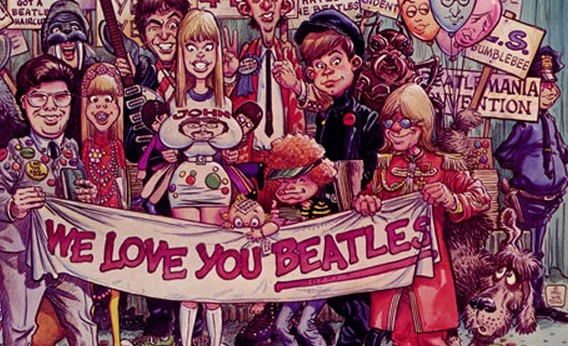
Assassin Mark David Chapman (left) makes an unwelcome appearance on the cover of Beatlesongs!

The record: Beatlesongs! The Best of the Beatles Novelty Records (Rhino Records, 1982 - RNLP 803)

Artist(s): Various, including the Rutles, Casey Kasem, Wild Man Fischer, Allan Sherman, and the comedy team of Peter Cook & Dudley Moore

Rhino Records' Beatlesongs!
History: Rhino Records started out as an actual record store on Westwood Boulevard in Los Angeles, founded in 1973 by the eccentric Richard Foos, but they began distributing their own records just five years later. Their first release was "Go to Rhino Records" (1978) by the notorious "Wild Man" Fischer, a schizophrenic ex-Zappa protege who'd been hanging out at the LA shop. Rhino Records issued a few punk and novelty singles after that, but their real forte turned out to be high-quality reissues of classic rock, soul, pop, and jazz records, and they became one of the top labels for such releases in the 1980s and 1990s.

In particular, Rhino became famous for its often quirky and clever compilation albums with distinctive packaging and well-researched liner notes. One early example was 1982's Beatlesongs! The Best of Beatles Novelty Records, a various artist LP with tracks about (but not by) the Beatles. Most of these are comedy songs released during the first wave of Beatlemania in America, circa 1964, but some are tracks recorded well after the group's demise. Unfortunately, the album was quickly taken off store shelves because of its deliberately tasteless cover illustration by William Stout, who depicted John Lennon's assassin, Mark David Chapman, as one of the attendees of a fictional "Beatlemania Convention."

I bought this in the 1990s at a real Beatles convention from a vendor who swore to me it would become a collector's item. It hasn't. But it still contains some interesting pop culture debris, mostly ephemeral records that were designed to have a very brief shelf-life. Rhino, meanwhile, was absorbed into Warner Music Group in 2009 and has largely been supplanted in the offbeat nostalgia biz by Shout! Factory.

All Music Guide says: 2.5 stars. "Unfortunately, the selections are not as representative as they might have been and occasionally venture into irrelevant territory." - Greg Adams [link]

Was it a hit: No, but "We Love You Beatles" by the Carefrees crawled up to #39 back in February 1964.

Choice excerpt from the liner notes: Musicologist Ken Barnes summarizes the "low comedy role" played by topical novelty records ("idol worship or idle wordplay, sycophancy or sicker fancies") and gives us background details on the artists, e.g. "Wild Man Fischer was so affected by the Beatles (his favorite group at the time) film Yellow Submarine, that he was moved to write 'I'm the Meany' after one of the cartoon characters. Wild Man says his new favorite group is the Go-Go's." The liner notes also contain an explanatory letter from Dudley Moore (by then a major movie star) to one of this album's producers, Harold Bronson. Moore says that "The L.S. Bumble Bee" was made quickly to capitalize on the druggy notoriety of "Lucy in the Sky with Diamonds" but musically was inspired more by the Beach Boys and the Supremes. "The only thing I can remember about the recording session," Moore writes, "was that Peter Cook had practically lost his voice when we were doing it, and found it very hard to put any tone into it."

Beatles label-mate Donna Lynn.
The listening experience: Quick and fulfilling. These twelve tracks are all brief, mostly in the two-or -three-minute range, and the songs tend to be upbeat and catchy, so listening to Beatlesongs! is a breeze. I must've listened to this record a lot in the '90s because I still knew the words to most of the songs by heart. Side One is fairly sedate stuff.

It starts with "The Invasion," a break-in record by Bill Buchanan and Howard Greenfield. Break-in records, for the uninitiated, are spoken-word comedy bits that are structured like news reports and employ cleverly-edited snippets of popular songs in an early, primitive form of sampling. Buchanan helped start this novelty sub-genre with his former partner, Dickie Goodman, back in the '50s with "The Flying Saucer (Parts 1 and 2)." "The Invasion" is a virtual replay of that record, only with the Beatles in place of aliens from outer space. "AMERICA, THIS IS THE END!" cries one panicked observer over the sound of an air raid siren.

Next up is something quite a bit more reverent: "Hold My Hand" by the Rutles, a late-1970s Beatles parody originally created by Eric Idle (of Monty Python) and Neil Innes (of the Bonzo Dog Band) for their British TV series, Rutland Weekend Television and later featured on SNL and their own feature-length NBC special. "Hold My Hand" is not a comedy number, per se, but rather a loving pastiche of the Beatles' early 1960s sound.

The Carefrees are up next with "We Love You Beatles," a song of devotion with a melody swiped from Bye Bye Birdie and sung with almost militaristic fervor.

Forgotten pop princess Donna Lynn, who recorded on the same American label (Capitol Records) as the Beatles, sings the goofy lament "My Boyfriend Got a Beatle Haircut," one of the rare records in which Beatlemania threatens to take a guy away from a girl, instead of the other way around. (On Side Two, the genders are reversed.)

Side One's craziest record -- by far -- is Casey Kasem's "Letter from Elaina," in which, over an instrumental rendition of  "And I Love Her,"  the famed DJ reads, with great sensitivy and gravitas, a missive from a hysterical female groupie who managed to get by security long enough to hug George for several seconds before he could break away, say, "Hi, bird," and drive away in a limo. ("My girlfriends were -- and are -- very envious," she boasts.) What's amazing about this record is how little actually occurs in the story and how much meaning Casey gives it with his tender tone of voice:


Side One ends with "Beatlemania," an instrumental mish-mash of the group's early hits, by Jack Nitzsche, the famed arranger and film composer, who throws in a bit of "Needles and Pins" -- a hit he cowrote with Sonny Bono -- for good measure. Apart from "Hold My Hand," every track on this side comes from the original 1960s heyday of Beatlemania.

Rhino Records mascot Larry "Wild Man" Fischer
On Side Two, things get a bit crazier. Kicking things off is "Beatle Rap," a "Rapper's Delight"-style novelty tune credited to a one-off group called The Qworymen (a play on John and Paul's pre-Beatle band, The Quarrymen) and apparently recorded exclusively for Rhino. Though the rapping is elementary by today's standards and the Beatle impressions are a bit shaky, this record is a blast for knowledgeable Beatlemaniacs, jam-packed with references -- some quite obscure -- to the Beatles and their careers, including the solo years. (The fake "Paul" mentions his then-recent drug bust.) Musically, it's built around the riff from "Day Tripper," but if you listen through headphones, you'll hear nods to "The Inner Light," "Strawberry Fields Forever," and "I Should Have Known Better." My favorite aside, from "John": "Anybody wanna buy some lithos?"

Cook and Moore are up next with their deliberately twee, pseudo-psychedelic pop song about a consciousness-expanding bumblebee. It's hard to believe that this song has been frequently been passed off as a "real" Beatles song and has turned up on Beatle bootlegs for years. It sounds nothing like them.

Next, Rhino Records' unofficial mascot, Wild Man Fischer, delivers the most out-there, avant-garde track on the whole compilation: his unhinged, off-key a cappella rant "I'm the Meany," which contains the line "She told me she was pregnant, so I hit her in the stomach!"

After that, Allan Sherman's "Pop Hates the Beatles," a parody of "Pop Goes the Weasel" complete with orchestral backing, sounds positively genteel. Sherman brings his usual Borscht Belt crankiness to the topic of the Beatles. The song is actually sung from the point of view of an exasperated father whose daughter is a confirmed Beatlemaniac. The live audience on this record, obviously composed of moms and dads of Sherman's generation, laugh appreciatively. Beatlesongs! ends with two quickie cash-in records from 1964 (or thereabouts).

The album's closer, "The Beetle" by hit songwriter Gary Usher, is an opportunistic attempt to create a new dance craze based very loosely on the Fabs.

It's cute enough, I suppose, but I got much more of a kick out of "Letter to the Beatles" by the Four Preps, a clean-cut 1950s pop quartet, i.e. the type of group largely made obsolete by the British Invasion. Perhaps fueled by jealousy, they released a musical lament about a poor guy whose best gal dumps him when she becomes obsessed with the Beatles and -- after receiving numerous unsatisfactory responses to her fan letters -- finally breaks down and agrees to purchase all the merchandise the group wants to sell her. Even if you love the Beatles so much that you're offended by this song, you have to admit that the chorus of "A Letter to the Beatles" is damned catchy. I think this tune is as worthy as any of closing this article, so I'll leave you with it. Enjoy.


Overall grade: B