Wednesday, June 20, 2018

Could 'Solo: A Star Wars Story' have been saved? Maybe not, but let's try anyway.

Alden Ehrenreich looks typically blank as Han Solo because he has no character to play.

A typical screening of Solo: A Star Wars Story.
Maybe Solo: A Star Wars Story never had a shot at being good, let alone necessary or impactful, it being yet another unsolicited prequel in a franchise already lousy with exposition. But I don't think it needed to be the pointless, empty, dispiriting slog that it turned out to be. Was I a fool for thinking this thing would actually be fun?

In the wake of the film's underwhelming debut—it "only" earned $84 million at the domestic box office over the Memorial Day weekend—plenty of theories are circulating as to why Solo failed to click with audiences. Franchise fatigue? Backlash from disgruntled fanboys (many of whom are weirdly fixated on their hatred of supporting character Rose Tico, who is not in Solo)? An overcrowded marketplace? All of the above?

I can't tell you with any certainty why certain viewers stayed away from Solo. That's for the industry analysts to decide. What I can tell you is that, for me, watching Solo was almost no fun at all and that I can't imagine this thing being anyone's favorite movie unless they'd only seen three movies and the other two were snuff films. And even then it would be close.

As it happened, I was in Indiana over the Memorial Day holiday, visiting my sister and her family. We all went to see the movie at the local multiplex, and I'll testify from first-hand experience that it played to soporific silence from the entire audience. I even had to fight the urge to nod off during the film's leaden middle passages and found myself wishing I'd brought a caffeinated beverage with me into the theater. The film's timid attempts at humor fell particularly flat. I think the socially-conscious droid L3-37 was supposed to be the film's designated comic relief character, the Jar Jar of Solo: A Star Wars Story. After one of her several failed wisecracks, I exhaled loudly enough with disappointment to make my niece giggle a little. That accounted for the one (1) audible laugh during the entire screening.

Curiously, speaking of Jar Jar, Solo: A Star Wars Story made me pine for the days of George Lucas' much-mocked prequel trilogy of the late '90s and early 2000s. As gratingly stupid as it is, The Phantom Menace at least provides some eye candy: cool-looking cities, cool-looking planets, cool-looking costumes, etc. Solo, on the other hand, is almost perversely drab, underlit, and murky. The title character spends the whole film bouncing from one inhospitable world to another, and we never get a good sense of the terrain in any of these places. It's like: mud world, another mud world, rock world, desert world. Gee, thanks a bunch, movie. A Star Wars movie should seem open and airy, bursting with possibilities. Solo, in sharp contrast, feels cramped and restrictive. There's not even a hint of adventure here.

Our antagonist: a petulant twerp.
I can't comment on the characters, since Solo didn't really have any. Instead, it had placeholders where interesting, well-developed characters would otherwise be. Wide-eyed, baby-faced Alden Ehrenreich bears little resemblance to Harrison Ford, other than being a bipedal mammal. I guess he says his lines all right—it helps that the script doesn't have him say, "Would that it were so simple."—but he's the least dynamic, compelling character in the movie, and that's a problem when the movie is named after him.

Does this movie even have an antagonist? I've heard Paul Bettany's character, stripey-faced gangster Dryden Vos, described as the film's main villain. But he's such a petulant little twerp it was difficult to take him seriously. In a real Star Wars movie, he'd be the lieutenant to the actual antagonist. I'm not sure how he got those scars on his face. I think he might just be a cat owner.

Everyone else? Eh, they're fine, I suppose. It's difficult to judge them properly because the script is so clunky. So many awful lines here. "She's part of the ship now." "You're the good guy." And that idiotic scene in which Han gets his last name. It's a complete ripoff of the scene from Mike Judge's Idiocracy (2006) in which Joe Bauers (Luke Wilson) finds himself being renamed "Not Sure."

While we're talking about that part of the movie, let's discuss the Empire for just a moment. I've written before about how the Empire never makes the least attempt to win over the public's affections. Well, in this movie, there's actually an Empire recruiting film, and I'll be good and goddamned if it isn't seemingly inspired by a Family Guy parody. That's right: Lucasfilm is now taking cues from Fuzzy Door Productions.

A better template for this movie.
Solo even gets the little details wrong. It's a longstanding Star Wars tradition, for instance, to have weird looking bands and singers providing background music. In this movie, I think we get one lame lounge act consisting of a woman with a radio dial over her mouth (?) and a guy who's just a head in a jar. And they're off-key the whole time. Give me the Max Rebo Band or the Modal Nodes over these bozos any day!

Admittedly, I have never given a great deal of thought to what Han and Chewie were like before joining up with Luke and the Rebellion. But, if I'd had to guess, I probably would've said their lives were something like The Dukes of Hazzard.  You know, "making their way the only way they know how. That's just a little bit more than the law will allow." Han and Chewie would be like Bo and Luke. The Millennium Falcon is their General Lee. And Jabba the Hutt (absent from Solo) is their Boss Hogg. I guess that makes Lando their version of, uh, Cooter or something. Look, it's not a one-to-one comparison.

But the way I see it, young Han Solo is a hotshot smuggler and pilot. He digs himself. He thinks he's too much. He has a badass ship. He has a badass sidekick. He has a badass blaster. And he's a handsome, athletic, quick-witted dude who is constantly outsmarting both the gangsters and the Empire. To him, every Stormtrooper might as well be Sheriff Rosco P. Coltrane, i.e. a dope who couldn't hit the broadside of a barn. Han's life is a series of daring escapades and narrow escapes, and that's the way he likes it. In other words, it's a goddamned adventure. The movie starts out with this narration: "It is a lawless time." To which I would have added: "And Han wouldn't have it any other way."

Above all, I thought sure young Han would be a womanizer, a galactic Don Juan constantly seducing ladies (plus occasional aliens and droids) wherever he goes. But no. Solo: A Star Wars Movie gives him a steady girlfriend, Qi'ra (Emilia Clarke), at the beginning of the movie, and Han remains stupidly loyal to her throughout the film. He's so earnest and wholesome, he might as well be a Boy Scout. I was certain there would be at least one scene in which Han is chased by a jealous husband, but Solo definitely isn't that kind of movie.

Instead, Solo wants to be basically a filmed FAQ about its title character. How did Han get his last name? How did he meet Chewbacca? How did he get his famous blaster? I would have structured it around a different question entirely: How did Han get his cynical attitude?

Another good role model for this film.
Let me elaborate. By the time we meet him in A New Hope, Han Solo is a selfish, sarcastic guy who keeps the world at arm's length. I think he does this as a defense mechanism. If he walls himself off emotionally, he can't truly get hurt. My version of his origin story would have explained how exactly he got that way.

Like I said before, my version of young Han Solo is a cocky, arrogant hotshot. But he's still a boy at heart. My script for Solo: A Star Wars Story, then, would be about Han's journey from boyhood into manhood. I would have kept the character of Qi'ra, as well as that of Han's quasi-mentor Beckett (Woody Harrelson), but their roles would have been different. Or, rather, their functions would have been different.

The first part of my Solo movie is about Han being a smuggler and having a grand old time at doing it. But then, he runs afoul of Beckett's gang somehow. Even this, though, seems like yet another lucky break for Han. Beckett has actually heard of Han, he says, and thinks that Han and Chewie would be good additions to the squad. Seeing as how the only alternative is having his head blown off, Han says yes.

Beckett's plan is to rip off some big time warlord, someone like Dryden Vos but not such a prep school punk. (And ixnay on those Garfield stripes on his face.) They have an operative on the inside: the warlord's beautiful mistress Qi'ra. Immediately, Han has the hots for Qi'ra, and soon she and Han are sneaking kisses whenever possible. It's possible that this is the first time Han Solo has ever actually been in love. Normally, he's the "find 'em, fuck 'em, forget 'em" type, but Qi'ra is different.

Beckett tells Han he has potential but that he has only been a small time operator up to now. And so, Han serves an apprenticeship under the more experienced crook, learning the ropes. In the end, the heist goes off successfully, and the warlord is killed, but it turns out Beckett has really only been using Han the whole time and plans to kill him and take his share of the money. Beckett tells Han, "It's a shame, too, kid. Because I was really beginning to like you. In fact..." Han shoots him at this point and casually kicks Beckett's body into a ravine, where it's eaten by animals. This is a key moment when Han starts to become more callous.

But the real moment of change for Han comes when he realizes that Qi'ra, too, was only in this for herself. She needed money to buy her way out of being a kept woman. Now she has it, and she doesn't need Han anymore. This has not been foreshadowed in any way throughout the movie, so the moment should feel like a real gut punch to the audience. We've come to know and like Qi'ra, and it's devastating to watch her dump Han. But she's not been a goody-goody either. She's more like a character out of film noir. I see Han as being analogous to the private eyes from those movies, e.g. Sam Spade or Philip Marlowe. The film, then, would be about how Han lets some dame play him for a chump and how he learns a tough life lesson along the way. That's classic Raymond Chandler/Dashiell Hammett-type stuff.

My movie ends with Han and Chewie in some shithole cantina halfway across the galaxy. Based on the way he's talking, we can see he's already started to develop the cynical persona of the Han we knew from the older movies. Suddenly, a strange emissary (Greedo?) walks up to Han and offers him a business card. It's from Jabba the Hutt. Han looks intrigued. Smash cut to end credits.

So, yeah, that's my take on Solo: A Star Wars Story. The TLDR version is this: Solo should have been Dukes of Hazzard in Outer Space. Just imagine this but with spaceships.

Ed Wood Wednesdays: The Wood Collaborator Odyssey, Part 11 by Greg Dziawer

By 1955, Bela Lugosi was getting by with a little help from his friends.
 
T
his week,
I've decided to keep the Ed-itorializing largely to myself.  Instead, through an assortment of vintage news clippings, I'd like to offer a snapshot of a pivotal month in the saga of Ed Wood and Bela Lugosi. These events unfolded in the spring of 1955. In April of that year, the 72-year-old Lugosi was famously hospitalized for drug addiction not long after shooting the silent test footage that Ed would later insert into Plan 9 from Outer Space.

Meanwhile, the release of Ed and Bela's previous film—then still called Bride of the Atom—was mere weeks away. Following Bela's hospitalization, the May '55 premiere of Atom immediately morphed into a benefit for the ailing, debt-plagued Hungarian actor. This upbeat article from the April 27, 1955 edition of The Lubbock Morning Avalanche details both the hospitalization and the "lavish" benefit gala. Note the mention of Bride producer/star Tony McCoy, who is said to have visited Lugosi in the hospital.

"A lavish Hollywood premiere is planned."

This celebrity gossip column from the May 21, 1955 edition of The Oakland Tribune is significantly less positive in its depiction of the Lugosi benefit, characterizing the evening's receipts as "pitifully low."

"Receipts were pitifully low."

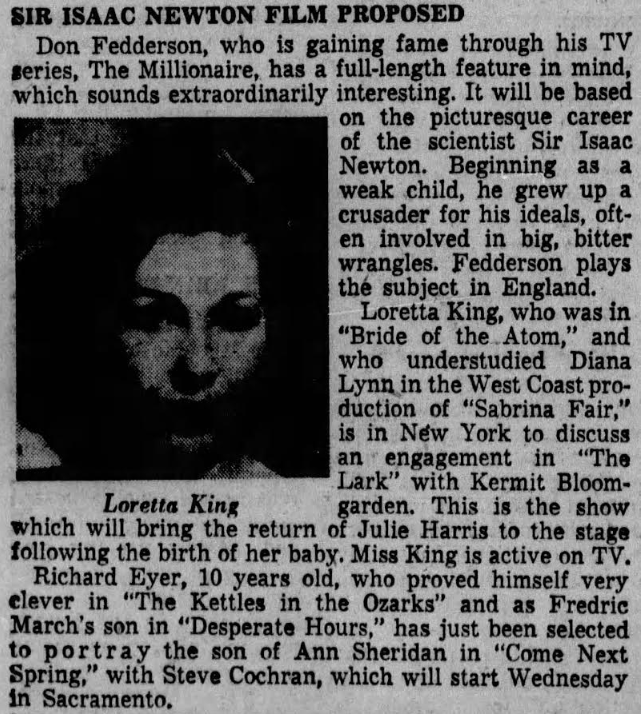
This next piece, which mentions Bride's leading lady Loretta King, was penned by Edwin Schallert and appeared in May 30, 1955 edition of The Los Angeles Times. You may remember that Schallert, father of actor William Schallert, had previously written about Glen or Glenda back in 1953. According to Schallert, King was "active on TV" at the time.

"Miss King is active on TV."

Like Edwin Schallert, Aline Mosby had also written about Glen or Glenda back in 1953. In fact, Mosby wrote numerous articles through the years featuring various friends, associates, and collaborators of Edward D. Wood, Jr. Her syndicated article here, clipped from the April 25, 1955 edition of The El Paso Herald Post, is especially sad and poignant in its depiction of Bela Lugosi in his twilight years. The article paints the actor as a pathetic figure, dependent upon the charity of friends. The "cruel satire" Mosby mentions was The Bela Lugosi Revue at The Silver Slipper in Las Vegas the previous spring.

"A quiet, gentle man who got into horror movies by mistake."

One last clipping to share with you, this one from the May 11, 1955 edition of The Los Angeles Times. It, too, describes the Bride of the Atom premiere and the subsequent Bela Lugosi benefit. The article name checks both Ed Wood and Tony McCoy, as well as Paul Marco and Dolores Fuller.  It's also interesting to note Vampira's presence at the benefit showing, making this yet another entry on the timeline of Ed's association with the horror hostess.

"Vampira, escorted by Paul Marco."

EPILOGUE: Bela Lugosi died on August 16, 1956, not even a year and a half after this benefit in his honor. He was 73. The former site of the Gardens restaurant at 4311 Magnolia Ave. in Burbank is currently occupied by an establishment called Joe's Great American Bar & Grill. The Paramount Theatre, originally constructed in 1923, was closed in 1960 and demolished in 1961. At its former location at the intersection of 6th St. and Hill in Los Angeles, you'll now find a wholesale jewelry building constructed in the late 1970s.

The site of the Bela Lugosi benefit is now Joe's Great American Bar & Grill in Burbank, CA.

Wednesday, June 13, 2018

Ed Wood Wednesdays: The Wood Collaborator Odyssey, Part Ten by Greg Dziawer

Lyle Talbot as captured by the legendary Drew Friedman.

Lyle Talbot in Plan 9.
One of the most persistent myths surrounding Edward D. Wood, Jr. concerns his untimely death on December 10, 1978. The standard story goes that Eddie passed away while watching a football game on TV, despite the oft-repeated fact that he had no interest in the sport whatsoever.

Well, I recently learned a little more about that fateful game while researching one of Wood's most frequent collaborators: Lyle Talbot (1902-1996), the sturdy, incredibly prolific character actor who appeared in Crossroad Avenger, Glen or Glenda, Jail Bait, and Plan 9 from Outer Space, amid dozens of other assignments in a film and TV career spanning six decades. In interviews, Talbot staunchly avoided mention of working with Ed Wood. But that changed with Tim Burton's 1994 biopic elevating popular interest in Eddie to its then-and-still pinnacle. 

With Glenda and Plan 9 back in the spotlight, Lyle Talbot ultimately acquiesced and started talking to the press about his days working with Ed Wood in the 1950s. Take, for instance, an article I found in the October 2, 1994 edition of the San Francisco Chronicle. Here, although Talbot's work with Wood is described as being from a "fallow" period in his career, the actor is finally empathetic toward his former boss. And that's despite the fact that he reveals his possible—and very personal—reason for his decades-long separation from the world of Wood.

Here is the article in its entirety:

Wednesday, June 6, 2018

Ed Wood Wednesdays: RIP Jacques Descent (1937-2018) by Greg Dziawer

Jacques Descent surrounded by some of the films he worked on over the years.

Jack in 2009.
I have some sad news to report to you this week. The dwindling number of associates and friends who knew and worked closely with Edward D. Wood, Jr. has decreased by one. Film producer Jacques "Jack" Descent—a man who had become my very best friend these last few years—passed away in the early afternoon of Tuesday, June 5, 2018.
Apart from his connection to Ed Wood, Jack lived an extraordinary life of his own, his career and accomplishments remaining largely unknown to this day. He reinvented himself again and again as a filmmaker and an inventor and a painter, among many other things, always a fearless pioneer. It was all about the deal, he frequently told me, self-identifying as more artisan than artist.  
In the last year, owing to some near-impossible circumstances, I found myself working with Jack on the post-production of a movie he'd shot and co-produced in 1974. The interiors had been filmed at the Cinema 35 Center, Jack's full-stack studio/lab at Hollywood Blvd. and Western Ave. in Los Angeles. Together, we sifted through more than five hours of raw 16mm superneg footage and an equal measure of quarter-inch Nagra sound reels, bringing this material back from the dead.  
Day in and day out, I saw how Jack had retained his hands-on managerial artistry, even a quarter century after retiring from the film business. I only regret that Jack never saw the finished film, which is now mere weeks away from completion. Beautifully shot, it reveals artistry of another sort. It was gratifying to see Jack gradually but ultimately accept that.  
OJ in his Bruno Magli shoes
Just two weeks ago, I had the privilege of spending the better part of five days with Jack as he lived out his last days. Despite the circumstances, Jack's mind was sharp and his outlook positive, still looking for the deal. The steady stream of stories and anecdotes became even more incredible. Paid out of his half of a film with Jayne Mansfield's last Cadillac. Meeting Jobs and Wozniak in 1974 and selling their first "product" before there even was an Apple. Buying a pair of Bruno Magli's in the same store on the same day as OJ Simpson bought the pair he allegedly wore. 
Jack was living in Beverly Hills at the time, he told me, and he wandered into the shoe store one afternoon. He knew OJ from around town, not a friend, just to say hello at restaurants. Jack spotted OJ, who was with a couple of other ex-NFL players.
"Hello, OJ. How are you?" 
As they conversed, OJ mentioned that he was buying a pair of Bruno Magli's. Although Jack had never heard of the brand, he figured why not? Different than OJ's lace-ups, Jack purchased a pair of leather slip-ons that day, more than a quarter of a century ago. They are now, surreally, in my closet. 
Decades prior, Jack shot Ed Wood in a fabled, gone-missing film called Operation Redlight, which Ed also scripted. The angora sweater Ed wore in that film hung in the front office of the Cinema 35 Center through the mid-'70s.

Jack's story has only begun to be told, a life well and fully lived. Endings are beginnings.

Relive Jacques Descent's life and career with these links:

Wednesday, May 30, 2018

Ed Wood Wednesdays: The Young Marrieds Odyssey, Part Four by Greg Dziawer

Ed Wood dedicated his final film to documenting the sex lives of the younger generation.

Ed Wood's last stand as a feature film director.
This week, I am again turning my attention to Ed Wood's last-known feature, a hardcore pornographic film from 1972 called The Young Marrieds. There's a lot to talk about here. For instance, I've already discussed the movie's various releases on home video as well as some of its Los Angeles filming locations. This time, however, it's the movie's very title that concerns me.

Every now and then, that rather odd turn of phrase—"young marrieds"—piques my curiosity and sends me on a search. This particular pairing of words remains sparsely used in the English lexicon, with most appearances clustered from the mid-1960s through the early '70s. It is quite uncommon today even to see "marrieds" used as a plural noun. But, half a century or so ago, the term "young marrieds" popped up in a fair number of newspaper articles and ads and was even used as the title of a 1961 novel by Judith Heiman.

Back then, the press identified young marrieds as a large and promising consumer base, marked by their increased likelihood of possessing college educations and their subsequently enhanced earning power. Having come of age during the postwar Populuxe era of the 1950s, these youngsters seemed poised to buy even more than their parents' generation had. The natural flip side to this acquisitiveness—and a theme commonly addressed in the popular literature of the time—is that young marrieds would accrue debt beyond their means. And so they did, but not before Ed Wood named a movie in their honor.

Never a man with great financial acumen, Ed typically throws socioeconomics to the wayside in The Young Marrieds, instead exploring the sexual hang-ups of the new generation, whose members were far better situated in those permissive times to explore their sexuality than their more conservative forebears. 

Judging by these 1960s clippings, "young marrieds" were the millennials of their day.

Title card from the ABC soap opera.
All of this is mere preamble to a surprising discovery I made only recently: from 1964 to 1966, ABC ran a black-and-white soap opera called (you guessed it!) The Young Marrieds. Depending on which source you believe, the series lasted either 380 or 382 half-hour episodes. I suspect this connection had already been made by other Woodologists but had somehow slipped past me, unnoticed or unreckoned, until just now.

Be that as it may, the now-forgotten show ran mostly in late morning time slots (plus a few afternoons) on ABC affiliates across the country. It was a spin-off, in fact, of the massively popular General Hospital, which still airs today as one of the last surviving soaps on network television.

The Young Marrieds took place in the fictional town of Queen's Point, a suburb of GH's mythical Port Charles. Still to this day on General Hospital, the occasional character hailing from Queen's Point will pass through Port Charles. Otherwise, once it was cancelled, The Young Marrieds seems to have entirely disappeared in the ether of the pop culture, never to be re-aired. The UCLA Film and Television Archives holds a mere seven episodes, likely all that remains of the series. When Ed Wood made a movie called The Young Marrieds in 1972, the ABC series of the same name would have been just barely visible in the nation's rear view mirror.

By 1973, however, this new generation of young marrieds was already beginning to decline as a sociological and economic force, their higher divorce rates and lower birth rates foiling the hopes of the corporations. The term would all but disappear from use by the mid-'70s, and those same corporations would adapt by learning to profit from debt, a proven business model as it remains sustainable to this day. 

It seems of little sociological significance, in retrospect, that an aging pornographer appropriated the term "young marrieds" for his final, ignoble feature. More telling, perhaps, the title could explain the crazy scene in Ed's movie in which frustrated housewife Ginny (Alice Friedland) masturbates while watching a soap opera in her living room. The fact that there really was a soap opera called The Young Marrieds makes this scene an irreverent inside joke. And, given this Wikipedia summary of the series, there seems to be yet another direct link between the TV show and the movie, since both feature characters with the surname Garrett. To wit:
The Young Marrieds focused on the conflicts between three married couples in the suburban community of Queen's Point. Dr. Dan Garrett and his wife Susan Garrett, commercial artist Walter Reynolds and his wife Ann Reynolds, and Matt Stevens and Liz Stevens, a young couple who were engaged and ready to begin their married life together. 

Featuring just a handful of actors whose names are still recognizable today—including Charles Grodin, Ted Knight and Lee MeriwetherThe Young Marrieds ended its abbreviated run on ABC with an unresolved cliffhanger. This is appropriate, since Ed's film, too, ends on a note of uncertainty. Namely, would-be suburban swinger Ben Garrett (Dick Burns, aka Louis Wolf) has to decide whether to engage in homosexual activity at an orgy or just walk away.

We'll never know Ben's ultimate decision. What's your guess?

P.S. This 1964 ABC promo reel includes some footage from The Young Marrieds. And keep an eye out for Ed Wood regular Timothy Farrell (Glen or Glenda, The Violent Years, Jail Bait), appearing on the likewise forgotten Day in Court

Wednesday, May 16, 2018

Ed Wood Wednesdays: The Wood Set Decoration Odyssey, Part Six by Greg Dziawer

A relic from the heyday of 1970s porn.

Prop of the week: a bronze statue.
When we examine the films Ed Wood worked on in some capacity during his final decade—plus the ones we think he might have worked on—we see how often they intersect through their set decorations. There are distinctive props, furnishings, and wall hangings that turn up again and again in these 1970s adult movies.

I've already covered several of these decorations previously. For instance, there are the Chinese guardian lions and the lion's head door knocker that show up in Necromania and The Young Marrieds, two feature films directed by Ed, as well as in numerous silent 8mm loops. Then there's the black velvet painting of a panther descending a stone staircase. And let's not forget the infamous gold and white skull

Some of these set decorations serve as signposts to the alert viewer that a particular movie was made at Hal Guthu's studio set on Santa Monica Blvd. That's not always a guarantee, though, that Ed Wood was involved. I've seen some films and loops that feature items from those sets but likely have nothing to do with Ed. However, the lion's share (no pun intended) of these set decorations strongly suggest that Ed Wood was involved in a production.

This week, I'm going to follow an item I first noticed in Necromania. I traced this item first to another one of Ed Wood's features and finally to a mysterious but intriguing loop.

Ed's feature film Necromania is rife with items that turn up in other movies. It was only recently, while watching the outtakes of Take It Out In Trade, that an item from Necromania I had not spotted previously caught my eye. In Necromania, when Danny (Ric Lutze) and Shirley (Rene Bond) enter Madame Heles' place at the outset of the story, there stands a small piece of bronze decorative statuary just inside the door, sitting on the floor in the lower right corner of the screen. It's a squat, bulbous thing maybe about a foot and a half high. In the Trade outtakes, during a shot of a travel poster, two such bronze statues appear in the bottom left and right corners of the screen, indicating they were a pair.

Bronze statues in (from left): Cafe Lust, Necromania, and Take It Out In Trade.

Mere days later, I was screening some 1970s adult loops, and—sure enough—there it was again. The loop in question, Café Lust, takes place on a cheap strip joint stage set. The cast consists of two gals and a guy. One of the aforementioned bronze statues sits atop a table in the corner of the set, just to the left of the stage. The stage itself uses a piece of zebra-striped fabric as a backdrop. I've seen this same fabric repurposed again and again in these movies: as a blanket, as a wall hanging, as decorative bric-a-brac, and even as a carpet! Café Lust gave me my best view yet of this faux zebra skin. Up close, it looks like it is indeed a carpet.

Café Lust is also fascinating in that it dates from the brief era when the porn industry was transitioning from softcore to hardcore, placing it circa 1970. (Meanwhile, the clapperboards visible in the outtakes from Take It Out In Trade indicate it was filmed in mid-January 1970.) Lust survives today, ID'ed as "White Box Productions #23." This is another example of a loop that was packaged anonymously in an effort to protect its makers. The filmmakers obviously took some other precautions. There are a few halfhearted attempts to block out genitalia with objects in the foreground, and an oral sex scene is clearly entirely faked, with the act itself obscured throughout by the actresses' hair.

Aesthetically, the sparse strip show stage in Café Lust makes the stage in The Young Marrieds look ornate by comparison. But that could be owing strictly to the lighting and we could be on the very same set. Also worth noting: the stripper's dance moves are extraordinarily similar to those of the stripper in The Young Marrieds.

The real question, as always, is: Was Ed Wood involved in this loop? The circumstantial evidence suggests that he was, but that's still just an inference. We're close, without a doubt, but there remains more work to do. 

Wednesday, May 9, 2018

Ed Wood Wednesdays: The Wood Preview Odyssey by Greg Dziawer

Plenty of time to get some popcorn at the refreshment stand.

Things are happening, folks. Exciting things that I can't wait to share with you.

I have a lot of upcoming articles in the works for Ed Wood Wednesdays. In fact, I have too many balls thrown in the air! As we wait for one to come down, I'd like to preview just some of the topics I'll be covering in the coming weeks and months.

  • Ed Wood's career in sponsored and industrial films has gone largely undocumented until now. In addition to discussing Eddie's work with Story-Ad Films in the late 1940s, I'll detail the nature of the closed circuit live television broadcasts that Ed listed on his resume, while working at Autonetics at the dawn of the '60s.
An article from the Poughkeepsie Journal, September 18, 1949.

  • I'll also be covering the distribution history of the final four films that Ed is known to have directed in the 1970s: Take It Out In Trade, The Only House in Town, Necromania, and The Young Marrieds. All four of these adult movies made the rounds before disappearing into decades-long obscurity. We'll find out where and when they played, and ID the films they were paired with. It's quite a wild story. The Young Marrieds, for instance, was astonishingly still playing in theaters into the early 1980s! But more on that to come.
An ad for Take It Out in Trade.

  • In addition, I'll take a closer look at a couple of vital figures from Ed Wood's past: Eddie's young brother Howard William Wood (who typically went by William) and his close friend from high school and beyond, George Keseg.
  • The unseen garage-cinema of Ed and Bela (1986) will finally get its due. Ahead of its time in more than ways than one, this biographical short film's interpretation of Bela Lugosi eerily anticipates Martin Landau's award-winning performance in Tim Burton's Hollywood biopic Ed Wood (1994).
  • If that isn't enough to get your attention, I'll also be attempting the most comprehensive index yet of Tor Johnson's wrestling matches.
Tor with hair, 1936.

All this and much more awaits you, true believer, right here at Ed Wood Wednesdays. Whatever you do, keep watching this space for updates!

Wednesday, April 25, 2018

Ed Wood Wednesdays: The Wood/Dziawer Odyssey, Part Eight by Greg Dziawer

This week, Greg finds himself on the trail of a blue panther.

Reunited and it feels so good.
Increasingly, as I continue this odyssey into the life and work of Edward D. Wood Jr, I find myself overwhelmed. That's certainly been the case recently, as I've spent the last two weeks working on three sprawling articles that just keep falling deeper into rabbit holes. Fortunately, I tell myself the holes are lined with angora.

All these topics have conspired to launch me into a near-existential crisis: Ed's work for Autonetics in the early 1960s; the myriad scandals experienced by some of his key collaborators; and the sheer madness of identifying all the recurring set decorations in his movies.

That was in addition to turning 50 recently, which startled me. My partner Kitten threw the first birthday party for me in nearly 40 years. Somehow, she managed to get my best friend from my youth there, the inestimably wise TStep. After the party he and I hung out. I had not seen him in nearly a quarter of a century. 

Last night, seeking respite from research, reflection and nostalgia, I decided to just surf the internet aimlessly. That entailed looking at screencaps from sex films in the general target zone when Eddie would have been active—the late 1960s through the mid-'70s. I didn't have to look far before finding something interesting. Literally in the first batch of screen captures I examined, I noticed a wall hanging in the background that had already turned up numerous times in my purview.

In one bedroom in Eddie's 1971 feature Necromania, there's a black velvet wall hanging of a greyish panther walking down a stone staircase. We've discussed this set decoration here before, and I knew it was only a matter of time before it showed up again. I was happily surprised to see it more clearly and with brighter colors than previously. At the same time, though, I was frustrated that only the lower half of the painting was visible in the background, since two hippie chicks were getting intimate in the lower foreground, spoiling my view. Yes, I said frustrating. I really have arrived at the point where I'm watching everything in these films except the sex! 

The panther painting turns up in How I Got My Mink (1969).

Still in all, these captures were more than enough for me to cue up the full-length film, a sex comedy called How I Got My Mink. This particular movie was released in 1969, predating Necromania by two years. While Eddie was not involved in this production, the use of that familiar panther painting further substantiates just how ubiquitous Hal Guthu's studio on Santa Monica Blvd. was in the sex films of that era. Guthu's soundstage was home to the interior sets for all three of Ed Wood's final feature films as a director (that we know of): Take It Out In Trade, Necromania, and The Young Marrieds. In addition, this studio was used for dozens—perhaps hundreds—of the 8mm porn loops in which Ed was likely involved in some fashion.

In the latter half of How I Got My Mink, three sex scenes take place just under the panther's gaze and stealthy approach. What I found most interesting here was just how blue the panther looked. Was this the result of color correction or was it the most accurate depiction of the wall hanging? As I regain my focus and continue along other lines of research, I wonder where that velvet painting will turn up next.

Get excited. TStep is back and the Blue Panther is on the loose!