The story: "Ed Wood Hollywood Deadwood" by David Michael Taylor
Synopsis: Struggling filmmaker Ed Wood drowns his sorrows in vodka at a Hollywood dive bar called Gold Diggers. Eddie is especially upset that his TV pilot, Final Curtain (1957), has failed to sell. His friend, actor/wrestler Tor Johnson, shows up and tries to comfort him. Eddie looks at their reflections in a mirror and imagines Tor as Inspector Clay from Plan 9 from Outer Space (1957) and himself as a little boy dressed in girl's clothes. He leaves the bar, dejected.
One of L.A.'s great cocktail bars.
Ed migrates over to another bar, Boardner's, where he commiserates with Maila "Vampira" Nurmi. She says the future is in television, but Ed laments that he can't get his pilot in front of the right people. The director's epic bar crawl then leads him to the Frolic Room on Hollywood Blvd., where he meets up with psychic Criswell, resplendent in a sparkly Nudie suit. Eddie asks Criswell about the future, and Cris says, "Perhaps on your way home, someone will pass you in the dark, and you may never know it, but they will reveal your future."
Stumbling home to his shabby apartment on Yucca, Ed Wood indeed passes a young man and woman he does not recognize. Could they be the key to his future? He calls out to them. Many decades later, these young people are standing in front of the building at 6383 Yucca Street in Los Angeles. The young man's mother has texted him that Ed Wood once lived here, but neither the young man nor the young woman knows who Ed is.
Excerpt:
She strips the top from the shaker and replaces it with a strainer as I feel myself straining in anticipation. Setting a fresh martini glass on the section of the bar I've clamed as my own for the evening, she tips the shaker, causing the cloudy cocktail to pour through the strainer and into my glass without spilling a drop. A lime wheel appears as if from nowhere and, with a deft hand, she closes its pulp around the lip of the glass.
Another stop on the tour.
Reflections: Some of you Beatle fans may remember the 1995 music video for "Free as a Bird," the "new" song that was created by taking an unfinished John Lennon demo and overdubbing new parts by Paul McCartney, George Harrison, and Ringo Starr onto it. A combination of computer-generated animation and live-action footage, including many vintage clips of The Beatles themselves, the video follows the path of a bird as it flies to crucial locations in Beatle history, including the Cavern Club, Penny Lane, the Strawberry Fields orphanage, and Abbey Road studios. Along the way, we spy brief visual references to Beatle songs, including "Birthday," "Helter Skelter," "Paperback Writer," and more. The more you know about the Fab Four, the more references you'll catch.
David Michael Taylor's "Ed Wood Hollywood Deadwood" is like "Free as a Bird" for Ed Wood fans. Instead of following the path of a bird as it soars majestically through Beatle history, it follows the path of Ed Wood as he stumbles drunkenly from one Los Angeles bar to another. But it, too, is an Easter egg hunt for diehard fans. The story visits a few key Woodian locations, including Gold Diggers, Pla-Boy Liquor, and the notorious Yucca Flats apartment building, and it's peppered with references to Ed's life and career. Much of the dialogue comes directly from the script of Plan 9, for instance, and the bartender has the same name as Ed's mother: Lillian. We also get multiple references to the obscure Final Curtain pilot, a nod to Tim Burton's Ed Wood (1994), and a reiteration of the old story that Ed's mother dressed him as a girl when he was a child.
There's a sighing, elegiac quality to both "Free as a Bird" and "Ed Wood Hollywood Deadwood," though the latter is far less reverential. They're both wistful reminders of a vanished world and the vanished people who inhabited it. The ending of Taylor's story seems to consign Ed Wood to the rubbish bin of history, the victim of youthful indifference, but the truth is that this story could only have been written by someone with a deep, abiding love for Eddie's work. Who else but a fan would bother to write something like this?
P.S. This story is almost fetishistic in its detailed descriptions of alcoholic beverages and cocktail bars. I'm not sure if these things are a major part of the author's life, but they were certainly a major part of Ed Wood's life, so I appreciate the extra effort displayed here. These descriptive passages really bring you into Eddie's dank, boozy world.
Synopsis: Vanessa Davis, an ex-NASA test pilot turned secret agent, is piloting a propeller plane to Romania as part of her latest dangerous mission. Her passenger is a mysterious, powerful man she has only recently met named Anton Voytek. For this mission, they are both using codenames. His is Lucifer; hers is Vampira. Over the Transylvanian Alps, the plane runs into bad weather and has to land. When Vanessa looks at Anton in the mirror, she realizes to her horror that he casts no reflection. Once the plane is on the ground, Vanessa tries to outrun Anton but to no avail. He soon overpowers her.
Some time later, Vanessa wakes up in a coffin in a remote chateau. She opens a curtain, only to be burned by sunlight. She is greeted by Diana, another female vampire under Anton's control. Vanessa soon realizes what she has become. Her life now revolves around hunting human beings and drinking their blood. Whenever she can, she lashes out at Anton and the other vampires in his "brood," but she is generally unsuccessful because she herself has the same weaknesses they do. She does manage to impale Diana, but Anton proves impossible to kill.
Eventually, with numerous vampires following her, Vanessa makes it back to her plane and even manages to take off. Anton takes the form of a bat and pursues her. They have an epic battle in the air, ending when Vanessa crashes the plane. Unfortunately, when the smoke clears, it is Anton who survives. He declares Vanessa to be a worthy adversary and sends her mortal remains back to her hometown of Oakdale, CA. Back home, Vanessa's elderly husband attends her funeral but is so grief-stricken that he himself wanders into traffic and is killed. Soon after, aliens begin to invade the earth as part of an initiative called Plan 9.
Excerpt:
She tried to fight him, but she just couldn't. To this moment her life mind and soul were hers alone to command, and the agency had invested long years training her to keep her that way she's been judged resistant to almost all forms of external persuasion. But this was different. Anton, this vampire, was inside her mind, and there was no damn way she could keep him out. In a moment, he knew her innermost thoughts, of her dreams, all the private things that she cherished. In a moment she was mind raped and in the end she was his.
Reflections: As I've made my way through Warm Angora Wishes, I've occasionally found myself wondering what would happen if someone totally unfamiliar with Ed Wood's films picked up this book and started leafing through it. How would that happen? Maybe, years from now, a copy turns up at a used bookshop, and the cover catches a shopper's attention. Would such a reader be able to make any sense of it? Or does the reader have to have at least a passing knowledge of Ed's 1950s films, particularly Bride of the Monster (1955) and Plan 9 from Outer Space (1957) to be able to enjoy this anthology?
Take "Children of the Sun" as an example. Now, there is plenty here to entertain the average reader of genre fiction, regardless of that person's level of familiarity with Ed Wood. At heart, this is a horror story that emphasizes the punishing physical and mental tortures of being a vampire. Vampirism is often romanticized in film and literature, so it was strangely refreshing to read Joe Overbay's brutal, unappetizing take on the lifestyle—which is basically like being a junkie, but a thousand times worse. And all of this is set against a backdrop of Cold War intrigue, complete with plenty of tense, high-flying action sequences. The author is mashing up a couple of popular genres in this story, so there's something for everybody... theoretically.
But what is the uninitiated reader to make of the early, totally-out-of-nowhere reference to UFOs? Or the mention of someone called Dr. Eric Vornoff? Or the fact that, in the final paragraphs of this story, the setting suddenly switches from Transylvania to California and involves aliens invading the earth? My guess is that these aspects of the story would be very, very confusing to an outsider. That's not a problem, necessarily. It's just something that's been on my mind. Maybe that's the secret gift of Ed Wood; as a muse, he lets you make imaginative leaps you might not otherwise dare.
The story: "The Black Madonna of Pioneer Cemetery" by Lina Martine
The spooktacular cast of Plan 9.
Synopsis: After attending a horror movie, two young couples on a double date decide to visit a creepy and mostly-abandoned cemetery. One of the girls, Tina, is reluctant to explore the grounds, even though it was her idea to go there in the first place! Ultimately, she and the others—Jimmy, Betty (aka Betts), and Eddie—climb over the fence that surrounds the graveyard. The rather eccentric but nice Eddie is especially excited to visit the grave of an outlaw named Freno Frost and make a rubbing of his tombstone. Tina is dating Eddie only because he's friends with Jimmy. She plans to become Jimmy's girlfriend once he and the fickle Betty inevitably break up.
The four young people are shocked when a tomb opens and a female ghoul emerges. They all immediately recognize her as the Witch, a sinister woman who'd been married to a much-older man. Jimmy, Tina, Betty, and Eddie are terrified when they hear more figures approaching them in the dark. The Witch attacks Jimmy and begins clawing and chewing him. Betty tries to fight her, but to no avail. Then, the Old Man attacks her by biting her neck.
The two survivors, Eddie and Tina, have no choice but to abandon their doomed friends and make a run for it. While trying to leave the cemetery, they barely escape a third ghoul: a large, clumsy, heavyset man. Betty and Jimmy are never heard from again, while Tina and Eddie break up due to the latter's transvestism.
Excerpt:
Tina's eyes were glued to the tomb door, which continued to swing outward. Spindly white arms reached out of the darkness inside. A lean, white, wolf-like face loomed out of the inky blackness, lips curled in a savage snarl. Shaking and quivering spasmodically, a woman in a torn black dress staggered out into the moonlight. She lurched to a halt, face turned up toward the moon, and let out a piercing shriek.
Reflections: As I've made my way through Warm Angora Wishes and Rubber Octopus Dreams, I've been reminded that Ed Wood is still largely defined by the handful of films he made in the 1950s. You say Ed's name, and people think of ghouls, cemeteries, and angora sweaters. All of those things are on prominent display in "The Black Madonna of Pioneer Cemetery," a story that takes the three iconic zombies from Plan 9 from Outer Space (1957)—the ones played by Vampira, Bela Lugosi, and Tor Johnson—and gives them a new set of victims to chow down on.
But author Lina Martine obviously knows more about Ed Wood than just the few core movies that have been played to death. For example, she includes a prominent reference to Kenne Duncan's character Freno Frost from The Lawless Rider (1954), an extremely obscure Western co-written by Ed. Who else but a superfan would even know that? And the story's framing device, i.e. horny young people visiting a spooky old cemetery, feels like a nod to Orgy of the Dead (1965). Come to think of it, cemeteries remained prominent in Ed's writing all the way through his career, even during his porn days of the '60s and '70s. If he could steer a story toward a cemetery, he would.
In her biography at the end of the story, Martine declares herself "addicted to James Dean/Maila Nurmi gossip." It's no surprise that Maila's Plan 9 character is at the very center of this story and that one of the doomed youngsters is named Jimmy. The story even mentions Jimmy's movie-star good looks, and I'm sure it's symbolic that Maila's character literally tries to eat him alive. Eddie is obviously a stand-in for Ed Wood, right down to his angora sweater fetish. But are the characters Betty and Tina meant to represent anyone in particular, or are they just typical horror movie victims? Only the author knows for sure.
The story: "Ed Wood and the Mystery Tower Sitter" by Gregory William Mank
Synopsis: It is October 1957, and Los Angeles television station KTLA is staging a unique publicity stunt to advertise its Nightmare Theatre program and the premiere broadcast of James Whale's Frankenstein (1931) starring Boris Karloff. Each night, a mysterious masked man hired by the station climbs up the famous KTLA broadcast tower and sits from dusk until midnight, while fans below gather and speculate about his identity. This has been going on for 21 days. Some think that the sitter may be Karloff himself, but this is unlikely, as Karloff is quite aged and too distinguished for such a stunt.
Actor Glenn Strange.
Young director Edward D. Wood, Jr. is among the gawkers at KTLA. One night, he brings a woman with him: a college student named Madeline whom Eddie has paid $35 to dress as Vampira. Madeline is quite snobbish and holds Eddie in utter contempt; she also sees phallic and sexual imagery in nearly everything, especially horror movies. The KTLA security guards shoo the onlookers away after midnight, but Eddie lingers a while to strike up a conversation with the sitter. He has correctly guessed that the masked man is actually actor Glenn Strange. Eddie wants Strange to double for the late Bela Lugosi in a film to be called Graverobbers from Outer Space. Strange is cordial but turns Eddie down, deeming himself unworthy.
Undefeated, Eddie goes to a Hollywood bar where showbiz types—many of them washed-up—habitually gather. There, he spots horror star Lon Chaney, Jr. Eddie boldly approaches Chaney and starts his pitch all over again.
Excerpt:
A rowdy crowd gathered this Saturday night on the grounds of KTLA, consumed with Frankenstein fever. Nature itself seemingly smiled on the revels—a huge moon, three nights from being full, had ascended above the tower, glowing approvingly over this Hollywood Gothic sideshow.
Reflections: At the beginning of Martin Scorsese's The King of Comedy (1982), wannabe comedian Rupert Pupkin (Robert De Niro) waits impatiently outside the Manhattan TV studio where a nightly talk show called The Jerry Langford Show is being taped. He is apparently hoping to catch a glimpse of Langford (Jerry Lewis) himself or one of Langford's celebrity guests. Numerous diehard fans gather at Langford's stage door each night, and they all know Rupert by name. He is obviously a regular at such gatherings. This is our first clue that something is seriously amiss with Rupert. What kind of man waits outside a talk show studio every night, clutching an autograph book? Later, when the delusional Pupkin concocts an audacious scheme to kidnap and replace Langford, we find our suspicions were more than justified.
There is something distinctly Pupkinesque about Ed Wood as he is depicted in "Ed Wood and the Mystery Tower Sitter." Perhaps he has no ill intentions for Glenn Strange or Lon Chaney, Jr., but his actions in this story seem uncomfortably desperate and pushy. He invites himself into other people's lives with little regard for such concepts as privacy or personal space. Eddie's argumentative relationship with Madeline even mirrors the uneasy, quarrelsome relationship between Rupert Pupkin and his accomplice Sasha (Sandra Bernhard) in The King of Comedy. Perhaps, if no classic horror star will agree to be in Graverobbers from Outer Space, Eddie will have to kidnap one.
Incidentally, the author points out that the KTLA "mystery tower sitter" publicity stunt was quite real, though Eddie was not involved and did not meet Lon Chaney, Jr. either. It is still interesting how the author of this story managed to take a colorful but obscure anecdote from showbiz history and weave it into the legend of Ed Wood.
I only recently learned of this strange, great graphic novel about Ed Wood.
In 1982, musician Brian Eno told Los Angeles Times reporter Kristine McKenna that the album The Velvet Underground and Nico (1967) only sold 30,000 copies in its first five years, but "everyone who bought one of those 30,000 copies started a band." We could quibble here. The seminal art-rock album had sold more than 30,000 copies by 1972, and it's impossible to say how many bands were formed as a direct result of its release. But you get Eno's point: the VU album had an influence far bigger than its meager commercial success would indicate. Somehow, this weird little LP inspired creativity in others.
Who knew this existed?
I feel Ed Wood has had a similar effect on his fans. He's the Velvet Underground and Nico of directors, if you will. Popularity eluded him during his lifetime, and even a big-budget, mainstream biopic about him massively underperformed at the box office in 1994. But still the Wood-inspired tribute projects continue to materialize, nearly half a century after his death. In the course of writing this column, I have discussed feature films, short films, albums, books, musicals, trading cards, fan art, and even toys inspired by the works of Edward D. Wood, Jr.
Just a couple of weeks ago, I reviewed John Wooley's graphic novel version of Plan 9 from Outer Space from 1990 and lamented that there weren't more Wood-inspired comics for us fans to enjoy. But I was in luck! The ever-reliable Bob Blackburn posted recently on Facebook about something called Ed Wood Jr. Graphic Novel (2022) credited to one Diana Wood, a Portland-based illustrator presumably unrelated to Eddie. This was totally outside my field of experience. I'd never heard of this artist or this book, but it was inexpensive and looked promising, so I took the plunge. To kill the suspense, I'm glad I did.
Incidentally, I bought this graphic novel from Amazon, and a page near the back of the book indicates that my personal copy was printed the day I ordered it at a facility near where I live. I must be a luddite or something, but is that how books work now? If so, I'm in. The book arrived remarkably quickly and was very slick and professional, like anything you'd find at Barnes & Noble. Très impressionnant! And this makes every copy unique. I'm happy to have this as a physical object and not a PDF file or a folder of JPGs.
The novel itself is a phantasmagoria that freely intermingles elements from Ed Wood's movies, Eddie's real life story, and author Diana Wood's fertile imagination. It's set in the early-to-mid-1950s, the same years covered in Ed Wood (1994). You will not see the booze-bloated, long-haired Eddie directing porno flicks or writing tawdry paperbacks. Instead, the book focuses most heavily on the making of Ed's first two features, Glen or Glenda (1953) and Jail Bait (1954), though Bride of the Monster (1955) and Plan 9 from Outer Space (1957) are evoked here as well.
After a suitably dramatic introduction from Criswell, we commence with the making of Glen or Glenda in 1953. A young, eager Eddie interviews with producer George Weiss, gets the job of writing and directing the film, tells girlfriend Dolores Fuller the good news, and then dons women's underwear, makeup, and a wig to get inspired to write the screenplay. Later, on the set, an elderly, ill Bela Lugosi is coughing terribly but still manages to give a performance that brings tears to Ed's eyes. With that in the can, Eddie dons female attire to shoot his own scenes. This surprises but does not anger or upset Bela. Ed's friend Bunny Breckinridge drops by the set and is impressed by Ed's boldness. Dolores is initially upset to see her boyfriend dressed as a woman but soon gets over it. Together they shoot the film's famous dream sequence, bringing the graphic novel's first chapter to a close.
Some panels from Ed Wood Jr. Graphic Novel. (Photo by Bob Blackburn.)
In the second chapter, budget-conscious George Weiss drops by the set and is shocked to find Ed not only dressed in drag but starring in the movie in addition to writing and directing. Eddie reassures him that all is well and completes the movie. We then see several iconic moments from Glen or Glenda: Glen confessing his secret to Barbara; Glen discussing his problems with his friend Johnny (Charlie Crafts); Glen having a nightmare in which his father (Captain DeZita) is depicted as the Devil; and Barbara reluctantly handing over her angora sweater to Glen. Ed Wood proudly screens the finished movie for an appalled George Weiss, who tells him it is terrible and will bomb at the box office. Eddie fumes, declaring that George is wrong.
We are then treated to a six-page mini-biography of Maila "Vampira" Nurmi called "The Story of Vampira," complete with many portraits of the lady herself. After growing up in Oregon, Maila moves to Los Angeles and becomes a glamour model. One night in the early 1950s, she attends a Halloween party dressed as a Morticia Addams-type female ghoul character called Vampira and lands a job hosting a TV horror show. The program is an immediate sensation—a true succès de scandale—and Maila becomes, in the book's words, "the first queen of counter culture." But Vampira's show only lasts a year, and Maila nearly lapses into poverty before accepting a role as a zombie in Ed Wood's Plan 9 from Outer Space. Against all odds, that film gains an "accidental fame" that rescues both Maila and Ed from obscurity.
I'm going to call this a Plan 9 from Outer Space toy. Try and stop me.
If I ever won the lottery, I'd spend at least a million dollars of it on toys. Instead of talking to a financial planner or stockbroker like a mature and responsible adult, I'd be on eBay and Amazon immediately, buying up every action figure, playset, and vehicle I ever wanted, including vintage classics from the '70s and '80s as well as items made more recently for the collector market. I'd devote an entire room -- or two or three -- of my house to that wonderfully useless plastic junk and spend many hours there. Eventually, I'd become a Howard Hughes-type recluse, content to stay indoors with all my fabulous possessions. Finally, finally, I could die happy.
This will never be my life.
The sad reality is that a lack of shelf space and a lack of money prevent me from becoming this kind of collector. Like just about everything else these days, toys are getting pricey. So I have to content myself with a few modest shelves of action figures, many rescued from dollar and discount stores and worth virtually nothing. Every once in a great while, however, I find a new item that's too tempting to resist.
Earlier this year, the NECA toy company, which mainly caters to adults, announced the lineup for Series 8 of its Toony Terrors line of horror figures: Svengoolie, Captain Spaulding (from 2003's House of 1000 Corpses), and Vampira. Anyone who follows me on Twitter knows that I'm an obsessive viewer of Sven's Saturday night spook show on MeTV. I'm also a longtime fan of cult movie star Sid Haig and have greatly enjoyed his ghoulish, gleeful Captain Spaulding character. But obviously, the main draw of Series 8 for me was that Vampira figure.
All three figures in Series 8 of Toony Terrors.
And so, way back in April, I preordered a set of all three figures from a site called Clark Toys. And then I waited. And waited. And waited some more. I was on the verge of giving up hope. Finally, just a few days ago, a box arrived at my doorstep containing Sven, Captain Spaulding, and our beloved horror hostess. I'd never purchased anything from NECA before and didn't really know what the Toony Terrors figures would be like. I thought maybe they'd be bobbleheads or similar to Funko Pops.
As I soon found out, Toony Terrors are six-inch action figures that give us slightly cartoony or caricatured versions of famous horror characters. ("Bring the fun of Saturday morning cartoons to your horror collection," the packaging declares.) Articulation is minimal. The heads are on ball joints, and the arms can be moved as well. Otherwise, the figures are immobile from the waist down. Each figure comes with an accessory. Svengoolie has a rubber chicken sculpted permanently in his left hand. (He's also the only figure with articulation at the wrists.) Captain Spaulding has an alternate, swappable head with a different facial expression. And Vampira has a prop skull that can also double as a swappable head for the Toony Terrors figures. Buyers should know that the sculpt of Vampira's hair prevents her head from being posed too dramatically. You can slightly tilt her face to the right or left, but that's about it.
Since both articulation and accessories are limited in this line, the real draw of Toony Terrors is the quality of its sculpts. All three figures in Series 8 were sculpted by Adrienne Smith, and I am pleased to say that they are uniformly excellent in terms of design, managing to be both cute and creepy at the same time. Fans of Plan 9 from Outer Space (1957) will immediately recognize Vampira. Her Morticia-like black dress, her hair, her facial expression, even her eyebrows -- all just as you remember them from the movie. Best of all, you can pose her with those long, pointy fingernails of hers sticking straight out. I'm positive Ed Wood would have purchased one of these figures himself if he'd been around in 2023.
I'm not a collector who keeps his toys in their original packaging, but NECA has kept mint-on-card collectors in mind with Toony Terrors. The packaging design is quite attractive, made to look like the marquee and ticket booth of an old time movie theater. The back of each card can also be used as a "bonus backdrop display." Vampira's card shows a velvet curtain, some fog, and some candles. I'm guessing it's meant as a recreation of the set of her 1950s TV show.
There's not much licensed, official merch related to Ed Wood, so this Toony Terrors Vampira figure was quite a treat. Sure, the toy is kind of stiff and static, but so was the real Vampira! Her character in Plan 9 was supposed to be a reanimated corpse, after all. I'm pleased as punch to have a little plastic replica of Maila Nurmi on my shelf. To keep her company, I've paired her with a 1990s Toy Biz figure of Marvel's Kingpin that's a dead ringer for Tor Johnson. They make a great couple.
(l to r) Maila Nurmi modeling in 1951; Maila as Vampira; Maila with Elvis Presley.
Much has already been written, including a full-length biography, about Maila Nurmi (1922-2008), the slinky actress who so memorably portrayed TV horror hostess Vampira and who—credited as Vampira— appeared briefly yet indelibly in Ed Wood's sci-fi/horror opus Plan 9 from Outer Space (1959). While Nurmi's sadly short-lived program, known variously as Dig Me Later, Vampira and The Vampira Show, was strictly a mid-1950s Los Angeles phenomenon, the actress managed to garner national attention during her brief time in the spotlight. Global attention, as a matter of fact, reminding me that pop culture is one of America's chief exports.
Vampira's worldwide fame is evinced by an intriguing article I discovered in the July 17, 1954 edition of the Sydney Morning Herald. Headlined "She Lives on Horror" and credited only to "our New York office," the article vividly describes Nurmi's then-outréshow and its devoted following. The Vampira Show had only been airing on KABC-TV for a couple of months by that point, but the article already describes Nurmi as "the linkpin in a new American cult." The article is quite a keepsake, considering that it includes an exclusive interview with the hostess herself when she was at the peak of her powers. KABC would cancel the series the next year, and Nurmi would try without much success to duplicate her success at crosstown rival KHJ-TV.
A 1954 article about Vampira.
The Herald article surprised me with its relative depth. The fancifully written text is studded with colorful details about Nurmi and the show she hosted, serving as a reminder that Ed Wood's coterie of collaborators led fascinating lives of their own. Nurmi gives her surname as Syrjäniemi and even helpfully spells it out for the journalist. She lists her place of birth as Petsamo, Finland, a fact that biographer W. Scott Poole disputes, and describes herself as "about 30." Maila and Ed had not crossed paths yet, so there is no talk of Plan 9, but the actress does discuss working with Mae West as well as a gig in a 1946 spook show called Spook Scandals. "I was the hit of the show," she boasts.
Maybe the most noteworthy aspect of the article is that Nurmi begins the interview in character as Vampira before dropping the facade entirely. "She laid aside the act," the journalist writes, "and became herself." Part of the transformation is physical: Nurmi removes her false fingernails and long black wig, revealing "a crop of close-cut blonde curls." She also uncinches her famous 17-inch waist.
If this article intrigues you and you have Amazon Prime, you can watch the excellent 2012 documentary Vampira and Me right here. While you're at it, check out this 1988 interview with Maila, too.
Far more about Maila Nurmi and other Wood collaborators is in the works for this series, so stick around in 2019 as I dive into the lives and careers of Captain DeZita, Tom Keene, Nona Carver and more!
By 1955, Bela Lugosi was getting by with a little help from his friends.
This week, I've decided to keep the Ed-itorializing largely to myself. Instead, through an assortment of vintage news clippings, I'd like to offer a snapshot of a pivotal month in the saga of Ed Wood and Bela Lugosi. These events unfolded in the spring of 1955. In April of that year, the 72-year-old Lugosi was famously hospitalized for drug addiction not long after shooting the silent test footage that Ed would later insert into Plan 9 from Outer Space.
Meanwhile, the release of Ed and Bela's previous film—then still called Bride of the Atom—was mere weeks away. Following Bela's hospitalization, the May '55 premiere of Atom immediately morphed into a benefit for the ailing, debt-plagued Hungarian actor. This upbeat article from the April 27, 1955 edition of The Lubbock Morning Avalanche details both the hospitalization and the "lavish" benefit gala. Note the mention of Bride producer/star Tony McCoy, who is said to have visited Lugosi in the hospital.
"A lavish Hollywood premiere is planned."
This celebrity gossip column from the May 21, 1955 edition of The Oakland Tribune is significantly less positive in its depiction of the Lugosi benefit, characterizing the evening's receipts as "pitifully low."
"Receipts were pitifully low."
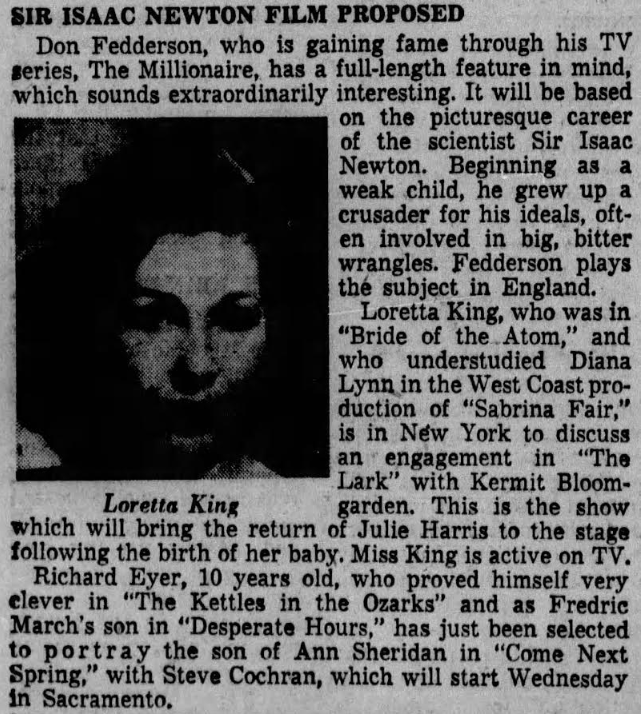
This next piece, which mentions Bride's leading lady Loretta King, was penned by Edwin Schallert and appeared in May 30, 1955 edition of The Los Angeles Times. You may remember that Schallert, father of actor William Schallert, had previously written about Glen or Glenda back in 1953. According to Schallert, King was "active on TV" at the time.
"Miss King is active on TV."
Like Edwin Schallert,Aline Mosby had also written about Glen or Glenda back in 1953. In fact, Mosby wrote numerous articles through the years featuring various friends, associates, and collaborators of Edward D. Wood, Jr. Her syndicated article here, clipped from the April 25, 1955 edition of The El Paso Herald Post, is especially sad and poignant in its depiction of Bela Lugosi in his twilight years. The article paints the actor as a pathetic figure, dependent upon the charity of friends. The "cruel satire" Mosby mentions was The Bela Lugosi Revue at The Silver Slipperin Las Vegas the previous spring.
"A quiet, gentle man who got into horror movies by mistake."
One last clipping to share with you, this one from the May 11, 1955 edition of The Los Angeles Times. It, too, describes the Bride of the Atom premiere and the subsequent Bela Lugosi benefit. The article name checks both Ed Wood and Tony McCoy, as well as Paul Marco and Dolores Fuller. It's also interesting to note Vampira's presence at the benefit showing, making this yet another entry on the timeline of Ed's association with the horror hostess.
"Vampira, escorted by Paul Marco."
EPILOGUE: Bela Lugosi died on August 16, 1956, not even a year and a half after this benefit in his honor. He was 73. The former site of the Gardens restaurant at 4311 Magnolia Ave. in Burbank is currently occupied by an establishment called Joe's Great American Bar & Grill. The Paramount Theatre, originally constructed in 1923, was closed in 1960 and demolished in 1961. At its former location at the intersection of 6th St. and Hill in Los Angeles, you'll now find a wholesale jewelry building constructed in the late 1970s.
The site of the Bela Lugosi benefit is now Joe's Great American Bar & Grill in Burbank, CA.
Some alternate cover art for Hollis James' novel, Ed Wood: Taxi Driver.
Editor's Note:This is the third installment in Greg's series about his personal connection to the work of Edward D. Wood, Jr. You can read the previous installments hereand here. J.B.
Chosen Paths, Part I
It occurred to me over the course of this last weekend that Ed Wood is all around me, whether I'm actively pursuing him or not. While it's true, ontologically, that Ed was all around me (and all of us) all along, it's clear that somewhere I suffered a cubisticshift in thinking.
In this week's Ed Wood Wednesdays, we'll begin to look at the result of this shift, as I adjust to seeing a world of Wood with fresh eyes.
On Saturday afternoon, Kitten, E.B., and I went out. I got my hair cut. We ate at Friday's. We went grocery shopping. Through the afternoon, I worked on hanging a large mirror above the couch in the living room. I had just finally subscribed to Amazon Prime a few nights prior, so I flicked on the TV while I was working. Somehow I arrived on Gangs of New York, it still remaining one of a few of Martin Scorsese's films that I had not yet seen. I turned that on in the background while I was working on the mirror.
Daniel Day Lewis in Martin Scorsese's Gangs of New York.
For context, Taxi Driver is one of my favorite films, and I consider Scorsese one of the great artists of our time. Taxi Driver has evoked Ed, specifically Glen or Glenda?, for others. The originator of Ed Wood Wednesdays, Joe Blevins, visually tied together the shared themes on a private Wood forum. Urban alienation. The albatross of "normal." Hollis James's novel Ed Wood: Taxi Driver or Plan 9 from Mau Mau Land likewise conflates the two films.
(left to right) Glen or Glenda?; a Taxi Driver poster; the cover of Hollis James' novel.
Gangs of New York grabbed my attention, despite myriad flaws, evoking A Clockwork Orange and The Warriors. Daniel Day Lewis is riveting, even quoting Travis Bickle in Taxi Driver when he self-identifies as, "God's Lonely Man."
As evening dawned, Kitten's friend Casey came over. She rescues dogs, the source of our beloved Nelby. Kitten's work husband Mark and his wife Jen adopted Lily that night, a new sister for Lucy. I was, by that time, watching Maila and Me, an affecting documentary about the person behindVampira that I'd seen numerous times before.
Mark and Jen holding Lucy and Lily.
Fifteen minutes before the end, Kitten came home. We hung the mirror on the hardware I had executed. It was crooked.
Martin Landau begs to differ with Bobby Slayton in this moment from Ed Wood.
INTRODUCTION: Before I head out for the Christmas holiday, I thought I'd share a previously unpublished Ed Wood article I had sitting in my "Drafts" folder. I was inspired by Greg Dziawer's article, "The Wood Halloween Odyssey," to share my own thoughts about Bela Lugosi's June 1954 appearance on The Red Skelton Show alongside fellow horror icons Vampira and Lon Chaney, Jr. The episode in question is a fascinating cultural artifact in a number of ways, and I wanted to write about it. Please enjoy and have a safe and happy holiday. J.B.
The published screenplay.
When Larry Karaszewski and Scott Alexander were writing the screenplay for the 1994 biopic Ed Wood, they rifled through Rudolph Grey's 1992 patchwork biography Nightmare of Ecstasy: The Life and Art of Edward D. Wood, Jr. looking for weird details and crazy anecdotes they could use. One passage chosen by the duo appears on page 103 of Grey's book in a chapter called "The Wood Spooks." Here, through new and archival quotes, Maila "Vampira" Nurmi, actor John Andrews, and Ed Wood himself give their thoughts on the time Bela Lugosi guest starred on CBS' long-running comedy series The Red Skelton Show in 1954, allegedly with Ed Wood in tow as his personal dialogue coach.
At that point in history, Skelton had only been with the so-called "Tiffany Network" a single season. A popular radio comedian turned TV star, he'd done two years on NBC before changing networks in 1953, and his show was not yet the ratings powerhouse it would soon be for CBS until its controversial cancellation in 1970. (For its last season, The Red Skelton Show briefly moved back to NBC, finally expiring for good in 1971.) The episode with Lugosi, "Dial 'B' For Brush," occurred as Skelton was in the process of rebuilding his TV brand. Skelton's show was not a Top 30 hit in 1954. In the broadcast, likening himself to a little boat caught in a storm, Skelton elaborately thanks CBS and his chief sponsor, Geritol, for their faith in him.
For Nurmi, this Red Skelton gig occurred during the year-long period when she hosted a celebrated horror show as her Vampira character on Los Angeles television. She showed some of Lugosi's movies on that iconic, now mostly-lost series. But Red Skelton was the first time she actually worked with the legendary Lugosi in the flesh. She'd long since forgotten the script by the time she talked to Rudolph Grey decades later, but she recalled being in "the kind of mausoleum they have where the caskets roll in and out of the wall." She described Lugosi as being an "elegant" and "genteel" man who mostly "stayed in his dressing room alone." The actor clearly made a strong impression on the nascent horror hostess. "He made me feel like a noblewoman," Nurmi enthused. "And here I was, this Hollywood tramp."
It was the contention of actor John Andrews (the werewolf from Orgy of the Dead) that Ed Wood assisted Bela Lugosi on The Red Skelton Show at Lugosi's insistence. "Eddie, they don't know how to write for me. You write. You write," Lugosi is claimed to have said at the time. But Ed himself didn't claim to have written the show.
Ed Wood merely says the following: "I was Lugosi's dialogue consultant. There were certain words which had to be changed because he couldn't form them properly." That's it. A rather modest boast, if it can even be called such.
In the book Bride of the Monster: Scripts from the Crypt by Gary Rhodes and Tom Weaver, this is cited as yet another example of delusional, grandstanding Eddie trying to insert himself into the Lugosi legend where he didn't belong. The skeptical authors won't even acknowledge that Eddie was involved with the show at all. It's important to note that Rhodes and Weaver merely offer their interpretation of the events. But if Wood were trying to make up a tall tale to enhance his own career, couldn't he have done better than saying he was a dialogue consultant on a show that wasn't even that big a hit at the time? One senses that Rhodes and Weaver are overcompensating for the hagiography and hero worship of Ed Wood by consistently portraying Ed as a self-promoting, opportunistic hack.
Comedian Bobby Slayton
Anyway, the story of Ed assisting Bela on The Red Skelton Show—even if apocryphal— must have been convincing enough for Karaszewski and Alexander, because a version of the anecdote makes it into Ed Wood. About a third of the way into Tim Burton's film, Eddie (Johnny Depp) is cold calling potential producers and investors for Bride of the Monster (at that point still called Bride of the Atom), when one respondent asks whether Bela is "available Friday night." Cut to a busy TV studio, where a nervous Bela (Martin Landau) is going over his script with Eddie. The idea that Ed somehow "got" Bela the TV gig is purely an invention of the screenplay. None of the participants, including Eddie, ever made that claim.
Possibly for legal reasons, no direct mention of Red Skelton or The Red Skelton Show is made in Ed Wood. The program Bela is working on is simply "a 1950s variety show" and its brash, gravel-voiced star (Bobby Slayton) is merely identified in the script as "the show host, a cheesy comedian." In reality, Red Skelton was a straight-ahead comedy series consisting of a monologue and some sketches. But here, it's a full-fledged variety showcase, closer to what Ed Sullivan was doing on Toast of the Town on Sunday nights. There are showgirls backstage, and Criswell (Jeffrey Jones) appears on the show to give his incredible, inaccurate predictions about how man will have colonized Mars by 1970.
It is unlikely that Alexander and Karaszewski had seen any footage from the real Red Skelton broadcast from 1954, so -- as with their parallel universe version of Ed's play The Casual Company -- they simply imagined what the vintage broadcast would have been like. In some respects, they weren't too far off the mark, and in others, they were wildly wrong. In their script, the cranky, impatient host appears as "his 'Slick' character, a befuddled moron in a funny hat" in a silly, vaudeville-style sketch opposite Bela Lugosi as "the Count." A sexy female announcer describes the premise to the audience: "And now we take you to a castle in Transylvania. Watch out. The landlord's a real pain in the neck."
In full, the host's character is referred to as "Slick Slomopavitz, seeker of adventure," and he seems to have wandered into Dracula's castle in search of shelter, rousing the centuries-old vampire from his coffin in the process. The idea is for Slick and Lugosi to trade scripted quips, reading from cue cards, but the comedian decides to improvise gags during a live broadcast, and the elderly Lugosi is confused and disoriented. The sketch is cut short, and the furious host storms off, complaining that "we should've got Karloff." Lugosi has thus been humiliated on national television, and it's now Eddie's job to pick him back up again.
It's true that live TV shows in the 1950s were prone to gaffes and unexpected happenings. Sets could topple over. Actors could flub their lines. Complete strangers could wander onto the set. The Lugosi character in Ed Wood is not wrong when he says that "this live television is madness." But it's very unlikely that a professional comedian with his own network show would start improvising brand new lines during an already-in-progress scene with a non-comic who is working from cue cards. It's Slick, not Bela, who would be called on the carpet for this. The surviving footage of the genuine broadcast reveals that nothing remotely like this happened on The Red Skelton Show in 1954. The show went according to schedule, and Lugosi was active and engaged throughout. He really throws himself into the comedy, even singing and dancing a little when necessary.
Red Skelton in character.
And that brings us to the television program itself. The Red Skelton Show is such a product of its time that it may not translate all that gracefully into ours.
The same isn't necessarily true of Skelton's comedic contemporaries of the 1950s. Through numerous series and specials, Sid Caesar set a sketch comedy template that Saturday Night Live would later follow, while giving the next generation of humorists, including Mel Brooks, Larry Gelbart, Neil Simon, and Woody Allen, their start in showbiz. Jackie Gleason's The Honeymooners is still being aped by sitcoms today, while Lucille Ball's I Love Lucy has never left the air in over half a century. Their work isn't as ubiquitous these days, but Jack Benny and Phil Silvers created onscreen personas that still resonate in scattered reruns and YouTube clips. Today's comics may not be directly influenced by Benny and Silvers, but it's still possible to detect elements of their personalities in their work. Ernie Kovacs, too, is still cited as a pioneer, maybe the first comedian who truly understood what made TV different from other media.
But Richard "Red" Skelton is something else: a holdover from a vanished, now almost forgotten era in American entertainment. Television itself was a relatively young medium in Red's day, and its vaudeville roots were in plain sight back then. A veteran of vaudeville (as well as the medicine show and burlesque circuits), Skelton specialized in comedy that was broadly silly, brazenly obvious, and often shamelessly sentimental, verging on bathetic. Slapstick and pantomime were key to his appeal, as was his folksy, friendly manner. Viewers could sense his warmth and sincerity coming through the cathode ray tubes, and they tuned in every week for more.
In a way, it's extremely bizarre casting that aggressive, motormouthed Bobby Slayton, the so-called "Pitbull of Comedy," should essentially stand in for Red Skelton in Ed Wood. These two performers' styles were vastly different. Skelton's classic character, Clem Kadiddlehopper, does have a few things in common with Slick Slomopavitz, including a low IQ and a goofy, ill-fitting costume.
Modern viewers might dismiss The Red Skelton Show as corny and old-fashioned, and they wouldn't be wrong. The host preferred the more gentle label "clown" to "comedian," and he even made a second career out of his cloying clown paintings. Other than being a relatively early adopter to the television medium, Skelton was not really an innovator. He was more of a traditionalist. That extended to his ultra-conservative political views as well. When he was abruptly ousted from CBS in 1970, after years of Top 10 ratings, Skelton blamed the encroachment of the hippie counterculture. Today, the routine for which Skelton is arguably best known, a word-by-word annotation of the Pledge of Allegiance, has virtually no comedy in it. It is simply a statement of unswerving patriotism.
It was Skelton himself who largely kept his own reruns off the air in the 1970s and beyond. He was embittered over the cancellation of The Red Skelton Show and never got over it. So the series did not become a staple of syndication the way I Love Lucy and The Honeymooners did. As a result, several generations grew up without Red as a cultural touchstone. Skelton died in 1997, and there have been various repackages of his vintage shows since then, marketed mostly to people who remember watching the comedian decades ago.
(left) Red Buttons; (right) Red Skelton
Do people even know who Red Skelton is anymore, apart from the "Pledge of Allegiance" routine? I was just listening to an episode of The Best Show With Tom Scharpling this week, and the host spent a good five minutes, maybe 10, absolutely lacerating Skelton as a one-joke hack from the bad old days of show business. "Do you know Red Skelton? He was a comedian... and he sucked." But the person Scharpling was describing (and unkindly imitating) was clearly Red Buttons. It was Buttons who did the "never got a dinner" routine, not Skelton. Really, Buttons and Skelton were not much alike stylistically. But they had similar stage names, looked somewhat alike, and worked at about the same time, so they might as well have been the same guy. That's how cruel time can be. And it gets worse: Scharpling claimed Skelton was in The Star Wars Holiday Special. He wasn't. That was Art Carney. So now, Carney, Buttons, and Skelton have all been folded into one person. Kinda sad.
This time, we can make Ed Wood: The Musical a reality!
Back in 2014,I was only too happy to tell you about Rick Tell'sEd Wood: The Musical, a catchy and imaginative stage show detailing the incredible life and bizarre career of Edward Davis Wood, Jr. Packed with memorable songs and bizarre yet compelling characters, Rick's wonderful play has the potential to be another cult musical hit, like Little Shop Of Horrors or Repo! The Genetic Opera. To paraphrase Homer Simpson, it could be bigger than curly fries! All it needs is a little startup money to get off the ground.
Well, today, on what would have been Ed Wood's 92nd birthday, Rick Tell is launchinga brand new Indiegogo campaign for Ed Wood: The Musical. The flexible goal is to raise $50,000 in the next month. This will help mount a proper production of the show, complete with a full cast and all the sets and props mentioned in Rick's imaginative script, e.g. a giant, throbbing brain, plus plenty of plastic flying saucers and plywood graves. Rick brings his case to the public in this entertaining campaign video, also featuring the show's director, Michael Arabian. If you're new to Ed Wood: The Musical, you'll finally get to hear some excerpts of the best songs from the score.
This is the best opportunity yet to make Ed Wood: The Musical a reality. Full details about the campaign, including rewards for various levels of support, can be found right here. There can be no more fitting tribute to the legacy of Ed Wood.
Let's make it happen, America! As Rick puts it, "Pull the string!"
Vampira and Dr. Tom Mason in the intro for WPIX's legendary Chiller Theatre.
If you don't mind, I'd like to share with you some Ed Wood-related TV treasures from the early 1960s. The first dates back to 1965 -- a half-century ago.
While Eddie was toiling on Orgy of the Dead, clips of his 1959 epic Plan 9 from Outer Space featuring Vampira and Dr. Tom Mason were being used in the opening montage of the legendary Chiller Theatre on New York's Channel 11 WPIX, an independent station, along with snippets from The Cyclops and Attack of the 50 Foot Woman. WPIX had been running horror movies under the Chiller Theatre banner since 1961, but the Wood-centric opening did not turn up until 1965, coinciding with the departure of host Zacherly "The Cool Ghoul."
WPIX had a strong signal and was well-known in those days to viewers throughout the so-called "tri-state area," encompassing New York, New Jersey, and Connecticut. It is conceivable, then, that Chiller Theater had a major impact on the baby boomers who grew up in that area of the country, introducing them to the joys and terrors of horror films. The Saturday night show might have scarred some kids for life.
One such victim/beneficiary was New Jersey-born writer Rob Craig, who grew up to be the author of the exhaustive study Ed Wood, Mad Genius: A Critical Look at the Films. In an extensive interview included in the newly-published The Cinematic Misadventures of Ed Wood, Craig talks at great length about the Chiller Theatre intro and the impact it had on his life. He began watching the WPIX show when he was eight years old and became entranced with it. "Like any self-respecting baby boomer," he said, "I was completely enamored of monster movies." The Chiller Theatre intro became such an object of fascination for Craig that, fifty years later, he could easily rattle off all the movies quoted within it.
But one particular excerpt stood out among the rest, as Craig explained to the Cinematic Misadventures authors:
"However, the one clip which really resonated with me -- and which I would not identify for many years -- was a very strange scene showing a sexy young woman with a tight black dress, long black hair, heavy makeup, and long dark fingernails. This sexy/creepy monster woman was walking towards the camera in a menacing way, with a deranged grimace on her face. Now, to an eight-year-old monster movie buff -- it may sound funny to say now -- but I found that clip extremely creepy. The woman's grimace indicated some sort of madness or evil which really unnerved me. It was an interesting combination, I think, of sex and horror."
You can probably guess the rest of the story: Rob Craig finally saw Plan 9 from Outer Space years later and had an epiphany when he finally recognized the mystery woman who had been haunting his dreams since childhood. Watching the intro, which was retired in the late 1960s, I can definitely see why the WPIX show affected Craig so strongly. The Plan 9 clips are right at the beginning of the montage -- unmissable, unmistakable.
Removed from its original context, the footage is genuinely unsettling and provocative all at once. It's darker and grainier than the current DVD version, which makes it a little more sinister. Furthermore, WPIX has added its own bombastic library music to the montage, underlining the sense of dread. Perhaps most importantly, the Plan 9 footage only lasts three seconds. A shot of Vampira standing still in the graveyard. A shot of Tom Mason standing still in (apparently) the same graveyard. Then back to Vampira, who approaches the camera with her arms out in front, as if she's reaching for the viewer directly through the TV screen. There's no time to process any of this. It's almost subliminal. Did I just see that?
Here, more so than in the full-length movie, the ersatz Dracula is as scary as the real thing. It really helps when you don't get a good look at him. And Vampira is sex and death made flesh, Eros and Thanatos in one body. The viewer is simultaneously attracted and repelled. I want to fuck her! She's going to kill me! So many conflicting thoughts, so little time.
Ed Wood's favorite show?
The second clip for today is the intro from a very obscure, extremely short-lived sitcom called Oh! Those Bells, which ran on CBS from March 8, 1962 to May 31, 1962. According to The Complete Directory of Prime Time Network TV Shows 1946-Present by Tim Brooks and Earle Marsh: "This series was a loosely structured attempt to bring contemporary slapstick humor to television. The Wiere Brothers, an internationally known trio of slapstick comedians, portrayed the last living members of a family with a long history as theatrical prop, costume, and wig makers."
Veterans of the vaudeville circuit, the three Weire boys -- Herbie, Harry, and Sylvester, all born in Germany and Austria-Hungary in the early 1900s -- had a long-running, free-wheeling comedy and music act which kept them afloat for decades in show business. The Pathe newsreel cameras captured their onstage antics a few times in the 1930s in films which still exist today. The boys started appearing in feature films in the late 1940s, working with stars as diverse as Roy Rogers and Bob Hope, before moving into television in the 1950s and 1960s, where they turned up on The Merv Griffin Show and Rowan & Martin's Laugh-In. The anarchic act came to an abrupt, sad end with the death of the youngest brother, Sylvester, at the age of 60 in 1970. Perennial guest stars, the Weire Brothers were perhaps too aggressively madcap to be the main attraction in any TV series or film. Oh! Those Bells was their one big shot at stardom, and it lasted a mere thirteen low-rated weeks.
The show's creator, Jules White, was famous for having directed dozens of Three Stooges shorts at Columbia. I guess he thought he'd try his luck with another knockabout trio. Eh, they can't all be winners. Oh! Those Bells, in fact, did garner comparisons to the Stooges, some positive and some negative. Brooks and Marsh again: "When things started to go wrong, their world looked like it had been taken over by The Three Stooges in their prime" But in their book Harry and Wally's Favorite TV Shows, critics Harry Castleman and Walter J. Podrazik declare: "Oh! Those Bells shows that slapstick died for a reason: It comes across as awfully stupid on TV. Watch an old Three Stooges short instead." Ouch.
Unsuccessful as it may have been, Oh! Those Bells did have at least one major fan: Edward Davis Wood, Jr., as always the patron saint of show business underdogs. Eddie would have needed all the laughs he could get by 1962. That was one of his relatively fallow periods. His last theatrically-released motion picture, The Sinister Urge, had been in the can for two years by then. His most recent directorial efforts were the top-secret industrial films he made for Autonetics Aviation. His screenwriting gigs on Shotgun Wedding and Orgy of the Dead were still in the future, as was his backup career has an author of cheap paperbacks. I can just imagine poor Ed in 1962, sitting in front of the TV and waiting in vain for the phone to ring... if he even had a phone. Oh! Those Bells must have struck Ed's fancy, because he wrote about it affectionately in Hollywood Rat Race, circa 1965. A chapter boldly titled "Sex -- Hollywood and You" begins with these words:
"What makes an actor or actress? I can't define the magic of acting with any facts or logic. I do know, as do most of you, that if something happens on the screen that I like, then I like it, if it's an actor or actress, then I like him or her. (I liked the television series The Bell Brothers starring the Bell Brothers, but it seemed few others liked it -- the ratings shooed them off the air. Does that make them any less talented as actors? I wouldn't think so, their nightclub dates are at an all-time high.)"
Eddie, though well-meaning, has his facts slightly scrambled. The show was actually called Oh! Those Bells, not The Bell Brothers. The real-life Wiere Brothers portrayed the fictional Bell Brothers on the show. It is true, however, that the Wieres remained a popular live attraction throughout the 1960s, even if they weren't able to translate that popularity to steady TV success.
But now, dear readers, pretend that you are Ed Wood in the spring of 1962. It's Thursday night, you've just done an uncredited script polish on Married Too Young, and it's time to kick back and watch the ol' tube, most likely with a glass of Imperial Whiskey in your hand. You tune to KNXT Channel 2 (the CBS affiliate in Los Angeles at the time), adjust the rabbit ears, give the cabinet a few whacks for luck, and wait for your favorite new show to flicker into view. And here is what awaits you:
Ed Wood's affection for Oh! Those Bells is instructive to the aspiring Wood-ologist. A person's television-viewing habits say a lot about him. You are what you watch. As an experienced stage actor and playwright, Ed likely would have appreciated Bells' theatrical setting. And the focus on wigs, costumes, and props would have been a selling point, too. (Wood rhapsodizes over these things in his short story "Final Curtain.")
But more importantly, this little biographical detail gives you an idea of what Ed found funny. From the antics of Paul Marco's bumbling Kelton the Cop in Wood's '50s films to the Bazooka Joe-worthy groaners in One Million AC/DC, it's clear that Ed Wood had a taste for low comedy. He liked his jokes corny, obvious, and old-fashioned. No wonder the Wiere Brothers suited him to a T. This is a sticking point for some viewers. Both Ed Wood, Mad Genius and The Cinematic Misadventures of Ed Wood gripe about Eddie's attempts at cornball comedy. I don't mind it, personally. I even find it kind of sweet, because it attests to Eddie's inner sincerity and naivete.
Since that Oh! Those Bells intro up there is rather brief, I thought I'd include the following clip to show you more of the Wieres' vaunted nightclub routine. Here, then, are the Wiere Brothers performing in the late 1960s on a Jerry Lewis TV special. A very tan, tuxedo-clad Jerry describes them as "three men who follow in the great tradition of the Marx Brothers, the Ritz Brothers, and the Smith Brothers." Lewis obviously had some lingering respect for the Wieres, because he cast middle brother Herbie Wiere in his film Cracking Up in 1983. That was the last major public appearance of any of the Weire Brothers. Sylvester, of course, was long gone by then. The eldest of the trio, Harry, died in 1992. Herbie followed in 1999. And that, as they say, was that.