Wednesday, August 15, 2018

Ed Wood Wednesdays: The Wood Promo Odyssey, Part Four by Greg Dziawer

Ed Wood in the early 1970s, around the time of The Only House in Town.

On DVD at last!
The low-budget softcore sex film The Only House in Town—generally thought to have been written and directed by Edward D. Wood, Jr.—remained something of a holy grail to his fans until it was released on DVD by Films Around the World in late 2015. Prior to that bare-bones disc, the film had been surreptitiously seen by a handful of hardcore Woodologists, thanks to a shoddy, time-coded bootleg copy that had been passed around for years.

After a nearly decade-long dry spell as a filmmaker, Ed Wood made his return to the director's chair in January 1970 for the sex comedy Take It Out in Trade. Along with NecromaniaThe Only House in Town was made in the aftermath of that unlikely comeback. Shot in mere days on 16mm, it is a freewheeling (read: all but totally lacking post-production) and nearly plotless feature financed by Noel Bloom's production company Cinema Classics. Noel's father, Pendulum Publishers honcho Bernie Bloom, was a patriarchal figure in Eddie's orbit at the time as well as his steadiest employer. In addition to its theatrical engagements, starting in 1971, The Only House in Town was chopped into pieces to make some 8mm home-market loops, which in turn were advertised in Pendulum's adult magazines

As it turned out, 1971 was a pivotal year in the evolution of the sex film as a mass cultural object. The Only House in Town played a near-invisible part in that story, though Ed's involvement would go unmentioned. His name is nowhere to be found in the credits, and his connection to the film was not widely reported until Rudolph Grey's biography Nightmare of Ecstasy in 1992.

Below are three Only House in Town ads from 1971. The first is from the July 23 edition of The Courier-Journal (Louisville, KY). The second is from the February 6 edition of The Journal Herald (Dayton, OH). And the third is from the August 18 edition of The Journal Times (Racine, WI).

Three ads for The Only House in Town from 1971.

And here's an ad from the September 4, 1971 edition of The Detroit Free Press (Detroit, MI). Looks like the movie was getting five screenings a day at the Globe Art Theatre.

"The very best in adult films."

This ad from the April 15, 1971 edition of The Amarillo Globe Times (Amarillo, TX) is interesting because The Only House in Town is paired with a film whose title is so scandalous it cannot even be printed. It also looks like the movie played at several locations in the Mini Vue Adult Cinema chain.

"A Most Unusual Kind of House."

This one comes to us from the February 25, 1972 edition of The Atlanta Constitution (Atlanta, GA). The New Glen Art was actually in nearby Decatur. Not a trace remains of it today. It's all dry cleaners and strip malls in this area now.

Compared to 8mm films, 16mm films were a luxury.

Securing playdates across America well into 1972 and beyond, The Only House in Town was but one of hundreds—perhaps thousands—of sex films in theaters at that time. As these vintage newspaper clippings attest, it largely occupied the bottom half of double bills, paired with films that are now forgotten. It, too, would likely be forgotten today if not for Ed's purported involvement. With its quasi-hippie characters, it paired well with films like Fred Baker's Events (1970) that attempted to capture the then-current zeitgeist of sexual permissiveness and open mindedness. The following ad appeared in the April 9, 1971 edition of The Albuquerque Journal (Albuquerque, NM). This is another Mini Vue location.

Balling it up in Albuquerque. I've heard it's strictly a 9:00 town.

The intersections between Baker and Wood are another matter for another day. (Hint: they involve both Lenny Bruce and Martha Graham!) Meanwhile, The Only House in Town maintained a steady drip of theatrical bookings between 1971 and 1973. The film's relative ubiquity is somewhat surprising. It's not difficult to imagine an extremely modest movie like this disappearing, little-seen, into the ether. The film's original marketing campaign was low-key but prolific. The existing newspaper ads display only the most basic promotional ballyhoo ("It's very, very wild"), but they do attest to the fact that this film was indeed playing in theaters across the country.

Here's another ad, this time from the March 14, 1971 edition of The Santa Fe New Mexican Sun (Santa Fe, NM).

Don't worry about Karen. She's much better now.

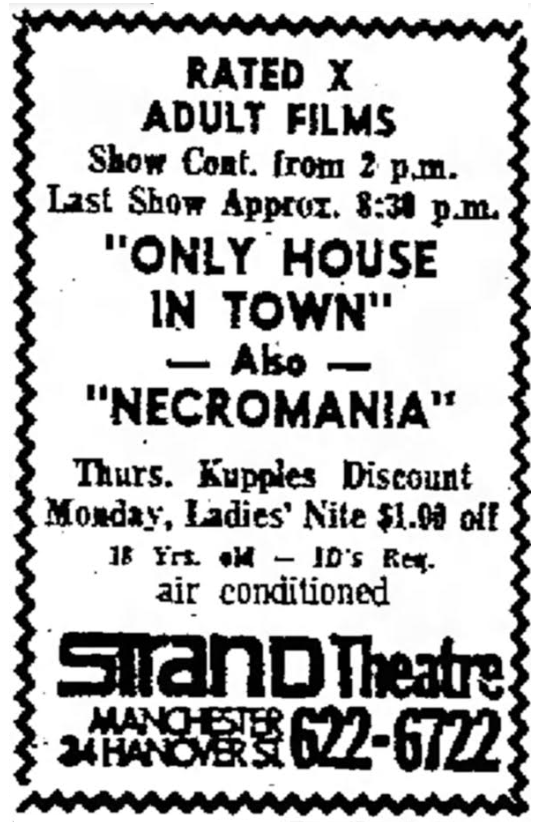
In fact, The Only House in Town kept getting theatrical showings on a regular basis right into the summer of 1973. Incredibly, in mid-June of that year, it played on a double bill with Necromania at the now-demolished Strand Theatre in Manchester, New Hampshire. Here's a clipping from the June 14, 1973 edition of The Nashua Telegraph.

A dollar off on Mondays, ladies.

By that time, thanks to the success of films like Deep Throat and Behind the Green Door, hardcore features had rapidly gained a foothold in the marketplace. We know that both Necromania and Take It Out in Trade existed in both softcore and hardcore versions. Furthermore, the AWOL, Wood-scripted Operation Redlight (1969) was shot softcore, but a crew member told the film's cinematographer/co-producer Jack Descent that he saw that film with hardcore inserts circa 1972.

It makes me wonder. Could The Only House in Town also have hardcore inserts?

Wednesday, August 1, 2018

Ed Wood Wednesdays: The Plan 9 Odyssey, Part Three by Greg Dziawer

If you can remember when computers looked liked this, maybe you played the Plan 9 video game.

Plan 9's unsuccessful video game
In 1992, the release of Rudolph Grey's seminal biography Nightmare of Ecstasy: The Life and Art of Edward D. Wood, Jr. ushered in a new era of recognition for filmmaker and author Ed Wood. More than a decade after The Golden Turkey Awards, Ed's reputation was finally taking a step beyond the reductive "worst director of all time" moniker that had, until then, shaped his limited public myth. 

When Grey's book inspired the 1994 Disney-produced biopic Ed Wood, with Hollywood superstar Johnny Depp in the title role, Eddie's posthumous renown doubtless reached its pinnacle. Sixteen years after his tragic, untimely passing, Ed Wood had finally become an object of mass pop culture interest.

Timing, they say, is everything. In late 1992, during the interim between the book and the film, a bizarre video game based upon Eddie's best-known "worst" film, Plan 9 From Outer Space, reached the market. Much like the movie that had inspired it, the game was largely panned by critics. In the pages of Computer Gaming World, for instance, writer Charles Ardai declared that the game "attains a degree of cheapness that even the movie didn't reach, which is quite an accomplishment." Ardai, who went on to co-found the internet service provider Juno, was an avowed non-fan of Wood's original film as well, calling it "pitiful and headache-inducing."

Developed by a now-defunct British software company called Gremlin Graphics and published by Konami—yes, the company behind Contra, Castlevania, Frogger, Metal Gear, Dance Dance Revolution, and much more—Plan 9 from Outer Space is a satirical, fourth-wall-breaking, point-and-click game. Not my cup of tea, honestly. 

A typical screenshot from the Plan 9 game.
For the record, the player assumes the role of a detective hired by a gruff, cigar-chomping producer who looks exactly like Tor Johnson but does not act or talk like him. Other Tor lookalikes populate this world, and there are cameos by Bela Lugosi and Vampira, too. 

The goal is to search through 70 various locations in Hollywood, including bars and cemeteries, and find all six reels of Plan 9 from Outer Space. Apparently, these reels have been purloined by Bela Lugosi's embittered stand-in, who wants to insert more footage of himself into Plan 9 and even colorize the entire movie! (Incidentally, a colorized Plan 9 is now widely available on DVD and BluRay from Legend Films.) As in other point-and-click games, there's not a lot of visceral, blood-pumping action here. Instead, as you make your way through the game, you'll find clues, read onscreen text, collect items in your inventory, and interact with various hostile weirdos. A tombstone in the corner gives some standard options, including HIT, TALK, and OPEN.

One notable aspect of Gremlin's Plan 9 from Outer Space game is that it contains crudely digitized clips of Ed Wood's original film. In the primitive days before streaming video and cinema-quality cut scenes, this was something of a novelty.

Gremlin dug its own grave with this one.
Ultimately, Gremlin released its Plan 9 from Outer Space game across three platforms: the Commodore Amiga, the Atari ST, and MS-DOS for IBM personal computers. Unfortunately, two of these systems, the Amiga and the ST, were released in 1985 and were on their last legs by 1992.

On the plus side, the Atari and IBM editions of the game actually included a VHS copy of the movie! That was definitely a rarity. But even that didn't compensate for Plan 9's limited graphics, repetitive soundtrack, and unsatisfying gameplay.

Needless to say, Gremlin's Plan 9 from Outer Space fell through the cracks a quarter century ago and is only barely remembered today. The game is intentionally designed to be frustrating—Ardai complains of the "little creature" who steals items from the player's inventory—and I find it difficult to navigate. A review from the January 1993 edition of Electronic Games magazine provides some good tips for playing Plan 9... before panning the game!

Fans of Ed Wood, especially those who enjoy point-and-click games, will naturally be tempted to play Plan 9 despite its poor reputation. Luckily, you still can! Thanks to the Internet Archive, you can play it here online. Chances are, you'll get stuck before finding all six reels. If that happens but you want to see more—the game includes little knowing details and images from Wood's movie that must have been utterly baffling to the average gamer at the time—you can watch others play here, here, and here.

Enjoy! And God help us in the future!

Monday, July 30, 2018

The Rock & Roll Hall of Fame inducts itself into itself

The newest inductee to the Rock & Roll Hall of Fame: the Rock & Roll Hall of Fame

CLEVELAND - In a move that has been met with little surprise and less controversy, the Rock & Roll Hall of Fame has voted unanimously to induct itself into the Rock & Roll Hall of Fame as part of its new Places and Institutions category.

"From Chuck Berry to Nirvana, rock music has been shaped by legendary, innovative performers over the years," says Caroline Hansen, vice president of collections and curatorial affairs for the Cleveland museum, "but in the past we've also recognized the contributions of producers, executives and songwriters in our Non-Performers category. The next logical step was to create a category especially for the buildings and physical locations that truly shaped rock history."

Besides the Rock Hall, the inaugural class of inductees includes: Sun Studio in Memphis, where Elvis Presley, Jerry Lee Lewis, Carl Perkins and others recorded; Yasgur's Farm in Bethel, NY, home of the original Woodstock music festival; Liverpool's Cavern Club, where The Beatles got their start; the Altamont Motor Speedway in Tracy, CA; and the notorious Riot House hotel in West Hollywood.

Dedicated in 1995, the $65 million museum is by far the newest site on that list.

"This may seem incredibly self-serving, even galling, but we put a lot of thought into this," maintains Hansen. "After much debate, we all agreed that the Rock and Roll Hall of Fame, located at 1100 E. 9th St. in Cleveland and open from 10am to 5:30pm Sunday through Tuesday and 10am to 9pm Wednesday through Saturday, is worthy of being inducted into itself. By the way, did I mention that we currently have an entire exhibit dedicated to Neil Young's fringe-y leather jackets from the '70s? Some of them still smell like doob!"

Hansen further argues that the Rock Hall is more, not less, worthy of induction than other buildings. "This place was designed by I.M. Pei. Who designed Sun Studio? Exactly. Some jerk that nobody remembers."

The Rock Hall further announced its intention to create an Inanimate Objects category for such legendary items as the plaster cast of Jimi Hendrix's penis and the Led Zeppelin mudshark.

Wednesday, July 25, 2018

Ed Wood Wednesdays: The Wood Poughkeepsie Odyssey, Part Six by Greg Dziawer

The Sunshine Mountaineers were basically The Soggy Bottom Boys of Poughkeepsie, NY.

Early last year, in "The Wood Poughkeepsie Odyssey, Part Four," I attempted to give you an overview of The Sunshine Mountaineers, a band Edward D. Wood, Jr. played in—and purportedly founded—when he was a teenager. I surmised at the time, incorrectly it turns out, that the Mountaineers were a country-and-western group influenced by hillbilly mountain music. It seemed a logical assumption, since traditional hillbilly music was waning in popularity at the time while more modern C&W was on the rise. But nope. The Sunshine Mountaineers were, in fact, a jug-totin, fake-beard-wearin' hillbilly band, right down to their straw hats and red necks.

In researching The Sunshine Mountaineers further, I found a few press articles mentioning the group from the summer and early fall of 1940. Curiously, Eddie is nowhere to be found in these clippings, suggesting he had left the band by then.
   
Poughkeepsie Eagle-News (June 6): On June 5, the band played a testimonial dinner for Thomas Case, a retired post office engineer. Although the article lists dozens of names of those present, Eddie's father is not among them, although he was then himself a veteran of the Poughkeepsie Post Office, working as a custodian. 

Thomas Case hadn't had a bite in weeks, so they bit him.

Poughkeepsie Eagle-News (July 26): The Mountaineers posed, out of costume, for publicity pictures at radio station WKIP in Poughkeepsie. The accompanying caption noted that the band was then performing twice weekly on the station (Tuesday and Thursday nights at 8:15) and listed eight performers in the group, four boys and four girls, Eddie not among them. Two of the boys just happened to have the same surnames as gentlemen who had attended the Thomas Case testimonial dinner the month prior. So it would seem that the men of the Poughkeepsie post office had spawned a hillbilly band.

On the radio, whoa oh oh. On the radio.

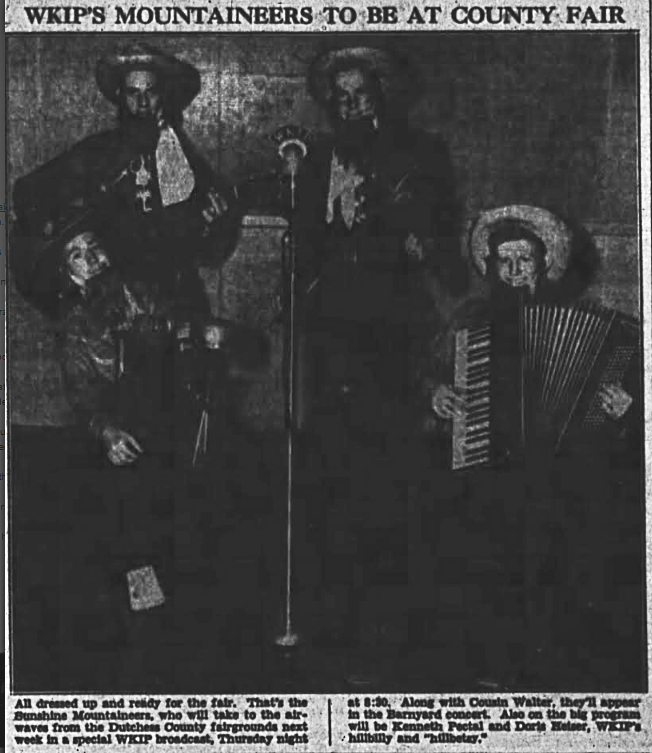
Poughkeepsie Eagle-News (August 26): The paper printed on this day a quintessential snapshot of the fully costumed Mountaineers, promoting their upcoming appearance at the Dutchess County Fair. They appear to be just a quartet of teen boys playing dress up. No names are mentioned, and it looks like mostly the same boys as in the July 26 photo, but the young man in the back on the right has a slight resemblance to Eddie. 

WKIP in Poughkeepsie. Sounds like a sitcom.

Poughkeepsie Eagle-News (August 28): This WKIP ad details the station's live broadcasts from the aforementioned country fair. The Sunshine Mountaineers were playing "every evening" at the fair, and the ad lists them first among the "special attractions." A good gig. President Franklin Roosevelt visited the fair that year, with the Crown Princess of Norway in tow. The fairgrounds were in Rhinebeck, north of Hyde Park. Featuring everything from livestock to sideshows and a baby contest, the Dutchess County Fair was a major annual event in the mid-Hudson Valley and received extensive coverage in the local papers. Note, too, WKIP's proud slogan: "Dutchess County's Only Radio Station."

Bethel, NY had Woodstock. Pougkeepsie had this.

Kingston Daily Freeman (September 19): The city of Kingston, NY lies west of the Hudson River and north of Marbletown, the community that was home to Ed Wood's paternal ancestors. An article in Kingston's local paper mentioned that The Sunshine Pioneers would be playing "songs that some of us remember" at a church musical. This gig must have seemed a comedown for the boys, after they'd already played on the radio and on a big stage at the county fair. Nevertheless, the Daily Freeman promoted the musical several times in the week leading up to the event. And the venue had some history of its own. The New Hurley Reformed Church was built nearly 200 years ago by Dutch settlers and is listed today on the National Register of Historic Places.

What do they do for fun in Kingston, NY? This.

Kingston Daily Freeman (October 2 1940): Thirteen days later, the Daily Freeman published an update on the church musical. Alas, our Sunshine Mountaineers missed the opportunity to perform in front of "a large crowd." The paper vaguely informs us the boys were "detained due to illness" and replaced by "a group of professional musicians."

Down with the sickness.

So what became of The Sunshine Mountaineers after this career setback? And where is Ed Wood in any of these articles? After all, the boys didn't just land a high-profile radio job and a coveted country fair gig only to disappear suddenly without a trace.

In future installments of this series, we'll learn what happened to The Sunshine Mountaineers before and after that heady summer of 1940. Join us!

Tuesday, July 24, 2018

Let's have fun with the funnies! Part Two: Into the Worth-iverse!

Mary Worth: Isn't she lovely? Isn't she wonderful?

There are comic strips I parody, and then there is Mary Worth. I am continually captivated by the saga of Ms. Worth, a sixty-something retiree who counsels the various misbegotten residents in her SoCal condo community of Charterstone. I do more Worth-related takeoffs than nearly all other comic strips combined, so I thought I'd gather some more recent ones into a post of their own.

Let's light this lavender-scented candle, huh?

Let's have fun with the funnies! Part One: The Random Stuff

This is your cultural legacy, America. Don't neglect it.

It's been a while since I've done a post like this. As you know if you follow this blog, I do a lot of parodies and remixes of newspaper comics. Occasionally, I like to collect these and post them here so I can delete them from my hard drive in good conscience. That's what this is: another collection of random junk headed for the incinerator.

Let's go.

Wednesday, July 18, 2018

Ed Wood Wednesdays: The Wood Ancestry Odyssey, Part Three by Greg Dziawer

Ed Wood's uncle Burton (not pictured here) was a dairy farmer until the 1940s.

A one-quart milk bottle
from Moon's Dairy (1950s)
Every now and then, I find myself delving so far into Ed Wood-related ephemera that I forget how I got there. At times like these, it's good to level-set and return to Poughkeepsie, New York, the city of Eddie's youth, where he grew up just a stone's throw east of the Hudson River. And from there we can travel back a generation to Ulster County across the Hudson and visit his father's large family.

I've been to the Hudson Valley before on these research jaunts, but this time I came across a figure who was utterly new to me: Burton Wood. Naturally, I wanted to learn more.

The list of Ed Wood's paternal aunts and uncles varies a bit, depending on the source. Burton is not included among them in the 1905 US Census, for instance, but he is buried at the Wood family plot in Fairview Cemetery in Stone Ridge, on the west side of the Hudson, 25 miles northwest of Poughkeepsie. 

It was in this general area—the farms and quarries of Ulster County—that Eddie's father and namesake grew up. Burton, his older sibling and Eddie's uncle, left his hometown in Ulster County sometime just after the turn of the century. Perhaps barely out his teens at the time, Burton traveled nearly 50 miles west toward more remote farmlands in Catskill. Here, he ran a dairy farm—Moon's Dairy, seemingly no longer in existence—for four decades.

Burton would return home to Poughkeepsie on occasion to visit his mother, but Eddie's uncle largely remains a mystery. He passed on February 3, 1946, at the age of 61. This obituary from the February 5, 1946 edition of The Poughkeepsie Journal matter of factly notes that he was "sitting at the dinner table" at the time. Note that Edward, Sr.'s involvement in the local VFW merits a mention here, too. Meanwhile, Ed, Jr. is dubiously listed as "Captain Edward Wood, United States Marines." The highest rank Eddie achieved while in the service was that of corporal.

Ed Wood's uncle buys the farm.

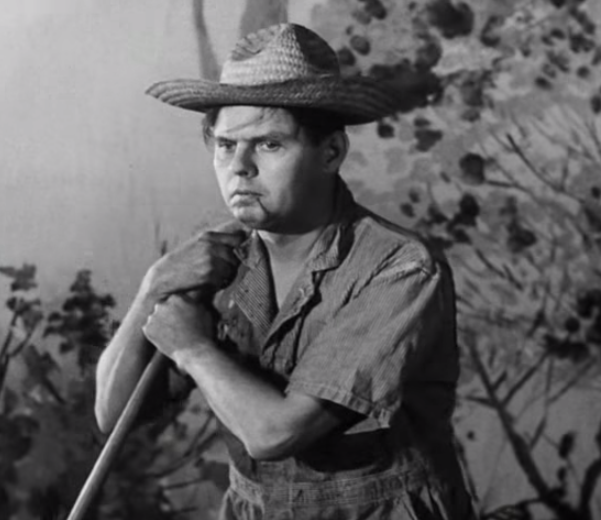
A judgmental farmer from Glen or Glenda
Edward Davis Wood, Jr., was just a little over three months from being discharged from the Marines when Burton died. What impact, if any, this dairy farmer uncle may have had on young Eddie remains unknown. When farm folk are depicted in Ed Wood's movies, it is usually as unsophisticated bumpkins. Think of Farmer Caulder (Karl Johnson), the man with the "spirits" on his breath, in Plan 9 from Outer Space. Then there's the straw-hatted rube in Glen or Glenda who worries that those newfangled automobiles will "scare the hosses."

Burton was preceded in death by his mother, Emily "Emma" Wood née Bunten, who passed in 1940. Emily married Eddie's grandfather Byron, who was also a farmer. And, as it turns out, she also had a half-brother named Edward Davis. 

Clearly it was this intriguing half-brother who inspired the first and middle names of Ed, Sr. and Jr. We'll visit him in a future installment of Ed Wood Wednesdays.

Wednesday, July 11, 2018

Ed Wood Wednesdays: The Wood Collaborator Odyssey, Part 12 by Greg Dziawer

These two explorers are looking for their mummy.

Before Glen or Glenda, there was Tomb Itmay Concern.
A certain degree of resourcefulness is a necessity for any exploitation filmmaker, especially one operating with the lowest of low budgets. As Edward D. Wood, Jr. embarked upon his directing career in the early 1950s, it was the cheapskate exploitation world that afforded him his first big opportunity to write, direct, and star in a feature film: Glen or Glenda (1953). Its producer, George Weiss, is legendary as a prolific filmmaker in this milieu. Exactly when he met Ed is unclear, although Dolores Fuller notes on page 66 in her autobiography A Fuller Life (2009, BearManor Media) that George was "an independent producer Eddie knew" prior to them collaborating on Glen or Glenda

Many of the interiors in Glen or Glenda were shot at Quality Studios, a tiny facility on Santa Monica Blvd. run by W. Merle Connell, who often acted as director and/or cinematographer on the hundreds of shorts and the passel of features shot there. Like Weiss, Connell was adept at shooting on a shoestring and began filming strippers in LA burlesque houses in the early '40s. He adopted the name Quality Pictures for what became a mail-order business in the latter half of that decade. Eventually opening his own studio, he would frequently partner with Weiss, a producer whose office was in the immediate vicinity at 5634 Santa Monica. Many of Weiss' Screen Classics Inc, films, beyond Glen or Glenda, were shot at Quality. Ed Wood shot Plan 9 from Outer Space at Quality a few years later, for instance. And Glen or Glenda's supposed insert scenes of burlesque strippers have since been attributed to Connell. 

The IMDb entries for both Weiss and Connell represent only a small percentage of their total output, with most of their films remaining unlisted. This week, we're documenting one such film, a charming 1950 burlesque short with the improbable title Tomb Itmay Concern. (And, yes, that's "itmay" with no space. It's intentional, as we'll soon see.) 

The film's setup could not be simpler. Two male archaeologists enter a sparse tomb—the sole set—where they use water to revive two sexy female mummies, neither of whom display any wrapping or signs of decay. The water, it seems, has been placed in the tomb specifically to tempt any visitors to bring these women back to life.

Waterboys: Don Mathers (left) and Little Jack Little explore a tomb.

Bela Lugosi and George Weiss on the Glenda set
For audiences in 1950, the plot of Tomb Itmay Concern must have been a reminder of the superstitions that had swirled ever since Lord Carnarvon, the first to enter King Tut's tomb in 1922, passed away due to a supposed "curse" placed upon him for having desecrated the crypt. In fact, in late 1949, the superstition was again at the fore, as another archaeologist had perished not long after entering an Egyptian tomb. Early the following year, the story of Carnarvon's death itself was resurrected, and it was determined that the man had died of normal, non-supernatural causes.

Just as with Glen or Glenda and its ties to the sensational Christine Jorgensen sex change saga, Tomb Itmay Concern had a story ripped from the headlines of the day. Viewers back then would doubtless have these "curse of the tomb" stories flitting around at least at the edges of their consciousness. 

The film's straight man, played by Don Mathers, explains that this is the tomb of Princess Itmay, revealing the title card to have been the film's first joke and not a gaffe. Tomb Itmay Concern, then, is a pun within a pun. "Tomb" being a play on "to whom." The same gag turns up in a 2006 episode of Tom and Jerry Tales and a 2017 short by Adam Taylor.

After quelling his partner's fears, Mathers exits the crypt to explore elsewhere. His sidekick, the "comic" relief, naturally can't resist reviving the girls. Once he does this, the diminutive explorer is no longer frightened, not even for a split second. This sidekick role is essayed by burlesque comedian Little Jack Little, who also appeared in Connell's final feature: a nudie cutie from 1960 called Not Tonight Henry. Mathers, too, appeared in this production.

Pinup queen Inez Claire
Having endured Little's lame jokes, audience members might have expected the proceedings in Tomb Itmay Concern to turn tragic, as in so many of Universal's Mummy movies. The Mummy's Hand (1940) even features a comedic duo (Dick Foran and Wallace Ford) not unlike Mathers and Little. Instead, viewers were surely pleasantly surprised to experience a sexy dance number by the mummified princess.

Itmay is played by Inez Claire, who had been stripping since at least 1944 and who maintained a lengthy and active career in burlesque. According to the credits, her servant is played by one Sally Starr, not to be confused with the 1930s film actress and cheesecake pinup or the 1950s cowgirl. This Sally Starr was a dark-haired stunner. Sadly, she doesn't dance in Tomb Itmay Concern, but she does use a banana as a prop in a joke that goes nowhere. Starr's skin color is also the subject of two of Jack Little's jokes, including the one that ends the movie!

The film, with Connell credited as both producer and director, is filed for copyright under Quality Pictures Co., not Screen Classics. The credits contain no mention of Weiss. But, also mentioned in her autobiography (page 67), Dolores Fuller notes that Weiss ran Quality Pictures. Incidentally, Tomb Itmay Concern runs exactly 10 minutes.

In future articles, I'll untangle the exact working relationship of Wood collaborators Weiss and Connell. I'll also delve into far more of their work that remains little-known to this day. Although we can't say whether Ed Wood was involved in any way in Tomb Itmay Concern—and I doubt he was and am not suggesting it—he was definitely approaching the orbit of Weiss and Connell at the time this short film was made. He may have been there already. Dolores Fuller mentions (page 66) that Eddie "kept abreast of developments" (no pun intended) in the world of low-budget Hollywood filmmakers at the time.

A final thought: The core idea of this short is the same in a nutshell as that for Orgy of the Dead (1965). That film even contains a mummy, albeit a more traditional one with wrappings. Could Tomb Itmay Concern have been a possible source of inspiration for Ed Wood? 

Tomb Itmay Concern is the final short on the jam-packed fifth volume of Something Weird Video's incredible Roadshow Shorts series. The volume contains more than its fair share of other material from Weiss and Connell, for those interested in exploring more of their work.