Showing posts with label death. Show all posts

Tuesday, September 30, 2025

My Month of Bowie, day 30: 'Toy' (2021)

Being dead didn't stop David Bowie from releasing one more studio album.

The album: Toy (ISO, 2021)
The baby who sold the world.

My thoughts: Until now, I have stubbornly resisted talking about Toy, an album David Bowie recorded in 2000 that was shelved by his label and remained unreleased until 2021, five years after the singer's death. For one thing, a posthumously-released LP seems to fall into the dreaded "apocrypha and miscellanea" category that I pledged to avoid at the beginning of the month. (Not part of the canon? Not interested.) Secondly, I knew that Toy mostly consisted of remakes of songs David Bowie had originally written in the 1960s. Unless we're talking about last night's pizza, leftovers aren't usually too appetizing to me.

But I changed my mind for a couple of reasons. First, when I wrote my defense of Bowie's under-loved Pin Ups (1973) album, I said that people should forget it was a collection of covers and just try to experience it as a half-hour of great rock music. So for me to dismiss Toy, which is Bowie covering himself, would be hypocritical. Second, and even more important, I listened to the first few tracks on Toy and enjoyed them enough to want to keep listening to the LP. So I guess we're doing this.

Most of these tracks are from early singles recorded before David's 1967 debut LP, which means that they're entirely unfamiliar to me. Or new, you might say. (Remember that NBC slogan from the '90s? "If you haven't seen it, it's new to you." Hard to argue with that.) Honestly, based on its sound and knowing nothing of its origin, I would have thought Toy to be just another early 2000s Bowie album. Even though it was produced by Mark Plati, who worked with David on Earthling (1997), it takes a lot from the Tony Visconti playbook. This is a very sonically-satisfying, richly-produced album that shows off Bowie's voice to best advantage.

I think it's significant that, when he was in his 50s, David Bowie revisited the songs he wrote when he was a much younger man—a mere lad, really. It's like finding a journal you kept when you were a kid and thinking, "Was that really me? Did I ever really think that way?" Bowie (in great voice, incidentally) brings some gravitas to these tunes that they might have lacked when they were sung by a teenager. Take the song "Baby Loves That Way" as an example. Being in a toxic relationship when you're 18 is very different from being in one when you're 54. And then there's "London Boys," which sounds like the older Bowie is gently lecturing his younger self about the follies of trying to be cool to impress your peers.

If there's a standout track on Toy for me, it's "You've Got a Habit of Leaving," originally a single Bowie released in 1965 when he was still Davy Jones. It's another toxic relationship song, so I'm guessing Bowie's personal life was already complicated in the '60s. To me, the remake could have been a hit in 2021 with its stark refrain: "Sometimes I cry/Sometimes I'm so sad." I was so taken with the Toy track that I listened to the original from '65 and found a charming but disposable Merseybeat bop. Maybe the reason why Bowie dug these songs up in 2000 is that he felt he could do them justice the second time around. He'd sure spent a lot more time in recording studios by then.

And that, I suppose, brings us to the end of My Month of Bowie. Thirty days hath September. But I don't think this is the end of my David Bowie journey by any means. What I wanted out of this project was a basic roadmap of David's career. And I got that. But I got more. A lot more. Who knows? Maybe some additional Bowie content will make its way onto this blog. God knows, there's plenty more to cover. I think I've reviewed about 5% of the man's total discography. So much territory to explore. Let's reconvene in September 2026.

P.S. Before I go, I want to share this clip of David Bowie on The Tonight Show Starring Johnny Carson. He performs "Life on Mars?" and "Ashes to Ashes." Isn't this neat? Thank you, algorithm, for bringing this to me.

Friday, September 26, 2025

My Month of Bowie, day 26: 'Blackstar' (2016)

Blackstar is part of this nutritious breakfast.

The album: Blackstar (ISO, 2016)

This is the end, my friends.
My thoughts
: Charles Foster Kane left us with one mysterious word: "Rosebud." David Robert Jones left us with an entire farewell album. Is the latter more revealing than the former? That's debatable. After listening to Blackstar at least three times, I'm still honestly not sure what message (if any) David Bowie was trying to convey with his final batch of songs. Perhaps he was merely signaling to the people on his homeworld that he was ready to be beamed up. Or maybe he had a sled called "Blackstar" when he was a child.

David Bowie's 26th and final album was released on his 69th birthday on January 8, 2016. The man himself died just two days later. What could be more final than that? It reminds me of how cartoonist Charles Schulz (1922-2000) died the day before the final installment of Peanuts appeared in newspapers. 

Sometimes, an artist's final work—the last album, the last movie, the last novel—takes on an added significance because the creator's death was unforeseen. Take John Lennon's Double Fantasy (1980) as an example. Songs like "Just Like Starting Over" and "Watching the Wheels" meant something different to us when Lennon was shot. But Blackstar was consciously conceived as a finale. David knew he was dying when he made this. While Bowie's lyrics are often inscrutable, especially on the LP's elaborate, ten-minute title track, the overall mood of this record is one of calm, resolute acceptance. He doesn't sound sad or frightened but simply like a man who has reached the end of a long, somewhat wearying journey.

And, one last time, Bowie managed to defy my expectations. I genuinely thought Blackstar would be an album of dirges and that the instrumentation would be very sparse, leaving Bowie's voice exposed and vulnerable. (I guess I was thinking of Johnny Cash's late-career recordings.) In retrospect, my  assumptions about Blackstar were way off. Bowie never made that kind of album in his life. Why would he do that on the last one? It would have been out of character. So the only thing stark about this album is its minimalist cover art. And, while there's a ballad or two on this LP, it's not a mope-fest by any means.

As with their previous collaborations, David Bowie and producer Tony Visconti give this album a rich, fulfilling, multilayered sound. The biggest surprise here, at least to me, is the drumming. There is some absolutely furious percussion on Blackstar, as if the singer's pall bearers were attending a rave later that same day. Another surprise was a track called "'Tis a Pity She Was a Whore." The title is inspired by a play from the 1620s, but the lyrics reminded me a lot of "She's Crafty" by The Beastie Boys. It's like the Beasties went to the finest finishing school in Europe and came out talking like proper English gentlemen.

Naturally, this album had me thinking about death, always a fun topic to ponder in the autumn as the leaves die all around us. Do you want your death to come as a complete surprise, so you don't spend weeks or months worrying about it in advance? Or do you want some time to prepare for it? I don't know. There's something to be said for both. 

Next: So what did I learn from all this?

Sunday, July 27, 2025

REPOST: A day spent (vicariously) with Tom Lehrer

Mathematician turned singer-songwriter turned mathematician Tom Lehrer.

NOTE: Today, we received the sad news that singer, songwriter, and mathematician Tom Lehrer had died at the age of 97. In light of that, I would like to repost an article about Tom that I wrote back in 2012.
Tom Lehrer would scoff at the idea of being anyone's hero. This is part of the reason why he's one of mine.

A native New Yorker born way back in 1928 (one shudders to do the grim calculations here), Lehrer was a child prodigy who graduated magna cum laude from Harvard at the age of 19. Since that time, he has spent most of his career either teaching or lecturing about mathematics at some of America's finest academic institutions, including MIT and the University of California at Santa Cruz. He formally retired in 2001, but he's still listed at the Rate My Professors website with a student review as recent as 2005.

Latter-day Lehrer
What sets Tom Lehrer apart from other mathematicians, apart from his claim of inventing the Jell-O shot, is that he devoted much of his time in the 1950s and 1960s to writing and performing some of the darkest, funniest songs I've ever heard -- deceptively joyous musical theater-type ditties with droll, sardonic lyrics about such topics as sex ("I Got It From Agnes"), drugs ("The Old Dope Peddler"), violence ("The Masochism Tango"), religion ("The Vatican Rag"), death ("I Hold Your Hand in Mine") and war ("So Long, Mom") with a candor that set him far apart from both the singers and the comedians of that era. Today, comedians can joke openly about pornography, incest, cannibalism, bestiality, and necrophilia on prime time network television, but this wasn't true 60 years ago when Tom's records couldn't even be played on the radio during respectable hours.

As with much of the music that now clutters up my brain, the bizarre and sometimes brutal song stylings of Tom Lehrer first entered my life through The Dr. Demento Show. This was back in the 1990s, before the internet was any damned good, and it was difficult to come by information about Tom's life or career back then. I couldn't even find a picture of the guy! I knew instinctively, though, that he wore glasses. Somehow, that was obvious to me. His myopia was audible

Despite the apparent rudeness of his lyrics, Mr. Lehrer conducted himself with the utmost decorum onstage, using impeccable Ivy League diction, eclectic and impressive vocabulary, and carefully-curated grammar. On his records, he comes across as man far too smart to take life the least bit seriously. Lerher's musical career occurred during the Cold War when it seemed ever-more-likely that mankind would annihilate itself with increasingly-deadly weapons. This looming apocalypse is the topic of several Lehrer songs, and he treats it the way he treats all other subjects: with an air of detached amusement at the absurdity of it all.

Tom Lehrer's 1953 debut
Today, almost two decades after I first heard "Poisoning Pigeons in the Park," (the song that made me a fan) I spent some quality time listening to virtually every Tom Lehrer recording available to the public. That's not a great investment of time, honestly. There are roughly three hours of Lehrer audio in total, nearly all of it consisting of Tom singing solo and accompanying himself on piano. 

His musical output boils down to two brief studio albums (Songs by Tom Lehrer and More of Tom Lehrer), three live albums (Revisited [a.k.a. Tom Lehrer in Concert], An Evening Wasted With Tom Lehrer, and That Was the Week That Was), plus a handful of miscellaneous recordings. He recorded a handful of his most famous songs with a full orchestra, for instance, plus he did a few well-remembered educational songs (like "Silent E") for a PBS children's program called The Electric Company. There are a few good CD compilations out there of Lehrer's work, but buyers should know in advance that the same exact songs from the two studio albums are heard on his first two live LPs as well. And I mean, they're note-for-note the same. If you buy the boxed set with his "complete" recordings, be prepared to sit through the same songs two or even three times.

Wednesday, May 28, 2025

Ed Wood Wednesdays, week 230: The Mortician's Tale (1966-1968)

Something about this particular story must have really captured Ed Wood's imagination.

Early in Tobe Hooper's The Texas Chainsaw Massacre (1974), a psychotic hitchhiker (Ed Neal) explains to a vanload of horrified hippies how the delicacy known as "head cheese" is made:
They take the head [of the cow] and they boil it, except for the tongue, and they scrape all the flesh away from the bone. They use everything. They don't throw nothing away. They use the jowls and the muscles and the eyes and the ligaments and everything! From the nose and the gums and all the flesh, and they boil it down into a big jelly of fats!
Ed Neal as the hitchhiker.
Ed Wood could definitely relate to this. Both his films and his writings have that distinct "head cheese" quality to them. If Eddie could help it, he didn't throw anything away either. He'd shamelessly recycle dialogue, plots, character names, and whatever he had on hand. He was so frugal that he edited footage from three separate, failed projects into his film Night of the Ghouls (1959) even though most of it clearly didn't belong there. And he'd occasionally publish short stories that were thin rewrites of stories he'd published only months before! In summary, he just took all the material he had available to him, the jowls and ligaments, and boiled it down into a big jelly of fats. Waste not, want not.

There is one particular plot that turns up at least three times in Ed Wood's literary canon, and it's a perfect metaphor for how Eddie worked. It tells of a disreputable mortician who bilks grieving families out of their money and blatantly abuses the helpless corpses placed in his care, sometimes for profit, sometimes just for fun. To put it mildly, this guy is a real scumbag: a liar, a thief, a necrophile, and a desecrator of graves. Even though he is eventually found out and must face the consequences of his actions, his story still leaves us with a feeling of disgust. And Ed Wood kept returning to that story! I wouldn't be surprised if it turns up in more places that I just haven't found yet! But why? What, exactly, was the appeal of this story?

Well, let's examine it. As far as I know, we first meet this dastardly scoundrel in Chapter Twelve of Orgy of the Dead (Greenleaf, 1966), Ed Wood's patchwork novelization of his film script from the previous year. As I explained in my review of that book, the mortician is just one of the deceased individuals being judged by the Emperor, a mysterious cloaked figure who rules over the underworld and who holds court in a spooky cemetery on a moonlit night. Most of the other "defendants" in the novel are imported from Wood's short stories, but our mortician friend is a new creation.

The Orgy novel.
In Orgy, the mortician is identified as Lyle Carriage, a "cocky," well-dressed man of 45. He's so arrogant, in fact, that the Emperor has to scold him for being too familiar. Lyle says that he was considered "worse than a killer" and that his story received (in a rare Woodian acknowledgement of Vietnam) "more newspaper space than the war." He started out as a physician but was unable to make much money in that profession. Then, fatefully, he inherited a funeral parlor from his uncle. The only other employee besides himself was an elderly embalmer. Fortunately, Lyle's medical training made the job a natural fit for him.

On his first day at the funeral parlor, Lyle was overwhelmed by the sight of a deceased young woman in her late teens. This may have been the first indication of the mortician's latent perversities. Typical of an Ed Wood character, he obsessed over the woman's appearance and outfit. He became especially fixated on a handkerchief he used to wipe some makeup off the woman's face.

After a few months, Lyle began to hatch a scheme. He bought a nearby cemetery, forced the embalmer into retirement, and hired a couple of local drunks (similar to the characters from "To Kill a Saturday Night") to be his gravediggers. He also started convincing families to hold closed-casket funerals for their loved ones. That way, he was free to exploit the corpses. He sold their hair, their blood, and even their internal organs. Eventually, he started removing the flesh from the bones. That way he had two more saleable commodities: skeletons and meat. He especially enjoyed mutilating the bodies of "young girls" and then wearing their clothes. All the while, coffins full of rocks were being buried five or six deep in his cemetery.

It was quite a profitable operation, but it couldn't last. One day, while Lyle was chopping up another young woman and wearing her clothes, one of the drunken gravediggers staggered into his office. The other gravedigger had just recently died, and his sentimental coworker wanted "one last look at his buddy." Upon making the horrible discovery, the surviving drunk notified the police. After posting bail, Lyle decided to abscond with some money he had hidden away in one of the coffins he had buried. That's when a bony hand reached up from beyond the grave and dragged Lyle down to hell. The Emperor sentences the mortician to a most cruel fate: he shall forevermore be forced to wear a "frilly pink dress" that is "tattered, decaying, [and] crawling with grave mold and worms." The phony funeral director runs screaming into the woods. Interestingly, Lyle has become a "little man" by the end of the chapter. He'd been tall at the beginning of it.

The mortician's gruesome story resembles not only Night of the Ghouls, in which conman Dr. Acula (Kenne Duncan) inadvertently provokes the wrath of the dead, but also the long-unproduced I Woke Up Early the Day I Died (1997), which also revolves around some money hidden in a coffin, plus the short story "In the Stony Lonesome" (1972). Interestingly, when he's digging up the coffin, Lyle uses a lighted match to see what he's doing, just as Officer Kelton (Paul Marco) does while rooting around in Inspector Clay's grave in Plan 9 from Outer Space (1957).

Monday, December 2, 2024

2024 Comics Fun Advent Calendar, Day 2: "The Next Ten Commandments"

I liked the detail of the Tampa Bay Buccaneers.

I grew up Catholic and spent many hours of my life (through no choice of my own) at a church called St. Robert Bellarmine in Flushing, Michigan. It was a very plain, almost barn-like structure when my family started going there in the early 1980s, but the parishioners raised money and made improvements to it over the years. Eventually, it became a pretty impressive place of worship. I mean, it won't put any cathedrals to shame, but for a church in a smallish Midwestern town, it's not bad.

One of the most prominent additions to the main sacristy was a series of stained-glass windows depicting scenes from the Bible. I generally didn't have much interest in what the priest was saying, so I'd stare at those windows, one of which depicted Moses reading the Ten Commandments. I suppose that memory stayed with me and eventually inspired today's comic.

The last time I ever set foot in St. Robert Bellarmine was in August 2018 for my father's funeral. The place looked better than ever.

Sunday, October 20, 2024

The small indignities of being Freddy Krueger

R.I.P. Ernest Rutherford.

The character of Freddy Krueger (Robert Englund) started out as a serious threat in Wes Craven's horror classic A Nightmare on Elm Street (1984). In that film, Freddy is a vicious, hideously scarred killer who preys on suburban teenagers in the dream world. As the series progressed, however, Freddy became a pop culture sensation and, improbably, an icon to children and teens across America. The movies became campier in tone, and Freddy started cracking a lot more jokes between murders. Do you think he ever felt pressured to come up with clever one-liners and puns? I pondered that issue and turned it into the web comic above. Hope you enjoy.

Wednesday, September 25, 2024

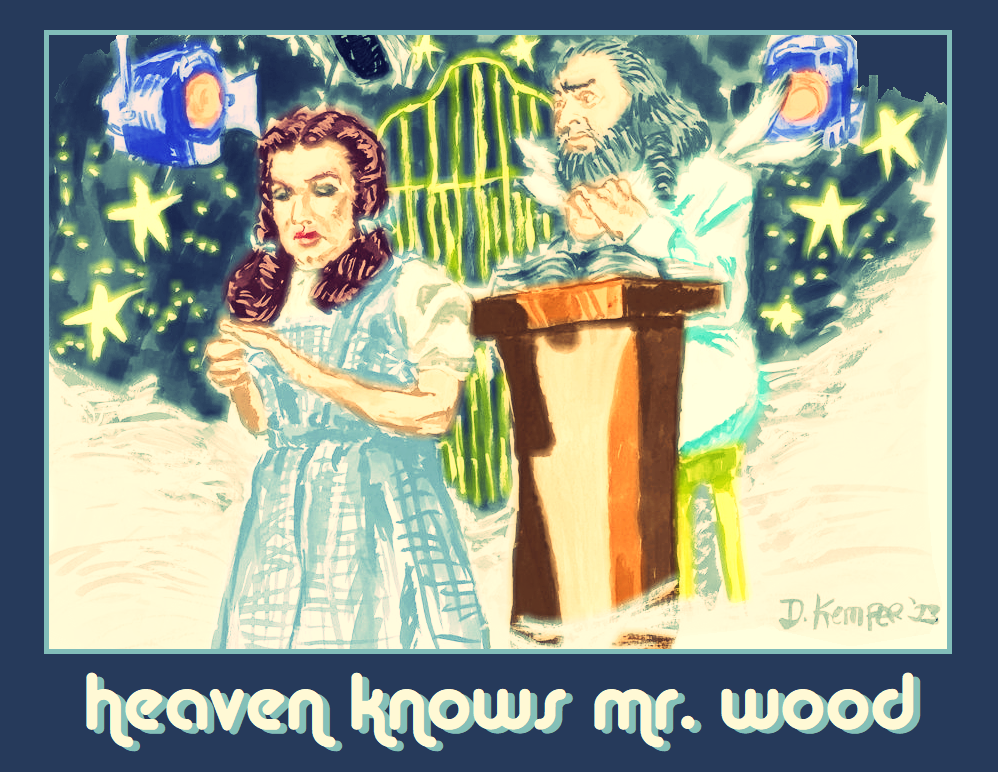
Ed Wood's Warm Angora Wishes: "Heaven Knows Mr. Wood."

Ed Wood goes to a very specific version of Heaven in this story.
NOTE: This article continues my coverage of Ed Wood's Warm Angora Wishes and Rubber Octopus Dreams (Arcane Shadows Press, 2024).
The story: "Heaven Knows Mr. Wood" by Dwight Kemper

This is where Ed Wood died.
Synopsis: In December 1978, filmmaker Edward D. Wood, Jr. and his wife Kathy are evicted from their Hollywood apartment and have to move in with a friend of theirs, actor Peter Coe. A few days later, while Peter, Kathy, and some other friends are watching a football game on television, Ed Wood dies of a heart attack in a back bedroom at the age of 54. There's a look of horror on his face. At his memorial service, the famed TV psychic Criswell, a longtime friend of Eddie's, tells Kathy that her late husband will be long-remembered and that God has "a soft spot for artists."

Meanwhile, Ed Wood arrives in Heaven and finds it to be a giant movie soundstage, complete with scenery and microphones. Even St. Peter, who sits at a podium at the Pearly Gates, looks and talks exactly like Bela Lugosi. Eddie is surprised, but not upset, to find himself dressed in the blue gingham dress and ruby slippers that Judy Garland wore in The Wizard of Oz (1939). Cross-dressing is not frowned upon in the afterlife. Peter tells Ed that his movies have brought happiness to many, and so the late director will be allowed to live in paradise. He already has a friend waiting for him at the Old Actors' Cloud.

Eddie ventures along the Yellow Brick Road until he meets the actual Bela Lugosi, who is hanging out with fellow horror icons Basil Rathbone and Boris Karloff. They stop to chat. Eddie eventually realizes that his dreams have come true. He is finally a filmmaker with unlimited money and resources, and Bela and the others are set to star in his next opus.

Excerpt
Startled, Eddie turned around and found himself in front of a high podium where a bearded man was waiting. Behind him were a pair of gates, the bars of which appeared to be lit by bulbs inside frosted plastic. The floor of the stage was covered with the crawling wisps of dry ice smoke. Ed looked down and saw he was now wearing a  sweater made from the finest angora and a gray skirt and sensible shoes.
Reflections: "Heaven," said Russell Green, "is where the donkey finally catches up with his carrot. Hell is the eternity while he waits for it." I think this old saying applies itself to Ed Wood pretty easily, and it was on my mind as I pondered Eddie's fate in the afterlife. I also thought about a 2013 episode of the web series Precious Plum in which the title character (Elaine Carroll), a child beauty pageant contestant, innocently asks her mother (Josh Ruben) what Heaven is like.

The carrot and the donkey.
"Like Target," replies the mother casually, "but everything's free."

I can sympathize with Plum's mother here. We often have a difficult time envisioning or describing the afterlife because we've obviously never experienced it. Besides, we're so focused on our earthly lives that we can't imagine an existence that's completely divorced from the physical, material world that we know. 

And so, most depictions of Heaven in art and fiction are just fancier versions of Earth. What else do we have to go on? Movies and television shows tell us that, after we die, we'll still look like ourselves, talk like we always have, and think with the same brains we had in life. Multiple writers have come to the conclusion that eternity will eventually grow boring for us, but this presupposes that we'll still have an attention span after we die.

Author Dwight Kemper addresses this problem in his story "Heaven Knows Mr. Wood," in which Ed Wood and Bela Lugosi reunite in the Great Beyond. And what do they do once they're up there? Make movies, of course! It's all they know. Kemper has Lugosi say in his unmistakable accent: "Heaven is vatever you make of it. Ve are all movie stars, so naturally, Heaven, it reflects vat ve know."

Maybe this isn't so bad. I'm a self-confessed game show addict, and one of my great pleasures in life is watching reruns of the '70s edition of Match Game hosted by Gene Rayburn. Every once in a while, I'll remember that Gene and nearly all the celebrity panelists (Brett Somers, Charles Nelson Reilly, Betty White, Richard Dawson) are dead. On the TV screen, they're still alive and filled with boundless energy. Where did all that energy go? Did it just evaporate into nothing when they died? It comforts me to think that, somewhere, there's a big Match Game reunion going on in Heaven right now.

I felt the same sort of comfort while reading "Heaven Knows Mr. Wood." In this story, Eddie dies broke and homeless, but in Heaven, he finally gets to be the filmmaker he always wanted to be on Earth. In other words, the donkey has finally caught up with his carrot.

Saturday, December 10, 2022

The 2022 Ed-Vent Calendar, Day 10: Eddie and Nurse Beulah

Ed Wood, minus his dentures, in September 1978.

Believe me when I say that no planning whatsoever went into this series. I just decided spontaneously on December 1 to write a short article per day about Ed Wood until Christmas. I didn't even think about the fact that the 44th anniversary of Eddie's death would fall somewhere in the middle of it. How sad that, during a time when Christians look forward to the birth of Jesus, we must pause to reflect on the death of Ed Wood. But that's the hand we've been dealt.

Is there anything left to say about that tragic day in December 1978 when Eddie—recently evicted from his Yucca Flats hovel and downing vodka shots at an alarming rate—died in the bedroom of his friend, actor Peter Coe? Well, yes. There's a minor supporting character in this story who has long intrigued me: an elderly nurse named Beulah Ames. She was apparently the first person to discover Ed Wood's dead body on the afternoon of December 10, 1978. In Nightmare of Ecstasy (1992), she's mentioned by both Peter Coe and Kathy Wood. Here's the relevant passage:

All the mentions of Beulah Ames in Nightmare of Ecstasy.

Who was Beulah Ames and how did she come to be in this apartment on December 10, 1978? Was she a neighbor? A friend of Peter Coe's? Admittedly, I'm intrigued by Beulah for two main reasons. First, obviously, is her wonderfully old-fashioned first name. You don't see too many Beulahs walking the streets these days. Second, there's the highly dramatic quote attributed to her: "Ooooooooooh! My God! Eddie's dead!" Now, maybe Peter Coe is exaggerating here. He was an actor, after all. But maybe Beulah Ames really did say something like this 44 years ago today.

Either way, Beulah remains one of the many mysterious figures in the Ed Wood saga. Perhaps as a result of posting this article, I will hear from someone with the lowdown on this aged nurse and her connection to either Peter Coe or Eddie. One can only hope.

Tuesday, August 3, 2021

Podcast Tuesday: "Putting the FUN in Funeral!"

Henry Winkler on Happy Days.

Do you ever think about your own funeral? It's difficult not to. As Tom Lehrer once famously sang, "When you attend a funeral, it is sad to think that sooner or later those you love will do the same for you. And you may have thought it tragic, not to mention other adjectives to think of all the weeping they will do." 

So right now, I'd like you to imagine your own little send-off ceremony. Who will show up? What will they say about you? Will it be a lavish, extravagant affair or perhaps something a bit more humble? Maybe your funeral will be a joyous celebration of your generous and productive life. Maybe it will be like something out of a soap opera or a Greek tragedy, with the mourners wailing uncontrollably because you were snatched away so quickly from them by the cruel hand of Death. Maybe it'll just be a little dull.

In the Season 6 Happy Days episode "Fonzie's Funeral (Part 2)," Arthur Fonzarelli (Henry Winkler) gets the rare opportunity to attend his own funeral! Some gangsters want him dead, so he pretends that he is, and the Cunninghams throw a fake memorial service in his honor. Calling himself "the widow Fonzarelli," Fonzie dons a black dress, a gray-haired wig, and a veil so that he can be there without arousing suspicion from the bad guys.

The Cunninghams know Fonzie is really alive, but some of the mourners think the service is real and grieve accordingly. Among the attendees: Officer Kirk (Ed Peck), Arnold Takahashi (Pat Morita), and the cast of Laverne & Shirley (Penny Marshall, Cindy Williams Eddie Mekka, Michael McKean, and David Lander). Fonzie gets to hear what all of these people say about him when they believe he's dead. That's a privilege most of us will never have.

Does any of this make for a good episode? Find out when we review "Fonzie's Funeral (Part 2)" on These Days Are Ours: A Happy Days Podcast

Wednesday, May 5, 2021

Ed Wood Wednesdays: The Wood/Dziawer Odyssey, Part 15 by Greg Dziawer and W. Paul Apel

Frank Leahy (lower right) arrives at Notre Dame University.

If you've been paying any attention to this series lately, you've surely noted my recent obsession with former Notre Dame head football coach Frank Leahy, the hero of Ed Wood's unproduced biographical screenplay The Frank Leahy Legend (1975). Once a mere footnote in my research on Ed—a strange topic for a script I wrongly assumed to be missing— Frank has become a persistent subject that I can't shake.

Faithful reader W. Paul Apel, who joined me on a recent Ed Wood Summit Podcast to dissect the screenplay, mentioned that he was planning to visit Leahy's grave. "Send me pics," I excitedly said. And so he did. He also penned an anecdote about his visit that I'm happy to share with you. Perhaps this will provide some ritualistic finality, and I'll be able to let go of Frank Leahy. We'll see.

Special thanks to W. Paul Apel for sharing the story of his visit and his pictures of Frank's grave and surrounding environs. I wonder if all of that peace and quiet makes Frank yearn for the sound of rolling thunder across the bleachers at the stadium at South Bend.

Wednesday, December 9, 2020

Ed Wood Wednesdays, week 112: Ed Wood's death certificate

It's time to think about Ed Wood's death again.

December 10 is a date well known to Ed Wood's fans, since that's the anniversary of Eddie's untimely passing in 1978. Evicted from his grungy apartment at 6383 Yucca St. in Los Angeles, just weeks before Christmas, Ed and Kathy Wood hastily relocated to actor Peter Coe's apartment less than ten miles away at 5635 Laurel Canyon Blvd. in Valley Village, where Eddie expired in a back bedroom on a Sunday afternoon as the others were watching the Rams on TV. As with many celebrities who left this world too soon, Ed Wood's alcohol-fueled death at the age of 54 is a key part of his legend. Fans can't help but romanticize, sentimentalize, or even mythicize his tragic ending. The fact that he died penniless and obscure, only to become famous in death, makes him the Vincent Van Gogh of B-movies.

Eddie would have understood this phenomenon all too well. As I've written many times, death was one of Ed Wood's muses, possibly the main one, topping even sex, booze, and women's clothing. The Grim Reaper looms over Eddie's most famous movies, especially Plan 9 from Outer Space (1959) and Orgy of the Dead (1965), both of which largely take place in cemeteries. Eddie's short stories and books are likewise rife with graveyards, tombstones, coffins, and corpses. Through his writing, Ed Wood frequently pondered how we die, what happens to our bodies after we die, and how we are remembered by those still living. As a quick primer, I refer you to the stories "Into My Grave" and "Epitaph for the Village Drunk."

In the primitive days before the internet, it was not so easy to dig up personal information about other people, even public figures like movie directors. So it was rather eye-opening when author Rudolph Grey included Eddie's full death certificate in the patchwork biography Nightmare of Ecstasy: The Life and Art of Edward D. Wood, Jr. (1992). With his truly morbid imagination, Eddie would likely approve of his fans studying this grim document in detail. 

Ed Wood's death certificate.

Friday, September 28, 2018

If we can't change gun laws, can we at least change gun vocabulary?

This is a picture of Clint Eastwood holding a gun. It has nothing to do with the rest of the story.

After every mass shooting incident in America—and there seems to be a new one every few weeks—there's always a heated but ultimately pointless debate about gun laws. Some argue that we need stricter laws about who can legally purchase guns and what kinds of guns they can own. Others say that such laws not only wouldn't work but would violate the Second Amendment to the United States Constitution.

Personally, I'm not a gun owner or user. I've never gone hunting in my life, though I do eat meat and wear leather so who am I to judge hunters? If it's really to control the animal population, as they say it is, I'm fine with it. Deep down, I don't think most hunters really give a damn about the animal population. I'm sorry, but I just don't buy that excuse. I think they just want to get out there and kill something, and they use the "animal population" story to justify it. But better they shoot a deer than a coworker, huh?

Then there's the old self-defense argument. If bad people break into your place, you'd want to shoot them, right? I don't think I'd be able to guard my home very effectively with a firearm either. That's always one of the big pro-gun arguments, isn't it? Protecting the homestead, a la Ralphie in A Christmas Story? Apparently, you need military-grade assault weapons for that, though. A Red Ryder air rifle's not going to get the job done.

I don't know if anyone's crunched the numbers on this, but I think it's much more likely that people are going to reach for a gun in anger during a dispute with family members, classmates, or neighbors than they are to shoot a burglar. I had a crazy uncle who lived down the street from my family, for instance, and he had a whole safe full of guns. It's a goddamned miracle no one in his family or his neighborhood got shot, because my uncle had a bad temper and liked his alcohol. Anger + booze + guns = family tragedy waiting to happen.

So I'm not a great believer in guns. But I still don't have a great deal of faith that gun control laws will change anything. And that's because I think the problem is something rooted deep in the American psyche. The idea that you can somehow fix your problems by going to a location (a school, a church, a warehouse) and shooting up the place is a fundamentally American concept, I'm sorry to say. I don't know how we got that idea, but it's there nevertheless.

The problem gets worse every time there's one of these mass shootings, and the news media goes into "tragedy porn" mode. The sad, demented individuals who commit these crimes are turned into instant superstars. I remember back in 2012 when that depraved young man with the orange clown hair opened fire in a Colorado movie theater during a screening of a Batman movie. His face was everywhere for days: TV, the internet, newspapers, magazines. Was there any surprise when he became something of a pop icon with his own fanbase?

Some media outlets, like YouTube's The Philip DeFranco Show, refuse to broadcast the names or faces of mass shooters. I applaud that. It's a good first step. But I think we need to make radical changes to the vocabulary surrounding guns and gun violence. The current terminology is too cool and empowering.

For instance, I hate that term "gunman." You could pick up a sword and start swinging it around wildly, but that doesn't make you a swordsman. The mere act of climbing onto a horse does not qualify you to be a horseman. You have to demonstrate some degree of skill first for those other titles. But all you have to do to be a gunman is hold a gun in any public place. It's not fair.

Besides, "gunman" sounds like the name of a costumed superhero, like Spider-Man or Superman. I suggest "some dude with a gun." Or, better yet, "Poopypants McGillicuddy." Nobody wants to be described that way on the news. Can you imagine? "Authorities say there is a Poopypants McGillicuddy on the roof of the 7-Eleven."

I also hate the term "active shooter." It sounds too much like a compliment. "Well, at least he's an active shooter. He's getting up off the couch, getting some exercise. He's not just some passive shooter, sitting there like a lump." This isn't cardio, CNN. It's mass murder. Stop giving these guys credit for being active. Suggested replacement: "Yosemite Sam" or "Poopypants McGillicuddy with explosive diarrhea." I know that's a lot of syllables, but we're talking about saving lives here.

Getting off on a tangent, I know the term "lone wolf" is more of a terrorism thing than a mass shooting thing, but there's some overlap between those fields. And that's definitely another term to retire. Let's leave the wolves out of this, huh? And, once again, the whole thing sounds too cool and heroic. I suggest using "friendless feeb" instead.

Lastly, the term "shooting spree" is beyond stupid. I can't believe we still use it, but I heard it in a news report just two or three mass shootings ago. Do I even need to explain this? "Spree" is a word you use with "spending" or "shopping," but not "shooting." It suggests a lighthearted romp, a carefree afternoon of fun and frolic. It should never be used in connection with murder. Hell, when I was growing up, there was a candy called Spree. So instead of "shooting spree," I say we use "fart-a-palooza."

You may say these terms of mine lack respect. But it's not true. I have tremendous respect for human lives, and I don't want them interrupted suddenly by gun violence. If we want people to stop committing these terrible crimes, we have to strip away every bit of dignity and power from them. Changing the vocabulary is one small way of doing that.

Wednesday, July 18, 2018

Ed Wood Wednesdays: The Wood Ancestry Odyssey, Part Three by Greg Dziawer

Ed Wood's uncle Burton (not pictured here) was a dairy farmer until the 1940s.

A one-quart milk bottle
from Moon's Dairy (1950s)
Every now and then, I find myself delving so far into Ed Wood-related ephemera that I forget how I got there. At times like these, it's good to level-set and return to Poughkeepsie, New York, the city of Eddie's youth, where he grew up just a stone's throw east of the Hudson River. And from there we can travel back a generation to Ulster County across the Hudson and visit his father's large family.

I've been to the Hudson Valley before on these research jaunts, but this time I came across a figure who was utterly new to me: Burton Wood. Naturally, I wanted to learn more.

The list of Ed Wood's paternal aunts and uncles varies a bit, depending on the source. Burton is not included among them in the 1905 US Census, for instance, but he is buried at the Wood family plot in Fairview Cemetery in Stone Ridge, on the west side of the Hudson, 25 miles northwest of Poughkeepsie. 

It was in this general area—the farms and quarries of Ulster County—that Eddie's father and namesake grew up. Burton, his older sibling and Eddie's uncle, left his hometown in Ulster County sometime just after the turn of the century. Perhaps barely out his teens at the time, Burton traveled nearly 50 miles west toward more remote farmlands in Catskill. Here, he ran a dairy farm—Moon's Dairy, seemingly no longer in existence—for four decades.

Burton would return home to Poughkeepsie on occasion to visit his mother, but Eddie's uncle largely remains a mystery. He passed on February 3, 1946, at the age of 61. This obituary from the February 5, 1946 edition of The Poughkeepsie Journal matter of factly notes that he was "sitting at the dinner table" at the time. Note that Edward, Sr.'s involvement in the local VFW merits a mention here, too. Meanwhile, Ed, Jr. is dubiously listed as "Captain Edward Wood, United States Marines." The highest rank Eddie achieved while in the service was that of corporal.

Ed Wood's uncle buys the farm.

A judgmental farmer from Glen or Glenda
Edward Davis Wood, Jr., was just a little over three months from being discharged from the Marines when Burton died. What impact, if any, this dairy farmer uncle may have had on young Eddie remains unknown. When farm folk are depicted in Ed Wood's movies, it is usually as unsophisticated bumpkins. Think of Farmer Caulder (Karl Johnson), the man with the "spirits" on his breath, in Plan 9 from Outer Space. Then there's the straw-hatted rube in Glen or Glenda who worries that those newfangled automobiles will "scare the hosses."

Burton was preceded in death by his mother, Emily "Emma" Wood née Bunten, who passed in 1940. Emily married Eddie's grandfather Byron, who was also a farmer. And, as it turns out, she also had a half-brother named Edward Davis. 

Clearly it was this intriguing half-brother who inspired the first and middle names of Ed, Sr. and Jr. We'll visit him in a future installment of Ed Wood Wednesdays.

Tuesday, October 10, 2017

Some thoughts on Ed Wood's 93rd birthday

Happy, happy birthday, Eddie!

Edward Davis Wood, Jr. would have turned 93 today. That is, if his alcohol-drenched heart hadn't given out in December 1978. The Bible promises us "threescore years and ten" (Psalms 90:10). So Eddie got about three-quarters of what he was due. Was he cheated? I dunno. Hard to say. He didn't exactly treat his body like a temple. More like a distillery. And, besides, he packed a lot of living into his 54 years. I mean, I never made any movies with Bela Lugosi. Did you? My mother only lived to 46, and I'd sure as hell rather have her alive today than Ed Wood.

Eddie became an interest of mine about 25 years ago, thanks largely to Danny Peary's Cult Movies and a well-timed movie marathon. He didn't become my taskmaster until four years ago when I started Ed Wood Wednesdays.  I can say that this series has more or less cured me of my need to know more about the director of Plan 9 from Outer Space.

I don't know all there is to know, and I'm a long way from seeing all there is to see and reading all there is to read. But I know enough. And I've seen and read more than enough. I'm sure there are 80 bazillion more porn films of his I could watch from the 1970s. But I don't wanna. Once you've seen 12 or 13 of those, you've seen 'em all. They're not sexy. Just kinda sad. And gross. And then sad some more. I'd rather sit through more of his Westerns than more of his pornos. At least some of the people in the Westerns look like they're getting fresh air and exercise. (That old sourpuss Kenne Duncan being a perennial exception.)

A lifelong drunk, a mediocre Marine, and a prodigious wife-beater, Ed Wood was no hero. He's certainly not my hero. I even flinch a bit at being called an Ed Wood fan, because that implies that I'm either a delusional idiot who thinks Eddie's movies are unassailable masterpieces or a smirking hipster making snide jokes about an unfortunate dead man. I've tried not to be either.

So if I'm not a fan, what am I? I'm a person who admires aspects of Ed Wood's work and thinks his life holds some -- though not infinite -- fascination. He's not without talent, you know. There are moments of genuine horror, humor, pathos, drama, and even wisdom in his works. Those who write him off as a clueless hack -- and that's almost everybody -- are mistaken. I'd say he was a better writer than he was a filmmaker, though he brought a lot of enthusiasm and inventiveness to those early movies of his. In a lot of ways, my experience with Ed Wood peaked with that film festival in 1992. I've been chasing that high ever since.

Eddie's been in the news quite a bit this year. For one thing, actor Martin Landau, who played Bela Lugosi in Tim Burton's Ed Wood (1994), died at the age of 89 this July and got a gratifying amount of news coverage. Meanwhile, James Franco's new film The Disaster Artist, chronicling the making of Tommy Wiseau's The Room, has been garnering many, many, many comparisons to Ed Wood. (Trust me on this; all these reviews wind up in my inbox.) And then there was that semi-disastrous recent screening of Take It Out in Trade at Fantastic Fest. I don't even want to get into it, but this garnered a lot of negative press. There was a flurry of statements and think pieces and accusations. To be honest, I barely followed it due to lack of interest. But if there's no such thing as bad publicity, then 2017 has been a pretty decent year for Ed Wood.

*sigh*

There's no real point to this article. Sorry about that. But I hadn't written anything for this blog for a while, and it was Ed Wood's birthday, and I decided to use that as an opportunity to vent a little. Don't let my lack of enthusiasm get to you. Greg Dziawer has enough enthusiasm for ten people, and I'm sure he's got plenty of articles lined up. Ed Wood Wednesdays could not be in better hands. Here's his latest.

Happy birthday, Ed.

Wednesday, March 29, 2017

Ed Wood Wednesdays: The Wood Ancestry Odyssey, Part One by Greg Dziawer

The Wood family headstone.

Sticks and Stones

Ed Wood, Sr. with his wife, Lillian.
We traveled to the Poughkeepsie of Ed Wood, Jr.'s youth here and there in recent Ed Wood Wednesdays, and this week we're going back even further in time, to Edward Davis Wood Sr.'s adolescence. Welcome to the first Wood Ancestry Odyssey. 

Though he moved to the city of Poughkeepsie, married, raised a family and remained there for the rest of his life, Ed's dad grew up out in the sticks. The 1905 New York State Census finds Ed Sr. aged 10, living with father Byron and mother Emily and six (of seven) siblings. Although not far from from Poughkeepsie, in the city of Marbletown just 25 miles northwest across the Hudson River in Ulster County, it was all lush country, lowland farms and upland forests. Situated on the eastern edge of the Catskills, the town was given its name owing to being built on large limestone deposits. 

The Dutch arrived there in the late 1630s, and by the 1660s the town was being settled. Its original inhabitants, the Esopus Indians, moved west and joined the Delaware tribes. Marbletown briefly served as State Capitol during the Revolutionary War, after Kingston burned. It grew to a population of nearly 5,000 by the beginning of the 20th Century. With over 5,500 inhabitants today, it has grown little since, and still remains predominantly Caucasian. When Byron and Emily Wood were raising their children, it was an agricultural/industrial town. These days, it's an idyllic getaway, fetching steep prices for its old stone houses. Julia Roberts sold her estate there for $1.5 million in 2009. 

The Wood siblings were Luella (the oldest, born in 1882 and living to 1981), Ransom, Mary, Anna/Annie, Edward, Gertrude, Ruth and Granvill (the youngest, just over 6 mos. old at the time of the 1905 Census). Luella had moved out by 1905, but the other siblings remained at home, living in the small hamlet of Kripplebush (one of numerous hamlets that comprise Marbletown), now on the National Register of Historic Places. Kripplebush is along the southern edge of Marbletown, Main St (now Route 209, the oldest road in the United States) running along its eastern edge, intersected by Kripplebush Road. 

The Census Record lists the family at Main St, and Byron's occupation as a flag quarryman. Flag is a designation of a type of rock (sheerbate flags, for example). He had grown up in Marbletown, first working as a stone cutter. Oldest son Rance, 17 years old in 1905, was already a farm worker, like the majority of men in Marbletown. He was a lifelong resident of Kripplebush. Ed Sr was in school.

Byron Wood (1853-1925) was Ed Wood's paternal grandfather. May he rest in peace.

Byron, too, would end up a farm worker, into his late sixties and still in Marbletown. Eddie Jr would not have remembered his grandfather, who passed away in early 1925 (in his early seventies like his son Ed Sr, generally a younger age than the hearty Wood siblings), when Ed Jr was still an infant. His grandmother Emily lived until 1940. Most of Ed Sr's siblings, as he did, left Ulster County. But the Wood siblings would eventually and finally return to Marbletown (with Ed Jr's mother Lillian), to the family burial plot in Stone Ridge. One of the hamlets in Marbletown, adjacent to Kripplebush and with Route 209 running right through it, Stone Ridge is home to Fairview Cemetery. Ed Jr's father, per his headstone, was a wartime soldier like his son. His 1917 draft registration card still has him living in Kripplebush at the age of 26, working as a Bell Hop. And Byron and Emily are therewith him at Fairview, reunited with most of their children. 

But the story does not die with them. We'll go even further back into Ed's roots, going back generations in New York. We'll go back to Marbletown, and on a farm there, we'll meet Ed's paternal great-grandfather Josiah and his wife Charlotte, right here at Ed Wood Wednesdays.

NOTE: Some fascinating bonus images related to this week's article have been posted to the Ed Wood Wednesdays Tumblr:    

Tuesday, September 27, 2016

For Herschell...

Artwork inspired by Herschell Gordon Lewis

We lost Herschell Gordon Lewis, the Godfather of Gore, yesterday. He was 90, so his death was hardly unforeseen. But, still, it's a less interesting world without him. I first saw his two most famous films, Blood Feast and Two-Thousand Maniacs, back in the VHS days when they came packaged with lurid, eye-catching covers. These were unlike the horror films I had seen in the past. The violence was outrageous, bloody, and right out in the open. No editing tricks or dim lighting to mask things here. I was shocked, scandalized, and enthralled. I rented them again and again.

Later, I found what an impact Lewis' movies had on John Waters and became even more of a fan. A former college professor with a varied writing resume, Lewis was an extremely funny, articulate man who gave great interviews and commentaries about his own work. Something Weird Video brought a lot of Herschell's films back into print and gave them nifty special editions. I feel like I learned a lot from those. Nuanced his films were not. Those looking for plausible plots, believable acting, or deft storytelling need not apply. But for those looking for pure, raw aggression against humanity, Lewis' films were heaven sent. I loved them to pieces. The artwork above is my modest tribute to the splatter king. RIP, HGL.

Monday, July 4, 2016

Two fireflies


The top panel is an unaltered Six Chix. I took the story over from there. Please imagine that the fireflies are played by Ray Liotta and Lorraine Bracco.

Saturday, June 4, 2016

Leroy victorious!

It had to end with one of them dying.

The comic strip The Lockhorns, originally created by cartoonist Bill Hoest (1926-1988), has been running since 1968. It is currently being continued by Hoest's widow, Bunny. The strip concerns two married, middle-aged suburbanites, Leroy and Loretta Lockhorn, who are constantly at odds over just about everything: money, food, alcohol, leisure time, etc. Despite the title of the strip, these two do not usually lock horns, i.e. argue vigorously with each other. Generally, one will just lob an insult at the other, who will just stand there and patiently take it. 

That's how it's gone for nearly 60 years. But what would a Lockhorns finale look like? That's what I tried to imagine in the following cartoon.


Wednesday, April 6, 2016

Merle Haggard (1937-2016): A brief remembrance

Merle Haggard, seen here in the early 1980s.

A few nights ago, irked by the prolonged existence of the Country Music Awards, I took to Twitter and went on a half-bitter, half-comedic, anti-CMA rant. It's not that I'm against country music. Far from it. Some of the best, most moving songs I've ever heard have come from that genre. The problem is that, every time I have the misfortune of tuning into a radio station that plays contemporary C&W, all I ever seem to hear is overproduced pop pap. It's tough to tell the commercials from the songs sometimes. What really sparked my ire that night, though, was I'd just been listening to a country song that had stopped me dead in my tracks, not a few hours beforehand: Merle Haggard's 1981 hit, "Are The Good Times Really Over?" What I liked about the song was how direct and honest it was. America had gone through a lot of hard times during the 1970s, and this was Merle delivering his unhappy but necessary State of the Union address. Could such a recording still be made today? It doesn't seem to have any connection with the music being advocated by the CMAs in 2016. That night, I googled Merle's name and was happy to find he was still alive. Old but alive. Well, now he's not. He died on his birthday at the exact age of 79. How's that for a country song premise? Anyway, here's the song that impressed me so much. Enjoy. And RIP, Merle.

Addendum: This article is not intended as an endorsement of every single view expressed by Merle Haggard in this song. Throughout his catalog, Mr. Haggard expressed a number of sentiments with which I do not personally agree. "Okie From Muskogee" is a perfect example. That song does not express my philosophy in any way, shape, or form, and yet I like it anyway. I wouldn't change it. Again, my admiration is for the directness and candor of the lyrics. If Muskogee were really as Haggard describes it, I wouldn't last ten minutes there. I liken my appreciation of Merle Haggard to my appreciation of The Notorious B.I.G., who was the subject of another post on this blog. I cannot possibly endorse the violence, misogyny, and homophobia in Biggie's lyrics, but that doesn't really affect my enjoyment of his music one bit. In fact, I don't really like hearing my own opinions echoed in art. Don't tell me what I already know or what you think I want to hear. Tell it to me like you think it is, and I'll make up my own mind. That's what Merle Haggard did, consistently and brilliantly.