Showing posts with label Poughkeepsie. Show all posts

Wednesday, December 18, 2024

Ed Wood Wednesdays, week 207: (Yet) Another Deep Dive into the Huffman Files

Emails! I get emails! I get stacks and stacks of emails!

In these strange, sad weeks following the death of my friend Greg Javer, I've found some comfort in the knowledge that Woodology—the study of Ed Wood's life and career—will carry on without him. It'll carry on without me someday, too. Greg was the most prominent contributor of material to this series, but he was far from the only one. Over the years, people like Bob Blackburn, James Pontolillo, Keith Crocker, W. Paul Apel, and Philip R. Frey have sent films, texts, photos and more my way. I'm grateful to all of you.

One of my more persistent emailers is a true zealot named Rob Huffman. He regularly supplies me with press clippings and other oddities that he's found in his research. Sometimes, I feel a little guilty that I can't always respond to his emails in a timely fashion. There are only so many hours in a day, you know? But I thought that you and I could go through some of Rob's recent finds together. How does that sound?

Wednesday, November 27, 2024

Ed Wood Wednesdays, week 204: The unveiling of Ed Wood's historical marker

A glimpse at the unveiling of Ed Wood's historical marker.

Since Thanksgiving is approaching and most Americans are preoccupied with travel, relatives, decorating, shopping, and food—or possibly all of theseI thought I'd keep it especially light and informal this week. So no big Ed Wood revelations or in-depth Ed Wood reviews, okay? Let's just have a little Ed Wood fun.

Pretty in pink?
Last Wednesday, I told you about how a New York State historical marker was being placed in front of Ed Wood's childhood home at 35 Delano Street in Poughkeepsie, thanks to the efforts of some high school students in teacher Robert McHugh's AP history class in Dutchess County. Those enterprising youngsters cited this very blog in their application to a nonprofit organization called the William G. Pomeroy Foundation, which seeks to denote places of historical significance in the state of New York. 

And, after two years, it worked! The Foundation agreed to mark Eddie's former home with a permanent, bright blue-and-yellow sign. Anyone who walks or drives by 35 Delano Street will know that this was once the home of the director of Glen or Glenda (1953). None of this could have happened without the research of such esteemed Woodologists as Greg Dziawer and James Pontolillo, both of whom have made invaluable contributions to this blog.

I couldn't be there for the unveiling of the sign, unfortunately, but I did write a speech for the occasion. That speech was delivered for me by director and film programmer Katie Cokinos. You can view a gallery of photos from the event right here. In some of the pictures, you can see that the marker was hidden under a pink cloth before it was revealed. To my eyes, at least from a distance, the sign appears to be wearing its very own pink angora sweater! What could be more appropriate?

A 16-minute video of the unveiling ceremony has also been posted to Instagram for those who would care to watch it. It includes Katie's speech, if that's a selling point. You'll really get a sense of how charming this building on Delano Street truly is. This is some old-school construction, and it has a lot more personality than the soulless architecture we see today. I'd be proud to live in a place like this. 

Before we leave this topic in the rearview mirror, I'd like to share an email I received from Katie the day after the unveiling:
Hi Joe,

What an amazing event! Ed Wood’s birthplace, 35 Delano (as in Franklin Delano Roosevelt), around the corner from the Bardavon Theater, the house is owned by Roberto Rossi whose family has a deli, Rossi and Sons, a block away. Robert McHugh, history teacher at Arlington High School, organized the memorial and event along with his students. And your wonderful, inspiring, informative tribute got a rousing applause. Love that this happened during his 100th year. I felt Edward Davis Wood Jr. smiling.

Thank you for participating albeit through your writing,
I only wish I could have been there in person!

Wednesday, November 20, 2024

Ed Wood Wednesdays, week 203: The saga of Ed Wood's historical marker

This house on Delano Street in Poughkeepsie was once Ed Wood's home.

And the year of Ed Wood continues! The 100th anniversary of Eddie's birth has brought with it many marvelous surprises, including some recognition from the director's home state of New York. On Wednesday, November 20, 2024, an official historical marker is being placed at 35 Delano Street in Poughkeepsie, New York to denote it as Ed Wood's childhood home. Amazingly, this blog played some small role in that achievement.

In June 2024, I received this intriguing email from a man named Robert McHugh:
I am a teacher near Poughkeepsie and for the past couple of years I have had my students apply for funding for historic markers for sites in Dutchess County. This year, one group of students decided to try for a marker about Ed Wood. They used some of the material from your sitethe reference to the wedding announcement of his parents in the Kingston paper was especially helpful—as part of the grant application. 
Good news: they were successful and there is now a historic marker being made that will likely be installed sometime over the next few months. (It takes quite a while to fabricate them; I don't know if we will have it by October 10 for his birthday.) It's going to go in front of one of the homes he lived in, at 35 Delano St. 
I'm not sure if you happen to live anywhere near Poughkeepsie, but we would love to invite you to the unveiling, whenever that would be. 
Thanks for posting all that great information about him online.
I thanked Robert for the email and gave due credit to Greg Dziawer, who has written extensively about Ed Wood's early life in Poughkeepsie for this blog. Greg, in turn, has credited the formidable James Pontolillo for his tireless (and ongoing!) research into Ed's New York years. Unfortunately, since I live in the suburbs of Chicago and work full time, I had to tell Robert that attending the unveiling of the marker was not possible.

In October, Robert gave me an exciting update: "The Ed Wood marker has finally been made. Now we have to figure out how to install it and think about an unveiling ceremony." In assembling the ceremony, Robert reached out to director and film programmer Katie Cokinos, who organized the special screening of Ed Wood (1994) that I attended virtually on Ed's 100th birthday last month. Knowing I would be unable to be there in person, Katie very nicely asked me to write a speech for the occasion. Here is that speech:
Ladies and gentlemen:

We are gathered here on this wonderful occasion to honor the memory of a man who received very little recognition in his own lifetime. Edward Davis Wood, Jr. was born in Poughkeepsie, New York on October 10, 1924 and became enamored of show business and the movies at a young age. He even worked as an usher at the Bardavon Theater on Market Street. I can imagine he spent many hours in that place, staring up at the screen and gazing in amazement at the larger-than-life figures projected there. He especially loved the cowboy stars, like Buck Jones, and of course the great horror icon Bela Lugosi.

For many of us, that's where the journey would end. We're content just to watch the screen and to live vicariously through other people's stories. We still do that today, except the screens have gotten much smaller and we can carry them in our pockets. But that wasn't enough for our Eddie. He didn't just want to watch other people's adventures. He wanted to have adventures of his own. That instinct led him, after a stint in the Marines during World War II, to Hollywood in the late 1940s.
 
Heed the words of Lyle Talbot.
Once on the West Coast, Ed Wood did everything he could to make his mark as a writer, director, and producer of motion pictures. And that's not all! He acted on both stage and screen, made TV commercials and pilots, and penned countless novels, short stories, and magazine articles. There seemed to be no end to his creativity or his ambition. Along the way, he attempted just about every kind of story there is: science-fiction, horror, Westerns, and even crime thrillers. He may never have gotten to work with Buck Jones, but he did work extensively with Bela Lugosi and even befriended the great horror icon. Bela wound up appearing in all three of Ed's most famous films: GLEN OR GLENDA, BRIDE OF THE MONSTER, and the infamous PLAN 9 FROM OUTER SPACE.

During his own, rather short time on this earth, Ed Wood received very little praise or recognition from the entertainment industry. He wasn't getting positive reviews in the press or awards from his colleagues. To the extent that Ed's films were noticed at all, they were mocked and derided for their low budgets, unlikely dialogue, and outrageous storylines. And yet, his quirky, memorable films have struck a nerve with fans for decades, and those fans have kept Eddie's memory alive long after his death in 1978. This year alone , the 100th anniversary of Ed Wood's birth, there have been at least three major new books about him, and his films continue to be shown in theaters across the country and re-released for home viewing as well.

And now, we place this marker at Ed Wood's childhood home. I am certain that Eddie would be flattered and thrilled by this honor. And if there is anything we can learn from his life, it's that we shouldn't be content to sit on the sidelines and watch other people do all the exciting things we wish we could do ourselves. As Lyle Talbot says in GLEN OR GLENDA, "We only have one life to live. We throw that one away, what is there left?"
I don't know if Katie will actually deliver that speech at the ceremony, but it was so nice to be asked. As for the marker, here is what it will look like. Perhaps, if you live near Poughkeepsie, you can stop by 35 Delano Street and see it for yourself someday.

This handsome blue and yellow marker stands as a tribute to Ed Wood.

Wednesday, January 10, 2024

Ed Wood Wednesdays: The saga of Ed Wood's 1940 high school yearbook photo (Guest Author: James Pontolillo)

A solemn Ed Wood (top row, center) poses for a class photo in 1940.

NOTE: Author James Pontolillo has been diligently researching the early, pre-Hollywood years of writer-director Edward D. Wood, Jr. His goal is to fill in some gaps in the timeline of Wood's life. The following article contains photographs and information that James has discovered while conducting this research. Enjoy. - J.B.

Ed Wood attended Poughkeepsie High School [Figure 1] from September 1940 until early May 1942 when he paused his studies in order to join the U.S. Marine Corps. For unknown reasons, Ed only took part in his 1940 Freshman class photo [Figure 2] and does not appear in his subsequent 1941 and 1942 class photos. 

Unfortunately, the 1940 yearbook staff managed to mix up Ed and two of his classmates when it came to identifying the participating students [Figure 3]. Ed was mislabeled as Thomas Martell, Tony Rinaldi was mislabeled as Ed, and Thomas Martell was mislabeled as Tony Rinaldi. Additional photos of all three men to demonstrate this point and short biographies of Ed's classmates are given here for the first time.

Wednesday, July 18, 2018

Ed Wood Wednesdays: The Wood Ancestry Odyssey, Part Three by Greg Dziawer

Ed Wood's uncle Burton (not pictured here) was a dairy farmer until the 1940s.

A one-quart milk bottle
from Moon's Dairy (1950s)
Every now and then, I find myself delving so far into Ed Wood-related ephemera that I forget how I got there. At times like these, it's good to level-set and return to Poughkeepsie, New York, the city of Eddie's youth, where he grew up just a stone's throw east of the Hudson River. And from there we can travel back a generation to Ulster County across the Hudson and visit his father's large family.

I've been to the Hudson Valley before on these research jaunts, but this time I came across a figure who was utterly new to me: Burton Wood. Naturally, I wanted to learn more.

The list of Ed Wood's paternal aunts and uncles varies a bit, depending on the source. Burton is not included among them in the 1905 US Census, for instance, but he is buried at the Wood family plot in Fairview Cemetery in Stone Ridge, on the west side of the Hudson, 25 miles northwest of Poughkeepsie. 

It was in this general area—the farms and quarries of Ulster County—that Eddie's father and namesake grew up. Burton, his older sibling and Eddie's uncle, left his hometown in Ulster County sometime just after the turn of the century. Perhaps barely out his teens at the time, Burton traveled nearly 50 miles west toward more remote farmlands in Catskill. Here, he ran a dairy farm—Moon's Dairy, seemingly no longer in existence—for four decades.

Burton would return home to Poughkeepsie on occasion to visit his mother, but Eddie's uncle largely remains a mystery. He passed on February 3, 1946, at the age of 61. This obituary from the February 5, 1946 edition of The Poughkeepsie Journal matter of factly notes that he was "sitting at the dinner table" at the time. Note that Edward, Sr.'s involvement in the local VFW merits a mention here, too. Meanwhile, Ed, Jr. is dubiously listed as "Captain Edward Wood, United States Marines." The highest rank Eddie achieved while in the service was that of corporal.

Ed Wood's uncle buys the farm.

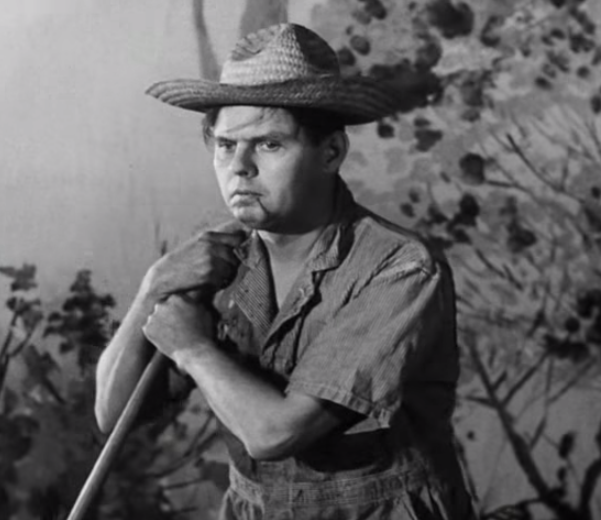
A judgmental farmer from Glen or Glenda
Edward Davis Wood, Jr., was just a little over three months from being discharged from the Marines when Burton died. What impact, if any, this dairy farmer uncle may have had on young Eddie remains unknown. When farm folk are depicted in Ed Wood's movies, it is usually as unsophisticated bumpkins. Think of Farmer Caulder (Karl Johnson), the man with the "spirits" on his breath, in Plan 9 from Outer Space. Then there's the straw-hatted rube in Glen or Glenda who worries that those newfangled automobiles will "scare the hosses."

Burton was preceded in death by his mother, Emily "Emma" Wood née Bunten, who passed in 1940. Emily married Eddie's grandfather Byron, who was also a farmer. And, as it turns out, she also had a half-brother named Edward Davis. 

Clearly it was this intriguing half-brother who inspired the first and middle names of Ed, Sr. and Jr. We'll visit him in a future installment of Ed Wood Wednesdays.

Wednesday, March 21, 2018

Ed Wood Wednesdays: The Wood Ancestry Odyssey, Part Two by Greg Dziawer

Party animals: Ed Wood's mother, Lillian (right) at a VFW function in 1954.

A striking resemblance.
Ed Wood's mother, Lillian C. Wood (1903-1989), plays an important but slightly vague role in the director's strange mythology. Legend has it that she's the one responsible for Eddie's cross-dressing during his formative years in Poughkeepsie, NY. She reputedly wanted a girl and dressed him up as such.

Is it true? Who knows? But it's a story Ed often told about himself to others, and it has since become one of the accepted "facts" of his life, even making it into the screenplay for the Tim Burton-directed biopic Ed Wood in 1994. "My mom wanted a girl, so she used to dress me up in girly clothing," Ed (Johnny Depp) explains to a shocked Dolores Fuller (Sarah Jessica Parker), once he's revealed his darkest secret to her.

But what of the woman herself? Other than the transvestism story, preciously little else is ever mentioned about Lillian, even though she lived long enough to be one of the interviewees in Rudolph Grey's Nightmare of Ecstasy. This week, let's try to change that a little. First, let's put a face to the name, a literal snapshot. 

While she never received nearly as much attention as her eccentric son, Lillian did get a modicum of press coverage during her lifetime. Through the years, she frequently posted in the local Poughkeepsie newspapers: small blurbs recording her illnesses and various trips to visit relatives. 

Furthermore, both Lillian and her husband, Edward D. Wood, Sr., were active at the local Vail-Wolff VFW Post #170. Edward had been the post's second commandeer for a stint in the early 1940s. And so, supportive wife that she was, Lillian took on numerous assignments as part of the post's Ladies Auxiliary. If there were a party at the VFW back then, it was usually Lillian credited with arranging it.

These activities generated a fair amount of ink in the local papers. In 1954 alone, Lillian was mentioned in eight different articles, nearly all of them about the Ladies Auxiliary or a related club charmingly called the Cootiettes or Cooties. Looking through these old clippings, I was stopped dead in my tracks by one particular photo of Lillian because of how strong a resemblance she bore to her famous son Ed. While this isn't too surprising, considering that they were blood relatives, the similarity of their faces was so uncanny that I wanted to share it with you.

Left: A 1954 press clipping about Lillian Wood. Top right: The Cooties' logo. Bottom right: VFW Post #170.

The article that caught my eye came from the July 15, 1954 edition of the Poughkeepsie New Yorker. The photo caption gives a little insight into what Lillian's life in Pougkeepsie was like while her son Ed was off in Hollywood, making movies like Glen or Glenda (1953) and Jail Bait (1954). To wit:
"Believed to be the oldest past president of Veterans of Foreign Wars auxiliaries in the sate, Mrs. Isabelle West (second from left), 23 Holmes Street, was honored at a surpise party at the Vail-Wolff post home last night, in celebration of her 86th birthday. Shown presenting a corsage to Mrs. West as she cuts her birthday cake is Mrs. Irene Knickerbocker, left, president of the Past Presidents' club of the Ladies Auxiliary of Vail-Wolff post, as Mrs. Lillian Wood, right, chairman for the party, and Mrs. Edith Robbins, second from right, president of the Queen Bee Cootiette club, look on."

If you're wondering about the Cootiettes, incidentally, you can read more about the organization here.

We'll visit Poughkeepsie and Ed's family again in future installments of this column. Stay tuned!

Wednesday, November 1, 2017

Ed Wood Wednesdays: The Wood Poughkeepsie Odyssey, Part Five by Greg Dziawer

Wed Woods: Ed Wood's parents, Edward and Lillian, tied the knot in 1923.

Save the Date

Submitted for your approval: an item from the Saturday, December 1, 1923 evening edition of The Kingston Daily Freeman.

Married on a Wednesday: Ed Wood's parents.
Wood-Phillips 
Miss Lillian Charlotte Phillips, daughter of Mrs. F.J. Phillips of 10 Columbia street, Poughkeepsie, and Edward Davis Wood, son of Mr. and Mrs. Bryan Wood of Stone Ridge, Wednesday evening, were married at the parsonage of the Hedding Methodist Church. The ceremony was performed at 7:30 o'clock by the pastor, the Rev. George H. Chesebro. The bride wore a gown of gray satin with over dress of canton crepe, a blue hat with gray trimmings and her flowers were white roses. Miss Ina Wright attended the bride as bridesmaid. She wore a blue cantou crepe gown with hat to match and carried pink roses. Philip Depew was best man. Following the ceremony, a reception was held at the home of the bride which was attended by about twenty-four guests, relatives and intimate friends of the couple. The couple have received a number of wedding gifts. After a wedding trip, they will make their home at 10 Columbia street, Poughkeepsie.

That modest announcement details the matrimony of Edward Davis Wood, Sr, and Lillian C. Phillips. They are—you are quite right—the parents of Edward Davis Wood, Jr, born 93 years ago in Poughkeepsie, New York, on October 10, 1924.

Kingston, New York, was 20 miles or so north of Poughkeepsie, just over the Hudson on the western side. The article no doubt appeared here owing to this area, West by northwest of P'oK across the river and over the bridge, being the patriarchal ancestral home of the Wood family after settling in Ulster County on the west side. His maternal ancestors hailed from the east side of the river, just north of Poughkeepsie. Ulster was known for its fertile farmland and rich limestone quarries. 

Poughkeepsie was an early urban center as Dutch settlers flocked there, as they did a generation before in Ulster County (the first explorers having landing there in the 1640s), and west across the Catskills and north into Quebec. As early as 1680, Dutch immigrant land barons were granted deeds from Native Americans, and in 1692, the first house was built in Poughkeepsie, just on the the edge of the river on the east side of town, half a dozen or so blocks north of the home in which Ed's parents first resided. 

I had previously mentioned that Ed's parents were married in 1922. Seeing this article, that was clearly wrong; they were not married until 1923. Within mere months, Eddie was conceived, likely at the residence mentioned in the article, 10 Columbia Street. Columbia ran and runs perpendicular to the river, and—I don't know if this is the building that stood there or not—the street corner today crossing a narrow street, with a narrow sidewalk on the residential side toward the river, in a vicinity sparsely populated by homes. On the southeast edge of P'oK is the exclusive Hudson Pointe, now (houses selling in the range of $300-400K, the corner of 10 Columbia St in front and to the right of the development's entry sign, looking across the river). 

In late 1923, when the young married Woods moved in with Frances, Eddie's maternal grandmother, the river was a stone's throw away. I haven't ascertained, just yet, exactly where Eddie's parents were living when he was born in late 1924. Half a dozen years later, Ed, his younger brother Howard (commonly known as William) and his parents were still living with the mother-in-law (Frances J. Phillips) at 44 Conklin Street. Until he joined the Marines and left Poughkeepsie in the spring of 1942, Ed and his family moved around—half a dozen or so addresses—within a narrowly circumscribed radius of a dozen or so blocks. Over time, doubtless impacted by the Great Depression, his family resided in increasingly spartan digs. 

Ed's maternal great-grandfather Samuel Phillips married his great-grandmother, Martha Emory. The Phillips side of the family hailed from the east side of the Hudson, just north of Poughkeepsie, where his mother Lillian is now buried. 

Eddie's maternal grandfather Frank Phillips, born in 1871, married Frances, his maternal grandmother. Ed's mother Lillian Charlotte Phillips was born in 1901. The reputed influencer of his transvestism, she lived until 1989. 

The marriage announcement incorrectly names Eddie's paternal grandfather Byron as "Bryan," married to Emily. Byron passed in 1925, so it's unlikely Eddie had any remembrance beyond family photographs and anecdotes. 

10 Columbia Street (as seen in this interactive map) was, in 1923, half a dozen or so blocks south, closer to the river than any other residence of Ed's in P'oK, of the soon-to-be-constructed Mid-Hudson Bridge. Columbia runs right into Franklin St, moving east, the oft-cited place of Ed's upbringing. 

When Ed was born, the beginning of the Mid-Hudson bridge project was 6 months away, and not completed until 1930. Ed's ancestral roots, lying tantalizing close just across the river, remained remote as his consciousness dawned. South of Albany, in 1923, there was no vehicular crossing of the Hudson.

Far to the west, Hollywood must have seemed a long way off.
Additional images for this week's article, including the original marriage announcement for Eddie's parents, are available at the Ed Wood Wednesdays Tumblr. Enjoy.

Wednesday, March 29, 2017

Ed Wood Wednesdays: The Wood Ancestry Odyssey, Part One by Greg Dziawer

The Wood family headstone.

Sticks and Stones

Ed Wood, Sr. with his wife, Lillian.
We traveled to the Poughkeepsie of Ed Wood, Jr.'s youth here and there in recent Ed Wood Wednesdays, and this week we're going back even further in time, to Edward Davis Wood Sr.'s adolescence. Welcome to the first Wood Ancestry Odyssey. 

Though he moved to the city of Poughkeepsie, married, raised a family and remained there for the rest of his life, Ed's dad grew up out in the sticks. The 1905 New York State Census finds Ed Sr. aged 10, living with father Byron and mother Emily and six (of seven) siblings. Although not far from from Poughkeepsie, in the city of Marbletown just 25 miles northwest across the Hudson River in Ulster County, it was all lush country, lowland farms and upland forests. Situated on the eastern edge of the Catskills, the town was given its name owing to being built on large limestone deposits. 

The Dutch arrived there in the late 1630s, and by the 1660s the town was being settled. Its original inhabitants, the Esopus Indians, moved west and joined the Delaware tribes. Marbletown briefly served as State Capitol during the Revolutionary War, after Kingston burned. It grew to a population of nearly 5,000 by the beginning of the 20th Century. With over 5,500 inhabitants today, it has grown little since, and still remains predominantly Caucasian. When Byron and Emily Wood were raising their children, it was an agricultural/industrial town. These days, it's an idyllic getaway, fetching steep prices for its old stone houses. Julia Roberts sold her estate there for $1.5 million in 2009. 

The Wood siblings were Luella (the oldest, born in 1882 and living to 1981), Ransom, Mary, Anna/Annie, Edward, Gertrude, Ruth and Granvill (the youngest, just over 6 mos. old at the time of the 1905 Census). Luella had moved out by 1905, but the other siblings remained at home, living in the small hamlet of Kripplebush (one of numerous hamlets that comprise Marbletown), now on the National Register of Historic Places. Kripplebush is along the southern edge of Marbletown, Main St (now Route 209, the oldest road in the United States) running along its eastern edge, intersected by Kripplebush Road. 

The Census Record lists the family at Main St, and Byron's occupation as a flag quarryman. Flag is a designation of a type of rock (sheerbate flags, for example). He had grown up in Marbletown, first working as a stone cutter. Oldest son Rance, 17 years old in 1905, was already a farm worker, like the majority of men in Marbletown. He was a lifelong resident of Kripplebush. Ed Sr was in school.

Byron Wood (1853-1925) was Ed Wood's paternal grandfather. May he rest in peace.

Byron, too, would end up a farm worker, into his late sixties and still in Marbletown. Eddie Jr would not have remembered his grandfather, who passed away in early 1925 (in his early seventies like his son Ed Sr, generally a younger age than the hearty Wood siblings), when Ed Jr was still an infant. His grandmother Emily lived until 1940. Most of Ed Sr's siblings, as he did, left Ulster County. But the Wood siblings would eventually and finally return to Marbletown (with Ed Jr's mother Lillian), to the family burial plot in Stone Ridge. One of the hamlets in Marbletown, adjacent to Kripplebush and with Route 209 running right through it, Stone Ridge is home to Fairview Cemetery. Ed Jr's father, per his headstone, was a wartime soldier like his son. His 1917 draft registration card still has him living in Kripplebush at the age of 26, working as a Bell Hop. And Byron and Emily are therewith him at Fairview, reunited with most of their children. 

But the story does not die with them. We'll go even further back into Ed's roots, going back generations in New York. We'll go back to Marbletown, and on a farm there, we'll meet Ed's paternal great-grandfather Josiah and his wife Charlotte, right here at Ed Wood Wednesdays.

NOTE: Some fascinating bonus images related to this week's article have been posted to the Ed Wood Wednesdays Tumblr:    

Wednesday, March 15, 2017

Ed Wood Wednesdays: The Wood Poughkeepsie Odyssey, Part Four by Greg Dziawer

Add caEd Wood, country crooner? It could have gone that way.ption

Mountain Music

Ed does his part for war bonds.
When we think of young Ed Wood growing up in Poughkeepsie, envisioning what he will someday be, we'd be forgiven for imagining a movie-mad boy dreaming of fame in Hollywood. The requisite elements of that story are there: getting a job as usher at a movie theater, childhood idols including Buck Jones and Bela Lugosi, and—the clincher—receiving a home movie camera as a birthday present. The seeds were sown, back home in Poughkeepsie, of the Hollywood filmmaker.

The story does, though, neglect the very real possibility that things could have gone another way. In this week's Ed Wood Wednesdays, we're taking a peek at Ed Wood's career (yes, that's a fair designation) in music, where he had his first breakthrough in the entertainment industry.

The Poughkeepsie New Yorker from October 24, 1943 includes a brief article in which Ed Wood urges the public to buy more war bonds. It's a curious piece, quoting a letter from Ed to the paper. After his war bond pitch, the article goes on to mention a recent letter to Ed's parents, before closing with the detail that's relevant here: He was one of the "original" Sunshine Mountaineers heard over WGY radio. 

The detail that Ed started a band called the Sunshine Mountaineers isn't new; that little factoid is generally mentioned in concert with information that Ed started his own band called Eddie Wood's Little Splinters in his teens and that he played several instruments. Both bands consisted of Ed and his friends, and it appears the Splinters came first. By the name of the band, you'd be hard pressed to know what sort of music they played. A big band, a jazz combo? I found reference to the Splinters being a Country and Western band. And that would make sense, as Ed's hero was cowboy film star Buck Jones. 

Going back even further into Ed's musical roots, 1924, the year of his birth, was also the dawning of traditional mountain music upon the popular landscape. Scottish immigrants brought their musical traditions to North America centuries prior, leaving England in fear of religious persecution, where they had settled after the Norman Conquest of 1066. Settling from Quebec to Nova Scotia and across the Catskills, the Scots' traditional musical forms merged and morphed through the years, from barn dance music to Northern Woods lumber camp folk songs. The name Wood, indicating one who lives near a wood, incidentally, has its roots in Scotland before the migration to England. The motto of the family coat-of-arms is to defend. 

Ed Wood's boyhood hero Buck Jones
By the early part of the 20th century, two forms of mountain music had emerged: the "hillbilly" style out of Southern Appalachia, and the more somber strain hailing from the Catskills. It was then, in the latter half of the 1920s, that the hillbilly stereotype came into being. Popular radio and record bands included The Rex Cole Mountaineers, and some bands took the stereotype to its extreme, dressing in straw hats and overalls, bearded and barefoot, toting jugs in addition to their string instruments. In your typical mountain music band, you are likely to find a guitar or two, a banjo or bluegrass mandolin (in Appalachia) or dulcimer (in the Catskills), a fiddle and/or a bass fiddle. 

This style of mountain music would remain popular right into World War II. By the late '30s, however, both country and western influences began to take root in America. In the post-war years, the genre eventually known as Country and Western would supplant traditional mountain music. Naming his band—or possibly renaming the Splinters—The Sunshine Mountaineers would situate a particular style of music in the minds of the audience. Though mountain music was waning, the Catskills, the mountains west of the Hudson River, remained a foothold of the tradition. 

Debuting in 1922, the pioneering WGY was the first radio station launched by General Electric. The station could boast of its range, reaching London and Havana, as well as its accomplishments. Within mere months after launch, WGY performed the first full-length live drama on radio—two and a half hours long, complete with the medium's first-ever use of foley effects. The station's home was Schenectady, New York, just north of the state capital of Albany, and an hour and a half's drive due North from Ed's hometown of Poughkeepsie. 

The Wood family—as we know from the 1930 US Census Record that oddly captures this bit of information—possessed a "radio set" Before he fell in love with movies, Ed was surely introduced to the world of entertainment via the radio. And it's worth noting, too, that the Bardavon Theatre, where Ed worked as an usher in high school, was also a full-fledged performing arts venue, staging vaudeville acts and playing host to every form of popular music. 

While the details behind Ed being "heard over" WGY as one of the "original" Sunshine Mountaineers remain unknown, we can surmise a few things: 
  • Of the instruments Ed could play, a string instrument or two was likely among them. 
  • Ed's initial artistic ambition, and breakthrough, was musical, heading a band.
  • The style of music Ed's bands played was country and western, to a significant if-not-dominant degree influenced by the popular regional mountain music styles popular on the radio when he was a child. 
  • The Sunshine Mountaineers continued performing even after Ed left the group.

The pioneering WGY. Note the GE logo on the side.
WGY increased its broadcasting signal strength a few times through the years, and in 1938 built the largest radio tower in the world, standing half the height of the Empire State Building. WGY dropped all programming immediately after Pearl Harbor, devoting itself entirely to the war effort (and no doubt urging listeners to buy war bonds). 

Exactly when and how often The Sunshine Mountaineers played on WGY, we can't say. (Presumably Ed and his friends would have driven north to the studio and performed live, as was customary) Nor do we know how The Sunshine Mountaineers scored the gig or what their background was. What we can say is that, sometime circa 1938-1941, Ed played in a band heard by what could fairly be described as a worldwide audience. 

Fighting in the South Pacific came next, and then a brief pursuit of life in the theater after he returned from the war. Finally, Ed began work in the medium for which he is best-remembered: film. Years later, in 1963, he would script Shotgun Wedding, drawing on hillbilly stereotypes, as had become common practice in the pop culture from Betty Boop to Hee Haw. He even purportedly wrote a spec script for the TV series The Beverly Hillbillies that was never produced. (Side note: The Beverly Hill Billies was also the name of a mountain music band that made its first recordings in 1930.) Little did we know that his kinship with this iconography lay deeper.

And little do we still know about Ed's career as a musician in his teen years. But we'll keep digging, and we'll travel back again to Poughkeepsie, right here at Ed Wood Wednesdays.

Special thanks to Raleigh Bronkowski, who shared the newspaper article of Ed hawking war bonds, and whose blog The Scene of Screen 13 is a mind-boggling treasure-trove of exploitation film newspaper ads. Further thanks go to Bob Blackburn, co-heir of the Wood estate, who shared priceless scans from an original copy of Buck Jones sheet music.

Wednesday, February 22, 2017

Ed Wood Wednesdays: The Wood Poughkeepsie Odyssey, Part Three by Greg Dziawer

In the realm of the census: The 1930 US Census records the details of Ed Wood's life and family.

"S" Is For "Street"
Although October 29, 1929 is historically considered the day of the stock market crash, and a key precipitator of the Great Depression, the US economy had been showing signs of ill health in myriad ways throughout 1929. Ed Wood turned five years old in early October 1929, and six months later, in early April, his residence was hand-recorded by a US census taker, Mrs. Van Etten.

In this week's edition of Ed Wood Wednesdays, we're visiting Ed's home in Poughkeepsie in 1930, a year when this country undertook its fifteenth official census. While the popular record of Ed's life in Poughkeepsie from his birth in 1924 until his enlistment in the military in 1942 locates him at 115 Franklin St, in previous Ed Wood Wednesdays, we've found Ed living at 35 Delano St from at least 1935 to 1940, and at 1 Fountain Place in the early '40s. Did Ed reside at any other residence as a kid growing up in Poughkeepsie? Bet your life on it!

The 1930 US Census Records contain over 2,000 pages for Dutchess County, New York, the vast majority listing residents of Ed's hometown of Poughkeepsie. It took me quite a while—a patient three hours or so scanning through the pages—to finally locate the listing for Ed and his family at the bottom of page 701 in one of the files. Not long before, I had run through the listing of residents at 35 Delano St, where I knew Ed resided as early as 1935. I only found a man and wife there, and knowing it was a multi-unit apartment house, I immediately felt deflated. If Ed was living there in 1930, clearly the census record was incomplete and we'd never know for sure.

Undaunted, I quickly bounced back, and it was only minutes and pages later that I found Ed's family listed at yet another residence: another apartment building at 44 Conklin Street. Conklin, like Delano, is a short L-shaped street on the interior of a larger block, in this case Mansion and Catherine Streets, concentrations of apartment houses and single-family homes on opposite sides of the street. The bottom end of Conklin intersects with the East-West Arterial, which takes you right on and over the Mid-Hudson Bridge a dozen or so blocks to the west. Within a couple of blocks of Conklin, there are three churches today: Baptist, Lutheran and Congregational. The neighborhood was designated entirely "W" for "white" in the records. 

House beautiful?: Some interior shots of 44 Conklin Street.
    
Scanning the Poughkeepsie records, I noted a number of interesting things. Wood was not a common family name, for instance. Gentrification was in full effect. And the "race" column in the records often referred to persons of African-American descent, direly, as "Nig."  
44 Conklin St. as it appears today.
44 Conklin is, like Ed's residences at Franklin and Delano, another multi-unit apartment house. The building hails from 1910, housing an upstairs and downstairs unit. Still standing, the original look of the building is now hidden beneath cheap vinyl siding. With four beds/two baths and six beds/two baths, respectively, the units at 44 Conklin were far more spacious than Ed's other residences in Poughkeepsie.

The 1930 Census Record lists the head of household at 44 Conklin St as Frances J. Phillips, Ed's maternal grandmother. She was living with her daughter Lillian and son-in-law Edward, and their two young sons Ed Jr. and Howard. A year and half younger than Ed, Howard W. Wood went by William, but the 1930 and 1940 Census Records corroborate his real first name as Howard.

In the spring of 1930, at the dawn of the Great Depression, Ed's dad was working as a factory machinist, common male employ. Less commonly, Ed and Howard's mom worked, too. The immediate aftermath of the crash necessitated change and adaptation. Living with the in-laws. Working moms.

Lillian was a department store "saleslady."  Among the ephemeral details in the record, the residence had (commonly) a "radio set." Rent was thirty bucks a month. Ed's grandma is most likely listed as "W" for "widow," but the recorder clearly first wrote "M" for "married" and then smudged it over with a nebulous correction.

And the whole Phillips' line of Ed's family was born in New York, at least as far back as Ed's matriarchal great-grandparents. The roots of the Wood family lie deep, in Poughkeepsie and beyond. 
We'll go there, and travel back a millennium to Scotland, dissecting the Wood family coat-of-arms, right here in future Ed Wood Wednesdays.

Before we depart, a few bonus items:
  • Additional maps of Conklin Street in Poughkeepsie

Wednesday, February 15, 2017

Ed Wood Wednesdays: The Wood Winter Odyssey by Greg Dziawer

Ed Wood lived through 54 winters, most of them in California.

The Black Diamond railroad bridge
I was born and raised and still reside after 48 years in northeastern Pennsylvania, currently living in the town of Wilkes-Barre. Wilkes-Barre, like the smaller towns all throughout this area, was once a booming coal town. Remnants of that era survive, including the Black Diamond, still a railroad bridge, visible from my office window as I type this, on the second floor of my house right along the Susquehanna River. In the 19th century, Wilkes-Barre was also a center of the textile industry. These days, just like Ed Wood's hometown of Poughkeepsie, New York, the industries have faded and economic blight is sadly prevalent. And just like Poughkeepsie, by mid-February, it's cold and wintry.

As I've gotten older, I've noted that by the latter part of winter, folks collectively seem beaten down. Getting short with each other. Aloof and preoccupied. It's a genuine affliction called Seasonal Affective Disorder, fittingly SAD for short. The Mayo Clinic describes it as "a type of depression that's related to changes in seasons — SAD begins and ends at about the same times every year. If you're like most people with SAD, your symptoms start in the fall and continue into the winter months, sapping your energy and making you feel moody."

By this time of year, I find myself itching for spring and sunlight, knowing that the stubborn cold will not fully release its grip for another month or so and that more snow is on the way. In fact, my recollections of the biggest nor'easter snowstorms experienced in my lifetime date them to the month of March. A few last kicks while we are down. But the sun came out this afternoon, brighter than I'd seen it in months, a welcome sign of things to come.
 
Worthwhile research.
While I personally don't feel so much affected by the weather this time of year, I do find the interpersonal dynamics of the day-to-day a bummer. A work day in mid-February surrounded by my miserable friends and associates is a veritable Circle of Hell. And it certainly takes its toll. I may not exactly be wracked with self-doubt and torpor, but tonight I do find myself wondering if I am adding anything worthwhile to the realm of Woodology and realizing that my focus is fuzzy and research scattered. 

It's emotion that spurs on these thoughts. Rationally, I know that I've made a dent into understanding the Wood Loop Orbit through the Winter, a vast and uncharted terrain that lies promisingly just ahead. As I read more articles from the Swedish Erotica film review mags of the latter half of the 1970s, I am increasingly confident in recognizing uncredited work by Ed's hand, as well as the distinct signatures of his style in the winter of his years. I could go on and on. I know that my personal odyssey continues to amaze, fascinate and obsess me in surprising ways. 

Ed left Poughkeepsie in 1942, nearly for good, when he and his buddy George Keseg dropped out of the 11th grade at Poughkeepsie High School and enlisted at age 17 in the Marines. Ed's family moved a few times and he lived in at least three residences in Poughkeepsie growing up, all close to the Mid-Hudson bridge, on the river's east side. Although he returned home for a brief stint after the war, he soon left the winter doldrums behind once and for all, ultimately landing in Hollywood.

We'll continue to follow him in his travels and travails, soaking up that southern California sunlight whenever we can, right here in future Ed Wood Wednesdays.

Wednesday, December 7, 2016

Ed Wood Wednesdays: The Wood Poughkeepsie Odyssey, Part Two by Greg Dziawer

Ed Wood lived here at 35 Delano St. in Poughkeepsie, NY.

Miracle on Delano St.

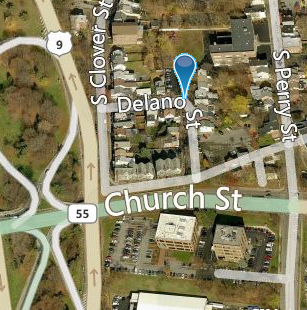
An overhead view of Eddie's old neighborhood.
In our first Poughkeepsie Odyssey, we recently shared a few details about Ed's final residence in his home town of Poughkeepsie, NY before he left for World War II: a modest apartment at 1 Fountain Place. Previously, the historical record had only identified Ed's birthplace, another apartment house at 115 Franklin St., a structure that was torn down within the last few years. Could he have resided elsewhere in Poughkeepsie while growing up?

We'll find out in this week's Ed Wood Wednesdays!

Eddie's father and namesake, Edward Davis Wood, married Lillian C. Phillips on November 28, 1922 at the Hedding Methodist Church in Poughkeepsie, New York. Little more than a year later, Lillian was pregnant with the couple's first son, Edward Davis Wood, Jr. Flash forward a decade, and the 1940 US census record has the family living at 35 Delano St in Poughkeepsie. 

According to that same document, the Woods were already living at 35 Delano at least as early as 1935. This residence—and, yes, it's still standing—is located about six blocks north of Ed's first home on Franklin St, and roughly a quarter mile from the east end of the Mid-Hudson Bridge. 

Delano is a one-way street that bends like an elbow about halfway through. It extends east from Clover St. before abruptly changing its mind and plummeting south to Union. The Woods' former residence at 35 Delano is located right near that elbow. The entire block largely consists of apartment houses and buildings.

The apartment house itself is a sturdy colonial built in 1870 with three units—presumably a ground floor apartment and two upstairs apartments—and a fireplace. Totaling ten rooms occupying 3,000 square feet, 35 Delano contains four bathrooms for its inhabitants. In 1940, Ed's neighbors at 33 and 37 Delano respectively were: Edward L. Food, a machinist, and his wife, Anna; and Pete J. Yerganson, a laborer who lived with his mother, also named Anna, his wife, Elaine, and their nine-year-old son, Richard.

Edward Davis Wood, Sr. would have been his mid-forties by this time. He was a custodian at the local post office, a job for which he earned $1,100 in 1939. That was a high-end salary among his (entirely Caucasian) neighbors at the time. And he needed the money, since the Woods had a second child by then: Eddie's oft-overlooked younger brother Howard William Wood, who typically went by his middle name.

There's always a bit of a wrinkle in cases like this. Joseph Masterson, the census taker who recorded these details on April 22, 1940, listed Edward D. Wood, Jr. as 16 years old. If Eddie was born in October of 1924—and I believe he was—he would actually have been 15 in April of 1940.

The 1940 census lists Ed's age as 16.

Meanwhile, a wedding anniversary article for Ed's parents in the Poughkeepsie Eagle News from November 28, 1940 places the Woods at their subsequent residence, 1 Fountain Place. The family, therefore, must have moved from Delano to Fountain Place sometime between April and November of 1940.

Eddie's parents celebrate an anniversary.

Not starring: George Keseg.
Already residing at 1 Fountain Place was Ed's close high school friend, George Keseg. George worked at the Bardavon Theater, like Ed, and was in the same grade at Poughkeepsie High School. The pair enlisted into the military on the same day in 1941, with Ed dropping out of school in his junior year. George was badly injured in the war and returned to Poughkeepsie in 1944. By 1946, when Ed briefly returned home after the war before leaving Poughkeepsie for good, he attempted—apparently without success—to stage his play, The Casual Company, there, with Keseg part of the acting troupe. 

Close as they eventually became, Wood and Keseg did not grow up together. The 1940 census places George at 1 Fountain Place, but in 1935, Keseg lived in Yonkers, about 70 miles due south. By 1940, he resided with his older sister, Helene, and her family: brother-in-law Joseph Wermter (born in Germany) and George's adolescent nieces, Joanna and Janet. Incidentally, Joseph made $1,250 as a bearing grinder in 1939.

What happened in Poughkeepsie wouldn't stay in Poughkeepsie, at least not for long. Ed returned briefly to his home town after the war in 1946, but he left again and soon landed in Hollywood. He never went back. But we'll go back again, right here at Ed Wood Wednesdays!

Special thanks to my friend, expert Woodologist James Pontolillo, whose research into Ed's upbringing in Poughkeepsie infuses this article throughout. For more views of 35 Delano St., check out the Ed Wood Wednesdays Tumblr.