 |
| This week, let's put the "Ed" in "higher education." |
"My school was the open road, pain and suffering my textbooks. My teachers? The gypsies and rapscallions I met along the way."
-Manny Coon
 |
| Anderson House in Washington, D.C. |
There is no solid evidence to suggest that Edward D. Wood, Jr. earned any degree beyond his high school education. He likely never even finished the 12th grade. But the pre-Hollywood years of his life are still only sketchily documented at best, so it's entirely possible Ed continued his studies in some fashion after his 1942-46 stint in the military. In Rudolph Grey's
Nightmare of Ecstasy, Wood's widow Kathy recalled: "He told me he went to Northwestern University in Chicago after he got out of the Marine Corps." Could this have been another of Ed's tall tales or did the director of
Plan 9 from Outer Space (1959) really study at the prestigious institution?
Ed's business partner John Crawford Thomas alleged that Eddie studied writing at the Kingsmith School of the Creative Arts in Washington, D.C. and even typed the script for
Crossroads of Laredo on official Kingsmith stationery. The address Thomas lists for the place—2118 Massachusetts Ave. NW—is that of the historic
Anderson House, which since 1939 has been a museum and library run by the Society of the Cincinnati. Rudolph Grey's own timeline of Ed Wood's life states that in 1946, Ed studied "at Kings School of Dramatic Arts, Frank Lloyd Wright Institute, Washington, D.C." Note the subtle name change from Thomas' version of the story.
Whatever academic adventures Ed Wood may have had in his own life, higher education remained a sub-motif in his work from the 1950s to the 1970s. In
Glen or Glenda (1953), for instance, Dolores Fuller's character, Barbara, is introduced as a college student with "only seven months to go" in her schooling. She is apparently studying psychology and has graduated by the end of the film, crowing, "My studies are through, college is concluded, and I'm free at last!" Not that all this education helps Barbara cope with the tricky issues of life. "The end of study is only the beginning of reality," she somberly declares. I've seen
Glenda with college-age audiences, and this line tends to get appreciative howls from them.
In truth, by the way, Dolores Fuller only pursued her own education
after leaving Ed Wood. In
Nightmare of Ecstasy, she lists "going to college" as one of her proudest post-Wood accomplishments. Eddie, meanwhile, merely frequented a bar called the College Inn with actor Kenne Duncan and cinematographer Bill Thompson.
More college connections? Well,
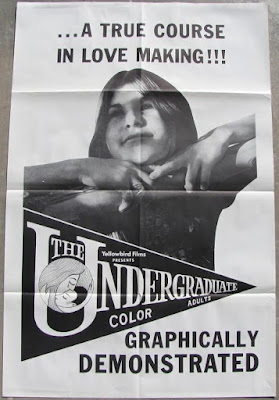
The Undergradute (1971), which Ed Wood wrote for producer Jacques Descent, takes place entirely on a college campus and consists of an explicit sex lecture given by an open-minded teacher (John Dullaghan) to his libidinous students.
The Class Reunion (1972), one of Ed's many collaborations with producer-director Stephen C. Apostolof, centers around the horny alumni of "the old alma mater," who gather in a hotel for a weekend to screw, drink, and reminisce. Wood and Apostolof would have explored collegiate life further in two more films,
The Basketballers and
The Teachers, but neither of these scripts was ever produced.
And then there are the two collegiate-themed articles I'm covering this week, both of them from 1974. Technically, these fall under the category of non-fiction, but Ed's supposed "research" is so obviously fraudulent that I'd be willing to think of them as short stories. These are presented as true-to-life exposés, but they derive solely from the imagination of Ed Wood.
 |
| More collegiate adventures. |
The stories:
- "College Cherries," originally published in Fantastic Annual, January/February 1974. Credited to "Dick Trent."
"College Interview," originally published in Cherry, vol. 3, no. 1, January/February 1974. Credited to "Ann Gora." Both of these articles were anthologized in Short Wood: Short Fiction by Edward D. Wood, Jr. (Ramble House, 2009).
Synopses:
- "College Cherries" describes the sex lives of contemporary college students, particularly females. Girls are no longer concerned about protecting their virginity, so boys are therefore less reliant on prostitutes and homosexuality to fulfill their needs. Meanwhile, the innocent campus fads of old, such as goldfish-swallowing and panty raids, have been replaced by "pot-sex orgy parties." Girls are also much more sexually aggressive now, which is an improvement over the old days, when women entered into marriage with little to no sexual knowledge. College, the article concludes, is a time for people to experiment with as many sex partners as possible. When these young people get married, they'll know "what it's all about" in the bedroom.
- "College Interview" presents itself as the testimony of a young woman called Dolores S., supposedly a student at "a major university." She does not believe that society will return to the puritanical ways of the past, when girls who got pregnant or even talked about sex openly were disowned by their families. Dolores says things are better now, when people can talk honestly about their sexual hang-ups. She says that sexual frustration drove people to insanity or alcoholism in the past. But no more! Dolores will do whatever she wants, including fellatio and lesbianism. Sex is out in the open, and it can't be "shoved back into the dark closet ever again."
Wood trademarks: "Missionary position" (again italicized, cf. "The Exterminator," "Never Look Back"); whorehouses (cf. "The Whorehouse Horror"); typing in ALL CAPS (cf. "Never Up—Never In"); phrase "what it's all about" (cf.
Necromania); women's underwear (cf.
Bloomer Girls); ellipses (cf. nearly all stories in
Blood Splatters Quickly and
Angora Fever); invention of the automobile and the airplane (cf.
Glen or Glenda); disdain for puritanism (cf.
Orgy of the Dead); the scourge of alcoholism (cf.
Nightmare of Ecstasy); mention of the play
The Blackguard (cf.
The Blackguard Returns); character named Dolores (possible nod to Dolores Fuller); "medical men of science" (cf.
Glen or Glenda).
Excerpts:
- (from "College Cherries") "And of course the panty and brassiere raids of yesterday were mild events when considered with the demands of today. Simply stealing the undies isn't enough any longer. Now the boys demand getting into the places which the panties and the brassiere covered… and where the lipstick was once well painted. However there are still the collectors… such as the young fellow who brags about having more than a hundred panties in his locker… each taken from a girl he has laid… or had various forms of sex with."
- (from "College Interview") "Now isn't it better that the whole thing is right out in the open? There certainly are fewer people going to the rubber room at the happy farm because of their sexual hang ups. Bedlam, the kookoo bin in England, might never have been necessary if the medical men and men of science started thinking with an open mind centuries ago. But they are a stubborn lot. They wanted all the knowledge so they could keep the rest of the people from finding out what a phony most of them were."
 |
| Dr. Alton in Glen or Glenda. |
Reflections: Throughout the 1960s and 1970s, college campuses were seen as hotbeds of sexual experimentation, where students were living wild, libertine lifestyles, finally unshackled from the stifling morality of the past. Or at least that's the image of campus life consistently presented in pornography of the era. In a way, this makes sense. College kids are generally young, healthy, and of legal age. Plus, they're out on their own, living away from their parents for the first time. And students of the era
were challenging social and political norms.
But the middle-aged men in the porno biz didn't really care about politics or society. They just wanted to drool over those attractive college kids having no-holds-barred, no-strings-attached sex. Sex without guilt! Sex without commitment! Sex with one partner after another!
It's interesting to me that these adult magazines had to disguise all this as supposed scientific research. Pseudo-documentary films like
Glen or Glenda (1953) and
The Undergraduate (1971) have been called "white coaters," since they attempt to present salacious or lewd material in a dry, educational manner. "College Cherries" and "College Interview" are the textual equivalent of "white coaters," since they're both written like news articles. In the former, Eddie even cites a bogus expert named Dr. Graham B. Balini, who insists that "Radcliffe girls think petting is dirty because it's teasing. They feel if you are going to do it, it's better just to have sexual intercourse.” Uh huh. Sure. Please do not ask for Dr. Balini's professional credentials.
It's difficult to suss out Ed Wood's true opinion of homosexuality in these articles. In "College Cherries," he writes: "Perhaps something very good has come from the sexual revolution on the campus however, because the incidents of male homosexuality has dropped considerably. When the girls were keeping the legs of their panties tight and the boys couldn’t find a whore or street girl they naturally turned to their own kind for their releases." Naturally, Ed.
In "College Interview," Dolores says that homosexuals will have no problem finding others of their kind on college campuses today, since everything is out in the open. Homosexuals existed in the past, too, "but whoever heard of homosexuality then except a few long bearded psychiatrists who turned out to be some kind of sex freak themselves?" I can't be sure, but I think Dolores is referring to Sigmund Freud here.
In all, "College Cherries" and "College Interview" are minor but interesting footnotes in the Ed Wood saga, mementos of a time when horny, aging men were obsessed with the sex lives of college students. For more nonsense in this same vein, be sure to check out
College Girls (1968), a film by Stephen C. Apostolof. Neither Ed nor Steve knew a damned thing about youth culture or college life, but that didn't even slow them down!


