Showing posts with label Conrad Brooks. Show all posts

Wednesday, May 13, 2026

Ed Wood Wednesdays, week 274: 'Conrad Talks Hollywood' (2011)

Remember My Dinner with Andre? Well, this is My Car Ride with Conrad.

"Marcel Proust was a very famous writer who used to dip biscuits in his cup of tea and suck on the biscuits, and all his memories come flooding back, and he wrote them down into wonderful novels."
-Peter Cook, "Memoirs of a Miner" (1985)

John Carpenter's debut feature Dark Star (1974) is a low-budget sci-fi comedy about a small crew of astronauts, all of them male, who have been out in space for 20 years and have gone completely buggy from the experience. Their vessel, the scoutship Dark Star, has not been properly maintained and is rapidly falling apart. Their mission, essentially bulldozing a path through space for future colonization, seems utterly pointless. They've long since lost interest in themselves and each other. And they're officially out of toilet paper. It's a real bummer, man.

Powell on ice.
To make matters worse, their leader, Commander Powell (Joe Saunders) has died, so laid-back ex-surfer Lt. Doolittle (Brian Narelle), has taken his place. Sort of. He's kind of half-assing the job, to be honest. Meanwhile, immature crew members Pinback (Dan O'Bannon) and Boiler (Cal Kuniholm) are squabbling like siblings, while the eerily zoned-out Talby (Dre Pahich) has retreated to the safety of a bubble at the top of the ship. When the Dark Star faces a life-or-death emergency (which I will not spoil), the overwhelmed Doolittle reaches a strange conclusion: "I have to ask Commander Powell." 

Yes, the dead man's body has been kept in cold storage, and his mind can still be accessed through a radio-like electronic device. The frostbitten Powell is no longer at the peak of freshness, though, and Doolittle struggles to keep him on track. (The commander is more interested in baseball than the safety of his former crew.) This plot element is imported directly from the fiction of Philip K. Dick, who wrote about communicating with the frozen dead via radio in Ubik (1969) and What the Dead Men Say (1964).

While crafting these articles, I've often found myself wishing I could access the mind of my colleague Greg Javer (1968-2024) the same way Doolittle did with Commander Powell. Many is the time I have thought, "I wonder what Greg would say about this?" Sadly, the technology that Philip K. Dick described in his fiction is not available in reality. At least not yet. We may get there someday. Until then, the best I can do is go through Greg's old articles and see if I can find some inspiration or information there.

To that end, I recently revisited an article Greg wrote in 2020 about actor/director Conrad Brooks (1931-2017), a key member of Ed Wood's repertory company and a low-budget filmmaker in his own right. Greg briefly mentioned a documentary short called Conrad Talks Hollywood (2011) that I'd never heard of. I kept meaning to watch it but never got around to it. Well, I figured that this week was as good a time as any.

Wednesday, January 22, 2025

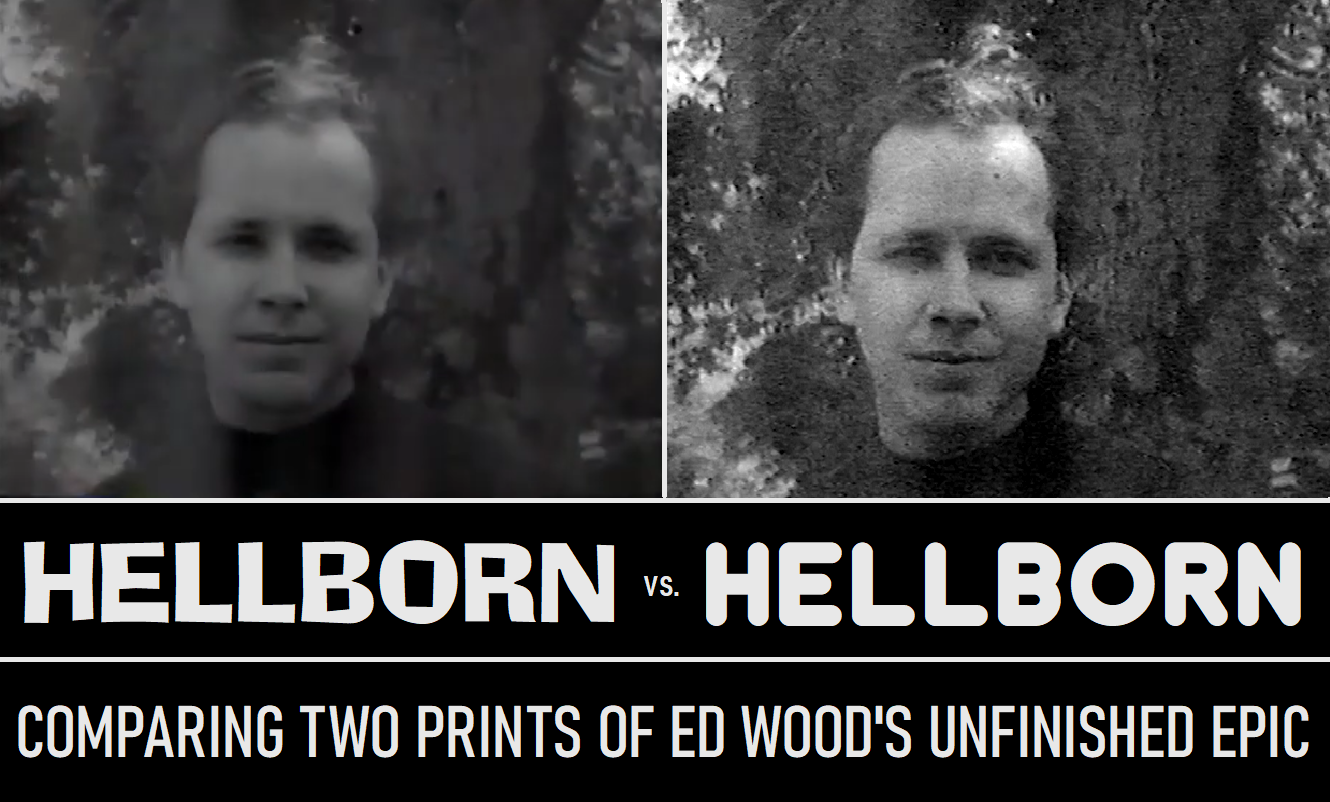
Ed Wood Wednesdays, week 212: Comparing two prints of 'Hellborn' (1956)

Two views of Conrad Brooks as a juvenile delinquent in Hellborn.

When Woody Allen was dissatisfied with September (1987), a somber, Chekhov-inspired drama he'd written and directed, he did something truly remarkable. Even though the movie was already in the editing stages, he scrapped everything he had completed, revised the script, recast all but two of the major roles, and reshot the entire film from scratch. The resulting motion picture garnered lukewarm reviews and earned back only 5% of its $10 million budget. It remains one of the biggest money-losers in the Allen filmography.

I think this story establishes Woody Allen as the cinematic opposite of Ed Wood, despite the passing similarity of their names. Eddie rarely had the luxury of throwing away footage that he'd shot and developed. His most famous feature, Plan 9 from Outer Space (1957), was literally built around using some precious silent film he'd shot of actor Bela Lugosi shortly before Bela's death. And when Ed's juvenile delinquent epic Hellborn (1956) ran out of money and couldn't be completed, Ed took some of the footage he'd shot for it and recycled it in Night of the Ghouls (1959) and The Sinister Urge (1960), regardless of whether it actually fit.

Generally, when we talk about Ed Wood's career, we can divide his film projects into two major categories: ones that got made and ones that didn't. Hellborn is in that rare middle territory, along with Range Revenge (1947), Crossroads of Laredo (1948), and The Night the Banshee Cried (1957): ones that sort of got made. Which is to say, enough footage was shot to give us a vague idea of what this project was supposed to have been. The remains of Hellborn were included in a 1993 documentary produced in conjunction with Cult Movies magazine that I reviewed some time ago on this blog.

Recently, however, reader Brandon Sibley informed me that the 2017 Blu-ray of The Violent Years (1956) from Vinegar Syndrome contained the Hellborn footage as well. This was certainly news to me, and I was eager to compare the 1993 and 2017 editions to see if there were any notable differences between them. Fortunately, since I don't own the Blu-ray (yet), Brandon was kind enough to rip a copy of the Hellborn footage for my perusal.

At first, I was shocked to see that the Vinegar Syndrome version ran over nine and a half minutes, while the Cult Movies version lasted only about seven minutes and 50 seconds. Had Vinegar Syndrome found nearly two minutes of precious extra Hellborn footage? Nah. A side-by-side comparison revealed that both versions of Hellborn contain the exact same shots in the exact same order, but the 1993 version runs about 25% faster than the 2017 version, hence the shorter running time. When I slowed down the 1993 edition just a little, it synced up with the 2017 edition perfectly. This begs the question, which running time is more accurate? I have no idea. My copy of the 1993 Hellborn documentary was made from a VHS tape, but Vinegar Syndrome says its copy of the footage was sourced from VHS as well. You'd think they'd run at the same speed. Nope.

Content-wise, as I indicated earlier, the two Hellborns are the same. I've never seen a script or even a plot outline for this film, but it seems to center around two violent street gangs—one all male, the other all female. We see both groups committing crimes, including mugging a man in an alley, terrorizing an ice cream salesman, and robbing a gas station. At the end, the two gangs rendezvous in the park. Conrad Brooks has a central role as a gleefully violent thug. Ed Wood plays two parts: a switchblade-wielding crime boss and a female robber. Mona McKinnon also turns up as a gun moll (or knife moll, if you will). Conrad's brother, Henry Bederski, has a memorable cameo as the aforementioned ice cream salesman.

There is a striking visual difference between these two transfers of the Hellborn footage. Neither one, it must be said, is in great shape. The source footage, much like that of Range Revenge, is alternately underlit and overexposed. Perhaps Ed's camerawork was faulty or the footage was poorly preserved. The 1993 transfer is rather dark and murky, but there's a reassuring, homogeneous smoothness to the images. In contrast, the 2017 version is considerably brighter but also quite a bit grainier, giving it a scratchy, speckled appearance.

As seen in Hellborn (sort of): Atlas Batteries and RPM Lubrication.

When I was performing the side-by-side comparison described above, my eyes initially preferred the dark-but-smooth 1993 version. But ultimately, the Vinegar Syndrome version won the day because it was sharper and revealed more background details. For instance, when the girl gang robs the ice cream joint, there's an oval-shaped neon sign in the window that reads "OPEN ICE CREAM." In the 1993 edition, this is just an indistinct ovular blob, but it's clear as day in the 2017 edition. Similarly, during the famous sequence in which Ed Wood (in full drag) robs a service station, there are signs advertising "ATLAS BATTERIES" and "RPM LUBRICATION" in the background. They're visible in both versions, but they're only legible in the 2017 version.

Another point in favor of the 2017 version is its soundtrack. The surviving footage for Hellborn is totally silent. One wonders what Ed Wood's plan would have been for completing the film. Stock music? Narration? Post-dubbed dialogue? It's a moot point, since the project was abandoned. The Cult Movies version from 1993 adds some tinny, lackluster synthesizer music to Ed's flickering, soundless footage. The score has a very distinct '80s/'90s sound and doesn't really match the footage at all. Meanwhile, Vinegar Syndrome chose to underscore Hellborn with some rambunctious 1950s rock music driven by saxophone, drums, and guitar. There's a snarling version of "MalagueƱa" that I especially enjoyed. If Hellborn's juvenile delinquent characters had been real, these are the records they might well have listened to!

I remain skeptical that Hellborn is a "lost masterpiece" or that it's of particular interest to anyone other than Wood completists. But, if you want it, it's out there to be found. In multiple places, no less!

Thursday, August 8, 2024

Ed Wood's Warm Angora Wishes: "Ridin' the Sunset Trail with the Plan 9 Kid"

Last man standing: Conrad Brooks was one of the last-surviving members of Ed Wood's inner circle.

NOTE: This article continues my coverage of Ed Wood's Warm Angora Wishes and Rubber Octopus Dreams (Arcane Shadows Press, 2024).

The story: "Ridin' the Sunset Trail with the Plan 9 Kid" by George "E-Gor" Chastain

Synopsis: Artist and film fanatic George "E-Gor" Chastain shares his memories of actor Conrad Brooks (1931-2017), whom he first met at a Famous Monsters of Filmland convention in 1989. By that time, Conrad was a regular on the convention circuit, signing autographs, selling memorabilia, and meeting fans whenever he could. Chastain and Brooks found they had a great deal in common, including a love of classic Westerns, and the two remained friends until Brooks' death in 2017.

Though most famous for appearing in the 1950s films of Ed Wood, including Plan 9 from Outer Space (1957), Conrad Brooks had dozens of screen credits as an actor and became a low-budget director in his own right during the 1990s and 2000s. According to Chastain, Brooks loved to reminisce about the actors he'd worked with, and he had colorful anecdotes about Jack Warden, Timothy Carey, Lawrence Tierney, and Joseph Wiseman. Chastain was happy to create promotional posters and buttons free of charge for Brooks.

In 2004, Brooks moved to a trailer in West Virginia, but he and Chastain stayed in touch through frequent phone calls. In his final years, Brooks became somewhat isolated and had neither cable nor internet access, but Chastain kept him in the loop regarding which celebrities had died and which classic movies were airing on TCM. He frequently mailed DVDs to Conrad's trailer so that the actor would never be without the old movies he loved.

Excerpt
All my life I've been searching for evidence of a more vibrant, stimulating world than the one I was born into, and I've found it on rare occasions, in the memories of older people (or deceased writers) talking about the long-gone world of their youth. It's strange that I could be so nostalgic for the world THEY lived in—but it's been a great comfort to me to imagine it existed, and still exists, if only in their memories. I'll always be grateful to Conrad Brooks and my many other inner-childhood heroes, mentors and good friends for sharing so much with me for so long.
Reflections: George Chastain's "Ridin' the Sunset Trail with the Plan 9 Kid" is the kind of fond, uncritical reminiscence you'd expect to hear at a testimonial dinner or a memorial service. Indeed, it reads like an extended eulogy for Conrad Brooks. If you were expecting a complicated, warts-and-all portrayal of the late actor-director, you won't find it here. This is strictly a wholesome, affectionate tribute from a fan. It was difficult to synopsize this piece, since it's not really even structured like a story. There's no "plot" here, per se, just a lot of random memories strung together in the order that they occurred to the author.

Monster kid George "E-Gor" Chastain
Conrad Brooks is the nominal subject of this article, but "Ridin' the Sunset Trail" functions as a mini-autobiography of George Chastain as well. We learn about George's childhood as a Navy brat, his early love of movies and other media, and the long-lasting friendships he forged with other movie fanatics. Over the decades, when he wasn't attending to his own aging parents, Chastain attended a lot of conventions and expos, met many of his heroes, co-edited a fanzine, posted to online forums regularly (especially The Classic Horror Film Board), and started a website devoted to TV horror hosts. 

While reading "Ridin' the Sunset Trail," I was reminded of Lem Dobbs' unproduced screenplay Edward Ford (1978), based on the life of actor (and Ed Wood associate) David Ward. That script is also about the strange, insular world of cinephiles who obsess over ancient Hollywood trivia and idolize Z-list actors the rest of the world has forgotten. One wonders what would have happened if David Ward and George Chastain ever met and started exchanging fun facts about the old, cheap Westerns and horror movies they loved. Their conversation might never have ended. I mean, here are just some of the many topics that Chastain discusses with great enthusiasm in this article:
  • the ultimate fate of Peter Lorre, Jr., an actor who falsely claimed to be Peter Lorre's son
  • Tor Johnson's numerous appearances on Western television shows
  • the legacy of Florida horror host Charlie "M.T. Graves" Baxter
  • the attendees of Bela Lugosi's funeral and whether or not they made tasteless jokes about Bela at the time
  • Bela's stunt double(s) in Bride of the Monster (1955)
  • Conrad Brooks' appearances in two Bowery Boys movies and a Vincent Price movie
  • the plot of Roy Rogers' The Trail of Robin Hood (1950), which brought together numerous cowboy stars
  • cowboy actor Ken Maynard's thwarted singing career
Although Warm Angora Wishes and Rubber Octopus Dreams is ostensibly an Ed Wood book, Eddie is merely a supporting player in "Ridin' the Sunset Trail." We get some description of Range Revenge (1948), the primitive, never-finished film that Ed and Conrad made when both were just starting out in Hollywood. Chastain also discusses Wood's working relationship with writer-producer Alex Gordon, through whom he met Bela Lugosi. 

Mostly, though, this article discusses Eddie through his connection to the world of B-grade Westerns. Both Eddie and Conrad, for instance, visited cowboy star Ken Maynard during his waning years. In his various films and unsold TV pilots, Eddie employed such Western actors as Bud Osborne, Johnny Carpenter, Kenne Duncan, Lyle Talbot, and Tom Keene. This was Ed's way of staying in touch with the cowboy films he had so loved as a child in Poughkeepsie. You'd really never guess any of this from Tim Burton's Ed Wood (1994), in which we only hear of Eddie's love of horror and sci-fi. Westerns were extremely important to Conrad Brooks, too, and Chastain laments the fact that neither Eddie nor Connie made their living from this genre.

"Ridin' the Sunset Trail" is a strange way to begin Ed Wood's Warm Angora Wishes and Rubber Octopus Dreams, since it's not really representative of the rest of the book. Nevertheless, it was instructive for me to read this article because it's a deep (deep) dive into the world of fan magazines and sci-fi conventions. Those things haven't really been a part of my life at all, but they played an important role in building and nurturing the cult of Ed Wood. 

Harry and Michael Medved often get the credit for making a posthumous star out of Wood with The Golden Turkey Awards (1980), but Chastain points out that Eddie and his movies were being publicized in the pages of Famous Monsters many years before the Medveds came along. In a way, then, "Ridin' the Sunset Trail" brings us back to the true origins of Woodology. Call it Roots.

Wednesday, July 31, 2024

Ed Wood Wednesdays, week 198: The difficulty of finding things when you don't know what you're looking for

Conrad Brooks (left) and Paul Marco in Plan 9 from Outer Space.

"It's tough to find something when you don't know what you're looking for."

Conrad Brooks says that notorious line about 37 minutes into Ed Wood's Plan 9 from Outer Space (1957), approximately the halfway point in the movie, and his fateful words have been evoking laughs from audiences for decades. The line has become iconic in its own way, so much so that an older Conrad Brooks playfully quotes himself in the documentary Flying Saucers Over Hollywood (1992).

A strange thought occurred to me recently, though: why?

What, exactly, is it about the line that makes it funny? Certainly, Brooks is speaking the truth here; it really is tough to find something when you don't know what you're looking for. Imagine being sent on a scavenger hunt without a list of specific items to locate. You'd have a tough time of it, right? So the character's logic is airtight. Nevertheless, the line hits our ears as unmistakably stupid, the kind of thing only a person with no self-awareness would say.

Partly, the humor comes from Conrad Brooks' utterly earnest, sincere delivery. He acts as though he has said something of importance when he has really communicated nothing. But consider his circumstances. His character in Plan 9, Jamie, is a uniformed Los Angeles cop who has been dispatched to a spooky, fog-shrouded cemetery that has been the site of several recent murders and other strange, supernatural incidents possibly involving zombies, aliens, and UFOs. Just what's been happening in this place, nobody knows.

It's a case so baffling it would test the mettle of even a seasoned lawman. Certainly, such matters are beyond Jamie's ken. Jamie's own boss, the venerable Inspector Daniel Clay (Tor Johnson), has recently been killed at this very cemetery. Now, a local woman named Paula Trent (Mona McKinnon) has reported being chased through the cemetery by a ghoulish old man (Bela Lugosi/Tom Mason). Jamie has been ordered to search the grounds, but what is he looking for? How will he even know when he finds it?

To make matters worse, Jamie has been paired with the least valuable man in the department, the bumbling Officer Kelton (Paul Marco). It is to Kelton that Jamie makes his infamous remark. The two officers do not seem to get along well—no one on the force likes Kelton—and Jamie is especially irritable because his shift ended an hour ago. How is a man supposed to make great insights under such conditions?

Wednesday, July 28, 2021

Ed Wood Wednesdays, week 120: A brief introduction to "Range Revenge"

Barbara Parsons and Conrad Brooks in Range Revenge (1948).

What was Edward D. Wood, Jr.'s first movie? That sounds like a pretty basic question, but the answer is not immediately clear. As with determining his so-called "last" movie, a lot depends on your definitions and parameters. 

If you were going strictly by Tim Burton's 1994 biopic Ed Wood, you'd think that Eddie had never stepped behind a camera until he made Glen or Glenda (1953). In Burton's film, he decides on the spur of the moment to become a filmmaker and assembles a cast and crew through his theater and studio contacts. But dedicated fans know that our man from Poughkeepsie had been involved in both film and TV productions for several years by the time he made Glenda.

If you don't limit yourself to Ed's feature-length directorial efforts, the field of candidates for his "first movie" widens considerably. How far back do you want to go? In Nightmare of Ecstasy: The Life and Art of Edward D. Wood, Jr. (1992), a man named Fred Robertson -- apparently a friend of Eddie's father -- remembered seeing about four minutes of footage that Ed Wood shot as an adolescent with his first camera. Robertson recalled "scenes of [Ed] playing G-man with cap pistols" and "a couple of guys playing cops and robbers." So it sounds like there was at least some semblance of a narrative to what I'll call The Robertson Footage

Do we count this as Ed Wood's first movie? Before you answer, consider that the current IMDb entries for such prominent filmmakers as Ron Howard, Steven Spielberg, and the Coen brothers contain similar homemade efforts. Incidentally, I think I've discovered a slight discrepancy in the saga of Ed Wood's infamous first camera. A photo caption in Nightmare says that Eddie received a "Kodak City [sic] Special," as a gift on his 17th birthday in 1941. But in that same book, Kathy Wood relates an anecdote about her late husband filming the doomed Hindenburg airship, which famously crashed in 1937. Was this yet another of Eddie's tall tales?

The hottest gift of 1941: a Kodak 16mm camera.

Since The Robertson Footage has never resurfaced, let's confine ourselves to Ed Wood's professional efforts from his 30-year tenure in Hollywood. Most filmographies, including the one in Nightmare, begin with the wobbly Western called Streets of Laredo or Crossroads of Laredo, shot in 1948 but abandoned in post-production and not completed until 1995. When I began this series of articles eight years ago, Laredo was the first Ed Wood movie I reviewed. At the time, I called it "very primitive and somewhat of a chore to watch."

A dark horse candidate for Ed's directorial debut is another 1948 Western -- Range Revenge, starring Wood mainstay Conrad Brooks and his two brothers, Henry and Ted, alongside Barbara Parsons and B-Western star Johnny Carpenter. Rudolph Grey doesn't even mention Range Revenge in Nightmare of Ecstasy. Other books like Muddled Mind: The Complete Works of Edward D. Wood, Jr. (2001), The Cinematic Misadventures of Ed Wood (2015), and Ed Wood, Mad Genius (2009) skip over it, too. 

Conrad Brooks alone kept the memory of the film alive. The first opportunity fans had to see this footage was in 1993, when Connie hosted a grab-bag-style documentary called Hellborn: The Aborted Masterpiece of Edward D. Wood, Jr., produced in conjunction with Cult Movies magazine. That hourlong tape contains previously unseen footage from Eddie's abandoned juvenile delinquent movie Hellborn, but it also includes what Brooks claims is Ed Wood's first professional directing job in Hollywood.

Connie's story about the footage goes this way: In 1948, he and his brother, Henry Bederski, were visiting Hollywood from their native Baltimore for a few weeks. They hadn't come West to be in showbiz necessarily, but they got to know a few people in the industry, including Edward D. Wood, Jr., himself fairly recently arrived from Poughkeepsie. Connie and Ed became fast friends, and Henry told Ed about his plan to make a modest "home movie" of himself and his brother to send back to Baltimore.

Sensing an opportunity, Eddie took over the project, offering to film the little screen test on a "good camera" for $60. That's nearly $700 in today's money, probably a hefty chunk of change for Conrad Brooks in those days. Henry and Connie felt Ed was overcharging them, but they acquiesced because they liked him and felt he needed the cash. The original plan was for Connie to act, Henry to direct, and Eddie to act as cameraman. Once they started filming on 16mm in Griffith Park, however, Ed cajoled Henry into acting and took over as director.

As with The Robinson Footage, it seems like there was at least some attempt at a narrative with Range Revenge. "The script was thrown away," Brooks told Cult Movies editor Michael Copner with a chuckle. This suggests that there was a script in the first place. Despite that, the actor remembers the shoot being a lot of fun. Brooks balks at giving the film a title. "Call it whatever you like," he jovially tells Copner. 

In later interviews, however, the actor specifically referred to the project as Range Revenge and said that his brother Henry had written a script for it and was annoyed by Eddie's interference. According to Brooks, Ed Wood "took over the whole picture" and "just shot things at random." The 11 minutes of overexposed black-and-white footage on the Hellborn tape bear out that description. 

Wednesday, May 26, 2021

Ed Wood Wednesdays, week 118: 'Hellborn' (1956/1993)

Hellborn is like a jigsaw puzzle with missing pieces.

One of the strangest passages in Ed Wood's Night of the Ghouls (1959) occurs just four and a half minutes into the film. Ostensibly a follow-up to Bride of the Monster (1955), Ghouls is another of Wood's supernatural horror thrillers. The plot revolves around a phony medium, Dr. Acula (Kenne Duncan), who inadvertently manages to summon the dead while performing fraudulent seances in a spooky mansion. For some reason, though, narrator Criswell takes a few minutes to talk to us about juvenile delinquency:
Your daily newspapers, radio, and television dares to relate the latest in juvenile delinquency. At times, it seems juvenile delinquency is a major problem of our law enforcement officers. But is this the major horror of our time? Is this violence and terror a small few perpetrate the most horrible, terrifying of all crimes our civil servants must investigate? 
The National Safety Council keeps accurate records on highway fatalities. They can even predict how many deaths will come on a drunken holiday weekend. But what records are kept? What information is there? How many of you know the horror, the terror I will now reveal to you?
As we hear this voice-over monologue, accompanied by hot jazz drumming and a wailing siren, Wood shows us flashes of seemingly unrelated footage: a police car whizzing from somewhere to somewhere else; young people dancing and eating at a pizzeria called Jake's Pizza Joint; two men (Ed Wood and Conrad Brooks) fighting in a pit as a crowd watches; a gang of three men beating the tar out of a fourth man as a girl stands off to the side; a car going off the road and tumbling down a cliff before crashing into a tree, etc. Apart from the shots of the police car—this is another of Ed's many police procedurals—none of this footage belongs in Night of the Ghouls. So what's it doing there? 

Wednesday, December 2, 2020

Ed Wood Wednesdays: The Wood Collaborator Odyssey, Part 22 by Greg Dziawer

After acting for Ed Wood, Conrad Brooks became a director.

There's no doubt that actor Conrad "Connie" Brooks (1931-2017) was a major player in the Ed Wood saga. Born Conrad Biedrzycki in Baltimore, he was a key member of the Wood repertory company in the 1950s, back when Eddie was making such classics as Glen or Glenda (1953), Bride of the Monster (1955), and Plan 9 from Outer Space (1959)Conrad's bald-pated brother, Henry Bederski (1910-2003), appeared in some of those familiar movies as well. As I wrote back in October, Eddie's very first directorial effort after moving to Hollywood might well have been 1948's Range Revenge, a modest Western vehicle for Conrad and Henry.

For decades, Conrad was skeptical about the value of those movies he made with Ed Wood in the '50s. But after attending some sold-out Plan 9 screenings in the wake of The Golden Turkey Awards (1980), Connie saw the light. He got back into acting in the 1980s and started writing and directing his own films in the 1990s, including titles like Blood Slaves of the Vampire Wolf (1996) and Jan-Gel: The Beast from the East (1999). He kept directing well into the new millennium and was acting right until the end of his life. He was not someone I ever really looked into, however, at least not until recently. I screened some of his '90s opuses a few weeks ago, and they were at times fun and even surreal. That is, if you enjoy that kind of garage cinema.

Some say that Conrad Brooks was shamelessly cashing in on his connection to Ed Wood, but I don't agree. Connie's enthusiasm for his work seemed genuine. He was a staple of the convention circuit in his later years, and the Ed Wood fans who got to know him personally found him to be fun, energetic, and gregarious. (Side note: I wish I'd been more into those conventions back in the '90s. I mean, Russ Meyer and Jesus Franco?!) And if Conrad was trying to "get rich quick" by riding Eddie's coattails, why did he eventually leave Hollywood and return home to live in his ex-wife's trailer?

Wednesday, October 14, 2020

Ed Wood Wednesdays: The Wood Collaborator Odyssey, Part 20 by Greg Dziawer

This week, Greg looks at a forgotten collaboration between Ed Wood and Conrad Brooks.

(top to bottom) Ed Wood,
Conrad Brooks, and Conrad's
brother Henry Bederski.
When we think of the performers who were a part of Ed Wood's orbit, a host of indelible personalities come immediately to mind. There's Vampira and Criswell. Tor Johnson. Timothy Farrell and Valda Hansen. And that's just to name a few of Eddie's supposed "stock players." In truth, Vampira and Valda Hansen each only appeared in one film directed by Ed, and Criswell and Farrell in only two apiece.
 
But there was one actor who appeared in all of Ed's first six films -- the "canon" for those dismissing his later work in adult films -- as a writer-director: Conrad Brooks (1931-2017). You'll remember him best as Jamie in Plan 9 from Outer Space, the cop who utters the memorable line, "It's tough to find something when you don't know what you're looking for." He pops up in multiple roles throughout Glen or Glenda. In Night of the Ghouls, he and Eddie get into a fistfight. 

I recently stumbled upon an interview with Brooks from the January 14, 2000 edition of the Pittsburgh Post-Gazette. By this time, Brooks had become a regular at cult film conventions, meeting fans and signing autographs. He had also become a director in his own right, returning to his roots making low-budget schlock, albeit with tongue firmly in cheek. The article provides a nice overview of Brooks' life and work, apart from typical fallacies like the saucers in Plan 9 From Outer Space being hubcaps. However, one detail jumped out at me, reminding me that there's another Ed Wood film possibly out there that has largely slipped through the cracks.

In the article, Brooks notes that his brother Henry Bederski wrote a film called Range Revenge and details Ed taking the reins to direct it. Described as a "home-movie" Western and shot in Griffith Park, Range Revenge was made circa 1948, marking it as one of Ed's first filmic efforts after arriving in Hollywood. Brooks' IMDb page identifies it as a 15-minute short.

While the film is presumably gone, it must not remain forgotten!

Conrad Brooks also mentions Range Revenge in the 2011 documentary/interview Conrad Talks Hollywood, which you can check out at YouTube or stream for a pittance on Amazon Prime. Here's another worthwhile interview with Conrad.

Last but not least, my friend Al Doshna, associate producer of the superb 1995 documentary The Haunted World of Edward D. Wood. Jr., maintains a wonderful page dedicated to his close friend Conrad Brooks here

Wednesday, July 1, 2020

Ed Wood Wednesdays, week 105: "On the Trail of Ed Wood" (1990)

Conrad Brooks, Ed Wood, Criswell, some graffiti, and Tor Johnson figure in this documentary.

A somewhat forgotten documentary.
Orson Welles' Citizen Kane (1941) can be described as a film about the rise and fall of publishing tycoon Charles Foster Kane, a man ultimately thwarted by his own ego and insatiable desire to be loved. But, seen in a different way, it can also be described as the story of a diligent reporter named Jerry Thompson (William Alland) who sets out to discover the meaning of Kane's last word—"Rosebud"—and interviews several of the great man's personal and business associates in order to file his report. At the end of his unsuccessful quest, Thompson dismisses the idea that "Rosebud" would have explained everything about his subject.
"No, I don't think so. No, Mr. Kane was a man who got everything he wanted and then lost it. Maybe Rosebud was something he couldn't get, or something he lost. Anyway, it wouldn't have explained anything. I don't think any word can explain a man's life. No, I guess Rosebud is just a piece in a jigsaw puzzle. A missing piece."
I flashed back to Citizen Kane while watching the little-loved 1990 documentary On the Trail of Ed Wood. This humble, hour-long film, made by Michael Copner and Buddy Barnett of Cult Movies magazine, is essentially an extended interview with Conrad Brooks (1931-2017), Eddie's close friend and an actor in several of his films, including Glen or Glenda (1953) and Plan 9 from Outer Space (1959). 

Conrad is a lot like the interview subjects in Citizen Kane, ruminating on the life of a famous dead man and trying to glean some meaning from the chaos. The difference is, the remembrances in Kane are full of drama, comedy, intrigue, tragedy, philosophy, etc. while Conrad Brooks' stories are often vague and slow-paced. Connie spent a lot of time with Ed Wood but doesn't seem to possess any special insight into the eccentric filmmaker. As a result, On the Trail of Ed Wood plays like the footage Orson Welles (or Jerry Thompson, for that matter) might have cut from Citizen Kane.

But that's not to say On the Trail is without merit. The documentary turns 30 this year, so this is as good a time as any to look back on it. If nothing else, it offers a snapshot of the Wood cult as it stood a decade after the publication of Harry and Michael Medved's The Golden Turkey Awards and four years before the release of Tim Burton's biopic Ed Wood. This was an in-between time for Eddie's fandom. The initial wave of curiosity provoked by the Medveds had cooled off, but the second, more scholarly wave of Woodmania hadn't really begun yet. In particular, Rudolph Grey's Nightmare of Ecstasy: The Life and Art of Edward D. Wood, Jr. (1992) was still two years away from publication, so the closest thing to a career-spanning Wood biography was the homemade 1981 chapbook Edward D. Wood Jr.: A Man and His Films by superfans Randy Simon and Harold Benjamin.

Besides Grey's book and Burton's movie, the 1990s also saw the release of three distinctive, stylized documentaries about Eddie: Ted Newsom's Look Back in Angora (1994), Mark Patrick Carducci's Flying Saucers Over Hollywood (1992), and Brett Thompson's The Haunted World of Edward D. Wood, Jr. (1995). Crude as it is, On the Trail of Ed Wood predates all of these, not to mention Grey's book. As far as I know, it's the first full-length documentary about Ed Wood of any real substance. For that alone, it deserves better than its current 3.8 rating at the IMDb.

The DVD version.
On the Trail of Ed Wood begins with a rudimentary credit sequence set to the theme from Swan Lake, a piece of music inextricably linked to Bela Lugosi. Conrad Brooks is listed as the host of the program, with Cult Movies publisher Buddy Barnett as the producer, a man named John Norris as the associate producer, and Cult Movies founder Michael Copner as the director. It would be more accurate to say that Copner, whose life took a tragic turn in the 2000s, is the documentary's true host, since it is he who welcomes us to the film, while Barnett is the one interviewing Brooks.

After these credits, On the Trail offers us some goofy man-on-the-street interviews shot in Hollywood, with Copner asking passersby what they know about Ed Wood and Plan 9. Perhaps coincidentally, this is also how Flying Saucers Over Hollywood starts. While I'm not hugely enthusiastic about this material in either film, this footage at least allows us to see what the busy intersection of Hollywood Blvd. and Cherokee Ave. looked like 30 years ago. (Side note: The legendary Musso & Frank Grill, a key location in Ed Wood and Once Upon a Time in Hollywood, is just offscreen.) 

"We have just seen the evidence," says Copner to the camera in the style of Criswell. "There are still people out there in the world today who have no idea who Edward D. Wood, Jr. really was. Now we hope to change all that with this videotape." On the Trail was originally marketed as a mail-order VHS tape in the pages of Cult Movies magazine, but the version I reviewed was a DVD edition from Alpha Video.

Copner gives us a very perfunctory, pre-Wikipedia description of Ed Wood (back when people thought Eddie made only six movies), then explains that he and Barnett ran into Conrad Brooks while doing research on a horror movie book. According to Copner, Brooks allowed the Cult Movies team to see rare pictures and other documents from Connie's own personal archives. Throughout the film, we glimpse various posters, lobby cards, and press kits related to Ed's movies, with Orgy of the Dead (1965) being the most recent film thus featured. There are also plenty of photographs, including behind-the-scenes pictures, headshots and promotional photos, and even some personal snapshots. I don't think any (or many) of these were new to me, but maybe this was all virgin territory in 1990. This was pre-internet and pre-Nightmare of Ecstasy.

The vast majority of On the Trail consists of Conrad Brooks, dressed casually in a red sweatshirt and dark blue slacks, slumped on a couch, reminiscing at great length (but not great depth) about Ed Wood. Buddy Barnett occasionally chimes in with questions or prompts. Connie is not exactly a natural raconteur, with his slow, halting delivery, and the slack editing here does him no favors. On the Trail really makes you appreciate those other '90s Ed Wood documentaries I mentioned, all of which feature multiple interview subjects rather than just one. I can imagine clips from this film being used in another, more focused movie.

As it is, Copner and Barnett's discussion with Conrad Brooks is divided into a few major sections, interrupted by occasional field trips to significant locations in Los Angeles. I've done what I can to find interesting or useful information in these parts of the documentary.

Thursday, January 11, 2018

Ed Wood Extra: To those we lost in 2017

Rance Howard, Martin Landau, Conrad Brooks, David Ward, and Steve Apostolof.

Before we get too far into 2018, I thought it only proper that we should acknowledge a few of those who died in 2017, specifically those whose lives intersected in some way with that of Ed Wood. Sadly, the number of people who knew Eddie or who worked with him directly is getting smaller and smaller each year. And even Tim Burton's Ed Wood is now 24 years old, if you can believe it, and a number of cast and crew members from that biopic have since died. In brief, 2017 took a hell of a toll on the Ed Wood community. It was nice, I suppose, to have some new books and BluRay releases, but they're a poor substitute for these extraordinary people.

Let's deal with the Burton film first. Two of the principal cast members of Ed Wood passed away in 2017. The one who got the lion's share of the headlines, naturally, was Martin Landau, who died at the advanced age of 89 on July 15 of last year. A native New Yorker whose career in film and television spanned an astonishing 64 years, Landau finally won an Oscar in 1995 for his portrayal of a cranky, crumbling Bela Lugosi, turning to Ed Wood for employment and companionship in his final years. Aided by Rick Baker's award-winning makeup, Landau managed to bring new insight and vulnerability to the much-imitated and caricatured Lugosi. Whenever I see Bela in a movie -- whether it's one of Wood's movies or not -- I think of Landau.

Departing our realm, too, was character actor Rance Howard, who played straight-shooting moneyman Donald McCoy in Ed Wood. (He wants Eddie's movie to end with a "sky full of smoke" and gazes up dreamily as he imagines the glorious destruction.) Father of Clint and Ron Howard, Rance was one of the most familiar faces in Hollywood, appearing in nearly 300 movies and television shows starting in the mid-1950s. He had an honest face and a slight Oklahoma drawl that served him well in dozens upon dozens of roles. Rance worked so often and with so many people, in fact, he comes much closer than Kevin Bacon to being the center of the Hollywood universe. Rance Howard died on November 25, 2017. He, too, was 89.

Perhaps the most significant Wood-related death of 2017 was of actor turned filmmaker Conrad "Connie" Brooks, who died just last month at the age of 86. An irreplaceable link to the past, Brooks was truly the last surviving member of Eddie's inner circle, having appeared in Glen or Glenda, Plan 9 from Outer Space, Bride of the Monster, The Sinister Urge, and Jail Bait. Since Eddie's personal and professional lives were so intricately intertwined, Conrad Brooks can safely be called one of Ed's cronies. Who knows how many more movies they would have made together if there were but world enough and time, not to mention cash? A staple of documentaries about Wood, always popping up to talk about his departed pal, Brooks was a B-movie lifer. Even without Eddie, the incorrigible, garrulous Connie appeared in dozens of low-budget flicks (as well as Burton's Ed Wood) and eventually wrote and directed a few of his own.

Attention should also be paid to the passing of stage and screen actor David Ward, who died in August at the age of 84. He'd been a resident of a Los Angeles nursing home for years, and Ed Wood superfan Bob Blackburn stayed in contact with him and visited him frequently until the end of his life. Ward was another of Wood's Hollywood cronies, especially during Eddie's boozy final years in the 1970s, though the two didn't really work on many movies together. Ward was also a personal friend of Bulgarian-born filmmaker Stephen C. Apostolof and made cameos in at least two of Apostolof's movies, The Cocktail Hostesses and Drop Out Wife, both scripted by Eddie. And Ed had other plans for David, including an adaptation of his short story "To Kill a Saturday Night," that never came to pass. The David Ward saga is an incredible one, inspiring the unproduced screenplay Edward Ford, which I thoroughly discussed here.

Speaking of Apostolof, the late filmmaker's oldest son Steve Apostolof died unexpectedly after a brief illness in Simi Valley, CA at the age of 60 on November 19, 2017. Like all of Apostolof's children, Steve made numerous visits to his father's sets and even made an onscreen appearance in 1978's Hot Ice, canonically the last film Ed Wood ever worked on. (Eddie was credited as an assistant director and was slated to make a cameo but was too drunk to do so.) In addition, Steve was one of the interviewees in Jordan Todorov's documentary Dad Made Dirty Movies. He took great amusement in his father's colorful career and helped keep the Wood-Apostolof legend alive by sharing his stories of those bygone days of the 1960s and '70s.

Rest in peace, one and all.