Showing posts with label Warm Angora Wishes and Rubber Octopus Dreams. Show all posts

Wednesday, December 25, 2024

Ed Wood Wednesdays, week 208: A look back at the year in Ed Wood

There was a lot of Ed Wood in 2024. Too much, perhaps?

In the career-spanning book Frank Zappa: The Negative Dialectics of Poodle Play (1995), author Ben Watson astutely observes that "1984 was a bamboozling year for Zappa consumers: The Perfect Stranger, Francesco, the triple-box Thing-Fish and then, as if that was not enough, a full-scale double rock album of new tunes, Them Or Us." 

Ed Wood consumers could relate, as 2024 was a bamboozling year for them too. This was the 100th anniversary of Eddie's birth in Poughkeepsie, NY, and it seemed to inspire a torrent of releases and rereleases. Fans could barely keep up. And by "fans," I mean me.

Ed Wood's Saving Grace
Let's first talk about the books. God, there were so many! For quite a while, Rudolph Grey's Nightmare of Ecstasy (1992) stood alone as the only full-length book about Edward D. Wood, Jr. Now, Woodology is practically a literary subgenre unto itself. This year gave us a few more entries.
  • Will Sloan announced his upcoming book Ed Wood: Made in Hollywood USA (OR Books), due in June 2025. It promises to be a wide-ranging critical study that includes Ed's movies as well as his novels and other written works.
  • I should also mention Fred Olen Ray's wonderfully goofy horror novel Deep Red (Retromedia Press), based on an unproduced screenplay Fred cowrote with a drunken, dying Eddie in the late 1970s. Fred's book came out in 2023, but I didn't find out about it until 2024. 
Ed Wood fans, you have your reading list for the next six months. Or more. You'd think that would have been enough for me, but this was also the year that I purchased a stack of vintage Ed Wood paperbacks from a seller on Facebook.

Has Flame of Islam been found?
And that's not even half the story! There were some significant home video releases in 2024 as well, all of them on Blu-ray. I guess the era of affordable, accessible DVDs has ended. Oh well. It was nice while it lasted. Here are the titles I added to my collection within the last 12 months.
  • In May 2024, a specialty label called Gold Ninja Video, which bills itself as the "Criterion of Public Domain Bargain Bins," released a two-disc limited edition of Ed Wood's Revenge of the Dead (1959). This is a movie we already know well under the rerelease title Night of the Ghouls but this edition includes the original credits, plus a slew of supplements and commentary tracks. Also included in this set are transfers of Jail Bait (1954), Final Curtain (1957), and (if you go snooping) The Sinister Urge (1960). There are also numerous extras related to actor Paul Marco, who portrays Kelton in the film, as the folks at Gold Ninja are big fans of his. Unfortunately, this seems to have vanished from the market shortly after its release. If you don't already own it, good luck finding it on auction sites.
  • Arguably the biggest Ed Wood home release of the year was Severin's Hard Wood: The Adult Features of Ed Wood. This is a three-disc set containing new—and, in some cases, drastically improved—scans of Necromania (1971), The Only House in Town (1970), The Young Marrieds (1972), and Shotgun Wedding (1963), plus some of Ed's adult loops from the 1970s. Again, there are numerous commentary tracks, some featuring the late, great Greg Javer, plus various featurettes. This is arguably the most ambitious Ed Wood home video release since Big Box of Wood (2011). I only regret that Greg passed away so shortly after its release and that we couldn't go through the contents of this set together. Unlike Revenge of the Dead, this collection is still available.
  • Just this week, I received a disc from BayView Entertainment and The 3D Film Archive containing a new transfer of Arch Oboler's forgotten feature Domo Arigato (1973), which I'd describe as a cross between a romantic drama and a travelogue of Japan. The dramatic parts are middling at best, while the travelogue parts are often spectacular, making excellent use of the 3D "Space Vision" gimmick. My interest in this particular disc is that it also contains a short film alleged to be Ed Wood's long-lost Flame of Islam under the title Cleopatra Follies (1953). It's extremely tame burlesque footage, including rather listless performances by Paula French and Shirley "The Pussycat Girl" Hayes, but the 3D effects are again quite impressive. Eddie's involvement was supposedly limited to writing the (sparse) voiceover narration.
As a result of all these releases, I definitely exceeded my "Ed Wood budget" for 2024. Bob sent me a complimentary copy of Kathy Wood and I, but the other books and discs I got were ones I'd paid for out of my extremely meager salary. Oh well. Who needs such trivialities as food and rent when you can have Necromania on Blu-ray? 

Before 2024 comes to a close, we must remark on the times Eddie made the news this year. As I mentioned earlier, October 10, 2024 would have been Eddie's 100th birthday. This year is also the 30th anniversary of Tim Burton's Ed Wood (1994). So, as you might guess, there were screenings of that film as well as Ed's most famous 1950s films in theaters across the country in October, especially in his home state of New York and his adopted home of California. It's wonderful that Ed's birthday happens to fall during "spooky season," as does the birthday of his most famous star, Bela Lugosi.

While I was not able to attend these screenings in person, I did attend one virtually via Zoom and even got to host a Q&A after a screening of Ed Wood in the Poughkeepsie, NY area. Not long afterward, this same town saw fit to designate Ed Wood's childhood home as an official historical site, complete with its own marker. This recognition came about because of the efforts of some high schoolers in the area who cited this very blog as one of their sources! It does my heart good to know that Greg was aware of all this before his passing.

Look, I'd love to say that 2024 was a banner year in Woodology. In a lot of ways, it was—the 100th birthday, the books, the Blu-rays, the historical marker. That was all great, and it's nice that Ed Wood and his career are still generating such interest well into the 21st century. But the death of my friend and colleague Greg Javer, one of the greatest Woodologists I've ever known, casts a pall over the entire year. A lot of the books, articles, and films I reviewed for this series were only available to me because Greg had sent them. Where we go from here, I don't know. I'm still regrouping. We'll figure this out, week by week. In the meantime, I hope you and yours are enjoying the holiday season.

Wednesday, October 9, 2024

Ed Wood's Warm Angora Wishes: "Appendix: The Correspondence of Ed Wood and Bela Lugosi"

Ed Wood was a man of letters. Many of them.
NOTE: This article concludes my coverage of Ed Wood's Warm Angora Wishes and Rubber Octopus Dreams (Arcane Shadows Press, 2024).
The story: "Appendix" by Frank Dello Stritto and Edward D. Wood, Jr.

Synopsis: Circa April 1973, author Frank Dello Stritto visited the Ackermansion, the Los Angeles home of Famous Monsters of Filmland editor Forrest J. Ackerman. While there, he found some old letters that had been written by Ed Wood in March 1954, most of them addressed to actor Bela Lugosi. Dello Stritto meticulously dictated them into a tape recorder, then transcribed the recordings when he got home to New Jersey. What follows are nine of those letters.

Edwin Schallert.
March 1, 1954: Ed is trying to secure work for Bela, who is headlining a revue at the Silver Slipper in Las Vegas. During a recent work trip to Vegas, Ed managed to run up a bill of $300, which amounts to over $3,000 in today's money. Bela is now obligated to pay most of this, with Ed contributing $48 of his own money. Ed disputes the bill and says it is very important to him that people know he is not trying to take advantage of Bela in any way, financially or otherwise. Eddie Fox, the publicity director for the Silver Slipper, is in Los Angeles to meet with a talent agent named Lou Sherrill. Ed says he will meet with Eddie Fox to discuss the matter personally, and he chastises Bela for mentioning the money dispute to Lou Sherrill. ("You could have come to me first.")

Meanwhile, Ed is convinced that the upcoming film The Bowery Boys Meet the Monsters (1954) will be "a hell of a lift" for Lugosi's career. He imagines the news stories it will generate, bringing attention to both Lugosi and the Silver Slipper. Furthermore, Ed says that Lou Sherrill has an idea for a new nightclub act starring Bela. Ed tells Bela that the actor's comeback is in full swing and that more triumphs lie ahead. As an example, Ed says he is talking to Los Angeles Times writer Edwin Schallert, who is planning a big article about Bela Lugosi. Schallert is headed to Vegas to review actor Howard Keel's show, and he will be swinging by the Silver Slipper to check out Bela's revue.

Ed warns Bela not to get taken by all the "sharpies" in Las Vegas. Ed says that, when he was there on business, he kept track of every expense he incurred. Bela should not pay for anything that Ed did not account for personally. He worries that he now looks bad in the eyes of Lou Sherrill. Ed stresses that Bela needs to tell Lou this was all a misunderstanding and that Ed is not a conman or a parasite.

Ed then returns to the subject of the Bowery Boys movie. Ed tells Bela not to worry about learning all the dialogue in the script. "We'll get it this time," he says. Ed claims to have a three-picture deal with Howco and declares that at least one of these films will be a star vehicle for Bela. According to Ed, horror films are enjoying newfound popularity at the moment; he points to some 3D films from Universal and Warner Bros. as examples. Bela's new film should fit right in. Eddie closes the letter by rehashing the matter of the $300 bill and emphasizing that he is being honest and scrupulous in his dealings with Bela.

March 5, 1954: Several days later, Ed responds to a "seven-point note" from Lugosi. Ed says that Schallert's story has not been printed yet. When it is, Ed will buy ten copies and send five to Lou Sherrill. Ed also thanks Bela for explaining the previous awkward situation to Lou via telegram. ("His attitude changed for the better almost immediately.")

Ed says that "the troubles on my picture [presumably 1954's Jail Bait] have ended," meaning that he will now be able to pay his previous debt to Bela. On the other hand, producer George Weiss says that Ed and Bela's previous film, Glen or Glenda (1953), has not turned a profit yet.  Ed is dubious of this, because Weiss has managed to pay off $1,000 in debts since it opened and Ed is owed 50% of the take. Ed further claims he has two more films in the works and thinks he can get Bela $5,000 for ten days of work. Ed will be producing Bela's movie for Monogram and will decide who gets paid what.

Ed mentions some press clippings that Bela has sent him. Ed says he forwarded these to Alex Gordon for preservation. Ed also congratulates Bela on extending his Vegas show another two weeks and says that it will not be difficult to line up some film work for the veteran actor now. He boasts that, between himself and Lou Sherrill, Bela now has "two good men on [his] side." Ed closes the letter by promising to write again soon. He also asks about some "collars" and some publicity photos.

Saturday, October 5, 2024

Ed Wood's Warm Angora Wishes: "Afterword"

The day Ed Wood stood still.
NOTE: This article continues my coverage of Ed Wood's Warm Angora Wishes and Rubber Octopus Dreams (Arcane Shadows Press, 2024).
The story: "Afterword" by Fred Adams, Jr.

Synopsis: In this appreciative essay, the author talks about how Ed Wood's ineptitude is ironically what brought him everlasting fame. People love to poke fun at how cheap and shoddy Ed's 1950s films were, but we shouldn't overlook the director's resourcefulness and ingenuity in making them with such limited resources. He didn't have big budgets, and he had to use his friends and acquaintances to play many of the roles in his movies. Would prestigious directors like Cecil B. DeMille and Robert Wise have fared as well under such circumstances?

Recognizable stars like Tor Johnson, Vampira, and Lyle Talbot may have been slumming when they appeared in Plan 9 from Outer Space (1957), but at least they were working. Ed Wood is often called out for his reliance on stock footage and library music, but even big-budget films have used these shortcuts. Besides, Ed didn't have the money to hire composers or film expensive action sequences. He wasn't working in the studio system; he was piecing these films together from whatever scraps of material he had. Plan 9 can be seen, then, as Ed Wood's ultimate labor of love.

Excerpt:
Plan 9 was finished for $60,000. Imagine Robert Wise filming The Day the Earth Stood Still on that budget. Gort would have had stovepipes for legs and a welding mask for his face. Forbidden Planet cost just under $2 million, $125,000 of it spent to build Robby the Robot. With that kind of budget, Ed Wood might have enlisted the likes of Ray Harryhausen to animate his flying saucers instead of using Cadillac hubcaps dangling from fishing line.
An inverted ice cream cone.
Reflections: This fun little essay by author Fred Adams, Jr. (presumably this gentleman) gave me flashbacks to a track called "Cheepnis" by Frank Zappa and The Mothers of Invention from the double live album Roxy & Elsewhere (1974). The song is a tribute to low-budget monster movies of the 1950s, and the strangely-spelled title refers to a special quality that these films have. Frank begins the song with a spoken-word monologue in which he explains the concept in more detail:
I love monster movies. I simply adore monster movies. And the cheaper they are, the better they are. And cheepnis in the case of a monster movie has nothing to do with the budget of the film, although it helps. But true cheepnis is exemplified by visible nylon strings attached to the jaw of a giant spider. 
I'll tell you a good one that I saw one time. I think the name of the film was It Conquered the World. Did you ever see that one? The monster looks sort of like an inverted ice-cream cone with teeth around the bottom. It looks like a teepee or a rounded-off pup tent affair. And it's got fangs on the base of it. I don't know why, but it's a very threatening sight. And then he's got a frown and an ugly mouth and everything .
There's this one scene where the monster is coming out of a cave. See? There's always a scene where they come out of a cave, at least once. And the rest of the cast... It must have been made around the 1950s. The lapels are about like that wide. The ties are about that wide, and they're about this short, and they always have a little revolver that they're gonna shoot the monster with. And there's always a girl who falls down and twists her ankle. Of course there is. You know how they are, the weaker sex and everything! Twisting their ankle on behalf of the little ice cream cone.  
Well, in this particular scene, folks, they didn't want to retake it because it must have been so good they wanted to keep it. But when the monster came out of the cave, just over on the left hand side of the screen, you see about this much two-by-four attached to the bottom of the thing as the guy is pushing it out, and then obviously off-camera somebody's going, "No! Get it back!" And they drag it just a little bit as the guy is going, "Kkkkhhhh! Kkkkhhhh!"  Now that's cheepnis!
While Roger Corman's It Conquered the World (1956) has no direct connection to Ed Wood, it came out around the same time as Wood's own Bride of the Monster (1955) and the aforementioned Plan 9 and is cut from the same cloth as them. Zappa's comment about Beverly Garland, the heroine of It Conquered the World, twisting her ankle reminded me of the scene in Plan 9 in which Mona McKinnon falls in the graveyard while running from the Ghoul Man (Bela Lugosi and Tom Mason). I can vouch for the part about monsters emerging from caves, too. While Eddie never actually filmed at Bronson Caves, many of his contemporaries did, most notably Phil Tucker of Robot Monster (1953) infamy.

(Side note: Fred Adams, Jr. speculates that, if Ed Wood had a bigger budget, he could have hired Elmer Bernstein. Well, Phil Tucker had no budget, and he did hire Elmer Bernstein!)

This was a very particular era in sci-fi and horror when the films were aimed largely at teenage audiences and employed wildly improbable stories, dubious acting, and extremely wonky special effects. For the most part, sci-fi and horror basically melded into one big genre during this time. The titles of such films were meant to grab you by the neck and force you to pay attention. I notice that some of the same words turn up in a lot of them: invasion, creature, attack, space, monster, robot, etc. The golden age seems to have started in the early 1950s and lasted until the mid-1960s or so.

Sure, there were classier films like Forbidden Planet (1956) and The Day the Earth Stood Still (1951) being made by the big studios, but many or most of these flicks were down at the Roger Corman level, especially the independently-produced ones. I don't know if anyone has given a name to this particular chapter of film history—apart from Frank Zappa, who called it "Cheepnis"—but this era is absolutely crucial to an entire nerdy subculture built around the ironic appreciation of so-called "bad movies." The cult TV series Mystery Science Theater 3000, whose very title evokes the era, could not have existed without such movies. I think the key to the popularity of these films is that they're preposterous and easily risible, but they're also generally fast-paced, action-packed, and fun.

Much of the Ed Wood phenomenon is rooted in this "Cheepnis" era of film history. The Wood cult centers around the handful of films he made during this period. Tim Burton's Ed Wood (1994) is largely about this. The stories in Warm Angora Wishes focus on this era almost exclusively. It's certainly where I started my journey into Woodology in the 1990s. Now, after more than three decades of studying the life and work of Edward D. Wood, Jr., I have come to think of "Cheepnis" as being just one aspect of the man's career. In fact, Ed's peak of productivity (roughly 1968-1973) occurred after this era was over. But I realize that some fans are just here for the 1950s stuff, so I try to give them some of that while acknowledging that there are other avenues to explore.

You might think that, since I'm reviewing a piece called "Afterword," I am done with Ed Wood's Warm Angora Wishes and Rubber Octopus Dreams. No. No, indeed. There is one more piece to go, and it might just be one of the most interesting things in this entire anthology. Stay tuned.

Wednesday, October 2, 2024

Ed Wood's Warm Angora Wishes: "The Atomic Dream and the Wilderness of Tibet"

When Vornoff met Lobo. (Or Bela met Tor.)
NOTE: This article continues my coverage of Ed Wood's Warm Angora Wishes and Rubber Octopus Dreams (Arcane Shadows Press, 2024).
The story: "The Atomic Dream and the Wilderness of Tibet" by Christopher R. Gauthier

Synopsis: Dr. Eric Vornoff, once a respected scientist in his homeland of Russia, has become a hunted fugitive. The government took a dim view of his experiments to create a race of atomic supermen and cruelly separated him from his wife and son. Vornoff sadly figures that the members of his family are either dead or rotting in a gulag somewhere. Now, with secret agents still on his trail, he travels through Tibet.

Lured by the sound of gongs, Vornoff hacks his way through the wilderness until he finds a strange carnival encampment that serves as a combination freak show and brothel. He witnesses numerous perverse acts there, including the torture of caged white women. Among the patrons are some Chinese soldiers. Presiding over the camp is a transgender "dragon lady" named Madam Wu. Her servant is a hulking, mute giant known only as Lobo.

Madam Wu has Lobo show Vornoff to his tent. Once inside, the two men become fast friends despite Lobo's inability to speak. Vornoff wins Lobo's affections by giving him an angora beret that had once belonged to Vornoff's wife. The angora causes Lobo to flash back to his early childhood, before he was enslaved by Madam Wu. Together, Vornoff and Lobo destroy the camp and kill its wicked mistress. Then, they board a plane for America to continue their work.

Excerpt:
The Dragon Lady’s henchman, the towering mutant mountain of a man was hairless. A long scar, obviously a result from some course of violence, scowled across his face. He was dressed in torn rags, and they did not fit him all that well, barely in fact. Clasped around his wrists were golden bands, shackles of the Dragon Lady, Vornoff thought. Or perhaps they were from origins of another kind. The beast of Tibet gave beckon and shone the lantern into the darkness, illuminating a bivouac where Vornoff was to find shelter, privacy, and peace.
Reflections: We're approaching the end of Warm Angora Wishes, and this story feels like a summary of everything the anthology has to offer its readers. For instance, this is at least the third story about how Dr. Vornoff (Bela Lugosi) and Lobo (Tor Johnson) from Ed Wood's Bride of the Monster (1955) originally met. I'd never really given it much thought, but other Wood fans obviously did. (Interestingly, Warm Angora Wishes gives us three very different answers to that question.) We get some angora action in this story as well, plus a male-to-female transgender character. No aliens or graveyards this time, but as comedian Steven Wright once said, "You can't have everything. Where would you put it?"

A scene from Multiple Maniacs.
I think the key to writing a story for this anthology is to borrow some plot points and characters from Ed Wood's films and then add some wild card ingredient to them. In this case, the wild card is Madam Wu and her strange, evil carnival. I could not help but think of Lady Divine and her notorious Cavalcade of Perversions from John Waters' Multiple Maniacs (1970). For the uninitiated, the extremely sketchy circus in Waters' film features such dubious acts as the Puke Eater and the Bicycle Seat Sniffer. Ultimately, however, the Cavalcade is revealed as a flimsy front for a criminal organization. Lady Divine's true intention is to rob and kill her paying customers. I wonder if Madam Wu has similar intentions for her patrons.

It's hard to believe, but Eli Roth's Hostel (2005) turns 20 next year. You remember that one, right? The story follows two dumb, horny American tourists, Paxton (Jay Hernandez) and Josh (Derek Richardson), as they travel through Europe. Eventually, they wind up in Slovakia, where they find themselves at the mercy of the Elite Hunting Club, a mysterious organization that tortures, disfigures, and murders tourists for sport. Paxton and Josh are ideal victims, epitomizing the "ugly American" stereotype, so we in the audience don't hold out much hope for them.

Roth's film was part of the so-called "torture porn" craze of the early 2000s, but the moment that really haunts me from Hostel is not violent at all. It occurs when Paxton arrives outside the abandoned factory that the Elite Hunting Club has turned into a torture chamber and human slaughterhouse. Paxton doesn't know exactly what goes on in this ominous place, and he's hesitant to enter. He decides to strike up a conversation with a Japanese man (played by extreme horror director Takashi Miike) who staggers out of the building, looking like he's just spent a night in a casino.

"Excuse me," says Paxton. "How is it in there?"

"Be careful," replies the Japanese man.

"Why is that?"

"You could spend all your money in there."

The Japanese man then walks away calmly. Somehow, I think this character could have himself quite a time at Madam Wu's camp.

Saturday, September 28, 2024

Ed Wood's Warm Angora Wishes: "Ed Wood and the Vampire"

Vampire! Vampire! Lemon! So close and yet...
NOTE: This article continues my coverage of Ed Wood's Warm Angora Wishes and Rubber Octopus Dreams (Arcane Shadows Press, 2024).
The story: "Ed Wood and the Vampire" by Danielle DeVor

Synopsis: It is 1955, and director Ed Wood is on a years-long quest to make a movie starring an actual vampire. He once thought actor Bela Lugosi made such a convincing onscreen Dracula because he was the genuine article, but Bela proved to be all too human. So Ed's quest continues. Ed's girlfriend Dolores says this is all a waste of time and storms out on him. Undeterred, Ed continues to make notes in his little green book. He's determined to keep track of every prominent actor to play Count Dracula in the hopes that one of them will be a genuine vampire.

A disappointment to Ed.
By 1958, a new actor from England named Christopher Lee is portraying the famous bloodsucker, so Eddie travels to Milwaukee to attend the premiere of Hammer's Horror of Dracula. Unfortunately, none of the actors from the film is in attendance that night. In New York, at a gala showing of the film, Eddie is unable to get anywhere near Christopher Lee, but he still determines that Lee is not a real vampire. Too healthy looking. Ed's wife Kathy also thinks this quest is foolish, but Eddie is more driven than ever.

In 1966, Eddie reluctantly attends a screening of Billy the Kid vs. Dracula to see John Carradine as the count. To his disappointment, the film is a "farce," and Carradine is clearly no vampire. The pickings get slim until 1974 when Jack Palance portrays Dracula in a made-for-TV movie. By this time, Eddie's personal fortunes have dwindled, forcing him to live in a "grimy" apartment. That same year, Ed Wood attends a screening of Blood for Dracula starring Udo Kier in the title role. This film, however, is mere pornography. Three years later, Louis Jourdan stars in another made-for-TV adaptation of the Bram Stoker novel. Despite the faithfulness to the source material, Eddie is far from convinced that Jourdan is a vampire.

The story ends in late 1978. Ed Wood has been evicted from his Yucca Street apartment. (His death goes unmentioned.) A disgruntled landlord throws Eddie's possessions into the trash, including that green notebook Ed had been keeping since the '50s. It is picked up by a genuine vampire who happens to be passing by.

Excerpt:
He'd looked for clues far and wide, and soon, there had been buzz about a new vampire on the block. One from England. As soon as he spied Christopher Lee, he had that feeling again. Could this be a real vampire hiding in plain sight? There was presence. Pizazz. Kathy thought he was nuts for travelling all the way to Milwaukee for the premiere, but he couldn't let this go.

Reflections: Some of the authors who contributed stories to Warm Angora Wishes are people I already knew well from the Ed Wood fan community, but many are writers I've never heard of until right now. One example of the latter is authoress Danielle DeVor, who has written numerous fantasy and horror novels, including some romances, but has been off my radar thus far. I'm not certain if she'd been an Ed Wood fan before this project or if the editor approached her because of her other, similarly-themed books.

Either way, DeVor brings a perspective to this material that I don't think I've seen from other authors. The Ed Wood in this story is not one I fully recognized, so it was almost like having a new character to play with. The story's chief conceit is that Eddie is seeking a real vampire in order to make a movie with him. Over the course of two decades, this quest takes over—and even defines—his life. He's like some Bizarro World version of Van Helsing who seeks to glorify, rather than kill, Dracula.

DeVor's Ed Wood seems to have a different set of aesthetic standards than the Ed I know. This one turns up his nose at Billy the Kid vs. Dracula (1966) and later scoffs at the idea of Western actor Jack Palance playing the character on TV. "What was this about cowboys and vampires?" DeVor writes. "This was some type of weird obsession with some people he didn't understand." In real life, Eddie was as obsessed with cowboy films as he was with horror films and famously tried and failed to get a Western/horror hybrid called The Ghoul Goes West made. And the idea of pairing Dracula with Billy the Kid is one I think would have appealed to Ed quite a bit.

Then, in 1974, Ed Wood attends a screening of Paul Morrissey's Blood for Dracula (1974)—which I assume was still being marketed as Andy Warhol's Dracula back then—and has this puzzling reaction:
He shouldn’t have wasted his time or the money. He didn’t expect to see a porn instead of a horror film. Not that he was against porn at all, but it surprised him. He’d never thought of meshing Dracula with pornography, but it would work. And it did, in an odd kind of way.
I've heard that the world has become more prudish in recent years, but I didn't think I'd see the day when Blood for Dracula was described as "porn." Yes, it has a few nude scenes and a smattering of simulated sex, but that accounts for a relatively small percentage of its run time. Is that what people think porn is nowadays? Anything with nudity or onscreen sex? Is Don't Look Now (1973) porn? How about Something Wild (1986) or Body Heat (1981)? How did TV series like True Blood (2008-2014) and Game of Thrones (2011-2019) sneak by us without getting labeled "porn"? They're both much more explicit than Morrissey's film. Besides, Ed Wood worked extensively in both softcore and hardcore pornography in the 1960s and '70s. By his standards, Blood for Dracula could be considered almost Victorian in its restraint. 

As for "meshing Dracula with pornography," that phrase neatly summarizes much of Ed's fiction. In his novels and short stories, he combined horror and erotica over and over again—often in ways that are much more graphic than Blood for Dracula. Ed Wood is so closely identified with erotic horror that the novel The Adult Version of Dracula (1970) has commonly been attributed to him. Whether the attribution is correct is a matter of debate, but Ed was the kind of writer who conceivably could have written such a book. Eddie even went out of his way to mention both Bela Lugosi and Dracula in his pornographic feature film Necromania (1971).

It's possible that the Ed Wood in this story is not the Ed Wood we know from history, just a fictional character with the same name and a vaguely similar career path. The one in this story doesn't seem to be a cross-dresser, nor is he a prolific writer. He makes films and hunts Dracula. That's it. In fact, DeVor's character spends more time chasing after vampires than he does making movies. Speaking of which, none of Eddie's films is named in this story, and neither Dolores nor Kathy is given a last name. While I assume they're Dolores Fuller and Kathy Wood, I can't say that with 100% certainty. 

The Ed Wood in this story seems to be on a downward career path and ends up being evicted from his Yucca St. apartment in the late '70s, all of which happened to the real Ed Wood. DeVor's Ed Wood also drinks a bit, but he's not a late-stage alcoholic shuffling down to the liquor store to cash his meager paycheck the way the real Eddie was. DeVor's character even drinks Wild Turkey, which probably would have been out of the real Ed Wood's price range. Compared to the real man with whom he shares a name, the Ed Wood of this story is living in luxury.

P.S. If this story appeals to you, I highly recommend this Cinemassacre video that compares all the screen versions of Bram Stoker's Dracula

Wednesday, September 25, 2024

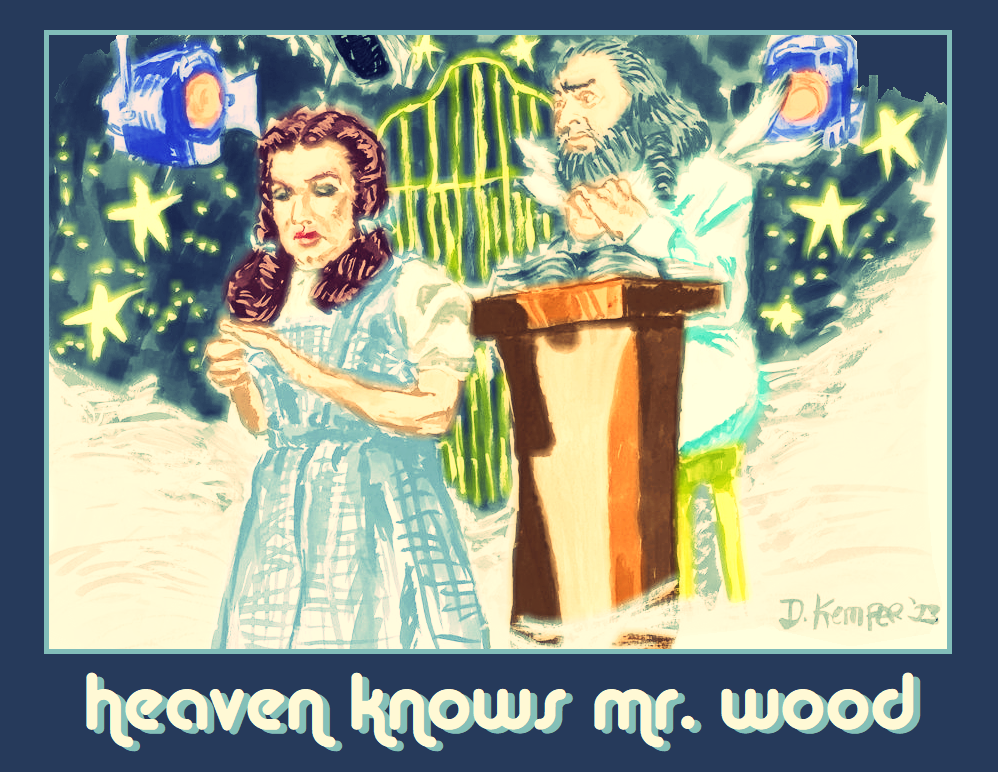
Ed Wood's Warm Angora Wishes: "Heaven Knows Mr. Wood."

Ed Wood goes to a very specific version of Heaven in this story.
NOTE: This article continues my coverage of Ed Wood's Warm Angora Wishes and Rubber Octopus Dreams (Arcane Shadows Press, 2024).
The story: "Heaven Knows Mr. Wood" by Dwight Kemper

This is where Ed Wood died.
Synopsis: In December 1978, filmmaker Edward D. Wood, Jr. and his wife Kathy are evicted from their Hollywood apartment and have to move in with a friend of theirs, actor Peter Coe. A few days later, while Peter, Kathy, and some other friends are watching a football game on television, Ed Wood dies of a heart attack in a back bedroom at the age of 54. There's a look of horror on his face. At his memorial service, the famed TV psychic Criswell, a longtime friend of Eddie's, tells Kathy that her late husband will be long-remembered and that God has "a soft spot for artists."

Meanwhile, Ed Wood arrives in Heaven and finds it to be a giant movie soundstage, complete with scenery and microphones. Even St. Peter, who sits at a podium at the Pearly Gates, looks and talks exactly like Bela Lugosi. Eddie is surprised, but not upset, to find himself dressed in the blue gingham dress and ruby slippers that Judy Garland wore in The Wizard of Oz (1939). Cross-dressing is not frowned upon in the afterlife. Peter tells Ed that his movies have brought happiness to many, and so the late director will be allowed to live in paradise. He already has a friend waiting for him at the Old Actors' Cloud.

Eddie ventures along the Yellow Brick Road until he meets the actual Bela Lugosi, who is hanging out with fellow horror icons Basil Rathbone and Boris Karloff. They stop to chat. Eddie eventually realizes that his dreams have come true. He is finally a filmmaker with unlimited money and resources, and Bela and the others are set to star in his next opus.

Excerpt
Startled, Eddie turned around and found himself in front of a high podium where a bearded man was waiting. Behind him were a pair of gates, the bars of which appeared to be lit by bulbs inside frosted plastic. The floor of the stage was covered with the crawling wisps of dry ice smoke. Ed looked down and saw he was now wearing a  sweater made from the finest angora and a gray skirt and sensible shoes.
Reflections: "Heaven," said Russell Green, "is where the donkey finally catches up with his carrot. Hell is the eternity while he waits for it." I think this old saying applies itself to Ed Wood pretty easily, and it was on my mind as I pondered Eddie's fate in the afterlife. I also thought about a 2013 episode of the web series Precious Plum in which the title character (Elaine Carroll), a child beauty pageant contestant, innocently asks her mother (Josh Ruben) what Heaven is like.

The carrot and the donkey.
"Like Target," replies the mother casually, "but everything's free."

I can sympathize with Plum's mother here. We often have a difficult time envisioning or describing the afterlife because we've obviously never experienced it. Besides, we're so focused on our earthly lives that we can't imagine an existence that's completely divorced from the physical, material world that we know. 

And so, most depictions of Heaven in art and fiction are just fancier versions of Earth. What else do we have to go on? Movies and television shows tell us that, after we die, we'll still look like ourselves, talk like we always have, and think with the same brains we had in life. Multiple writers have come to the conclusion that eternity will eventually grow boring for us, but this presupposes that we'll still have an attention span after we die.

Author Dwight Kemper addresses this problem in his story "Heaven Knows Mr. Wood," in which Ed Wood and Bela Lugosi reunite in the Great Beyond. And what do they do once they're up there? Make movies, of course! It's all they know. Kemper has Lugosi say in his unmistakable accent: "Heaven is vatever you make of it. Ve are all movie stars, so naturally, Heaven, it reflects vat ve know."

Maybe this isn't so bad. I'm a self-confessed game show addict, and one of my great pleasures in life is watching reruns of the '70s edition of Match Game hosted by Gene Rayburn. Every once in a while, I'll remember that Gene and nearly all the celebrity panelists (Brett Somers, Charles Nelson Reilly, Betty White, Richard Dawson) are dead. On the TV screen, they're still alive and filled with boundless energy. Where did all that energy go? Did it just evaporate into nothing when they died? It comforts me to think that, somewhere, there's a big Match Game reunion going on in Heaven right now.

I felt the same sort of comfort while reading "Heaven Knows Mr. Wood." In this story, Eddie dies broke and homeless, but in Heaven, he finally gets to be the filmmaker he always wanted to be on Earth. In other words, the donkey has finally caught up with his carrot.

Saturday, September 21, 2024

Ed Wood's Warm Angora Wishes: "The Green Dragon (Inspired by 'Glen or Glenda')"

I've heard he sits on your doorstep.
NOTE: This article continues my coverage of Ed Wood's Warm Angora Wishes and Rubber Octopus Dreams (Arcane Shadows Press, 2024).
The story: "The Green Dragon (Inspired by Glen or Glenda)" by Kurt McCoy

Bela Lugosi in Glen or Glenda.
Synopsis: A large, scaly, green dragon rises up from the sea and approaches a high-rise building in an unnamed city. The monster slithers up to the top and enters the penthouse laboratory of a strange scientist named Dr. Vorkhoff. The dragon declares, as usual, that it is hungry. Vorkhoff and the dragon gaze at a magical obsidian mirror, which allows them to view all the people in the city below them. They single out an avid pulp fiction reader named Denis Davis. Denis looks at his own reflection in a window and sees a woman named Denise staring back at him.

Soon, Denis becomes obsessed with Denise to the point that his feminine alter ego is all he can think about. Eventually, when he can stand it no longer, he ventures into a department store and pretends to buy a new wardrobe for his "twin sister." An understanding sales clerk helps him pick out some outfits, plus lingerie and makeup. It takes Denis a while to get used to these things, especially the torturous high heels.

When he ventures out in public in women's clothing for the first time, Denis is initially thrilled to see the world through fresh eyes. Soon, though, he is harassed by some police officers who taunt him and beat him nearly to death. The badly-injured Denis finds himself in the office of Dr. Vorkhoff, who says the young man is lucky to be alive. But Denis is more worried about Denise. The doctor says that, in order for Denise to survive, Denis must make a great sacrifice. The man agrees.

Vorkhoff performs a sex change on Denis, who now is permanently Denise. As payment, Vorkhoff has taken Denis' penis and placed it in a decorative coffin. But Denise has to rush out of the building to keep away from the hungry dragon. Once outside, Denise sees the reflection of Denis as he withers and dies, a tragic but necessary sacrifice. Where Denis merely sat on the sidelines and watched the world go by, Denise will live her life to the fullest. Back in the penthouse, Vorkhoff and the dragon gaze into the mirror to select their next subject.

Excerpt:
For a moment he found himself face to face with a beautiful woman, his blue eyes and hers locked in mutual surprise. Denis started to say something before he could think of anything to say. She opened her mouth then abruptly closed it at the same time. They both laughed at their shared awkwardness.
Reflections: When I first saw Glen or Glenda (1953) in 1992 and conned a few friends into seeing it with me, the character we all imitated afterward was Bela Lugosi's mysterious Scientist. (That's how he's identified in the credits, so that's what I'm calling him.) We'd never seen anyone like him in any movie. Even in the wild and wooly pantheon of Ed Wood, the Scientist is one strange man: a solitary, nameless alchemist who dwells in an eerie yet elegant laboratory/den filled with ghoulish bric-a-brac. From this lonely place, which seemingly exists outside the normal time-space continuum, he observes and guides the mortals who dwell beneath him. He has the powers of a god and can change men into women with a wave of his aged hand.

In Ed Wood (1994), even Eddie (Johnny Depp) has some trouble when he tries to explain the Scientist character to Bela (Martin Landau). Their conversation goes like so:
ED: Your part's a little different. You're like the god that looks over all the characters and oversees everything. 
BELA: I don't understand.

ED: You control everyone's fate. You're like the puppet master.

BELA: Ah, so I pull the strings!

ED: Yes, you pull the strings. "Pull the strings." I like that!
The Man in the Planet (Jack Fisk)
The only character in movie history who might be able to relate to the Scientist is the Man in the Planet (Jack Fisk) from David Lynch's Eraserhead (1977). They have similar jobs, controlling the lives of others from a purgatorial wasteland. The near-constant drone of background noise in Eraserhead is oddly reminiscent of Glen or Glenda as well, since Lugosi's appearances as the Scientist are often underscored by the sounds of thunder and howling wind. But the shirtless, badly-burned Man in the Planet is more like a janitor or an elevator operator than a true god. Plus, he doesn't say a solitary word in his movie. The Scientist in Glen or Glenda, on the other hand, is quite verbose, given to emotional outbursts, baffling non-sequiturs, and rambling philosophical speeches. 

In one of the Scientist's best-remembered soliloquys, he warns us of "the big green dragon who sits on your doorstep." Author Kurt McCoy has used this classic line as the basis for an entire story, turning the dragon into a full-fledged, speaking character. McCoy has also given the Scientist an actual name (Dr. Vorkhoff) and has placed his lab in a physical location (the weirdly ancient top floor of an otherwise-modern skyscraper). But the Scientist retains his inscrutability. Who is this man? Why does he do what he does? And how? What are the limits of his power? "The Green Dragon" doesn't exactly answer those questions, but it does expand intriguingly upon what we see in Glen or Glenda.

Who knows? Maybe Vorkhoff and his dragon pal are still at it somewhere, gazing through their enchanted mirror in search of another wayward soul. Bonus points to McCoy, by the way, for zeroing in on the fact that mirrors and reflections were of major importance to Ed Wood, both in his work and in his life. Don't forget that Ed once wrote a whole story called "Never a Stupid Reflection" (1973). I somehow get the impression that Eddie spent many hours contemplating his own reflection, especially when he was all dressed up in his finest angora.

Wednesday, September 18, 2024

Ed Wood's Warm Angora Wishes: "Ed Wood Hollywood Deadwood"

This story deals with Ed Wood's alcoholism and career setbacks. It's more fun than it sounds.
NOTE: This article continues my coverage of Ed Wood's Warm Angora Wishes and Rubber Octopus Dreams (Arcane Shadows Press, 2024).
The story: "Ed Wood Hollywood Deadwood" by David Michael Taylor

Synopsis: Struggling filmmaker Ed Wood drowns his sorrows in vodka at a Hollywood dive bar called Gold Diggers. Eddie is especially upset that his TV pilot, Final Curtain (1957), has failed to sell. His friend, actor/wrestler Tor Johnson, shows up and tries to comfort him. Eddie looks at their reflections in a mirror and imagines Tor as Inspector Clay from Plan 9 from Outer Space (1957) and himself as a little boy dressed in girl's clothes. He leaves the bar, dejected.

One of L.A.'s great cocktail bars.
Ed migrates over to another bar, Boardner's, where he commiserates with Maila "Vampira" Nurmi. She says the future is in television, but Ed laments that he can't get his pilot in front of the right people. The director's epic bar crawl then leads him to the Frolic Room on Hollywood Blvd., where he meets up with psychic Criswell, resplendent in a sparkly Nudie suit. Eddie asks Criswell about the future, and Cris says, "Perhaps on your way home, someone will pass you in the dark, and you may never know it, but they will reveal your future."

Stumbling home to his shabby apartment on Yucca, Ed Wood indeed passes a young man and woman he does not recognize. Could they be the key to his future? He calls out to them. Many decades later, these young people are standing in front of the building at 6383 Yucca Street in Los Angeles. The young man's mother has texted him that Ed Wood once lived here, but neither the young man nor the young woman knows who Ed is.

Excerpt:
She strips the top from the shaker and replaces it with a strainer as I feel myself straining in anticipation. Setting a fresh martini glass on the section of the bar I've clamed as my own for the evening, she tips the shaker, causing the cloudy cocktail to pour through the strainer and into my glass without spilling a drop. A lime wheel appears as if from nowhere and, with a deft hand, she closes its pulp around the lip of the glass.
Another stop on the tour.
Reflections: Some of you Beatle fans may remember the 1995 music video for "Free as a Bird," the "new" song that was created by taking an unfinished John Lennon demo and overdubbing new parts by Paul McCartney, George Harrison, and Ringo Starr onto it. A combination of computer-generated animation and live-action footage, including many vintage clips of The Beatles themselves, the video follows the path of a bird as it flies to crucial locations in Beatle history, including the Cavern Club, Penny Lane, the Strawberry Fields orphanage, and Abbey Road studios. Along the way, we spy brief visual references to Beatle songs, including "Birthday," "Helter Skelter," "Paperback Writer," and more. The more you know about the Fab Four, the more references you'll catch.

David Michael Taylor's "Ed Wood Hollywood Deadwood" is like "Free as a Bird" for Ed Wood fans. Instead of following the path of a bird as it soars majestically through Beatle history, it follows the path of Ed Wood as he stumbles drunkenly from one Los Angeles bar to another. But it, too, is an Easter egg hunt for diehard fans. The story visits a few key Woodian locations, including Gold Diggers, Pla-Boy Liquor, and the notorious Yucca Flats apartment building, and it's peppered with references to Ed's life and career. Much of the dialogue comes directly from the script of Plan 9, for instance, and the bartender has the same name as Ed's mother: Lillian. We also get multiple references to the obscure Final Curtain pilot, a nod to Tim Burton's Ed Wood (1994), and a reiteration of the old story that Ed's mother dressed him as a girl when he was a child.

There's a sighing, elegiac quality to both "Free as a Bird" and "Ed Wood Hollywood Deadwood," though the latter is far less reverential. They're both wistful reminders of a vanished world and the vanished people who inhabited it. The ending of Taylor's story seems to consign Ed Wood to the rubbish bin of history, the victim of youthful indifference, but the truth is that this story could only have been written by someone with a deep, abiding love for Eddie's work. Who else but a fan would bother to write something like this?

P.S. This story is almost fetishistic in its detailed descriptions of alcoholic beverages and cocktail bars. I'm not sure if these things are a major part of the author's life, but they were certainly a major part of Ed Wood's life, so I appreciate the extra effort displayed here. These descriptive passages really bring you into Eddie's dank, boozy world.

Saturday, September 14, 2024

Ed Wood's Warm Angora Wishes: "Octodeathopus: The Legend of Lobo"

How did Lobo become Lobo? Strap in, pally, and you'll find out.
NOTE: This article continues my coverage of Ed Wood's Warm Angora Wishes and Rubber Octopus Dreams (Arcane Shadows Press, 2024).
The story: "Octodeathopus: The Legend of Lobo" by J. "Doc Dread" Murray

Synopsis: In 1904, presumably somewhere in Eastern Europe, twin brothers Otto and Joseph Javorsky (aged four) are wrestling in front of their family's cottage when Otto is suddenly scooped up by a caravan of passing gypsies. Otto becomes part of the gypsies' traveling show and eventually takes the place of a wrestling bear named Lobo when that animal passes away. He even assumes Lobo's name as his own. By 1927, however, they decide to trade Lobo to a group of Tibetans in exchange for supplies. The Tibetans use Lobo as a beast of burden.

Lobo's brother. See the resemblance?
In 1945, the now-grown Joseph Javorsky works on the top-secret Atomic Super Man project with fellow scientists Dr. Eric Vornoff and Professor Strowski. But the project is suddenly canceled by the government in 1946, and Vornoff is forced to flea. His goal is to make it to the United States to continue his work, but he first heads to Tibet. There, he is amazed to find a man he initially thinks is Joseph Javorsky but is actually Joseph's twin brother, Otto aka Lobo. Vornoff soon makes Lobo his obedient servant. They travel together and pick up an octopus at a market in Shanghai. 

In 1947, with the octopus in tow and growing larger all the time, Vornoff and Lobo head for America aboard a rusted-out freighter. Along the way, they kill the ship's captain and loot the strongbox. By October 1948, they have settled in Lake Marsh, California, and Vornoff resumes his work. Lobo and Vornoff haven't been living in the area long when they fatally run over an old widower in their car. The incident is investigated by a local cop, Officer Kelton. Vornoff is somewhat distressed by this, but he is excited that he's found a house, the Old Willows Place, that is perfect for his experiments. It even has a pond for his octopus.

Flash forward to 1955. Local newspaper reporter Janet Lawton tells of her horrific experiences at the Old Willows Place, where Dr. Vornoff tried to use her and her fiancé, policeman Dick Craig, in his dreadful medical experiments. Luckily, they managed to escape when the place went up in flames and Vornoff was killed by his own octopus. But the story is not over! Both Lobo and the octopus manage to survive. And Joseph Javorsky, still very much alive, arrives by plane in America at a place called Yucca Flats to begin a new project.

Excerpt:
The octopus has grown since we've boarded this old, rusted freighter. It seems there is an endless supply of rats aboard this vessel. The octopus leaves its tank and hunts our quarters at night. The captain is a drunk and has found a shipping container of fine vodka. In a drunken stupor he told me where the ship's strong box is and the treasures it contains. No one will be surprised should he fall overboard.
Reflections: "Octodeathopus" is yet another story in Warm Angora Wishes that draws heavily upon Ed Wood's Bride of the Monster (1955) and Plan 9 from Outer Space (1957) and attempts to weave these films into a larger narrative, along with several other sci-fi and horror films of the era. For me, the real stroke of genius here is the revelation that Lobo, Tor Johnson's character from Bride, is the twin brother of Dr. Joseph Javorsky, the doomed Soviet scientist that Tor played in Coleman Francis' The Beast of Yucca Flats (1961). Apparently, Lobo's real name was Otto, and he and Joseph grew up together until Otto was plucked up by some passing gypsies at the age of four. Come to think of it, those guys do look a lot alike.

I was also highly amused to learn that it was Lobo who actually ran over Bela Lugosi's unfortunate Ghoul Man character from Plan 9. It seems that Dr. Eric Vornoff unwisely allowed his hulking manservant to drive that day. Whoops! Later in the story, author J. "Doc Dread" Murray includes a clever reference to It Came from Beneath the Sea (1955). The giant octopus from that film, we learn, is actually Vornoff's beloved pet. It lost a couple of tentacles in the explosion at the end of Bride, which is why it only has six arms in Beneath the Sea. The timing on this could not have been better, since MeTV's Svengoolie just showed It Came from Beneath the Sea a few weeks ago, meaning that film was still fairly fresh in my mind.

With a title like "Octodeathopus," you can tell that this story is not taking itself seriously at all. It's just a fun little bit of speculative fan fiction that will probably be incomprehensible to anyone outside the Ed Wood fan community. But if you're an active part of that community and have seen Eddie's 1950s films dozens of times, to the point where the characters have taken up permanent residence in your brain, J. "Doc Dread" Murray's strange tale should be quite a pleasant little diversion.

Wednesday, September 11, 2024

Ed Wood's Warm Angora Wishes: "Children of the Sun"

This story emphasizes the vampiric nature of Vampira.
NOTE: This article continues my coverage of Ed Wood's Warm Angora Wishes and Rubber Octopus Dreams (Arcane Shadows Press, 2024).
The story: "Children of the Sun" by Joe Overbay

Dracula's brides from the 1931 film.
Synopsis: Vanessa Davis, an ex-NASA test pilot turned secret agent, is piloting a propeller plane to Romania as part of her latest dangerous mission. Her passenger is a mysterious, powerful man she has only recently met named Anton Voytek. For this mission, they are both using codenames. His is Lucifer; hers is Vampira. Over the Transylvanian Alps, the plane runs into bad weather and has to land. When Vanessa looks at Anton in the mirror, she realizes to her horror that he casts no reflection. Once the plane is on the ground, Vanessa tries to outrun Anton but to no avail. He soon overpowers her.

Some time later, Vanessa wakes up in a coffin in a remote chateau. She opens a curtain, only to be burned by sunlight. She is greeted by Diana, another female vampire under Anton's control. Vanessa soon realizes what she has become. Her life now revolves around hunting human beings and drinking their blood. Whenever she can, she lashes out at Anton and the other vampires in his "brood," but she is generally unsuccessful because she herself has the same weaknesses they do. She does manage to impale Diana, but Anton proves impossible to kill.

Eventually, with numerous vampires following her, Vanessa makes it back to her plane and even manages to take off. Anton takes the form of a bat and pursues her. They have an epic battle in the air, ending when Vanessa crashes the plane. Unfortunately, when the smoke clears, it is Anton who survives. He declares Vanessa to be a worthy adversary and sends her mortal remains back to her hometown of Oakdale, CA. Back home, Vanessa's elderly husband attends her funeral but is so grief-stricken that he himself wanders into traffic and is killed. Soon after, aliens begin to invade the earth as part of an initiative called Plan 9.

Excerpt:
She tried to fight him, but she just couldn't. To this moment her life mind and soul were hers alone to command, and the agency had invested long years training her to keep her that way she's been judged resistant to almost all forms of external persuasion. But this was different. Anton, this vampire, was inside her mind, and there was no damn way she could keep him out. In a moment, he knew her innermost thoughts, of her dreams, all the private things that she cherished. In a moment she was mind raped and in the end she was his.
Reflections: As I've made my way through Warm Angora Wishes, I've occasionally found myself wondering what would happen if someone totally unfamiliar with Ed Wood's films picked up this book and started leafing through it. How would that happen? Maybe, years from now, a copy turns up at a used bookshop, and the cover catches a shopper's attention. Would such a reader be able to make any sense of it? Or does the reader have to have at least a passing knowledge of Ed's 1950s films, particularly Bride of the Monster (1955) and Plan 9 from Outer Space (1957) to be able to enjoy this anthology?

Take "Children of the Sun" as an example. Now, there is plenty here to entertain the average reader of genre fiction, regardless of that person's level of familiarity with Ed Wood. At heart, this is a horror story that emphasizes the punishing physical and mental tortures of being a vampire. Vampirism is often romanticized in film and literature, so it was strangely refreshing to read Joe Overbay's brutal, unappetizing take on the lifestyle—which is basically like being a junkie, but a thousand times worse. And all of this is set against a backdrop of Cold War intrigue, complete with plenty of tense, high-flying action sequences. The author is mashing up a couple of popular genres in this story, so there's something for everybody... theoretically.

But what is the uninitiated reader to make of the early, totally-out-of-nowhere reference to UFOs? Or the mention of someone called Dr. Eric Vornoff? Or the fact that, in the final paragraphs of this story, the setting suddenly switches from Transylvania to California and involves aliens invading the earth? My guess is that these aspects of the story would be very, very confusing to an outsider. That's not a problem, necessarily. It's just something that's been on my mind. Maybe that's the secret gift of Ed Wood; as a muse, he lets you make imaginative leaps you might not otherwise dare.

Friday, September 6, 2024

Ed Wood's Warm Angora Wishes: "Spyang Ki Chung 'Little Wolf'"

This story shows us what Lobo was like before he hit the big time.
NOTE: This article continues my coverage of Ed Wood's Warm Angora Wishes and Rubber Octopus Dreams (Arcane Shadows Press, 2024).
The story: "Spyang Ki Chung 'Little Wolf'" by Adkov Telmig

A monastery in Western Tibet.
Synopsis: Exiled Russian scientist Dr. Eric Vornoff scavenges in the desolate Western Plateau of Tibet. He is fully aware that agents from his home country are after him, and he nearly succumbs from the harsh weather and the heavy equipment he is lugging around. Luckily, he is rescued by a caravan of nomads and taken to a small mining town. In a largely deserted monastery, Vornoff meets and (after a fashion) befriends a three-foot-tall monk known as Little Wolf. Vornoff and Little Wolf visit a local market to buy food. There, Vornoff sees a man with some of the valuable uranium he desperately needs for his experiments. The man agrees to bring Vornoff plenty of uranium in exchange for a large sum of money.

With Little Wolf's help, Vornoff is granted permission from an aged monk to set up his equipment and perform his experiments within the monastery. He says he will use atomic power to create a race of supermen. When the man from the marketplace shows up with the promised uranium, Vornoff casually shoots and kills him. When Little Wolf asks him why he did this, Vornoff replies that he has no money but needed the uranium to continue his work. What else was he supposed to do? Little Wolf then asks to be part of Vornoff's experiment. Vornoff tells his companion that it will be painful but that he will emerge from the experience more powerful than he has ever been.

Two enemy agents, identified only as the Cold Men, show up at the monastery in their relentless hunt for the exiled scientist. Vornoff does not seem terribly concerned by their arrival because he now has a powerful bodyguard: Little Wolf, now supersized and mute. The formerly-diminutive monk makes quick work of the Cold Men, literally tearing their bodies apart. Vornoff decides that Little Wolf's name no longer suits him. From now on, he shall be called Lobo.

Excerpt:
A small detachment of Tibetan soldiers kept wary watch on the scrofulous lot. They stood in tight groups, warming their hands over fires in metal barrels. They stood out in their uniforms and furred hats. All of them seemed to smoke thin stick-like, oily-looking black cigarettes. They eyed Vornoff suspiciously, but none of them had questioned him or asked him for papers. It wasn’t the kind of town where questions were common. This was a good thing for Dr. Vornoff who had by now crossed four or five borders without the benefit of any official passports or permits.
Sardu and Ralphus: best friends.
Reflections: When I first downloaded my copy of Warm Angora Wishes from Amazon, I skimmed through it a little, just to get the lay of the land. I casually noticed that one story was about how Dr. Eric Vornoff (Bela Lugosi) and his mute henchman Lobo (Tor Johnson) from Bride of the Monster (1955) originally met in "the wilderness of Tibet." Someone had taken that throwaway line from the movie and made a whole prequel out of it. But I didn't want to spoil the story for myself, so I merely glanced at a few sentences and moved on. I suppose I was anticipating something like the story of how the Lone Ranger met Tonto. My curiosity level was at roughly six out of ten; prequels have a tendency to overexplain things that were better left unknown.

I could not have predicted anything like "Spyang Ki Chung," which is easily one of the strangest and most intriguing stories I've read so far in this collection. Obviously, the story has an outrageous central gimmick, i.e. that the huge, lumbering Lobo was once a dwarf in a monastery and that it was Vornoff who made him a giant. It's exactly the kind of imaginative leap you'd hope to find in an Ed Wood-inspired anthology. But what really makes the story memorable are its descriptive passages about Tibet. This is a land about which I know virtually nothing, so I was fascinated by the author's evocative yet unsentimental prose about the land and its people. "Spyang Ki Chung" is the first story in this collection to remind me of Cormac McCarthy. I wager it'll be the last, too.

This story also got me thinking about villains with dwarf sidekicks. That seems to be a semi-common trope in fiction, but I'm hard-pressed to think of good examples. Let's see. There's Sardu and Ralphus in Bloodsucking Freaks (1976), Dr. Evil and Mini-Me in The Spy Who Shagged Me (1999), and Livia and the Imp in The Undead (1957). Didn't Hordak also have an imp on She-Ra (1985-1987)? Mr. Roarke on Fantasy Island (1977-1984) was more mysterious than evil, so he doesn't count. Do Jabba the Hutt and Salacious Crumb from Return of the Jedi (1983) count? Maybe Salacious isn't a dwarf among his own kind, but he's dwarfed by Jabba.

Come to think of it, this might not be that common a trope.