Showing posts with label The Sinister Urge. Show all posts

Wednesday, December 31, 2025

Ed Wood Wednesdays, week 257: Carl Anthony (1932-2021) [PART 2 OF 2]

Is there more to say about Carl Anthony? I'd better hope so.

Last week, as you'll recall, we were talking about actor Carl Anthony (birth name: Carl Anthony Wuco), who played prominent roles in two of Ed Wood's best-known movies, Plan 9 from Outer Space (1957) and The Sinister Urge (1960). We discussed how Carl grew up the youngest of three brothers in a Croatian-American family in the suburbs of Cleveland before pursuing a career in show business, first as a daredevil pilot in Florida and then as a film and television actor in Hollywood. 

Quite an intiguing character, this Carl Anthony. But I neglected to talk about the thing Carl's actually remembered for: his film career.

Wednesday, December 24, 2025

Ed Wood Wednesdays, week 256: Carl Anthony (1932-2021) [PART 1 OF 2]

It's time to shine a spotlight on a key player in the Ed Wood canon.

I have not been especially kind in my descriptions of actor Carl Anthony (1932-2021), a friend of Ed Wood who played prominent roles in both Plan 9 from Outer Space (1957) and The Sinister Urge (1960) and who later appeared as an interview subject in the documentary Flying Saucers Over Hollywood (1992). Here are some of the adjectives I've applied to Carl's work over the years: "colorless," "pedestrian," "stiff," "dull," and "uncomfortable." Not exactly the rave of the century. Hey, at least Carl got his own trading card in Drew Friedman's Ed Wood Players set. 

Carl's trading card.
Look, if you're studying the work of Edward D. Wood, Jr., you're going to spend some time (vicariously) with Carl Anthony. Hearing his voice. Looking at his face. And Carl is maybe, just maybe, not the most fun actor to watch. Though they're on opposite sides of the law, his characters in both Plan 9 and Sinister are kind of the same: surly, impatient, and unimaginative. This actor has the demeanor of a man waiting for a bus that will never arrive. And he has a pebble in his shoe the entire time.

But Christmas is a time for forgiveness and reconciliation, and I thought I'd give Carl's work a more charitable evaluation this year. Perhaps it will help to learn more about the man himself. He was born Carl Anthony Wuco in Garfield Heights, OH, a suburb of Cleveland, on November 4, 1932. That makes him one of the younger members of the Ed Wood repertory company. Of his Plan 9 costars, the closest in age would have been Conrad Brooks, born in 1931.

Carl's parents, Anthony and Gloria, stayed in Garfield Heights while their son moved first to Florida and finally to California to pursue his show business aspirations. According to back-to-back obituaries that ran in the August 22, 1965 edition of The Cleveland Plain Dealer, both Anthony and Gloria died "suddenly" on Monday, August 16, 1965. Details about their deaths will be included in next week's article.

Carl Anthony Wuco had two older brothers: Walter (who died in 2004) and Raymond (who died on December 30, 2014 at the age of 86). Raymond's elaborate obituary in the January 7, 2015 edition of The Cleveland Plain Dealer is quite an entertaining read by itself. Raymond was a distinguished mathematics teacher who spent 25 years as a religious Brother in the Marianist Catholic order but left the order in the early 1970s and married a woman named Lynn Valin in 1975. The two met when Raymond was teaching at a college in California. His academic career lasted 50 years and spanned both the monk and non-monk eras of his life. The obituary also reveals that the family name Wuco was originally Vuco, which is Croatian in origin. If you're wondering where Carl Anthony got his dark wavy hair and strong jawline, it's his Croatian roots.

Wednesday, August 28, 2024

Ed Wood's Warm Angora Wishes: "The Violent Urge"

Two of Ed Wood's crime thrillers come together in "The Violent Urge."
NOTE: This article continues my coverage of Ed Wood's Warm Angora Wishes and Rubber Octopus Dreams (Arcane Shadows Press, 2024).
The story: "The Violent Urge" by Brian Carney

One of Ed Wood's crime thrillers.
Synopsis: A young thug named Dirk brutally murders a young woman named Lisa at Lover's Lane. He's been instructed to do this by his boss, Janet, but Dirk views his killings as "art" and doesn't really care about any financial compensation. Janet is the leader of an underground smut ring, and Lisa was about to rat her out to the police and so had to be eliminated. Dirk has done his part, but Janet is furious that he left a pornographic picture at the crime scene. 

Dirk's solution is to commit further murders and mayhem at Lover's Lane, making the cops think there's a sex-crazed psycho on the loose. They'll be so busy trying to catch him that they'll forget all about the smut ring. Dirk's insidious plan almost works, but one of his intended victims turns out to be an undercover cop in drag. Dirk barely escapes arrest, and Janet decides that he should lay low for a while. She has her boyfriend Danny drive Dirk to the home of Paula Parkins (aka Paul), a wealthy young lady who's part of a gang of female juvenile delinquents. Dirk, Paula, and the gang enjoy a wild and violent party, during which they watch some stag films starring the girls.

Later, Janet delivers some of the aforementioned stag films to a hard-boiled lady gangster named Gloria. It turns out Gloria is having some of the same problems that Janet had been having with Lisa earlier. She sure could use a hitman right about now, someone to neutralize any threats. Janet offers Dirk's services. Gloria thinks Dirk has potential.

Excerpt:
His body was black and blue with bruises, there were bite marks on his legs and shoulders. The gash on his chest had needed four stitches but it was barely a scratch. The trunk of the Star Chief was full of 8mm film cannisters, wrapped in flowered sheets stolen from Paula's parents' bed before they could come back and see the damage. 
Dirk does his thing.
Reflections: Some prayers are answered, readers. Not all, but some. At this point in my journey through Ed Wood's Warm Angora Wishes and Rubber Octopus Dreams, for instance, I was praying for a story that had nothing whatsoever to do with ghouls, flying saucers, aliens, haunted houses, or cemeteries. I'd had my fill of all those things. Then Brian Carney, like a true hero, came to my rescue with a story inspired by two of Ed Wood's crime dramas, The Violent Years (1956) and The Sinister Urge (1960). Eddie's sci-fi and horror films tend to hog the spotlight, so it's nice to see his noir efforts get some love for a change.

"The Violent Urge" manages to answer one of the nagging questions from Ed Wood's filmography. Namely, how did gangster Gloria Henderson (Jean Fontaine) ever wind up hiring a loose-cannon thug like Dirk Williams (Dino Fantini) in The Sinister Urge? You have to admit, it's a strange pairing. She's no-nonsense; he's basically all nonsense. She demands order; he offers chaos. She tries to keep a low profile; he's bound to attract attention. And, ultimately, Dirk proves a liability to Gloria's operation.

Author Brian Carney manages to craft a convincing origin story for the unlikely Gloria/Dirk alliance, and he incorporates the juvenile delinquents from The Violent Years. I was glad to spend a little more time with those fun-loving gals. Does Paula Parkins (Jean Moorhead) get to say her famous "so what?" catchphrase from the movie? You'd better believe she does. As a little flourish, Carney includes a sly reference to Hellborn (1956), one of Ed's unfinished films. Janet and Dirk are said to have attended Wellbourne High School, known colloquially as Hellborn High.

Better yet, Carney manages to write all of this in the gleefully nasty style of a trashy pulp novel, complete with loving descriptions of lurid violence. (The story literally starts with a lengthy, drawn-out description of  a stabbing.) The author refers to the shared fictional world depicted in this story as the "Delinquiverse," which I love. It would have been nice to include mixed-up Don Gregor (Clancy Malone) from Jail Bait (1954), too. Don, like Paula Parkins, is a spoiled, bored rich kid who gets into crime for kicks, so they may have had a lot in common. But then, what would Carney have called the story? "The Violent Jail Urge"? 

Wednesday, July 3, 2024

Ed Wood Wednesdays, week 195: Eddie and the Amazing Colossal Episode Guide (1996)

Ed Wood was one of the filmmakers lampooned in The MST3K Colossal Episode Guide.

God, I loved mall bookstores. 

My idea of a perfect Sunday.
Look, I know there are still malls, and many of those malls still have bookstores. But I think it's safe to say that the heyday of the mall bookstore is long over, one of many casualties of the internet. There was a time (think: 1990s and early 2000s) when my idea of a perfect Sunday afternoon involved whiling away a few carefree hours at B. Dalton's and Waldenbooks, mostly browsing but purchasing occasionally, too. I'd always make a beeline for one of two departments, Humor and Entertainment, before wandering over to the magazine rack to see if Cinefantastique or Fangoria had something of interest for me.

In retrospect, mall bookstores played a fairly significant role in my life. Some of the last real quality time I had with my father was spent at a large shopping center in northeastern Indiana. While visiting my sister, who lives with her family in a small town near Fort Wayne, my dad and I would always find a few hours to sneak off to the local mall and see what it had to offer. Our first stop would always be Barnes & Noble, which sold a wide variety of books and magazines, plus music, movies, and various tchotchkes. I'm not a coffee drinker, but I came to love the smell of the coffee brewing at the in-store café. And I loved the light classical music playing on the overhead speakers, too. To this day, hearing Beethoven's "Rondo a Capriccio" transports me back to those very pleasant times.

I'm convinced there are a great many books that owe their entire existence to mall bookstores, particularly those books with humorous gimmicks or pop culture connections as their main selling points. A perfect example is The Mystery Science Theater 3000 Amazing Colossal Episode Guide (1996) from Bantam Books. It was typical of the TV-based books of the era: detailed descriptions of the MST3K episodes that had aired up to that time, augmented by reminiscences of the actors, writers, and crew members who worked on the show. Though not exactly essential, the ACEG is a fun souvenir for fans of the long-running comedy series, which at the time was just ending its seven-season run on Comedy Central before moving to the Sci-Fi Channel. 

When this book came out, I remember eagerly thumbing through its pages a few times at the mall before finally spending $16.95 (a not-inconsiderable amount) on my own copy. Just my luck, the binding proved extremely fragile, forcing me to transfer the pages of the Amazing Colossal Episode Guide to a Trapper Keeper. At the time, I was just becoming a Mystery Science Theater 3000 fan and there were many episodes I had not yet seen. It blew my mind to think that they'd covered both Kitten with a Whip (1964) and Monster a Go-Go (1965), two obscure cult films whose titles I only knew from the writings of John Waters. I realized from reading the ACEG that I had many hours of entertainment ahead of me.

Wednesday, June 19, 2024

Ed Wood Wednesdays, week 193: The mystery of Henry Kekoanui (UPDATED!)

This actor appeared in Ed Wood's The Sinister Urge and nothing else that we know of.

Do you know what an artesian well is? It's a naturally-occurring site where pressurized water rises to the surface of its own accord, without human intervention. In other words, it's a well you don't have to pump. Rudolph Grey's book Nightmare of Ecstasy: The Life and Art of Edward D. Wood, Jr. (1992) is a lot like that—the literary equivalent of an artesian well. Turn to just about any page in it, and interesting little details will bubble to the surface on their own. I've had my copy for about 30 years, and I'm still finding new things in it.

There's an entire section in the book, for instance, about the making of The Sinister Urge (1960). This was Ed Wood's final "mainstream" film as a writer-director before he descended permanently into the world of softcore and hardcore pornography. Since Sinister deals with the so-called "smut racket" and even includes a flash of nudity, it's tempting to think of it as a transitional film in Eddie's career, i.e. a signpost to where his career was heading.

On page 101 of Nightmare of Ecstasy, you'll find a small gallery of images—Grey fancifully calls it a "quartet"—from The Sinister Urge. What caught my attention recently was the photo in the upper left-hand corner, a publicity still of someone identified as Henry Kekoanui. It's a striking image. The dark-haired, mustachioed man is shirtless and has an intense look in his eyes, like he's about to strike. Imagine Gomez Addams as a 1950s bad guy wrestler. Henry's arms and upper body are muscular, but his midsection is a bit paunchy. He's being photographed in some strange, eerie void where a dramatic shadow looms over him. And he seems to be carrying something, perhaps a garment, in his left hand.

Wednesday, May 26, 2021

Ed Wood Wednesdays, week 118: 'Hellborn' (1956/1993)

Hellborn is like a jigsaw puzzle with missing pieces.

One of the strangest passages in Ed Wood's Night of the Ghouls (1959) occurs just four and a half minutes into the film. Ostensibly a follow-up to Bride of the Monster (1955), Ghouls is another of Wood's supernatural horror thrillers. The plot revolves around a phony medium, Dr. Acula (Kenne Duncan), who inadvertently manages to summon the dead while performing fraudulent seances in a spooky mansion. For some reason, though, narrator Criswell takes a few minutes to talk to us about juvenile delinquency:
Your daily newspapers, radio, and television dares to relate the latest in juvenile delinquency. At times, it seems juvenile delinquency is a major problem of our law enforcement officers. But is this the major horror of our time? Is this violence and terror a small few perpetrate the most horrible, terrifying of all crimes our civil servants must investigate? 
The National Safety Council keeps accurate records on highway fatalities. They can even predict how many deaths will come on a drunken holiday weekend. But what records are kept? What information is there? How many of you know the horror, the terror I will now reveal to you?
As we hear this voice-over monologue, accompanied by hot jazz drumming and a wailing siren, Wood shows us flashes of seemingly unrelated footage: a police car whizzing from somewhere to somewhere else; young people dancing and eating at a pizzeria called Jake's Pizza Joint; two men (Ed Wood and Conrad Brooks) fighting in a pit as a crowd watches; a gang of three men beating the tar out of a fourth man as a girl stands off to the side; a car going off the road and tumbling down a cliff before crashing into a tree, etc. Apart from the shots of the police car—this is another of Ed's many police procedurals—none of this footage belongs in Night of the Ghouls. So what's it doing there? 

Wednesday, July 5, 2017

Ed Wood Wednesdays, week 67: Revisiting 'The Sinister Urge' (1960)

Scratchy-voiced Gloria Henderson (Jean Fontaine) made her debut on MST3K in 1994.

Neglected no more: The Sinister Urge.
Edward D. Wood, Jr. really didn't direct that many feature-length films during his so-called "golden age," i.e. the years before he permanently descended into the world of pornography in the 1960s. There are the big three, naturally: Glenda, Plan 9, and Bride Of The Monster. The ones everyone knows from the Tim Burton biopic. The standbys. There's Jail Bait, too, a neglected "middle child" that has never received as much love and attention as its siblings. The Violent Years, though scripted by Wood, was (at least nominally) directed by William Morgan, so it doesn't quite count. Wood claims he edited two of those made-for-TV Tucson Kid episodes with Tom Keene into a quasi-feature, but this has never surfaced. Wood's other titles from this era (The Sun Was Setting, Final Curtain, etc.) are featurette-length.

That just leaves The Sinister Urge, an anti-smut scare film from 1960, by some counts the "last" movie Ed Wood ever made. When reference books say Ed Wood only directed five movies, they're ending their tally with this one. For whatever reason, despite its importance in the Wood canon, The Sinister Urge has gotten rather short shrift in this project. Sure, I did a complete write-up on the movie back in 2013, but I haven't rewatched it since then. I basically sat through it once all the way through, shrugged, and moved on. And yet, here is a full-length movie written and directed by Ed Wood when he was still sort of in his prime. He was only 36 when it came out. Thanks to some repurposed footage from the abandoned juvie flick Hellborn, Ed even plays a semi-prominent (if brief) role in it. Doesn't that deserve more attention?

I started wondering if maybe there were more to The Sinister Urge than I'd originally gleaned. So I decided to rewatch the movie with fresh eyes. Right away, I was struck by the first shot: a blonde (one-film wonder Betty Boatner), clad only in a bra and slip, running in terror toward the camera on a dirt road. The camera seems to be on the back of a car or truck, because it's moving, too. For an Ed Wood movie, this is a very dynamic beginning. Keep in mind that Glenda starts with Bela Lugosi sitting in a chair, and Plan 9 starts with Criswell sitting behind a desk. In contrast, The Sinister Urge doesn't have any scene-setting narration or preamble. Other than the title appearing onscreen, it doesn't even have opening credits. More so than at any other time in his filmmaking career, Ed Wood seems eager to get the action underway. This is as in medias res as he gets.

Don't worry, though; the usual Ed Wood inertia is not far away. In his DVD introduction to the film, Ted Newsom suggests that credited cinematographer William C. Thompson only shot the interiors for The Sinister Urge. And, true to form, there is a marked difference between the indoor and outdoor scenes in this movie. One plot thread has pompadoured hoodlum Dirk (Dino Fantini), driven mad by exposure to pornography, stalking and killing young women in Los Angeles' Griffith Park. These scenes crackle with an energy that vanishes once the film heads inside.

For the most part, this film is even more static and talky than usual for Wood. Our heroes are two hardworking, grim-faced policemen: Lt. Matt Carson (Kenne Duncan) and Sgt. Randy Stone (Duke Moore). Matt is a little sharper than Carson, sort of the Sherlock to his Watson, but neither is particularly energetic. Matt and Randy spend most of their time in the former's dark, wood-paneled office, discussing a string of porno-related murders and decrying the rottenness of the smut racket. When they do venture out to a crime scene, their hard-boiled dialogue goes like so:

Randy: (examining a woman's corpse) Just like the others. 
Matt: Pretty kid, too. 
Randy: She doesn't look much like a kid now. 
Matt: Maybe she grew up during that moment of truth. When she died. 
Randy: The same M.O. Killed the same way. The same everything. 
Matt: With one great difference. 
Randy: What's that? 
Matt: Her name will be different.

Duke Moore and Kenne Duncan in The Violent Years.
Move over, Joe Friday, huh? Actually, The Sinister Urge may be the best movie yet to illustrate Ed Wood's obsession with Dragnet-style police procedurals. I still maintain that Jack Webb was one of Eddie's greatest unheralded influences, more so than Tod Browning or James Whale. Why else would Glen Or Glenda, a film ostensibly about gender fluidity, be structured around a police investigation? Wood was so enamored of the tough-guy repartee between Duncan and Moore that he wanted to build an entire second feature, The Peeper, around their characters. Maybe he even had dreams of a mini-franchise starring these two. It's obvious why that never happened, though. To cast sleazy, sarcastic Kenne Duncan as a good guy seems all wrong, and Duncan's chemistry with bland, pudgy Duke Moore is virtually nonexistent. At one point, Wood tries to lighten the mood with a scene in which Randy plays a mischievous little prank on Matt, who has fallen asleep at his post. But "impish" just isn't in Kenne Duncan's wheelhouse, and the scene falls flat.

On the other side of the law, we have porno filmmaker Johnny Ryde (Carl Anthony), a man who "used to make good movies," and his boss/distributor/lover, scratchy-voiced Gloria Henderson (Joan Fontaine). They, too, spend a good deal of time sitting around and talking. Interestingly, Johnny and Gloria have both their strategy sessions and their makeout sessions in Gloria's sparsely-decorated living room, making this movie yet another example of Ed Wood using the homestead as his favorite backdrop. Gloria's house, in fact, doesn't look much different from the troubled homes featured in Glen Or Glenda, Jail Bait, and Plan 9. And just like those domiciles, this one is threatened by outside forces. When knife-wielding Dirk breaches the perimeter, it spells doom for the household and everyone in it.

The character of Gloria, on this viewing, reminded me a lot of Vic Brady (Timothy Farrell), the gangster from Jail Bait. Both of these people spend their lives in a constant state of agitation, always snapping at the people around them. Irritation is Gloria's default reaction to pretty much any stimulus. There is a scene, for instance, in which Johnny introduces Gloria to gawky, naive Mary Smith (Jeanne Willardson), a starlet he plans to exploit. Before Johnny even attempts to say Mary's name aloud, Gloria explodes with rage: "Names at this stage are unimportant! Names are your department anyway!" If the crooks are trying to win Mary's trust, this is a strange way of going about it. One wonders how Gloria ascended to a position of prominence in the underworld with so little finesse.

As for Carl Anthony's character, reader Milton Knight points out that the name Johnny Ryde is very similar to that of Johnny Hyde (aka Ivan Haidabura), the Russian-born talent agent who was instrumental in shaping Marilyn Monroe's early career. Hyde changed Monroe's image drastically, a process that included plastic surgery, and helped her secure important early film roles. Certainly, then, there are parallels to Johnny Ryde's treatment of innocent Mary Smith, who is encouraged to change her hair, wardrobe, deportment, diction, and place of residence. Hyde had already been dead a decade when The Sinister Urge was released; Monroe herself died in 1962.

All in all, my opinion of The Sinister Urge hasn't really changed since 2013. I still find the film suffocating and sluggish at times, though eccentric characters like Gloria and Dirk help liven up the proceedings. Johnny Ryde might be an onscreen stand-in for Ed Wood, but Carl Anthony plays him as such a colorless dullard that it hardly matters. The Sinister Urge closely follows the template of Reefer Madness, simply substituting pornography for marijuana, but Wood's film lacks the transcendent nuttiness of Louis Gasnier's anti-pot parable. Of the films from Eddie's classic era, this will probably be the one I watch the least. Some have praised this movie for being more coherent and focused than Wood's other efforts, and it is. Personally, though, I feel Wood's appeal rests on his abnormality, his asymmetry, so coherence is not necessarily what I'm looking for in his movies.

But I'm glad I revisited The Sinister Urge just the same, because there are some prime Wood-ian moments that I had forgotten. Perhaps my favorite comes when a group of tough-looking young women, another one of Eddie's many girl gangs, storms into an ice cream parlor at the behest of Gloria and Johnny to beat up the proprietor, a stocky older man named Claussen who has snitched to the cops. There's a closeup shot of one of the girls shoving a vanilla ice cream cone right in Claussen's fat face. Eddie doesn't hold the shot quite long enough for my taste, but it's a thing of surreal beauty nevertheless. The moment is worthy of Bunuel.

An episode from 1994.
Just to make sure no stone was left unturned, I finally decided to watch the Mystery Science Theater 3000 version of The Sinister Urge. For some reason, I'd been avoiding this one, maybe figuring it would be a bit too mean-spirited. Wood's movie was used as the basis for an episode during the show's sixth season back in November 1994, when it was still on Comedy Central. This wasn't MST3K's first voyage into the Wood canon by any means. The show had memorably tackled Bride Of The Monster during its fourth season and had razzed The Violent Years just three episodes prior to The Sinister Urge. Since the show's theme song promised viewers "cheesy movies, the worst we can find," it's only natural that they should aim their sights at a filmmaker widely considered "the worst director of all time."

The MST3K episode turned out to be a lot of fun and nothing to worry about. The Violent Years gets off fairly lightly here. It doesn't provoke the same agonized reactions as Manos: The Hands Of Fate or Red Zone Cuba. Host Mike Nelson and his robot pals (voiced by Kevin Murphy and Trace Beaulieu) don't threaten to mutiny or anything like that. In The Mystery Science Theater Amazing Colossal Episode Guide (1996), writer-performer Paul Chaplin describes Wood's movie in almost affectionate terms:
In this movie, the production end of Gloria's empire seems rather charming: the smut involves women in baggy swimsuits being photographed by a kindly elfin immigrant. Arousing? Not particularly. But is that really the main point of smut? For reasons too complicated to get into, Gloria kills Dirk when she means to kill Johnny (or is it the other way around?). The cops reveal the mistake to her, and she emits a harshly nasal "Nuh! Uh-uh! No way!" it's become one of our favorite moments. Gloriahard, raspy, and shrillserves as a reminder of the world Ed Wood inhabited. You get the idea this is a real woman playing herself.
Along with the usual string of pop culture references, invoking everyone from Eric von Stroheim to Marian McPartland, the episode's main running gags involve Joan Fontaine's harsh voice (the show claims you could shave with it), the stiffness of Carl Anthony's performance (he's compared with Hymie, the robot from Get Smart), and the resemblance of actor Dino Fantini to a young Bob Dylan. There are also some jokes about Ed Wood's tendency to pad his films with dull, extraneous shots, like people parking or getting in or out of cars. (A typical riff: "Film it all, Ed!") A few token references are made to Ed Wood's transvestism (he is said to have dressed like the aforementioned Ms. McPartland), but these do not get out of hand.

There are also a number of jokes about the character of Officer Kline (Fred Mason), a complete nonentity who pops up periodically throughout the film. Mike and the 'bots pretend to be hugely excited by Kline's utterly unexciting appearances. Weirdly, The Sinister Urge ends on a shot of Kline, who stands guard over the bodies of Dirk and Johnny as Lt. Carson takes Gloria downtown. So maybe this character really was of great significance to Ed Wood.

At one point during the recycled Hellborn footage, Mike Nelson comments: "I think Ed Wood has directed himself into a corner." Wood himself is onscreen that very minute, literally standing in the corner. Moments later, Tom Servo (Murphy) exclaims, "I think these scenes are from a completely different movie!" "Maybe," replies Crow (Beaulieu), "but they work so well here!" Is it possible that the MST3K writers knew this footage had been repurposed, or was it just a lucky guess on their part? Or was it so obvious that they figured it out on their own?

By the way, it seems initially that the episode's host segments, i.e. the scenes that take place outside the theater, have little to do with The Sinister Urge. There's an episode-long plot about the character of TV's Frank (Frank Conniff) becoming a mad bomber after seeing too many violent movies. But, eventually, even this cycles back around to Ed Wood. Sort of. Mike Nelson and the robots decide to crack the case, and Tom and Crow start talking and dressing like the cops in the movie. "Don't play schoolgirl with me!" Crow barks to an informant (Chaplin). "I've got so much on you, I'll send you so far up the river, you'll think you were a salmon!"

As Grade B dialogue goes, that's Grade A. 

Wednesday, September 25, 2013

Ed Wood Wednesdays, Week 12: "The Sinister Urge" (1960)

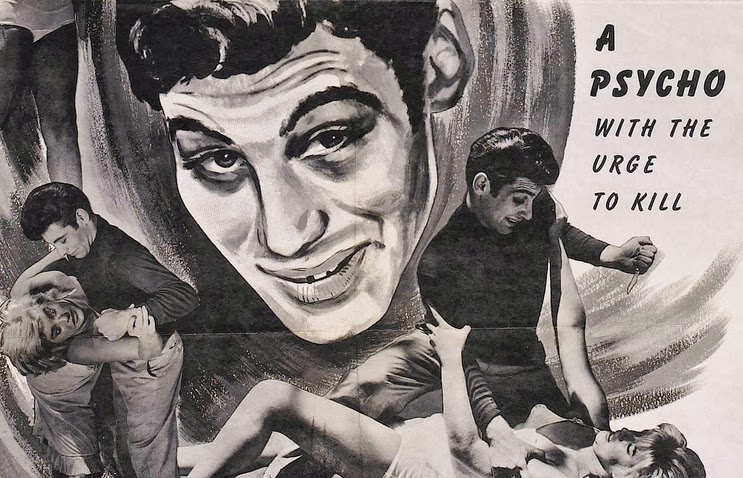
"A psycho with the urge to kill": The Sinister Urge isn't coy about naming one of its main influences.

A slightly paunchy Ed in The Sinister Urge.
The year is 1960. Edward D. Wood, Jr., 36 years of age, has been in Hollywood for twelve years at this point and in that time has done virtually everything there is for a young man to do in showbiz. He's acted in films and onstage. He's been employed by a major studio, Universal, in a position of some responsibility as a night production coordinator. He's worked in local television as a writer and director as well, sometimes even getting paid for it. 

More importantly, Ed has written, directed, and produced his own feature films. He's worked with one certified movie legend, Bela Lugosi, and a whole host of colorful, nationally-known pop culture figures, including Vampira, Tor Johnson, and Criswell, not to mention several of the B-movie cowboy actors (such as Kenne Duncan, Tom Keene, Bud Osborne, and Tom Tyler) he had idolized when he was a young moviegoer in Poughkeepsie, NY. Several of Wood's scripts have been purchased and produced by other filmmakers, too, occasionally to financial success. He's helped stage a Las Vegas revue and even made technical training films for the government.

In short, Ed Wood has been around the block.

None of this has made him wealthy or famous, however. In fact, he's always broke. "I should have a million dollars right now," he sadly tells his friends during his moments of self-pity. But his enthusiasm for show business is unshakable, and he's always focused on the next project with a tragicomic sense of optimism. Unfortunately, his drinking will become an increasing problem in the years to come, and Ed will be forced to rely more and more on favors from friends to find work as he steadily descends the ladder of respectability from low-budget science-fiction, horror, and crime films to softcore "nudie cuties," smutty paperbacks, and finally hardcore pornography. In the pivotal year of 1960, his career is at a crossroads, and he seems to know it.

Wood's last mainstream film.
Those are the circumstances under which Ed Wood directed his so-called "last" feature film, The Sinister Urge (1960), and they're not especially pretty. Actually, a good chunk of the film had already been made back in 1956, when Ed did one day's worth of shooting on a rock-music-themed juvenile delinquent picture to be called Hellborn. Producer George Weiss, who had shepherded Ed's debut film Glen or Glenda (1953), couldn't raise any more money, and the production shut down.

Several years later, actor Conrad Brooks sold the rights to the precious Hellborn footage to independent producer Roy Reid, who agreed to let Eddie make a "new" movie out of it for Headliner Productions, which had previously distributed The Violent Years (1956). As with Night of the Ghouls (1959), Ed wrote and directed an original story that incorporated the existing film footage. The cast was a mixture of Wood's typical repertory players (Harvey B. Dunn, Duke Moore, Connie Brooks, Kenne Duncan, and Carl Anthony) with a few prominent newcomers, mainly LA nightclub performer Jean Fontaine, who supplied her own wardrobe, and a hungry up-and-comer named Michael "Dino" Fantini, who was culled from an acting school. Perhaps out of loyalty, Ed hired his longtime cinematographer, William C. Thompson, to shoot The Sinister Urge, even though the veteran cameraman was losing his eyesight.

As nearly every single biographer of Ed Wood has noted, the plot of the film, in which a once-legitimate filmmaker has gotten involved in the manufacturing of illegal pornography, very much mirrors Ed's own life and career. Perhaps taken together, Glen or Glenda and The Sinister Urge form a more complete self-portrait of Ed Wood.

But how does the film stack up today? Let's succumb to our sinister urges and investigate.

Title screen from the film.

Alternate titles: Racket Queen, Act of Compulsion, Hollywood After Dark, Immoral Intruder, Chains of Evil, Hellborn.

Availability: The film is available with an introduction by filmmaker Ted Newsom as part of the Big Box of Wood collection (S'more Entertainment, 2010). It's available as a standalone DVD as well (Sinister Cinema, 2008).

The backstory: Much like Ed's previous films, Jail Bait and Night of the Ghouls, the plot of The Sinister Urge revolves around a criminal couple. The twist here is that the no-nonsense, tough-talking mastermind in the relationship is the woman -- brassy blonde Gloria Henderson (singer Jean Fontaine, in her first and last screen role), who runs a pornography or "smut" ring for her thuggish bosses in "the Syndicate." (That's what people used to call the mafia.) Her lover and accomplice is the wonderfully-named Johnny Ryde (Plan 9 from Outer Space veteran Carl Anthony), a formerly-respected movie director who now oversees the making of sleazy, no-budget pornographic films and photos. It's a lucrative but highly dangerous operation, with the police (led by Duke Moore and Kenne Duncan) constantly raiding their studios, confiscating their films, and tailing their every move.

The reason for this drastic police intervention is the fact that Gloria and Johnny's pitiful little racket is somehow the hub of the entire city's criminal community. The immoral pornographers even have a greasy, low-rent thug in their employ named Dirk (played with genuine menace by Dino Fantini in his only notable screen role) who kills anyone who may pose a threat to the operation, i.e. models who squeal to the cops. Dirk is basically Gloria and Johnny's vicious "attack dog," but he's getting to enjoy his work too much, not only killing but sexually assaulting his victims as well... and doing so without much subterfuge in broad daylight. Dirk's exploits have brought on even more police scrutiny, and the Syndicate wants him taken care of "permanently."

From there, it's a series of murders, attempted murders, and double crosses that lead to a very moralistic Dragnet-esque finale, with all of the scumbags either dead or headed to jail.

Disappointingly, there do not seem to be many colorful anecdotes surrounding the making of The Sinister Urge. Perhaps sensing this was his last chance at legitimacy or even semi-legitimacy, Ed Wood very much wanted to prove that he could bring a film in on time and on budget with no screw-ups or shenanigans. Producer Roy Reid had every confidence in him, and Wood submitted a carefully-written proposal called "My Plans for Shooting Arrangement and Why" (sample line: "There is an excellent chance of bringing this picture in in four days and one pre-production.") and an itemized budget (Ed's fee for directing: $2600; total budget: $20,152, which today would be about $160,000).

Much of the shooting was done on a ranch owned by cast member Harry Keaton, brother of Buster Keaton, making his last-ever screen appearance in the role of "girly" photographer Jaffe under the semi-pseudonym "Harry Keaten." The micro-budgeted film seems to have played mostly in LA but did make it to New York's then-infamous 42nd Street "grindhouse" circuit, where it ran for 13 weeks. What's notable is that The Sinister Urge is the first of Ed's directorial efforts to contain a brief flash of female nudity, which occurs when a sex-crazed Dirk rips the brassiere from one of his female victims.

Rudolph Grey's Nightmare of Ecstasy includes a photograph of a "bondage" scene, but no such sequence survives in the existing print. It should be noted that a few frames from one scene, in which Kenne Duncan shows some grisly photos to Harvey B. Dunn, have been clearly chopped out by the censors. Nightmare of Ecstasy also mentions that Ed filmed some "additional scenes" for The Sinister Urge in 1961, the year after its original release. Considering how very tame the film is, it's likely that these scenes were a little racier than what was already in the movie.

A threat to American womanhood? This?!?

The viewing experience: Stultifying and drab, but not worthless. The Sinister Urge is an extremely hypocritical film that preaches against pornography with the same fervor that Reefer Madness condemned marijuana but at the same time invites viewers to ogle the (somewhat) scantily-clad women on display in the film and take pleasure from their debasement. Certainly, the two sanctimonious cops on the case must spend a lot of their time poring over "dirty" films and photos. Could that perhaps be why they're so willing to spend virtually all their waking hours on this case? At one point, Kenne Duncan (also in his last screen role) tells us that smut is even more addictive than dope. This is interesting news, since by pure coincidence, I just read about a recent scientific study that suggests that the brain does not actually react to porn the way it does to narcotics and that "porn addiction" may not even exist.

Perhaps because of censorship issues, The Sinister Urge never depicts anything like real pornography anyway. At the moment of the big police raid, here is what is happening: Jaffe is taking some still photos of three women in swimsuits lying on their stomachs next to each other. When the cops kick in the door and start arresting everyone and seizing everything, it seems like a glimpse of a fascist police state, yet I think the movie wants us to feel glad that these lawmen are doing their job to protect the innocence of American womanhood. I've mentioned before that Ed Wood's personality was a strange, self-defeating combination of swinger and square, playboy and prude, and never is that more clear than in The Sinister Urge.

Before embarking upon this project, I had no idea how much influence Jack Webb and Dragnet had over Eddie, but now it's crystal clear. The hard-working plainclothes detectives portrayed by Kenne Duncan (a sexually-voracious sleazeball, by the way, whose boastful nickname was "Horsecock") and Duke Moore (whose character, just as in Night of the Ghouls, is kept from taking a date to the theater in order to focus on police work) are supposed to remind us of Jack Webb's Sgt. Joe Friday, but instead their scenes play out like an alternate universe version of Dragnet in which two dull sidekicks are paired together without a leading man.

In many ways, The Sinister Urge suffers from a shortage of charisma, a problem that  also plagued Crossroad Avenger: The Adventures of the Tucson Kid, another Ed Wood project with Kenne Duncan. In the past, Wood's films had larger-than-life personalities like Bela Lugosi, Tor Johnson, and Criswell to spark the audience's interest. Here, unfortunately, too many of Ed's loyal but dull second stringers have been promoted to leads. I've already mentioned the tedium of Duncan and Moore's talky scenes at the police station. The boredom there is briefly relieved by a welcome appearance from Harvey B. Dunn as a concerned taxpayer, but then Dunn disappears after being shamed by one of Kenne Duncan's Dragnet-esque sermons. (In his shooting plan, Wood says that the "taxpayer" character, Romain, is crucial. That's perhaps why he cast Dunn in the relatively small part.)

On the criminal side of the film, hard-boiled Jean Fontaine (who was married to a rich man and only pursued showbiz as a hobby) and twitchy, greasy Dino Fantini add some much-needed color and eccentricity, but the central character of Johnny Ryde, who by all accounts was Ed's onscreen surrogate*, is too demanding for a pedestrian actor like Carl Anthony, who seems supremely stiff and uncomfortable. Gloria's "syndicate" bosses, too, are a flop. They seem like bland bureaucrats rather than flashy gangsters. Maybe that was part of Ed's plan, effectively deglamorizing the world of crime by showing mob bosses as bean counters and number crunchers.  I must say that Gloria and Johnny's pad, supposedly a den of sin and vice, looks like the standard living room set from every late-1950s/early-1960s TV sitcom. You get the sense that Rob Petrie might come in and trip over the ottoman at any moment.
*Yes, in a much-noticed "in joke," Johnny's office contains lobby cards for Plan 9, Jail Bait, The Violent Years, and Bride of the Monster. Johnny refers to the maker of those films as "a friend."

Actress Jean Fontaine, aka "Gloria."
But what about the standard "Ed Wood" brand of eccentricity? What about his pet themes? Oh, they're here. Have no doubt of that. First and foremost, The Sinister Urge is a clumsy patchwork job that tries to incorporate old footage into a new story by means of dubbed-in dialogue and cutaway reaction shots. The mismatches aren't as crazy as the ones in, say, Bride of the Monster (1955), but they'll do. Similarly, the dialogue is oddly formal and heavy on exposition and outdated slang. While not as quotable as some of Wood's other films, it's noticeably off-kilter at certain points. ("I don't dig the angel bit," says Dirk after Johnny unsuccessfully tries to bump him off.) If there's a character you'll be quoting or imitating afterward, it's probably going to be Gloria, whose climactic "that's not Dirk" speech is already well-known to fans of MST3K.

In the aforementioned scenes from Hellborn, Ed himself appears as a clearly over-aged, somewhat paunchy delinquent, fighting with Conrad "Connie" Brooks outside a pizza joint, thus making his first major acting appearance in one of his own films since Glen or Glenda seven years earlier. That pizza joint is highly reminiscent of the teen hangout repeatedly mentioned in Ed's novel Devil Girls (1967), and one of the female spectators is wearing -- you guessed it -- a fuzzy angora sweater. (I almost typed "a fuzzy pink angora sweater" before remembering that the film was in black-and-white.)

Alcoholism runs all through this film, with Gloria and Johnny boozing it up from one end of the picture to the other. And, yes, there is a scene of transvestism. In order to lure Dirk out of hiding, the police send a male officer dressed in drag to Griffith Park (Dirk's favorite crime scene) to act as "bait" for the mad killer. Does he go for it? Like a moth to a flame, baby. And did I mention that the first victim in the film is a model named Shirley? For those of you just joining us, "Shirley" was Ed Wood's drag name. If you get a kick out of technical mistakes, furthermore, you'll be happy to know that the boom mic is prominent in several scenes, perhaps indicating that either Ed Wood or Bill Thompson was getting sloppy by this point.

Meanwhile, just to show you how interconnected Ed Wood's works truly are, there is a portion of The Sinister Urge that plays like a dramatization of his posthumously-published manuscript, Hollywood Rat Race (Four Walls Eight Windows, 1998). In that book, Ed writes about would-be starlets who come to Hollywood with big dreams after being the lead in a high school play but then wind up being exploited by sleazeballs and phonies. In this movie, the cops discuss such unfortunate young ladies, and then we get to actually see one such victim  in action -- an ingenue named Mary (with all the innocence that name implies) who winds up owing money to Gloria and Johnny and, in order to pay them back, begins a sordid life of indentured servitude as a model for their smutty pictures and films. Such a shame. If only she'd read Ed's book before coming to Hollywood.

Next week: Have I got a treat in store for you? Actually, to be honest, I don't know because the next film is one I've never seen. Could be great. Could be terrible. Could be somewhere in the middle. One of Wood's occasional collaborators in the 1950s and 1960s was a Russian-born director-producer named Boris Petroff. Wood was an unbilled "consultant" (and perhaps more) on Petroff's Anatomy of a Psycho in 1961, and Petroff borrowed the character of Lobo (as played by Tor Johnson) from Bride of the Monster for his infamous 1957 anti-classic The Unearthly. Well, in 1963, Boris Petroff effectively ended his filmmaking career with a backwoods, "hick-sploitation" movie based on a script ghost-written by none other than Eddie Wood. Join me in seven days for an unabashed look at Shotgun Wedding aka Child Brides of the Ozarks. Sounds tasteful enough, doesn't it? Y'all come back now, hear?