Showing posts with label Ed Wood Wedesdays. Show all posts

Wednesday, July 22, 2020

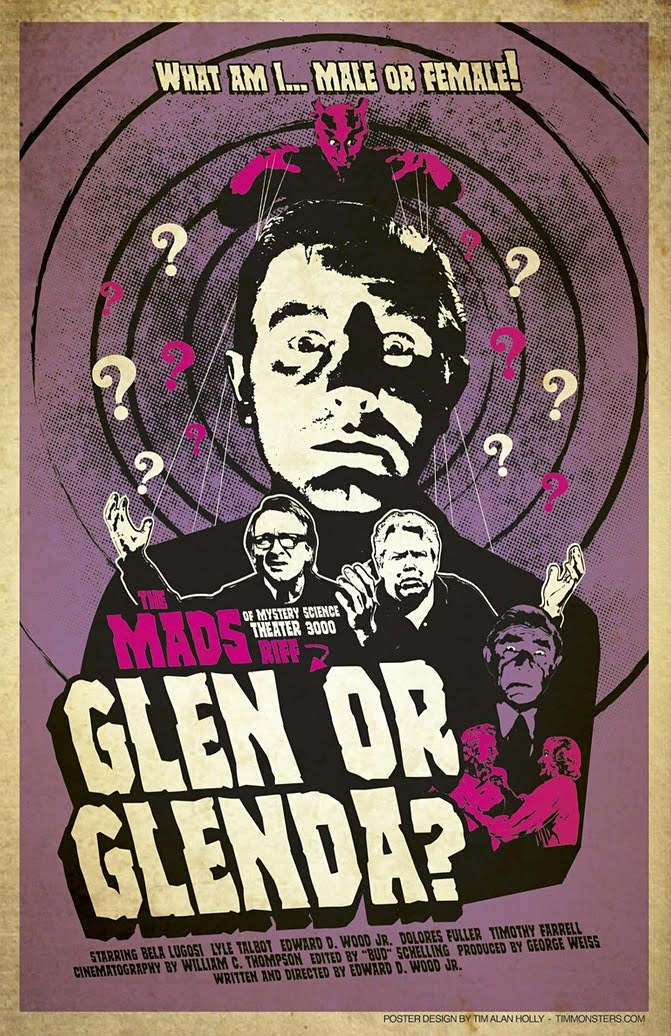
Ed Wood Wednesdays, week 106: "The Mads: Glen or Glenda" (2020)

Frank Conniff and Trace Beaulieu riff on Glen or Glenda.

A poster created for the event.
The global pandemic has changed many people's plans in 2020. That includes the entertainers who regularly perform live in front of audiences. Clubs and theaters have largely been shut down this year, and it's uncertain when they'll reopen. In the meantime, many performers have opted for online-only shows. A streaming session is not exactly like an in-person live concert, naturally, but it's better than nothing. And it does allow performers to interact with fans after a fashion. Compromise is the name of the game here.

Last night, Mystery Science Theater 3000 veterans Frank Conniff and Trace Beaulieu performed an online "riffing" of Edward D. Wood, Jr.'s Glen or Glenda (1953) for over 2,000 fans. For the last few years, Conniff and Beaulieu have been touring as the Mads, a nod to their MST3K mad scientist characters, TV's Frank and Dr. Clayton Forrester. They've even had a podcast, Movie Sign with the Mads. Conniff and Beaulieu were very familiar with Glenda, having provided live commentary on Wood's semi-autobiographical feature dozens of times previously. But this was their first time riffing it online via Zoom, with Beaulieu in Minnesota and Conniff in New York. Comedian Chris Gersbeck acted as the show's producer and coordinator. Since the riffing streamed live over YouTube, viewers were able to comment via a chat feature.

Considering this was the Mads' Zoom debut, the show went very smoothly. Apart from a few fan complaints about the volume of the movie, which Gersbeck quickly corrected, there were no major technical glitches. Conniff and Beaulieu were in fine form as well. They obviously knew the movie forwards and backwards, inside and out, man to woman, woman to man, etc. In the grand tradition of MST3K, they commented on all the many glorious glitches, gaffes, and oddities of Wood's eccentric movie. When Eddie walks toward the camera wearing a pointy bra under his blouse, Beaulieu implores, "Ed, turn the high beams off!" And when portly, balding Henry Bederski wipes down his sweat-soaked fedora in front of a very minimalist street corner set, Conniff quips, "I didn't know the dark, existential void had a bus stop!"

The great thing about a live riffing like this is that the comedians point out things in Glenda that even I hadn't noticed after dozens of viewings. One of my favorite such moments arrives near the end of the movie when we see stock footage of children playing in a schoolyard. We are supposedly seeing one of the film's characters, Alan ("Tommy" Haines), when he was a boy. Beaulieu points out that there's one kid in the footage who just kind of wanders around aimlessly, then stands at the very edge of the frame with just his elbows and ankles visible. Elsewhere, the Mads noted that certain props, including a bookcase and even a Y-shaped tree, turned up in multiple scenes. Conniff also called attention to the fact that Conrad Brooks is credited as "Banker," even though the film has no bankers in it! How did I never catch that?

After the movie was over, Conniff and Beaulieu stuck around for another half hour to answer questions from viewers, and it was at this point when it became apparent that the Mads were major admirers of Glen or Glenda. Both cited it as their favorite "cheesy movie," and Conniff compared it favorably to Tommy Wiseau's equally infamous The Room (2003), saying that Wood's movie preached a message of tolerance toward the LGBTQ community (long before it even had that name) while Wiseau's movie was hateful and misogynistic. Conniff further offered that Wood's true gift as a filmmaker was his sincerity, while Beaulieu pointed out that Glenda was stylistically similar to the films of David Lynch. When the Mads said that the evening was a tribute to Ed Wood, it was obvious that they meant it.

Trace Beaulieu and Frank Conniff: Together but apart.

A DVD of the shorter, censored version.
A TALE OF TWO VERSIONS: As many longtime Ed Wood fans know, there are two versions of Glen or Glenda in circulation currently. One is the version I originally saw on the Rhino Video VHS edition of the film in the 1990s. I now call it the uncensored print. It also appears on the two-disc set called The Ed Wood Collection: A Salute to Incompetence. The second, slightly shorter version of the film is more common. I call it the censored print. It's on the DVD releases from Image Video and Legend Films and has been included in such sets as The Ed Wood Box and The Worst of Ed Wood. Both the censored and uncensored Glendas have been uploaded to the internet.

For last night's streaming show, Frank Conniff and Trace Beaulieu used the longer, uncensored print of Glen or Glenda. But, judging by a pre-show chat Beaulieu had with producer Chris Gersbeck, he and Conniff were more accustomed to the shorter, censored print. Beaulieu estimated that the uncensored print had about five extra minutes of material compared to what he was used to. He pointed out the infamous "cigarette lighting" scene and some extra shots during the dream sequence. Since the Mads have riffed Glen or Glenda on nearly 50 other occasions, Beaulieu had to adjust his timing to the longer edition of the film.

As for the specific differences between these versions, I refer you to my Glen or Glenda transcript. In that article, the material in red type only appears in the uncensored print. After last night's streaming show, I decided to make a side-by-side comparison of the two editions to see exactly how they differed. Even after all these years, there were some revelations in this experiment.

One immediate difference is seen in the main title cards. These have been altered in all existing prints of the film, with the bottom of the frame crudely blocked by a grey cloud and the words "GLEN or GLENDA" added ex post facto by some third party. Since Wood's movie was known by so many titles (I Changed My Sex, I Led 2 Lives, etc.), I'll assume that distributor Wade Williams removed another, lesser known name and substituted the familiar Glen or Glenda handle instead.

The copyright information at the bottom of the screen is another obvious addition to the print, but the wording is a little different between the censored and uncensored versions. In the former, it merely says: "Copyright MCMLIII Screen Classics Productions." But in the latter, the words "25th Anniversary Special" have also been added. Beaulieu and Conniff referred to the longer version of the movie as the "25th anniversary edition."

(left) Title card for the censored version; (right) title card for the uncensored version.

Confusingly, the film's end card carries the "25th Anniversary" banner in both versions, censored and uncensored. However, the uncensored version has an added line: "Copyright Renewed 1981 Paramount Pictures Corporation." This leads me to believe that the "25th Anniversary Special" banner is native to the original print and was placed there at the behest of Glenda producer George Weiss.

(left) The end card of the censored version; (right) end card of the uncensored version.

Watching the two prints side by side was quite educational. I already knew about the major cuts that had been made to the censored version, including the aforementioned "cigarette lighting" scene and the gender-bending twist ending of the foundry sequence. But this time, I noticed that a couple of references to homosexuality had also been cut -- one from Dr. Alton (Timothy Farrell) and one from Inspector Warren (Lyle Talbot). The censored print still has multiple references to homosexuality, just fewer of them. And in the censored print, Barbara (Dolores Fuller) is no longer allowed to describe the specific content of that newspaper article about the sex change operation. The Glen or Glenda transcript has been updated to show these lines in red print.

Just as Beaulieu mentioned, Glenda's lengthy dream sequence was also altered. There's a brief pantomime routine shot in front of a black screen that has been entirely excised in the shorter version of the film. Why, I don't know. In the deleted footage, Glen (Ed Wood) is seen walking uphill at an angle. Then there's a matching shot of Barbara walking uphill at the same angle. Glen continues walking uphill, then turns around to face his blonde-haired lover. Barbara walks further uphill with her arms extended, a visual motif Wood repeats in Plan 9 from Outer Space (1959) and Orgy of the Dead (1965). Finally united, Glen and Barbara hug and kiss. But then Glen magically disappears (just as Ed Wood did in his "Magic Man" commercial), leaving Barbara upset and confused. She rubs her temples in agony.

Again, there was no obvious reason to cut this material, since it contains no problematic dialogue and certainly no sex or violence. Perhaps it was removed for pacing reasons. Later in the dream sequence, there's a more salacious shot of Glen ripping off Barbara's blouse in a rage. This, too, has been cut from the censored version. It still blows my mind that author Rob Craig based his analysis of Glen or Glenda on the shorter, censored print in his book Ed Wood, Mad Genius: A Critical Study of the Films (2009). And it was very frustrating that Legend Films chose to use the shorter edition of Glenda for its restoration/colorization. Hopefully, the longer, more complete version of the movie will reach more Wood fans in the future, and the censored print will fade into obscurity.

Wednesday, October 19, 2016

Ed Wood Wednesdays: The 'Glen Or Glenda' Odyssey, Part One by Greg Dziawer

These posters weren't exactly subtle about what inspired Ed's movie.

"A lady is a lady, whatever the case may be."
-Dr. Alton (Timothy Farrell) in Glen Or Glenda

Christine Jorgensen holds the Daily News.
Born just a year and half after Ed Wood, only in the Bronx instead of Poughkeepsie, George Williamson Jorgensen likewise enlisted in the military in his late teens, having been drafted shortly after graduating high school in 1945. By 1946, both discharged, Ed began pursuing the creative life while George began pursuing Christine.

Finally, after knocking around Hollywood for a half dozen years, Ed landed his big break. A feature. And even better, impossibly, a feature about a subject through which he could Trojan Horse his own story, a plea for transvestism. We all know that's Glen or Glenda, but the rapid-fire sequence of events in getting the film to market is worth mentioning. It's even worth opening a new Odyssey, and sharing a key document that, already in early 1953, months before Glen or Glenda was even released, reveals Ed's awareness as Outside Artist.

"EX-GI BECOMES BLONDE BEAUTY": That Daily News headline from December 1, 1952 started it all, launching Christine Jorgensen into the staid 1950s, where she remained celebrated and, owing to her class and wit, rarely derided. Her return to the United States from Sweden, landing at Idlewild Airport (now JFK) in Queens—the busiest international air passenger gateway in the US at the time—was the largest press gathering to date. She was, for a spell, arguably the most famous woman in the world.


Beating just about everyone to the punch, low-budget exploitation film producer George Weiss hired a hungry young Ed Wood to write and direct Glen or Glenda, a film intended to cash in on the Christine Jorgensen case, in early 1953. Although Wood veered far from the nominal source, he turned the assignment quickly, which was all that mattered. Inside of a week from the time that Christine landed in the States, this newspaper article credited to UPI correspondent Aline Mosby was already in syndication. The following clipping originally appeared in the February 19, 1953 edition of the Daily Herald in Provo, Utah.

"A sort of Orson Welles of low-budget pictures."

As much as I'd like to comment
...on this unbelievably early tie of Ed to Orson Welles, as kindred maverick artists by implication, as well as this early recognition of Welles' ultimate place in film history
...on the "tiny studio"
...on Ed and Martha Graham
I'll try to stop and let it speak for itself. Weiss clearly managed quick placement of a promotional piece, the content clearly provided almost if not entirely by Ed. It makes it his first (perhaps only) nationally syndicated newspaper interview.

By April, Glen or Glenda premiered across drive-ins and hardtop fleapits, adopting different titles for different regions. It continued playing these venues for a full decade.

Christine Jorgensen remained a staple of the pop culture throughout the 1950s, appearing in men's adventure magazines (interesting to imagine the average joe's reaction), as spokesperson for the transgendered and belatedly as subject of her own movie bio. She died in 1989 at the age of 62, felled by bladder and lung cancer.

As for Ed, we'll explore more in future Ed Wood Wednesdays!

Special Thanks: The scan of the article above is from The Scene Of Screen 13, a blog where you will additionally find a ton of Ed-related movie ads in local papers, and a veritable mountain of ads from the world of ex- and sexploitation during Ed's era. And for more about Christine Jorgensen, make sure to check out the Ed Wood Wednesdays Tumblr.

Wednesday, March 30, 2016

Ed Wood Wednesdays: Eddie Or Not? The Ed-Tribution Odyssey, Part Two by Greg Dziawer

Greg continues to navigate the strange and misleading world of Ed Wood attributions.

In previous and numerous installments of Ed Wood Wednesdays, we visited a number of paperbacks attributed falsely to Ed as author. It's a veritable game of research Wack-A-Mole. No sooner do I do a little quick research (or more simply it's a given) to rule out Ed's authorship than two more bullshit Ed-tributions rear their head in my browser. I'll allow for fair maybes with some evidentiary background or informed consensus; I'll even take a sensible inference! Given the ease at which the information is obtained to rule out Ed, I'll conclude charitably that the non-profit claimants are mostly acting in an ignorant good faith. But I'll qualify that statement by saying that the sellers – by far the most perfidious purveyors of mis-Ed-tributions – seem to have a hint of self-interest and a huckster's parsing of language and truth at play.

In other words, just go to Ebay. I've listed links to actual auctions in the past, but really there's no need. Just go search, and in no time flat you'll come across a listing of a non-Ed paperbacks, generally at about five to ten times the price of its market value. A cynic could retort, I know being one, "Ah, market value is whatever someone's willing to pay!" Alas, that's the huckster in me.

So, then, let's play a few rounds of Wood Wack-A-Lie:


Exhibit #1: Take Death For A Lover

Ed Smith's cover for Take Death For A Lover.

Take Death For A Lover (1968) by Alan Marshall; A Pleasure Reader (an imprint of the insanely prolific Greenleaf).

Marshall is a house pseudonym (known and unknown, often including Donald Westlake, as well as Evan Hunter and Lawrence Block) at Greenleaf Classics, with a whopping 150 titles indexed here. There's no concrete connection to Ed that I can discern anywhere. Admittedly, Ed did write for Greenleaf, both under his own name and a house pseudonym.

As the title melds sex and death, give a moment's reflection to it being a reprint of Orgy Of The Dead, previously published by Greenleaf. No one has suggested this, and no one should have. There's a zombie on the cover.

Seen on Ebay. "Ed Wood" ends the title listing, with no further mention or attempt at substantiation elsewhere in the listing. The Buy-It-Now price is only a hundred bucks!

Back cover: Hilda ran from one shame to another, until her life became a monolith of degradation, and the taste of countless sins grew bitter in her mouth...

Eddie or Not? Cool cover and title, but nope.


Exhibit #2: A Family Affair

The cover art for J.X. Williams' A Family Affair, as murkily displayed on Ebay (left).

Speaking of Greenleaf and house pseudonyms, this Ember Library imprint title from 1966 is credited to the impossibly prolific J.X.Williams. Leaving aside the matter of William's identity, which will only complicate matters, what we know is that Ed wrote a title credited on the cover to the mysterious, highly likely purely fictitious and pseudonymous Williams, as revealed by his name appearing on its title page.

The J.X. Williams moniker was widely shared across Greenleaf imprints, by knowns and unknowns again, Victor J. Banis, Earl Kemp, and John Jakes among them. Crossover of actual authorship occurred between the Marshall and Williams house pseudonyms in the vast world of the Greenleaf Classics. But there was that sole Wood title.

Seen on Ebay as The Affair. The seller there added to the murk by cutting off the title on the cover scan and editing it accordingly in the listing. Forty bucks and it's yours!

Eddie or Not? You know the answer.

A trio of genuine Ed Wood novels published by Greenleaf.

For the record, Ed did author three books for Greenleaf:

Exhibit #3: A Manual Of Human Sexuality, Volume 3


"She learned everything about sex from a manual. Emmanuel was their gardener."

A Manual Of Human Sexuality, Volume 3 (1973); Edusex (Gallery Press, Inc.) by Norman Bates (Charles D. Anderson).

Just when I was feeling confident that Norman Bates was solely a pseudonym used by Charles D. Anderson and not a shared pseudonym, certainly not Ed's pseudonym, I dug a little into this title. The first copyright record I found did not list a volume number, and the author was credited as Robin Y. Eagle, a fellow staffer of Ed, Leo Eaton, Bill Jones and Anderson circa 1970-71 in the Pendulum magazine office on W. Pico Blvd. But then I found a record for Volume 1, credited to Anderson and listing Bates as pseudonym. Volume 3 was/is up on Ebay now (with Norman Bates listed on the cover) and at a few places, minimally at 125 clams and always claimed to be by Ed. Three volumes (at least), the first and third by Anderson and the second by Eagle, often pseudonymously Robert Elgin, maintaining that name into the mainstream.

Pendulum and Calga dissolved in early 1973, leaving only Gallery Press, across the magazines and paperbacks. These Edusex paperbacks were the last gasp of the halcyon days of the Pendulum family of imprints, dozens upon dozens of titles in the Encyclopedia of Sex (Pendulum) and Sexual Enlightenment series (Calga), both based upon the T.K. Peters source and the frequent haunt of Ed's pen.

Eddie or Not? Really?

Wednesday, March 23, 2016

Ed Wood Wednesdays: The Wood Magazine Odyssey, Part Seven by Greg Dziawer

The next step on our tour of Ed Wood's career? The foul year of 1975.

In our last index of magazines, we listed all titles filed for copyright by Gallery Press, Inc in 1974. As with that year, the 1975 filings were solely under the Gallery Press imprint, and the volume of publications considerably less than in the early '70s, when Pendulum/Calga was in full swing (no pun intended). Fifty-three titles and 75 issues were filed in 1975, a number of issues dated late 1974 that had yet to be filed. Most titles saw the release of only a single issue (three issues at most for only a handful of titles), but a few early Pendulum titles still continued, e.g. Swap and Wildcats into their respective eighth volumes. New titles included such gems as Bush Lovers, Cunny, and Young Sugar. Excepting three titles of Case Histories, the sociological angle, once the province of the defunct SECS Press and Edusex imprints, was almost entirely gone; no longer was it necessary to continue the ruse of educational content, due to the relaxation of obscenity laws and now-widespread existence of pornographic magazines. Worth noting: Gallery Press also published adult paperbacks in 1975.

Wednesday, February 17, 2016

Ed Wood Wednesdays: The Wood Magazine Odyssey, Part Three by Greg Dziawer

Let us journey once again into the swirling vortex of Ed Wood's magazine writing career.

Another fine Pendulum publication.
By 1972, Bernie Bloom's Pendulum Publishers, Inc. was humming along, producing magazines, paperbacks and films. The magazines were packaged and distributed by mob boss Michael Thevis. Thevis diversified beyond solely magazine distribution in the late '60s, his Peachtree News Company of Atlanta merely the first in a long line of companies. He launched Pendulum as an adult paperback publisher in 1967 in Atlanta, then Bernie incorporated the name in LA in 1968. The name of Calga Publishers, Inc. derived from the then-current state postal abbreviations for California (CAL) and Georgia (GA).

By 1972, Pendulum's small office on 5585 W Pico Blvd in Los Angeles churned out an average of three magazines per week under the Pendulum and Calga imprints. Both were legitimate business in their own right, operating from the same address. In those days, Calga published titles under its own imprint, as well as under two DBAs (copyright-speak for "doing business as," in which a business can use a fictitious name so long as it's not trademarked): Gallery Press and Edusex. Pendulum, too, carried a DBA: SECS Press (also a concurrent paperback line: the Sex Education Clinical Series).

Ed Wood, the most prolific staff writer at the W Pico office, wrote as much as the other four or so staffers combined. His resume lists 51 short stories and 52 articles in 1972 alone. (Thanks to Bob Blackburn, co-heir of the Ed Wood estate, for this count.)

Although much of Ed's work from this era has been identified, it is our hope that this list furthers research ultimately leading to the discovery of more. Stories and articles were often written under pseudonyms, or even without credit, and the staff also wrote any and all supporting text: photo captions and narratives accompanying photo sets, and even editorials. The magazines often formed the basis for paperbacks, the staff quickly stitching them together to collect the $100 bonus per paperback offered by Bernie Bloom.

The following list contains all titles filed for copyright in 1972, 154 individual titles in all. A few were filed for copyright as books, though listed in the periodical copyright index owing to being serialized. Volume and Number were oft-times fluid, duplicating or even skipping a number. Some titles only had Volume numbers. The specific day of copyright likewise varied, sometimes coming after publication, sometimes before, and at the end and beginning of the year, copyright records for 1972 cover a handful of titles published in late 1971 or early 1973.

Pendulum/SECS Press


Pendulum

Balling
v2n1 FebMar

Black and White
v2n1 AprMay
v2n2 JunJul
v2n3 OctNov

Blazing Films
v6n1 JanFeb
v6n2 AprMay
v6n3 OctNov

Body and Soul
v6n1 FebMar
v6n2 JulAug

The Boy Friends
v4n1 JulAug

Dynamic Films
v6n1 MarApr
v6n2 JulAug

Ecstasy
v4n1 FebMar
v4n2 JulAug
v4n3 OctNov

Flesh & Fantasy
v5n1 MarApr

Garter Girls
v6n1 FebMar
v6n2 MayJun
v6n3 SepOct
v7n1 NovDec

The Girl Friends
v4n1 JanFeb (in notice: Dec71)
v4n2 MayJun

Girl Lovers
v2n1 JulAug

Gold Diggers
v4n1 JanFeb (in notice: Dec71)
v4n2 MayJun

Heads Up
v4n1 JanFeb (in notice: 1971)

Lezo
v6n1 MarApr

Nude But Nice
v2n1 FebMar
v2n2 MayJun

Nude Rebels
v4n1 FebMar
v4n2 MayJun
v4n3 SepOct
v5n1 JanFeb73 (in notice: Dec72)

One Plus One
v4n1 JanFeb (in notice: Dec71)
v4n2 AprMay

Orgy
v4n1 AprMay
v4n2 SepOct

Pendulum
v4n1 AprMay

Pussy Willow
v4n2 AugSep
v4n3 NovDec

Roulette
v6n1 JanFeb
v6n2 MayJun

Savage Sex
v4n1 FebMar
v4n2 AprMay

Sensuous Strippers
v3n1 MarApr
v3n2 JunJul

Spice 'n' Nice
v3n1 AprMay
v3n2 AugSep
v3n3 NovDec

Suck-em-Up
v2n1 MarApr

Swap
v6n1 MarApr
v6n2 MayJun
v6n3 OctNov

Two Plus Two
v4n1 JanFeb (in notice: Dec71)
v4n2 AprMay

The Wild-Cats
v6n1 FebMar
v6n2 MayJun

Wild Couples
v4n1 MarApr
v4n2 JulAug

Young Beavers
v6n1 MarApr
v6n2 JulAug


SECS Press

Adult Garden of Sex
SECS Press
n6 MarApr
n7 JulAug
n8 NovDec

Bride & Groom
SECS Press (book)
1 FebMar
3 JulAug
4 SepOct

The Sexual Man
SECS Press
n4 JanFeb
n5 AprMay
n6 JunJul
n7 OctNov

The Sexual Woman
SECS Press
n5 FebMar
n6 AprMay
n7 AugSep
n8 JanFeb73 (in notice: Dec72)

Workbook of Adult Sexual Education
SECS Press (book)
2 MarApr
3 MayJun

World of Love & Sex
SECS Press (book)
11 Apr


Calga/Gallery Press/Edusex


Calga

Belly Button
v3n1 AprMay

Erotic Love
v3n2 OctNov

Group Sex (An Illustrated Study of Group Sex)
v4n1 MarApr
v1n2 AugSep
v1n3 NovDec

Hit and Fun
v3n1 FebMar
v3n2 AugSep

An Illustrated Study of Voyeurism (Formerly: Voyeurism)
v3n2 OctNov

Lesbianism
v3n1 AprMay

Lesbo Lassies
v4n1 JanFeb (in notice: Dec71)
v4n2 MayJun
v4n3 OctNov

Love Me
v3n1 FebMar
v3n2 JunJul

Mastering Sexual Adequacy
v1 JanFeb (in notice: Dec71)
v1 MarApr
v3 Apr May

Primer for Sexual Education
v5 JanFeb
v5 MarApr
v7 JunJul
v8 SepOct
v9 NovDec

The Reel Thing
v1 JanFeb
v2MayJun
v3SepOct

Sado-Masochism (A Study of Sadomasochism)
v4n1 JanFeb
v4n2 MayJun

Skin & Bones
v4n1 FebMar
v4n2 JulAug

A Study of Erotic Love Practices
v3n1 MarApr

Switch Hitters
v3n1 MarApr
v3n2 AugSep
v3n3 NovDec

U.S. Sex and World Views
v5 FebMar
v6 AprMay

Voyeurism (Continued as An Illustrated Study of Voyeurism)
v3n1 AprMay


Gallery Press

Boyplay
Gallery Press
v1n1 NovDec

Cherry
Gallery Press
v1n1 NovDec

Couples Doing It
Gallery Press
v1n1 AugSep72
v1n2 OctNov

Deuce
Gallery Press
v1n1 NovDec

Fantastic
Gallery Press
v1n1 AugSep
v1n2 NovDec

Gallery
Gallery Press
v1n1 OctNov

Gemini
Gallery Press
v1n1 SepOct
v1n2 NovDec

Goddess
Gallery Press
v1n1 SepOct
v1n2 NovDec

Hellcats
Gallery Press
v1n1 OctNov

Legendary Sex Tales
Gallery Press
v1n1 SepOct

Lesbian Life
Gallery Press
v1n1 AugSep
v1n2 NovDec

Monster Sex Tales
Gallery Press
v1n1 AugSep

Party Time
Gallery Press
v1n1 AugSep
v1n2 NovDec

Passion
Gallery Press
v1n1 OctNov

Savage
Gallery Press
v1n1 SepOct
v1n2 NovDec

Turn On
Gallery Press
v1n1 SepOct
v2n1 JanFeb73 (in notice: Dec72)

Wanted Women
Gallery Press
v1n1 SepOct
v2n1 JanFeb73 (in notice: Dec72)

Weird Sex Tales
Gallery Press
v1n1 JulAug

Woman's World
Gallery Press
v1n1 SepOct
v2n1 JanFeb73 (in notice: Dec71)


Edusex

The Anatomy of Sex
Edusex
v1 AugSep
v2 NovDec

Female Sexuality
Edusex
n1 OctNov

The Sex Experience
Edusex
n1 AugSep
n2 NovDec

Sex Forum
Edusex
n1 OctNov

Sex in America
Edusex
n1 OctNov

The Sex Scene
Edusex
n1 NovDec

Sex Studies
Edusex
n2 NovDec

Sexworld
Edusex
n1 AugSep
n3 NovDec


We'll continue indexing all magazine titles produced by Pendulum/Calga during Ed's tenure there (the majority of the publisher's existence) in future installments of Ed Wood Wednesdays.

Wednesday, April 29, 2015

Ed Wood Wednesdays, week 60: 'The Lawless Rider' (1954)

Johnny Carpenter (center) in the Ed Wood-written-and-produced The Lawless Rider.

"What is acting? It is to portray with all your ability and sincerity a character, a person, with all your heart and soul. Who is this character? Say she is a horse woman! How can you play a horse woman if you don't know the first thing about horses, or riding them?"
-Edward D. Wood, Jr., Hollywood Rat Race
"I got so bugged I turned it off and turned on another show.
But there was the same old shoot-'em-up and the same old rodeo.
Salty Sam was tryin' to stuff Sweet Sue in a burlap sack.
He said, 'If you don't give me the deed to your ranch,
I'm gonna throw you on the railroad track!'"

-The Coasters, "Along Came Jones"

A posse of sorts.
Imagine for a moment how exciting the Old West -- or at least Hollywood's approximation of it -- must have seemed to a suggestible, excitable kid growing up in unexciting Poughkeepsie, New York during the Great Depression. Today, Edward Davis Wood, Jr. is best known for his one-and-only movie about outer space. But for little Eddie, a faithful attendee and later usher and ticket taker at his hometown movie theater, the wide open, untamed territory left of the Mississippi River on the map provided all the space he could possibly want or need. He saw Universal's take on Dracula when he was seven years old, and it left a permanent mark on his psyche. But it was the cowboy pictures, particularly the cheap ones, which truly and permanently won his heart with their white-hatted heroes, hissable villains, and cut-and-dried moral certainty.

Westerns had a major impact on several generations of Americans, including some who grew up to become titans of science fiction. There are echoes of John Ford throughout George Lucas' Star Wars saga, for instance, while Gene Roddenberry famously pitched Star Trek to network executives as a celestial variation on Wagon Train. Ed Wood, meanwhile, grew up to write and direct Plan 9 from Outer Space, an interplanetary struggle which climaxes with an earthbound, O.K. Corral-style showdown and common barroom fisticuffs. The film's ad hoc trio of earthling heroes (an airline pilot, a military man, and a cop) could even be considered a posse. Their ultimate mission, like that of John Wayne in The Searchers, is to rescue a kidnapped white woman from the clutches of a race of outsiders whom they regard with suspicion and contempt.

By the time Ed Wood reached Hollywood in 1947, the uncomplicated and unambiguous Westerns he preferred were on the wane, chased out of cinemas and onto television by grittier fare, a fact he would lament repeatedly in his circa-1965 showbiz primer Hollywood Rat Race, which is chock full of references to and anecdotes about B-list cowboy stars. As both a writer and a filmmaker, Ed Wood was beholden to the demands of the marketplace, which is why he bounced around from genre to genre throughout his career like a common claim jumper. But Eddie kept trying to return to the range however he could, be it as a director (Crossroads of Laredo; Crossroad Avenger), a scenarist (Revenge of the Virgins), or even a stuntman (The Baron of Arizona). He also forged personal and professional alliances with such obsolete screen cowboys as Tom Keene, Tom Tyler, Bud Osborne, and badman Kenne Duncan, throwing film and TV roles their way whenever possible, often in non-Westerns.

But now, we must turn our attentions to another Western would-have-been, a pretender to the thrones of Autry, Rogers, and Cassidy who went by the professional name of Johnny Carpenter, though his true forename was Jasper. For it was with the late Mr. Carpenter that Ed Wood made this week's nearly-forgotten film.

THE LAWLESS RIDER (1954)

A lobby card possibly designed to trick viewers into thinking The Lawless Rider was in color.

A poster touting costar
Texas Rose Bascom
Alternate titles: Outlaw Marshal [working title]

Availability: To my knowledge, The Lawless Rider has never been released on VHS, DVD, or laserdisc. It is only through the benevolence of Ed Wood historian Phillip R. Frey that I was able to view a print of this exceedingly rare film.

The backstory: Let's go back a century to the fateful year of 1915. The era of American History we now call the "Old West" or the "Wild West" had just ended back then. Even so, the mythologizing of the period was already in full swing. The bookish Democrat Woodrow Wilson occupied the Oval Office, but he hadn't gotten his country into the already-in-progress World War I quite yet. Babe Ruth, not yet a Yankee, was making his unsuccessful debut as a pitcher for the Boston Red Sox. (He'd get better.) And Thomas Edison, still vital at 68, had invented some newfangled gizmo for recording telephone conversations.

Meanwhile, the future screen star known as Johnny Carpenter was still Jasper Carpenter, a year-old infant growing up on his daddy's modest farm in Debinsville, Arkansas, a town so small it's since been swallowed up by nearby Russellville just south of Route 40. Jasper grew up riding horses but dreaming of baseball, not knowing his future lay in the former rather than the latter. A horrific hit-and-run accident in 1936 permanently derailed Jasper's baseball dreams and sent him packing for Hollywood, where he'd try to become the next cowboy matinee idol under a semi-new name. (Or, briefly, an entirely new one: John Forbes.) Carpenter's future friend and partner, Edward D. Wood, Jr., wouldn't even be born for nearly another decade and wouldn't make it to the Left Coast until 1947.

Yakima Canutt, stuntman supreme
But the motion picture business was well underway by 1915, even without Ed Wood or Johnny Carpenter to help it along. That was the year of  D.W. Griffith's landmark, still-controversial The Birth of a Nation (also known as The Clansman). And there were already Westerns... and Western stars, for that matter! Most prominent among these was Tom Mix, headliner of nearly 300 silent cowboy films, many of them self-directed. Foreman of Bar Z Ranch, one of about 40 films Mix made in 1915, was the first-ever production to employ the services of a brash, 20-year-old rodeo champion with the memorable moniker of Yakima Canutt.

In truth, Enos Edward "Yakima" Canutt (1895-1986) had been busting broncos since the age of 11 and was among the first rodeo stars to invade the fledgling movie industry in its early days. With his bravery and skill, however, he eclipsed all his rope-slinging contemporaries in the field. Starting from that early Tom Mix short, Canutt's truly legendary career as a stuntman, stunt coordinator, and second unit director lasted sixty action-packed years, finally ending with Breakheart Pass (1975), a Charles Bronson picture distributed by United Artists. In between, along with too many cowboy films to count, he provided his services to Gone with the Wind, Ben-Hur, Spartacus, Stagecoach (which contains his single most famous stunt), Rio Bravo, Old Yeller, and dozens more. For about half a century, when Hollywood needed to pull off a tricky or dangerous action sequence in a motion picture, they turned to Yakima Canutt because they knew he was the man for the job. More than most, Mr. Canutt truly earned his star on the Hollywood Walk of Fame. Steven Spielberg was enough of a fan to work a Canutt-inspired stunt sequence into Raiders of the Lost Ark (1981).

Despite crossing paths with John Wayne and Stanley Kubrick, Yakima Canutt's own directing career never really amounted to a whole hell of a lot: only about a dozen fairly obscure theatrically-released features, mostly clustered together in the mid-to-late 1940s. And on many of these, Canutt had a credited co-director, usually Spencer Gordon Bennet or Fred C. Brannon. (Canutt and Brannon even co-directed some made-for-TV flicks in the 1960s.) Feature films with Yakima Canutt as a solo director are relatively rare. I can only find five, among the literally hundreds of films on his resume. There's 1945's Sheriff of Cimarron with Sunset Carson; 1948's Oklahoma Badlands and Carson City Raiders, both vehicles for Allan "Rocky" Lane (best known today as the voice of TV's talking horse, Mr. Ed); 1948's Sons of Adventure; and finally the movie we're covering this week, The Lawless Rider from 1954. As near as I can tell, the great Yakima Canutt never again helmed a theatrical feature after Lawless. The second-unit and stunt jobs kept coming, though, and those were what paid the bills and made him famous anyway.

A recipe for failure.
In my article about another Wood/Carpenter collaboration of similar vintage, Son of the Renegade (1953), I explained the essential, tragicomic conundrum of Johnny Carpenter's muddled screen career. Simply put, he was about two decades behind the times and was creating antiquated product for a market which had either ceased to exist or which, at best, had moved on to other distractions. Carpenter's big push for screen stardom didn't come until the 1950s when he, then about 40, produced and starred in a series of low-budget, independently-financed Westerns, of which The Lawless Rider was one. By that time, though, the genre had gone through considerable changes, and Carpenter hadn't or perhaps couldn't adapt. This very problem is an important motif throughout Ed Wood's Hollywood Rat Race. To read that book is to understand why The Lawless Rider ultimately failed. Some cogent examples of Ed's complaints:
  • [T]he Western itself ... changed so fantastically. The cowboy film was no longer a cowboy film, it was a "Western." It wasn't a clear battle between hero and villain, good and evil. Now the hero had to have doubts about his achievements. Everyone needed a dose of neurosis, and be up to their ears in Freudian, subconscious problems. (page 68)
  • Even the Westerns got into the swing of sex. No longer did the cleanly dressed cowboy kiss his horse and ride off into the sunset to begin another adventure. Instead, he began to wear the dirtiest clothing, kick his horse in the ass, and take the roughest dance hall broad into the hayloft with him. (page 108)
  • Take the simple Western of the 1930s. It's almost impossible, even with a petition signed by thousands of names, to get one on the Saturday morning kiddie shows. Unless the hero wears a black hat and dirty clothes, rides a black horse, rapes his leading lady, and visits his psychiatrist once a week "it just ain't got it." (page 130)
The Lawless Rider is the exact opposite of everything Wood describes above. It most certainly is a clear battle between a hero (Carpenter) and a villain (Kenne Duncan, forever the heel), and it is never ambiguous for whom the audience is meant to be rooting. Furthermore, Carpenter's uncomplicated, straight-shooting protagonist has no inner life to speak of, hence no subconscious or pesky Freudian doubts. Nor does the hero have any sex life. The movie provides him with a sort-of-romantic interest in the wholesome person of "internationally famous trick roping champion" Texas Rose Bascom, whose husband, Weldon, and brother-in-law, Earl, are also in the Lawless cast. In terms of physical intimacy, however, Johnny and Rose never progress beyond cordial greetings. At least the previous year's Son of the Renegade had given Johnny Carpenter some more interesting sexual options, even if he did not take advantage of them. ("I just don't have time for anybody," he said in that film.)

As for wearing "a black hat and dirty clothes," Johnny Carpenter's morally upright character only dons such items when he is impersonating a hired killer as part of a plan to infiltrate the villain's gang. Otherwise, his clothing, like his hygiene and manners, is impeccable.

This credit makes it official. This is an Ed Wood movie.
Filming for The Lawless Rider seems to have taken place at the same all-purpose movie ranch in the Hollywood Hills where Son of the Renegade and countless other movies and TV shows were shot. Based on what's visible onscreen, there is every indication that this should have been a quick, uncomplicated production which came in on time and on budget. But this website says differently. According to the information there, the movie exceeded its $20,000 budget and experienced "legal troubles" that delayed its release by two years. This is also said to be the first project to unite Alex Gordon with B-movie kingpin Samuel Z. Arkoff, who allegedly negotiated the movie's tardy release. I cannot confirm any of that, but I thought I'd pass it along. You're welcome.

Though ultimately distributed by United Artists, the movie was made through a limited partnership dubbed Royal West Productions. All of the buildings we can see, including a blacksmith's shop and a sheriff's office, look like generic facades with no distinguishing features. All of Ed's Westerns, including Crossroad Avenger and Crossroads of Laredo, share this assembly-line quality, as if they all took place at some cowboy-themed amusement park somewhere off the Interstate.

Eddie's fans, however, will likely have their imaginations ignited by the opening credits. While Ed Wood himself is wrongfully denied even partial credit for the screenplay, he is listed prominently as an "Associate Producer" along with Weldon Bascom. That means The Lawless Rider is not some "apocryphal" or "speculative" Ed Wood movie, like Married Too Young (1962) or Revenge of the Virgins (1959). Nope, it's a bona fide, iron-clad, board-certified addition to the Wood filmography, as deserving of inclusion on that roster as Plan 9 from Outer Space. Appropriately, the cast and crew is dotted with "golden age" Wood regulars. Alex Gordon is the film's executive producer, for instance, while William C. Thompson is the cinematographer. Besides lead baddie Kenne Duncan, grizzled old Bud Osborne is also in the cast. Of course, all of these folks are overshadowed by the headliner's trusty steed, "Skipper, the Fastest Horse in the Movies," who is only second billed to Carpenter himself. That's just the kind of movie this is.

Ringers: Noel Neill and Frankie Darro
Like Ed Wood, Johnny Carpenter had an entourage of his own, and it's not surprising that several of them -- including Bill Coontz, Roy Canada, Bill Chaney, and Lennie Smith -- turn up in The Lawless Rider. As a producer, Carpenter had a habit of bringing in one or two ringers to play supporting parts. When it comes time to distribute and market a motion picture, it's always handy to have a few recognizable and therefore exploitable names in the cast. (That practice continues among independent filmmakers to this very day.)

In Lawless, these were Noel Neill and Frankie Darro. Neill, who portrays a tough, proto-feminist journalist named Nancy James, is best known as one of the two actresses* to portray Lois Lane on TV's The Adventures of Superman with George Reeves. Frankie Darro, who plays the troubled kid brother of heroine Texas Rose, was a former child star and stuntman turned character actor specializing in nervy, loudmouthed punks. His most famous performance, in fact, was as the voice of delinquent-turned-donkey Lampwick in Disney's Pinocchio (1940).

It is no surprise, especially with such bland leads as Johnny Carpenter and Rose Bascom, that Noel Neill and Frankie Darro are easily the most interesting people in The Lawless Rider. Neill's storyline -- she's a frontier journalist who bravely challenges a cattle-thieving crime boss -- deserves more screen time than it gets here.

As for Darro, in my review of his 1941 comedy The Gang's All Here, I called him "a yappy little Chihuahua who goes around snapping at pit bulls." And that's exactly what he plays here, too, to fairly good comedic effect. In fact, the very best scene in the entire movie comes when Johnny Carpenter shoots the guns right out of would-be hotshot Frankie Darro's hands before sending the chastened youngster home with his tail between his legs. It uncannily presages that moment in Kill Bill: Vol. 1 (2003) when Uma Thurman's Bride disarms and then spanks an unworthy opponent before telling him, "Go home to your mother!" It's highly unlikely that Quentin Tarantino ever saw The Lawless Rider, but you never know. He obviously watches a lot of movies.

* The other, Phyllis Coates, was in Ed Wood's The Sun Was Setting. Yes, Eddie worked with both Lois Lanes.

Carpenter and company on the Lawless Rider set.
The viewing experience: Surprisingly tame, if reasonably enjoyable. If nothing else, the film is helped along by its economical hour-long running time and relatively brisk pace. Had I chanced upon The Lawless Rider playing at some off hour on TCM and missed the opening credits, I would not have immediately guessed that Ed Wood had anything to do with it or that the movie was special or significant in any way.

Although Bill Thompson is the cinematographer, there are no striking or unusual images here as there are in the '50s films he lensed for Ed Wood. And despite the presence of Yakima Canutt in the director's chair, the action scenes in this film, mostly fistfights with some trick shooting and plenty of horseback riding, seem rote and by-the-book. Lawless is, at heart, a cheaply-made and largely unexceptional Western morality play, more akin with the tastes of the 1930s than the 1950s. Only its naivete distinguishes it.

It is difficult to imagine anyone but a cap-gun-toting child of the Eisenhower era, the kind who wears a toy sheriff's badge on his pajamas at night, becoming truly engrossed in this standard issue shoot-'em-up. As I have already explained, this film proudly eschews the complexity and ambiguity which were the norm in theatrically-released Westerns by the 1950s in favor of the moral certainty of an earlier era. But, unlike most of Eddie's other work, Western or otherwise, this one does not make any hairpin turns or pause for philosophical diatribes. Not even the dialogue is particularly Wood-ian. Let us, then, return to Johnny Carpenter's comment in Nightmare of Ecstasy: The Life and Art of Edward D. Wood, Jr. about how this script was written:
"We were writing The Lawless Rider in [Ed's] house at Riverside Drive and Victory Boulevard. Ed did everything. He was writer, production assistant, helped get people for me. We worked for each other for nothing. He would write a line of dialogue, and I would tear it up and throw it away. His dialogue was a little bit too perfect. The choice of words was not correct for the frontier."
Actor Henry Bederski contradicts this ("Johnny Carpenter couldn't write a story to save his life."), but a viewing of The Lawless Rider backs up Carpenter's version of the events. Having sorted through many, many examples of Ed Wood's writing, I can say that this script does not bear Wood's usual trademark expressions or his patented brand of stilted quasi-formality. I only counted a single, definitive Wood-ism: a spare "So what?" uttered by a thug. (This is also a catchphrase in the Wood-scripted The Violent Years.) It seems possible that someone, likely Carpenter himself (who else would have cared?), must have rewritten the dialogue line by line, systematically removing nearly all traces of Wood's weirdness in order to make the movie as normal and coherent as possible.

In their Cult Movies interview from 1994, Frank Henenlotter and Rudolph Grey accused director Stephen C. Apostolof of doing the same basic thing with Eddie's 1970s scripts, but the Apostolof films are much more eccentric in their own way than The Lawless Rider and allow for more of Eddie's personality to shine through, as well as his language. Since Steve Apostolof was not a native speaker of English, he might have deferred to Eddie when it came to dialogue. As the quote above indicates, on the other hand, Johnny Carpenter had some definite ideas about how the characters in his movies should speak.

Nancy James meets Freno Frost.
Let's set aside the dialogue, then, and focus on the plot, since Ed's presence may still be felt there. What exactly happens in The Lawless Rider? Well, the film takes place in 1896 in a fictional locale called Loma County, presumably in California. (The name is reminiscent of the real-life city of Loma Linda.) A crusading newspaperwoman named Nancy James (Noel Neill) arrives in town and tries to set up shop, only to be harassed and threatened by conniving crime boss Freno Frost (Kenne Duncan) and his gang of henchmen.

Although the local sheriff (Weldon Bascom) and Marshal Brady (Douglass Dumbrille) try to keep the peace, the greedy, violence-loving Frost really runs the town. He makes his money through cattle rustling, and he wants to wrangle a controlling interest in a cattle ranch owned and operated by Texas Rose Bascom (herself). He intends to do this through Rose's punk kid brother, Jim (Frankie Darro), who already owes Frost money and who seems poised to fall into a life of crime in his foolish quest for status and power. Rose has no intention of kowtowing to Frost, however, and violently rejects Frost's sleazy, opportunistic offer of marriage. Meanwhile, virtuous Deputy Marshal Johnny Carpenter (himself) has reluctantly tendered his resignation to Marshal Brady so that he may return home to the family ranch and help his sister.

Another dual role for Johnny Carpenter
Freno Frost buys Jim's interest in the Bascom ranch for a buck, and Frost's men start rustling cattle with newfound boldness from all the ranchers in the area. Rose sends a telegram to Johnny, her ex-boyfriend, asking for his help. The telegram informs Johnny that Freno Frost has sent for a notorious hired killer named Rod Tatum (also played by Johnny Carpenter), which suggests he is up to something particularly nefarious.

By this time, though, Johnny is no longer a lawman and is instead working on his sister's ranch. Johnny learns from his sister that Tatum is currently locked up in jail, so he decides to impersonate the killer and return to Loma County in disguise. (It's a good thing Johnny Carpenter and Rod Tatum look so much alike!) His first assignment as "Tatum" is to kill Jim Bascom! Obviously, he's not about to do that. He merely scares the bejeezus out of the kid and sends him on his way. Once in Loma County, the disguised Carpenter convinces Freno Frost and his thugs that he's really Rod Tatum. Things get a little confusing, however, when the genuine Rod Tatum breaks out of jail and rides into town. The "two" Tatums have a gunfight from which Johnny, the faker, emerges victorious.

In the film's turbulent and rather rushed final act, Texas Rose Bascom  holds a talent show in Loma County to benefit the ranchers who have suffered financial disaster at the hands of the Frost gang. The concert includes (somewhat underwhelming) rope tricks from Rose herself and Western music by Hank Caldwell and His Saddle Kings. In attendance, along with the local gangsters, are some of Johnny's own sidekicks. (He'd secretly gotten a message to them in case he needed backup.) Freno Frost doesn't want the show to go well, so he sends one of his goons, Black Jack (Lou Roberson), to interrupt it. Johnny and Black Jack get into a fight, during which the former's fake mustache falls off. The jig, as they say, is up.

This leads to an all-out melee between the good guys and bad guys: fisticuffs at first, but soon escalating to gunfire. During the chaotic battle, Freno Frost fatally shoots Rose's wayward brother, Jim, but Johnny Carpenter manages to finally kill Frost with a stick of dynamite. This, I guess, solves everything. Once the dust settles, Johnny discovers that Rose's ranch is rich with silver deposits, a fact that Freno Frost had known months earlier. His work done, the newly reborn Deputy Marshal Carpenter rides off toward his next assignment for Marshal Brady. The end.

Clancy Malone as doomed Don Gregor.
Does any of this seem particularly Wood-ian to you, reader? I will admit that, in very vague terms, Johnny Carpenter's The Lawless Rider bears some superficial resemblance to Ed Wood's own Jail Bait from the very same year. It's significant that these were both products of the period in the early 1950s during which Ed Wood was partnered with Alex Gordon. (Gordon, again, was a producer on Lawless and a co-writer on Jail Bait).

In both movies, we have a swaggering, tough-talking gangster type (Freno Frost/Vic Brady), an impetuous, trigger-happy young man (Jim Bascom/Don Gregor) who falls under his sway, and a justifiably-worried older sister (Rose Bascom/Marilyn Gregor) caught between them. I suppose this analogy makes Johnny Carpenter's character in The Lawless Rider the equivalent of Steve Reeves' bland Lt. Bob Lawrence, which is actually a pretty fair comparison.

Furthermore, both Lawless and Jail stop dead for several minutes so that we can watch a variety show act. In Lawless, it's Rose Bascom's lasso-swinging and the amiable music of Hank Caldwell, while in Jail, we are "treated" to several minutes of a minstrel show featuring Cotton Watts and Chick.

And finally, the plots of both films hinge on a man's outrageous and implausible plan to change his appearance and impersonate someone else. In Lawless, Johnny Carpenter slaps on a fake mustache and some black clothes to "become" Rod Tatum. And in Jail, of course, Vic Brady undergoes plastic surgery so he cannot be recognized by the police or identified by an eyewitness.

And yet, for the most part, The Lawless Rider is more of a historical curiosity for Ed Wood completists than it is a truly compelling narrative. Certainly, the prominent inclusion of Eddie's name in the credits and the participation of several key Wood cronies makes it a keeper. Ultimately, though, this is a Johnny Carpenter movie more than it is an Ed Wood movie. As such, Johnny Carpenter got his way on this production, and the finished movie suffers for it, as does the audience.

Carpenter must have considered himself quite the thespian in those days, because he attempts dual roles in both Son of the Renegade and The Lawless Rider. (This was well before comedian Peter Sellers became famous for playing multiple parts within the same film.) In Renegade, if you'll remember, Carpenter played a father and a son both nicknamed "Red River Johnny." Here, in Lawless, his part almost amounts to a triple role: the main good guy, a secondary bad guy, and the main good guy pretending to be a secondary bad guy. The trouble is, he plays all three of these parts pretty much the same.

Johnny Carpenter's riding and shooting skills may have been top notch, but he lacked the charisma to bring a creaky, past-its-sell-by-date affair like The Lawless Rider to life. While watching it, I found myself wishing Ed Wood had been given a freer hand in crafting this script.

Next: Another generous donation from the Phillip R. Frey Foundation! Like The Lawless Rider, this is a film I have been wanting to see and review for years but have never been able to find. It is one of the very few movies -- perhaps the only one -- in which Edward D. Wood, Jr. is simply an actor for hire. Curious yet? Does it pique your interest if I were to say that this is another film from the director of Nympho Cycler and The Love Feast, the legendary Joe Robertson? If so, or even if not, please join me in a fortnight for my dissection of Mrs. Stone's Thing (1970).