|
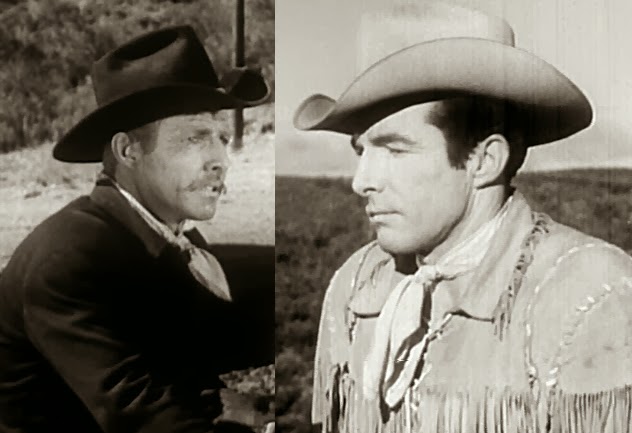
| A posse of sorts. |
Imagine for a moment how exciting the Old West -- or at least Hollywood's approximation of it -- must have seemed to a suggestible, excitable kid growing up in unexciting Poughkeepsie, New York during the Great Depression. Today, Edward Davis Wood, Jr. is best known for his one-and-only movie about outer space. But for little Eddie, a faithful attendee and later usher and ticket taker at his hometown movie theater, the wide open, untamed territory left of the Mississippi River on the map provided all the space he could possibly want or need. He saw Universal's take on
Dracula when he was seven years old, and it left a permanent mark on his psyche. But it was the cowboy pictures, particularly the cheap ones, which truly and permanently won his heart with their white-hatted heroes, hissable villains, and cut-and-dried moral certainty.
Westerns had a major impact on several generations of Americans, including some who grew up to become titans of science fiction. There are echoes of John Ford throughout George Lucas'
Star Wars saga, for instance, while Gene Roddenberry famously pitched
Star Trek to network executives as a celestial variation on
Wagon Train. Ed Wood, meanwhile, grew up to write and direct
Plan 9 from Outer Space, an interplanetary struggle which climaxes with an earthbound, O.K. Corral-style showdown and common barroom fisticuffs. The film's
ad hoc trio of earthling heroes (an airline pilot, a military man, and a cop) could even be considered a posse. Their ultimate mission, like that of John Wayne in
The Searchers, is to rescue a kidnapped white woman from the clutches of a race of outsiders whom they regard with suspicion and contempt.
By the time Ed Wood reached Hollywood in 1947, the uncomplicated and unambiguous Westerns he preferred were on the wane, chased out of cinemas and onto television by grittier fare, a fact he would lament repeatedly in his circa-1965 showbiz primer
Hollywood Rat Race, which is chock full of references to and anecdotes about B-list cowboy stars. As both a writer and a filmmaker, Ed Wood was beholden to the demands of the marketplace, which is why he bounced around from genre to genre throughout his career like a common claim jumper. But Eddie kept trying to return to the range however he could, be it as a director (
Crossroads of Laredo; Crossroad Avenger), a scenarist (
Revenge of the Virgins), or even a stuntman (
The Baron of Arizona). He also forged personal and professional alliances with such obsolete screen cowboys as Tom Keene, Tom Tyler, Bud Osborne, and badman Kenne Duncan, throwing film and TV roles their way whenever possible, often in non-Westerns.
But now, we must turn our attentions to another Western would-have-been, a pretender to the thrones of Autry, Rogers, and Cassidy who went by the professional name of Johnny Carpenter, though his true forename was Jasper. For it was with the late Mr. Carpenter that Ed Wood made this week's nearly-forgotten film.
THE LAWLESS RIDER (1954)
 |
| A lobby card possibly designed to trick viewers into thinking The Lawless Rider was in color. |
 |
A poster touting costar
Texas Rose Bascom |
Alternate titles: Outlaw Marshal [working title]
Availability: To my knowledge,
The Lawless Rider has never been released on VHS, DVD, or laserdisc. It is only through the benevolence of Ed Wood historian Phillip R. Frey that I was able to view a print of this exceedingly rare film.
The backstory: Let's go back a century to the fateful year of 1915. The era of American History we now call the "Old West" or the "Wild West" had just ended back then. Even so, the mythologizing of the period was already in full swing. The bookish Democrat Woodrow Wilson occupied the Oval Office, but he hadn't gotten his country into the already-in-progress World War I quite yet. Babe Ruth, not yet a Yankee, was making his unsuccessful debut as a pitcher for the Boston Red Sox. (He'd get better.) And Thomas Edison, still vital at 68, had invented some newfangled gizmo for recording telephone conversations.
Meanwhile, the future screen star known as Johnny Carpenter was still Jasper Carpenter, a year-old infant growing up on his daddy's modest farm in Debinsville, Arkansas, a town so small it's since been swallowed up by nearby Russellville just south of Route 40. Jasper grew up riding horses but dreaming of baseball, not knowing his future lay in the former rather than the latter. A horrific hit-and-run accident in 1936 permanently derailed Jasper's baseball dreams and sent him packing for Hollywood, where he'd try to become the next cowboy matinee idol under a semi-new name. (Or, briefly, an entirely new one: John Forbes.) Carpenter's future friend and partner, Edward D. Wood, Jr., wouldn't even be born for nearly another decade and wouldn't make it to the Left Coast until 1947.
 |
| Yakima Canutt, stuntman supreme |
But the motion picture business was well underway by 1915, even without Ed Wood or Johnny Carpenter to help it along. That was the year of D.W. Griffith's landmark, still-controversial
The Birth of a Nation (also known as
The Clansman). And there were already Westerns... and Western stars, for that matter! Most prominent among these was Tom Mix, headliner of nearly 300 silent cowboy films, many of them self-directed.
Foreman of Bar Z Ranch, one of about 40 films Mix made in 1915, was the first-ever production to employ the services of a brash, 20-year-old rodeo champion with the memorable moniker of Yakima Canutt.
In truth, Enos Edward "Yakima" Canutt (1895-1986) had been busting broncos since the age of 11 and was among the first rodeo stars to invade the fledgling movie industry in its early days. With his bravery and skill, however, he eclipsed all his rope-slinging contemporaries in the field. Starting from that early Tom Mix short, Canutt's truly legendary career as a stuntman, stunt coordinator, and second unit director lasted sixty action-packed years, finally ending with
Breakheart Pass (1975), a Charles Bronson picture distributed by United Artists. In between, along with too many cowboy films to count, he provided his services to
Gone with the Wind, Ben-Hur, Spartacus, Stagecoach (which contains his single most famous stunt)
, Rio Bravo, Old Yeller, and dozens more. For about half a century, when Hollywood needed to pull off a tricky or dangerous action sequence in a motion picture, they turned to Yakima Canutt because they knew he was the man for the job. More than most, Mr. Canutt truly earned his star on the Hollywood Walk of Fame. Steven Spielberg was enough of a fan to work a Canutt-inspired stunt sequence into
Raiders of the Lost Ark (1981).
Despite crossing paths with John Wayne and Stanley Kubrick, Yakima Canutt's own directing career never really amounted to a whole hell of a lot: only about a dozen fairly obscure theatrically-released features, mostly clustered together in the mid-to-late 1940s. And on many of these, Canutt had a credited co-director, usually Spencer Gordon Bennet or Fred C. Brannon. (Canutt and Brannon even co-directed some made-for-TV flicks in the 1960s.) Feature films with Yakima Canutt as a solo director are relatively rare. I can only find five, among the literally hundreds of films on his resume. There's 1945's
Sheriff of Cimarron with Sunset Carson; 1948's
Oklahoma Badlands and
Carson City Raiders, both vehicles for Allan "Rocky" Lane (best known today as the voice of TV's talking horse,
Mr. Ed); 1948's
Sons of Adventure; and finally the movie we're covering this week,
The Lawless Rider from 1954. As near as I can tell, the great Yakima Canutt never again helmed a theatrical feature after
Lawless. The second-unit and stunt jobs kept coming, though, and those were what paid the bills and made him famous anyway.
 |
| A recipe for failure. |
In my article about
another Wood/Carpenter collaboration of similar vintage,
Son of the Renegade (1953), I explained the essential, tragicomic conundrum of Johnny Carpenter's muddled screen career. Simply put, he was about two decades behind the times and was creating antiquated product for a market which had either ceased to exist or which, at best, had moved on to other distractions. Carpenter's big push for screen stardom didn't come until the 1950s when he, then about 40, produced and starred in a series of low-budget, independently-financed Westerns, of which
The Lawless Rider was one. By that time, though, the genre had gone through considerable changes, and Carpenter hadn't or perhaps couldn't adapt. This very problem is an important motif throughout Ed Wood's
Hollywood Rat Race. To read that book is to understand why
The Lawless Rider ultimately failed. Some cogent examples of Ed's complaints:
- [T]he Western itself ... changed so fantastically. The cowboy film was no longer a cowboy film, it was a "Western." It wasn't a clear battle between hero and villain, good and evil. Now the hero had to have doubts about his achievements. Everyone needed a dose of neurosis, and be up to their ears in Freudian, subconscious problems. (page 68)
- Even the Westerns got into the swing of sex. No longer did the cleanly dressed cowboy kiss his horse and ride off into the sunset to begin another adventure. Instead, he began to wear the dirtiest clothing, kick his horse in the ass, and take the roughest dance hall broad into the hayloft with him. (page 108)
- Take the simple Western of the 1930s. It's almost impossible, even with a petition signed by thousands of names, to get one on the Saturday morning kiddie shows. Unless the hero wears a black hat and dirty clothes, rides a black horse, rapes his leading lady, and visits his psychiatrist once a week "it just ain't got it." (page 130)
The Lawless Rider is the exact opposite of everything Wood describes above. It most certainly
is a clear battle between a hero (Carpenter) and a villain (Kenne Duncan, forever the heel), and it is never ambiguous for whom the audience is meant to be rooting. Furthermore, Carpenter's uncomplicated, straight-shooting protagonist has no inner life to speak of, hence no subconscious or pesky Freudian doubts. Nor does the hero have any sex life. The movie provides him with a sort-of-romantic interest in the wholesome person of "internationally famous trick roping champion" Texas Rose Bascom, whose husband, Weldon, and brother-in-law, Earl, are also in the
Lawless cast. In terms of physical intimacy, however, Johnny and Rose never progress beyond cordial greetings. At least the previous year's
Son of the Renegade had given Johnny Carpenter some more interesting sexual options, even if he did not take advantage of them. ("I just don't have time for anybody," he said in that film.)
As for wearing "a black hat and dirty clothes," Johnny Carpenter's morally upright character only dons such items when he is impersonating a hired killer as part of a plan to infiltrate the villain's gang. Otherwise, his clothing, like his hygiene and manners, is impeccable.
 |
| This credit makes it official. This is an Ed Wood movie. |
Filming for The Lawless Rider seems to have taken place at the same all-purpose movie ranch in the Hollywood Hills where
Son of the Renegade and countless other movies and TV shows were shot. Based on what's visible onscreen, there is every indication that this should have been a quick, uncomplicated production which came in on time and on budget. But
this website says differently. According to the information there, the movie exceeded its $20,000 budget and experienced "legal troubles" that delayed its release by two years. This is also said to be the first project to unite Alex Gordon with B-movie kingpin Samuel Z. Arkoff, who allegedly negotiated the movie's tardy release. I cannot confirm any of that, but I thought I'd pass it along. You're welcome.
Though ultimately distributed by United Artists, the movie was made through a limited partnership dubbed Royal West Productions. All of the buildings we can see, including a blacksmith's shop and a sheriff's office, look like generic facades with no distinguishing features. All of Ed's Westerns, including
Crossroad Avenger and
Crossroads of Laredo, share this assembly-line quality, as if they all took place at some cowboy-themed amusement park somewhere off the Interstate.
Eddie's fans, however, will likely have their imaginations ignited by the opening credits. While Ed Wood himself is wrongfully denied even partial credit for the screenplay, he is listed prominently as an "Associate Producer" along with Weldon Bascom. That means
The Lawless Rider is not some "apocryphal" or "speculative" Ed Wood movie, like
Married Too Young (1962) or
Revenge of the Virgins (1959). Nope, it's a bona fide, iron-clad, board-certified addition to the Wood filmography, as deserving of inclusion on that roster as
Plan 9 from Outer Space. Appropriately, the cast and crew is dotted with "golden age" Wood regulars. Alex Gordon is the film's executive producer, for instance, while William C. Thompson is the cinematographer. Besides lead baddie Kenne Duncan, grizzled old Bud Osborne is also in the cast. Of course, all of these folks are overshadowed by the headliner's trusty steed, "Skipper, the Fastest Horse in the Movies," who is only second billed to Carpenter himself. That's just the kind of movie this is.
 |
| Ringers: Noel Neill and Frankie Darro |
Like Ed Wood, Johnny Carpenter had an entourage of his own, and it's not surprising that several of them -- including Bill Coontz, Roy Canada, Bill Chaney, and Lennie Smith -- turn up in
The Lawless Rider. As a producer, Carpenter had a habit of bringing in one or two ringers to play supporting parts. When it comes time to distribute and market a motion picture, it's always handy to have a few recognizable and therefore exploitable names in the cast. (That practice continues among independent filmmakers to this very day.)
In
Lawless, these were Noel Neill and Frankie Darro. Neill, who portrays a tough, proto-feminist journalist named Nancy James, is best known as one of the two actresses* to portray Lois Lane on TV's
The Adventures of Superman with George Reeves. Frankie Darro, who plays the troubled kid brother of heroine Texas Rose, was a former child star and stuntman turned character actor specializing in nervy, loudmouthed punks. His most famous performance, in fact, was as the voice of delinquent-turned-donkey Lampwick in Disney's
Pinocchio (1940).
It is no surprise, especially with such bland leads as Johnny Carpenter and Rose Bascom, that Noel Neill and Frankie Darro are easily the most interesting people in
The Lawless Rider. Neill's storyline -- she's a frontier journalist who bravely challenges a cattle-thieving crime boss -- deserves more screen time than it gets here.
As for Darro, in my review of his
1941 comedy The Gang's All Here, I called him "a yappy little Chihuahua who goes around snapping at pit bulls." And that's exactly what he plays here, too, to fairly good comedic effect. In fact, the very best scene in the entire movie comes when Johnny Carpenter shoots the guns right out of would-be hotshot Frankie Darro's hands before sending the chastened youngster home with his tail between his legs. It uncannily presages
that moment in Kill Bill: Vol. 1 (2003) when Uma Thurman's Bride disarms and then spanks an unworthy opponent before telling him, "Go home to your mother!" It's highly unlikely that Quentin Tarantino ever saw
The Lawless Rider, but you never know. He obviously watches a lot of movies.
*
The other, Phyllis Coates, was in Ed Wood's The Sun Was Setting. Yes, Eddie worked with both Lois Lanes.
 |
| Carpenter and company on the Lawless Rider set. |
The viewing experience: Surprisingly tame, if reasonably enjoyable. If nothing else, the film is helped along by its economical hour-long running time and relatively brisk pace. Had I chanced upon
The Lawless Rider playing at some off hour on TCM and missed the opening credits, I would not have immediately guessed that Ed Wood had anything to do with it or that the movie was special or significant in any way.
Although Bill Thompson is the cinematographer, there are no striking or unusual images here as there are in the '50s films he lensed for Ed Wood. And despite the presence of Yakima Canutt in the director's chair, the action scenes in this film, mostly fistfights with some trick shooting and plenty of horseback riding, seem rote and by-the-book.
Lawless is, at heart, a cheaply-made and largely unexceptional Western morality play, more akin with the tastes of the 1930s than the 1950s. Only its naivete distinguishes it.
It is difficult to imagine anyone but a cap-gun-toting child of the Eisenhower era, the kind who wears a toy sheriff's badge on his pajamas at night, becoming truly engrossed in this standard issue shoot-'em-up. As I have already explained, this film proudly eschews the complexity and ambiguity which were the norm in theatrically-released Westerns by the 1950s in favor of the moral certainty of an earlier era. But, unlike most of Eddie's other work, Western or otherwise, this one does not make any hairpin turns or pause for philosophical diatribes. Not even the dialogue is particularly Wood-ian. Let us, then, return to Johnny Carpenter's comment in
Nightmare of Ecstasy: The Life and Art of Edward D. Wood, Jr. about how this script was written:
"We were writing The Lawless Rider in [Ed's] house at Riverside Drive and Victory Boulevard. Ed did everything. He was writer, production assistant, helped get people for me. We worked for each other for nothing. He would write a line of dialogue, and I would tear it up and throw it away. His dialogue was a little bit too perfect. The choice of words was not correct for the frontier."
Actor Henry Bederski contradicts this ("Johnny Carpenter couldn't write a story to save his life."), but a viewing of
The Lawless Rider backs up Carpenter's version of the events. Having sorted through many, many examples of Ed Wood's writing, I can say that this script does not bear Wood's usual trademark expressions or his patented brand of stilted quasi-formality. I only counted a single, definitive Wood-ism: a spare "So what?" uttered by a thug. (This is also a catchphrase in the Wood-scripted
The Violent Years.) It seems possible that someone, likely Carpenter himself (who else would have cared?), must have rewritten the dialogue line by line, systematically removing nearly all traces of Wood's weirdness in order to make the movie as normal and coherent as possible.
In their
Cult Movies interview from 1994, Frank Henenlotter and Rudolph Grey accused director Stephen C. Apostolof of doing the same basic thing with Eddie's 1970s scripts, but the Apostolof films are much more eccentric in their own way than
The Lawless Rider and allow for more of Eddie's personality to shine through, as well as his language. Since Steve Apostolof was not a native speaker of English, he might have deferred to Eddie when it came to dialogue. As the quote above indicates, on the other hand, Johnny Carpenter had some definite ideas about how the characters in his movies should speak.
 |
| Clancy Malone as doomed Don Gregor. |
Does any of this seem particularly Wood-ian to you, reader? I will admit that, in very vague terms, Johnny Carpenter's
The Lawless Rider bears some superficial resemblance to Ed Wood's own
Jail Bait from the very same year. It's significant that these were both products of the period in the early 1950s during which Ed Wood was partnered with Alex Gordon. (Gordon, again, was a producer on
Lawless and a co-writer on
Jail Bait).
In both movies, we have a swaggering, tough-talking gangster type (Freno Frost/Vic Brady), an impetuous, trigger-happy young man (Jim Bascom/Don Gregor) who falls under his sway, and a justifiably-worried older sister (Rose Bascom/Marilyn Gregor) caught between them. I suppose this analogy makes Johnny Carpenter's character in
The Lawless Rider the equivalent of Steve Reeves' bland Lt. Bob Lawrence, which is actually a pretty fair comparison.
Furthermore, both
Lawless and
Jail stop dead for several minutes so that we can watch a variety show act. In
Lawless, it's Rose Bascom's lasso-swinging and the amiable music of Hank Caldwell, while in
Jail, we are "treated" to several minutes of a minstrel show featuring Cotton Watts and Chick.
And finally, the plots of both films hinge on a man's outrageous and implausible plan to change his appearance and impersonate someone else. In
Lawless, Johnny Carpenter slaps on a fake mustache and some black clothes to "become" Rod Tatum. And in
Jail, of course, Vic Brady undergoes plastic surgery so he cannot be recognized by the police or identified by an eyewitness.
And yet, for the most part,
The Lawless Rider is more of a historical curiosity for Ed Wood completists than it is a truly compelling narrative. Certainly, the prominent inclusion of Eddie's name in the credits and the participation of several key Wood cronies makes it a keeper. Ultimately, though, this is a Johnny Carpenter movie more than it is an Ed Wood movie. As such, Johnny Carpenter got his way on this production, and the finished movie suffers for it, as does the audience.
Carpenter must have considered himself quite the thespian in those days, because he attempts dual roles in both
Son of the Renegade and
The Lawless Rider. (This was well before comedian Peter Sellers became famous for playing multiple parts within the same film.) In
Renegade, if you'll remember, Carpenter played a father and a son both nicknamed "Red River Johnny." Here, in
Lawless, his part almost amounts to a triple role: the main good guy, a secondary bad guy, and the main good guy
pretending to be a secondary bad guy. The trouble is, he plays all three of these parts pretty much the same.
Johnny Carpenter's riding and shooting skills may have been top notch, but he lacked the charisma to bring a creaky, past-its-sell-by-date affair like
The Lawless Rider to life. While watching it, I found myself wishing Ed Wood had been given a freer hand in crafting this script.
 Next: Another generous donation from the Phillip R. Frey Foundation! Like The Lawless Rider, this is a film I have been wanting to see and review for years but have never been able to find. It is one of the very few movies -- perhaps the only one -- in which Edward D. Wood, Jr. is simply an actor for hire. Curious yet? Does it pique your interest if I were to say that this is another film from the director of Nympho Cycler and The Love Feast, the legendary Joe Robertson? If so, or even if not, please join me in a fortnight for my dissection of Mrs. Stone's Thing (1970).