Showing posts with label MST3K. Show all posts

Wednesday, July 9, 2025

Ed Wood Wednesdays, week 235: "The Mads Are Back: Bride of the Monster" (2022)

Some lovely artwork by Carmen Cerra for Bride of the Monster.

Much like Dracula, Mystery Science Theater 3000 will never die.

Sure, the long-running comedy series seems to be in limbo for now, with no new "official" episodes produced since December 2022. But the comedians and writers who worked on MST3K have launched similar series of their own and are still wisecracking their way through a wide variety of movies and shorts. In 2020, for example, MST3K veterans Trace Beaulieu and Frank Conniff launched a pay-per-view web series called The Mads Are Back. It started as a way for Trace and Frank to continue their touring act during the global pandemic, but they've kept the web series going to this very day, amassing four seasons and half a dozen specials so far.

You'd probably expect the films of Edward D. Wood, Jr. to be a part of any series like this, and, true to form, Beaulieu and Conniff have riffed both Glen or Glenda (1953) and Night of the Ghouls (1959) for The Mads Are Back. I was especially interested in screening those episodes because neither film had ever been covered on MST3K proper. On the other hand, I was aware of the fact that Beaulieu and Conniff had also riffed Ed Wood's Bride of the Monster (1955) in 2022. That movie had already been used on MST3K—way back in January 1993, during the show's fourth season on Comedy Central—so I was not as keen to see Bride of the Monster riffed on The Mads Are Back. I mean, what else is there to say about this film?

Wednesday, July 3, 2024

Ed Wood Wednesdays, week 195: Eddie and the Amazing Colossal Episode Guide (1996)

Ed Wood was one of the filmmakers lampooned in The MST3K Colossal Episode Guide.

God, I loved mall bookstores. 

My idea of a perfect Sunday.
Look, I know there are still malls, and many of those malls still have bookstores. But I think it's safe to say that the heyday of the mall bookstore is long over, one of many casualties of the internet. There was a time (think: 1990s and early 2000s) when my idea of a perfect Sunday afternoon involved whiling away a few carefree hours at B. Dalton's and Waldenbooks, mostly browsing but purchasing occasionally, too. I'd always make a beeline for one of two departments, Humor and Entertainment, before wandering over to the magazine rack to see if Cinefantastique or Fangoria had something of interest for me.

In retrospect, mall bookstores played a fairly significant role in my life. Some of the last real quality time I had with my father was spent at a large shopping center in northeastern Indiana. While visiting my sister, who lives with her family in a small town near Fort Wayne, my dad and I would always find a few hours to sneak off to the local mall and see what it had to offer. Our first stop would always be Barnes & Noble, which sold a wide variety of books and magazines, plus music, movies, and various tchotchkes. I'm not a coffee drinker, but I came to love the smell of the coffee brewing at the in-store café. And I loved the light classical music playing on the overhead speakers, too. To this day, hearing Beethoven's "Rondo a Capriccio" transports me back to those very pleasant times.

I'm convinced there are a great many books that owe their entire existence to mall bookstores, particularly those books with humorous gimmicks or pop culture connections as their main selling points. A perfect example is The Mystery Science Theater 3000 Amazing Colossal Episode Guide (1996) from Bantam Books. It was typical of the TV-based books of the era: detailed descriptions of the MST3K episodes that had aired up to that time, augmented by reminiscences of the actors, writers, and crew members who worked on the show. Though not exactly essential, the ACEG is a fun souvenir for fans of the long-running comedy series, which at the time was just ending its seven-season run on Comedy Central before moving to the Sci-Fi Channel. 

When this book came out, I remember eagerly thumbing through its pages a few times at the mall before finally spending $16.95 (a not-inconsiderable amount) on my own copy. Just my luck, the binding proved extremely fragile, forcing me to transfer the pages of the Amazing Colossal Episode Guide to a Trapper Keeper. At the time, I was just becoming a Mystery Science Theater 3000 fan and there were many episodes I had not yet seen. It blew my mind to think that they'd covered both Kitten with a Whip (1964) and Monster a Go-Go (1965), two obscure cult films whose titles I only knew from the writings of John Waters. I realized from reading the ACEG that I had many hours of entertainment ahead of me.

Wednesday, November 29, 2023

Ed Wood Wednesdays: A roundup of Ed Wood news! (Fall 2023)

A new version of one of Ed's films is coming to BluRay soon!

For a director who's been dead for 45 years this December, Ed Wood has maintained a surprisingly high profile in the 2020s. He never totally goes away, at least not for long. It seems like there's always some Wood-related project in the works, related to his films, his writings, or his life. Ed Wood tribute movies and documentaries are always in production or pre-production somewhere, though many of these may never be finished or released. I know this because the makers of these films (and potential films) contact me occasionally to tell me of their grandiose plans. I wish them all a lot of luck.

Eddie's own movies are occasionally rereleased or repackaged as well. Currently, a company called Gold Ninja Video is taking pre-orders for a new two-disc Blu-ray edition of Eddie's Night of the Ghouls (1959). This remastered version will carry the film's original title, Revenge of the Dead, and comes with a slew of special features. Most impressively, this package includes several of Ed's other movies, including Trick Shooting with Kenne Duncan (1960), Jail Bait (1954), and Final Curtain (1957), plus the Super 8 version of Plan 9 from Outer Space (1957). Ghouls, Plan 9, and Jail Bait will all have optional commentary tracks as well. My esteemed colleague Greg Dziawer has written the liner notes. Can't wait to have this one in hand!

But not all the news I have this week is so positive.

Probably the biggest Ed Wood-related story of the past few months was that the makers of the new, crowdfunded episodes of Mystery Science Theater 3000 wished to use Plan 9 from Outer Space for the show's proposed 14th season. Unfortunately, their Thanksgiving weekend fundraising drive only managed to raise $2.7 million toward the show's $4 million goal, and this was an "all or nothing" campaign. On November 26, MST3K creator Joel Hodgson sent this melancholy message to all who had donated:
Greetings, backers.

Well, we’ve come to the end of the month, and the end of the Turkey Day Marathon and this campaign.
 
While we’re incredibly grateful for all of the support, enthusiasm, and encouragement, it’s clear we’ve fallen short of our goal this time.

First, to be clear, please understand that that means that no one will be charged anything, and we will not be collecting anything that you pledged to this campaign , since the agreement was that we’d only collect funds if we reached our minimum goal. No charges will be put on anyone’s credit cards.

Second, and more important, please know that we’re incredibly grateful for all of your input, feedback, concerns and questions, and are thinking about all the suggestions you have made over the past month.

One silver lining is that the continued support for this campaign, and the show, may have opened up some new conversations about potential partnerships and fundraising that could be key in getting the show another season.

We’ll spend some time now exploring those, and working to integrate all of the feedback and suggestions we’ve heard from you, and will follow up again next year, Lord willing and the creek don’t rise, when we’ve had a chance to regroup and have more to share downstream.

For now, whether you pledged or not, please accept our thanks and gratitude for your ongoing dedication and investment in MST3K.

We’re proud that the show continues to mean so much, to so many, and will keep working to figure out a path forward so that we can hopefully continue to #MakeMoreMST3K.

Until then, have a wonderful holiday season, and thanks again for all of your support.

Cheers and Thanks,

Joel and Team MST3K
For the time being, Ed Wood's most famous film will not be receiving the full MST3K treatment. So Plan 9 from Outer Space will not be joining Bride of the Monster (1955), The Violent Years (1956), and The Sinister Urge (1960) quite yet. But don't despair! There's a RiffTrax version of Plan 9 from 2009 featuring commentary from MST3K veterans Mike Nelson, Bill Corbett, and Kevin Murphy. 


And who knows? Maybe the MST3K team will find a way to make Season 14 happen after all. Lord knows, Ed Wood went through his own struggles to raise money for films. Maybe Joel and the gang can take inspiration (or at least consolation) from him.

Wednesday, March 15, 2023

Ed Wood Wednesdays, week 145: The Mads: Night of the Ghouls (2023)

Some really cool artwork by Carmen Cerra depicting Dr. Acula's gruesome death.

Well, that was fun. 

Back in 2020, at the height of the pandemic, I watched a livestream of MST3K veterans Trace Beaulieu and Frank Conniff—collectively known as The Mads—riffing Ed Wood's Glen or Glenda (1953). Frank was in his apartment, Trace was in his, and they commented on the film via Zoom. Frank and Trace have kept doing these livestreams for the last few years, and I've checked in occasionally. I'd watch more of them, but they're pay-per-view. I somehow missed or ignored their livestream of Bride of the Monster (1955) last September.

This week, however, they made me an offer I simply couldn't refuse. On Tuesday, March 14, they riffed Ed's sadly overlooked Night of the Ghouls (1959), the final entry in the so-called Kelton Trilogy. To my knowledge, Ghouls has never received this treatment before. The film was never used on MST3K itself, and it's been ignored by such MST3K derivatives as Rifftrax and Cinematic Titanic. I've long felt that Ghouls would be perfect fodder for riffing, at least as good as Plan 9 or Bride. (Trace himself admitted that Plan 9 in particular has been riffed to death.)

The marvelous Marcelle Hemphill.
Last night's livestream proved that my suspicions were correct. Trace and Frank, both avowed fans of the film and of Ed Wood, were in fine form as they picked apart the many, many absurdities of Night of the Ghouls: its disjoined editing, its heavy reliance on voiceover narration, its stagy acting, its many narrative digressions, and its overabundance of scenes in which police cars race across the screen. The riffs were what you'd expect from two MST3K graduates, albeit with a bit more profanity. 

Frank is the more politically-oriented of the two Mads, so he made topical references to Marjorie Taylor Greene, Ron DeSantis, and defunding the police, but these were kept to a minimum. I appreciated the numerous deep cut references to the Marx Brothers and Frank Zappa. Every time the name "Lucille" was mentioned in the movie, for example, Trace sang a bit of "Lucille Has Messed My Mind Up" from Zappa's Joe's Garage album. Meanwhile, Frank showed off his extensive knowledge of Woodology with shoutouts to Nightmare of Ecstasy (1992) and Take It Out in Trade (1970). 

One great thing about events like this is that they give me the opportunity to see new things in movies I've watched dozens of times already. I had somehow missed, for instance, that there is an obvious movie light in front of the sheriff's office at the beginning of the film. (Ed must've wanted to make sure the sign outside was visible at night.) For whatever reason, I found myself focusing on some of the magnificent 1950s automobiles in Night of the Ghouls, especially the gigantic 1958 Pontiac Bonneville driven by Duke Moore's character, Lt. Bradford.

I've already written a great deal about the movie's leading actors: Tor Johnson, Valda Hansen, Kenne Duncan, etc. And their performances in Ghouls are as mesmerizing as ever. During this viewing, however, my attention was diverted by some of the unsung supporting players. I was particularly taken with Marcelle Hemphill (1888-1981) as Mrs. Wingate Yates Foster, the gullible old lady being bilked out of her money by Duncan's scheming Dr. Acula. Marcelle seemed like the prototypical "wealthy dowager" type, yet this is somehow her only known screen credit. She may be a topic of further research.

Look, your enjoyment of a livestream like this really depends on your tolerance for MST3K and its lampooning of old B-movies. Personally, seeing Bride of the Monster on MST3K in the '90s deepened my appreciation of that movie and made my Ed Wood fandom even stronger. Since then, I've enjoyed seeing Ed's other films given similar treatment, including Rifftrax's version of Revenge of Dr. X (1970). But I can understand if you find all this stuff disrespectful or just distracting. If you like both MST3K and Ed Wood, I'm just making you aware of it. If you don't, forget I said anything.

You can find hours of material by Frank Conniff and Trace Beaulieu right here. As of this writing, their version of Night of the Ghouls has not yet been made available for download at their site, but I imagine it soon will be. In the meantime, you can snag their versions of Glenda and Bride.

Wednesday, July 22, 2020

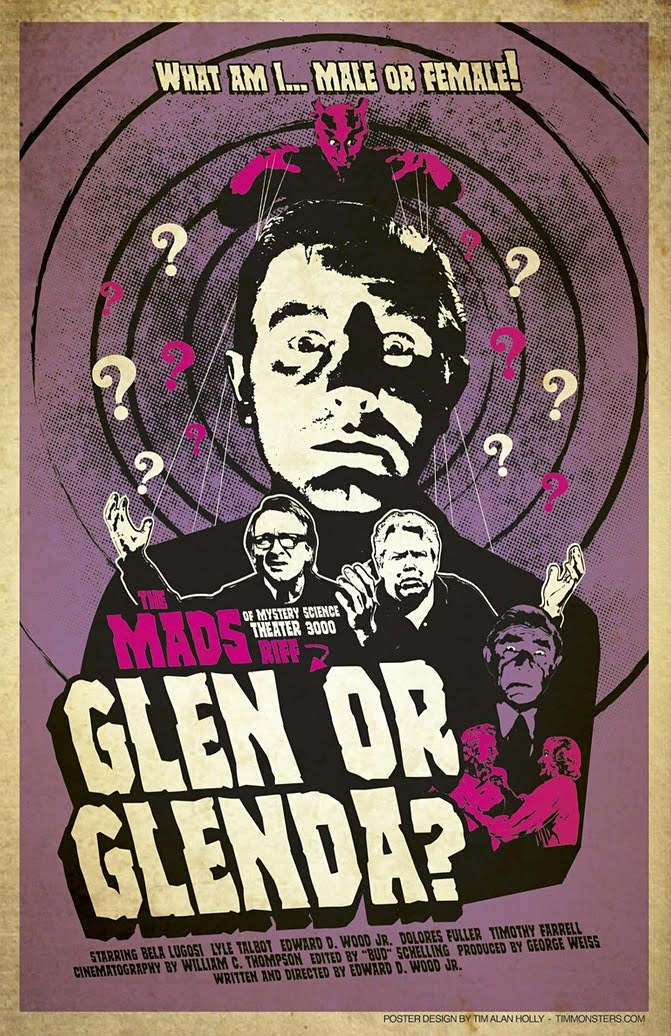
Ed Wood Wednesdays, week 106: "The Mads: Glen or Glenda" (2020)

Frank Conniff and Trace Beaulieu riff on Glen or Glenda.

A poster created for the event.
The global pandemic has changed many people's plans in 2020. That includes the entertainers who regularly perform live in front of audiences. Clubs and theaters have largely been shut down this year, and it's uncertain when they'll reopen. In the meantime, many performers have opted for online-only shows. A streaming session is not exactly like an in-person live concert, naturally, but it's better than nothing. And it does allow performers to interact with fans after a fashion. Compromise is the name of the game here.

Last night, Mystery Science Theater 3000 veterans Frank Conniff and Trace Beaulieu performed an online "riffing" of Edward D. Wood, Jr.'s Glen or Glenda (1953) for over 2,000 fans. For the last few years, Conniff and Beaulieu have been touring as the Mads, a nod to their MST3K mad scientist characters, TV's Frank and Dr. Clayton Forrester. They've even had a podcast, Movie Sign with the Mads. Conniff and Beaulieu were very familiar with Glenda, having provided live commentary on Wood's semi-autobiographical feature dozens of times previously. But this was their first time riffing it online via Zoom, with Beaulieu in Minnesota and Conniff in New York. Comedian Chris Gersbeck acted as the show's producer and coordinator. Since the riffing streamed live over YouTube, viewers were able to comment via a chat feature.

Considering this was the Mads' Zoom debut, the show went very smoothly. Apart from a few fan complaints about the volume of the movie, which Gersbeck quickly corrected, there were no major technical glitches. Conniff and Beaulieu were in fine form as well. They obviously knew the movie forwards and backwards, inside and out, man to woman, woman to man, etc. In the grand tradition of MST3K, they commented on all the many glorious glitches, gaffes, and oddities of Wood's eccentric movie. When Eddie walks toward the camera wearing a pointy bra under his blouse, Beaulieu implores, "Ed, turn the high beams off!" And when portly, balding Henry Bederski wipes down his sweat-soaked fedora in front of a very minimalist street corner set, Conniff quips, "I didn't know the dark, existential void had a bus stop!"

The great thing about a live riffing like this is that the comedians point out things in Glenda that even I hadn't noticed after dozens of viewings. One of my favorite such moments arrives near the end of the movie when we see stock footage of children playing in a schoolyard. We are supposedly seeing one of the film's characters, Alan ("Tommy" Haines), when he was a boy. Beaulieu points out that there's one kid in the footage who just kind of wanders around aimlessly, then stands at the very edge of the frame with just his elbows and ankles visible. Elsewhere, the Mads noted that certain props, including a bookcase and even a Y-shaped tree, turned up in multiple scenes. Conniff also called attention to the fact that Conrad Brooks is credited as "Banker," even though the film has no bankers in it! How did I never catch that?

After the movie was over, Conniff and Beaulieu stuck around for another half hour to answer questions from viewers, and it was at this point when it became apparent that the Mads were major admirers of Glen or Glenda. Both cited it as their favorite "cheesy movie," and Conniff compared it favorably to Tommy Wiseau's equally infamous The Room (2003), saying that Wood's movie preached a message of tolerance toward the LGBTQ community (long before it even had that name) while Wiseau's movie was hateful and misogynistic. Conniff further offered that Wood's true gift as a filmmaker was his sincerity, while Beaulieu pointed out that Glenda was stylistically similar to the films of David Lynch. When the Mads said that the evening was a tribute to Ed Wood, it was obvious that they meant it.

Trace Beaulieu and Frank Conniff: Together but apart.

A DVD of the shorter, censored version.
A TALE OF TWO VERSIONS: As many longtime Ed Wood fans know, there are two versions of Glen or Glenda in circulation currently. One is the version I originally saw on the Rhino Video VHS edition of the film in the 1990s. I now call it the uncensored print. It also appears on the two-disc set called The Ed Wood Collection: A Salute to Incompetence. The second, slightly shorter version of the film is more common. I call it the censored print. It's on the DVD releases from Image Video and Legend Films and has been included in such sets as The Ed Wood Box and The Worst of Ed Wood. Both the censored and uncensored Glendas have been uploaded to the internet.

For last night's streaming show, Frank Conniff and Trace Beaulieu used the longer, uncensored print of Glen or Glenda. But, judging by a pre-show chat Beaulieu had with producer Chris Gersbeck, he and Conniff were more accustomed to the shorter, censored print. Beaulieu estimated that the uncensored print had about five extra minutes of material compared to what he was used to. He pointed out the infamous "cigarette lighting" scene and some extra shots during the dream sequence. Since the Mads have riffed Glen or Glenda on nearly 50 other occasions, Beaulieu had to adjust his timing to the longer edition of the film.

As for the specific differences between these versions, I refer you to my Glen or Glenda transcript. In that article, the material in red type only appears in the uncensored print. After last night's streaming show, I decided to make a side-by-side comparison of the two editions to see exactly how they differed. Even after all these years, there were some revelations in this experiment.

One immediate difference is seen in the main title cards. These have been altered in all existing prints of the film, with the bottom of the frame crudely blocked by a grey cloud and the words "GLEN or GLENDA" added ex post facto by some third party. Since Wood's movie was known by so many titles (I Changed My Sex, I Led 2 Lives, etc.), I'll assume that distributor Wade Williams removed another, lesser known name and substituted the familiar Glen or Glenda handle instead.

The copyright information at the bottom of the screen is another obvious addition to the print, but the wording is a little different between the censored and uncensored versions. In the former, it merely says: "Copyright MCMLIII Screen Classics Productions." But in the latter, the words "25th Anniversary Special" have also been added. Beaulieu and Conniff referred to the longer version of the movie as the "25th anniversary edition."

(left) Title card for the censored version; (right) title card for the uncensored version.

Confusingly, the film's end card carries the "25th Anniversary" banner in both versions, censored and uncensored. However, the uncensored version has an added line: "Copyright Renewed 1981 Paramount Pictures Corporation." This leads me to believe that the "25th Anniversary Special" banner is native to the original print and was placed there at the behest of Glenda producer George Weiss.

(left) The end card of the censored version; (right) end card of the uncensored version.

Watching the two prints side by side was quite educational. I already knew about the major cuts that had been made to the censored version, including the aforementioned "cigarette lighting" scene and the gender-bending twist ending of the foundry sequence. But this time, I noticed that a couple of references to homosexuality had also been cut -- one from Dr. Alton (Timothy Farrell) and one from Inspector Warren (Lyle Talbot). The censored print still has multiple references to homosexuality, just fewer of them. And in the censored print, Barbara (Dolores Fuller) is no longer allowed to describe the specific content of that newspaper article about the sex change operation. The Glen or Glenda transcript has been updated to show these lines in red print.

Just as Beaulieu mentioned, Glenda's lengthy dream sequence was also altered. There's a brief pantomime routine shot in front of a black screen that has been entirely excised in the shorter version of the film. Why, I don't know. In the deleted footage, Glen (Ed Wood) is seen walking uphill at an angle. Then there's a matching shot of Barbara walking uphill at the same angle. Glen continues walking uphill, then turns around to face his blonde-haired lover. Barbara walks further uphill with her arms extended, a visual motif Wood repeats in Plan 9 from Outer Space (1959) and Orgy of the Dead (1965). Finally united, Glen and Barbara hug and kiss. But then Glen magically disappears (just as Ed Wood did in his "Magic Man" commercial), leaving Barbara upset and confused. She rubs her temples in agony.

Again, there was no obvious reason to cut this material, since it contains no problematic dialogue and certainly no sex or violence. Perhaps it was removed for pacing reasons. Later in the dream sequence, there's a more salacious shot of Glen ripping off Barbara's blouse in a rage. This, too, has been cut from the censored version. It still blows my mind that author Rob Craig based his analysis of Glen or Glenda on the shorter, censored print in his book Ed Wood, Mad Genius: A Critical Study of the Films (2009). And it was very frustrating that Legend Films chose to use the shorter edition of Glenda for its restoration/colorization. Hopefully, the longer, more complete version of the movie will reach more Wood fans in the future, and the censored print will fade into obscurity.

Wednesday, April 1, 2020

Ed Wood Wednesdays, week 99: "Bride of the Monster: The One-Act Play" (2002)

Tor Johnson and Bela Lugosi tread the boards in Bride of the Monster.

The movie that inspired a writing project.
I've been on the internet since before the internet was any good at all. In the mid-1990s, when I first started posting to Usenet newsgroups, there was no such thing as social media, and most of the platforms we use every day (Facebook, Twitter, YouTube) were still years in the future. Even Google didn't start until 1998, leaving AltaVista as the search engine of choice. Back then, I had a dial-up modem, some rudimentary typing skills, and a lot of pop culture opinions.

If all this sounds achingly familiar, it's because I've written about this era of my life before when I posted my Glen or Glenda transcript from 1997 and my Orgy of the Dead script parody from 1998. Well, today, I'm going to share yet another vintage chunk of text from the olden days, though this one at least dates from the current millennium.

In the late 1990s, my online life revolved around a Mystery Science Theater 3000 newsgroup called rec.arts.tv-mst3k.misc. The show was still airing new episodes back then on the Sci-Fi Channel, and fans would regularly post reviews on RATMM. In August 1998, when MST3K premiered its version of the 1961 monster movie Gorgo as part of its ninth season, I decided to upload a short script called Gorgo: The One-Act Play to the newsgroup. This was basically a little comedy sketch featuring characters from the original film, Sam and Joe, discussing the possible consequences of bringing a Godzilla-like monster to London. (Sample dialogue: "Say, Joe, you don't think they're made at us, do ya?")

The response to Gorgo; The One-Act Play was fairly positive on RATMM, so I kept writing comedy sketches based on other episodes of Mystery Science Theater 3000. Thus was born The MST3K One-Act Play Project. Another RATMM regular, Craig J. Clark, started writing his own MST3K-based plays just a few months after I started. Craig eventually put together a now-dormant website collecting both his plays and mine. It looks like the last entry in The MST3K One-Act Play Project was posted by Craig in June 2004. Remarkable longevity for such a gimmicky idea.

What follows is the text of my one-act play based on Ed Wood's Bride of the Monster. It was originally posted just over 18 years ago on March 7, 2002. I was more than a decade into my Wood fandom at that point, but Ed Wood Wednesdays wasn't even a glimmer on the horizon. At the time, I was in my mid-20s and working as a junior high Spanish teacher in Joliet, IL. I can remember writing these plays during my lunch break and then emailing them from my school computer to my home computer. Good times.

Anyway, I hope you enjoy this artifact from the semi-distant past.

Wednesday, July 5, 2017

Ed Wood Wednesdays, week 67: Revisiting 'The Sinister Urge' (1960)

Scratchy-voiced Gloria Henderson (Jean Fontaine) made her debut on MST3K in 1994.

Neglected no more: The Sinister Urge.
Edward D. Wood, Jr. really didn't direct that many feature-length films during his so-called "golden age," i.e. the years before he permanently descended into the world of pornography in the 1960s. There are the big three, naturally: Glenda, Plan 9, and Bride Of The Monster. The ones everyone knows from the Tim Burton biopic. The standbys. There's Jail Bait, too, a neglected "middle child" that has never received as much love and attention as its siblings. The Violent Years, though scripted by Wood, was (at least nominally) directed by William Morgan, so it doesn't quite count. Wood claims he edited two of those made-for-TV Tucson Kid episodes with Tom Keene into a quasi-feature, but this has never surfaced. Wood's other titles from this era (The Sun Was Setting, Final Curtain, etc.) are featurette-length.

That just leaves The Sinister Urge, an anti-smut scare film from 1960, by some counts the "last" movie Ed Wood ever made. When reference books say Ed Wood only directed five movies, they're ending their tally with this one. For whatever reason, despite its importance in the Wood canon, The Sinister Urge has gotten rather short shrift in this project. Sure, I did a complete write-up on the movie back in 2013, but I haven't rewatched it since then. I basically sat through it once all the way through, shrugged, and moved on. And yet, here is a full-length movie written and directed by Ed Wood when he was still sort of in his prime. He was only 36 when it came out. Thanks to some repurposed footage from the abandoned juvie flick Hellborn, Ed even plays a semi-prominent (if brief) role in it. Doesn't that deserve more attention?

I started wondering if maybe there were more to The Sinister Urge than I'd originally gleaned. So I decided to rewatch the movie with fresh eyes. Right away, I was struck by the first shot: a blonde (one-film wonder Betty Boatner), clad only in a bra and slip, running in terror toward the camera on a dirt road. The camera seems to be on the back of a car or truck, because it's moving, too. For an Ed Wood movie, this is a very dynamic beginning. Keep in mind that Glenda starts with Bela Lugosi sitting in a chair, and Plan 9 starts with Criswell sitting behind a desk. In contrast, The Sinister Urge doesn't have any scene-setting narration or preamble. Other than the title appearing onscreen, it doesn't even have opening credits. More so than at any other time in his filmmaking career, Ed Wood seems eager to get the action underway. This is as in medias res as he gets.

Don't worry, though; the usual Ed Wood inertia is not far away. In his DVD introduction to the film, Ted Newsom suggests that credited cinematographer William C. Thompson only shot the interiors for The Sinister Urge. And, true to form, there is a marked difference between the indoor and outdoor scenes in this movie. One plot thread has pompadoured hoodlum Dirk (Dino Fantini), driven mad by exposure to pornography, stalking and killing young women in Los Angeles' Griffith Park. These scenes crackle with an energy that vanishes once the film heads inside.

For the most part, this film is even more static and talky than usual for Wood. Our heroes are two hardworking, grim-faced policemen: Lt. Matt Carson (Kenne Duncan) and Sgt. Randy Stone (Duke Moore). Matt is a little sharper than Carson, sort of the Sherlock to his Watson, but neither is particularly energetic. Matt and Randy spend most of their time in the former's dark, wood-paneled office, discussing a string of porno-related murders and decrying the rottenness of the smut racket. When they do venture out to a crime scene, their hard-boiled dialogue goes like so:

Randy: (examining a woman's corpse) Just like the others. 
Matt: Pretty kid, too. 
Randy: She doesn't look much like a kid now. 
Matt: Maybe she grew up during that moment of truth. When she died. 
Randy: The same M.O. Killed the same way. The same everything. 
Matt: With one great difference. 
Randy: What's that? 
Matt: Her name will be different.

Duke Moore and Kenne Duncan in The Violent Years.
Move over, Joe Friday, huh? Actually, The Sinister Urge may be the best movie yet to illustrate Ed Wood's obsession with Dragnet-style police procedurals. I still maintain that Jack Webb was one of Eddie's greatest unheralded influences, more so than Tod Browning or James Whale. Why else would Glen Or Glenda, a film ostensibly about gender fluidity, be structured around a police investigation? Wood was so enamored of the tough-guy repartee between Duncan and Moore that he wanted to build an entire second feature, The Peeper, around their characters. Maybe he even had dreams of a mini-franchise starring these two. It's obvious why that never happened, though. To cast sleazy, sarcastic Kenne Duncan as a good guy seems all wrong, and Duncan's chemistry with bland, pudgy Duke Moore is virtually nonexistent. At one point, Wood tries to lighten the mood with a scene in which Randy plays a mischievous little prank on Matt, who has fallen asleep at his post. But "impish" just isn't in Kenne Duncan's wheelhouse, and the scene falls flat.

On the other side of the law, we have porno filmmaker Johnny Ryde (Carl Anthony), a man who "used to make good movies," and his boss/distributor/lover, scratchy-voiced Gloria Henderson (Joan Fontaine). They, too, spend a good deal of time sitting around and talking. Interestingly, Johnny and Gloria have both their strategy sessions and their makeout sessions in Gloria's sparsely-decorated living room, making this movie yet another example of Ed Wood using the homestead as his favorite backdrop. Gloria's house, in fact, doesn't look much different from the troubled homes featured in Glen Or Glenda, Jail Bait, and Plan 9. And just like those domiciles, this one is threatened by outside forces. When knife-wielding Dirk breaches the perimeter, it spells doom for the household and everyone in it.

The character of Gloria, on this viewing, reminded me a lot of Vic Brady (Timothy Farrell), the gangster from Jail Bait. Both of these people spend their lives in a constant state of agitation, always snapping at the people around them. Irritation is Gloria's default reaction to pretty much any stimulus. There is a scene, for instance, in which Johnny introduces Gloria to gawky, naive Mary Smith (Jeanne Willardson), a starlet he plans to exploit. Before Johnny even attempts to say Mary's name aloud, Gloria explodes with rage: "Names at this stage are unimportant! Names are your department anyway!" If the crooks are trying to win Mary's trust, this is a strange way of going about it. One wonders how Gloria ascended to a position of prominence in the underworld with so little finesse.

As for Carl Anthony's character, reader Milton Knight points out that the name Johnny Ryde is very similar to that of Johnny Hyde (aka Ivan Haidabura), the Russian-born talent agent who was instrumental in shaping Marilyn Monroe's early career. Hyde changed Monroe's image drastically, a process that included plastic surgery, and helped her secure important early film roles. Certainly, then, there are parallels to Johnny Ryde's treatment of innocent Mary Smith, who is encouraged to change her hair, wardrobe, deportment, diction, and place of residence. Hyde had already been dead a decade when The Sinister Urge was released; Monroe herself died in 1962.

All in all, my opinion of The Sinister Urge hasn't really changed since 2013. I still find the film suffocating and sluggish at times, though eccentric characters like Gloria and Dirk help liven up the proceedings. Johnny Ryde might be an onscreen stand-in for Ed Wood, but Carl Anthony plays him as such a colorless dullard that it hardly matters. The Sinister Urge closely follows the template of Reefer Madness, simply substituting pornography for marijuana, but Wood's film lacks the transcendent nuttiness of Louis Gasnier's anti-pot parable. Of the films from Eddie's classic era, this will probably be the one I watch the least. Some have praised this movie for being more coherent and focused than Wood's other efforts, and it is. Personally, though, I feel Wood's appeal rests on his abnormality, his asymmetry, so coherence is not necessarily what I'm looking for in his movies.

But I'm glad I revisited The Sinister Urge just the same, because there are some prime Wood-ian moments that I had forgotten. Perhaps my favorite comes when a group of tough-looking young women, another one of Eddie's many girl gangs, storms into an ice cream parlor at the behest of Gloria and Johnny to beat up the proprietor, a stocky older man named Claussen who has snitched to the cops. There's a closeup shot of one of the girls shoving a vanilla ice cream cone right in Claussen's fat face. Eddie doesn't hold the shot quite long enough for my taste, but it's a thing of surreal beauty nevertheless. The moment is worthy of Bunuel.

An episode from 1994.
Just to make sure no stone was left unturned, I finally decided to watch the Mystery Science Theater 3000 version of The Sinister Urge. For some reason, I'd been avoiding this one, maybe figuring it would be a bit too mean-spirited. Wood's movie was used as the basis for an episode during the show's sixth season back in November 1994, when it was still on Comedy Central. This wasn't MST3K's first voyage into the Wood canon by any means. The show had memorably tackled Bride Of The Monster during its fourth season and had razzed The Violent Years just three episodes prior to The Sinister Urge. Since the show's theme song promised viewers "cheesy movies, the worst we can find," it's only natural that they should aim their sights at a filmmaker widely considered "the worst director of all time."

The MST3K episode turned out to be a lot of fun and nothing to worry about. The Violent Years gets off fairly lightly here. It doesn't provoke the same agonized reactions as Manos: The Hands Of Fate or Red Zone Cuba. Host Mike Nelson and his robot pals (voiced by Kevin Murphy and Trace Beaulieu) don't threaten to mutiny or anything like that. In The Mystery Science Theater Amazing Colossal Episode Guide (1996), writer-performer Paul Chaplin describes Wood's movie in almost affectionate terms:
In this movie, the production end of Gloria's empire seems rather charming: the smut involves women in baggy swimsuits being photographed by a kindly elfin immigrant. Arousing? Not particularly. But is that really the main point of smut? For reasons too complicated to get into, Gloria kills Dirk when she means to kill Johnny (or is it the other way around?). The cops reveal the mistake to her, and she emits a harshly nasal "Nuh! Uh-uh! No way!" it's become one of our favorite moments. Gloriahard, raspy, and shrillserves as a reminder of the world Ed Wood inhabited. You get the idea this is a real woman playing herself.
Along with the usual string of pop culture references, invoking everyone from Eric von Stroheim to Marian McPartland, the episode's main running gags involve Joan Fontaine's harsh voice (the show claims you could shave with it), the stiffness of Carl Anthony's performance (he's compared with Hymie, the robot from Get Smart), and the resemblance of actor Dino Fantini to a young Bob Dylan. There are also some jokes about Ed Wood's tendency to pad his films with dull, extraneous shots, like people parking or getting in or out of cars. (A typical riff: "Film it all, Ed!") A few token references are made to Ed Wood's transvestism (he is said to have dressed like the aforementioned Ms. McPartland), but these do not get out of hand.

There are also a number of jokes about the character of Officer Kline (Fred Mason), a complete nonentity who pops up periodically throughout the film. Mike and the 'bots pretend to be hugely excited by Kline's utterly unexciting appearances. Weirdly, The Sinister Urge ends on a shot of Kline, who stands guard over the bodies of Dirk and Johnny as Lt. Carson takes Gloria downtown. So maybe this character really was of great significance to Ed Wood.

At one point during the recycled Hellborn footage, Mike Nelson comments: "I think Ed Wood has directed himself into a corner." Wood himself is onscreen that very minute, literally standing in the corner. Moments later, Tom Servo (Murphy) exclaims, "I think these scenes are from a completely different movie!" "Maybe," replies Crow (Beaulieu), "but they work so well here!" Is it possible that the MST3K writers knew this footage had been repurposed, or was it just a lucky guess on their part? Or was it so obvious that they figured it out on their own?

By the way, it seems initially that the episode's host segments, i.e. the scenes that take place outside the theater, have little to do with The Sinister Urge. There's an episode-long plot about the character of TV's Frank (Frank Conniff) becoming a mad bomber after seeing too many violent movies. But, eventually, even this cycles back around to Ed Wood. Sort of. Mike Nelson and the robots decide to crack the case, and Tom and Crow start talking and dressing like the cops in the movie. "Don't play schoolgirl with me!" Crow barks to an informant (Chaplin). "I've got so much on you, I'll send you so far up the river, you'll think you were a salmon!"

As Grade B dialogue goes, that's Grade A. 

Wednesday, April 26, 2017

Ed Wood Wednesdays: The 'Young Marrieds' Odyssey, Part One by Greg Dziawer

Ben exits the Nude A Go Go in Ed Wood's The Young Marrieds.

Loser of the Week

Sportscaster Stu Nahan
I remember Stu Nahan (1926-2007) as one of the color commentators in the Rocky films. Not yet in my teens, I don't think it occurred to me that Stu Nahan was essentially playing himself. For the better part of 30 years, from the 1970s through the '90s, Stu was a sports anchor in the Los Angeles television market. Early on, he appears to have had a bad week in the local press, the very same week that Ed Wood and crew were shooting the exterior location of the strip club in The Young Marrieds.

In this week's Ed Wood Wednesdays, we're taking a trip down La Cienega Blvd in West Hollywood, circa spring 1971.

I'm sure many of you noticed the two moments in The Young Marrieds when Ben exits the strip club, and quickly rushing by behind him as the camera follows him, we see a sign on the building. The club, as identified by Joe Blevins previously here at Ed Wood Wednesdays, is the Nude A Go Go. We can make out part of the sign to the right of the entrance in the first shot of Ben exiting, and the sign to the left of the door reads:

LOSER OF THE WEEK
STU NAHAN
AND HIS COMPUTER

Not sure what this meant exactly, I inferred it might have something to do with Stu having made a sports prediction (or predictions) with a computer, obviously novel at the time. The prediction(s) must have been wrong, and were likely regarding an LA team, as the proprietors of the Nude A Go Go saw fit to dub Stu their Loser of the Week. Incidentally, the sign also listed Fidel Castro and Richard Nixon among its losers of the week. But what was this all about?

Saturday, October 1, 2016

What Torgo does all day

Imagine what Torgo's resume must look like.

For the first day of October, I thought I'd revive an ancient internet meme with a a Manos twist. Enjoy. Or don't. 

Saturday, May 7, 2016

For no reason at all, a portrait of Edward D. Wood, Jr.

A devil-may-care Eddie in The Love Feast (1969).

This took a while, surprisingly. Longer than it should have. I'm sure this portrait of Ed Wood probably could have been accomplished in Photoshop in about five seconds, but I assure you, all those little blobs of color you see up there were done one at a time, painstakingly, over the course of a few hours. Yes, hours. During that time, using a small, grainy still of Ed as my only reference material, I spent quite a while contemplating the man's face. His appearance was pretty badly ravaged by 1969, thanks to all those years of alcoholism and professional rejection. I found some colors in his face that should not be found in human skin: grayish-brown patches with a hint of green and blobs of deep burgundy. A man's face should not match the carnation pinned to his jacket.

And yet, there's also something of the satyr in Ed's demeanor, even at this point in his life. There's a spark of playfulness in his eyes and his smile. Hopefully, I captured that. Either way, I can tell you that Ed's spotty necktie was a nightmare to capture, as was the shrubbery next to him. Tragically, I had to crop most of the shrubbery so that the pic would fit on this blog. The full version is here.

Incidentally, the title of this piece is A Chubby Angel With Gin Blossoms. It's a reference to the Overdrawn At The Memory Bank episode of Mystery Science Theater 3000.

Here's another Wood portrait, this one based on Eddie's role in Mrs. Stone's Thing.

Ed feels pretty. Oh so pretty.

Tuesday, October 13, 2015

Hey, it's my second thing for Splitsider!

My latest piece for Splitsider is about trucker tapes.

Just a little heads up, in case you somehow missed it. The website Splitsider, which is about the world of comedy, ran another one of my articles. This one is called "The Raunchy, Underground World of Trucker Tapes," and it's the fruition of a long-time obsession of mine. I've gotten some nice comments about it online through Twitter and Facebook, which is gratifying. I don't know how I became interested in trucker comedy, probably because of a few scattered references to "filthy trucker tapes" on MST3K. But I knew I wanted to turn it into an article when I started looking into the career of a comic named Gene Tracy, aka "Mr. Truckstop." There are hours and hours of this guy's stuff posted to YouTube, and I've spent way too many late nights listening to it -- not as comedy, really, more as sociology. I think one thing which fascinated me was the fact that Tracy's audiences were rowdier than what you'd normally expect on a comedy album. You get the sense that any one of his gigs could have turned into a knock-down, drag-out melee at a moment's notice if, say, somebody spilled his beer on somebody else's shoes. In other words, there's a danger to those performances. But I was also interested in the fact that truckers have their own little universe of comedy stars, performers virtually unknown to the rest of the world.

Wednesday, September 23, 2015

'The Critic' (1963): Symbolic of junk!

"Could this be the sex life of two things?"

By 1963, Mel Brooks was 37 years old and a fairly well-known comedian and writer, even if he hadn't yet done any of the things with which we truly associate him today. Get Smart, The Producers, Blazing Saddles, and Young Frankenstein were all in his future then. But he'd written for a couple of crucial early TV sketch programs at that point in his life, namely Your Show of Shows and Sid Caesar's follow-up show, Caesar's Hour. Also, perhaps more importantly, Brooks had recorded three popular, well-regarded comedy albums with fellow Your Show veteran Carl Reiner. These LPs featured the duo's much-imitated "2000 Year Old Man" routine, in which Reiner would play an earnest interviewer and Brooks would play an impossibly old European Jewish man who had seemingly witnessed all of human history first-hand and was pretty blasĂ© about the whole experience.

An ad for The Critic.
Meanwhile, by 1963, Connecticut-born filmmaker Ernest "Ernie" Pintoff was 31 years old and already making a name for himself with his then-ultra-modern cartoons, like Flebus (1957), The Violinist (1959), and The Interview (1960), which combined "hip" humor with jazzy, almost abstract minimalist artwork. The Violinist, in fact, had garnered Pintoff a BAFTA award and an Oscar nomination. Not too shabby. Clearly, like Brooks, Ernie Pintoff had established himself as a showbiz up-and-comer. As fate would have it, Pintoff finally won his Oscar when he collaborated with -- you guessed it -- Mel Brooks on 1963's The Critic. Half a century later, Brooks reminisced about The Critic when he was interviewed for the  PBS documentary Mel Brooks: Make A Noise. These were his thoughts on the origins of the short film:
"There was a brilliant guy, a cartoonist and sweet as sugar. His name was Ernest Pintoff, and he said, there was a guy called Norman McLaren who used to do films, beautiful films that were truly avant garde. I'm talking about late '40s, early '50s. So when Pintoff said to me, 'Look, I've got a good idea. You watch one of these films and just mumble to yourself.' I said, 'That's good.' I'll be this old Jew trying to make sense out of what I'm seeing. There's no better philosophical sound than a Jewish accent. If somebody's going to wax philosophically, he'd better have a Jewish accent, or he's going to sound like a dope. A Jew never sounds like a dope. Anyway, we made this little short and submitted it, and it won an Academy Award."
And deservedly so, since The Critic is a total delight, even today. There's not much to it, really, just some sprightly harpsichord music, various dots, blobs, and squiggles, and the cranky Semitic commentary of Mel Brooks' character, a 71-year-old Russian-American named Murray, who pays decent money to see a foreign film and feels ripped off when he is presented with meaningless modern art instead. Simple as it is, The Critic is an obvious predecessor to TV's Mystery Science Theater 3000, and writer-performer Kevin Murphy (the voice of Tom Servo from seasons 2 through 10) has acknowledged it as an influence. I wonder, too, if Woody Allen caught this film before making What's Up, Tiger Lily? in 1966.

Within a few years, Mel Brooks would be writing directing and occasionally starring in full-length films of his own. Ernie Pintoff spent most of his career directing perfectly-ordinary, yet successful network television shows, including Kojak, Dallas, and The Dukes of Hazzard. He passed away in 2002. In any event, here is the film itself. Please do enjoy. "It must be some symbolism. I think it's symbolic of junk!"

Wednesday, June 3, 2015

Ed Wood Wednesdays, week 61.5: '[MISTED] Orgy of the Dead' (1998)

Some old school ASCII art for some old school Internet comedy.

Note: As of this writing, I'm still working on my article about the pornographic loops Ed Wood made for the Swedish Erotica series in the 1970s, some of which just may feature arguably the biggest porn star of all time. Again, I've decided it's better to hold the article back a little while and do the research properly, rather than do a half-assed job and post it now. But never fear, dearest readers! I would never leave you in the lurch! Once again, I have scoured through the vaults and found a dusty old relic for your amusement (hopefully). Truth be told, I probably would have devoted a week of the project to this particular script anyway, since it was a crucial milestone in my own Ed Wood fandom. - J.B.

A dishwasher and his cartoon alter ego.
I've been thinking a lot this week about a piece The Onion ran back in February 2004 called "Day Job Officially Becomes Job." Like virtually all Onion articles, this one was written anonymously in a deadpan, faux-journalistic style. Though formatted as a serious local news item, it's really a short story in disguise -- and a darkly funny, heart-wrenching one at that.

Set in Hillsboro, Oregon (in reality, the state's fifth-largest city and a fairly picturesque place if Google Images is telling me the truth), "Day Job Officially Becomes Job" focuses on a defeated-looking, 29-year-old dishwasher named Mark Seversen who gives up on his dreams of becoming a professional cartoonist one day as his shift at a restaurant comes to an end. After years of cleaning and stacking soup bowls by day and churning out a homemade autobiographical comic book by night, Seversen suddenly realizes that he has become what he always dreaded: a professional, full-time dishwasher. From that point on, he is no longer an artist. "After four years of washing dishes to support my drawing projects," he says, "I've made the transition to washing dishes to support myself."

Sunday, June 16, 2013

Mill Creek comedy classics #11: "Hollywood and Vine" (1945)

If you like the intersection, you'll love the movie.

The flick: Hollywood and Vine (PRC Pictures, Inc., 1945)

Current IMDb rating: 5.8

Director: Alexis Thurn-Taxis (A Night for Crime, The Yanks Are Coming)

Actors of note: 
  • James Ellison (I Walked with a Zombie)
  • Wanda McKay (The Lady Eve, The Great McGinty)
  • Ralph Morgan (The Life of Emil Zola, first president of the Screen Actors Guild)
  • Daisy (twenty-seven Blondie movies between 1938 and 1950)
  • Emmett "Pappy" Lynn (Night of the Hunter, The Ten Commandments)

Intersections of note: Hollywood Boulevard and Vine Street, Los Angeles, CA 90028, today the location of a sushi restaurant, an Irish pub, a parking lot, and an empty retail space.

The gist of it: Martha (McKay), a pretty young lass on her way to Hollywood, stops for lunch at a little hamburger stand operated by the eccentric and talkative Pop Barkley (Lynn). There, she attracts the attention of successful playwright Larry Winters (Ellison), who follows her to Tinseltown, where he's working on the adaptation of his Broadway hit, Grandfather's Follies. Thinking it belongs to Martha, Larry brings along a talented little stray dog (Daisy) whom he dubs Emperor after Strauss' Emperor Waltz, which was playing on Pop's jukebox when he and Martha met.

Martha eventually does reconnect with Larry, who passes himself off as a newcomer named "Larry Summers" and takes up residence in a modest bungalow near Martha's. Soon, Larry's bosses and his snooty fiancee are searching frantically for him. Meanwhile, Emperor becomes a big Hollywood star whose overnight success leads to a zany custody battle involving most of the other characters.

"Uncle Carl."
My take: I wonder when Hollywood started turning its cameras back at the movie business, realizing its own industry was as bizarre and fascinating as any scenario a writer could dream up. One of the little joys of this movie is the chance to see a now rather quaint-looking version of Hollywood, a place where people still went to the Brown Derby and the Trocadero.

Watching this movie in 2013 was like seeing the innocent first draft of Barton Fink or Mulholland Drive with all the surrealism and seediness taken out. The "pretending to be poor" thing, too, seems like a harbinger of John Landis' Coming to America. While he's pretending to be a pauper, Larry takes a job at a drugstore, where he works for fussbudget Franklin Pangborn who does his trademark "prissy queen" routine again. The movie never comes out and says it, but I'd like to think that the place is Schwab's Pharmacy.

The studio in the film is called Lavish Pictures, where the members of the Lavish family all have phony-baloney jobs (like "Assistant to the Assistant Story Editor") and phony-baloney offices (with numbers such as "7 and 3/8ths"). I'd imagine this was a swipe at the Laemmle clan, whose founder inspired this famous quip from Ogden Nash: "Uncle Carl Laemmle/Has a very large faemmle."

Sharp-eyed MST3K fans will note that this film was released by the poverty row studio called PRC Pictures, which stands for "Producers Releasing Corporation" and not "Penile Replacement Corporation," as Tom Servo had it.

By the way, I wonder if any scenes from Hollywood and Vine wound up on the cutting room floor because there are some subplots which never get wrapped up. One running gag, for instance, has tough-looking gangster types come into the drugstore and cryptically request a "banana surprise," which makes Franklin Pangborn very nervous. Nothing ever comes of this, though. And there's a wraparound story in which Pop Barkley tells some reporters how he came to be enormously wealthy, but I don't think this was adequately explained either.

Daisy the dog, the actual star of this movie.
Is it funny: Occasionally. As a satire of the motion picture business, Hollywood and Vine is fairy toothless. Studio chiefs are penny-pinching blowhards who keep their whole family on the payroll. Romances are manufactured for the benefit of the press. Directors are temperamental divas. Aspiring actors are likely to end up working in drug stores. I knew most of that.

Because of Daisy, Hollywood and Vine has plenty of bark, but the script has no bite. The movie lavishes much more attention on the dog than it does on the rather dull human love story supposedly at the center of the plot. I guess it's funny watching the talented pooch roll over, play dead, bark on command, close doors, and hide objects when necessary, but it's obvious that the animal is waiting for cues from a handler who is just off-camera. At the time, Daisy was in the middle of a very hot movie career, playing the role of the Bumsteads' dog in a series of cheap-but-popular comedies based on the Blondie comic strip. What's really funny in this film is the "star treatment" lavished on Daisy/Emperor, including lawsuits and charges of tax evasion. I chuckled quite a bit during the Empreror Goes Hollywood montage. After all, like Elvis Costello once said, "You're nobody 'til everybody in this town thinks you're a bastard." Or a bitch, so to speak.

Ellison and McKay play their parts straight down the middle, so most of the comedic dialogue in the film is given to the supporting players like "Pappy" Lynn, whose crazy old coot character quickly wore on my nerves. I did like the way his character wound up figuring into the film's longest-running gag at the very end, though.

My grade: B-

P.S. - Not a Negro stereotype in sight here. No minorities of any kind, in fact.

Monday, June 10, 2013

Mill Creek comedy classics #7: "Affairs of Cappy Ricks" (1937)

Walter Brennan in Affairs of Cappy Ricks: Who's up for a threesome? No takers?

The flick: Affairs of Cappy Ricks (Republic, 1937) [buy the set]

Current IMDb rating: 5.9

Director: Ralph Staub (Country Gentlemen)

Actors of note:
  • Walter Brennan (Rio BravoSergeant York, TV's The Real McCoys, three-time Oscar winner)
  • Mary Brian (Brown of Harvard, The Front Page)
  • Lyle Talbot (Plan 9 from Outer Space, Glen or Glenda?)
  • Frank Shields (tennis pro and grandfather of Brooke Shields)

The gist of it: Cantankerous business mogul Cappy Ricks (Brennan) returns to San Francisco after a long sea voyage, only to find his house and his business have changed drastically for the worse in his absence. One of his daughters, Ellen, is unhappily married to Matt, the wimpy, sad-sack son of his late partner, and the son's unbearable, domineering mother, Mrs. Peasley, has moved into and redecorated the Ricks homestead. Worse yet, his other daughter Frankie (Brian) is engaged to the useless Waldo Bottomly, Jr. (Shields), the son of Cappy's business rival, pompous Waldo Bottomly, Sr., whose company manufactures modern "push-button" gadgets Cappy despises.

Aided by his crony -- and Frankie's ex-boyfriend -- Bill Peck (Talbot), Cappy launches an incredible plan to regain control of his life. He gathers Ellen, Matt, Mrs. Peasley, and Frankie on his boat, takes them way out into the ocean ("300 miles off the sea lanes"), and then arranges for them all, Cappy and Bill included, to be marooned on a deserted island so that they'll learn to be self-sufficient and not modernized, sissified "land lubbers."

It should be noted that this was the fifth of six movies about Cappy Ricks (each time he was played by a different actor), a once-popular character whose origins go back to a series of short stories written by Peter B. Kyne. The movie just assumes we know who he is and who the other characters are. For newbies like me, though it gets very confusing very quickly until a news broadcast late in the film sorts a lot of it out. If you want to read a whole book about Cappy's adventures for free, you can do so right here.

Walter Brennan skinny and not-so-skinny.
My take: Was Walter Brennan ever young, or was he born 60 years old? Cappy Ricks was released the year after Come and Get It earned him the first of his three Oscars. He was only 42 when he made this flick, but he appears much, much older. Apparently, he lost most of his teeth in an accident in '32 and played codgers and coots forever after. It worked for him, obviously, as he enjoyed decades of success in television and film. This film was a low-budget quickie, just another paycheck and a few days of filming for Walter.

His character here, both a captain of industry and an actual sea captain, seemed to me to be a bully, a cheat, a liar, and a Luddite. If the movie had thought of him that way, Affairs of Cappy Ricks would be somewhat more successful. But the movie considers him a hero, I think, a Quixote of the Sea, fighting valiantly against modern times and all these newfangled gadgets and ideas of ours. We're supposed to be rooting for him, and I spent the whole movie waiting for someone to sock him in the jaw, which is what he deserves. His plan is not only insane and illegal but cruel and controlling. I am not much of a fan of traveling, because it generally requires one to be confined to a rather limited space for long amounts of time. If I'd been on that boat of his for weeks on end, I'd have probably jumped overboard.

It's also unfair that most of the other characters are so silly and shrill, because it stacks the deck in Cappy's favor. Just because they're wrong doesn't make him right. More problematic is the film's nasty misogynist streak. One persistent theme is that women need macho men to yell at them, boss them around, and overtake them physically. "You have no choice" isn't a line that should be used in a romantic way, but it is here.

Anyway, this thing is strictly routine as far as production values and direction. It's obviously a vehicle for Brennan, who's a little scrawnier than I'm used to seeing him, but there are a couple of mildly interesting people in the cast. I'm probably one of the few people in the world who get excited when Lyle Talbot's name appears in the opening credits of a movie. A bland, somewhat stocky supporting actor, Talbot somehow became part of Ed Wood's repertory company in the 1950s. Stuffy, spoiled Mrs. Peasley should be a fun character, but the actress who plays her, Georgia Caine, is no Margaret Dumont, aka Hollywood's daffy dowager par excellence.

Meanwhile, though, Mystery Science Theater 3000 fans might just be interested to know that one of the smaller roles in the film, a sailor on Waldo Bottomly's ship, is played by the same guy who was the suck-up salesman Jimmy in the short industrial film Hired! (Jam Handy Productions, 1940).

Poopdeck Pappy
Is it funny: Sorry, but I'm going to have to say no. Affairs of Cappy Ricks broke a streak for me in that it was the first film in the collection that didn't make me laugh out loud even once.

Your appreciation for this flick will largely depend on your level of enjoyment of Walter Brennan in the title role. Me, I found him tiresome after a few minutes -- nowhere near as funny as The Simpsons' Captain McAllister. Some of the things that bother Cappy are so mild that I had no idea why he was making such a big deal of them. He comes home to find the place now has a few small knickknacks on the shelves and some modest paintings on the wall, and he rants about all the "trick decorations." The movie backs him up all the way on this, but I didn't see the problem.

The script has a few clever but not quite funny lines, as when Mrs. Peasley complains that she's tired of eating "fish and eggs and eggs and fish," and Ellen, her daughter-in law, reminds her: "You used to like caviar. That's eggs and fish in one!" As a lifelong Popeye fan, I suppose I should mention that Cappy Ricks reminded me a bit of Popeye's irascible father, the somewhat similarly-named Poopdeck Pappy, but E.C. Segar had the good sense to portray Pappy as a scoundrel and not a role model.

My grade: C+ (with regrets)

P.S. No negative Negro stereotypes here, but Mrs. Peasley does make some ill-advised comments about "cannibals."