Showing posts with label Kenne Duncan. Show all posts

Wednesday, April 23, 2025

Ed Wood Wednesdays, week 225: More about Mondo Oscenità (1966)

Betty Boatner relaxes in a scene from Mondo Oscenita.

Forgive me for making a second trip to the buffet so soon, but I'm not quite done with Mondo Oscenità (1966) aka World of Obscenity, the forgotten shockumentary with never-before-seen footage from Ed Wood's unfinished juvie epic Hellborn (1956). Reader Brendon Sibley made me aware of this odd little film, which was rereleased by Something Weird Video in 1997. Oscenità was directed by Joseph P. Mawra, an exploitation filmmaker best remembered for the infamous Olga series of grungy, B&W bondage movies originally released in 1964 and 1965. Oscenità contains copious footage from the Olga films, and Brendon informs me that one of those films, Mme. Olga's Massage Parlor (1965), is now considered lost. The fleeting clips we see in this documentary might be all that remains of it.

A typical Olga film.
At the time of its release, Oscenità was an obvious attempt to cash in on the popularity of the Italian film Mondo Cane (1963). Mawra even gave himself a bogus Italian name (Carlo Scappine) for this one. From what I can tell, there are no original scenes in this entire movie; it is all repurposed footage, much of it violent and/or sexual in nature. Mawra simply used whatever material he had available to him to pad the running time, perhaps hoping that the narration by Joel Holt (aka Lou Hopkins) would tie it all together into something coherent.

Beyond the Hellborn footage, which came to Mawra via producer George Weiss, Mondo Oscenità has further scenes of interest to fans of Ed Wood and cult cinema in general. About 45 minutes into the film, for instance, we see a young blonde woman in a flimsy negligee, lounging on a white vinyl couch and smoking a cigarette. After a few seconds, a middle-aged man enters, clutching a half pint of bourbon and two glasses. He sets these items on a nearby coffee table, then snuffs out the girl's cigarette and his own in an ashtray. Now unencumbered, the two lovers make out for a few seconds before the scene fades to black. On the soundtrack through all this, the narrator drones on about how movies have glamourized crime and extramarital sex:
The human desire for realism in motion pictures has created this unfortunate situation. When the code of censorship was in effect, certain responsibilities were set aside for the film producers whereby there would be definite and explicit rules applying to the treatment of sex upon the screen. Promiscuity and adultery or casual disregard for the marriage vows should not be condoned or presented in a way seeming to be desirable. Further rules specified that scenes of passion should not be introduced unless essential to the plot and that these scenes should not include lustful embraces or open-mouthed kissing, nor should there be any suggestive postures or gestures. The spectacle upon the screen of intense passion resulting from love should not corrupt the emotions of the audience. If, however, the passion is presented in such a way as to suggest lust alone, this does tend to stimulate the same emotions in the audience.
What makes this sequence noteworthy is that the blonde on the couch is Betty Boatner, who played the doomed Shirley in Ed Wood's The Sinister Urge (1960), while her male paramour is Western baddie Kenne Duncan, who played the starring role of Lt. Matt Carson in that same film. In addition to being a drinking buddy of Ed Wood, Duncan was a mainstay in Wood's repertory company in the '50s and '60s. Their projects together include Night of the Ghouls (1959) and Trick Shooting with Kenne Duncan (1960). Duncan also worked on such Wood-adjacent films as Pete Perry's Revenge of the Virgins (1959) and Ronny Ashcroft's The Astounding She-Monster (1958). 

Wednesday, October 25, 2023

Ed Wood Wednesdays, week 168: Tales from the Huffman Files

Five points if you know which TV show I'm referencing. (HINT: It ain't Tales from the Crypt.)

Remember trick-or-treating when you were a kid? You'd try to keep track of what candy you were collecting along the way, but you'd never get an accurate inventory until you got home and dumped out that pillow case or plastic pumpkin head and sorted through your treasure. There'd always be some weird candy in there that you'd never heard of, stuff you'd never see any other time of the year. Mexican Hats? Bottle Caps? Mary Janes? Tootsie Rolls in flavors other than chocolate? All this stuff seemed exotic to me back then.

Well, I had a similar feeling this week when faithful reader Rob Huffman, host of Sin & Sci-Fi in the '60s, sent me some vintage Ed Wood-related newspaper clippings. These are the Mary Janes and Mexican Hats of Woodology, the obscure stuff that you wouldn't even think to look for because you never knew it existed in the first place. How Rob keeps finding this material I don't know. Let's sort through it together, huh?

The first item comes to us from The Los Angeles Evening Citizen News, March 12, 1952, and concerns actor Kenne Duncan of Night of the Ghouls (1959) and The Sinister Urge (1960) fame. While touring Japan in 1951, Kenne lost a .22 pistol that was later recovered in an irrigation ditch.

(left) An article about Kenne Duncan; (right) A Japanese poster for Kenne Duncan.

When he sent this to me, Rob joked that Kenne probably shot someone and ditched the murder weapon, but the cops covered it up because he was a celebrity. ("I'm kidding," he clarified.) Ed Wood fans will be familiar with Kenne Duncan's Japanese tours, which were documented in the short film Trick Shooting with Kenne Duncan (1960) and Ed's posthumously-published book Hollywood Rat Race (1998). You can read my thoughts on both of those things right here. I guess the snarling Western actor, memorably nicknamed "Horsecock," had a major following in Japan. That puts him in the same category as Kentucky Fried Chicken, Cheap Trick, and Little Jimmy Osmond.

Rob also sent me some tantalizing excerpts from Criswell's long-running syndicated newspaper column. Here's an item from 1972 about Ed Wood's long-gestating I Woke Up Early the Day I Died project, which was not actually produced until 1997. This was published in The Bridgeport Post on March 26, 1972.

Criswell (right) talks about The Day I Died.

Cris and Ed Wood were close friends as well as professional collaborators, so the celebrated seer would have known all about this unproduced screenplay that Ed had been working on (under various titles) since the 1950s. As of 1972, the script was simply called The Day I Died. The morbid plot description that Cris gives us makes the film sound a lot like Eddie's short story "Into My Grave," which was published in 1971. Notice that this column makes no mention of the main character's murderous crime spree. The other truly noteworthy detail is the mention of "Wes Kale, a dramatic new discovery." I cannot find any documentation of Mr. Kale, who sounds like a SpongeBob character. When the script was finally made, Billy Zane played the lead.

The next item on the agenda comes from Criswell's column of December 21, 1975. It, too, was published in The Bridgeport Post and concerns an aborted Ed Wood project called Erotica 76 that was totally unknown to me. Cris says Eddie was planning to direct it.

Was Ed Wood (right) hoping to direct Erotica 76?

Each new detail of this article is more baffling than the one that preceded it. Erotica 76? Jeopardy? Dennis Owens? What are you talking about, Criswell? You reference all of these things as if we know exactly what they are.

Nightmare of Ecstasy: The Life and Art of Edward D. Wood, Jr. (1992) makes no mention of Erotica 76 or Dennis Owens. I cannot even find a director, producer, screenwriter, or actor of any note called Dennis Owens. (The closest is an East Coast news anchor with that name.) Orgy of the Dead (1965) is a title we're all familiar with, but what is Jeopardy? Could Criswell be referencing the 1953 crime drama, directed by John Sturges? I doubt he's talking about the extremely long-lived game show of that name. That wouldn't make sense in this context.

Furthermore, how will a film that sounds like blatant, low-budget pornography "revive the old days of Hollywood" or "set the new trend of entertainment for the entire family"? I guess all of these questions (and more) will forever remain unanswered. But before we leave this news clipping, let's take a moment to appreciate Criswell's philosophizing about "the waves of time." Eddie makes this kind of dreamy, vague observation a lot in his writing; he and Cris truly thought alike.

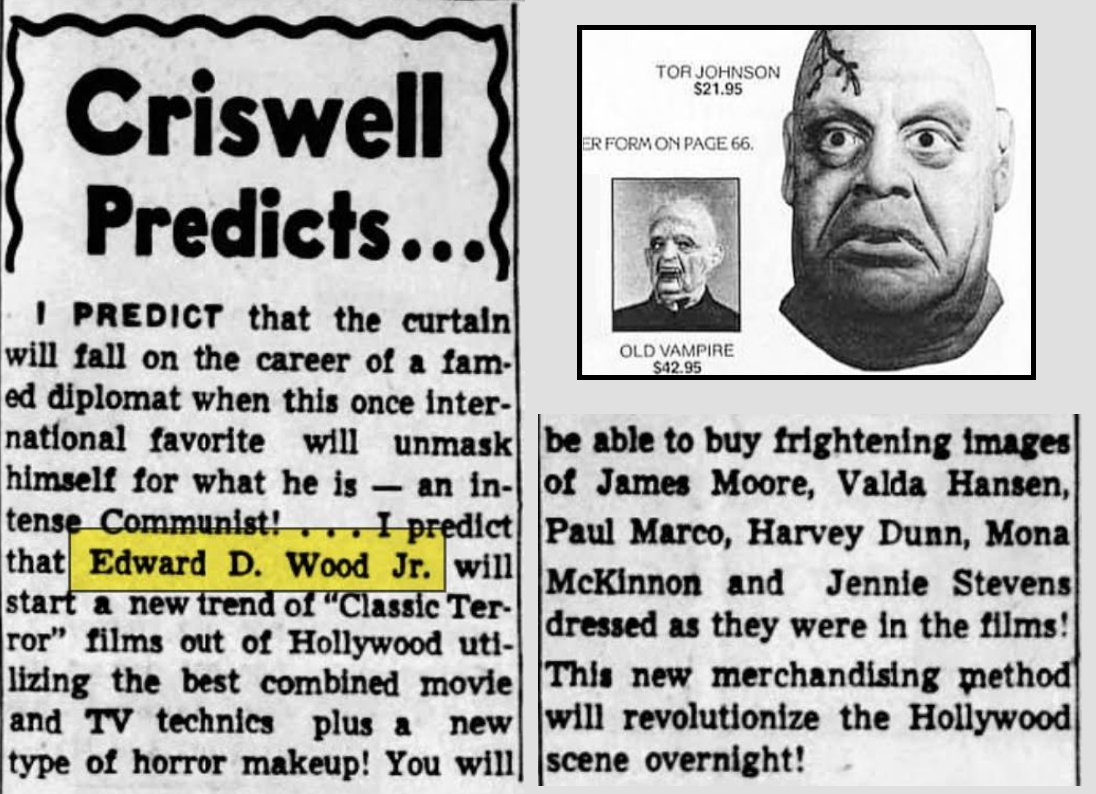
The third and final Criswell article for today comes from the April 23, 1958 edition of The Escondido Times-Advocate and concerns the merchandising of the actors in Ed Wood's repertory company.

A Criswell column from 1958. Inset: An early 1980s ad for Don Post studios.

As mentioned earlier, Criswell and Ed Wood were good friends, and I think the former mentioned the latter in his column occasionally just to get Eddie's name in print. In those pre-internet days, a struggling writer-director in Hollywood needed as much media attention as he could possibly get. I don't know if Criswell's columns opened any doors for Eddie, but they couldn't have hurt. Ink is ink.

Here, the great prognosticator declares that Eddie will not only revive classic Hollywood horror movies but will utilize "the best combined movie and TV technics plus a new type of horror makeup." Perhaps  Cris was already describing Night of the Ghouls, in which Tor Johnson's badly-scarred Lobo wears the most elaborate makeup ever seen in a Wood-directed movie. In the 1960s, Tor's familiar face became the basis for a popular Halloween mask from Don Post Studios. That company no longer exists, but several versions of the Tor mask are still on the market today.

What's interesting is that Criswell predicted a whole line of masks based on the cast of Night of the Ghouls, but he doesn't include the three most obvious candidates for this treatment: himself, Tor Johnson, and Kenne Duncan. Instead, he suggests masks based on James "Duke" Moore, Paul Marco, Harvey B. Dunn, Mona McKinnon (who appears in Ghouls via repurposed footage), Valda Hansen, and even the obscure Jean Stevens (identified here as "Jennie"). Again, I think this was Cris' sneaky way of getting his costars' names in print.

Rob Huffman sent me further Ed Wood clippings, but I think we will save those for a future installment of this series. After all, you don't eat all your Halloween candy on one night, do you?

Monday, May 4, 2020

Ed Wood Extra! "Exclusive Interview with Hollywood Director Edward D. Wood, Jr." by Baron Von Brenner (1973)

Baron Von Brenenr wrote abut Ed Wood in a 1973 issue of Psychic Review.

NOTE: Among Ed Wood's many eccentric acquaintances was Wendell John Brenner (1916-1975), aka Baron Von Brenner, a self-professed psychic and TV horror host who introduced Eddie to actor John Agar. Brenner also wrote a profile of Eddie for the July-August 1973 edition of Psychic Review. I am including the full text of that article below, trying to keep the spelling, grammar, and punctuation intact. Also included are the pictures that ran with the article, complete with the original photo captions. Brenner's article is a strange mixture of fact and fantasy, sometimes distorting the truth to a ridiculous extent. I hope you will enjoy it. - J.B.

Portrait of Director Ed D. Wood, Jr.
This particular photo of Mr. Wood was designed
by — and a favorite of — the late Bela Lugosi
A Saturday and Sunday matinee movie buff, just barely able to reach the ticket window with his dime, Edward D. Wood, Jr. knew at that early age in Poughkeepsie, New York that he was destined to be a part of the Hollywood scene. That he would some day be instrumental in bringing some of the most outstanding, well-loved and remembered personalities to the silver screen.

Throughout his "growing up" years, his military service in the United States Marines during World War II, this desire grew until he finally arrived in Hollywood in 1948. "Buck Jones was always my favorite of all Western Stars, but he died four years earlier and I never got to meet him," he sadly related, but there were many stars that he wanted to know and work with and the opportunity came before he knew it.


"The first big time actor I met was the famous comic, Franklin Pangborn, in a segment of the "MYRT AND MARGE SHOW" being filmed at the old Hal Roach studio. The series never got off the ground, but I later used Phyllis Coates, whom I met at the same time in "THE SUN WAS SETTING" with Angela Stevens and Tom Keene."


Angela Stevens, Tom Keene, Edw. Wood, Jr. and cameraman - Ray Flin on the set of "THE SUN WAS SETTING" written and directed by Edw. D. Wood, Jr.

Having both written and directed that film, Mr. Wood, Jr. went on to team Tom Keene with Tom Tyler in the color feature "CROSSROAD AVENGER" which also had the ever famous Lyle Talbot, Kenne Duncan, Bud Osborne, Don Nagel and Harvey B. Dunn.

"Only Don and Lyle are left of this group, Kenne having passed on just last year," he added.

With the blossoming of his amazing talent and creative genius, Eddie began to realize his boyhood dream come true.

Collaborating with Producer George Weiss for a film entitled, "I LED TWO LIVES", (later changed to "I CHANGED MY SEX"), he met the late Bela Lugosi.

"From then on we went strictly into the horror field and worked on five more films together, only to be concluded by the hand of Death that reached out and took Bela from us."

Cesar Romero and guests with Edward D. Wood, Jr.

Bill Thompson,cameraman, Director
Edward D. Wood, Jr. and Criswell on the
set of "PLAN #9 FROM OUTER SPACE".
During this same period, Eddie met and became a very close friend of Tor Johnson and his family, and direct him in all of his films, which included the never-to-be-forgotten "BLACK SHEEP" with Tor and John Carradine, "REVENGE OF THE DEAD" which co-starred that famed Western villain, Kenne Duncan, and "PLAN #9 FROM OUTER SPACE" which also featured the world-famous and renowned predictor - Criswell.

"BRIDE OF THE MONSTER" was the film that first brought Tor Johnson to the screen as "Lobo". The makeup created for that character was done by the famous makeup man, Harry Thomas. It was used again in "REVENGE OF THE DEAD", which was the last feature film that Tor appeared in before his untimely death in 1971. 

"Tor is missed very much but his horror films are frequently seen on television, and will always keep him with us", said Eddie. "What's more, we are going late production on a new feature in the fall of this year... "THE THREE STAGES OF MAN" which will include Tor's son Karl Johnson, as well as featuring Criswell along with veteran actor Alan Baxter who made so many gangster films over the years. Also in a feature role will be John Carpenter, who now runs a free ride ranch for Handicapped Children."

Karl Johnson is not a newcomer to the screen, as he worked with his father, Tor Johnson, in several of his films. He resembles his Dad in stature and is also a very powerful person, having also been a professional wrestler. We hope that this will be the beginning of a new revival of Horror films, as we feel that they are an important part of the movie industry, and also have a place in our culture. And although I know he won't agree with me, Karl is sure to take over where his father left off on the screen.

Abounding with energy, at only 49, Edward D. Wood, Jr. has probably had one of the most rewarding and successful careers in Hollywood. I don't want to give the impression that it has come to an end. Quite the contrary. It seems to be just beginning. Having recently completed writing original stories and screenplays for such films as "ORGY OF THE DEAD", "CLASS REUNION", "THE SNOW BUNNIES", "DROP OUT WIFE", "THE COCKTAIL HOSTESSES", and most recently... "CONVICT GIRLS" which goes before the cameras at the end of the summer... all for the extremely talented producer, director, A.C. Stevens, Eddie has been busy.

John Agar, recently selected for starring role in
"CONVICT GIRLS", written by Edw. D. Wood, Jr., and
produced and directed by A.C. Stevens, will be-
gin filming sometime in the late summer months.
Watch for more pictures and information in future
issues of the PSYCHIC REVIEW.
Most recently, Eddie tells me, (another Scoop for the Psychic Review), they have selected the extremely handsome, talented John Agar to play the Male Lead in "Convict Girl". Mr. Agar has set a record for the number of science-fiction films he's stared in and has appeared with such great personalities as John Wayne, Wendell Corey, Henry Fonda and many others, in films as well as on television.

A brilliant, well-respected actor, John has thrilled millions of movie-goers around the world with his performances. By casting professionals like Mr. Agar, Mr. Stevens and Eddie are sure to have a box-office success. In my opinion, the movie-going public is tired of the nudity that seems to have taken over the industry.... it's time to bring back the kind of films that are entertaining, enlightening and that the entire family can go to see together.

This seems to be the direction that Eddie and Mr. Stevens are aiming toward and we would like to commend them for it. Hopefully, other film producers and directors will follow their fine example.

"THE CLASS REUNION" the original story and screen-play written by Eddie, is now under consideration for achievement by the Academy of Motion Picture Arts and Sciences, and he's beside himself with joy.

But he has not stopped with simply making films. He has more than 1,0000 short stories and articles published and has just finished his 101st novel. Somewhere in his superhuman busy schedule he finds time for his lovely wife, Kathy, and their three "children" a Tibetan Spaniel, Casey and two Corgies, Wheelie and Bumper-Sticker, (the later being named by Gov. Ronald Reagan of Calif. when Eddie was active in the campaign to elect Sam Yorty Mayor of Los Angeles in 1965).

He said of himself, "If I hadn't been as determined to making movies I probably would have been a Zookeeper. I love animals so"... and they love him  too. They sense when someone is sincere, and has a gentle nature.... and Eddie is all of that.

Our hats are off to Edward D. Wood, Jr., and we wish him continued success and good fortune in all that he desires... there's an Oscar there with his name on it somewhere, for he has shared his greatest gift with Mankind... himself.

The Premiere Stars at the San Fernando Theater for the film "REVENGE OF THE DEAD" (from left to right) Dudley Manlove of N.B.C., Allan Nixon,
Vampira, Tor Johnson, Stepin Fetchit, Bela Lugsosi, Jr., Paul Marco, and Dolores Fuller.

POSTSCRIPT

Wendell John Brenner
Much of what you just read could be generously described as hogwash. Ed Wood and Bela Lugosi did not make five films together. They barely made three. Ed certainly did not direct The Black Sheep (1956) with Tor Johnson, Bela Lugosi, Basil Rathbone, Lon Chaney, Jr., and John Carradine. That was Austrian filmmaker Reginald Le Borg, who helmed dozens of low budget pictures in multiple genres from the mid-1930s to the late 1950s, when he switched to television. Revenge of the Dead (1959) was not Tor Johnson's last film appearance. If Convict Girl is another name for Fugitive Girls (1974), there was no male lead for John Agar to play. The Class Reunion (1972) would never have been an Oscar contender. Ed Wood and Steve Apostolof (A.C. Stephen) were certainly not making old-fashioned, family-friendly films. Their films relied very much on nudity.

Some of the article is either Brenner's opinion or is otherwise unverifiable, i.e. Eddie having "one of the most rewarding and successful careers in Hollywood." Who can say, meanwhile, whether or not Ronald Reagan named one of Ed's dogs Bumper-Sticker? Eddie certainly did work with Los Angeles mayor Sam Yorty, so it's possible he met or even knew Reagan. It's not impossible. Wood and Brenner were friends, so it's the latter's opinion that Eddie was "sincere and had a gentle nature." The sincerity I don't doubt, but alcoholism bought out some very un-gentle behavior from Ed Wood.

Several of Eddie's real-life projects are described (more or less) accurately, including The Sun Was Setting, Crossroad Avenger, Bride of the Monster, Revenge of the Dead, and I Changed My Sex. We also get a glimpse of one of Eddie's many unrealized projects, this time a film called The Three Stages of Man, with a projected cast of Karl Johnson, Alan Baxter, and Johnny Carpenter. The unmade film doesn't even get a mention in Rudoph Grey's book Nightmare of Ecstasy: The Life and Art of Edward D. Wood, Jr. (1992). Unfortunately, Karl never did take over his father's place in the movie industry.

In a private Facebook forum devoted to Ed Wood, fans Angel Scott and Will Sloan speculated that The Three Stages of Man was the proposed 1973 anthology film based on Eddie's short stories. Ed got as far as writing a script and doing some preliminary casting for that project, so it came pretty close to getting made. What's more, the stories that would have been included in the film correspond neatly to three different stages of life. There's a story about youth ("Mice on a Cold Cellar Floor"), one about middle age ("To Kill a Saturday Night"), and one about old age ("Epitaph for the Village Drunk").

I'd never heard the story of Ed Wood meeting fey, fussy character actor Franklin Pangborn. Eddie claims that Pangborn was filming a "segment" of Myrt and Marge at Hal Roach's studio in Culver City. Myrt and Marge was a radio soap opera that ran from 1931 to 1946. From the context of Eddie's story, it seems like there was a failed attempt to turn it into a TV series during those very early days of the medium. There was a 1933 Myrt and Marge film adaptation, though it's best known for featuring Ted Healy and the Three Stooges. Incidentally, the radio show starred Mytle Vail (aka Myrtle Damerel), best known today for her "daffy old lady" roles in The Little Shop of Horrors (1960) and A Bucket of Blood (1959), both written by her grandson, Charles B. Griffin.

Overall, what I like about this article by Baron Von Brenner is its can-do optimism and its naivete. This is the Eddie we know from the 1994 biopic Ed Wood, the guy who's convinced the rain is just about to stop and that his next picture is going to be a smash hit. By and large, this article isn't particularly accurate, but I wish it were. In a way, by winning two Academy Awards, Ed Wood did make one of Brenner's wilder predictions come true. It turns out that there were Oscars with Eddie's name written on them.

P.S. I've found a clearer, more detailed picture of the Revenge of the Dead premiere with Stepin Fetchit in attendance. In this picture, though, the gentlemen on the left are cropped out.

Allan Nixon, Vampira, Tor Johnson, Stepin Fetchit, Bela Lugosi, Jr., Paul Marco, and Dolores Fuller.

Wednesday, October 10, 2018

Ed Wood Wednesdays: The Wood Nudie Odyssey, An Introduction by Greg Dziawer

What was the connection between Ed and Elvis? Nudie Cohn, for one.

Kenne Duncan's colorful shirts.
When you think of Elvis Presley and Ed Wood and what, if anything, might connect these two men's careers, the obvious answer is Dolores Fuller. After spending a few years as Eddie's significant other and leading lady, including co-starring in his 1953 masterpiece Glen or Glenda, Dolores went on to success as a songwriter, penning lyrics for such Elvis Presley songs as "Spinout," "Rock-A-Hula Baby," and "I Got Lucky." 

But you probably knew that already. Does the Wood/Presley connection go deeper?

A few weeks ago, I was re-watching Trick Shooting, the early '60s short written and directed by Ed and starring his friend and associate, Western baddie Kenne Duncan. Just a few days earlier, I'd been surfing the internet, completely independent of Kenne or Eddie (or so I thought), when I came across a beautiful collection of photos of suits designed by Nudie Cohn for bluegrass musician Dale Berry. Shot by acclaimed cinematographer Darius Khondji (Se7en, Midnight in Paris), these images starkly capture Cohn's bold, otherworldly designs, which were somehow both richly ornate and elegantly simple. I realized immediately that I'd seen examples of custom-made "Nudie suits" all my life, but the existence of their common maker eluded me.

In his review of Trick Shooting, Joe Blevins remarked on the "rhinestone cowboy" outfits Kenne dons in the film. Although he didn't mention Nudie by name, he was right in recognizing the lineage. Nudie Cohn had, in fact, designed shirts, coats and suits for everyone from Roy Rogers to Sonny and Cher. And, yes, even Glen Campbell was a client. With his evocative, expressionistic embroidery, mixing the figurative and abstract seamlessly, Cohn dressed the cowboys and angels of Hollywood for decades.

Like Ed and Kenne, Nudie Cohn resided in North Hollywood at the peak of his career. But he'd been born Nuta Kotlyarenko some 10,000 miles away in Kiev in 1902. Before designing clothing for the stars, Nudie was making costumes and lingerie for burlesque performers.

All of this brings me back to Trick Shooting. A little over four minutes into the film, Kenne Duncan is seen wearing an embroidered, powder blue shirt with a hat to match! A minute and a half later, he's wearing another eye-catching shirt, this one beige and featuring a large embroidered image of a Native American with a feathered headdress. Even in the newsreel clips of Kenne's promotional trip to Japan in the early 1950s, the screen villain wears these fancifully decorated shirts.

As many dozens of times as I'd seen Trick Shooting, I'd never once thought about who might have designed those awesome garments! With Darius Khondji's pictorial still fresh in my mind, I knew instantly that they were the work of Nudie Cohn!

A man. A suit. A legend.
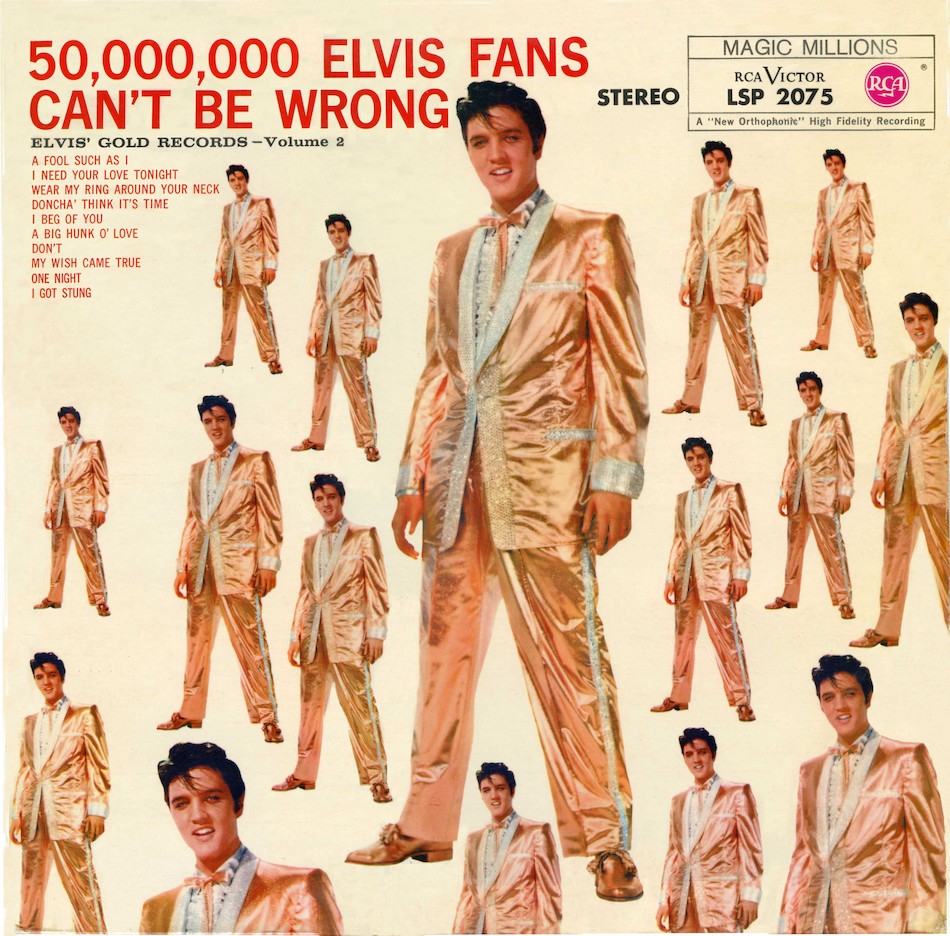
If you're still wondering about how this intersects with Elvis Presley, consider the following: Ed Wood wrote and directed a film featuring costumes by Nudie Cohn. Although these outfits were not created specifically for this project, they were unmistakably Cohn's work nevertheless. And Nudie also created the famous gold lamé suit worn by Elvis in 1957's Loving You. It's an outfit so closely associated with the singer that he wore it on the cover of his LP, 50,000,000 Elvis Fans Can't Be Wrong (1959). Comedian Jerry Seinfeld even donned a faithful copy of the suit when he impersonated Elvis on the cover of Rolling Stone in 1994. 

In other words, Nudie Cohn created an indispensable part of the Elvis Presley legend.

In future installments of The Wood Nudie Odyssey, we'll return to the short film Trick Shooting, Ed's friend Kenne Duncan, the L.A. burlesque stages of the 1950s, and much more.

Wednesday, July 5, 2017

Ed Wood Wednesdays, week 67: Revisiting 'The Sinister Urge' (1960)

Scratchy-voiced Gloria Henderson (Jean Fontaine) made her debut on MST3K in 1994.

Neglected no more: The Sinister Urge.
Edward D. Wood, Jr. really didn't direct that many feature-length films during his so-called "golden age," i.e. the years before he permanently descended into the world of pornography in the 1960s. There are the big three, naturally: Glenda, Plan 9, and Bride Of The Monster. The ones everyone knows from the Tim Burton biopic. The standbys. There's Jail Bait, too, a neglected "middle child" that has never received as much love and attention as its siblings. The Violent Years, though scripted by Wood, was (at least nominally) directed by William Morgan, so it doesn't quite count. Wood claims he edited two of those made-for-TV Tucson Kid episodes with Tom Keene into a quasi-feature, but this has never surfaced. Wood's other titles from this era (The Sun Was Setting, Final Curtain, etc.) are featurette-length.

That just leaves The Sinister Urge, an anti-smut scare film from 1960, by some counts the "last" movie Ed Wood ever made. When reference books say Ed Wood only directed five movies, they're ending their tally with this one. For whatever reason, despite its importance in the Wood canon, The Sinister Urge has gotten rather short shrift in this project. Sure, I did a complete write-up on the movie back in 2013, but I haven't rewatched it since then. I basically sat through it once all the way through, shrugged, and moved on. And yet, here is a full-length movie written and directed by Ed Wood when he was still sort of in his prime. He was only 36 when it came out. Thanks to some repurposed footage from the abandoned juvie flick Hellborn, Ed even plays a semi-prominent (if brief) role in it. Doesn't that deserve more attention?

I started wondering if maybe there were more to The Sinister Urge than I'd originally gleaned. So I decided to rewatch the movie with fresh eyes. Right away, I was struck by the first shot: a blonde (one-film wonder Betty Boatner), clad only in a bra and slip, running in terror toward the camera on a dirt road. The camera seems to be on the back of a car or truck, because it's moving, too. For an Ed Wood movie, this is a very dynamic beginning. Keep in mind that Glenda starts with Bela Lugosi sitting in a chair, and Plan 9 starts with Criswell sitting behind a desk. In contrast, The Sinister Urge doesn't have any scene-setting narration or preamble. Other than the title appearing onscreen, it doesn't even have opening credits. More so than at any other time in his filmmaking career, Ed Wood seems eager to get the action underway. This is as in medias res as he gets.

Don't worry, though; the usual Ed Wood inertia is not far away. In his DVD introduction to the film, Ted Newsom suggests that credited cinematographer William C. Thompson only shot the interiors for The Sinister Urge. And, true to form, there is a marked difference between the indoor and outdoor scenes in this movie. One plot thread has pompadoured hoodlum Dirk (Dino Fantini), driven mad by exposure to pornography, stalking and killing young women in Los Angeles' Griffith Park. These scenes crackle with an energy that vanishes once the film heads inside.

For the most part, this film is even more static and talky than usual for Wood. Our heroes are two hardworking, grim-faced policemen: Lt. Matt Carson (Kenne Duncan) and Sgt. Randy Stone (Duke Moore). Matt is a little sharper than Carson, sort of the Sherlock to his Watson, but neither is particularly energetic. Matt and Randy spend most of their time in the former's dark, wood-paneled office, discussing a string of porno-related murders and decrying the rottenness of the smut racket. When they do venture out to a crime scene, their hard-boiled dialogue goes like so:

Randy: (examining a woman's corpse) Just like the others. 
Matt: Pretty kid, too. 
Randy: She doesn't look much like a kid now. 
Matt: Maybe she grew up during that moment of truth. When she died. 
Randy: The same M.O. Killed the same way. The same everything. 
Matt: With one great difference. 
Randy: What's that? 
Matt: Her name will be different.

Duke Moore and Kenne Duncan in The Violent Years.
Move over, Joe Friday, huh? Actually, The Sinister Urge may be the best movie yet to illustrate Ed Wood's obsession with Dragnet-style police procedurals. I still maintain that Jack Webb was one of Eddie's greatest unheralded influences, more so than Tod Browning or James Whale. Why else would Glen Or Glenda, a film ostensibly about gender fluidity, be structured around a police investigation? Wood was so enamored of the tough-guy repartee between Duncan and Moore that he wanted to build an entire second feature, The Peeper, around their characters. Maybe he even had dreams of a mini-franchise starring these two. It's obvious why that never happened, though. To cast sleazy, sarcastic Kenne Duncan as a good guy seems all wrong, and Duncan's chemistry with bland, pudgy Duke Moore is virtually nonexistent. At one point, Wood tries to lighten the mood with a scene in which Randy plays a mischievous little prank on Matt, who has fallen asleep at his post. But "impish" just isn't in Kenne Duncan's wheelhouse, and the scene falls flat.

On the other side of the law, we have porno filmmaker Johnny Ryde (Carl Anthony), a man who "used to make good movies," and his boss/distributor/lover, scratchy-voiced Gloria Henderson (Joan Fontaine). They, too, spend a good deal of time sitting around and talking. Interestingly, Johnny and Gloria have both their strategy sessions and their makeout sessions in Gloria's sparsely-decorated living room, making this movie yet another example of Ed Wood using the homestead as his favorite backdrop. Gloria's house, in fact, doesn't look much different from the troubled homes featured in Glen Or Glenda, Jail Bait, and Plan 9. And just like those domiciles, this one is threatened by outside forces. When knife-wielding Dirk breaches the perimeter, it spells doom for the household and everyone in it.

The character of Gloria, on this viewing, reminded me a lot of Vic Brady (Timothy Farrell), the gangster from Jail Bait. Both of these people spend their lives in a constant state of agitation, always snapping at the people around them. Irritation is Gloria's default reaction to pretty much any stimulus. There is a scene, for instance, in which Johnny introduces Gloria to gawky, naive Mary Smith (Jeanne Willardson), a starlet he plans to exploit. Before Johnny even attempts to say Mary's name aloud, Gloria explodes with rage: "Names at this stage are unimportant! Names are your department anyway!" If the crooks are trying to win Mary's trust, this is a strange way of going about it. One wonders how Gloria ascended to a position of prominence in the underworld with so little finesse.

As for Carl Anthony's character, reader Milton Knight points out that the name Johnny Ryde is very similar to that of Johnny Hyde (aka Ivan Haidabura), the Russian-born talent agent who was instrumental in shaping Marilyn Monroe's early career. Hyde changed Monroe's image drastically, a process that included plastic surgery, and helped her secure important early film roles. Certainly, then, there are parallels to Johnny Ryde's treatment of innocent Mary Smith, who is encouraged to change her hair, wardrobe, deportment, diction, and place of residence. Hyde had already been dead a decade when The Sinister Urge was released; Monroe herself died in 1962.

All in all, my opinion of The Sinister Urge hasn't really changed since 2013. I still find the film suffocating and sluggish at times, though eccentric characters like Gloria and Dirk help liven up the proceedings. Johnny Ryde might be an onscreen stand-in for Ed Wood, but Carl Anthony plays him as such a colorless dullard that it hardly matters. The Sinister Urge closely follows the template of Reefer Madness, simply substituting pornography for marijuana, but Wood's film lacks the transcendent nuttiness of Louis Gasnier's anti-pot parable. Of the films from Eddie's classic era, this will probably be the one I watch the least. Some have praised this movie for being more coherent and focused than Wood's other efforts, and it is. Personally, though, I feel Wood's appeal rests on his abnormality, his asymmetry, so coherence is not necessarily what I'm looking for in his movies.

But I'm glad I revisited The Sinister Urge just the same, because there are some prime Wood-ian moments that I had forgotten. Perhaps my favorite comes when a group of tough-looking young women, another one of Eddie's many girl gangs, storms into an ice cream parlor at the behest of Gloria and Johnny to beat up the proprietor, a stocky older man named Claussen who has snitched to the cops. There's a closeup shot of one of the girls shoving a vanilla ice cream cone right in Claussen's fat face. Eddie doesn't hold the shot quite long enough for my taste, but it's a thing of surreal beauty nevertheless. The moment is worthy of Bunuel.

An episode from 1994.
Just to make sure no stone was left unturned, I finally decided to watch the Mystery Science Theater 3000 version of The Sinister Urge. For some reason, I'd been avoiding this one, maybe figuring it would be a bit too mean-spirited. Wood's movie was used as the basis for an episode during the show's sixth season back in November 1994, when it was still on Comedy Central. This wasn't MST3K's first voyage into the Wood canon by any means. The show had memorably tackled Bride Of The Monster during its fourth season and had razzed The Violent Years just three episodes prior to The Sinister Urge. Since the show's theme song promised viewers "cheesy movies, the worst we can find," it's only natural that they should aim their sights at a filmmaker widely considered "the worst director of all time."

The MST3K episode turned out to be a lot of fun and nothing to worry about. The Violent Years gets off fairly lightly here. It doesn't provoke the same agonized reactions as Manos: The Hands Of Fate or Red Zone Cuba. Host Mike Nelson and his robot pals (voiced by Kevin Murphy and Trace Beaulieu) don't threaten to mutiny or anything like that. In The Mystery Science Theater Amazing Colossal Episode Guide (1996), writer-performer Paul Chaplin describes Wood's movie in almost affectionate terms:
In this movie, the production end of Gloria's empire seems rather charming: the smut involves women in baggy swimsuits being photographed by a kindly elfin immigrant. Arousing? Not particularly. But is that really the main point of smut? For reasons too complicated to get into, Gloria kills Dirk when she means to kill Johnny (or is it the other way around?). The cops reveal the mistake to her, and she emits a harshly nasal "Nuh! Uh-uh! No way!" it's become one of our favorite moments. Gloriahard, raspy, and shrillserves as a reminder of the world Ed Wood inhabited. You get the idea this is a real woman playing herself.
Along with the usual string of pop culture references, invoking everyone from Eric von Stroheim to Marian McPartland, the episode's main running gags involve Joan Fontaine's harsh voice (the show claims you could shave with it), the stiffness of Carl Anthony's performance (he's compared with Hymie, the robot from Get Smart), and the resemblance of actor Dino Fantini to a young Bob Dylan. There are also some jokes about Ed Wood's tendency to pad his films with dull, extraneous shots, like people parking or getting in or out of cars. (A typical riff: "Film it all, Ed!") A few token references are made to Ed Wood's transvestism (he is said to have dressed like the aforementioned Ms. McPartland), but these do not get out of hand.

There are also a number of jokes about the character of Officer Kline (Fred Mason), a complete nonentity who pops up periodically throughout the film. Mike and the 'bots pretend to be hugely excited by Kline's utterly unexciting appearances. Weirdly, The Sinister Urge ends on a shot of Kline, who stands guard over the bodies of Dirk and Johnny as Lt. Carson takes Gloria downtown. So maybe this character really was of great significance to Ed Wood.

At one point during the recycled Hellborn footage, Mike Nelson comments: "I think Ed Wood has directed himself into a corner." Wood himself is onscreen that very minute, literally standing in the corner. Moments later, Tom Servo (Murphy) exclaims, "I think these scenes are from a completely different movie!" "Maybe," replies Crow (Beaulieu), "but they work so well here!" Is it possible that the MST3K writers knew this footage had been repurposed, or was it just a lucky guess on their part? Or was it so obvious that they figured it out on their own?

By the way, it seems initially that the episode's host segments, i.e. the scenes that take place outside the theater, have little to do with The Sinister Urge. There's an episode-long plot about the character of TV's Frank (Frank Conniff) becoming a mad bomber after seeing too many violent movies. But, eventually, even this cycles back around to Ed Wood. Sort of. Mike Nelson and the robots decide to crack the case, and Tom and Crow start talking and dressing like the cops in the movie. "Don't play schoolgirl with me!" Crow barks to an informant (Chaplin). "I've got so much on you, I'll send you so far up the river, you'll think you were a salmon!"

As Grade B dialogue goes, that's Grade A. 

Wednesday, May 10, 2017

Ed Wood Wednesdays: The Wood Dziawer Odyssey, Part Four

Eros and Tana from Plan 9 wearing some of Ed Wood's favorite accessories
 
Eros and Thanatos: A Neck Scarf Odyssey
"Thus were their faces: and their wings were stretched upward; two wings of every one were joined one to another, and two covered their bodies."
Ezekiel 1:11

I've mentioned before that the Swedish Erotica pornographic loop series on which a destitute Edward D. Wood, Jr. labored in the early 1970s ultimately adopted silk and chiffon neck scarves as de rigueur attire for its actresses. These fashion accessories—in a variety of colors, typically saturated, some even adorned with patterns—became signatures of the series. The scarves also show up across several related loop series produced by the Bloom family from 1975 to 1978 and even beyond. Danish Films, Danish International Films, Swedish Erotica Classics and—needless to say—the flagship Swedish Erotica series all extolled the scarf.

In my research, I learned that Ed was cashing a check from Art Publishers, Inc. (a classy-sounding alias for the Bloom/Caballero/Swedish Erotica porn empire) for the better part of the last two years of his life, a period in which he was previously thought to be unemployed. Those scarves, then, were with him for most of the decade.

Wednesday, September 7, 2016

Ed Wood Wednesdays: The Wood Promo Odyssey, Part Two by Greg Dziawer

Romance on her lips and a six shooter on her hip: A lobby card for The Lawless Rider

Previously at Ed Wood Wednesdays, the esteemed proprietor of this blog, Joe Blevins, brilliantly dissected The Lawless Rider...and Ed Wood's involvement in it.

This week, I'm sharing images of my lobby card set from the film (photos courtesy: Kitten).

To state the obvious, there are Seven Deadly Sins, an equivalent number to the unique cards in this set. I bought it on eBay earlier this year, a Buy-it-Now for under 15 bucks before shipping, in my recollection. Though I received eight cards, one is a duplicate. I have thought about this far too long and hard, wondering if the seller had a few sets and mis-packed mine?; if the set deliberately had a dupe, maybe one for the ticket window?; if the distributor had mis-packed the set upon providing it to a theater? 

The Woodologist in me finds it very fitting. All I knew is that there is very likely an eighth card out there. I am no expert on lobby card sets but an uneven number screams NO. 

Here are the seven Lawless Rider cards I have:


And if you see that eighth card, pardner, be sure to drop us a line.

Wednesday, February 12, 2014

Ed Wood Wednesdays, week 31: "Revenge of the Virgins" (1959)

"Savage Maidens Without Men!": Another Western thought to be written by Edward D. Wood, Jr.

"This is the revenge of the virgins. Once again, the trespassers have paid the penalty, and the legend continues. Beware the savage guardians of the Golden Horde."
-narrator Kenne Duncan, Revenge of the Virgins 
"The power of men is illusory. The power of women is real."
-author Salman Rushdie

One of Pete Perry's sexploitation classics.
This week, we turn our attention to two men named Pete, one real and the other (most likely) imaginary. The real one is Peter "Pete" Perry, Jr., yet another of schlock cinema's "utility infielders," who managed to keep his career in Hollywood alive for almost 30 years by diversifying his resumé. A little editing here, a little producing-directing there, maybe some writing and acting from time to time, etc. In that sense, his filmography resembles that of multifarious B-movie contemporaries like Ronald V. Ashcroft, Don Davis, and Edward D. Wood, Jr. But Pete's career in exploitation filmmaking is obscured by clouds of doubt and ambiguity. Biographical information about the man is frustratingly rare.

Most of the writing about Pete Perry has been in the form of reviews of the movies he made. The magnificently-named blog Johnny LaRue's Crane Shot has this career overview, which calls Perry "a pioneer of the sexploitation genre." And Goregirl's Dungeon has a nicely-illustrated feature about one of Perry's films, too. You'd think there would be an interview with this man or at least a few scattered anecdotes about him, but if they exist, I cannot locate them.

The most specific detail I can find about Perry from an official source is this one-sentence biography on the website of Something Weird Video, a company which now distributes several of his films: "Director Peter Perry," says SWV's Lisa Petrucci, "often worked with [adult film producers] David F. Friedman and Harry Novak during the 1960s under a number of aliases." Oh, man, did Pete Perry have aliases. Over the years, he was Dick Crane, A.J. Gaylord, Arthur P. Stootsberry, and Seymour Tuchus (my personal favorite). He seems to have gotten his start working for other filmmakers with Ed Wood connections. For instance, he wrote The Flesh Merchant (1956), which was directed by W. Merle Connell, i.e. the man whose bondage footage had been clumsily edited into Glen or Glenda? back in 1953. Then, Pete Perry worked for Ronnie Ashcroft as a writer-actor on the potboiler Girl with an Itch (1958).

The very next year, Pete directed his own first feature, a "nudie Western" novelty called Revenge of the Virgins (1959). This film was distributed by a company called Radio Voice of America or RVA. Critic Rob Craig has cleverly noted that these are also the initials of Ronnie V. Ashcroft, hinting at another possible connection between the two men. After Virgins, Perry would go on to direct a dozen more flicks over the next 20 years, almost always in softcore, with such rather well-remembered titles as The Notorious Daughter of Fanny Hill (1966), My Tale is Hot (1964), and Kiss Me Quick! (also 1964).

The Notorious Cleopatra, credited to
"A.P. Stootsberry" (aka Pete Perry, Jr.)
But directing was not Pete's only gig! As an editor, Pete Perry was employed several times by the notorious anti-auteur Al Adamson (1929-1995), who combined sex and violence in such ensanguined films as Blood of Dracula's Castle (1969), Horror of the Blood Monsters (1970), and Five Bloody Graves (1970), all three of which featured John Carradine. Meanwhile, the Internet rumor mill asserts that Pete Perry is the same person as Bethel Buckalew, who worked extensively as a writer, director, producer, and production manager in softcore sex films of the 1970s. Perry and Bucklalew do have several films in common, including The Notorious Cleopatra (1970) and Mag Wheels aka Summer School (1978). But Perry himself disputed that claim in a brief statement he gave to the Temple of Schlock blog in 2008. While he distributed My Boys Are Good Boys (1978), a comedy directed by Buckalew, he had no part in the making of that film. According to Perry, Buckalew "is a real person. I used to use him in the early days as my production manager, but then he went off on his own and did those other things."

Pete's company, Peter Perry Productions, indeed has a few late-1970s titles to its name, including Good Boys. In his own personal writing resumé from the '70s, Ed Wood claims to have penned a screenplay for "Pete Perry Prod." called Bed Time Talk. No other record of this film exists, and I have no evidence that it was ever produced. Considering Eddie's talent for churning out screenplays in a hurry, I have little doubt that he wrote something called Bed Time Talk once upon a time, but it doesn't seem to have gotten past the screenplay stage. By the end of his directing career, like Ed Wood before him, Pete Perry attempted to transition from soft to hardcore with A Woman's Dream (1980), whose cast includes at least a few actors with names I recognize, mainly from the invaluable Rialto Report podcast, namely Jamie Gillis and Herschel Savage.

As for Pete himself, he seems to have retired from the business after editing Chris Warfield's Sounds of Sex in 1985. My Internet sources informally tell me that Perry is alive and living out West, possibly in Nevada, these days. I wish him well.

Pete LaRoche's Outlaw Queen
But now, friends, it's time to discuss the career of another Pete, specifically Pete LaRoche, a writer who just may have been our very own Edward D. Wood, Jr. working under a pseudonym. Here is what the Internet's best Ed Wood fan site, The Hunt for Edward D. Wood, Jr., has to say about him:
The issue of Pete LaRoche is an interesting one. The name (and a variant, "Peter La Roche") appears on only three movies in the IMDb, all with some sort of connection to Ed. Outlaw Queen and The Wetbacks both feature involvement by Ed's friend and protege, Ronnie Ashcroft (see The Astounding She-Monster). Revenge of the Virgins features narration by Ed's best friend Kenne Duncan, also features Nona Carver (whose only other work is Take It Out In Trade) and uses the same music used in The Beast of Yucca Flats, which stars Tor Johnson and features Conrad Brooks. All of this is quite interesting, of course, but doesn't really point directly to Ed. The only problem is, I can find absolutley no information about Pete LaRoche anywhere else. So, for now, my suspicion is that "Pete LaRoche" might just be Ed, and his films will be listed here [in a separate section of the site], with the most apocryphal of the apocryphal films.
In his book, Ed Wood, Mad Genius, critic Rob Craig chooses to include Revenge of the Virgins in his survey of Eddie's career and gives it a full write-up, which he prefaces thusly:
Ed Wood's participation in this low-budget film is disputed; it is included on the assumption that Wood wrote, or contributed to the screenplay, which is credited to a "Pete LaRoche." The only other screenplays credited to LaRoche are Wetbacks (1959) and Outlaw Queen (1957), but there are at least two magazine articles during the time period with a similar by-line, dealing with Western movie stars William S. "Bill" Hart and Tim McCoy. Pete LaRoche may in fact be a separate individual, or one of Wood's many pen names, as Wood was an avid fan of the Western film genre, and could have easily been the author of all extant "LaRoche" pieces.
One of Pete LaRoche's fact-based Western articles from the 1970s.
It is interesting to note that Craig covers neither The Beach Bunnies (1976) nor The Snow Bunnies (1972) in his book, despite the fact that both are clearly and unambiguously credited to Edward D. Wood, Jr. And yet Revenge of the Virgins does make his cut! This movie, then, must have struck Rob Craig as genuine enough to merit taking up space in his book. One connection that neither of these writers seems to make is that all of LaRoche's screenplays are Westerns, a factor which ties it to the LaRoche-written magazine articles. The Hunt for Edward D. Wood, Jr. actually links to the piece about William S. Hart, so I've had a chance to peruse it. Craig asserts that these articles were written "during the time period" that LaRoche was working as a screenwriter, but this is not strictly true. The LaRoche movie scripts stretch from 1956 to 1959.

The two known LaRoche articles, however, appeared in 1971 --  not coincidentally, when Ed Wood was working quite frequently as a magazine writer. And, yes, he did occasionally pen fact-based Western articles during that time. (See: "Pearl Hart & The Last Stage" from week 9 of this series.) Pete LaRoche's biographical sketch of Western actor-director William S. Hart appeared in the June 1971 issue of True West magazine. The other known LaRoche piece, "Colonel Tim McCoy -- Army Man, Movie Star," also surfaced in June 1971, this time in a publication known simply as The West. What's truly fascinating, at least to dedicated Wood-ologists, is that "Army Man, Movie Star" was reprinted in August 1974 in a magazine called Golden West, Vol. 10., No. 9. But here, it was credited to "Glenn Shirley." Draw your own conclusions.

Hart's manliness: above reproach.
I am still currently attempting to secure a copy of "Army Man, Movie Star" from a library in Arizona. But I have read the William S. Hart article, and I have no trouble believing it is Ed Wood's work. More specifically, this article could easily have been a chapter in Ed's book, Hollywood Rat Race, which devotes an inordinate amount of ink to the directors and actors of the cowboy pictures Wood so loved. Hart (1864-1946) was born in Newburgh, NY, a mere 17 miles from Ed's own birthplace of Poughkeepsie, and just like Ed, Hart first worked as a stage actor before getting into movies. The screen icon's acting-directing career, which was noted for its rugged manliness and realism, stretched from 1914 to 1925 when he was displaced by "showmen" like Tom Mix and Hoot Gibson and retired to his ranch in Newhall, CA. Pete LaRoche seems especially impressed by the fact that Hart insisted upon doing his own stunts. Here, I must point out that Ed Wood's first-ever appearance in a movie was as a stuntman in the Sam Fuller-directed Western, The Baron of Arizona (1950), starring Vincent Price. When LaRoche writes of Hart's on-set derring-do, he makes this very Hollywood Rat Race-esque observation:
Today all of it would be filmed with a double while the studio's valuable property star would be sitting in the shade probably sipping a tall, cool one. This is not to say that all of today's stars are unable to perform the dangerous stunts which are written into the script. John Wayne, Robert Mitchum, Kirk Douglas, Lee Marvin and a few others are fully capable of meeting any demands; but their studios wouldn't allow it if a double or trick photography could make a passable substitute.
Many of the hallmarks of Ed Wood's book are present in this one brief passage: alcohol consumption ("sipping a tall, cool one"), the phoniness of Hollywood, and the pampered nature of modern movie stars. Eye-catching lists of celebrity names, like the one seen above, are extremely common in Rat Race as well. Wood's typically byzantine gender politics are also on full display in this article. The author goes off on a longish digression about the nature of male-female relationships in Hart's movies, seemingly offering his own "frontier" version of Freud's Madonna-whore complex:

Louise Glaum
In most of his films, [Hart] was reformed by the "good" girl after having shown (in a time of crisis) that there was a basic goodness in his own character. As for sex in his films, Louise Glaum usually played the seductive gal who made no bones about what she was selling, and Hart paid for it, no questions asked. This was an authentic part of the frontier town, and Bill Hart did not leave it out. This was the era of the "man," and his wants were not denied or restricted. Hart made this plain in all his films. Saloons were there. Gambling went on around the clock, and the ever-present dancehall girls were around to please, entertain and satisfy. While women were a precious item on the frontier, they were not regarded as highly destructible and fragile as the women of today. 
Hart was truthful in the handling of his women. He was gentle to the gentlewoman who, in his films, represented what was fine in womanhood, but he was hard in dealing with the kind who aroused his wrath. A notable example of this treatment was vividly displayed in his film of 1916, Hell's Hinges. While he was against a young minister's establishing a church in the town of Hell's Hinges, he respected him for attempting to carry out his mission in the face of strong opposition. And when Louise Glaum, the town's foremost Lady of Joy, seduced the young minister after having plied him with whiskey, Hart broke in on her and thoroughly manhandled her.
So there you have it, ladies: Baffling and Unhelpful Gender Stereotypes of the Oooooooold West! Fool around with a man of the cloth and get the crap beaten out of you. And now, we turn our attention to a most curious late 1950s Western in which women hold all the true authority, while impotent and incompetent men strut around and peck at each other like addle-brained roosters in a cockfight. None of the women in this film are "highly destructible" or even remotely "fragile," and the closest thing this movie has to a "gentlewoman" is a rather weak-willed man.

REVENGE OF THE VIRGINS (1959)

Title screen from the film.

Alternate titles: None. Even the French title translates as Revenge of the Virgins.

Availability: Revenge of the Virgins is available as half of a DVD called Naughty West Double Feature (Something Weird Video, 2003), along with Van Guylder's The Ramrodder (1969), a movie whose cast features Marsha Jordan as well as Manson Family member Bobby Beausoleil. (And, yes, it was filmed at the notorious Manson hangout, the Spahn Movie Ranch.) Something Weird also offers Revenge on its own as a download for ten bucks.

Russ Meyer's breakthrough.
The backstory: For about as long as motion picture cameras have existed (let's say the 1890s), people have been using them to record sexually explicit scenes and images. Watch any of those made-for-cable documentaries about the "history of sex in the movies," and you're bound to find grainy, flickering, black-and-white footage of people stripping off and doing all sorts of interesting things to themselves and each other, including bondage and S&M scenarios. But because of religious restrictions, moral concerns, and censorship laws, such potentially "objectionable" movies had to occupy a clandestine or subterranean place in our society for decades. Ultimately, by the 1950s, "stag films" and "loops" became part of the Twentieth Century way of life, though the only method to see them was by visiting out-of-the-way theaters or by renting them privately and projecting them on a bedsheet or small screen at a bachelor party or men's club meeting. Meanwhile, thanks to Hugh Hefner's Playboy magazine, which debuted in 1953, (mild) female nudity became somewhat more acceptable as mainstream entertainment for heterosexual men. At least in print, that is. The movie world wasn't quite as accepting yet.

But in 1959, there appeared on the entertainment scene a new form of diversion: the "nudie cutie," a feature-length narrative film which incorporated female nudity into a storyline. With Lena Dunham now flashing her boobs regularly on HBO's Girls, this may not seem like such a big deal. But in the waning years of the Eisenhower Administration, this was a revelation! The father of the genre is widely considered to be writer-director Russ Meyer (1922-2004), who not coincidentally had been a photographer (and a damned good one) for Hefner's Playboy. Though he would go on to make better, more inventive movies, Meyer's game-changer was a modest "Frenchy comedy" called The Immoral Mr. Teas (1959), starring Bill Teas, a combat photographer who had served alongside Meyer in the Marines in WWII. Produced on a modest $24,000 budget, the film attained a level of commercial success unheard of in the sex film market, with grosses in the low seven digits. (In today's money, imagine taking about $200,000 and turning it into $8 million.) A key to the film's success was the fact that its abundant nudity was completely removed from any sexual context. Teas merely imagined seeing naked women wherever he went, and the movie allowed us -- through the magic of cinema -- to see what he was seeing.

So The Immoral Mr. Teas is a sex film with no sex. Just what the doctor ordered! In its own way, Mr. Teas is as much a landmark in movie history as Gerard Damiano's Deep Throat (1972), a feature-length film which actually contained unsimulated sex acts as part of its story.

But just as Damiano's much-celebrated, much-hated film was preceded by producer Bill Osco's less-heralded, now-forgotten Mona: The Virgin Nymph (1970), there is some debate as to which director actually started the whole "nudie cutie" phenomenon in the late 1950s. Russ Meyer is the widely-acknowledged king of the genre, but it is worth pointing out that Pete Perry's Revenge of the Virgins appeared the very same year. It was critic Rob Craig who gave me the idea that perhaps Perry had beaten Meyer to the punch. Granted, both Teas and Virgins were quickly made, so it is entirely possible that Perry saw Meyer's film and rushed his own "nudie cutie" into production before the year was over. Or this could be one of those "great minds think alike" situations where both Meyer and Perry saw where the sex film industry was headed and started to work along similar paths. This could be a sexual-cinematic example of the "multiple discovery" theory, in which important breakthroughs are reached independently and simultaneously by different experimenters.

It's important to point out that The Immoral Mr. Teas and Revenge of the Virgins are not even vaguely alike, tonally or structurally. The one crucial element they have in common is the inclusion of female nudity in a storyline which contains no onscreen sex. Otherwise, these are very different movies! Meyer's full-color comedy is a lighthearted, rather drowsy little trifle of a film which plays more like a series of skits or vignettes. While the women in the film do not engage in any explicit sexual activity, Mr. Teas' fantasies are certainly fueled by male lust, hence the word "immoral" in the title. On the other hand, Perry's movie is a brisk, violent, no-nonsense Western in which the female nudity is never presented in a sexual manner at all. In fact, even though it's the film's selling point, the toplessness of the "Indian" characters is never once commented upon and now comes across as an almost surreal nonsequitir, like the random naked lady (played, no kidding, by Russ Meyer starlet/girlfriend Kitten Natividad) who makes an unexplained appearance in Airplane! (1980).

Ramona Rogers, aka Jean Nieto.
So Pete Perry may or may not have invented the "nudie cutie," but he was most definitely an early adapter and deserves to be called a pioneer in his field. And what kind of team did Mr. Perry assemble to create this groundbreaking film of his? Well, I alluded earlier in this article to Pete's possible connection to Ronnie Ashcroft, director of last week's film, The Astounding She-Creature. There is considerable overlap in the cast and crew between Virgins and She-Creature. Most obviously, the two films share a score: the jarring, Stravinsky-like compositions of Guenther "Gene" Kauer. The only examples of "new" music in Perry's film are the upright piano heard in an early saloon scene, plus the thudding "war drums" used to represent the Indians. (Both of these might be stock, as they are used more as sound effects than true background music.)

Elsewhere in the crew, one of the two credited cinematographers on Revenge of the Virgins is Gene Gropper, who did some reshoots on She-Creature for Ronnie Ashcroft. And the uncredited narrator is Ed Wood's good buddy, Western badman Kenne Duncan, who played one of the leads in She-Creature. Besides Duncan, the most interesting name in the cast for Wood-ologists is Nona Carver, who plays the blonde-haired "white goddess" who leads an all-female tribe of Native Americans. Carver, of course, is the stripper who played a madam in Ed Wood's Take It Out in Trade (1970).

The topless Indian maidens, the "Golden Horde," appear to be played by strippers and pinup models, none of whom amounted to much in the film industry. There are six altogether, none of them Native American in ancestry. Only one has even a second credit to her name. That would be Ms. Betty Shay, who appeared as a dancer in a filmed burlesque show called Merry Maids of the Gay Way (1954). Another member of the Golden Horde, Ramona Rogers, at least has a few extant glamour shots and seems to have also worked under the name Jean Nieto.

Charles Veltmann, Jr. and costar Jodean Lawrence.
As for the film's non-nude performers, there are a surprising many who went on to long, successful careers, and a few who... well, didn't.

Among the latter group is milquetoast Charles Veltmann, Jr. (aka Charles Veltman), who booked at least one more Western, John Wayne's famously troubled The Alamo (1960), but nothing else. Ralph Cookson, a grubby barkeep here, didn't even get that far. Colorful character actor Stanton Pritchard has a brief filmography indeed, but it includes Ronnie Ashcroft's Like Wow! (1962). Louis Massad didn't get a great deal of film credits, but racked up plenty of TV gigs in the 1960s and 1970s, mainly in Westerns (Gunsmoke, The Virginian) and action shows (Mission: Impossible, McCloud). Del Monroe has a similarly TV-heavy career, with the expected emphasis on shoot-'em-ups and manly fare (Mannix, The Rockford Files, The Fall Guy). The late Hugo Stanger (1901-1990) worked in films for 30 years, snagging some of his most plum assignments (Beetlejuice, Psycho III) near the end.

The actor listed in the credits of Revenge of the Vrgins as "Hank Delgado" has an almost-entirely undistinguished filmography... unless he's really Henry Darrow (birth name: Enrique Delgado), who has been getting steady TV and film work (including recurring roles on TV's Harry O, The Bold and the Beautiful, and at least three incarnations of Zorro) since the late 1950s. In that case, Revenge of the Virgins was the beginning of a lengthy Hollywood career.

By far, however, the best and most compelling performance in this film is given by feisty Jodean Lawrence (1932-2010), an actress who was still going by the name Jodean Russo back then. Lawrence was her maiden name, and she reverted to it after getting divorced. A Los Angeles stage performer of note, Lawrence's film and TV career didn't take off until the 1970s. She went on to appear in such prominent motion pictures as Airport (1970) and Johnny Got His Gun (1971), along with a slew of TV shows (Little House of the Prairie, The Streets of San Francisco, The Six Million Dollar Man). Her death  in 2010 merited an obituary in Variety. In case you were wondering, Edward D. Wood, Jr. was not likewise honored.

The viewing experience: Though conceived as a hybrid of the Western and burlesque genres, Revenge of the Virgins reminded me more of those 1970s horror movies, including Tobe Hooper's The Texas Chain Saw Massacre (1974) and Wes Craven's The Hills Have Eyes (1977), in which a group of "normal" people travel to a desolate, remote location, only to find themselves being cold-bloodedly picked off, one at a time, by a family of savage, feral strangers. In this film, however, the "victims" are depicted in an entirely unflattering way, so our sympathies are not aroused by their deaths. The "killers," on the other hand, are portrayed in a basically neutral manner and do not suffer any casualties, unlike the grotesque clans in the Hooper and Craven films. And while the horror films of the 1970s, 1980s, and beyond eventually winnow the pool of potential victims down to one last female survivor, the fabled "final girl," Revenge of the Virgins narrows down its "straight" cast to a single, rather effeminate man. The plot of this movie is extremely basic and straightforward, with very few digressions or distractions, so I think I'll let narrator Kenne Duncan -- who recites the prologue with the chummy, impersonal bonhomie normally reserved for Hawaiian travelogues -- set the scene for us:
Nona Carver as "Yellow Gold"
Out of the early days of our Western frontier have come many legends. Some of these stories are based on fact. Others, no doubt, were conceived in the minds of grizzled old prospectors, too long alone in the hot barren waste, consumed by their one dream -- the dream of finding gold. Each one convinced that he would one day hit the biggest bonanza of all. Many of these stories, as you know, concerned Indians. They were the large tribes or nations in Arizona, such as the Apache, the Navajo, Hopi, Zuni, Papago and many more. California's Indians were divided into smaller tribes. There were a good many of these groups who were all but extinct when the Spaniards landed. Most of them are far more primitive than their brothers in other territories. Their culture was that of the Stone Age. 
This story deals with the last days of one such tribe. Already small when Spain first claimed California as her own, their numbers steadily dwindled as they waged an unending war against the white man. They refused to be converted to Christianity by the padres of the mission. The white man was their mortal enemy, to be killed on sight. While their number was decreasing, the number of their enemy was increasing. The Anglo or Yankee had migrated West and was embarked upon the feverish search for gold. The remnants of this tribe had been driven back into the hills in an area which was thought to be rich in gold. Individual prospectors and parties of men had gone into these hills, never to return. There came a time when the only remaining members of this tribe were women. Their men had been all killed in their ceaseless battle with the white man or had died of pestilence. 
Ironically, the leader of these women was herself white. She had been captured as a baby, and the only reason she had been spared was the fact that heir hair was the color of yellow gold. To the superstitious minds of these primitive people, this was the symbol. She had been sent to them by the Sun God, and they treated her as a goddess as she grew to young womanhood. Since she had known nothing but the ways of these Indians, their enemy became her enemy, and she fought and killed her own people. 
This is the story of one party of white men and one white woman who, in their search for gold, encountered these Amazons of the West. 
A member of the Golden Horde fires an arrow.
The knowledgeable Wood-ologist will easily find numerous parallels here between Duncan's narration and the plot and dialogue of the Ed Wood-scripted Orgy of the Dead (1965). The very first sentence, for instance, is evocative of a line spoken by horror writer Bob (William Bates) in the later film: "All of my books are based on fact... or legend. That's perhaps why they're more interesting and sell in the top spots." An emphasis on "facts" is a key Wood-ian motif, as discussed in some detail in my review of The Beach Bunnies. Moreover, the theme of worshiping gold above all else is a major motif in Orgy as well, with Pat Barringer's character paying the ultimate price for her devotion to the precious metal.

Of all the movies in the Ed Wood canon, Orgy and Virgins are the two which feature a great deal of non-sexual female nudity, though the topless diving sequence from Venus Flytrap (1970) is another good example. You might remember that Orgy featured its own Native American character, the Indian maiden who was forced to dance for Emperor Criswell. Another Orgy character, the Princess of Darkness, described this young lady as "one who loved flames. Her lover was killed by flames. She died in flames." While Orgy's lone Indian character worshiped fire, the members of the Golden Horde in Revenge of the Virgins fiercely protect the gold on their land, for reasons that the non-Indian characters describe as some kind of primitive, indecipherable superstition. The white characters, of course, want the gold for selfish, practical reasons.

Whose side is the movie on? Clearly, not with the treasure seekers, as they exist mainly to die for our amusement. But the Golden Horde aren't very sporting either, shooting the white folks with arrows from a distance with no warning. "Well, that's the Apaches' idea of fair play," says Stanton Pritchard in disgust. The Indians only risk a close-range attack after the last survivor has been bitten by a snake* and is too weak to fight back. Besides, we never get to really know any of the Golden Horde as individuals. We are rarely left alone in their presence, apart from one ritualistic dance scene which again hearkens back to Orgy.

In other words, the Native American characters are rightfully protecting what is theirs, but they're doing so in a rather cowardly way, so morally they're kind of a wash. The film's final shot, with the female Indians swarming around a male victim, makes an interesting counterpoint to scenes from such other Wood-scripted "girl gang" flicks like The Violent Years and Fugitive Girls.
*Yes, Revenge is yet another (alleged) Ed Wood movie with a snake in it. See also: Bride of the Monster, Necromania, The Astounding She-Monster, and Orgy of the Dead.

Pan Taggart: Ed Wood's onscreen surrogate?
The basic plot of Revenge of the Virgins is extremely simple, and Kenne Duncan's introductory narration gives away most of what happens in this hour-long feature. Dandified city slicker Melvin Potter (Veltmann) and his greedy, domineering, sexy wife Ruby (Lawrence) have just arrived in a frontier town looking for a business investment with the small amount of cash Melvin has socked away. Ruby wants wussy, submissive Melvin to purchase the saloon, but he finds that it's simply out of his price range. (It seems Melvin's previous business ventures have not been too profitable.) But while he's checking out the place, Melvin encounters a local character: a hard-drinking old coot named "Pan" Taggart (Pritchard), whose wild stories about a mother lode of gold deep in Injun country are a source of great amusement to the snickering patrons of the tavern, who buy him drinks but don't believe any of what he says. Yet Melvin is somehow convinced by Taggart, and they make plans to gather a group of men and weapons and go after that gold.

Whether he knew it or not when he was writing this script, Ed Wood created a good onscreen surrogate for himself in the character of "Pan" Taggart, whose nickname is short for "panhandler." In his later years, when he was deep into alcoholism and working for Pendulum Publishing, Eddie would regale his much-younger coworkers with anecdotes about his glory days working in motion pictures with Bela Lugosi, and they treated him much like the bar patrons treat Taggart in Revenge of the Virgins, finding Ed amusing but giving little credence to his words.

Anyhow, when Melvin relates his new plans to Ruby, she reacts as if this were Jack and the Beanstalk, and her husband had just sold the family cow for a handful of magic beans. Their big scene together is classic Wood. The reversal of traditional gender roles is on full display here, as it is Ruby who clearly "wears the pants" in the relationship, even though she looks womanly and dresses in a very alluring and feminine manner. (Throughout the film, Ruby repeatedly tells Melvin to "shut up," a phrase she shares with macho Jail Bait gangster Vic Brady.)
Ruby: Who is Pan Taggart?! 
Melvin: He's that prospector I told you about, the one that knows about the gold. 
Ruby: I sent you out to try and talk a deal with the owner of the saloon, and you come back without talking to him? And have the gall to tell me you wasted your time talking to a stupid old fool? 
Melvin: But.. but, Ruby... 
Ruby: I want that saloon. Do you understand? For once in my life, I wanna be somebody! I wanna run that place and be the queen of the beehive. And have all the people come to me for things. I wanna make money. Big money! 
Melvin: Ruby, Ruby, you just said it! That's exactly what's been on my mind! Big money! 
Ruby: Well, then go out and buy the saloon! 
Melvin: Ruby, honey, forget about that saloon for a minute. That's not what I'm talking about! Besides, if... if you were to be the queen around a place like that, honey, I... I just couldn't stand it! All those men pawing at you! 
Ruby: Oh! 
Melvin: Ruby, honey, listen to me! Hear me out just this once. Now we both want big money, but I'm telling you again I just haven't got the wherewithal to buy a place like that! 
Ruby: Before you married me, you sold out a freighting business in Illinois! What did you do with the money? 
Melvin: Well, I... I sold out the place because I couldn't make a go of it. Now, now if you've got a place that isn't doing very well, you're not going to get very much for it, are you? Now, Ruby, listen... this Taggart swears up and down that the gold is there. And I believe him! 
Ruby: Why? 
Melvin: Well, if it wasn't there, say... say he made up this whole story just to mooch a bottle and some food, he wouldn't be willing to risk his life, now would he? Much less three months of hard work and a long trip. Oh, no, no. He can get a bottle and food a lot easier than that! 
Ruby: Where's this gold supposed to be? 
Melvin: At a place he calls Gold Creek. It's deep in Indian Territory. Now, honey, it's no picnic to get there, but we can be rich! Real stinking rich! And we won't have to sweat it out in that lousy saloon for the next 15 years! Listen, Ruby, all we have to do is bag it up! Bags of gold!
"Tell me about the rabbits, George!"
The only two men Melvin manages to convince to go in with him are a couple of no-good desperadoes (Delgado and Stanger) on the run from the law. These men immediately start scheming how to screw naive, too-trusting Melvin over; they also start making inappropriate sexual overtures toward Ruby. This ragtag party of five -- Taggart, the Potters, and the two crooks -- head out in search of Gold Creek. From this point on, Charles Veltmann, Jr. temporarily takes over the voiceover chores from Kenne Duncan, making Revenge of the Virgins another Ed Wood movie with multiple narrators. After a few minutes of screen time, there are two additions to the group -- a pair of Cavalry deserters (Massad and Monroe), who also do a lot of dastardly, sneaky plotting behind Melvin's back. Frankly, having two matching pairs of scumbags was overkill. The desperadoes and the deserters are difficult to tell apart, so these two "new" characters don't add a great deal of variety to the film. I guess their real purpose is to provide more victims for the Golden Horde to kill, and believe me, the archery-related deaths start early in the proceedings and don't let up.

The only real moment of pathos along the way is when Pan Taggart is killed. His death comes mere seconds after he finally gets his hand on the gold that he has been dreaming about for years. His last words before being struck by an arrow are: "Gold! Gold! Here it is! Gold!" The irony of this does not go unnoticed by the other characters. "Old coot tries for ten years to convince somebody that there's gold up here," says Delgado. "When he finally makes it back, he gets one minute to feel it between his fingers." That's life in a nutshell, ain't it? Later, when Ruby is struck down, Melvin insists on putting a marker at her gravesite. ("It seems kinda lonesome without a touch of somebody cared.")

As Rob Craig notes in his assessment of this film, graves and funerals are a common theme in Ed Wood's writing career. In the Pete LaRoche article about William S. Hart, he even devotes a few sentences to the final resting place of Hart's beloved pinto, Fritz. ("Fritz is buried at the William S. Hart Ranch in Newhall, Calif.," the article informs us, "his memory commemorated by a suitable monument.")

Ultimately, Revenge of the Virgins leads to a climax in which Hank Delgado plans to shoot Charles Veltmann, Jr. in the back while the latter prattles on obliviously about the saloon he'll buy with his share of the gold once he returns to town. The scene very much reminded me of the famous "rabbits" scene between George and Lenny in Steinbeck's Of Mice and Men. I don't know whether or not Ed Wood was thinking of that when he wrote this screenplay, but it seems likely. The difference here is that there's no undercurrent of tragedy in Revenge, since both characters -- the shooter and the shootee -- are almost entirely worthless.


All in all, this is a movie that Ed Wood fans in particular and seekers of strange entertainment in general will definitely want to check out, if only for its lost-era oddness and squeaky-clean brand of decadence. Revenge of the Virgins is easy to find in a variety of formats, and it's a quick, quirky, relatively painless viewing experience, even for rookies who may find themselves overmatched by the likes of Orgy of the Dead. Better yet, if you're an aspiring Wood-ologist but are a bit squeamish about pornography, this is an ideal "gateway drug." Revenge will allow you to check out the "naughty" side of Eddie's career without the potential embarrassment of seeing actors and actresses in sexual situations, either real or simulated.

Or if you're slightly put off by the prospect of sitting through a black-and-white Western from the 1950s, you may be put at ease to learn that this one is roughly 50% boobs, 40% people being shot with arrows, and 10% Ed Wood dialogue. That's a winning formula, I'd say. Moreover, this little movie is a museum artifact of cinematic sexploitation plus a statement (albeit a muddled one) on both the role of women in society and the treatment of the American Indians by white settlers. What more do you want from an hour of light entertainment?

In two weeks: One of the most talked-about, shocked-about motion pictures of 1959 was Otto Preminger's Anatomy of a Murder, a film so scandalous that even star Jimmy Stewart's father came out publicly against it. Of Hollywood's offerings the very next year, easily the most controversial was Alfred Hitchcock's now-seminal slasher Psycho. If you take Anatomy of a Murder and cross-pollinate it with Psycho, what do you get? I have no idea, but director Boris Petroff was hoping audiences would be curious enough to be lured into the movie theaters and drive-ins of America to see his latest creation, a sleazy crime thriller whose screenplay was credited to Petroff's wife, Jane Mann, and film/TV writer Don Devlin. But there are those who believe that a certain Edward Davis Wood, Jr. may have had a hand in the creation of this particular movie. Did he? We'll sort all this out in one short week as we examine Anatomy of a Psycho (1961).