Showing posts with label Million Dollar Kid. Show all posts

Wednesday, November 14, 2018

Ed Wood Wednesdays, week 76: Johnny Duncan in 'Plan 9'

From Batman & Robin to Plan 9, Johnny Duncan had a colorful career in pictures.

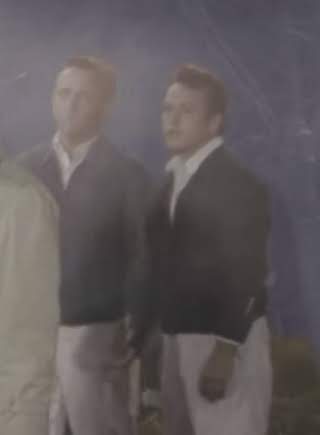
The morgue wagon boys.
Strange things are afoot at the old cemetery near Jeff and Paula Trent's house. Two gravediggers have been killed—torn apart, as if by a bobcat—and a handful of police officers have arrived on the scene to take the witnesses' statements and search the grounds for any clue as to who or what committed these murders. The investigation is led by plainclothesmen Inspector Daniel Clay (Tor Johnson) and Lt. John "Johnny" Harper (Duke Moore), aided by two uniformed patrolmen (Paul Marco and Carl Anthony). Lt. Harper tells Inspector Clay that the "morgue wagon oughta be along most any time" to collect the bodies. The sooner the better, since this boneyard stinks to high heaven.

Confident that Lt. Harper has the foul-smelling crime scene well in hand, Inspector Clay departs to explore the rest of the cemetery. An unwise decision, we'll soon learn. Remarkable events transpire in rapid order. A single flying saucer zooms over the area, bringing with it a blinding light and an incredible wind that is neither hot nor cold, just powerful. The Trents (Gregory Walcott and Mona McKinnon) are on their back porch at the time and find themselves thrown to the ground while having a heart-to-heart chat. Lt. Harper and the two patrolmen witness the UFO, too.

By this point, two morgue wagon attendants—decked out in matching jackets, collared shirts, and white pants—have arrived to carry away the bodies. They're carrying one of the gravediggers on a stretcher. When the saucer flies over their heads, however, all five men are knocked to the ground. The morgue wagon guys unceremoniously dump the gravedigger's body into a nearby field. Somewhere else in the cemetery, the man-mountain Inspector Clay remains standing. Fate has something far worse in store for him that night.

A body (Hugh Thomas, Jr.) is thrown into a field.

Batman and Robin (1949)
I've seen Ed Wood's Plan 9 from Outer Space (1959) countless times over the last 26 years, but it was only recently that I paid any attention whatsoever to those two guys from the "morgue wagon." (And, incidentally, that does not seem to be a standard industry term. Ed Wood simply made it up.) Part of what drew my attention to them was revisiting the colorized version of Plan 9 released by Legend Films in 2006. The addition of color to a black-and-white film brings out details that might otherwise go unnoticed, including props, sets, and, yes, background actors.

In the Legend Films edition, for instance, the two morgue attendants are tinted in such a way that they look like a set of twins in matchy-matchy outfits, as if they'd been dressing alike since childhood and carried that habit into their adult years. Once you notice them, it's difficult to ignore them as they theatrically throw themselves to the ground, then regain their composure and confer among themselves.

One of these stretcher bearers has been positively identified as actor-dancer Johnny Duncan (1923-2016), best known today for having portrayed Robin the Boy Wonder in the 1949 Columbia serial Batman and Robin. He was the second actor to play the famed DC character, following Douglas Croft in a 1943 Batman serial. And, yes, that's definitely Duncan in Plan 9. He confirmed as much in a lively, career-spanning 2005 interview. He had little recollection of the film or of Ed Wood, other than the fact that Eddie "made some cheap pictures." For the actor, it was just another job in a screen career that spanned about two decades.

That's the damnedest thing about Johnny Duncan, a Kansas City, MO native who started as a professional dancer in the 1930s when he was a teenager before leapfrogging to a movie contract with Fox. He worked with many famous people over the years, including esteemed directors like John Ford and Stanley Kubrick, and yet he did not seem to take himself especially seriously.

Duncan was the very epitome of a journeyman actor, going from job to job with no real thought as to building a reputation or personal brand. As he tells it, he never actively sought out a film career. It just sort of happened. An agent saw him and signed him, and that was that. From Westerns to musicals to comedies, Johnny was up for anything. He just went wherever he was wanted until he wasn't wanted anymore. After his career dried up in Hollywood, Johnny got out of movies and into the business world; by the 1990s, he was Vice President of Fall Creek Resorts in Branson. He seemed content to live out his days in his native Missouri, though he occasionally missed California and its people.

In his later years, long since retired from showbiz, Johnny Duncan gladly appeared at conventions to meet fans and discuss his role as Robin. Though Duncan's diverse resume includes such titles as The Wild One (1953), The Caine Mutiny (1954), and Spartacus (1960), his name will forever be connected to the deathless Batman franchise. And Johnny seemed perfectly fine with that, having been a fan of the comics before he ever took the role of Dick Grayson. He claimed he even read Batman books on his honeymoon, much to his bride's annoyance.

Filmed over the course of about three grueling months in 1949, Batman and Robin was eventually released in 15 separate chapters, each one averaging about 17 minutes. These would be shown as appetizers before a main feature. The series, directed by Spencer Gordon Bennet, is notable for including the first live-action depictions of such seminal Batman characters as reporter Vicki Vale and Commissioner Gordon. The latter is played by another Plan 9 from Outer Space actor, Lyle Talbot, bringing his usual reassuring stoicism to the part.

Lyle Talbot as Commissioner Gordon in Batman and Robin (1949).

Johnny Duncan in The Flaming Urge.
Johnny Duncan had some funny anecdotes about making Batman and Robin, including how his paunchy costar Robert Lowery had to be squeezed into his costume each day. The costumed crime fighters called each other "Fatman and Bobbin" on the set. Already 26 at the time, Duncan was technically too old to play the adolescent Boy Wonder, but his short frame and tousled hair made him look younger than he was. His high, thin, affectless voice also contrasted with Lowery's deeper, more nuanced vocals.

Though the Columbia serial is considerably more serious than William Dozier's 1966 Batman TV series, the former was clearly an influence on the latter. It is jarring, however, to see that the 1949 version of Wayne Manor is an underwhelming two-story suburban dwelling that looks like it could be the home of Ward and June Cleaver. And the Batmobile is simply a 1949 Mercury convertible straight off the lot. A nice vehicle, sure, but not nearly as customized as other Batmobiles we've known.

Batman and Robin was just one of Johnny Duncan's many showbiz adventures. The Missourian's career as a dancer and actor brought him into contact with such luminaries as Sammy Davis, Jr., Humphrey Bogart, Jimmy Cagney, Lana Turner, Alan Ladd, future president Ronald Reagan, and more. Several of these Hollywood legends, including Bogey and Cagney, became close personal friends of his. He even did a number of films with the East Side Kids, including Million Dollar Kid (1944), which he called "probably the worst picture I ever did." He befriended several of the Kids along the way, including Huntz Hall. That connection was lasting. Shortly before Hall died in 1999, he called Duncan to talk over old times.

"You know it was really a sad thing," Duncan reflected, "because Huntz was really nothing like he was on the screen—stupid like that, you know?"

Johnny Duncan had never worked with Edward D. Wood, Jr. before Plan 9 from Outer Space, and the two would never again cross paths professionally. But Duncan did appear in an arson drama called The Flaming Urge (1953) with Harold Lloyd, Jr. of Married Too Young (1962) fame. Duncan had filmed his part in the movie under the more innocent title The Spark and was dismayed by the suggestive name switcheroo. "I've never seen it yet to this day," he admitted.

When asked in 2005 whether he would write an autobiography, Duncan said, "My life has been interesting to me. It really has." But he worried that younger people would not recognize such names as Joan Crawford or James Cagney. "So I don't know if it would be an interesting book to them or not." Nevertheless, in 2011, Richard Lester published a biographical volume called Johnny Duncan: Hollywood Legend. As always, Duncan was depicted on the front cover in his Robin costume. 

Friday, December 27, 2013

Mill Creek comedy classics #73: "Million Dollar Kid" (1944)

Adjusting for inflation, this would be The $13.2 Million Kid today.

The flick: Million Dollar Kid (Monogram Pictures, 1944) [buy the set]

Current IMDb rating: 7.1

Director: Wallace Fox (Smart Alecks)

Character man Robert Grieg
Series regulars:
  • Leo Gorcey, Huntz Hall, Gabriel Dell, Bobby Stone (all in Smart Alecks)
  • Jimmy Strand (cameoed in Clancy Street Boys and stayed with the series from 1943-1944; non-ESK films include Faces in the Fog and Are These Our Parents?)
  • Buddy Gorman (this is the first of his ESK films I've reviewed; he was with the series from 1943-1951; he also appeared in White Heat and Meet Me In St. Louis)
  • David Durand (did three ESK films at the end of his career; had previously appeared in Angels with Dirty Faces and Bob Hope's The Ghostbreakers, plus a series of "Terry Kelly" short films at Columbia)
  • Bernard Gorcey (Leo's dad; appeared in quite a few ESK/Bowery Boys movies, including Clancy Street Boys; other films include The Picture of Dorian Gray and Chaplin's The Great Dictator)

Other actors of note:
  • Herbert Heyes (Miracle on 34th Street, The Ten Commandments)
  • Robert Grieg (Hollywood and Vine; the Marx Brothers' Horse Feathers and Animal Crackers; Preston Sturges' The Palm Beach Story, Unfaithfully Yours, Sullivan's Travels, and The Lady Eve)
  • Mary Gordon (James Whale's The Bride of Frankenstein and The Invisible Man)
  • Patsy Moran (a Monogram stock player; worked on TV and in films with Lucille Ball, Laurel & Hardy, W.C. Fields, Bob Hope, and more)
  • Stan Brown (Only Angels Have Wings, You Can't Take It With You)
  • Al Stone (nothing else; this was his first and last movie)
  • Louise Curry (Citizen Kane, The Reluctant Dragon)

Funny lady Iris Adrian
The gist of it: Muggs (Gorcey) is upset about a string of muggings that have been giving the East Side a bad rep and nearly as upset that dimwitted Glimpy (Hall) has invited his even-more-dimwitted cousin Herbie (Stone) to join the East Side Kids. One night, the Kids save wealthy Mr. Courtland (Heyes) from being mugged by some tough gangsters. Courtland is grateful and gives the Kids his card. Later, Glimpy and Herbie find Courtland's wallet and the money inside it, leading Police Captain Matthews (Beery) to believe that the East Side Kids themselves are the muggers.

At the police station, Courtland exonerates the Kids and invites them to his home to use his elaborate gymnasium. The Kids get along surprisingly well with Courtland, but they soon notice that not all is well with the rich man's children. His older son is away, flying for Uncle Sam in WWII. His lovely daughter Louise (Curry) is engaged to charming conman Andre (Brown) who claims to be a French military officer but is actually an American phony whose "uniform" came from a costume shop. After tailing him, Muggs and Glimpy discover that Andre is two-timing Louise with a floozy nightclub singer named Mazie Dunbar (Adrian).

This little conundrum is pretty easily (and cleverly) solved when Muggs brings the outraged Mazie to Andre and Louise's engagement party, but there's a more serious issue with Courtland's younger son, Roy (Duncan). You see, Roy is part of the gang of muggers that's been terrorizing the neighborhood -- not because he needs money, but just because he's bored and looking for kicks. When the Kids learn that Courtland's older son has been tragically shot down in combat overseas, they do everything they can to bring the real muggers to justice without incriminating Roy so that nice Mr. Courtland won't lose both of his sons. Things get complicated, though, when the crooks kidnap one of the Kids, Skinny (Benedict).

Perry juxtaposes silly and serious.
My take: Since the unexpected success of Diary of a Mad Black Woman (2005), critics have complained about writer-director-star Tyler Perry combining deadly serious issues with broad, silly comedy in a clumsy and artless fashion, i.e. juxtaposing domestic violence with the sketch-comedy buffoonery of "Madea." But Million Dollar Kid proves that this is nothing new. Yet again, an East Side Kids movie takes an entirely unwanted detour into heavy melodrama, then still tries to keep the Three Stooges-type wackiness going. I get emotional whiplash from these movies.

As Danny Peary points out in his book Cult Movie Stars, the Dead End/East Side movies are liberal sermons at heart. The point is that uneducated, lower-class youths are not inherently bad; they just need kindly benefactors, including policemen and wealthy philanthropists, to set them on the right path. His level of moral turpitude varies from film to film, but Leo Gorcey is usually a goody-two-shoes in these movies, despite his tough talk. Huntz Hall is weak-willed and therefore more fallible. He always ends up doing the right thing, but it's because Gorcey slaps him around if he doesn't.

The writers and directors at Monogram had apparently stopped trying to give any of the other Kids individual personalities by 1944. Other than Muggs and Glimpy, the other gang members are interchangeable. Obviously, Monogram was trying to switch things up a little by bringing in the new character Herbie, who manages to be even dumber than Glimpy. But just as obviously, that little experiment didn't work and the character (and the actor) disappeared forever. Frankly, though, all this is moot.

When Mr. Courtland gets that most-dreaded telegram from the War Department, Million Dollar Kid stops being a goofball comedy, and no amount of pratfalls or malapropisms can bring it back. Oh, and I couldn't help but notice that this movie yet again took the East Side Kids out of their natural environment. In this case, Muggs and the boys spend virtually all their time at the ritzy home of the Courtlands. I felt really badly for the butler (Grieg) who gets fired for being slightly snooty to the rude, destructive Kids. The movie forgets about this character, and I shudder to think what must have happened to him after losing his job. Damn those East Side Kids!

Leo and Bernard Gorcey
Is it funny: Nah, not really. If there's humor here, it's in the subplot about the fake Frenchie and his bottle-blonde bimbo girlfriend. I would have made this the main focus of the movie and completely left out the "prodigal son" story, which only serves to drag the movie down.

For me, the funniest moment of the movie is when Stan Brown tries to keep his pathetic charade going after the jig is clearly up. There was some real potential with these characters, but they don't get enough screen time. "New guy" Herbie, on the other hand, gets way too much screen time. While all of the East Side Kids are overaged to one degree or another, Al Stone looks like a middle-aged man. Muggs cracks wise about this very topic, but that only makes the situation worse by calling attention to it.

For these reasons and more, Million Dollar Kid just didn't do it for me. Leo Gorcey does have a funny little scene with his dad, Bernard, who looks like a shrunken, older version of his son. However, Bernard plays a delivery man who arrives at the Courtland house to bring the fateful telegram. Therefore, it's monstrously inappropriate to have these two engage in vaudeville-type banter at this point in the movie. What could the makers of this film have been thinking?

My grade: C

P.S. - Scruno had dropped out of the East Side Kids by this point -- Ernest Morrison fought for real in WWII, then got out of acting altogether -- but Million Dollar Kid still manages to sneak in a little bit of old-timey racism when Muggs makes a crack about "Ubangis" and Glimpy responds by grabbing his lips and stretching them out. This is a reference to a cultural misnomer about Ubangi tribeswomen wearing lip plates. Hey, folks, don't blame me. I didn't write these movies.