Showing posts with label Stan Laurel. Show all posts

Monday, August 26, 2013

Mill Creek comedy classics #53: "All Star Extravaganza" (1931-1934)

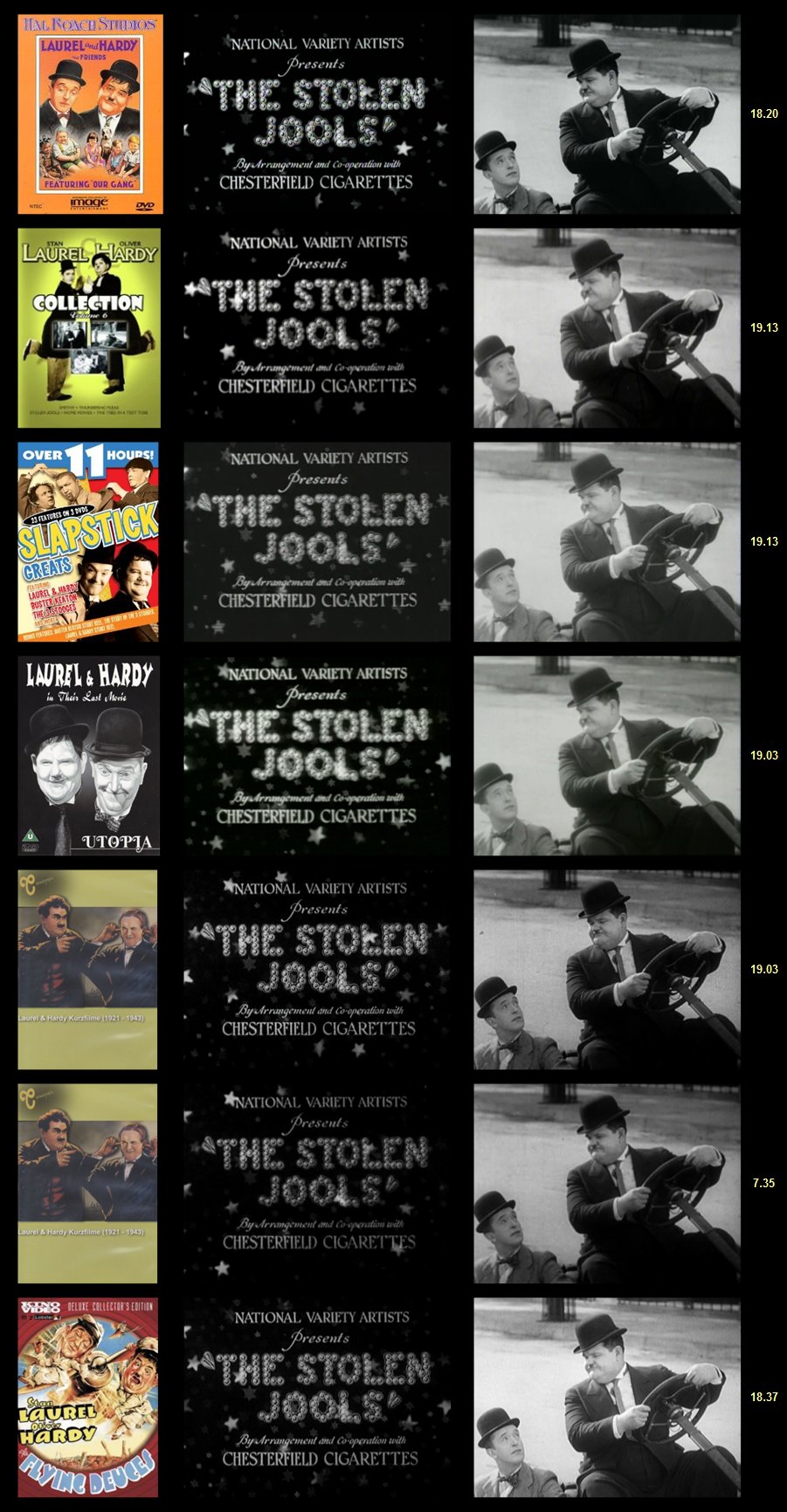
Excerpt from an online chart comparing the quality of various prints of The Stolen Jools.

NOTE: This program consists of three shorts from the early 1930s with no obvious or hidden connections between them other than chronological proximity and similar length.

The first flick: The Stolen Jools (Paramount release of a National Variety Artists production, 1931) [buy the set]

Current IMDb rating: 5.9

Directors:
  • William C. McGann (directed such 1930s films as In Old California with John Wayne and Two Against the World with Humphrey Bogart; his special effects credits from the 1940s include The Treasure of the Sierra Madre, The Big  Sleep, Key Largo, and more)

Top-tier actors of note:
  • Our Gang (lineup includes Chubby, Mary Ann, Wheezer, Farina, Stymie, and Pete the Pup)

Second-tier actors of note:

Billy Rhodes.
The gist of it: The morning after a ball attended by (practically) every star in Hollywood, Norma Shearer (herself) finds that her jewels have been stolen and calls the police. A police inspector (Kane) travels around to restaurants, hotels, movie studios, and private residences interviewing all the actresses and actors who were there (the above-listed folks, all portraying themselves). Eventually, "pre-teen flapper" Mitzi Green solves the mystery.

My take: An extraordinary souvenir of Hollywood's golden days, The Stolen Jools is a short film produced by an organization called the NVA (National Variety Artists) to raise money for tuberculosis. Paramount distributed the film free of charge, while the other studios involved pooled their resources and stars to make it, while the good folks at Chesterfield Cigarettes paid for any incidental costs... rewarded only with two very prominent plugs for their product in the finished film. The idea is that theaters would show this film before the main feature, and then the ushers would collect donations from the audience.

An obvious patchwork job, Jools had at least a half-dozen directors and twice that many writers, including future Wizard of Oz scenarist Edgar Allan Woolf. The quality and entertainment value is all over the place, naturally, but the film's historical value is undeniable. What's most interesting is that the film treats its celebrity guests as equals in terms of screen time. Of all the luminaries in the cast, it's second-stringer Eddie Kane who's at the center of the story. Maybe he had more time on his hands. Who knows? Some of the stars have remained famous over the ensuing 80+ years. Others haven't held up so well. Of course, we have the benefit of hindsight. The Stolen Jools plays a lot like those Warner Brothers cartoons from the 1930s which feature caricatures of the film stars of the day. I remember being both fascinated and baffled by those as a kid.

Perhaps one of the best things about this spotty film is that it is not maudlin or preachy in the least. There is not a single mention of tuberculosis in the script, nor any attempts to make the audience feel guilty. Nope. This is just silly entertainment with no attempt whatsoever at profundity. This is for the best, believe me. (Do you hear me, Billy Crystal?)

Is it funny: Yes and no. Scenes range from "quite funny indeed" to "not funny at all." The film cheerfully acknowledges its own lousiness, which takes the curse off it a bit. In one scene, Barbara Stanwyck (sharing screen time with her then-husband Frank Fay) is taken out and shot for her "comedic" poem. In another sequence, late in the film, a projectionist ("Gabby" Hayes) directs an errand boy (future Munchkin "Little BIlly" Rhodes) to take a print of the film and bury it. Many, many jokes fall dead to the floor, and not all the actors here are particularly adept at comedy.

Wallace Beery scores some decent laughs early on as a police sergeant who's unconcerned about murder and fire but goes ballistic when he hears of a car that's parked on the wrong side of the street. (That's LA for you!) Laurel & Hardy get another big laugh by appearing immediately after Inspector Kent promises to put his "best men" on the case. The appearance of the Our Gang kids is nice but too brief, and in their big scene, Wheeler and Woolsey remind us why they're mostly forgotten. Barton Fink fans, meanwhile, will note that both Jack Oakie and Wallace Beery are in this film, but there is no wrestling.

My grade: (as a Hollywood artifact) A-; (as a comedy) C+

P.S. - No negative ethnic or racial stereotypes here, unless you're offended by the Cisco Kid saying he doesn't "dance in English."

~~~
Crotchety Andy Cline stars in the rather obscure 1931 Mack Sennett laffer, Ghost Parade.

The second flick: Ghost Parade (Mack Sennett Comedies, 1931) [buy the set]

Current IMDb rating: 4.5

Mack Sennett
DirectorMack Sennett (innovative "King of Comedy" who founded the landmark Keystone Studios in 1912, the first enclosed motion picture facility ever built; super-prolific actor/director/writer/producer with literally hundreds of credits from 1908 to 1935, when he went broke; worked only sporadically after that; won an Oscar for Wrestling Swordfish in 1932 and an honorary lifetime achievement Oscar in 1937; actors who started with Sennett include W.C. FieldsCharlie Chaplin, Fatty Arbuckle, the Keystone Cops, and Bing Crosby)

Actors of note
  • Harry Gribbon (The Cameraman, Baby Face)
  • Andy Clyde (It's a Wonderful Life, TV's Lassie)
  • Marjorie Beebe (F.W. Murnau's City Girl)
  • Marion Sayers (The Garden of Allah)
  • Frank Eastman (a handful of two-reelers from 1930-1932)
  • Babe Stafford (prop man and director for Sennett from late 1920s to mid-1930s)
  • Aline West (one and done, baby; this is it for her)

The gist of it: Befuddled codger Mr. Martin (Clyde) is trying to sell Mosby Manor, the spacious home of a deceased ancestor who died in the Civil War, but the spooky old mansion is plagued by noisy ghosts and even a runaway gorilla (Gemora). Martin's screechy, panicky secretary Marge Smith (Beebe) and the klutzy, cowardly Constable (Gribbon) are of no help whatsoever. But it's all a scam being perpetrated by a couple of swindlers (Sayers and Stafford) who want to scare Mr. Martin into selling them his oil-rich land at a deep discount. Fortunately, Martin's level-headed son, Frankie (Eastman), shows up at a crucial time to set things right.

An establishing shot of Mosby Manor.
My take: Mack Sennett's phenomenal, groundbreaking run in Hollywood was sputtering out when he made Ghost Parade, and after watching this misbegotten film, it's easy to see why. It's pure hackwork from start to finish -- amateurish, clumsy, dull, and (worst of all) virtually laugh-free. The script is unimaginative and witless, and the performances tend to grate on the nerves. So Sennett doesn't have much to work with, but his flat-footed direction only makes matters worse. Was the great man coasting or had he truly lost the knack? Maybe all the pie fights and pratfalls had taken their toll on him. From watching Ghost Parade, you'd never know that Sennett had any chops as a filmmaker at all. Simple jokes -- like a running gag in which a dog seems to speak with a human voice -- are so clumsily conveyed that they elicit only embarrassed silence from the viewer. I'd like to think that Mack was asleep at the switch here. It's too sad to think that he put his heart and soul into Ghost Parade.

Andy Clyde is fine, I suppose, but Harry Gribbon and Marjorie Beebe are intolerable. There are a few oddball touches I liked, though not necessarily comedic ones. Our first view of Mosby Manor is a rather whimsical cartoon designed to look like a worried human face. Perhaps this story would have worked better as an animated cartoon. Imagine what the Fleischer Brothers could have done with this material. Another scene which caught my attention was one in which the Constable chases a screaming Miss Smith around the house while wearing a demon mask. It makes no sense and adds nothing to the story, but I could not help but think of the terrifying sequence in Tobe Hooper's The Texas Chain Saw Massacre (1974) in which Leatherface chases Pam while wearing a mask of human skin. Masks tend to be terrifying because they hide the facial features, leaving their wearers unknowable. Even Jason's hockey mask or Michael Myers' plain-white William Shatner mask accomplish this.

Is it funny: Nah. This is just another "scaredy cats in a haunted house" plot, and there are dozens and dozens of better examples of this type of story to be found elsewhere. Some attempted running gags, like Miss Smith pronouncing the word xylophone as "zilla-phone," do not run so much as limp along painfully until they collapse. The one comedic saving grace here is Charles Gemora, but that's just because I'm always amused by guys in gorilla suits. Just the idea that this used to be a career is amusing to me.

My grade: C-

P.S. - Racial stereotypes? Yeah, this short's got 'em. Namely, it has a black domestic named Magnolia (West) who, when she first appears, is running away from "ghosts" and has her hair braided in the style of the dreaded "pickaninny" stereotype. It's an ugly word, and I'm sorry to have to use it, but it applies here. What can I say, folks? The world of our grandparents was very different.

~~~
A lovely hand-pained poster for the 1934 short film La Cucaracha starring Steffi Duna.

The third flick: La Cucaracha (RKO release of a Pioneer Pictures Production, 1934) [buy the set]

Current IMDb rating: 5.8

Director: Lloyd Corrigan (minor 1930s writer-director; acting credits include The Manchurian Candidate, It's a Mad Mad Mad Mad World, The Big Clock, and more)

Actors of note:
  • Steffi Duna (Waterloo Bridge, The Great McGinty)
  • Don Alvorado (The Old Man and the Sea, The Big Steal)
  • Paul Porcasi (Casablanca, King Kong, Mr. Deeds Goes to Town, much more)
  • Plus the music of Eduardo Durant and his Rhumba Band (Groucho Marx's Copacabana)

Sexy psycho Steffi Duna
The gist of it: Renowned theater owner Señor Martinez (Porcasi) has come to a small club called El Oso to see if a dancer named Pancho (Alvarado) is worthy of hiring and taking back to Mexico City. But Pancho's jealous, scheming girlfriend Chaquita (Duna) does not want to lose Pancho and will do anything in her power to keep her man from being "discovered." First, she insults Martinez's taste in food and tricks him into pouring a lot of Tabasco sauce on his salad. Then, at the urging of the management, she sings a vengeful, fiery version of "La Cucaracha" obviously aimed at Pancho, who is perfectly willing to cast his "angel" aside if there's money in it.

When Pancho does take the stage, performing a routine to the famed "Mexican Hat Dance," Chaquita refuses to yield the floor. The performance becomes a musical battle between "La Cucaracha" and "Mexican Hat Dance." Pancho and Chaquita dance offstage in anger, but before the furious young man can murder his lover, Martinez walks in and tells them he loved their act and that he's taking both of them back to Mexico City!

My take: La Cucaracha was one of Hollywood's earlier (notice I didn't say earliest) Technicolor productions, and it seems clear that the film was largely made to show off the fancy, eye-grabbing process. There are numerous musical numbers with dancers in ultra-colorful costumes, lovingly shot as if this were a fashion show and not a musical comedy. I couldn't help but think of those early 3D films in which characters blatantly direct the action toward the camera in order to get the most out of the gimmick. Other than the color, the main attraction is obviously Hungarian-born singer-actress Steffi Duna. Duna is very sexy, and her acting and singing are passable, but her character is a complete nightmare. Chaquita is childish, clingy, pushy, paranoid, and downright annoying. She's one boiled rabbit away from being Glenn Close in Fatal Attraction.

Pancho is no better -- a vain, greedy twit who brags about the women he's dumped and who seems very close to committing murder or at least domestic battery at the climax of this film. Chaquita and Pancho are awful people who, I guess, deserve one another. But I really wasn't buying the "happy" ending of this film. By the way, I rarely get to hear the full version of "La Cucaracha," so this film reminded me that the chorus makes a very prominent reference to smoking marijuana. That chorus is repeated again and again, which would likely provoke unintended laughs from today's audiences.

Is it funny: Well, that depends. Is this truly intended as a comedy? The romantic psychodrama between Chaquita and Pancho is quite intense and not seemingly played for laughs. The designated funny moments occur between Chaquita and the Edgar Kennedy-esque Señor Martinez. She gets to be the Bugs Bunny to his Yosemite Sam here, and the film truly goes the "cartoony" route with Martinez's face literally turning bright red with rage. Steam doesn't come out of his ears, but that would not have been out of the question. I'd say these moments are comic relief in what is otherwise a fairly serious story. But I chuckled once or twice during them.

My grade: B-

Overall grade for All Star Extravaganza: B


P.S. - For obvious reasons, there are no negative black stereotypes here. As for its portrayal of Mexican characters.... well, I'd say that it's mostly unflattering. Martinez, Chaquita, and Pancho certainly are not role models. At best, they are fools. At worst, they are potential murderers. And they are not balanced by positive characters either. La Cucaracha largely seems like an American's view of life in Mexico. It's all eating, drinking, singing and dancing down there, right? We're dangerously close to Frito Bandito territory here.

Sunday, August 18, 2013

Mill Creek comedy classics #51: "Stan Laurel Festival" (1918-1923)

Stan Laurel stars in Mud and Sand, a parody of the bullfighting drama, Blood and Sand.

A young Stan Laurel
NOTE: This feature-length program consists of three short subjects Stan Laurel made before his days as half of the Laurel & Hardy comedy team. Born Arthur Stanley Jefferson in Lancashire, England, in 1890, Stan was about 30 years old when he made these early silent films. The son of show people, he started acting on the English music hall circuit in 1910 and served as Charlie Chaplin's understudy. In fact, the two future legends of screen comedy came to the United States at the same time as part of impresario Fred Karno's theatrical troupe in the mid-1910s. 
Once established in America, Stan formed a romantic and professional partnership with actress Mae Dahlberg, who rechristened him "Stan Laurel" and herself "Mae Laurel." Together, they toured the country. In addition to his theatrical work, he began appearing in films in 1917 and was a full-time movie actor by 1924. He and Oliver Hardy, who had signed separate contracts with the Hal Roach Studio, started working as a team in 1927 and would stay that way for the rest of their careers. Stan Laurel Festival captures the comedian during his pre-fame years, already a showbiz veteran but not yet a movie star and still experimenting with his onscreen persona.


The flick: Mud and Sand (Metro Pictures, 1922) [buy the set]

Current IMDb rating: 5.7

Director: Gilbert Pratt (in the silent era, directed short films for Hal Roach and Mack Sennett; in the sound era, wrote for Laurel & Hardy and the Three Stooges)

The star: Stan Laurel (most famous for his 25-year partnership with Oliver Hardy, which yielded Sons of the Desert, The Music Box, Way Out West, and much more)

Other actors of note: Mae Dahlberg aka "Mae Laurel" (Stan's common-law wife at the time, appeared in his movies for about seven years), Julie Leonard (a regular in Eddie Boland and Stan Laurel films of the early '20s; married for 18 years to Norman Taurog, who directed many Elvis Presley films), Leona Anderson (House on Haunted Hill; recorded an LP, Music to Suffer By), Sam Kaufman (Suspense, Kismet); Wheeler Dryden (half-brother of Charles Chaplin; appeared in Chaplin's Limelight and Monsieur Verdoux)

Poster for the film.
The gist of it: In a small Spanish village, a young man named Rhubarb Vaselino (Stan Laurel) has his family worried because he's taken up the dangerous art of bullfighting, alongside his best friend Sapo. On their first day as matadors, Sapo is killed instantly, but Rhubarb proves to be a natural at fighting bulls and earns an invitation to battle the fearsome toros of Madrid. Before his departure, he marries his sweetheart Caramel (Leonard). In Madrid, Rhubarb is even more successful, becoming a major celebrity and letting the fame go to his head. He goes to a restaurant where he dances with the famous Pavaloosky aka La Paloma (Mae Laurel), but she is enraged when he accidentally spritzes her with seltzer water.

That same day, he falls under the spell of the seductive Filet de Sole (Anderson) and goes to her apartment that night. Caramel discovers Rhubarb and Filet together and leaves him. Heartbroken, Rhubarb prepares for the last bullfight of the season. He accidentally wins, thanks to a cape that has been soaked in ether by Pavaloosky. While the crowd throws their hats into the ring to honor Rhubarb, Pavaloosky throws a brick at his head and knocks him out cold. As he is immediately buried right there in the bullring, a caption tells us: "If you want to live long and be happy, cut out the bull!"

Mud and Sand parodies Valentino.
My take: Like The Villain Still Pursued Her, Mud and Sand is a parody of a specific work -- in this case, a Rudolph Valentino flick called Blood and Sand, which had come out only three months earlier and was one of the biggest box office hits of that year. "Rhubarb Vaselino" is an obvious pun on Rudolph Valentino's name, while "Caramel" and "Filet de Sole" are cognates of characters named Carmen and Doña Sol, respectively.

Not being too terribly familiar with the Valentino film, itself based on a 1909 novel by Vicente Blasco Ibáñez, I can't tell you how accurate this parody is. Audiences at the time would have known, however, which is why this story is told in such a broad, sketchy outline. It plays like the summary of a longer, more complete narrative. In one scene, for instance, Filet drops her purse on the floor and forces Rhubarb to pick it up right in front of Caramel. "My purse, slave!" says the intertitle. What's the significance of this? Well, apparently in Blood and Sand, there is a sadomasochistic element to Valentino's affair with Doña Sol.

But apart from the satirical element of the film, Mud and Sand is still a string of jokes built around the story of a bullfighter, not too different from one of the Three Stooges' bullfighting films, except with one comedian instead of three. The bulls defeated by Rhubarb go sailing over the entranceway to the arena, like the catapulted cow from Monty Python and the Holy Grail. Rhubarb climbs a trellis to Caramel's balcony, only to have it tip over. Rhubarb's grandmother is a salty old dame who wants to make her grandson a bootlegger. (Prohibition was still on.) And there are many, many jokes that play on the double meaning of "bull." Typical silly comedy stuff.

So how's Stan Laurel? Well, he hadn't developed his trademark "good-hearted, naive simpleton" routine yet. But this film does take good advantage of Laurel's scrawny physique and elongated, rubbery face. He obviously knew how to take a pratfall and does so several times in Mud and Sand. I'm not quite sure if I would have sensed a legend in the making from this film, but it's passable entertainment.

I should add that Mill Creek's particular print of this film adds its own soundtrack with some very catchy 1920s-style "hot" jazz. The music is not timed in any way to the action, but I enjoyed it so much I didn't really care.

Is it funny: Like I said, it's no comedic masterpiece, but I got a few laughs out of Mud and Sand. There's a pretty funny sequence with amateur bullfighters waiting outside the arena for their chance to fight. Nobody wants to go first, so they keep trading places in line. Then Rhubarb enters, and bulls start flying out of the building. He tallies them up on a chalkboard outside, then goes back in -- only to find himself flying out of the arena! But he goes back in again, and the scene ends with medics somberly taking a bull out on a stretcher.

The whole "wooing" scene is cute, too: before he climbs up to Caramel, Rhubarb sings to her from ground level, and a nearby dog starts to howl. And I liked the moment when the great bullfighter is primping before his big showdown, which includes licking a giant lollipop while servants dress him. When some men gather around to shake his hand, Rhubarb accidentally offers one of the fellows his lolly, only to quickly retrieve it and daintily dust it off with a whisk broom.

My grade: B

P.S. - While there are no African-American stereotypes on display here for obvious reasons, one could argue that the entire film consists of Spanish stereotypes. The few foreign names and phrases in the film are a weird mixture of French and Spanish. ("Mon dios!" rather than "Dios mio!") Another intertitle tells us that a certain club is frequented by matadors, toreadors, humidors, and cuspidors (which is to say, spittoons). At one point, Rhubarb gives his mother some of his winnings and tells her that this will keep her in tomatoes and garlic for two years. In another scene, Rhubarb lacquers his hair down with a shiny, greasy tar-like substance. I don't see any real racial malice here, but the film does make fun of Spain's culture and people in a way some modern viewers may find offensive.

~~~

Stan Laurel plays a suspiciously Chaplin-esque "nervy young man" in Just Rambling Along.

The second flick: Just Rambling Along (Pathé release of a Robin Films production, 1918) [buy the set]

Current IMDb rating: 5.7

Director: Hal Roach (legendary producer/director profiled in my review of Niagara Falls)

Bud Jamison
Other actors of note: Clarine Seymour (True Heart Susie, Scarlet Days; discovered by D.W. Griffith and seemingly destined for stardom but died suddenly during an emergency operation), Noah Young (Safety Last!, Bonnie Scotland), James Parrott aka Paul Parrott aka Jimmie Parrott (younger brother of comedian Charley Chase, extremely busy comedic actor, writer and director from the 1910s to the 1930s; worked behind the scenes on many Laurel & Hardy films including The Music Box and Way Out West but died at age 41 of a heart attack brought on by alcohol and drug addiction), Bud Jamison (Holiday Inn; Chaplin's A Dog's Life; portly character actor familiar to all fans of the Three Stooges for his many, many appearances as a comedic foil in their Columbia short subjects; a diabetic, his firm belief in Christian Science and rejection of traditional medicine shortened his life considerably), Max Hamburger (Harold Lloyd's Lonesome Luke series)

The gist of it: The print of the film I saw starts with a rather long series of educational captions explaining the movie's history and that of its star Stan Laurel. At last, the film proper begins. As the easygoing title implies, there is not much in the way of "plot" here. It's just a few minutes of gags. Laurel is a Chaplin-type freeloader who is first glimpsed fighting over a wallet with a small child... whose burly father (Young) happens to be a police officer. Stan manages to steal a little money from the kid, then joins a line of lustful men who are following a pretty young lady (Seymour) into a cafeteria-style restaurant. After scoring some free samples of food from the chef (Jamison) and buying only a ten-cent cup of coffee, the freeloader sits down with the young lady to eat, unaware that she has casually switched bills with him. He gets a nasty surprise when he reaches the checkout counter... and some nastier ones still when he tries to sneak out without paying.

AWOL Toto the Clown
My take: This brief comedy, Stan's second, is the oldest-surviving example of the comedian's film work. Considering it was made from a negative that was just about to turn to dust, it looks pretty good. At some point in its long life -- and it's now nearly a century old -- it must have wound up in the custody of a company called Blackhawk Films. They're the ones who have added the film's rather long-winded opening text, a series of title cards that tell us how Stan Laurel got his big break in movies when another comedian, Hippodrome star Toto the Clown, decided he didn't want to do any more movies and left the Pathé company desperately searching for a replacement. Enter Stan Laurel, who apparently inherited this film and its leading lady from the departed clown.

I don't know if any of that is true, but Stan does as well as any comedian could have with this slight material. It's obvious how strongly he was influenced by his former castmate, Charlie Chaplin, who had already taken the country by storm by then. Laurel very closely imitates Chaplins's facial expressions and mannerisms. If anything, the film is too brief. It seems like it ends before the story really even gets started. But as historical curios go, it's a fascinating memento.

Is it funny: It gets the job done. Let's say that. The film's best comedic set piece is the showdown between Laurel's sneaky character and Jamison's French chef, who wears the type of heavy black greasepaint mustache and eyebrows we now associate with Groucho Marx. Stan hides food in his clothes when the chef isn't looking and has the nerve to sample nearly everything on the menu -- items he won't and can't purchase. After all this, he gives the exasperated chef his order: one cup of coffee. This pairing of skinny Stan Laurel with a hefty, mustachioed foil is perhaps a harbinger of his partnership with Oliver Hardy. The opening credits make a big deal of leading lady Clarine Seymour, but she doesn't really do that much here except sit, smile, and look pretty. Whether she's funny or not, I couldn't tell you.

My grade: B


P.S. - No stereotypes that I could find.

~~~

Decades before the XTC album, Stan Laurel starred in the citrus-themed comedy Oranges and Lemons.

The third flick: Oranges and Lemons (Pathé release of a Hal Roach production, 1923) [buy the set]

Current IMDb rating: 5.7

Director: George Jeske (directed other 1920s Stan Laurel shorts, including Smithy and Short Kilts; in the 1910s, an actor who was an original Keystone Cop and appeared in a few Chaplin shorts such as Tango Tangles; in the 1930s, a screenwriter whose credits include The Life of the Party)

Other actors of note: Katherine Grant (Miss Los Angeles 1922; appeared in almost 50 films between 1922 and 1926); Eddie Baker (Chaplin's City Lights, the Marx Brothers' Monkey Business, Laurel & Hardy's Sons of the Desert, W.C. Fields' It's a Gift), George Rowe (Buster Keaton's Day Dreams, Harold Lloyd's Grandma's Boy), James Finlayson (All Over Town, The Perils of Pauline) , "Tonnage" Martin Wolfkeil (appeared in Stan Laurel and Charley Chase comedies of the mid-1920s)

An ad for Sunkist oranges.
The gist of it: Clumsy, knuckleheaded Sunkist (Laurel) works in various capacities for a company that raises, picks, and then packages citrus fruits. His girlfriend, pretty Little Valencia (Grant), works on an assembly line there, too. Sunkist's ornery boss, Orange Blossom (Baker), keeps assigning him to various tasks, both indoors and outdoors, but our hero manages to cause havoc wherever he goes. Soon, Orange Blossom and some other angry men are chasing Sunkist around the place, and a full-scale war breaks out at the plant with citrus fruits often being employed as projectiles.

My take: This is another film to which Blackhawk Films has added a lengthy text preamble, this time to rhapsodize about what a great gagman Stan Laurel was, the best of the silent era and surpassing even Larry Semon. While Semon used stock gags and built scenes around them, the text tells us, Stan would start with the scenes first and then incorporate gags into them. That may be true, but neither the scenes nor the gags are terribly inspired here. I'd estimate that 40% of this film is people running on treadmills or throwing citrus fruits at each other. A person can only take so much of that.

Is it funny: Not terribly so, but I think I might have chuckled at a few of the physical gags. Again, as with Just Rambling Along, Oranges and Lemons' best scene is one that pairs Stan Laurel with a heavyset man who becomes enraged at Laurel's incompetence. In this case, it's a brawny orange-picker ("Tonnage" Wolfkeil) who foolishly asks Sunkist for help. And I liked one of the intertitles that states that Orange Blossom wouldn't hurt a mosquito "unless its back was turned." Zing!

My grade: C+


P.S. - Stereotype-free again!

OVERALL GRADE FOR STAN LAUREL FESTIVAL: B