Showing posts with label W. Paul Apel. Show all posts

Wednesday, July 1, 2026

Ed Wood Wednesdays: The Ed Wood Summit Podcast vs. 'The Curse of Ed Wood' (2003)

The council of elders has reconvened to cover a most unusual movie from 2003.

Making a movie is hard, you guys. I mean, just so ridiculously goddamned hard. Merely getting the actors to show up when and where you told them is a chore in and of itself. And then you actually have to film them saying and doing stuff. It's a nightmare. Something can (and probably will) go wrong at any point in the moviemaking process—from preproduction to production to postproduction. Even after all that turmoil and strife, the fate of your film is in the hands of skeptical viewers, jeering critics, and a vast network of middlemen and sleazeballs.

No one knew these struggles better than writer-director Edward D. Wood, Jr. (1924-1978). From the late 1940s to the late 1970s, he struggled to get his ideas and his stories onto the big screen. Along the way, he faced any number of obstacles: a scarcity of money and resources, hostile and humiliating reviews, shaky or nonexistent distribution, his own out-of-control alcoholism, and (according to some) a total lack of aptitude. But despite all this, he managed to make some movies that have resonated with viewers for generations, including the immortal Glen or Glenda (1953) and Plan 9 from Outer Space (1957). It's no wonder he's become a hero to low-budget, independent filmmakers everywhere.

Sometimes, those indie filmmakers pay tribute to Ed Wood through their own weird little movies. And that's how we get films like Tim Swartz's surreal softcore effort Barely Lethal Lebanese Vampires: The Curse of Ed Wood (2003). (I'm disguising the title somewhat in an effort to flummox the censors.) I was recently made aware of this totally-forgotten film thanks to an unexpected Google Alert. After watching five minutes of it, I decided I needed to get some other Woodologists involved. 

In short, it was time for a new episode of The Ed Wood Summit Podcast. The redoubtable James Pontolillo did some in-depth research into the history of this misbegotten film, including contacting its director. W. Paul Apel and Rob Huffman brought their own insights and ideas to the table. And I was there to add some moments of levity. Naturally, none of this would have been possible without the late, great Greg Javer, who created the podcast in the first place. You can watch the latest episode right here:

Wednesday, June 17, 2026

Ed Wood Wednesdays, week 279: 'The Valley Obscured by Smog' (2026)

W. Paul Apel's new novel catches up with Ed Wood in his later days.

The world is so small sometimes, it's a miracle we all fit in it. 

Ron Howard as Richie Cunningham.
If you read this blog for anything other than the Ed Wood content, you know that I cohost a podcast about the long-running nostalgic sitcom Happy Days, which originally aired from 1974 to 1984. The show stars actor-turned-director Ron Howard as Richie Cunningham, a mild-mannered Wisconsin lad navigating his high school and college years and dreaming someday of becoming a writer. 

After seven seasons, Ron left the series in 1980 to focus on his producing and directing career, so his Happy Days character is said to have "joined the Army." In the show's final season, Richie finally returns home to Wisconsin, a wife and family in tow. His father, Howard (Tom Bosley), announces he has lined up a job for Richie at the local newspaper, The Milwaukee Journal, but Richie has other plans: he's moving to Hollywood to make it as a screenwriter!

In real life, one of Ron Howard's earliest cinematic projects away from Happy Days was a romantic comedy called Leo and Loree (1980), which he co-wrote and executive produced for his own company, Major H Productions. The film, which stars fellow Happy Days alum Don Most, tells the story of an ambitious recent college graduate named Leo Greene who defies his father's wishes, forsakes a respectable teaching career, and moves to Hollywood to make it as an actor. Having no connections in town whatsoever, he crashes on the couch of an old friend of his named Dennis (David Huffman). Our in-depth review of Leo and Loree was released just yesterday. In fact, I was editing it while I was preparing this very article!

Given all this background, you can imagine my state of déjà vu when I received a copy of W. Paul Apel's new Ed Wood-inspired novel, The Valley Obscured by Fog (Bear Manor Media, 2026). The book centers around Alan Starkwell, a recent college graduate who disappoints his parents when he turns down a newspaper job his father has lined up and moves to Hollywood to become a screenwriter. Alan, too, crashes in the home of a former classmate. He even cites the film American Graffiti (1973) starring Ron Howard as inspiration for wanting to get into the movies!

Wednesday, August 6, 2025

Ed Wood Wednesdays, week 239: The return of The Ed Wood Summit Podcast

Straighten that tie, mister! We've got a show to do!

When my late colleague Greg Javer (1968-2024) started The Ed Wood Summit Podcast back in January 2021, I'll admit that I didn't immediately see the full potential of the project. After all, what could he accomplish through videos that we weren't already accomplishing through our weekly articles about the life and career of Edward D. Wood, Jr.? I was more than happy to participate in the series, but I couldn't yet envision where Greg was going with this thing.

Well, I soon learned what made The Ed Wood Podcast so special. It became the ideal place to discuss Ed Wood and his work, both as a writer and a filmmaker. I was proud to be a guest on the show numerous times, usually reviewing Ed's books and stories. Other guests included such dedicated Wood experts as James Pontolillo, Milton Knight, W. Paul Apel, Rob Huffman, Mike H, and Robert Monell. In a very special episode from April 2023, the show even welcomed actress Casey Larrain, who'd worked with Ed on such films as Love Feast (1969) and Nympho Cycler (1971). 

At the center of it all was Greg himself, the Zen master of Woodology. He had all the qualities of a good host and moderator: curiosity, humor, patience, empathy, etc. The world could use a few million more of him. Greg is gone now, but it would be a shame for The Ed Wood Podcast to disappear with him. In that spirit, a few veterans of the podcast have reconvened to record the long-delayed 34th episode. The topic of discussion is an extremely obscure pulp novel from 1966 entitled Wild Nympho. It's credited to a mysterious one-and-done author named Matt Ronson, but could it really be the work of Ed Wood? That's what we're here to find out.

Our moderator, Rob Huffman, has also uploaded the episode to his own, excellent YouTube channel.

Wednesday, June 25, 2025

Ed Wood Wednesdays: The Ed Wood Polo Shirt Odyssey (Guest Author: W. Paul Apel)

What does this humble garment have to do with Ed Wood? Let's find out!

As long as he’s been infamous, Ed Wood has always been linked with clothing. The "worst director of all time" bit has gone hand in hand with the cross-dressing bit since the beginning of his rediscovery in the '80s, almost as if one is a bonus added punchline to the other. Not only did this guy direct Plan 9 from Outer Space (1957), goes the legend, but he did it in an angora sweater.

Much has been written about Eddie's passion for women's clothing, including a lot by Eddie himself. He started his career with the semi-autobiographical plea for tolerance, Glen or Glenda (1953), and ended it with stacks of adult paperbacks filled with cross-dressing and gender-bending characters, each clad in outfits Eddie never failed to describe in loving, microscopic detail.

Very little, by comparison, has been written, whether about or by Eddie, concerning men's clothing. And that's the corner of Eddie's closet I’d like to get into today. Let's push aside Eddie's alter ego Shirley's sizable wardrobe and look at what he wore by day. Specifically, his polo shirts.

This odyssey all began with one of the aforementioned adult paperbacks, an adaptation of the Wood-scripted Steven Apostolof flick Orgy of the Dead (1965). Ever since I first read in Rudolph Grey's Nightmare of Ecstasy (1992) that this feature length series of striptease acts had been improbably adapted into a piece of literature by Wood himself, and saw the striking cover art by Robert Bonfils, I knew I had to own my own copy someday.

When that day finally came, decades later, I was struck by an oddity among the many photo illustrations. I had heard the tale of how Eddie had absconded with publicity stills taken on the set of Orgy by Robert Charles Wilson for use in this publication, but I wasn't expecting to see, inexplicably, a photo of Eddie himself right there on page 107.

Wednesday, June 4, 2025

Ed Wood Wednesdays, week 231: Catching up with some recent reader feedback

What can I say? I love a cheap pun.

I have some very knowledgeable and attentive readers. This is mostly a good thing, but it can be a little worrying sometimes. Niche fandoms tend to attract people who are passionate and detail-oriented when it comes to their chosen subject matter, so I know that some complaints and corrections are (potentially) headed my way whenever I post a new article in this series. For the most part, however, Ed Wood's dedicated fans have been extremely generous in sharing books, articles, scripts, videos, photographs, and more with me. I'm truly grateful for that. Many articles in this series have come about because of the items people have sent me or because of the information they've shared with me.

Generally, the day I post a new Ed Wood Wednesdays article, I'll mention it on my various social media accounts, including the very active Ed Wood Jr. Facebook forum moderated by Bob Blackburn. These Facebook posts often inspire some interesting and informative responses. But social media is, by its very nature, ephemeral, so I wanted to document some of these responses before they evaporate forever from my memory.

Wednesday, May 7, 2025

Ed Wood Wednesdays, week 227: "Death Takes a Hell-A-Day" (1966)

Uncle Forry penned an introduction for one of Ed Wood's early novels.

I've made my way through many of Ed Wood's books from the 1960s and '70s, both fiction and nonfiction, and I've found that very few of them have introductions or preambles of any kind. Oh, Eddie will occasionally include a preface in one of his supposedly-factual "sociosex" paperbacks, like Suburbia Confidential (1967), which he wrote under the dubious pen name Dr. Emil Moreau. But generally, Eddie just liked to jump right in with Chapter One. No foreplay.

A definite exception is the 1966 novelization of Orgy of the Dead published by Greenleaf Classics. This book came out fairly early in Ed's writing career—it's actually the second book listed in the bibliography from Nightmare of Ecstasy (1992)—and it comes from the brief time when Ed's literary agent was Famous Monsters of Filmland founder Forrest J. "Uncle Forry" Ackerman. Unfortunately, since Forry was not really interested in drumming up work for Ed and seemed to hold him in outright contempt, their partnership was not terribly productive. While Forry mostly tried to duck Ed Wood by any means necessary, the beloved magazine editor did find time to pen a colorful little intro for the Orgy tie-in book.

While Orgy of the Dead has been republished several times since 1966, the Ackerman intro has kind of vanished into the ether in the ensuing decades. I've read this novel several times (and may review it here someday), but even I had never seen the book's original preface. I mentioned this on an Ed Wood Facebook forum recently, and my pleas were heard by the great W. Paul Apel, author of I Watched Football Early the Day I Died (2023). Paul was kind enough to send me the introduction, and I now pass that introduction on to you. I thought we could go over it together.

Wednesday, July 5, 2023

Ed Wood Wednesdays, week 157: I Watched Football Early the Day I Died (2023)

An unproduced Ed Wood script from the 1970s has now seen the light of day.

Francis William "Frank" Leahy. Now, where did I first run across that hallowed name from sports history? Probably in issue #11 of  Cult Movies magazine, which reported that Ed Wood wrote an unproduced film about him circa 1975 called The Frank Leahy Legend. After a tiny bit of digging, I soon learned that Ed's script was based on a book by Bernard J. Williams and that the unmade screenplay still existed and was languishing in an archive in Los Angeles somewhere. Not being a football fan myself, I probably never would have heard of Leahy, who died in 1973, otherwise. He just wasn't on my radar.
A new book from Bear Manor.
I could have pursued this case further, but I simply never got around to it. What can I say? Ed Wood wrote a lot of things in his 54 years, and a script about a 1940s Notre Dame football coach somehow didn't seem as exciting as a novel about a cross-dressing hitman or a movie about wife-swapping suburbanites. Life is short, as both Ed Wood and Frank Leahy knew all too well. So I let The Frank Leahy Legend stay on the shelf. 

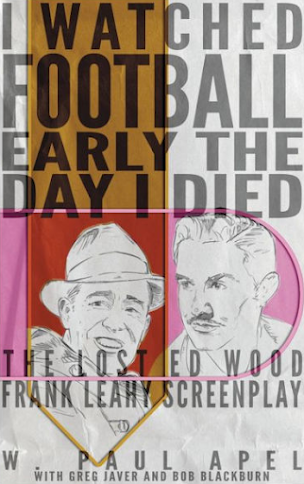
But a couple of dedicated Woodologists, W. Paul Apel and Greg Javer, decided to hunt down the Leahy script, and now their findings have been published in a new book from Bear Manor Media called I Watched Football Early the Day I Died. In addition to the complete screenplay, rescued from the Loyola Marymount University archives, this volume contains a foreword by Bob Blackburn, friend to Ed's widow Kathy, and introductory notes by Greg and Paul. Best of all, Paul provides explanatory notes throughout the entire screenplay; it's like a commentary track for a movie that was never made.

While reading the screenplay, I kept thinking of a quote from the notorious John Andrews in Nightmare of Ecstasy: "Eddie wrote a horror script that would have been fine for 1934 but not 1974." Yeah, even during his booziest, porn-iest, most debauched years, Eddie could get mired in the past sometimes. What's most amazing about The Frank Leahy Legend is that Ed Wood (or anyone) considered it to be marketable to jaded movie audiences who'd already seen The Godfather (1972) and The Exorcist (1973). Even nostalgic movies from the 1970s like Paper Moon (1973) and The Summer of '42 (1971) looked at the past through a modern lens.

Meanwhile, apart from a smattering of profanity, The Frank Leahy Legend is the type of creaky, old-fashioned, highly sanitized biopic you might have seen in the 1930s or '40s, the kind that basically acts as a feature-length commercial for its subject. If you watch enough TCM during the off-peak hours, you'll see these flattering films about politicians, songwriters, war heroes, entertainers, inventors, and athletes. Try sitting through something like Swanee River (1939) or The Babe Ruth Story (1948), and you'll know what I mean. This type of cornball biopic was already old hat when Steve Allen starred in The Benny Goodman Story in 1956, and Eddie was trying to get away with an even cornier script two decades later! Actual line spoken (without irony) by an actual character in this movie: "You know Frank Leahy, you're truly an amazingly, great man..."

Leahy: Neither hero nor villain.
But was Leahy amazing? Or great? Or amazingly great? Eh, I don't know. He certainly won a lot of football games in his day, but he did it by bending the rules just a bit. He got married. He had kids. He yelled at his players occasionally. He sold rubber or something on the side. He really liked Notre Dame. Does that count as a personality?

Leahy's life doesn't really fit any of the standard biopic templates, and in this unproduced screenplay, the reader can sense Ed Wood struggling to turn this material into something resembling a movie. I wouldn't call Leahy a hero or a role model, necessarily, and his life is not exactly inspiring. Then again, he's not a villain or a cautionary tale either. We can't learn anything from his story, because Frank doesn't learn anything from his own story. Even that scoundrel Charles Foster Kane has an epiphany in the last few seconds of his life.

Furthermore, Leahy doesn't seem to have had a quirky, outsized personality, the kind that would make him a good movie character. His coach and mentor Knute Rockne did, though, and Ed's screenplay makes Knute a colorful supporting character. Our protagonist, however, remains opaque. Either Frank Leahy is unknowable or there is just nothing to know about him beyond the surface details.

Either way, W. Paul Apel makes a splendid companion on this journey through the screenplay, jumping in whenever he has something to add or explain. (His commentary definitely helped me understand a few murky plot points along the way.) Unlike me, Paul's actually read the book upon which this script is based, so he can better explain how Ed Wood adapted this material. My guess is that Eddie was merely a hired gun on this movie and banged out this script strictly for the paycheck, but he manages to work some of his obsessions into The Frank Leahy Legend anyway. There are numerous funeral scenes, for instance, and even a prominent reference to Eddie's beloved angora.

For the most part, it seems like Eddie went out of his way to avoid showing any football in this supposedly football-centric movie. We know Wood was no sports fan, so when he wrote The Frank Leahy Legend, he tended to skip over all those pesky games and practices. Instead, we get a lot of scenes of Leahy talking to people in various offices. Glen or Glenda (1953) and Plan 9 from Outer Space (1957) are similarly chatty in nature, as is Wood's later film The Young Marrieds (1972). While the lack of action in this script could have been a budgetary concern, the stiflingly static nature of The Frank Leahy Legend makes it feel like something from Ed Wood's 1950s heyday.

Overall, The Frank Leahy Legend is an intriguing "what if?" from Ed Wood's strange career. It's a relatively wholesome piece of work from a time when Eddie's own life was anything but. Perhaps that's why he wanted to work on this project. It was a chance to do something with no connection whatsoever to pornography or even horror. This biopic may have been stodgy and old-fashioned, but it was respectable. This was one he could write home to Mother about.

You can purchase your own copy of I Watched Football Early the Day I Died directly from Bear Manor or from online retailers like Barnes & Noble or Amazon.

Wednesday, May 31, 2023

Ed Wood Wednesdays: The Ed Wood Summit Podcast #33 by Greg Dziawer

This week, we review a novel with an alarming title!

While there are a number of reasonably well-known Ed Wood books published during the last decade and half of his life—Killer in Drag (1963) and Death of a Transvestite (1967) jump immediately to mind—there also exist dozens of little-known titles.

In this edition of The Ed Wood Summit Podcast, I'm joined by Joe Blevins, James Pontolillo and W. Paul Apel to review one of the latter, perhaps the first review of an obscure 1971 paperback.

Check it out to find out which book it is:


A special thanks to my guests for providing their expert insights into a tome that, in today's world, will likely offend some as outmoded in its viewpoints. It's also at times incredibly graphic, and in candidly estimating it, the language in the podcast is likewise explicit.

Wednesday, October 27, 2021

Ed Wood Wednesdays: The Ed Wood Summit Podcast #21 by Greg Dziawer with W. Paul Apel

Has Greg turned up a forgotten Ed Wood classic?

Late one night, about a month ago, I was idly paging through some vintage adult magazine scans from the early 1970s. I was just about to go to bed when the text of a particular short story caught my tired attention. I read some more, and upon closer inspection, it seemed a little bit like it could have been written by Ed Wood!

The story in question, "The Golden Rivet," was uncredited. It was surrounded by captioned pictorials (including "The Love God" and "Wild Women of the West") that claimed to hail from sex films. The magazine itself—the first issue of Skin Film Erotic Cinema Review from 1970—carried a Swedish publishers address in the index.

What was going on? I invited W. Paul Apel back to The Ed Wood Summit Podcast to discuss it with me. Tune in and find out the truth about the mysterious Golden Rivet!


Thanks to the poster at Internet Archive for scanning and uploading the entire magazine issue here. And a special thanks to our podcast sponsor Triple X Books (triplexbooks.com). The next time you grab some affordable vintage adult paperback scans there, drop an order note and let them know The Ed Wood Summit Podcast sent you!

Wednesday, May 5, 2021

Ed Wood Wednesdays: The Wood/Dziawer Odyssey, Part 15 by Greg Dziawer and W. Paul Apel

Frank Leahy (lower right) arrives at Notre Dame University.

If you've been paying any attention to this series lately, you've surely noted my recent obsession with former Notre Dame head football coach Frank Leahy, the hero of Ed Wood's unproduced biographical screenplay The Frank Leahy Legend (1975). Once a mere footnote in my research on Ed—a strange topic for a script I wrongly assumed to be missing— Frank has become a persistent subject that I can't shake.

Faithful reader W. Paul Apel, who joined me on a recent Ed Wood Summit Podcast to dissect the screenplay, mentioned that he was planning to visit Leahy's grave. "Send me pics," I excitedly said. And so he did. He also penned an anecdote about his visit that I'm happy to share with you. Perhaps this will provide some ritualistic finality, and I'll be able to let go of Frank Leahy. We'll see.

Special thanks to W. Paul Apel for sharing the story of his visit and his pictures of Frank's grave and surrounding environs. I wonder if all of that peace and quiet makes Frank yearn for the sound of rolling thunder across the bleachers at the stadium at South Bend.

Wednesday, April 21, 2021

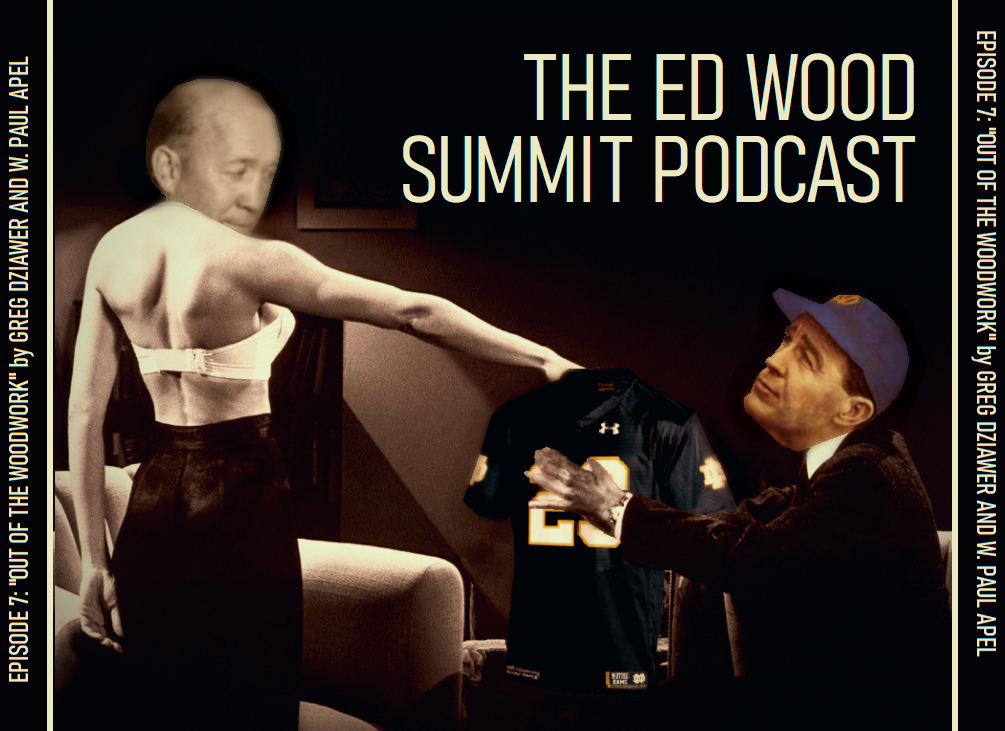
Ed Wood Wednesdays: The Ed Wood Summit Podcast #7 by Greg Dziawer and W. Paul Apel

Knute Rockne (left) hands the sacred Notre Dame football program over to Frank Leahy.

The cover to Ed's script.
This week on The Ed Wood Summit Podcast, it was my privilege to speak to Wood superfan W. Paul Apel, whom I met through a private Facebook group. Our topic of conversation was the newly-unearthed screenplay The Frank Leahy Legend, a sports biopic originally written by Ed in the mid-1970s but never actually produced. As you'll soon see from the video, this unusual document provided a lot of fodder for speculation and discussion. Even in a career as varied as Ed Wood's, this script stands out.

As a prelude to the two-hour-plus podcast, however, Paul himself shares his thoughts:
Perhaps one of the most confounding entries on Ed Wood’s resumé is the mysterious unproduced screenplay The Frank Leahy Legend, written for the equally mysterious Scotty Williams Entertainment, and based on a book by the same name by Bernard J. Williams.

Up until now, no Ed Wood experts have read the screenplay or reviewed it, let alone published their findings, but that’s not where the mystery ends. How did Wood, an underdog who wore his quirks on his (angora) sleeve, end up writing about macho, win-at-all-costs Notre Dame coach and Knute Rockne protégé Frank Leahy?

We may never know. However, Greg Diawer and I finally secured a copy of the lost Wood screenplay and thoroughly dissected, reviewed and discussed it here. Now, Woodologists everywhere will finally get a glimpse into this once obscure line on Wood’s resumé and find out if Wood’s irrepressible personality and unique style make it into Leahy’s life story – or if this is ultimately a work for hire, devoid of Woodian weirdness.

Thanks, Paul. And now, on with the show.