The council of elders has reconvened to cover a most unusual movie from 2003.
Making a movie is hard, you guys. I mean, just so ridiculously goddamned hard. Merely getting the actors to show up when and where you told them is a chore in and of itself. And then you actually have to film them saying and doing stuff. It's a nightmare. Something can (and probably will) go wrong at any point in the moviemaking process—from preproduction to production to postproduction. Even after all that turmoil and strife, the fate of your film is in the hands of skeptical viewers, jeering critics, and a vast network of middlemen and sleazeballs.
No one knew these struggles better than writer-director Edward D. Wood, Jr. (1924-1978). From the late 1940s to the late 1970s, he struggled to get his ideas and his stories onto the big screen. Along the way, he faced any number of obstacles: a scarcity of money and resources, hostile and humiliating reviews, shaky or nonexistent distribution, his own out-of-control alcoholism, and (according to some) a total lack of aptitude. But despite all this, he managed to make some movies that have resonated with viewers for generations, including the immortal Glen or Glenda (1953) and Plan 9 from Outer Space (1957). It's no wonder he's become a hero to low-budget, independent filmmakers everywhere.
Sometimes, those indie filmmakers pay tribute to Ed Wood through their own weird little movies. And that's how we get films like Tim Swartz's surreal softcore effort Barely Lethal Lebanese Vampires: The Curse of Ed Wood (2003). (I'm disguising the title somewhat in an effort to flummox the censors.) I was recently made aware of this totally-forgotten film thanks to an unexpected Google Alert. After watching five minutes of it, I decided I needed to get some other Woodologists involved.
In short, it was time for a new episode of The Ed Wood Summit Podcast. The redoubtable James Pontolillo did some in-depth research into the history of this misbegotten film, including contacting its director. W. Paul Apel and Rob Huffman brought their own insights and ideas to the table. And I was there to add some moments of levity. Naturally, none of this would have been possible without the late, great Greg Javer, who created the podcast in the first place. You can watch the latest episode right here:
Straighten that tie, mister! We've got a show to do!
When my late colleague Greg Javer (1968-2024) started The Ed Wood Summit Podcast back in January 2021, I'll admit that I didn't immediately see the full potential of the project. After all, what could he accomplish through videos that we weren't already accomplishing through our weekly articles about the life and career of Edward D. Wood, Jr.? I was more than happy to participate in the series, but I couldn't yet envision where Greg was going with this thing.
Well, I soon learned what made The Ed Wood Podcast so special. It became the ideal place to discuss Ed Wood and his work, both as a writer and a filmmaker. I was proud to be a guest on the show numerous times, usually reviewing Ed's books and stories. Other guests included such dedicated Wood experts as James Pontolillo, Milton Knight, W. Paul Apel, Rob Huffman, Mike H, and Robert Monell. In a very special episode from April 2023, the show even welcomed actress Casey Larrain, who'd worked with Ed on such films as Love Feast (1969) and Nympho Cycler (1971).
At the center of it all was Greg himself, the Zen master of Woodology. He had all the qualities of a good host and moderator: curiosity, humor, patience, empathy, etc. The world could use a few million more of him. Greg is gone now, but it would be a shame for The Ed Wood Podcast to disappear with him. In that spirit, a few veterans of the podcast have reconvened to record the long-delayed 34th episode. The topic of discussion is an extremely obscure pulp novel from 1966 entitled Wild Nympho. It's credited to a mysterious one-and-done author named Matt Ronson, but could it really be the work of Ed Wood? That's what we're here to find out.
Our moderator, Rob Huffman, has also uploaded the episode to his own, excellent YouTube channel.
Zeus was a horny bastard, as Ed Wood understood all too well.
I've covered dozens of Ed Wood's short stories and articles over the years, but I've never owned any of the vintage adult magazines in which they were originally published a half-century or more ago. Most of the short pieces that I've reviewed on this blog have come from the three marvelous Wood anthologies assembled by Bob Blackburn between 2014 and 2022. The magazines Ed Wood worked on during the 1960s and '70s have become very expensive on the secondary market—well out of my price range—and I'm grateful to Bob for buying dozens of them so that Ed's work can be reprinted and enjoyed by fans today. A few more of Ed's articles have been sent my way by generous readers, typically as PDFs or JPGs. Those were much appreciated as well.
I now own this exact magazine.
Recently, though, reader and podcaster Rob Huffman let me know that a copy of the May/June 1973 issue of Gallery Press' Boy Play was available online for a stunningly low price, and I couldn't resist. The Nixon-era gay porn magazine contained one verified short story credited to Ed Wood, but based on past conversations with Greg Javer, I knew that Eddie probably wrote multiple pieces for that same issue. Sure enough, when the copy of Boy Play arrived in my mailbox a couple of weeks later, I found Ed's unmistakable writing style throughout the entire issue. My preliminary diagnosis is that Eddie wrote every last word in it, including the unsigned editorial at the beginning. Hell, he may have written the copy in the ads!
Would you believe it took me this long to realize that Boy Play is a mere reversal of Playboy, the most famous adult magazine ever published in America? Funny how swapping those two syllables makes all the difference in the world.
I'll probably end up writing multiple blog posts about this one magazine. For now, though, I'd like to concentrate on the one short story in this issue that Ed wrote under his own name. It's called "Zeus and His Lovers," and the title gives you a good indication of its contents.
The story: "Zeus and His Lovers" (aka "Zeus... and His Lovers"), originally published in Boy Play, vol. 2, no. 2, May/June 1973. Credited to Edward D. Wood, Jr.
Synopsis: Zeus, king of the Greek gods, is happily married to Hera. They have an extremely active and mutually satisfying sex life. In addition, Zeus has numerous mistresses, a fact he does not hide from Hera. However, there is still something bothering him. He feels tremendous pressure to compete sexually with the other male gods, and it seems that all of them have taken young boys as lovers. Zeus is the only one who hasn't.
Zeus and Hera have a marathon lovemaking session. In the afterglow, the god and goddess discuss Zeus' sexual dilemma. The other gods have definitely noticed that he doesn't have a boy lover, and they're starting to talk. There's even a popular "epigram" about Zeus that's going around. Hera tells her husband that she supports him totally in whatever he does and would not be hurt if he took a young male lover. Zeus tells her he already has a boy picked out: a beautiful mortal named Ganymede, who will be the new cupbearer to the gods.
Wood trademarks: mythology (cf. "Thor and His Magic Hammer"); the word "lovely" (cf. Glen or Glenda, many others); heavy use of ellipses and italics; sheer material; supposedly "new" things that are not really new (cf. Glenda); references to characters' body temperatures; pink clouds; kaleidoscope; androgyny; ancient Greece (cf. "The Greeks Had a Word For It," "Sappho Revisited").
Excerpt:
"It is not for me to say what you should do, Zeus. It is only that I must serve you. You must do as you see fit. And if that is the fad, then you should most certainly investigate the cause for the fad and find out what enjoyment might be captured in the tender young bodies of boys."
Reflections: Back in 2022, the late, great Greg Javer and I reviewed an Ed Wood story from 1973 called "Thor and His Magic Hammer." As its title suggests, this strange little fable explores the sex life of the Norse god of thunder, specifically how a mortal woman named Andralia gives Thor a few pointers in the bedroom and makes him a better lover. "Magic Hammer" originally appeared in the May/June 1973 issue of Gallery Press' Goddess. That makes it an obvious counterpart to "Zeus and His Lovers": same publisher, same release date, similar subject matter. Eddie must've been going through a mythology phase in 1973. Or maybe the subject was always on his mind. Remember that Glen or Glenda (1953) makes an incongruous reference to Morpheus, god of sleep.
In hindsight, it's not difficult to see what attracted Ed to this strange, often disturbing material. Greek mythology is rife with loathsome and depraved behavior, much of it sexual in nature, including instances of adultery, rape, incest, and pedophilia. This is the stuff of trashy, exploitative fiction, exactly the kind that Ed Wood wrote. The fact that the Greek gods are capable of supernatural acts, such as turning into animals, only aids them in their debauchery. Their perversion truly knows no bounds.
While the story of Zeus and Ganymede inspired artists for centuries, it seems today like a textbook case of predatory sexual behavior. According to the myth, Zeus was so taken with this beautiful adolescent boy that he took the form of an eagle, swooped down to earth, grabbed Ganymede, and carried him back to Mount Olympus. There, Ganymede indeed became the cupbearer to the gods, just as it says in this story, as well as Zeus' lover. It's never clear that Ganymede consented to any of this. Nevertheless, Zeus was so grateful for the boy's service that he granted Ganymede eternal youth and beauty. Is anyone else reminded of the real-life story of Liberace and Scott Thorson? While the famed pianist could not make his young lover immortal, he did pay for Thorson to have numerous plastic surgeries.
It's interesting to note that, in "Zeus and His Lovers," Ed Wood portrays Zeus' wife, Hera, as simpering and submissive. Greek mythology portrays her as anything but. In fact, Zeus' love affair with Ganymede angered Hera greatly. She was intensely jealous of her husband's new boy toy and made no secret of this. So why does Ed write her like the ultimate supportive wife, a woman who encourages her husband to have numerous lovers, even young boys? Perhaps this was Ed's commentary on marriage and how a wife "should" behave.
I'd also like to point out that the rest of Boy Play magazine is not about "playing" with actual boys. The magazine includes many explicit pornographic photos of men, and they're all very much of age. Some even look rather weather-beaten. Again, as with his story for Goddess magazine, Eddie may have taken the title of the publication too literally. Maybe even he didn't get the wordplay.
Emails! I get emails! I get stacks and stacks of emails!
In these strange, sad weeks following the death of my friend Greg Javer, I've found some comfort in the knowledge that Woodology—the study of Ed Wood's life and career—will carry on without him. It'll carry on without me someday, too. Greg was the most prominent contributor of material to this series, but he was far from the only one. Over the years, people like Bob Blackburn, James Pontolillo, Keith Crocker, W. Paul Apel, and Philip R. Frey have sent films, texts, photos and more my way. I'm grateful to all of you.
One of my more persistent emailers is a true zealot named Rob Huffman. He regularly supplies me with press clippings and other oddities that he's found in his research. Sometimes, I feel a little guilty that I can't always respond to his emails in a timely fashion. There are only so many hours in a day, you know? But I thought that you and I could go through some of Rob's recent finds together. How does that sound?
I don't think Ed Wood wrote this 1962 article and here's why.
Ed Wood wrote a lot, you guys. No, you don't understand. I mean, he wrote a lot. Way more than you'd think a raging alcoholic with only a tenuous grasp on reality would be able to manage. In addition to his scripts, both produced and unproduced, Eddie penned novels and short stories, plus nonfiction books and magazine articles, all in massive quantities. For some projects, he used his real name, while at other times he wrote pseudonymously or even anonymously. Besides releasing many of Ed's books and articles, adult publisher Bernie Bloom used Ed as a sort of literary "man-of-all-work" at Pendulum in the 1970s. Who knows how many pieces of unsigned filler text, including editorials and photo captions, Ed wrote while in Bernie's employ?
A canonical Wood work.
This hyperabundance of work is both a blessing and a curse to the Woodologist. It's wonderful to have so much writing to study and enjoy. But Ed Wood's bibliography is an absolute mess, often frustrating to navigate. It can be very difficult to tell what he wrote and what he didn't. To help us out, we can divide his literary output into a few extremely broad categories. First, there is what I'll call "canonical Wood." These are the works that bear Ed's own name and are generally not in dispute. (I say "generally" because some Wood scholars are extremely skeptical and question his authorship of anything.)
Beyond these uncontroversial works, we have what I call the "stealth canon." These are works that are widely known to be Ed Wood's but don't bear the man's own name. They're listed on his carefully self-curated resumes, and Eddie even signed some copies of them. Eddie's best known aliases are probably Dick Trent and Ann Gora, and these turn up frequently in the "stealth canon," but he wrote under many pen names. His aliases may number in the dozens.
After that, though, you have a whole universe of speculative Wood works—not in the canon (or even the stealth canon) but bearing enough of Wood's trademarks to arouse curiosity. Maybe it's about one of his "pet" subjects, like angora or cross-dressing. Maybe it uses some of his favorite words or expressions. Maybe it's from Pendulum or one of Eddie's other known publishers and comes from the era when we know Ed was active. Or maybe someone just has a hunch about a particular book or article. Does it past the duck test? That's where the debates begin.
I can't say I've read everything Ed Wood wrote. (I don't know if anyone has, other than Eddie himself.) But I've read many works, both long-form and short-form, that he is known or widely believed to have written. And there are certain things I'm looking for when I'm given a text and asked whether I think Ed Wood penned it. This can be especially tricky, since Ed had a number of different modes or styles as an author. He could be surreal and dreamy when he wanted, especially in his short fiction, or he could be dry and encyclopedic if necessary. You never know which Eddie you're going to get. I'm not joking when I say it may depend on how drunk or sober he was when he wrote it.
Recently, podcaster and pop culture scholar Rob Huffman shared with me and some other Wood fans a few pages from an article called "The Art of Tattooage," credited to an author named J. Lee Anderson. It appeared in a men's magazine called Chére in 1962. This now-forgotten magazine was the product of an adult publisher called France, which released both magazines and paperback novels in the 1960s. Ed Wood is thought—or at least rumored—to have written for France in the early 1960s, possibly using "J. Lee Anderson" as a pen name. Rob has explored these possibilities in depth with my colleague Greg Dziawer in the past.
Naturally, I took a good, long look at "The Art of Tattooage" to see if I could detect any traces of Ed Wood within it. Dating from 1962, this would be one of the earlier examples of Wood's writing, if it were his, but the fully-canon novel Killer in Drag (1963) shows that Eddie's signature style was already formed during this time period. So his authorial voice would be detectable if "Tattooage" were indeed his work.
Alas, this article did not give me any particularly strong Woodian vibes. For one thing, in describing the seedy tattoo parlors of early '60s Los Angeles, J. Lee Anderson uses a lot of words that I just can't imagine Ed Wood using very often: dowdy, truculent, vagaries, bemoan, echelon, conjecture, etc. On the other hand, the author never uses any of the words Eddie loved to employ in his own writing: thrill, soft, lovely, conventional, accept, etc. It would also have been nice to see some of Eddie's telltale ellipses.
In a broader sense, Eddie had a way of taking any topic and steering it toward his lifelong obsessions: death, alcohol, and women's clothing. He'd shoehorn these subjects (and anything else that came into his head) into his writing whether they fit the subject matter or not. "The Art of Tattooage" does none of that. Albeit a bit pretentious in his vocabulary, the author of this article sticks to the topic of tattoos and does not veer off on any quasi-philosophical rants. at least not in the passage I read. Eddie rarely had that kind of discipline.
If there's anything Woodian in "The Art of Tattooage," it's the way J. Lee Anderson uses old-timey slang and eye dialect. The article gives us a colorful quote from a tattoo artist who declines to be photographed: "The boss don't want no pitchers. The heat's on. We don't want publicity around here. And no pitchers." Ed Wood often wrote about the underworld of crime, and his characters in this milieu usually talk like gangsters in a Bugs Bunny cartoon, so that dialogue could have come from one of Eddie's works. Otherwise, this article lacks the tone and cadence I expect from Ed.
But don't take my word for it. Follow that link up there and read it for yourself. See if it passes your version of the duck test.
Nona Carver in Rudolph Grey's Nightmare of Ecstasy.
One of the most arresting images in Rudolph Grey's Nightmare of Ecstasy: The Life and Art of Edward D. Wood, Jr. (1992) is a snapshot of burlesque performer and actress Nona Carver, who played "old whore" Sleazy Maisie Rumpledinck in Ed's obscure adult film Take it Out in Trade (1970). The picture, credited to Grey himself, shows a late-middle-aged Carver in her home, proudly gesturing to a room absolutely packed with random junk: hats, pillows, framed artwork, artificial flowers, old clothes, blankets, and more. Most of this is simply piled on the floor in large heaps, giving the impression that Carver (clad in a tank top and short shorts) is a delusional hoarder.
Nona Carver is one of the many intriguing side characters in Nightmare, and the book gives us a few more scraps of information about her. Makeup man Harry Thomas tells us, for example, that Nona performed at the Gayety Theatre on Main Street in Los Angeles. He also offers this memorable description of her: "Big bazooms but very thin little legs. Chewing gum all the time."
Ed's wife Kathy states that Nona was the girlfriend of actor Kenne Duncan, the cantankerous B-Western baddie who became Ed Wood's close friend and a member of Eddie's repertory company. Nona herself says that she "met Ed Wood quite a few times at Kenne's house." It's worth noting that Nona starred in the softcore feature Revenge of the Virgins (1959), which Kenne narrated. The screenplay for that film has frequently been attributed to Ed Wood. My colleague Greg Dziawer disputes this and says that the film's credited screenwriter, Pete La Roche, was a very real person and separate from Ed Wood.
The longest quote attributed to Nona Carver in Nightmare of Ecstasy is this anecdote about her visits to Ed and Kathy Wood's downtrodden apartment on Yucca and Cahuenga in Los Angeles.
Nona Carver talks of "strangers on the mooch to drink" at Ed Wood's apartment.
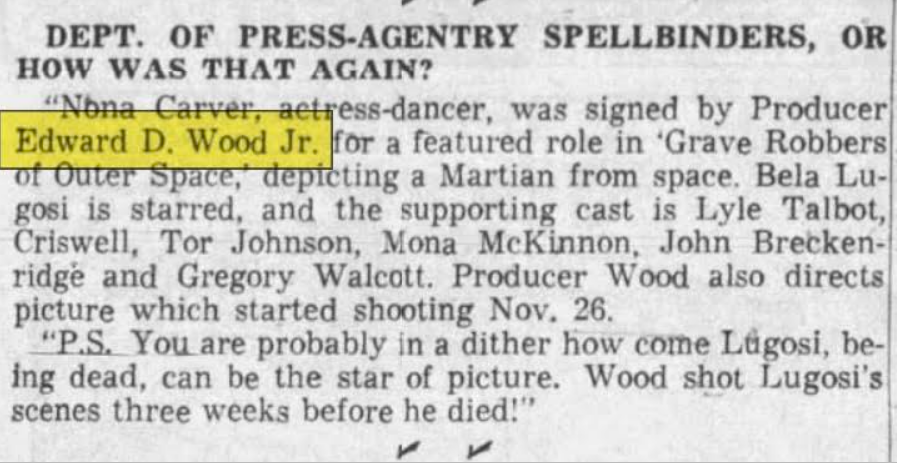
I recently learned a little more about Nona Carver when the unstoppable Rob Huffman sent me some vintage news clippings about her. This article from the November 29, 1956 edition of The Los Angeles Mirror suggests that Nona almost played an even more prominent role in the Ed Wood saga. Entertainment columnist Dick Williams says that Nona would play "a Martian from space" in Plan 9 from Outer Space, then still known as Grave Robbers from Outer Space (or Grave Robbers of Outer Space). Nona's role ultimately went to Joanna Lee, who came to resent her association with the film.
Nona Carver could have played Tanna in Plan 9.
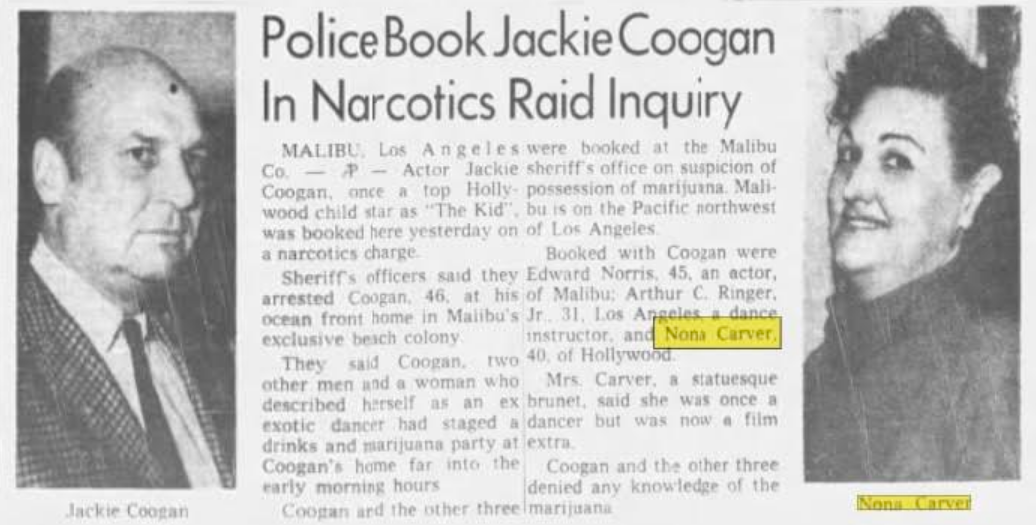
The next Nona story that Rob sent me is even stranger, if you can believe it. It comes to us from The Modesto Bee, January 8, 1961 and tells us about the time Nona Carver was busted after attending a "marijuana party" at the beachfront Malibu home of former child star Jackie Coogan. This was well after Coogan's days of acting alongside Charlie Chaplin in The Kid (1921) but a few years before he played the role for which he is most famous today: Uncle Fester on The Addams Family (1964-66).
Nona and Fester? Who'd have guessed?
The article yields some interesting information about Nona Carver, including the fact that she was 40 years old at the time of this incident and retired from exotic dancing. She gives her profession as "film extra." Other than Virgins and Trade, however, the only film role I can find for her is in 1962's Terrified, a suspense thriller that looks like a a cheapjack imitation of Psycho (1960).
The next article that Rob sent me comes from Ed Wood's hometown paper, The Poughkeepsie Journal, May 2, 1967. It concerns Eddie, his brother Bill, and their father.
Ed's brother Bill (pictured at left) visited his ailing father in 1967.
It seems that both Ed Wood and his younger brother Bill returned briefly to New York State in 1967 to visit their ailing father, Edward D. Wood, Sr., who was in an Albany hospital. Sadly, the Wood family patriarch died just four days after this article was printed. He was 72 years old. I can't help but imagine what Ed's last visit with his father was like. I keep picturing that extremely subdued scene from Alice's Restaurant (1969) in which Arlo Guthrie (playing himself) visits a dying, still-smoking Woody Guthrie (Joseph Boley) in the hospital. Arlo is respectful but taciturn, as he really has nothing to say to his father at this moment. In the hallway outside Woody's room, Arlo talks to his mother Marjorie (Sylvia Davis).
ARLO: He's gotten a lot worse since I saw him.
MARJORIE: Well, let's say no better.
(Arlo glances around awkwardly, unsure of what to do in this situation, then leans in and kisses his mother. He turns around and walks away without another word, passing a nurse pushing an old man in a wheelchair as he leaves.)
Or who knows? Maybe it was nothing like that. Maybe Ed Wood, Jr. and Sr. had a deeply satisfying, far-ranging conversation and got to resolve whatever issues they had between them, allowing the elder Wood to slip into death with a clear conscience.
I have one last item for you today. Rob Huffman hipped me to this remarkable 2001 blog post by renowned science-fiction editor Earl Kemp (1929-2020). In the 1960s, Kemp worked at a publishing company called Greenleaf Classics, which released a few of Ed's books, including the novelization of Orgy of the Dead (1966). Because of this, Earl got to meet and interact with both Ed Wood and Criswell. He says the two were constant companions and could even finish each other's sentences.
I don't want to spoil any of the article, so I'd advise you to go read it for yourself. Suffice it to say, it's a wonderfully descriptive and evocative passage, detailing what it was like to spend time with these two extraordinary human beings. As a bonus, Kemp also includes the entire Greenleaf style manual, which is surprisingly nitpicky and even stodgy at times. Having read much of Ed Wood's prose, I doubt our man followed guides like these very closely. Or at all.
Five points if you know which TV show I'm referencing. (HINT: It ain't Tales from the Crypt.)
Remember trick-or-treatingwhen you were a kid? You'd try to keep track of what candy you were collecting along the way, but you'd never get an accurate inventory until you got home and dumped out that pillow case or plastic pumpkin head and sorted through your treasure. There'd always be some weird candy in there that you'd never heard of, stuff you'd never see any other time of the year. Mexican Hats? Bottle Caps? Mary Janes? Tootsie Rolls in flavors other than chocolate? All this stuff seemed exotic to me back then.
Well, I had a similar feeling this week when faithful reader Rob Huffman, host of Sin & Sci-Fi in the '60s, sent me some vintage Ed Wood-related newspaper clippings. These are the Mary Janes and Mexican Hats of Woodology, the obscure stuff that you wouldn't even think to look for because you never knew it existed in the first place. How Rob keeps finding this material I don't know. Let's sort through it together, huh?
The first item comes to us from The Los Angeles Evening Citizen News, March 12, 1952, and concerns actor Kenne Duncan of Night of the Ghouls (1959) and The Sinister Urge (1960) fame. While touring Japan in 1951, Kenne lost a .22 pistol that was later recovered in an irrigation ditch.
(left) An article about Kenne Duncan; (right) A Japanese poster for Kenne Duncan.
When he sent this to me, Rob joked that Kenne probably shot someone and ditched the murder weapon, but the cops covered it up because he was a celebrity. ("I'm kidding," he clarified.) Ed Wood fans will be familiar with Kenne Duncan's Japanese tours, which were documented in the short film Trick Shooting with Kenne Duncan (1960) and Ed's posthumously-published book Hollywood Rat Race (1998). You can read my thoughts on both of those things right here. I guess the snarling Western actor, memorably nicknamed "Horsecock," had a major following in Japan. That puts him in the same category as Kentucky Fried Chicken, Cheap Trick, and Little Jimmy Osmond.
Rob also sent me some tantalizing excerpts from Criswell's long-running syndicated newspaper column. Here's an item from 1972 about Ed Wood's long-gestating I Woke Up Early the Day I Died project, which was not actually produced until 1997. This was published in The Bridgeport Post on March 26, 1972.
Criswell (right) talks about The Day I Died.
Cris and Ed Wood were close friends as well as professional collaborators, so the celebrated seer would have known all about this unproduced screenplay that Ed had been working on (under various titles) since the 1950s. As of 1972, the script was simply called The Day I Died. The morbid plot description that Cris gives us makes the film sound a lot like Eddie's short story "Into My Grave," which was published in 1971. Notice that this column makes no mention of the main character's murderous crime spree. The other truly noteworthy detail is the mention of "Wes Kale, a dramatic new discovery." I cannot find any documentation of Mr. Kale, who sounds like a SpongeBob character. When the script was finally made, Billy Zane played the lead.
The next item on the agenda comes from Criswell's column of December 21, 1975. It, too, was published in The Bridgeport Post and concerns an aborted Ed Wood project called Erotica 76 that was totally unknown to me. Cris says Eddie was planning to direct it.
Was Ed Wood (right) hoping to direct Erotica 76?
Each new detail of this article is more baffling than the one that preceded it. Erotica 76? Jeopardy? Dennis Owens? What are you talking about, Criswell? You reference all of these things as if we know exactly what they are.
Nightmare of Ecstasy: The Life and Art of Edward D. Wood, Jr. (1992) makes no mention of Erotica 76 or Dennis Owens. I cannot even find a director, producer, screenwriter, or actor of any note called Dennis Owens. (The closest is an East Coast news anchor with that name.) Orgy of the Dead (1965) is a title we're all familiar with, but what is Jeopardy? Could Criswell be referencing the 1953 crime drama, directed by John Sturges? I doubt he's talking about the extremely long-lived game show of that name. That wouldn't make sense in this context.
Furthermore, how will a film that sounds like blatant, low-budget pornography "revive the old days of Hollywood" or "set the new trend of entertainment for the entire family"? I guess all of these questions (and more) will forever remain unanswered. But before we leave this news clipping, let's take a moment to appreciate Criswell's philosophizing about "the waves of time." Eddie makes this kind of dreamy, vague observation a lot in his writing; he and Cris truly thought alike.
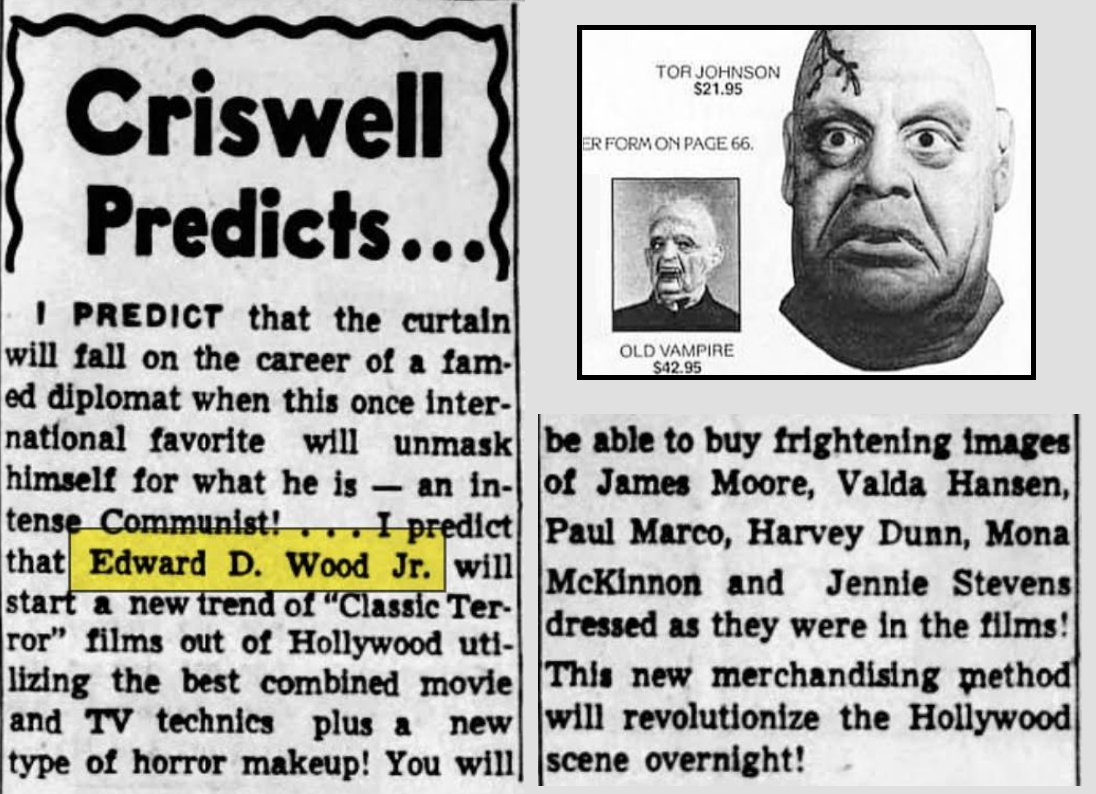
The third and final Criswell article for today comes from the April 23, 1958 edition of The Escondido Times-Advocate and concerns the merchandising of the actors in Ed Wood's repertory company.
A Criswell column from 1958. Inset: An early 1980s ad for Don Post studios.
As mentioned earlier, Criswell and Ed Wood were good friends, and I think the former mentioned the latter in his column occasionally just to get Eddie's name in print. In those pre-internet days, a struggling writer-director in Hollywood needed as much media attention as he could possibly get. I don't know if Criswell's columns opened any doors for Eddie, but they couldn't have hurt. Ink is ink.
Here, the great prognosticator declares that Eddie will not only revive classic Hollywood horror movies but will utilize "the best combined movie and TV technics plus a new type of horror makeup." Perhaps Cris was already describing Night of the Ghouls, in which Tor Johnson's badly-scarred Lobo wears the most elaborate makeup ever seen in a Wood-directed movie. In the 1960s, Tor's familiar face became the basis for a popular Halloween mask from Don Post Studios. That company no longer exists, but several versions of the Tor mask are still on the market today.
What's interesting is that Criswell predicted a whole line of masks based on the cast of Night of the Ghouls, but he doesn't include the three most obvious candidates for this treatment: himself, Tor Johnson, and Kenne Duncan. Instead, he suggests masks based on James "Duke" Moore, Paul Marco, Harvey B. Dunn, Mona McKinnon (who appears in Ghouls via repurposed footage), Valda Hansen, and even the obscure Jean Stevens (identified here as "Jennie"). Again, I think this was Cris' sneaky way of getting his costars' names in print.
Rob Huffman sent me further Ed Wood clippings, but I think we will save those for a future installment of this series. After all, you don't eat all your Halloween candy on one night, do you?
Criswell told an amazing tale in the April 1955 issue of Spaceway.
The summer of 2023 was the hottest on record, and there are alarming news stories about catastrophic weather events seemingly every week. It often feels as if we're on a collision course with oblivion and that there is no turning back. Sure, we collectively survived Y2K a couple of decades ago, but the human race may well be extinct by the time Y3K rolls around.
In short, these would be great times for Criswell (1907-1982), the well-coiffed prognosticator who became not only Ed Wood's good friend but also an important member of the Wood repertory company with his roles in Plan 9 from Outer Space (1957), Night of the Ghouls (1959), and Orgy of the Dead (1965). More and more these days, we seem to be living through one of the many outlandish doomsday predictions that Criswell made over the years through his columns, books, and other media appearances.
Recently, reader Rob Huffman, host of the YouTube series Sin & Sci-Fi in the '60s, sent me one of those apocalyptic Criswell pronouncements: "The Dying Planet," which Cris wrote for a pulp sci-fi magazine called Spaceway in April 1955. A relatively short-lived publication from William L. Crawford's Fantasy Publishing in Los Angeles, Spaceway lasted only from December 1953 to June 1955 with a brief revival in 1969 and 1970. Criswell was a regular contributor to Spaceway and even appeared on its cover a couple of times. (L. Ron Hubbard also contributed to Spaceway, if that tells you anything.)
Some artwork by the great Paul Blaisdell accompanied this Criswell story.
Spaceway April 1955.
"The Dying Planet" captures Cris at his bonkers best. In this article, the great seer tells us of a distant yet inhabited planet called Bellarion—whose society mirrors ours in many ways—that is veering away from its usual orbit and will enter our solar system in the "very near future." Our planet will not necessarily perish because of this catastrophe, but there will be numerous consequences ranging from bizarre to tragic to merely inconvenient. Among them:
"Your hair will not remain combed, but will stand up in wild disarray, due to the coming electrical disturbances."
"Huge buildings will become loosened from their foundations and will fly off into space."
"Pregnant women will explode."
"The skies will rain blood because of the millions of crushed bodies floating in space."
"In cemeteries, the dead will be lifted from their graves through a strange magnetic force which will influence only dead cells."
That last one I mentioned is especially noteworthy because it presages both Ed's own Plan 9 as well as George Romero's seminal Night of the Living Dead (1968). In Romero's film, the zombie plague is apparently caused by the Venus Space Probe and the radiation it brought back to our planet.
Speaking of classic sci-fi and horror, the Spaceway article is accompanied by artwork from the great Paul Blaisdell (1927-1983), who created iconic monster costumes and other props for such classic B-movies as It Conquered the World (1956), The Beast with a Million Eyes (1955), The She-Creature (1956), and many more. Occasionally, Paul himself would climb into the costumes and portray the monsters himself. It's regrettable that Paul Blaisdell and Ed Wood never had the opportunity to work on a film project together.
Immediately following "The Dying Planet," the April 1955 issue of Spaceway also includes a biographical article about Criswell attributed to one "Charles F. Wireman." I put that name in quotes because "Charles" is pretty blatantly Criswell writing under a pen name. He doesn't even bother to change his telltale writing style from one article to the next. In "The Dying Planet," for instance, Criswell refers to "trend, pattern of habit, and the unalterable laws of cycle," a phrase I also recognized from Criswell's delightful 1970 album. Then, "Charles F. Wireman" uses the exact same phrase on the very next page! So much for covering your tracks.
Regardless of its authorship, the biographical article has some interesting Criswell trivia in it. For instance:
Criswell's favorite character in history is Napoleon, and his favorite age in history is from 1890 to 1900. His favorite American writer is Edgar Allen Poe. Criswell's most cherished newspaper interview was with the late H.G. Wells, who proved to be a great influence.
The article stops short of telling us Criswell's turnons and turnoffs, and for that, I am grateful. I am also grateful to Rob Huffman for sending me this wonderful example of Criswell arcana.
This week, we're tackling one of Ed Wood's more obscure adult paperbacks.
By 1969, Ed Wood had spent the better part of the previous decade writing adult paperbacks. He was then transitioning into an incredibly prolific stint writing short stories and articles for various Pendulum/Calga magazines, published by Bernie Bloom. Pendulum would ultimately publish many of Ed Wood's full-length books as well, including both novels and nonfiction works.
But Eddie was writing for other publishers during this busy time in his career, too, including a mostly-forgotten company called Private Editions. This was a relatively obscure imprint even in its heyday, connected to the publisher Columbia (per Ed's own resume). Private Editions released Ed's salacious paperback Night Time Lez (1968) as well as the novel that is our focus this week: the truly remarkable and politically-charged Toni: Black Tigress (1969). Interestingly, the publisher's address listed in Toni—7805 Deering Ave in Canoga Park, CA—is the same as that of adult magazine publisher Press Arts, Inc. Today, it's the home of Ferguson Plumbing Supplies.
These days, Toni: Black Tigress remains one of Ed Wood's rarer books, infrequently turning up at online auctions (and at times for exorbitant prices) and perhaps, until now, never reviewed. We aim to change that with the latest edition of The Ed Wood Summit Podcast. Expert Woodologists Joe Blevins, James Pontolillo and Rob Huffman graciously join me for the task.
FAIR WARNING: Please note that this book covers racial and sexual matters in a highly insensitive, in fact offensive, manner.
Special thanks must go to Rob Huffman for painstakingly scanning his rare, valuable copy of Toni: Black Tigress so that we could read it for this podcast.
What can I say, folks? Between work and some other extracurricular obligations, I have simply not had much time for Ed Wood lately. I know that's become a tired refrain in 2023, but it also happens to be true. Hopefully, in the not too distant future, Eddie will crawl his way back up to the top of my to-do pile. But it hasn't happened yet.
That's okay, though, because an utter madman named Rob Huffman keeps sending me Ed Wood-related detritus. Every couple of days, I'll check my email and see he's sent me even more stuff. Remember just last month when he sent in that 1954 photograph of Ed Wood, Dolores Fuller, Bela Lugosi, Devila (whom Ed was planning to turn into the next Vampira), and LaTanya? Well, this week, he's found another copy of that same picture. "A little cleaner than the newspaper clipping," he says. "I have no idea of its origin." Here it is for your perusal.
(l to r) Bela Lugosi, Dolores Fuller, LaTanya, Devila, Ed Wood.
Rob also sent this photo, obviously taken at the same event. Note Bela's outfit, Ed's outfit, the Jail Bait (1954)poster in the background, and the mess of photographs on the table. I honestly have no idea who the third man is, but I bet you know and will tell me as soon as this article goes live.
Ed Wood and Bela Lugosi at some kind of publicity event in 1954.
Rob has sent me even more stuff, but that's literally all I have time for right now. Even as I type this sentence, other obligations beckon to me.
Casey Larrain's back... and Greg Dziawer's got her!
Actress Casey Larrain is an important figure in the saga of Edward D. Wood, Jr. After all, she and Eddie worked together on three movies—Love Feast (1969), Take It Out in Trade (1970), and Nympho Cycler (1971). And the total is four if you count Love Making USA (1971), which reuses some footage of Eddie and Casey from Love Feast. But Casey has kept herself out of the limelight for decades. She's not interviewed in Nightmare of Ecstasy (1992), nor does she appear in any of the Wood documentaries. This week, though, she's the guest of honor on The Ed Wood Summit Podcast. Give a listen!
The fun never ends. My good pal, Robert G. Huffman, recently sent me some old newspaper clippings that I had never seen before. Regarding Ed Wood, of course!
As a teaser for what's to come, let's briefly consider this one from the September 11, 1954 edition of the Pittsburgh Courier:
Note the poster for Jail Bait (1954) in the background.
While Devila remains a figure needing further research, the story of LaTanya is well-told here.
It's curious, isn't it? She thought she designed gowns for "two dozen" films, by Ed's own production company?!?
(from left) Rob Huffman, Greg Dziawer, Jean Marie Stine.
This week on their podcast, Sin & Sci-Fi in the '60s, Rob Huffman and Greg Dziawer talk with Jean Marie Stine, the author of Ed Wood: The Early Years(2001) and a colleague of Ed's when he was writing adult paperbacks in the 1970s. Join them for this interesting and far-ranging discussion!
You can find more Sin & Sci-Fi content right here.
Rob Huffman wrote me with some thoughts on actor Timothy Farrell.
"You must think me a crackpotat this point," Rob Huffman recently said to me in an email. No, Rob, I can honestly say I don't think you're a crackpot. I know you're a crackpot. That's who writes me, ladies and gentlemen—the obsessives, the die-hards, the never-give-uppers. I mean, who else is still reading this Ed Wood series after nine years? Sane, healthy, well-adjusted people?
Anyway, a few days back, I posted a little article about Timothy Farrell's performance in Ed Wood's Glen or Glenda (1953). In response to this (I think?), Rob sent me an email about Tim's still-living son, an ex-cop turned private investigator. Rob was apparently going to contact this shadowy son but thought better of it after hearing him on a podcast devoted to private investigators. (Such things exist? I thought PIs kept a low profile.) According to Rob, however, the younger Farrell knew very little of Timothy's film work.
Even though Timothy Farrell (real name: Timothy Sperl) played key roles in both Glenda and Jail Bait, plus the Wood-scripted The Violent Years (1956), I have not invested any time investigating the man's life whatsoever. I've been solely interested in Tim as an actor. Or at least I was until I read his alarming IMDb biography:
Worked as a bailiff in the Los Angeles Sheriff's Department while also working in the movies. One of his movies, Paris After Midnight (1951), was actually busted in a vice raid in the mid-'50s, which caused him professional embarrassment. He went on to work 20 years as an L.A. deputy marshall and eventually was appointed County Marshall in 1971. He was convicted of felony charges after his appointment, however, for "illegal use of deputy marshalls in political activities," and was given a six month sentence, but received probation due to poor health. He was fired in 1975.
Look, folks, I can't vouch for any of this. But you've gotta admit, it's interesting, right? And I'm well aware that those obsessives, die-hards, and never-give-uppers I mentioned at the beginning of this article already knew this stuff and probably want to send me a bunch more Timothy Farrell trivia. Which they're free to do, naturally. I can't promise I'll acknowledge all of it. Sorry.
This current series, The 2022 Ed-Vent Calendar, is strictly for me. What with work and other entanglements, I had really gotten out of the habit of writing anything, so I wanted to force myself to generate a few weeks of content for this blog. If people read it, great. If they don't... well, that's less great but still fine.
One person who definitely does read these articles is the unstoppable Rob Huffman. I figured he'd have some feedback on the Ed-Vent Calendar eventually, and I wasn't wrong. He sent me this neat photo of an ashtray from the dearly departed Cameo Room, the Hollywood bar where Kathy Wood first fell in love with Ed.
Remember when you could smoke in bars?
That very ashtray was going to serve as a crucial prop in a book that Rob was writing: a "pseudo-autobiography" of Ed Wood in the 1970s! His story would have Ed and Kathy stealing that ashtray from the Cameo Room as a memento. (Kathy would later chuck it at Ed's head during an argument.) This sounds like an interesting and fun project. Rob says he got about 150 pages into it and had even attracted some publisher interest before he abandoned it.
Rob also found this vintage postcard for the place, which is nice because it shows you the surprisingly plush interior. And on the exterior, we see that the bar was decorated with large cameos, hence the name.
A postcard advertising the Cameo Room. Nice place, huh?
I might as well show you the back of the postcard, too, since it's full of interesting historical details. You can see, for instance, that the card is postmarked 1950, which gives you some idea of its vintage. We even get the name of the manager, Rene Perdini, and another stamp that says, "BUILD YOUR FUTURE WISELY SAFELY U.S. SAVINGS BONDS." That's a real throwback to another era, as is the phone number (NOrmandie 1-3627). Even the brief message scrawled on the card has some human interest. For some reason, I find it charming that the words "today" and "tomorrow" used to be hyphenated. And it's nice to know that the Cameo was a "swell place to eat."
The back of the postcard pictured above.
Rob sent me more information and commentary about other aspects of the Ed-Vent Calendar, but I think I've given you more than enough for one day. After all, this is supposed to be short-form content.
"We have top men working on it right now." "Who?" "Top... men."
This series has unexpectedly been on hiatus for the last few weeks. Sorry about that. What can I say, folks? Life gets in the way of Ed Wood scholarship sometimes. It's certainly not for lack of material to cover. In fact, there's way, way too much still left to cover. And more of Ed Wood's work is being discovered all the time—articles, stories, novels, scripts, loops, and even feature films. Had we but world enough and time...
Meanwhile, loyal reader and former Ed Wood Summit Podcast guest Rob Huffman has been faithfully flooding my inbox with photos and press clippings about Eddie and his various professional associates. I think his intent was to inspire me or Greg Dziawer to write a new article. Well, in a roundabout way, he was successful, because this week we are delving deep into The Huffman Files.
This week, Greg and Rob explore Ed Wood's work for a company called France.
Ed Wood's fans know that their hero wrote numerous adult books, stories, and articles for Pendulum Publishing in the 1960s and '70s. Earlier this year, however, I stumbled upon an LA Weekly article by Tony Mostrom suggesting that Eddie also wrote for another adult publisher called France. According to Mostrom, Wood "penned cruddy porn paperbacks" for the company in the "dreary" early 1960s. Ed's work for France is much less known than his work for Pendulum, and I was eager to learn more about it.
I reached out to my friend and colleague Rob Huffman, who subsequently shared a few more details with me, gleaned from crime-fiction author John Gilmore's 2011 memoir Laid Bare. Rob then realized he had learned about Ed Wood working for France years ago, so we started digging for texts to review.
The results of our endeavor comprise this week's edition of The Ed Wood Summit Podcast.
During our conversation, Rob and I made our surmises about Red Garter #1, a magazine published by France (aka International Publications, Inc.) in 1962. You can find a scan of that magazine right here. What do you think? Is this the work of Edward D. Wood, Jr.? We have additional thoughts on this topic, so there will be much more to come!
Meanwhile, all episodes of The Ed Wood Summit Podcast can be found here.