 |
| A raven-haired exotic dancer arouses the libido of a troubled husband in Ed Wood's The Young Marrieds. |
 |
| The After Hours DVD |
"Man and woman, who enter the covenant of marriage. It is not all that it seems for the young marrieds. Primordial cradle of life, birthplace of man. This ever-moving, ever-changing substance, containing billions of living particles, issued forth and then washed ashore. Beginnings of man and woman. Man and his mate are only one of countless species who inhabit the fertile earth. He has perfected his thinking processes and created for himself the crutch of civilization to harbor him in his environment. Man alone could not accomplish this feat of the millenniums. This source of comfort, strength, and physical fulfillment was enhanced and complimented by his beautiful counterpart, woman. The light of passion and glow of warm desire. And who think these ideals are all that is needed to make the modern marriage prevail."
-preamble to Ed Wood's The Young Marrieds (After Hours version)
 |
| The Alpha Blue DVD |
"Primordial cradle of life, birthplace of man. This ever-moving, ever-changing substance, containing billions of living particles, issued forth and then washed ashore. Beginnings of man and woman. Man and his mate are only one of countless species who inhabit the fertile earth. He has perfected his thinking processes and created for himself the crutch of civilization to harbor him in his environment. Beauty of storybook love."
-preamble to Ed Wood's The Young Marrieds (Alpha Blue version)
 |
| A novel from the Silver Age. |
David C. Hayes' Muddled Mind: The Complete Works of Edward D. Wood, Jr. divides the career of its subject into four distinct eras: the Golden Age (1948-1967), the Silver Age (1968-1969), the Bronze Age (1970-1972), and the Vodka Age (1973-1978). Of these, it is the so-called Bronze Age that has demanded most of my time and attention throughout the Ed Wood Wednesdays project. In hindsight, this was Eddie's last great burst of creative productivity before late-stage alcoholism got the best of him and his muse drowned in a deluge of cheap whiskey. I might tweak Hayes' definitions a little and extend the Bronze Age to at least 1973 and perhaps even into 1974, the year that brought us "The Autograph" and
Fugitive Girls. In general, though, it does make sense to segregate Eddie's professional life into distinct phases.
Whereas the LBJ-era Silver Age was mostly characterized by the release of many, many adult paperbacks (
Purple Thighs, Hell Chicks, etc.), the Nixon-era Bronze Age saw Eddie toiling in a variety of media. He was still publishing full-length fiction and non-fiction books, of course, but he was also churning out short stories for publisher Bernie Bloom, and writing film scripts for director Stephen C. Apostolof. But what makes the Bronze Age truly remarkable is that it was the last time Edward D. Wood, Jr. was actually doing what he's famous for doing: directing motion pictures. As I've learned from researching Ed Wood Wednesdays, directing was hardly Eddie's greatest strength, but it remains the occupation with which he is most closely associated. Apart from
The Sinister Urge (1961) and the industrial films he made for Autonetics Aviation in the early part of the decade, Eddie did almost no directing during the 1960s. A new decade and some relaxed social attitudes toward pornography, however, created a brief window of time during which Ed Wood was able to reclaim the role of director, the job he set out to do when he moved to Los Angeles in 1947.
I have
discussed before the potentially-thorny issue of what constitutes "Ed Wood's last movie." Almost a year ago, I said that it "depend[s] on your definitions of 'last' and 'movie.'" I stick by that. It's important to remember that Eddie was, like many independent filmmakers of his era, something of a utility infielder. He directed, sure, but he also acted, wrote, edited, assisted, gophered, and consulted. He did whatever was required of him, really. Sometimes credited, sometimes not. Anything for a coveted paycheck. As such, he remained involved, to one extent or another, with the production of motion pictures until the year he died at the age of 54 in 1978. He was credited under his own name as an assistant director on Steve Apostolof's diamond heist film
Hot Ice that very year, just a few months before his much-abused heart finally quit on him. And his career hardly ended with his death, thanks to posthumous productions adapted from or inspired by his work.
But if you think of Ed Wood primarily as a man who directed movies and thus achieved infamy as "the worst director of all time," then you're bound to be interested in the hastily-produced and desperately under-financed X-rated movies he made during his Bronze Age, for these were indeed his final directorial efforts. (That is, unless you count
Meatcleaver Massacre. But that's a whole other story.) I have already covered two of these exceedingly rare birds:
Take It Out in Trade (1970) and
Necromania (1971). A third such production,
The Only House in Town or
The Only House (1970 or 1971, sources vary) is still missing in action and cannot be reviewed. It may be lost forever. But now, thanks to the diligence of Eddie's fans, yet another pornographic film directed by Wood in the early 1970s is readily available to the public. And it, too, has staked a claim as being "Ed Wood's last movie."
T h e Y o u n g M a r r i e d s ( 1 9 7 2 )
 |
| Lovely, lovely Alice Friedland contemplates the boundaries of marriage in The Young Marrieds. |
Alternate titles: Not a one that I can find. That fact is significant. It suggests that the film did not receive much, or any, international play, nor did any sly distributors try to repackage and resell the film in later years by slapping on a new name.
The Young Marrieds may not have even been released on VHS. It had an original theatrical run and then pretty much vanished for decades, largely unmourned.
Availability: After more than 40 years in near-total obscurity, during which it was not even covered in such books as
Nightmare of Ecstasy or
Ed Wood, Mad Genius,
The Young Marrieds is now readily available in not one but
two easy-to-order DVD versions. After Hours Cinema markets a disc called
Ed Wood's Dirty Movies ($27.99) that contains both
The Young Marrieds and
the Wood-scripted
Nympho Cycler, as well as a Rene Bond film called
Shot on Location and a variety of trailers, including a rare one for
The Young Marrieds. The package also includes an informative essay called "Ed Wood in the Early '70s" by porn archaeologist Dimitrios Otis.
Meanwhile, Alpha Blue Archives has made available a DVD that contains
The Young Marrieds ($24.95) as well as "The Lost Films of Alice Friedland," including such non-Wood features as
Kiss My Analyst, Analyze Your Sex, and the truly bizarre
The Adventures of Flash Beaver, plus some examples of Ms. Friedland's work in pornographic loops. It should be noted that the Alpha Blue and After Hours versions of the movie are
not identical.
.jpg) |
| Alice Friedland in Please Don't Eat My Mother! |
The backstory: Apart from the strong authorial hand of Edward Davis Wood, Jr., which is evident throughout
The Young Marrieds, what distinguishes this pornographic feature from dozens of others from the early 1970s is the participation of stripper/model/actress Alice Friedland, whose numerous film appearances between 1969 and 1977 have garnered her a cult following that survives to this day. It is Alice's eye-catching photograph, not Ed Wood's, which is plastered across the Alpha Blue DVD of this movie, after all. Her long-lasting appeal is easy to understand. Slim-bodied but ample-chested, Alice Friedland possessed a California tan, a mane of long, tawny hair, and a pair of shapely legs that gave her a healthy, all-American appearance. In fact, she strikingly resembled another cult actress, doomed ex-Playmate of the Year Claudia Jennings (1949-1979), with whom Friedland appeared in 1976's
The Great Texas Dynamite Chase. Though perhaps not quite in Jennnings' league acting-wise, Friedland had a definite screen presence and could convincingly portray innocence, naughtiness, playfulness, toughness, vulnerability, and even moral outrage.
Very little has been written heretofore about Ms. Friedland's career, which was mostly confined to softcore sex films such as Harry Novak's horror spoof
Please Don't Eat My Mother! (1973), along with occasional appearances in more mainstream fare, including Sam Peckinpah's
The Killer Elite (1975) and the film for which she is best known, John Cassavetes'
The Killing of a Chinese Bookie (1976), in which she played a no-nonsense stripper named Sherry. Fortunately, in mid-2012, Alice consented to
an hour-long telephone interview with
Chinese Bookie fan James M. Tate for his
Cult Film Freaks podcast. Due to that interview, I have been able to piece together a general overview of Alice's life and career.
"I was just kind of floating along. I just wanted to suck all the marrow out of life. I wanted to enjoy myself, because life is so short. I just wanted to have fun. I didn't care about anything back then."
-Alice Friedland, reminiscing about her youth
 |
| Alice Friedland worked here. |
Born in 1949, the photogenic Alice Friedland was a long-time Los Angeles and Las Vegas stripper who supplemented her income with both nude modeling and acting in the 1960s and 1970s. Movies were always a sideline for her; dancing was her primary source of income. In the early days, she worked at one of LA's most famous burlesque houses,
the Pink Pussy Cat on Santa Monica Boulevard, where her clientele included George Kennedy, Bob Hope, and Wilt Chamberlain. The best part of the job, she maintained, was the adoration and attention she got from men. She never bothered getting an agent but kept going on interviews anyway in the hopes of booking a film role here and there. It worked. Willing to do nudity and not completely hopeless as an actress, Alice was hired by quite a few B-movie directors over the years, including a couple (Pete Perry and Ed De Priest) with professional ties to Ed Wood. Her first screen gig came at age 20, when she played a nurse in a now-obscure film called
Dr. Masher (1969). Other roles were soon to follow, often as strippers. As was the custom of the time, she used a variety of pseudonyms along the way, sometimes just barely bothering to disguise her true identity. She was alternately "Claudine Benet," "Alice Fredlund," "Alicia Friedland," and "Brandy O'Toole." As a stripper, she said, her most common
nom de guerre was "Alexis." For
The Young Marrieds, she was "Patti Kramer" for the first and last time.
An interesting note: during her interview with James M. Tate, Alice Friedland insisted that all of her films were softcore. "I have a line," she said, "that I don't cross." She further insisted that "there was never any penetration" in her films. Though she said she admired porn star Jenna Jameson, she claimed she didn't want to become a hardcore actress because she saw the devastating effect it had on other young women around her. I have examined some of Alice's sex scenes from
The Young Marrieds, which was one of her earlier films, and she does indeed perform unsimulated, unmistakable vaginal and oral sex acts in a few brief shots. At the time, Ms. Friedland had some distinctive tan lines with lots of criss-crossing straps, so she's easy to identify. Some of the closeups, however, could well be a body double (the insert shots are clumsily mismatched to the master shots; it could be anyone's vagina), and some of her sex scenes are shot from such an angle that the intercourse could be staged. But some of her on-screen sex is clearly real. So she at least
flirted with hardcore pornography, but she certainly did not make a career of it.
Several years after
The Young Marrieds, Alice Friedland was dancing at a still-existent strip joint called the
Body Shop on Sunset Boulevard ("The Only Nude Strip Club on the Sunset Strip") when she was spotted by actor Seymour Cassel and recruited to play a prominent supporting role in the Cassavetes film. She agreed to appear in the role despite some initial squeamishness. "Even though I was a dancer," she explained to James Tate, "I was kinda shy." Although she was proud to have appeared in a well-known film by such a prominent director, one whose admirers include Martin Scorsese, Friedland admitted to Tate that she "didn't get" the heavily-improvised
Killing of a Chinese Bookie when she first saw it. "Maybe I need to see it again." Overall, despite meeting a lot of top-flight actors along the way (including James Caan and Ben Gazzara),Alice Friedland was utterly unimpressed with her own screen career, frequently dismissing the films and her performances in them as "corny" and "cornball." Those are the epithets she used over and over again in her conversation with Tate.
 |
| Alice Friedland worked here, too. |
Her movie credits ended in the late 1970s, when she relocated to Las Vegas and began dancing at the infamous
Palomino Club, the only place in Sin City where tourists could see naked ladies and get drunk under one roof. There, she danced for famous customers like Vincent Price, Frank Gorshin, and Matt Dillon. In October of 1977, through the intercession of photographer Scott Hooper, she finally appeared in
Playboy herself, though she was dismayed that it was a pictorial about "ladies of the evening." Friedland worked in the sex industry for years but was never a prostitute or call girl.
As the years rolled along, Friedland realized that she couldn't keep stripping forever and needed a backup plan for her life. At one point during her Vegas years, she was dating the CEO of the Corrections Corporation of America and got the idea to become a corrections officer. By 1983, she had actually married a police officer named Richard Lutes, who further encouraged her in this goal. Finally, in 1997 at the age of 48, Alice Friedland passed her corrections training and began working as a guard in a women's prison in Vegas. (Presumably, this was the Southern Nevada Women's Correctional Facility, which later became the Florence McClure Women's Correctional Center.) She was now Officer Lutes. Though the job was "physical" and "challenging," she was well compensated and loved her work. One embarrassing incident occurred when she was recognized by stripper Liberty West, who was an inmate at the prison. Alice had to deny her stripping past, but word got around the facility anyway. In 2004, deciding to try something new, Friedland moved to Arizona and started working at a men's prison. This experience, she said, was not as positive, and she felt she was not treated well. Finally, after nearly a decade as a corrections officer, she had to retire when the symptoms of multiple sclerosis started interfering with her work. She'd been in denial about having MS, but eventually it became impossible to ignore. Today, she is retired and living with her husband in Arizona and stays in contact with her
Chinese Bookie costar, Donna Gordon.
 |
| A vintage print ad for The Young Marrieds. |
As for the film she made with Edward D. Wood, Jr., I must regretfully report that the making of
The Young Marrieds is not well-documented... or documented at all, for that matter. Much more is known about Ed Wood's other X-rated directorial efforts from that era:
Necromania and
Take It Out in Trade.
The opening credits of
The Young Marrieds are just about useless. Only four actors are listed: Louis Wolf (as Ben), Patti Kramer (as Ginny), George Black (as Friend) and Cynthia Walker (as The Girl). I've already introduced you to Patti; the other three have no other credits. A print ad for
The Young Marrieds' "World Premiere First Run" at
the Eros 2 theater on New York's 8th Ave. touts the appearance of "the beautiful Miss Cynthia Walker," as if she is the star of the picture. She's not. Her supporting character arrives early in the film, then disappears and is never mentioned again.
The technical credits are similarly sparse. The director is "Richard Trent," a slight variation on Wood's oft-used pseudonym "Dick Trent." The screenplay, which I am quite certain is Ed Wood's work, is attributed to "Hank Barnum." Perhaps Eddie was flashing back to his days on the carnival circuit when he gave himself that showman's moniker. There are only two more crew members listed: "Camera: Saul Berger" and "Music: Lou Schwartz." As far as I can tell, neither of these fellows -- if they even exist -- warrant an IMDb entry. While many of the scenes are shot in tacky, eye-assaulting indoor sets, there is a smattering of location footage in this film. Most interestingly, Louis Wolf's character, Ben, repeatedly visits a strip club (the Nude A Go Go) on La Cienega Boulevard in West Hollywood. In at least one shot, you can see the long-gone McKenzie Gallery at 861 N. La Cienega, next door to the club, which must have been located about where
Nobu Los Angeles, an upscale Peruvian-Japanese eatery, is today.
Early in the film, Ben picks up a female hitchhiker outside the club, and they cruise down the thoroughfare in Ben's modified Volkswagen, which he has turned into something like a dune buggy. Although Wolf and Walker's dialogue is all but drowned out by the sound of the engine, this scene still affords us the opportunity to glimpse West Hollywood as it appeared more than 40 years ago. Mostly, we get to see what cars looked like in 1971: Cadillacs and Lincolns the size of river barges intermingled with comically tiny Beetles and boxy microbuses. The ascendance of Japanese imports was still in our collective future then.
 |
| The curious case of Benjamin Blatkin. |
I cannot say with any certainty who financed
The Young Marrieds or why they did it. The credits -- unhelpful as ever -- say only that this film is the work of Palo Productions, a will-of-the-wisp operation with no other titles to its name, apart from a 1967 educational filmstrip called
Stories for All Times. (And that may well be a
different Palo Productions.) Perhaps tellingly, there was a mass market paperback called
The Young Marrieds released by Pendulum Publishing in 1971. That salacious quasi-educational "Pendulum Psychomed Study," which billed itself as "a photographic study of the marital habits of the younger generation" is said to be "compiled by Benjamin Blatkin." Mr. Blatkin, as you might have guessed, has no other credits either. Perhaps, like the Pendulum-backed
Necromania,
The Young Marrieds was another attempt by Pendulum Publishing to break into the adult film market. The paperback might have been a spin-off or tie-in item. It is certainly remarkable that Pendulum Publishing, the company at which Eddie was employed in the early 1970s, released a book with the very same title as Ed's movie in roughly the same general time frame. (For you sticklers out there, even though
The Young Marrieds is listed in most places as a 1971 release, it carries a 1972 copyright. Make of that what you will.)
Details about
The Young Marrieds' theatrical life and release history are predictably scarce. I can't find any posters for the film, but someone has nevertheless posted a promotional tagline to the IMDb: "They do things differently nowadays. A LOT differently!"
This movie must have made the rounds at porno theaters across the country for at least a couple of years in the early 1970s. That New York print ad I mentioned earlier is dated January 31, 1974. Like I said, the film does not seem to have achieved any mass-produced VHS release at all. A 16mm print is said to have been discovered at a Vancouver yard sale in 2004. (How it wound up in Vancouver, I'll never know.) When The Young Marrieds was included as part of Anthology Film Archive's week-long Ed Wood tribute in September 2014, that one-time-only screening might have been its first theatrical playdate in decades. How odd that, in 2014, the film should have received two separate, near-simultaneous DVD releases.
What's truly remarkable is that these two editions are not even remotely identical. The After Hours version is about nine full minutes longer than the Alpha Blue version and contains several very interesting extra sequences (which I will describe anon). On the other hand, the Alpha Blue version is, on the whole, cleaner and less garbled with fewer spots where missing frames have caused the audio to skip like a worn-out record. It seems like someone, somewhere along the line, got ahold of The Young Marrieds and reedited it, rearranging some brief scenes (some voice-over narration has been shifted around), and taking out some tangential moments that have less to do with the main story. This version of the film was apparently better-preserved than the original, longer cut. The two DVDs of The Young Marrieds are, without question, mastered from entirely different sources. Funny old world, isn't it?
 |
| Alice Friedland and Louis Wolf in The Young Marrieds. |
The viewing experience: Let us not kid ourselves and pretend that
The Young Marrieds is something that it isn't. It is of course significant that this is a pre-
Deep Throat pornographic feature in which a young woman ultimately finds sexual satisfaction through unconventional means, but otherwise, Ed Wood's ramshackle movie hardly feels like a narrative, stylistic, or sexual breakthrough for anyone involved. This is one for the raincoat brigade -- the frustrated dirty old men of America. Most of the running time is devoted to fairly unimaginative and low-energy sex scenes set to extremely repetitive, guitar-driven jazz and rock music. The climactic orgy in this hardcore film feels as flaccid and deflated as the softcore bacchanals in Stephen C. Apostolof's films like
The Class Reunion. I get the impression from these movies that bored suburbanites in the 1970s were having "swinging parties" like these because they simply couldn't think of anything else to do with their time. (I wonder how many such events ended in embarrassment back then.)
Apart from Alice Friedland, who's at least trying to establish a multifaceted character here, the actors in Wood's cast are largely sluggish, uncertain, and reluctant in their performances. In my review of
Blood Splatters Quickly: The Collected Stories of Edward D. Wood, Jr., I said that eroticism was not Eddie's strength, even though he was working in pornography. That holds true for
The Young Marrieds. In fact, many modern viewers may take offense at what seem to be homophobic and misogynistic overtones in his script for this film. These people will likely deem
The Young Marrieds not only un-sexy but
anti-sexy.
What makes
The Young Marrieds worth seeing is the fact that Ed Wood's own obsessions, quirks, delusions, tropes, and trademarks are evident throughout the entire running time. The sex scenes themselves are punishingly dull, but the plot-and-dialogue-driven sequences that connect them are truly fascinating and compelling in the tradition of Eddie's best and most personal work. The best way for me to illustrate that to you is by taking you through the hour-long film one scene at a time.
Let's get some preliminaries out of the way. The plot of
The Young Marrieds focuses, as you'd expect, on a young married couple: brash Ben Garrett (Louis Wolf) and his more-reserved wife Ginny (Alice Friedland). While Ben toils behind a desk at Bank of America, Ginny is a listless housewife. After work, Ben habitually goes to a strip club, and one particular dancer there has captured his imagination and become his sexual ideal, dominating his fantasies. Ben also has a one-time-only tryst with a free-spirited hitchhiker (Cynthia Walker). At home, Ginny and Ben argue a lot about sex, since he's always horny and wants his wife to be more demonstrative.
The movie is mostly about what the Garrets do to solve their "sex problem." First, they use arguing as foreplay. Then, Ben brings a camera into the bedroom and takes sexually explicit photos of Ginny. Then, they try some role playing scenarios. Ultimately, Ben takes a cue from his coworker Jim (George Black) and takes Ginny to a swingers' party. The party is attended by three couples: Ben and Ginny, Jim and his platinum blonde wife Donna, and a third couple, both bisexuals, Betty and Greg. Although highly resistant at first, Ginny does wind up participating in the orgy and has sex with Greg while Ben makes love to Donna. That's basically it as far as plot in
The Young Marrieds. That's the boring part, really. The delight, my friends, is in the details.
 |
| The ocean from the beginning of the film. |
The Young Marrieds begins with footage of the ocean accompanied by ponderous voice-over narration by a mysterious observer who will comment on the events through the entire picture. If you go back to the beginning of this article, you will find two versions of the opening spiel from this scene. The narrator, who adopts a rather smug and professorial tone, is part storyteller, part psychologist, and part philosopher. The character, then, is a pure Ed Wood creation. His speeches turn up at odd, unexpected points in the movie and are marked by their garbled syntax, flowery digressions, questionable judgments, and just plain odd word choices. Wood's fans will be reminded, naturally, of Dr. Alton (Timothy Farrell) in
Glen or Glenda?, but there are echoes of Criswell's narration from
Plan 9, Night of the Ghouls, and
Orgy of the Dead, too, along with Professor Collins' long-winded sex lecture in
The Undergraduate.
The scene abruptly shifts to a Hollywood strip club, where Ed Wood has seemingly created an entire sequence by taking some utterly unremarkable (and likely silent) footage of a cheerful, raven-haired dancer going through her act and simply adding crowd noise, loud fuzz-guitar music, and an entire off-camera conversation between Ben and some unseen, hoarse-voiced pal. It's very much like the "foundry sequence" from
Glen or Glenda?, especially since the two men's conversation turns to issues of sexual tolerance. Naturally, our narrator puts his two cents in. Note Ben's homophobia and his friend's open-mindedness. (Just like in
Glenda.)
Also, please note that this dialogue has been pieced together, line by line, from both DVD versions of The Young Marrieds. Keep in mind, too, that all we're seeing on screen is the one dancer. For all we know, she's dancing in an otherwise-empty room! Ben and his pal exist here only as voices on the soundtrack.
Ben: Honey, you are outta sight!
Pal: Heh heh!
Ben: Turn me on! You know, women ought to be forced to come here to study how it ought to be done.
Pal: Oh, I wish my wife could move like that!
Ben: Yeah, these broads really know how to move.
Narrator: This is the story of one of the young marrieds, Ben, who has been watching the performance of his ideal woman, a stripper.
Ben: She is a nice piece! Do you suppose she goes down on the side?
Pal: What do you think? Man, I bet she swings both ways!
Ben: Hey, what do you mean?
Pal: You know! I bet she's AC/DC!
Ben: Aw, come off it! A broad like that?
Pal: Sure! Why not?
Ben: 'Cause it's weird, man! It's just not right!
Pal: What's right and wrong when it comes to sex? A lot of people do things you never think about!
Ben: Like what?
Pal: Like the president of one bank sleeping with the president of another bank!
Ben: That's a lotta crap!
Pal: (laughing) It happens!
Ben: I don't care if it happens! I don't like fags and queers!
Pal: That doesn't change it! People still do it whether you like talking about it or not!
Ben: Anybody who does that kind of stuff is a lousy weirdo freak! That's all there is to it!
Pal: Okay, okay, settle down.
Ben: Listen, I gotta leave now. I'm late as it is.
Pal: Okay. Take it easy.
Narrator: Ben is the normal, middle-class husband of America. His search for personal fulfillment is the truth of the story you are about to view. You will see his anxieties develop as he progresses into the freedom of being himself. This transformation is due in part by the initiation of his mate into similar experiences.
 |
| Ben picks up an amorous hitchhiker. |
Next up for "hero" Ben is that aforementioned extramarital romp with the young female hitchhiker, whom he conveniently finds about five feet away from the front door of the strip club. Their vapid conversation is suspiciously close to one of those far-fetched "I can't believe this is really happening" letters from
Penthouse Forum, in which readers brag about their supposed sexual conquests. Ed Wood should have post-dubbed this scene as well, since the traffic noise makes the dialogue all but inaudible. Why he went with location sound here is a puzzler. As always, Eddie's grasp of modern slang is inexact. Anyway, a sampling:
Ben: How far you going?
Girl: I don't know. How far would you like to go?
Ben: Come on! You're putting me on! A guy thinks about this type of thing happening, but I never believed it ever would.
Girl: Well, you can believe it now. This is your lucky day. I feel good, I wanna get fucked, and you're it!
Ben: Far out. Where do we go? Motel? Your place?
Girl: No sweat. I know a perfect place. It's right up the coast a little bit.
This non-sparkling conversation is one of the scenes that goes on quite a bit longer in the After Hours version. We learn that Ben's silver dune buggy is actually a Volkswagen, for instance, and the hitchhiker explains that she does this kind of thing all the time. ("Well, I do it as often as I can.") The reedited version of the movie cuts a lot of this out so that we get to the sex sooner. Eventually, in both versions, Ben and the girl do arrive at the wooded area where they will make love. Again, in the classic Ed Wood tradition, our lovers exchange unlikely remarks, and the omniscient narrator continues to opine with abandon. His reference to the couple making love in nature like Adam and Eve reminded me of a similar motif in Eddie's scripts for
Drop Out Wife and
The Class Reunion.
Ben: You want to do it here? I might get a thorn in my ass or something.
Girl: I wouldn't let that happen. It's beautiful here. I like to get it on out in the woods, back to nature and all that stuff.
Ben: I dunno. Is there any chance of us getting caught?
Girl: No way. Come on, it'll do you good. I wanna feel that big cock of yours between my legs.
Narrator: The guilt complex which we all seem to have in degrees at first prevents Ben in participating fully in the sex play with the lovely young girl.
Ben: Boy, I hope you know what you're doing.
Girl: Don't worry. I know what I'm doing.
Narrator: After her initiating the first moves, for intercourse, Ben begins to feel he can relate in a more relaxed manner. This is what he seeks, what he wants -- a woman without tendencies to frustrate him.
(We hear the sound of dogs constantly barking in the background.)
Ben: Boy, it's nice out here, isn't it?
Girl: Yeah, it makes it doubly nice.
Ben: Boy, I feel funny.
Girl: Why's that?
Ben: Getting out of my clothes, out here in the woods.
Girl: What's the matter? You afraid of bug bites?
Ben: No, not bug bites.
Girl: My bites?
Ben: No, not your bites.
Girl: Well, what are you afraid of, then?
Ben: I'm not afraid of anything.
Narrator: The foreplay dispensed with, the two young people are seen like Adam and Eve in nature, fused with their bodies in much-needed love.
 |
| "You've been in one of those... those NUDE places!" |
After this never-mentioned again rendezvous, during which the girl never removes her black knee-high boots, Ben returns to his wife, Ginny, in their suburban home. This is represented by a flimsy and garishly-painted set, decorated with the kind of starving-artist paintings you'd expect to find in a fleabag motel. Here, we are introduced to one of the classic themes of Ed Wood's career: marriage and other long-term heterosexual relationships as a hellish purgatory in which the libidinous men are constantly nagged and scolded by the joy-killing women. The narrator, naturally, is on Ben's side. You may not be.
Narrator: Ben's wife manifests the opposite of his fantasy woman.
Ben: Hi, honey.
Ginny: Eight-ten?!
Ben: Oh, hell! Listen, I think i'll go shower before I have dinner! I've had a hard day.
Ginny: I bet!
(Dramatic stinger on the soundtrack.)
Ginny: I guess you've seen enough today!
Ben: Where?
Ginny: I mean, you've been in one of those... those NUDE places! I suppose I look tame after that!
Ben: Damn it! I told you, I just go there to look at the girls!
Ginny: Why not look at me?
Ben: It's not the same!
Ginny: Are those girls better looking than I am?
Ben: No, it's not that. It's just that they dig turning guys on and what they have to show.
Ginny: And I'm not because I'm frigid?
Ben: It's true, you don't get all steamed up!
Ginny: I would if you paid more attention to me.
Ben: All right, let's see your tits.
Ginny: Ben, the lights are on!
Ben: Sure, just like in the bar. Let's see if you can turn me on like those chicks do!
This leads to a rather awkward and prolonged scene in which, trying to please her husband, Ginny bares and plays with her large breasts while Ben gives directions. After a few minutes, though, she abruptly stops, and the couple goes back to arguing. Ben's homophobia again comes to the fore here. One must wonder why Ed Wood keeps bringing up this subject. It's debatable whether Eddie is endorsing Ben's views or simply presenting them to let us know what kind of guy Ben is. It's worth mentioning that the script has now given us two characters (Ginny and the unseen pal) who question Ben's homophobia. Note, too, Ben's use of the colorful expression "Good Christ!" which also pops up in
Fugitive Girls.
Ginny: I can't do this, Ben! I just can't!
Ben: You're hung up! That's the problem! You're just hung up bad!
Ginny: I'm not like you!
Ben: That's for damned sure!
Ginny: You're not so damned perfect! You have your hang-ups, too!
Ben: Oh yeah? I don't know of any, do you?
Ginny: What about queers and lesbians?
Ben: Now, wait a minute! Queers and lesbians aren't normal! I'm talking about normal, man and woman, not what goes on out in the street!
Ginny: Well, I think that!
Ben: Well, do you want to talk about this all night and not get anywhere, or do you want to do what we were doing?
(Ginny angrily flashes her vagina.)
Ginny: Is that what you want? Is that close enough for ya? Can you stick your head right down by my pussy? Is that what you want?
Ben: Good Christ!
Narrator: Only through his wife's anger will Ben achieve a release for his needs.He will be able to pour out his desires and act aggressively in his marriage duties.
It's now time to follow Ben to work. The world of business has long been a source of both fascination and confusion for Ed Wood. He knows that men get dressed up and go to office buildings every weekday, but he's vague on the details of what actually happens inside those buildings. This tendency goes back to
Glenda with its absurd speech about "the modern world and its business administration" and continues through the short stories of the early 1970s as well, not to mention the office depicted in
The Cocktail Hostesses, where the boss eagerly boffs his underpaid secretary every Friday afternoon. Here, in
The Young Marrieds, we get an establishing shot of a Bank of America building in Los Angeles. The film then cuts to an extremely unconvincing "office" set with a scuzzy-looking leopard-skin couch in the corner and a world map pinned to the wall. (Shades of
Plan 9 here.) This scene introduces Ben's cheerful friend and coworker, Jim, and gives us some more narration, too. Jim catches Ben sulking at his desk.
Narrator: In the cruel realities of the next day, Ben returns to his daily labors.
Jim: Hey, Ben! Ben!
Ben: Oh, what?
Jim: Hey, you were really lost, weren't you?
Ben: I guess I was. What's up?
Jim: Hey, now, listen, I just wanna check on the Ferber account. You know, they're a couple payments behind.
Ben: Oh yeah. I'll get right on it.
Jim: Hey, you were really in deep thought, weren't you? Ya lucky dog!
A brief return to the strip club gives us this unlikely pronouncement from the obviously-biased narrator, who seems to be giving Ben way too much credit. The loutish and selfish character we see on-screen is not nearly as thoughtful, dreamy, and tormented as the apparently-complex person the narrator is describing.
Narrator: Although partially satisfied by the love he has shared with his wife, he still has a hollow feeling that needs to be filled. His conscious self turns inward to seek the dream world of thought that compensates for his lack of security in the real world. Through the use of this dream fantasy, Ben is able to relate to something. The stripper helps him to evolve his thinking and form a plan, one that he hopes will help solve his sex problem.
 |
| Ben's surprise for his wife is a camera. |
And what, exactly, is this "plan" Ben is formulating? Simple. He brings home a very large camera and convinces Ginny, who wears a sheer nightie, to pose for erotic photographs. For a supposedly "frigid" wife, Ginny goes along with this plan without too much prodding from Ben. Of course, Alice Friedland was a nude model in real life, so this scene would not have presented a problem for her. Of interest here is the fleeting mention of
Playboy magazine, a publication that featured Ms. Friedland several years after this movie.
Ben: I'm home!
Ginny: Six-ten! You're getting better! Oh, a surprise? How nice!
Ben: We're gonna have a lotta fun with this! I'll show it to you when we go to bed.
Ginny: Oh, a camera! Let me see it, Ben!
Ben: Yeah, we're gonna have a lotta fun with this! I'm gonna start my own photo collection.
Ginny: You mean of me?
Ben: Of course!
Ginny: I don't know.
Ben: You'll love it! You pose and I'll take the pictures! I want you to see how good you really look!
Ginny: As good as those girls in Playboy magazine?
Ben: Better!
Narrator: Now, armed with the tools necessary to start his experiment of love learning, Ben approaches his wife with mixed emotions. The stimulus of being photographed excites her. She poses seductively as an exhibitionist. However, she is still in competition with the fantasy dancer of Ben's mind.
Ginny: Oh, Ben, put the camera down! Please put the camera down and come and take me now!
Narrator: Ben now has taken his first step toward psychic liberation. He no longer feels hollow or dissatisfied but primed for new experimentation. This seems to be the only way he can realize the fantasy ideal which has become his retreat and refuge.
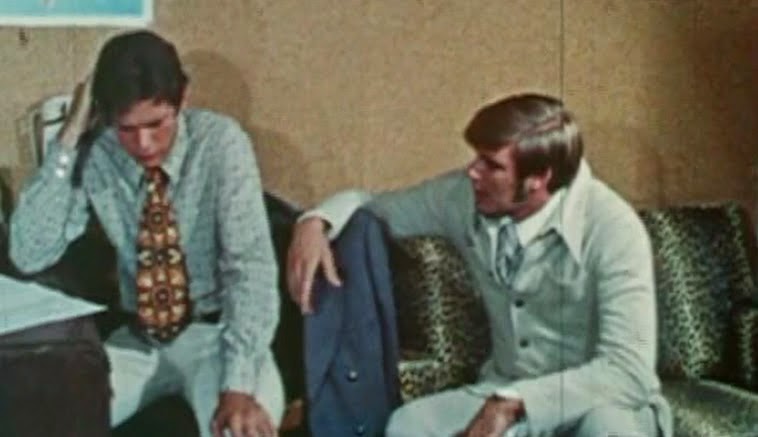 |
| "It's pretty obvious you've got a sex problem." |
"Psychic liberation." Right. Whatever you say, narrator. Next up is a scene that only appears in the After Hours version of the film. I'm guessing it was cut from the other version because it's all talk and no sex. Anyway, Ben returns to work and has another heart-to-heart discussion with Jim. Again, that pesky Ferber account comes up for debate. This is when Jim raises the specter of "swinging," i.e. wife-swapping. The motif of characters discussing intimate sexual problems with friends and coworkers is one that runs through Eddie's film work from
Glen or Glenda? to
Drop Out Wife. The dialogue here has a weird, circular non-logic to it. These men talk about their wives the way they'd talk about their cars. Jim's utter nonchalance in describing his orgies is very amusing here. I don't know whether or not it was intentional.
Jim: Hey, Ben, have you had any news on that Ferber account yet?
Ben: Damn it! It slipped my mind completely, Jim! I'll get on it today.
Jim: You're really into something, huh? Anything you want to talk about?
Ben: Aw, don't worry, Jim! It's not a problem really. It's actually the reverse.
Jim: You mean a solution?
Ben: Yeah, I just solved a big problem in my life, and I can't get over it.
Jim: Hey, I know how you feel. I went through the same thing myself.
Ben: What do you mean?
Jim: Well, hell, Ben. It's pretty obvious you've got a sexual problem. I mean, that's it, right?
Ben: Yeah.
Jim: That's what I thought. You know, Donna and I went through the same thing myself. I got involved in one of those swinging clubs, took her to a few orgies, you know. That opened her up.
Ben: You and Donna? Orgies?
Jim: Take a look at these.
(He shows Ben some photographs.)
Ben: Hey, that's Donna with those two guys!
Jim: That's right. You know, she likes it best that way. One in her mouth and one down below, you know?
Ben: Wait a minute! You're moving too damned fast! You mean, you let Donna suck off other guys?
Jim: While I take pictures or screw the wives or, you know, anything like that. Blows me. Whatever.
Ben: Damn!
Jim: It takes some getting used to, you know. That first time, I was really shook up. Pretty shaky. But I learned fast. It takes a man and, you know, gets you turned on, seeing another guy take an interest in your wife.
Ben: I dunno.
Jim: Hey, take your time, Ben. Think about it. You know, there's no hurry. Ginny's a fine girl. Real fine.
Ben: No, forget it. She'd never do it.
Jim: Oh no?
Ben: It's not her thing.
Jim: You ever ask her? You know, she might surprise you. Donna surprised me.
 |
| The dancer who dominates Ben's imagination. |
After yet another trip back to the strip club and the "fantasy dancer," we go back to the Garrett homestead for one of the most revealing and pivotal scenes in the film. As always, Ben and Ginny's lives revolve around their "sex problem." There is evidence that Ginny may be tiring a bit of Ben's camera gimmick. She wants to try some role playing instead. What's worth mentioning here is how the movie treats Ginny's request to be in charge for the night. There's dramatic music with an ominous snare drum on the soundtrack, as if she's proposed something truly shocking and horrifying. Ben says she can do whatever she wants, but when she actually does, he reacts as if it's something distasteful and burdensome. That said, however, this scene has one of my favorite lines in the whole movie: the truly Wood-ian demand, "I want you to stop fooling with that damned camera and take my nightie off!" (Nightgowns are a major motif/fetish in Eddie's life and career.)
Ginny: You're turning into a real pro. Thinking of selling those pictures?
Ben: Listen, if I did, there'd be lots of buyers. You look damned good.
Ginny: What's this thing?
Ben: It's a timer. With this, I"ll be able to get into the pictures with you.
Ginny: Oh, really?
Ben: Yeah, we can take some real action shots.
Ginny: Ben, can I ask you something?
Ben: Sure.
Ginny: Can I do anything I want?
Ben: Of course! That's why I'm doing all of this, to try to get you to loosen up!
Ginny: Good, because I want to be in charge tonight!
(Stinger.)
Ben: Oh?
Ginny: I want you to take orders from me, and I want to do things my way!
Ben: You mean no pictures?
Ginny: Oh, don't worry about those damned pictures! We'll take them when I want to take them!
Ben: Okay, whatever you want.
Ginny: I want you to stop fooling with that damned camera and take my nightie off!
Ben: My pleasure! And then we can...
Ginny: SHUT UP, BEN! I told you, I wanna do it my way, no suggestions from you.
Ben: Okay, I'll be your slave for the evening.
Ginny: Good, now get going! Hurry up, take my nightie off! Tongue me, Ben! Tongue me hard! OH, BEN! Dammit, tongue me! That's enough!
Ben: Don't tell me that's it!
Ginny: Just the beginning. I feel good, Ben. Better than I ever have before. I guess it's what you've been saying all along.
Ben: Don't worry about what it is. Just dig it!
Ginny: Get the camera ready.
Ben: It's all ready.
Ginny: I want you to take pictures of me 'til I'm tired, and I want you to take pictures of both of us.
Ben: Whatever turns you on.
Ginny: That's what turns me on.
 |
| The bizarre and wonderful Brink of Passion sequence. |
This interlude is followed by a brief transitional scene in which Jim and Ben talk by phone at the office. Ben says he has some photos Jim might be interested in. (I think we know what those are.) The truly mind-bending sequence is what comes next. Unfortunately, it only exists in the After Hours version, and the audio is a little worse-for-wear, but it still constitutes one of the absolute highlights of
The Young Marrieds, the one time when Ed Wood goes for full-on absurdism and surrealism.
While the hubby is at work, Ginny strips naked in her living room and masturbates while watching a TV soap opera called The Brink of Passion. This very strange show is never seen, only heard, and the actors seem to be making up the dialogue as they go along. Their delivery is halting and nonsensical, and one barely gets a sense of what's supposed to be happening on this program. As far as I can tell, a woman named Joanie is pressuring her lover, George, to divorce his wife. He's reluctant to do so, because divorce is frowned-upon in society. Meanwhile, two kids identified as "the Genius twins" have been left, apparently for too long, at their "grandmommy's" house, where they call out over and over for their mother as the sound of crying echoes nightmarishly in the background. And all this must be a great stimulant to Ginny, as she continues masturbating throughout the program.
I have no idea what Ed was going for here, and I can understand why it was cut from the shorter version, but Eddie's fans really have to see the Brink of Passion sequence to truly believe it. I cannot convey it to you in words.
After that? Well, over at Bank of America, Jim and Ben seal the deal and agree to attend an orgy together with their wives. Jim gives Ben some photographs he can use to convince Ginny to go along with it. The next scene, again only included in the After Hours version, consists of Ben and Ginny discussing the plan and looking at Jim's photos. The following scene has a few more of my favorite lines in the entire picture. Ginny is in peak form here.
Ginny: So that's what it looks like!
Ben: Were you curious?
Ginny: All women are! Imagine having two guys on you. It's disgusting but exciting at the same time!
Ben: Would you like to try it? I could arrange it.
Ginny: So you'd let some other guy do it to me! Why, would it turn you on?
Ben: Don't get so goddamned puffy! I'm not trying to cheat on you! Sure, I'd let another guy screw you. It would do you some good, make you see where it's at.
Ginny: While you...?
Ben: While I screw their wives.
Ginny: Lovely.
Ben: Don't knock it if you haven't tried it.
Ginny: Okay, then set it up. Only...
Ben: Only what?
Ginny: I want to make sure all the men are well hung. I want some big cocks for a change.
Ben: I know what you want, you hot little bitch. You want all the cock you can get.
 |
| Jim and Donna get ready for a big night. |
This gets Ginny and Ben in the mood, and there's another protracted lovemaking sequence. (Yawn.) This is followed by yet another scene only included in the After Hours DVD. It's the only scene in
The Young Marrieds to exclusively focus on Jim and his wife, Donna, in their repugnant, matador-themed bedroom -- with twin beds, no less -- as they prepare for the festivities. What's really interesting here is how unenthusiastic Donna is about all of this. It's clear from this conversation that the whole "swinging" lifestyle was Jim's idea, and she's just humoring her husband by going along with it. I love that her #1 worry is that the other swingers will actually want to hang out and talk after the sex is over. (The horror! The horror!)
Jim: Oh, babe, everything's ready! You know, it looks like we're gonna have a great time tonight. Everything's ready, and Betty and Greg, they're good people. Real good people.
Donna: Well, I hope they don't sit around all night after we ball. I hope they don't want to sit around and chew the fat all night.
Jim: Yeah, I know. Well, relax and let me fix you a drink. We'll unwind a little before they get here! Okay? Oh, I forgot. You know, Ben's coming tonight.
Donna: Ben Garrett from work?
Jim: Yeah, Ben and Ginny. I finally talked them into it. You know, I've had it for that goddamned bitch ever since I met her.
Donna: That should be interesting.
Jim: You know what they say. They say two's a company, three's a blast. How about this? How about a little action tonight?
Donna: Come on, you don't want to wear yourself out before tonight.
Jim: Oh, really?
Donna: No.
You tell him, Donna! Anyway, the Alpha Blue version catches up with the After Hours version at this point in the movie as the Garretts sit in their car outside Jim and Donna's place, preparing themselves for whatever's about to happen to them. Of course, our old pal the narrator has to have his say on the subject as well.
Narrator: Ben and his spouse, with deep second feelings, arrive for their sexual test. They both are anxious about what will happen next but are determined to stick it out.
Ben: Here we are.
Ginny: To tell you the truth, Ben, I'm nervous. I mean, really nervous!
Ben: To tell you the truth, Ginny, I'm a little nervous, too. Let's go.
 |
| A bearskin rug takes center stage at the orgy. |
From here on out, the rest of the movie takes place at Jim and Donna's orgy, which is confined to a single room with a mangy-looking bearskin rug on the floor. The dialogue sounds semi-improvised, with people actually talking over one another the way people do in real life, rather than patiently exchanging pre-scripted lines, the way they do in the rest of the movie. Still, some classic Ed Wood lines manage to stick out. As expected, Ben gets into the spirit of things very quickly and pairs up with Donna, who sports sort of a Carol Brady blonde hairdo with dark roots. On the other side of the room, however, Ginny prissily fends off the amorous Greg. ("I told you I'm not a swinger! Now go and find somebody else!") The classic Ed Wood motif of rampant alcohol consumption finally makes its way into
The Young Marrieds during the orgy. Much of the dialogue during these scenes is about the fetching, pouring, serving, and imbibing of adult beverages.
Up to this point, I had thought Ben was the movie's major homophobe, but it now becomes clear that Ben's prejudice must have rubbed off on Ginny, too. After Greg strikes out, Betty starts coming on to Ginny, and the latter does not react well at all.
Ginny: What are you doing, you stupid lesbian?
Betty: Oh, you'll learn, honey! You'll learn, honey!
Ginny: You're a weirdo!
Betty: Don't get so excited!
Ginny: You mean you actually like making it with a girl?
Betty: Oh, sure, it's wonderful!
Ginny: You'd have to be some kind of a sicko!
Betty: Oh, no, a girl knows just what to do!
 |
| Betty fixes a pesky painting. It won't stay put, though. |
One of the most charming and memorable aspects of
The Young Marrieds appears at this point in the proceedings. A small painting falls off the wall behind the truly hideous couch where Betty and Ginny are seated. ("What happened to this picture?" the former wonders aloud.) Betty fixes it, but it falls off again. Later, it's back on the wall without explanation. None of this appears to be scripted but just an accident that wound up being permanently captured on 16mm film. Even for the zoned-out horndogs in the audience, this must have been distracting. One is reminded of the infamous disappearing-reappearing pencil behind the secretary's ear in
Bride of the Monster.
The irate Ginny repeatedly tells her husband that she wants to go home. Since Ben's having such a swell time, he obviously won't comply. He says, "We agreed we would come and try it once." He tells her to settle down and have a drink. Her response: "I'm not going to settle down! I'm not going to have a drink! I told you, I wanted to go! I'm not going to stay here! Not with all these maniacs! It's sickening! It really is!" I'm not sure what Ginny expected at a party for swingers, but her discomfort seems very genuine. The situation gets so bad that Jim and Greg have a private conversation about it at the wet bar. (Behind them is the same exact painting from Ginny and Ben's bedroom!)
Greg: What's wrong with that chick out there, anyway?
Jim: Oh, don't let her get to you, Greg. You know, she's never been to one of these parties before. She's kind of new to it. You work on her awhile.
Greg: I hope she's not going to mess up the whole party.
Jim: No, I don't think so. You know we have pretty good parties most of the time. I think we can work around her. (offering to pour a drink for his guest) Straight?
Greg: Please.
 |
| Greg and Jim hope Ginny doesn't ruin the party. |
So our stud Greg goes back into the living room to "work on" Ginny a little more. She's having none of it. ("What are you doing? God, if it isn't a lesbian, it's a sex maniac! Would you put me down? What's the matter with you") When she's told to relax and enjoy herself, Ginny has another classic Wood-ian comeback ready to go: "How can I enjoy myself with a bunch of ex-zookeepers?" Ben is too busy fooling around with Donna to be of any assistance to his own wife, who is saying no in a variety of ways. As is customary in this movie, the narrator passes judgment on both Ben and Ginny, praising the former and shaming the latter. The following speech is one that many modern day viewers, especially women, might find incredibly offensive and wrong-headed:
Narrator: The couples have paired, and Ben has found his complying female and is happy. His wife, with her usual complaining zeal, uses rejection as a shield. However, her companion for the night is dominant enough to force her to do things she really wanted.
Folks, I don't know what to tell you about a line like that. I really don't. I'm sorry I had to include it, but that's the reality of the situation. I don't want to whitewash the past. This stuff happened. All I can offer is the old alibi about this movie being the product of another, less-enlightened time. The phrase "rape culture" wasn't part of the lexicon in 1971 the way it is today. Back then, I guess, it was perfectly acceptable -- at least in a movie -- to have a man take an uncooperative woman by force because, deep down, that's what she "really wanted." Nowadays, that kind of thinking will land you in prison. Back then, it was just part and parcel of the whole "macho" mindset of the 1970s. The word "frigid" is rarely if ever applied to women these days either. It, too, is a reminder of a less-civilized era when women were simply labeled "frigid" if they didn't comply with every sexual demand of men, unfailingly and without question.
In this movie, Greg's "dominance" works, and Ginny becomes his willing sexual partner. Across the room, Ben still has his hands full with Donna. Jim, I suppose, is off screwing Betty somewhere. That is where the Alpha Blue version of
The Young Marrieds ends. We see Ben and Donna having sex, then a simple black-and-white title card reading "THE END" appears, and that's it. End of movie. See you later, partner.
 |
| The party is in full swing at this point. |
The After Hours version carries on for a few extra minutes, and these minutes are absolutely crucial because they provide the kind of out-of-left-field plot twist I expect from Ed Wood, especially after reading his short stories. In fact, this twist changes the entire movie and puts all the events in a different light.
Without the last few minutes,
The Young Marrieds is mainly just an excuse to watch some attractive strangers fuck for an hour or so. But
with the twist ending restored, the movie becomes an actual human story with a point to make.
The Young Marrieds could have actually been one of Ed's stories with an ending like this. Here's what happens: after being sexually satisfied by Greg, even though he is definitely not the "well hung" guy she had said she wanted, Ginny finally agrees to make love to Betty. ("I'm ready for you now!") Everyone else gathers around to watch the two women have sex. Ginny's homophobia has been definitively conquered, but Ben's is still very much intact. He is appalled by his wife's actions and expresses his dismay to Jim.
Ben: Hey, wait a minute!
Jim: Woah, Ben, you got no say in this. You gotta take it all, my friend. If that's what she wants, that's what she gets.
Ben: But she's my wife!
Jim: That's not the funniest part, old buddy.
Ben: What do you mean?
Jim: Turnabout's fair play. We got a rule around here. After all, you know, Ginny started on Betty, so Greg's got a claim on you.
Greg: What's the matter, Ben? Haven't you ever sucked cock before?
Jim: Hey, have a good time, guys!
Ginny: Oh, it feels so good!
Betty: See, I told you it would!
Narrator: Ben is startled at seeing his wife in the embrace of a lesbian act. This protest leads him into another stratos of sex play. The very head of trouble that Ben feared lifts itself through the gay veil and confronts Ben squarely with its presence. There is no time for Ben to go into his dream fantasy for comfort or guidance. He has to make a decision.
Ginny: (writhing on the floor) OH MY GOD!
(Ben looks very troubled; images of men kissing flash on the screen.)
 |
| Ben has to make a decision. |
I'm not sure what exactly the narrator is trying to convey with his convoluted, pseudo-poetic speech, which he reads in the cadence of Rod Serling at the end of every
Twilight Zone episode, but I think the key phrase here is "turnabout is fair play." As I see it, Ben has been a greedy chauvinist pig throughout
The Young Marrieds, treating his wife terribly at every step as if she's nothing but a human sex toy who exists for his pleasure only. In the final scene, he is at last exposed as the complete hypocrite he has always been. He only cares about himself, and now he's paying the price for his selfishness. He's been talking about "loosening up" his wife for the whole movie, but he's the one who's truly uptight. I'm glad that the movie ends with Ginny in ecstasy and Ben on the verge of what he considers sexual humiliation. He definitely had it coming.
But the movie is not quite over! The After Hours version ends with a return to the ocean from the beginning of the movie and one last, totally meaningless, apropos-of-nothing speech by the ever-wise narrator. I will leave you with those words, which could have only emanated from the typewriter of Edward D. Wood, Jr.
Narrator: Let us be patient, tender, wise, forgiving in this strange task of living. For if we fail each other, each will be gray driftwood lapsing in the bitter sea.


