Gilbert Giddyup (left) and Speedy McGreedy shill for Hardee's.
Hardee's was not part of my childhood, at least not to any great extent. The restaurant chain had only a marginal presence in mid-Michigan in the 1970s and 1980s, lagging behind McDonald's and Burger King, plus KFC, Wendy's, Arby's, Taco Bell, and numerous others. I can only remember going to Hardee's with my family on a handful of occasions in my youth. A trip there was decidedly out of the ordinary. A big deal, you might say.
I cannot even recall seeing a single TV commercial for Hardee's when I was growing up. While I was very familiar with the antics of Ronald McDonald, Grimace, and the Hamburglar, I was denied the animated adventures of such Hardee's mascots as Gilbert Giddyup, Speedy McGreedy, and Supermouth. Were these Hardee's characters part of your childhood? Did you dream about them the way I used to dream of the residents of McDonaldland?
This is what Milton Bradley's Candy Land looked like in 1978.
The game board as it looked in '78.
It's funny howan utterly ephemeral piece of music will become firmly lodged in one's brain for decades. Take, for instance, the instrumental music in an early '80s ad for the Milton Bradley board game Candy Land. There was a particular 30-second spot for this product that I must have seen dozens of times while watching Popeye and Andy Panda cartoons as a kid. Obviously, Milton Bradley bought up a lot of advertising time on children's TV shows, and I was smack dab in the middle of the target demographic.
The commercial itself is typical of the era. In a sunshine-yellow suburban kitchen somewhere, a young brother (played by a pre-Christmas Story Peter Billingsley) and sister play the game with their mom, while a gentle-voiced male announcer explains how it all works.
But underneath the narration is a jaunty, repetitive little melody with a whistle-like sound. To this day, I remember that insidious little ditty by heart. I will likely never forget it. As for the narrator's spiel, I didn't commit every word of it to memory, but there are certain passages that stick out: "You'll discover the Gingerbread Plum Tree, a Rainbow Pass, and Gumdrop Mountain! But be careful of the Cherry Pit Falls, and don't get stuck in Molasses Swamp!" The way he weirdly emphasizes "Rainbow Pass," as if it's a major selling point, is rather memorable.
Incidentally, one thing I learned in the course of researching this article is that there is no "definitive" version of the classic game. The internet can't even decide whether it's called Candy Land or Candyland. Under either spelling, the game goes back to 1949. The gameboard itself and the box it comes in have been redesigned and revamped many times since then. What was once merely "Molasses Swamp," for instance, is now a sentient creature unappealingly named "Gloppy." Other characters, like "main antagonist" Lord Licorice, have been added to Candy Land since the days of my youth. (In my day, bad luck was the only antagonist in Candy Land.)
Through trial and error, I learned that the version of the game seen in the famous ad dates back to 1978. Most sources say the commercial first appeared in the early 1980s, possibly 1983.
The indelible Candy Land jingle played a minor yet arguably-significant role in my life. I can remember humming it over and over to annoy my older sister during a long car trip. She must have identified the song, too, because she said, "Mom, tell Joey to stop singing the Candy Land song!"
A few years later, when I joined the school band, a few of my fellow musicians-in-training and I would try to learn as many pop songs, TV and movie themes, and advertising jingles as possible on our respective instruments. Then as now, I played the euphonium—a little-understood and much-neglected instrument to which I was dutifully assigned after failing to make the grade on the cornet.
Being relegated to the low brass section was moderately more fun if I could play a reasonable facsimile of '"Black Dog" by Led Zeppelin or "The Ballad of Jed Clampett." I remember it was a major victory (in my own mind) when I learned the familiar seven-note "Miss Gulch" theme from The Wizard of Oz. But there was this one kid, Marc Wojtowicz, who played the saxophone and had a dizzying range of tunes at his command. And one of them was—you guessed it—the Candy Land jingle. That may not impress you, but it impressed the hell out of me.
Anyway, here's the commercial. If the song takes up permanent residence in your subconscious, remember that I tried to warn you.
UPDATE FOR 2024: Reader Dan Mahoney informs me that the jingle used in the Candy Land commercial is actually a piece of stock music called"Whistling Robot" by British composer and organist Harold Smart (1921-1980). In more recent years, Harold's music has turned up on SpongeBob SquarePants and its various spinoffs. Thanks for setting the record straight, Dan!
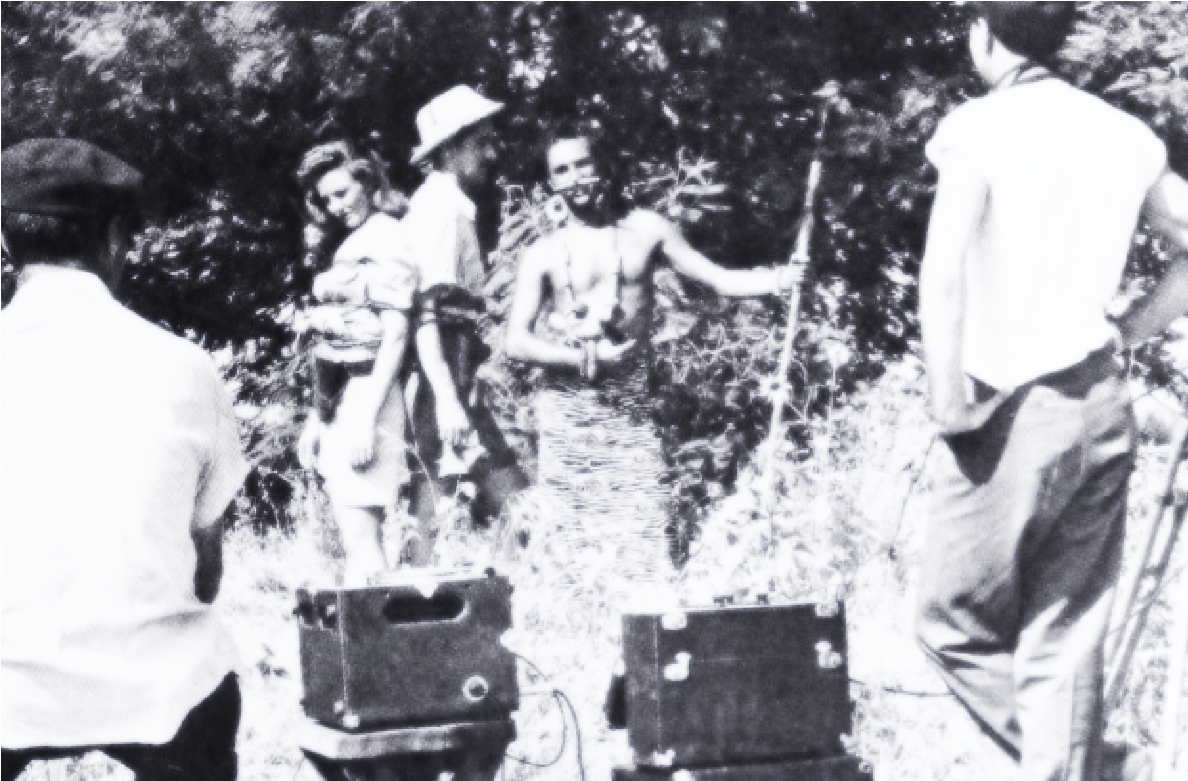
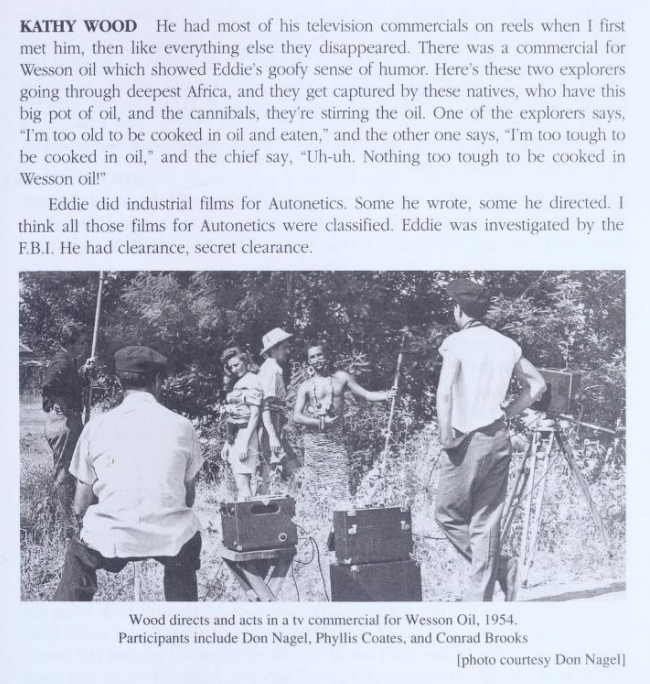
Ed Wood (center, wearing pith helmet) shills for Wesson Oil in 1954.
There are a lot of lost treasures in the Ed Wood canon—various films and writings that have gone missing over the decades. But which is the ultimate holy grail, the one piece of "Ed Wood lost media" I'd most like to rediscover? Is it Ed's early 1960s training films for Autonetics? His manuscript for the biography Lugosi: Post Mortem? Any of those made-for-TV productions he put on his resume, with titles like The Little Old Lady from Pasadena? That record of "The Day the Mummy Returned" he made with Tor Johnson?
All tempting choices, to be sure, but I'd like to suggest another, less obvious candidate: his lost 1954 commercial for Wesson Oil. Why this one? Well, unlike many of the projects Ed Wood claims to have worked on, the Wesson ad was all but certainly real. While Eddie was staggeringly prolific, both as a filmmaker and a writer, his inflated resume is dotted with projects that only ever existed in Ed's alcohol-soaked imagination. The 1954 cooking oil ad, however, is fairly well-documented.
Let's take a close look at an excerpt from Rudolph Grey's Nightmare of Ecstasy: The Life and Art of Edward D. Wood, Jr. (1992). On page 125, as a part of a chapter called "Idea Man," Grey includes an anecdote from Ed Wood's widow, Kathy, and a photograph supplied by actor Don Nagel.
An excerpt from Nightmare of Ecstasy related to the Wesson ad.
Okay, plenty to talk about here. First, Kathy says that Ed had a reel of his TV commercials that subsequently "disappeared." We already know that, starting in 1949, Ed Wood started making TV commercials as part of some half-baked business plan. He'd make low-budget, generic commercialsbefore actually being hired by any companies, then sell those commercials to advertisers. Instead of making an ad for a specific used car dealer, for instance, Eddie made an ad for used cars in general—like the basic idea of buying preowned vehicles. Unsurprisingly, this didn't work.
The Wesson commercial hasn't turned up yet, but at least four of Eddie's commercials can still be viewed today. And, blessedly, they're like mini-Ed Wood movies, each with its own plot and characters. Eddie himself plays a leading role in one of them ("Magic Man").
I imagine the lost Wesson spot is in a similar vein, especially given Kathy's description. Notice, however, that between 1949 and 1954, Ed changed his strategy a little when it came to advertising. Instead of generic commercials for no specific sponsor, Eddie was now tailoring his commercials to specific companies. I am certain that Ed's Wesson spot was made on spec and not commissioned or sanctioned by Wesson in any way. Why? Well, here's what an actual Wesson commercial from the 1950s looks like:
As you can see, it's nothing like what Ed Wood was trying to do with his Wesson ad. But Kathy's synopsis of the commercial raises a few more questions. She mentions two explorers, one who's "too old" and one who's "too tough." But take a look at the photo supplied by Don Nagel. There are indeed two explorers tied up by natives, but neither one looks particularly old or tough. In fact, one is a lovely woman played by Superman actress Phyllis Coates, who had previously worked with Eddie on The Sun was Setting (1951). And yet, Kathy's description of the dialogue in the Wesson commercial is too specific to have been totally imagined.
I guess the only way we're going to solve this mystery is to track down a copy of that Wesson commercial and view it for ourselves. Hey, Ed Wood rarities keep showing up. Why not this one? Let's search those vaults, America!
For very personal reasons, the Old Spice ads make me feel sad.
Not an actual Nazi.
The actor in the goofy, over-the-top Old Spice adsis Isaiah Mustafa. That name is branded into my memory for the weirdest, saddest reason ever.
You see, a few years ago, I was a regular member of an online movie discussion forum where that actor's brother was also a frequent participant, much more active than I was. He was very proud of his brother's career and would occasionally post updates about what Isaiah was up to. All very nice and positive stuff. No problem there.
Unfortunately, one day there was a thread on the forum about the use of terms like "grammar nazi" and whether they were offensive and should be avoided or banned. I argued that history was full of infamous, real-life people whose names eventually became figures of speech. I cited, I believe, Attila the Hun as an example. As events recede further into the past, I argued, they become more and more abstract, so it is inevitable that they will take on symbolic meaning. A character like the "Soup Nazi" on Seinfeld is not intended as a literal member of the National Socialist Party, and there is no implication of antisemitism in his portrayal. The epithet merely means that he is very focused on rules, neatness, and absolute control. Banning terms like "grammar nazi," then, is ultimately futile. It's just how language works. Eventually, the "n'" in "Nazi" will be lower case. I still feel that way. You may not.
One person who definitely disagreed with me on this point was the Old Spice guy's brother. He accused me of being, in essence, a Nazi sympathizer or Nazi enabler, if not an actual Nazi myself. It was, unequivocally, the nastiest thing anyone has ever said about me, online or offline, in my entire life. (And I was once a customer service rep for a major automobile manufacturer, so I've been called plenty of nasty names.)
I was shell-shocked. At the time, I still felt that online forums actually mattered, so I responded to this attack with a lengthy, heated post in which I accused the Old Spice guy's brother of being blinkered and dogmatic to the point of being unreasonable. I refrained from implicating him in the deaths of 6 million Jews, however, a kindness he did not extend to me. I don't believe the dust-up between us ever came to any sort of agreement or peace accord. We both just kind of gave up on it and never directly interacted again on that now-dormant forum. To this day, I cannot sit through the Old Spice ads without feeling an awful mixture of embarrassment, anger, shame, and regret.
The unmistakable Bradbury Building in a commercial for Twix.
This has been a weird week for me and candy commercials with ties to cult cinema. On Wednesday, I told you about a York Peppermint Pattie ad obviously modeled on Requiem for a Dream, and now I'm writing about a Twix ad filmed at one of the most prominent locations from Blade Runner. What can I say? The internet keeps making me sit through pop-up ads for candy, and this is the result.
Specifically, a 2014 spot for Twix called "Factory Tour" was filmed at the historic Bradbury Building in downtown Los Angeles. If you've seen Los Angeles Plays Itself, you already know all about this place, but even if you haven't, you've likely seen it in a movie or TV show. Completed in 1893 and designed by Sumner Hunt and George Wyman, the Bradbury is the oldest architectural landmark in L.A. It has been a popular filming location for decades due to its distinctive look: plenty of oak, wrought-iron railings, geometric staircases, and a giant skylight.
Though Ridley Scott used the hell out of it in Blade Runner, the Bradbury has stood in for any number of buildings in TV and film over the decades, giving off a vibe which is simultaneously elegant and seedy. And that's just how it looks in the otherwise-lighthearted Twix commercial, where it's supposed to be a candy factory. Note how the oppressive and foreboding atmosphere of the building completely dominates the 30-second commercial. The actors seem to know that they're in the belly of a pitiless and insatiable beast. Doesn't that just make you want to run out and buy some Twix bars?
Quick! Is this shot from a candy commercial, a harrowing depiction of drug use, or both?
File this under "too bizarre to be real, yet too random to be made-up." York Peppermint Pattie, a product of the candy kingpins at Hershey, has an ad called "Environmental Connection" which seems uncomfortably close to the famous, much-parodied "getting high" montage from Requiem for a Dream, Darren Aronofsky's bleak 2000 film about drug addiction. Judge for yourself, though. Don't let me unduly influence you.
Here's the ad:
And here's the corresponding scene from Requiem for a Dream:
It's not just me, right? This is totally intentional, right? The quick cuts, the gasping for breath, the close up of a dilating pupil. It's all taken directly from Requiem for a Dream. The message isn't really even all that subtle: "Look, fatty, we know that chocolate is your heroin. Don't try to pretend that you have free will. You're our junkie slave, and you know it! Now have another York Peppermint Goddamned Pattie!"
One of the (many) great disappointments of my youth was that my mother never once bought Imperial margarine at the grocery store. I'm not sure which brand we used, but it wasn't Imperial, that's for sure. I always wanted to try this perfectly-ordinary butter substitute so that, upon eating it for the first time, an Edward-the-Confessor-type crown would magically appear on my head and I'd hear the familiar regal fanfare, just like the people in the TV commercials. I was understandably curious, too, about Parkay and its mysterious talking tubs of oleo. But Imperial held the greater fascination. Imagine being one dinner roll away from becoming royalty! Did the crown come with any attendant power, I wonder? Did you get to keep it, or did it vanish once you became acclimated to the taste of Imperial? So many, many unanswered questions.
Excerpt from a vintage print ad for Bonkers fruit candy. Artwork by Mort Drucker.
Someone saved on old strawberry Bonkers wrapper.
Does Nabisco even make candy anymore? Cookies, yes, but candy? I don't know, but they sure gave it a whirl in the go-go, profit-hungry 1980s, when every consumerist dream seemed within tantalizingly easy reach. I can imagine the marketing meetings that must have occurred then, with a slick Gordon Gecko type giving his sales pitch to the honchos at Nabisco: "I can practically taste that allowance money, boys! All we gotta do is take it right out of their sticky little hands!"
Back in 1983, to that end, the National Biscuit Company introduced its ultimately-unsuccessful answer to competitor M&M/Mars' Starburst: Bonkers fruit candy. Chewy and gum-like in consistency, these artificially-flavored, chemically-saturated, rainbow-colored treats came in longish, skinny foil packages, just like Starburst. But Bonkers were thicker and chunkier, and each individual piece contained a core which was darker and denser than the lighter-colored outer layer. "Chewy outside, super fruity inside!" is how the ads explained it.
I wish I could tell you to toddle on down to your local drug store or gas station and pick up a package, but that's not possible. After a few years of mid-'80s popularity, Bonkers fell out of favor and were thereafter found only in specialty candy shops. Nabisco phased the brand out sometime during the 1990s. Another candy wannabe had bitten the nougat, so to speak.
Bonkers revivals have been in the offing for the last decade or so, but nothing substantive has come of it. A nostalgia-minded confectioner called Leaf Brands, whose other products include Astro Pops, Wacky Wafers, and (ahem) Farts, purchased the Bonkers name most recently, circa 2012, and promised to bring back the beloved candy -- with additional flavors, no less. As of this writing, all Leaf Brands has done is brag a little on social media, posting to a Bonkers Fruit Chews page on Facebook as recently as April 22 . The company's self-imposed 2014 deadline for getting the candy back on store shelves was decidedly unmet, however. Here, to drive you mad, is a link to Leaf's page for Bonkers. Their current alibi? "We are in the process of acquiring the machinery needed to wrap these amazing fruit chews." A likely story, Leaf. No new Bonkers have been forthcoming.
Previously, in 2004, a company called Joyco briefly released its own Bonkers candies, but these bore no resemblance to the Bonkers of old, leading to dashed hopes and bitter disappointment for children of the '80s.
As fondly remembered as the candy is, it cannot compare to the popularity of the TV and print advertising campaign for Bonkers. Rather like Burma-Shave, with its famous rhyming highway signs, Bonkers was a case where the promotion easily overshadowed the product. Bonkers' commercials, which debuted in '83 along with the candy, memorably centered around a demented Southern housewife -- most online descriptions call her an "old lady," but I'd say she's no more than middle-aged -- who generally speaks in a monotone directly to the camera. Try as I might, I could not find the name of the actress who played this part so wonderfully and with such gleeful malevolence. There is some speculation on internet candy forums (yes, such things exist) that it's Lily Tomlin from Rowan & Martin's Laugh In, but it's clearly not. The character may well be inspired by Tomlin, who played the vaguely similar Ernestine the Telephone Operator, but it's not her.
The Bonkers lady
Anyway, the commercials are all set in some weirdly antiquated, early 20th century version of the Deep South. Thirty seconds at a time, they give us a glimpse of a disturbing alternate universe where eating Bonkers candy causes giant pieces of fruit to come crashing down from the sky. Pop an orange-flavored Bonkers into your mouth, for instance, and within seconds you will find yourself crushed by an orange the size of a Volkswagen.
Victims of a typical Bonkers blitzkrieg are not only pinned to the ground under Brobdingnagian strawberries and watermelons but are also overtaken by maddening, incessant laughter. "Bonkers," the ads explain, "bonk you out." The candy's very name betokens its mind-scrambling effects. Meanwhile, the victim's home has been utterly destroyed by the falling fruit. There is rubble, debris, and smoke everywhere. So Bonkers promises a delicious fruity taste along with incurable insanity and massive property damage. No wonder kids adored these commercials. They promised chaos, which children love nearly as much as sugar.
At the center of it all is our prim, apron-wearing Dixie hausfrau, the only one who seems to know the true, incredible import of eating Bonkers candy. Is she disturbed by the terrible consequences of ingesting the fruit-flavored cubes? Not at all. The stiflingly old-fashioned world she inhabits -- a snoozy place where the only "entertainment" is an upright piano in the parlor -- is so straight-laced and circumspect that she semi-secretly welcomes the anarchy brought on by Bonkers candy.
Curiously, this woman is surrounded by doubters, skeptics, and naysayers who do not understand the awesome and terrible power of Bonkers. Their ignorance gives her a great deal of smug satisfaction, since she knows what's going to happen and they don't. "Some folks think Bonkers is gum," she intones in the most famous Bonkers ad. "They know it's candy now!" When we kids imitated these commercials in the schoolyard back in '83, this was the line we quoted to one another. At this moment, the housewife is like the token oldster in a horror movie who tries to warn the youngsters that they're headed for disaster. They never listen, of course, the fool kids. But even our savvy housewife is not immune to the wrath of Bonkers! She slyly ties to cheat fate by side-stepping the falling fruit, but to no avail. Soon, she, too, is lying helpless and prone beneath a bunch of grapes the size of beach balls. "Some candy!" she manages to get out between fits of laughter, the Bonkers-induced madness having claimed her.
Here, for your enlightenment, is a selection of mid-1980s TV commercials for Bonkers, all featuring the same superlative actress. It is perhaps best simply to enjoy the deadpan, cartoon-like surrealism of these spots and not dwell overmuch on their disturbing implications. Surely, in the Bonkers-verse, there must be occasional fatalities from the relentless fruity onslaught. And imagine the weary rebuilding which must take place in between commercials. How could construction workers, plumbers, electricians, and carpenters possibly put their hearts into their labors, knowing that all of their efforts could be wiped out in mere seconds by anyone with a sweet tooth and enough pocket change to buy a pack of Bonkers?
One wonders, too, about the role of religion in this world. Certainly, as conservative Southerners, these characters would be regular Christian churchgoers. But how could you continue worshiping God in a world where giant berries were constantly raining down from the sky, destroying your humble property? Would you assume that Bonkers had power greater than that of God, or would you conclude that God Himself was acting through Bonkers, using the fruity delights as his instruments of wrath? These ads raise so many theological questions.
So persuasive were these ads that, apparently, some young and very impressionable viewers were taken in by them completely, not realizing that trickery and exaggeration were being employed in this fiendish marketing campaign.
On YouTube, I found a seven-minute-long testimonial by a now-grown man who learned the hard way that television advertisements do not always tell the truth. As a 7-year-old child, he convinced his parents to buy him a pack of watermelon-flavored Bonkers, only to learn to his great disappointment that eating the candies did not cause gargantuan watermelons to descend from the sky onto the roof of his parents' Chevy Malibu. "I unwrapped the package of Bonkers," he recalled, "took out a piece of that watermelon flavor, popped it in my mouth, and started chewing. And I waited. No sound from above. No crashing. I don't hear anything. Oh, what happened? Where's my giant piece of fruit?" Eventually, after the boy burst into tears, his mother let him know the truth: "Honey, it was just an advertisement." Bonkers, then, taught this young man an important, if unpleasant, lesson about the way the world really works. I'd say, in a weird way, he actually got his parents' money's worth and more.
Print advertisements for Bonkers.
Before I let you go, I'd like to mention the concurrent print campaign for Bonkers. This, too, was memorable in its own way and helped create a strong brand identity among candy-crazed young people. During those peak Bonkers years of the mid-1980s, Nabisco advertised the product heavily in comic books. Apart from a few Marvel titles like The Amazing Spider-Man, I was pretty much a die-hard DC reader in those days, gorging myself on Action Comics and Justice League of America, and I can remember seeing such ads many times back then in those publications.
Our disillusioned YouTuber up there remembered the comics ads, too. At one point in his tale of woe, he holds up a familiar-looking example. "Let me show you the ad," he says. "You may even recognize this, that appeared on the backs of comic book and at the checkout shelves. It says, 'BONKERS! FRUITY CANDY HITS YOU WITH A NEW FLAVOR!' And you see the old lady from the commercial, a portrait of her there with the watermelon laying across her and the different flavors."
Indeed, the mysterious housewife from the television commercials was represented via caricature in the print ads, putting her in the company of such cartoon mascots as Charlie Tuna and the Vlassic stork. When I wasn't watching cartoons as a kid, I was reading comic books, so this strange lady was never far from my mind in those days. And neither, consequently, were Bonkers candies. In my research for this article, I discovered -- to my utter delight -- that one of these ads was drawn by Mort Drucker, my favorite cartoonist from MAD Magazine. He didn't sign his Bonkers work, the way he did with his Shrunken Head Apple Sculpture ad (another comic book staple), but he scarcely needed to do so. Those hatch-marks on the lady's cheeks are unmistakable, and those blissed-out background extras are pure Drucker. Enjoy.
This Bonkers ad by Mort Drucker would certainly get me to buy the product.
This dude wears a vest just to study! That's fancy!
Memory's a funny thing. There are now long, long stretches of my life that are little more than a blur in my mind. But, come what may, I will in all likelihood never forget the opening line of a 1981 television commercial for an unsuccessful candy bar.
In the oft-replayed ad, a bespectacled, curly-haired young man sits at his desk, slaving over a stack of books, a pencil clutched in his hand. It must be fairly late, because he is working by lamplight, and the cluttered room is otherwise dark and shadowy. In frustration, unable to cope, the fatigued scholar sets down his pencil, takes off his glasses, and addresses the camera in an anguished fashion: "Homework! Homework! Give me a break!" The voice-of-God announcer then suggests that what the lad needs is a Summit candy bar. A few "candy porn" shots later, the young man takes, eats, and is satisfied.
This little-remembered confectionery was a product of the Mars candy bar company during the early years of the Reagan administration. Essentially Twix with peanuts, the ironically-lowly Summit bar lasted only a few years, including a half-assed 1983 makeover, before being yanked from store shelves.
But the iconic Summit TV commercial survives on YouTube, fortunately. That inimitable opening salvo -- "Homework! Homework! Give me a break!" -- became something of a catchphrase in the Blevins household. We'd say it well into the late 1980s, long after the Summit bar itself vanished from the American scene. The color has badly faded from this print, but the famous lament is intact.
In reviewing the 30-second spot,I realized I had forgotten the commercial's delirious second half, in which a young woman, also a student, finds herself utterly overwhelmed by hormone-crazed male suitors, all of whom accost her in the school hallway to ask her to "the game." She, too, begs to be given "a break," at which point the boys produce -- seemingly from thin air -- a barrage of Summit bars, all of which they point directly at her face. A greedy, ravenous look overtakes our heroine.
The moment fairly drips with sexual suggestion. The screenshot below looks like a behind-the-scenes shot from a porno film in which all the dicks had to be CGI'd in during post-production because the leading lady had a "no dicks near my face" clause in her contract.
And she grew up to be Lady Gaga... so that's interesting.
This is the huge, orange face America eventually grew to love.
Prefatory notes by the author: "Larry" was actually written back in 2008 when there was such a thing as Larry King Live on television. The way it came about was that I was browsing through CNN's website and found some old Larry King transcripts there. Reading through them, I realized that Mr. King's particular brand of rambling, disjointed insanity was even funnier when soberly transcribed word for word. Believe me, what you're about to read is only a mild exaggeration of an actual King interview. Also, back when I wrote this, I was a professional transcriptionist and spent many hours and days and weeks of my life listening to recordings of focus groups and telephone surveys and converting them into text documents. So I was in complete sympathy with the person who had the task of transcribing Larry King Live. By the way, woodchucks are funny to me for some reason. Enjoy.
Stan "The Man" Freberg: Floats the jokes right down the drain! (And "pay radio" did come to pass!)
Somehow, I wasn't ready for the death today of Stan Freberg, even though the man was 88 and had been in failing health for years. All I know is that yesterday, there was a Stan Freberg, and today there isn't one. So today loses in a landslide. A comedian, satirist, radio star, voice actor, singer, songwriter, puppeteer, TV pioneer, and game-changing ad man, Stan was a wizard with words. But words are failing me now, as I try to describe what Mr. Freberg's work meant to me and why it was so important to the history of comedy.
I don't want to fall back on that label of "influential." Yes, it's very nice that he was influential on several generations of fans, some of whom grew up to create music and books and movies of their own. "Weird Al" Yankovic is probably Stan's most famous acolyte, and the two got to work together in the 1990s on CBS' short-lived Saturday morning offering, The "Weird Al" Show. Many more Stan fans probably went into advertising themselves and enjoyed the creative freedom he helped make possible with his innovative "soft sell" campaigns. His ads still work! In particular, a decades-old spot for the Milky Way candy bar created in me an irresistible craving for Milky Ways, even though it's not a product I normally purchase. Stan should've gotten a commission on that sale.
But, still, I say phooey to that "influential" jazz. That word makes it seem like Stan Freberg's whole purpose on this earth was to provide an example for others to follow later, like he was a means to an end. Stan was not a means to an end. He was the end!. His work provides plenty of pleasure on its own, well beyond its historical importance. I should know. I have several hours of his material on my iPod, and it is rare that a week goes by that I don't listen to some of it.
I hardly know where to begin in recommending his work to you. Maybe Three Little Bops, a jazzy little cartoon he voiced for Warner Bros in 1957? Something from Stan Freberg Presents the United States of America, perhaps? (There, I'm partial to "A Man Can't Be Too Careful What He Signs These Days" with Stan as a curmudgeonly Ben Franklin with serious qualms about affixing his name to the Declaration of Independence.) I could point you in the direction of his brief-but-brilliant CBS radio series, The Stan Freberg Show or one of those masterful sides he cut for Capitol Records, like "St. George and the Dragonet" or "The Banana Boat Song (Day-O)" or even "Widescreen Mama." (Sample lyrics: "Widescreen mama, don't you Cinerama me!")
All of these things are Stan, and yet none of them "are" Stan. He was a complicated guy: multi-faceted, multi-talented, and multi-media, though he loved radio best of all. Maybe I'll just play you the record that turned me from a Stan Freberg fan to a Stan Freberg fanatic. It's called "The World Is Waiting for the Sunrise," and it's a parody of a then-current hit by Les Paul and Mary Ford. He leaves the lyrics of the original song intact, more or less, and instead chooses to spoof the fussed-over, studio-perfected sound of the record. Here, just listen:
"Look out!!! The equipment is smoking!!!!! Run for your life!!!!'
"Oh my god, I think I'm gonna cryyyyyyyyyyyyyyyy!"
In their infinite wisdom, the gods who run the internet have decided that I must sit through the Clearblue Advanced pregnancy test commercial several dozen times each day. Why, internet gods, why? What did I do to offend thee? Whenever I click on a video or article these days, I brace myself for that insipid music, that stilted acting, that dreary dialogue. Keep in mind, I have now seen this commercial more times than I've seen all my favorite movies put together. I should have it memorized by now,
There are a few different versions of this commercial floating around. The shortest edit mercifully cuts down the dialogue by a few lines, for example, but adds an uncomfortably long, text-only, oppressively silent disclaimer at the end explaining that this particular pregnancy test is not meant to take the place of a visit to a real doctor and that, if you use it, your child has a 40% higher chance of being born with either more or fewer fingers than what is considered "normal."
Either way, you get the basic plot here: two textbook "basic bitches" sit across a kitchen table, and one reveals to the other that she is two weeks pregnant, causing the other to squeal with delight. And how does the baby-mama-to-be know the number of weeks? With the Clearblue Advanced Pregnancy Test with Weeks Estimator™, of course! It seems pretty benign, and it only lasts 15 seconds. So why do I hate this ad so much? Let me count some of those ways.
This ad's color scheme: taste the rainbow.
The music. I mentioned this before, but the background score is beyond wretched. There's no integrity to it whatsoever. I mean, just listen to it! It's this sappy, wussy, "la la la," frou frou frippery, the musical equivalent of low-fat yogurt with no fruit on the bottom. And I think part of the melody is swiped from the "Every kiss begins with Kay" jingle from Kay Jewelers. At least those ads have the decency to include Jane Seymour, a lady of character and taste, rather than these two colorless ninnies. And speaking of color...
The overall production design. I know that Clearblue has "blue" in the name and that the company's business model is founded upon baby-making, but even so, the "baby blanket blue" color scheme in this ad is oppressive to my eyes. I mean, the clothes, the walls, the furnishings, and even the actresses' faces and arms have this pale, washed-out blue tint to them. This whole commercial looks like it got badly faded on laundry day. And, of course, the women in this world don't eat, so what do they do with their plates? Stick 'em on the wall, of course! Gah! What awful parallel universe is this? Because it certainly doesn't look like any place on Earth.
The acting. I can't decide whether the acting in this commercial is subtly brilliant or not-so-subtly terrible. If these women are supposed to be actual friends who really do care about one another, then the acting on display here sucks eggs. But, on the other hand, if the subtext here is that these women secretly hate each other and can barely disguise their contempt for one another, the acting is pretty good. Because that's what comes across when Not Pregnant Lady covers her face to deliver the commercial's big line: "Oh my god! I think I'm gonna criiiiii-yeeeee!" On the outside, she's pretending to smile. On the inside, she's screaming, "I hate you! I hate you! I hate you!" But I'm pretty sure these women are genuinely supposed to enjoy each other's company, so I'm going to say that the acting is lousy.
The women themselves. One of my favorite hobbies is making snap judgments about people based on just fleeting first impressions and very little actual evidence. So, of course, that's what I did with the women in this commercial. I've judged them and found them guilty on a number of charges. Specifically, I have decided that these two ladies are the poster children for "basic bitchery" in the social media era. Their lives revolve around yoga, North Face jackets, UGG boots, pumpkin spice, and their own smartphones. And what do they do to relax? Well, they sip overpriced coffee from giant white mugs in a hermetically-sealed kitchen and natter on about the joys of getting knocked up.
So there you have it, folks. I think the evidence is all there. The Clearblue Advanced pregnancy test commercial is a flagrant and unmistakable violation of the Geneva Convention. Its cast and crew should be soundly horsewhipped for a period of no less than 15 consecutive hours. Thank you.
When you saw this cat, that meant the show was over, man.
TV theme songs are dying, and Madison Avenue is killing them. Thanks to an ever-increasing number of commercials allowed per half hour by the FCC, the old standard 24-minute television episode was shortened to a mere 22 minutes.
The incredible shrinking sitcom wasn't done with its reverse growth spurt yet! The average new episode of a supposed half-hour comedy now clocks in at something like 20.5 minutes, with the other 9.5 going to ads for Geico, State Farm, All State, Nationwide, Esurance, and many other insurance companies, all of whom truly love and care about you, really. That's not even counting the time devoted to product placement during the episodes themselves. ("Your mother-in-law is coming for two weeks? Where's she gonna sleep? On our $499 Karlstad beige natural sofa from Ikea?")
With the insatiable admen gobbling up more and more of each program, TV sitcoms now have less time to themselves to, you know, actually tell the little stories they're supposed to tell. As a result, the once-vaunted TV theme song -- for my money, one of the great art forms of the 20th Century -- is now an endangered species, either cut down to just a few seconds or even removed entirely.
And those are just the opening theme songs! What about the distinctive closing theme songs that TV shows used to have? I'm afraid those truly are a goner. But before they disappear from our screens and our memories forever, I thought I'd give a rundown of some personal favorites. WKRP IN CINCINNATI (1978-1982)
No discussion of great closing theme songs could ever be complete without mention of the famously-incoherent, famously-awesome closing tune from WKRP in Cincinnati. Composed and performed by a quirky Atlanta musician named Jim Ellis, this unhinged, almost animal-like ditty is forever lodged in the subconscious memories of countless baby boomers and Generation X-ers, many of whom lost precious hours trying to decipher the lyrics. They need not have bothered: Ellis never came up with actual lyrics for the song (whose only known title is "WKRP Close"), so he muttered some nonsense with a few intelligible words like "bartender" thrown in. The song becomes like an audio Rorschach Test. You hear in it what you want to hear.
THE BRADY BUNCH (1969-1974)
Pretty much all the 1960s and 1970s shows associated with producer Sherwood Schwartz, including Gilligan's Island and It's About Time, have better-than-average theme songs. Schwartz took a particular interest in this aspect of his programs, often writing or co-writing the themes himself. Maybe the most indelible and diabolical of his creations is the instantly-familiar theme song for what is, hands down, the corniest family sitcom of all time, The Brady Bunch. I must have loved this show when I was a kid. For years, it was a favorite in syndication, and I can remember watching the reruns on pretty much a daily basis. I'm sure I've seen every Brady episode at least two or three times apiece. Maybe I was tuning in just to hear the funky, organ-accented instrumental version of the theme which ran over the closing credits.
SESAME STREET (1969- ) One place where the theme song will never, ever die is PBS, namely because they don't have to deal with TV commercials and can fill up their hours and half-hours with more actual content... that is, when they're not begging for pledges like common panhandlers. Like most of you who grew up in front of the idiot box, I have especially fond memories of Sesame Street. I was in it for the puppets and the cartoons, baby, not all that "ABCs and 123s" jazz. Whatta show. It was like a Saturday Night Live or Monty Python for preschoolers. And thank the good lord and savior Jim Henson that I got in and out before the onslaught of Elmo and all he stood for. Anyway, the end of each Sesame Street episode was always a mixed blessing for me as a kid. While I was sad to the see the episode expire, leaving me to the tender mercies of The McNeil-Lehrer News Hour or some such, I was psyched to hear the superbad closing theme music.
Though just about every aspect of the Muppet universe has been captured in excruciating detail, there is precious little information available about this song. It's considered merely an instrumental version of Joe Raposo's opening song, but it strays quite far from its progenitor. Some fans have nicknamed it "Funky Chimes," though, and MF Doom sampled it on a typically spacey track called "Kookies."
ARCHER (2010-)
Another place where theme songs will never die is animated cartoons. Animation is slow, expensive, and complicated to produce, and theme songs help to eat up time. Have you noticed that most long-running animated shows (The Simpsons, Family Guy, South Park) tend to have fairly elaborate title sequences? The longer the theme, the shorter the rest of the show. FX's spy spoof Archer has a great title sequence of its own, but perhaps even more memorable is the hep, swingin' tune which plays over the end credits. "The Killer" by Mel Young and His Orchestra was not written or recorded especially for the series. It's a piece of stock music dating back to the 1960s. I wish I could tell you more about Mr. Young, but I can't find much about the guy. But here's another Mel Young track called "On the Beat."And here's something by Mel called "Stockpot" from 1968.
Did you hear the oneabout the nun who joins a very strict convent and is only allowed to utter two words every ten years? Well, our nun survives ten difficult years there and then reports to the Mother Superior's office to say her two precious words. "Food bad," she says before quietly returning to her cell. Ten more miserable years pass, and the nun says, "Bed hard." After ten more grueling years, the nun can take no more. She says to the Mother Superior, "I quit." And the Mother Superior replies, "Well, no wonder! You've been here thirty years, and all you've done is bitch, bitch, bitch."
I can relate to the nun in that story because I, too, have to ration my spoken words sometimes. I'm one of those people who get sore throats very frequently, on average of once a month. I've been to various doctors about it, and there's never been much they can do. My sinuses drain into my throat or something, I've been told. Don't worry. The problem is well under control. I can always feel when these flare-ups are coming, and there are steps I can take to treat the symptoms and shorten their duration. It's not fun, exactly, but I'm managing very nicely.
No talking, please. PLEASE!
This condition has been a part of my life for about 20 years now, and one thing I have learned is that the less I talk, the better. Even when I am healthy and feeling great, my voice gives out very easily. You can see how something like this could have affected my past careers as a teacher and as a customer service rep. One of the great features of my current job is that there is very little talking involved. Oh, sure, there's the usual banter and chit chat, and there are certain occasions when actual conversation is more efficient than e-mail. But there are also long stretches of each day when I don't have to say a solitary word. These sore throats generally last three to five days. I can always tell when the flare-up is "peaking," and on such days, I try not to talk at all and communicate solely through e-mail and handwritten notes. This is not unusual for our department, since one of my coworkers is a deaf-mute and does most of her communicating this way.
The only problem is that, at heart, I am a know-it-all and smart-aleck who has to resist the urge to chime in with an opinion about any given topic. If you've ever discussed something with me online, you know that I am capable of burying you in paragraphs upon paragraphs of rhetoric. Under the right circumstances, I can be like that in person, too. I have to suppress that part of my personality on "sore throat" days. But sometimes, that's not an option. Today, for instance, was my weekly therapy session. It was the only talking I'm going to do today, but it was an hour of almost nonstop wear and tear on my vocal cords. Right now, my voice is absolutely shredded, but it was still worth it since I need my weekly opportunity to vent. Random childhood memory: For a few months when I was in junior high, my friends and I became obsessed with a very low-budget commercial for one of those cheesy "golden oldies" compilation albums called Fun Rock. The ad seemed to be in nonstop rotation on local TV until we'd memorized it like members of a cult reciting from some sacred scripture. Almost a quarter of a century later, I can still remember the announcer's hysterical opening spiel: "Remember when rock had no message, no meaning, no nothing but PURE FUN?!?!?" One kid down the street, Andy, went so far as to get his parents to actually order the album for him. It took up, as the ad proclaimed, "three giant cassettes," and I was able to strong-arm Andy into making me copies of two of them on the absolute cheapest, worst-quality blank tapes I could find. Somewhere amid the collected debris of my life, I think I still have one of those tapes.
"I'm Buster Brown. I live in your shoe. Sleep well, children."
A live-action Buster
When you think of Buster Brown, you probably picture those ugly shoes that no kid ever wanted to wear. Fair enough, but much like Skippy peanut butter, Buster Brown shoes were named for a now long-forgotten, theoretically lovable cartoon tyke from the early decades of the 20th century.
Created by comics innovator Richard Outcault, the man often credited with inventing the comics form itself, young Buster Brown and his canine companion Tige had their own newspaper strip from 1902 to 1921 and subsequently appeared in live-action short films, Broadway plays, radio shows, and even a television series. All of those trickled away by the time the 1960s rolled around, leaving the shoe business as Buster's only lasting legacy.
The lad started endorsing shoes in 1904, nearly from the beginning of his career, and he'sstill at itover a century later. In case you're curious about the character behind the shoe commercials, Buster was a well-to-do but mischievous lad who had a taste for low-level chaos despite his rather prissy appearance. In each story, he would get into some kind of comical shenanigans and would receive his comeuppance in the form of a spanking, yet he would never learn his lesson or reform his ways for long. One of his trademark bits was to make a ridiculous pronouncement on some matter and then declare that matter to be "resolved." In fact, "Resolved!" became Buster's catchphrase.
So... all in good fun, right? A harmless piece of Americana, right? WRONG! As the following pictures will prove, Buster Brown is the most horrifying hellbeast ever devised by man. He has the piercing stare of a psychopath, a fact that contrasts hideously with his weirdly formal, effeminate appearance. His dog, Tige, is no better -- a snarling, gargoyle-like creature with the mouth of a shark and an eerie fixed gaze matching that of his master.
Read on at your own peril, gentle traveler.
Still believe in God? How about now?
The full-color version of this was too gruesome even for this site!
Yes, Jerry Maren was in the Lollipop Guild. No, that doesn't help.
And it's sharp and pointy, too! Perfect for stabbing!
Surely, that's red paint. What else could it be?
Buster won't take "no" for an answer.
"Why so serious?"
So unwholesome. So very, very unwholesome.
You can dress Buster! Or he can watch YOU get dressed! Whatever.