Wednesday, October 30, 2024

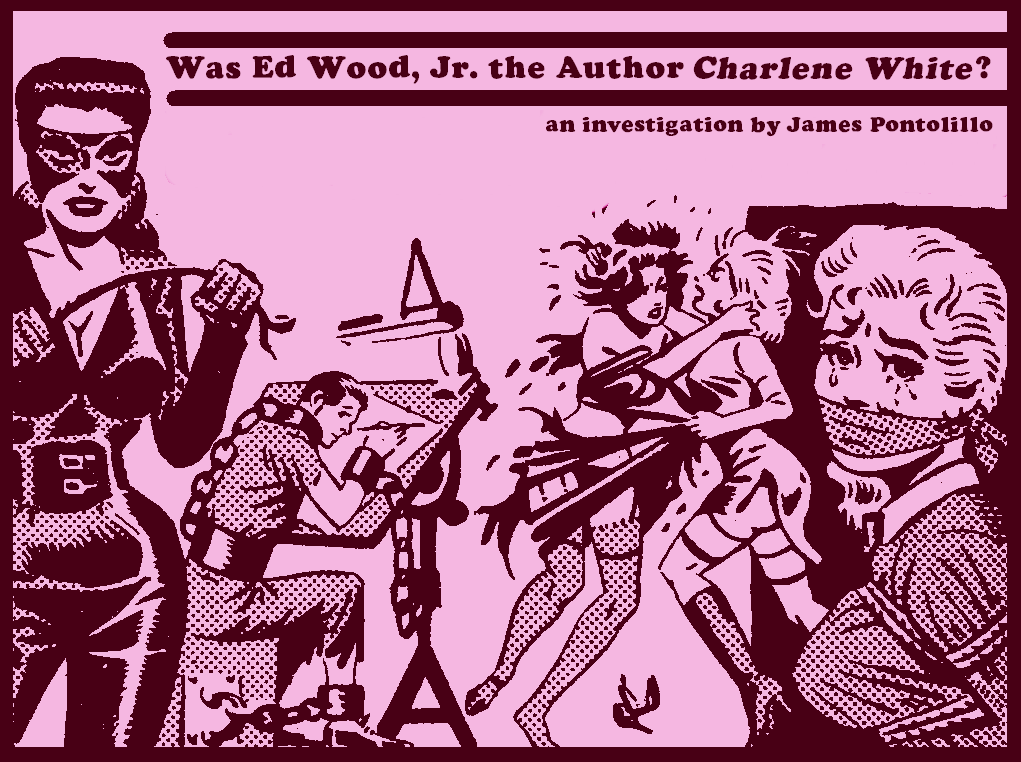
Ed Wood Wednesdays: Was Ed Wood, Jr. the author Charlene White? (Guest Author: James Pontolillo)

Ed Wood had many pen names. Was this one of him?

A copy of the 1966 Charlene White sleaze novel Not So Funny was recently listed on Ebay with an asking price of $950 and authorship attributed to Ed Wood, Jr. But what evidence is there that Charlene White was one of Eddie’s pseudonyms?

Background

In 1966, Satellite Publications (Stanley Malkin and Eddy Mishkin's New York City-based operation that employed multiple other addresses in an attempt to mislead authorities) issued two books by Charlene White: Mask of Evil (hereafter Mask[1] ) and Not So Funny (hereafter Funny; [2]). Both were mass market format paperback originals priced at 95 cents ($9.70 in 2024 dollars) and featured cover art by renowned commercial artist Eric Stanton [3]. The books also included black and white Stanton cartoon work as interior advertisements [4,5]

The print run sizes for these novels are unknown. Sleaze publishers like Satellite treated their paperback books just like the magazines they distributed – limited shelf life with new replacement titles issued monthly. Leftover stock was usually sold at a significant discount to a secondary market reseller. In some cases, the books were returned to the publisher who would strip off the original covers, glue on new ones, and then send them back out to market. As a result, the unwary customer could inadvertently purchase the same book twice.

Mask and Funny are rare collectible books that, due to the Stanton covers alone, currently command prices in the $200-$600 range depending upon their physical condition. Copies sometimes hit the market with considerably higher asking prices ($700-$1000) buoyed by the claim that Ed Wood is the author. Reputable antiquarian booksellers inform customers that this identification is unproven; individual online sellers rarely do so.

My first encounter with the claim that "Charlene White" was one of Eddie's pseudonyms occurred in an online Ed Wood forum/message board sometime around the year 2000. The idea gained significant traction with the 2012 release of Cornell University Library’s finding guide for its Ed Wood Collection. The core of the collection derives from a posthumous donation of works assembled by book collector and science-fiction editor Robert Legault (1958-2008) [6]. It was subsequently expanded with materials donated by writer/editor/publisher/collector Johan Kugelberg [7]. The Cornell collection is the largest publicly available repository of Ed Wood's published works. While Mask is in the collection, Funny is not represented there.

The Books

Mask of Evil cover.
Mask of Evil – This novel follows the sexual awakening and subsequent promiscuous escapades of Brigitte Lamersay, a 20-year-old, perpetually-innocent French nymph as she wends her way through Long Island (NY) high society in search of her adoptive mother’s long-lost American lover. There is a plot amongst all the sexual debauchery, but just barely. Much of the sex is non-consensual, fairly transgressive for the time, and leans heavily into sadism. 

One highlight of the novel is an unusual costume party (men as trees; women as flowers) that quickly degenerates into an anything-goes orgy. This is followed by masked sexual rituals that blogger Joe Blevins described as "Eyes Wide Shut with a brain injury… an enfeebled, lobotomized Eyes Wide Shut. It’s rich people having kinky mask parties." After many adventures, Brigitte finds her man and then a different kind of fun begins. 

The novel initially appears to end with Chapter 14. But after typesetting, the novel would have been 16 pages short of the publisher’s standard book length. So, we are then treated to a new, more complex ending spun out over Chapters 15-17 (meeting the required number of pages) written as if the events of Chapter 14 had never occurred. To complete the reader’s sense of déjà vu and disorientation, the last three paragraphs of Chapters14 and 17 are virtually identical.

Not So Funny cover.
Not So Funny – This novel follows Olga, a well-endowed 18-year-old girl who grows up in a small coal town. She runs away to the big city to escape the clutches of a filthy, physically abusive, and sexually predatory stepfather. While working as a waitress, Olga meets and quickly falls in love with a ruggedly handsome circus animal trainer named Craig. They marry and Olga goes on the road with her new husband. She immediately gains three sworn enemies in the closed community of the circus: her new father-in-law Andrew (who had pledged his son to marry a circus girl), Hilda (the circus girl in question), and Tina (jealous that her brother Karl – for whom she has an incestuous love – is attracted to Olga). 

Much of the novel is devoted to the ins and outs of this swirling melodrama and repeated attempts to undermine Olga in her husband's eyes. The most memorable part of the book revolves around Olga’s friendship with Elmer, a perpetually sad and reclusive clown. One night Elmer takes her in his small clown car to a rundown house in "the village." What transpires there is a phantasmagoric mix of a gay bathhouse encounter and the mirror maze scene from the movie Something Wicked This Way Comes leading to Olga’s sexual humiliation. Ultimately, all of the plots against Olga collapse as death and serious injury are visited upon her rivals by a seemingly just universe. Olga performs an illegal sex act on her husband Craig in the last few sentences of the book, making it clear that they will have a beautiful life together.

Having read both books several times, I have yet to decide whether they were written by the same author. The writing styles are dramatically different with the author of Mask appearing well-educated while the author of Funny seemingly barely escaped grade school. Mask is full of graphic, transgressive sexual acts. Funny is much tamer and, with few exceptions, stays on a "straight and narrow" path, sexually speaking. 

Moreover, Mask is overrun with characters, including many with no role whatsoever in advancing the plot, while Funny has a much tighter focus on eight individuals. The events of Mask take place in real-world locations (Long Island; Pelham, NY; Midtown Manhattan), with the Pelham, NY sequence accurately describing the town's geography. Funny, on the other hand, exists in a featureless void whose locations (the big city, the circus lot, the village) are simplistic generalities that are never described in any substantive way. 

Despite this, the books do share a number of elements: the sexual awakening of a young woman; the grateful sexual abuse victim trope; a similar approach toward introducing nudity and the initiation of sexual acts; orgasms described as planets crashing together (and on one occasion each as a kaleidoscope); repeated instances of sexual sadism; and masked, ceremonial sexual rituals. On this last point, both books feature women dressed as flowers erotically dancing to Tchaikovsky's "Waltz of the Flowers" (from the 1892 ballet The Nutcracker).

Is This You, Ed?

There certainly is a smattering of elements in Mask and Funny that might lead one to think that they were written by Eddie. One of Mask’s main characters has the alliterative name of Randy Ransome/Randon Ransome. Both books contain a sex scene where an orgasm is described as a kaleidoscope of colors, a practice that Eddie used in 17 of his 27 known novels (a rate of 63%; see Sources for the list of known novels). Funny includes a snake element that plays a pivotal role in one of the failed attempts to drive Olga away from the circus. Snakes, in some form, appear in 23 of 27 of Ed’s known novels (85%). 

Finally, there is this inspirational section of text from Mask:
Suddenly, she knew she had to scream. Her lips parted without volition and a harsh, rough sound poured from her. At the same time the young man's breathing became jagged, cutting litany. Infinity became finite and stood still.
Eddie had a penchant for invoking the concept of infinity in his writings.

On the other hand, Eddie never explicitly claimed that "Charlene White" was one of his pseudonyms. Neither Mask nor Funny was included in a list of published works that Eddie generated in the mid-1970s. Nor do they appear similar to the titles of any of his still-missing novels. As the participants on The Ed Wood Summit Podcast #22 concluded, the Wood-like elements in Mask are part of a larger text that was clearly not written by Eddie. His typical obsession with angora, excessive drinking, and a close attention to female clothing are nowhere to be found in either of these novels.

In an attempt to identify diagnostic features in Eddie’s writings, since 2016 I have applied grammar and language analysis tools, as well as statistical measures of word usage and textual complexity, to a group of 27 known Wood novels (see the list in Sources). After several iterations, a group of 45 keywords emerged that are common in Eddie’s novels. His use of this group averages 75% (Side-Show Siren is low at 53%; The Gay Underworld is high at 91%). By comparison, Mask and Funny infrequently use only a handful of the keywords, scoring a paltry 28% and 11% respectively. A twelve-word subset of the 45 keywords is particularly diagnostic because of their very high prevalence in Eddie’s novels.
  • angora, fluff, lovely, pink, sheer, simply, sweater – 100%
  • delight, nylon, panties – 96%
  • furry, negligee – 92%
Mask uses only two keywords of this subset (negligee, pink); Funny does not use any of them.

One final metric that I’ve developed I like to call (tongue-in-cheek) Woodiness. It’s a numerical measure of keyword usage that is prorated to the average use of each individual keyword. Thus, an instance of a more commonly used keyword "scores" more points than a less commonly used keyword. The following plot shows this data [8]. Eddie's known novels have an average Woodiness value of 2754 (Side-Show Siren is low at 1224; TV Lust is high at 5493). In comparison, Mask and Funny score only 176 and 23 respectively. By all measures, these two books in no way resemble Eddie’s known novels.

Mask of Evil and Not So Funny are certainly worth collecting for their iconic Eric Stanton cover art, quirky story lines, and as relics of the battle waged by American publishers to expand the boundaries of our First Amendment protections. But don't collect them thinking they were authored by Ed Wood, Jr. Because all of the evidence is that they were written by someone else.

Sources

  • Brittany A. Daley, et al. (Eds.), 2005, Sin-A-Rama: Sleaze Sex Paperbacks of the Sixties, Los Angeles, CA: Feral House, 287 pp.
  • Charlene White, 1966, Mask of Evil, FN 226, Buffalo, NY: First Niter Books Inc., 157 pp.
  • Charlene White, 1966, Not So Funny, AH 145, Buffalo, NY: After Hours Books Inc., 157 pp.
  • List of 27 known Ed Wood, Jr. novels: Black Lace Drag (1963), Parisian Passions (1966), Side Show Siren (1966), Drag Trade (1967), Security Risk (1967), Watts… the Difference (1967) Watts… After (1967), Devil Girls (1967), Death of a Transvestite (1967), It Takes One to Know One (1967), Suburbia Confidential (1967), The Gay Underworld (1968), Night Time Lez (1968) Sex, Shrouds and Caskets (1968), Young, Gay and Black (1968), Purple Thighs (1968), Hell Chicks (1968), Carnival Piece (1968), The Sexecutives (1968), Toni: Black Tigress (1969), To Make A Homo (1971), The Only House (1972), Mary-Go-Round (1972), Diary of a Transvestite Hooker (1973), Forced Entry (1974), Sex Salvation [Saving Grace] (1975), and TV Lust (1977).
  • A number of Eddie’s well-known works were not included in this list because they were either not novels (e.g., socio-medical studies [The Oralists] and SECS Press collaborations) or they were written under goal-based restrictions that limited the content (e.g., movie tie-ins [Orgy of the Dead], photo novels [Raped in the Grass], and stage adaptations [Casual Company]).

Tuesday, October 29, 2024

Podcast Tuesday: "A Nice Pair of Cupcakes"

The future chick Cupcake (Didi Conn) meets her exact double on The Fonz and the Happy Days Gang.

I'm sure you've heard the theory that, somewhere in this world, there is a person who looks exactly like you. Same facial features, same hair, same body type, etc. There may even be more than one such person. The scientific validity of this is dubious at best, but it's still fun to think about. And it's a great plot device for writers, which is why it has turned up in so many movies, TV shows, plays, novels, short stories, etc. Two lookalike characters could intentionally switch places with each other, or one could simply be confused for the other and get into all kinds of wacky predicaments. Everyone from Charlie Chaplin to Mark Twain has had a go at this kind of story.

The sitcom Happy Days was not exactly immune from clichés and stock situations, but they never did the classic "doppelganger" plot, unless you count the fact that actor Al Molinaro played two characters: amiable restaurateur Al Delvecchio and Al's rarely-seen brother, Father Delvecchio, a Catholic priest. Have no fear, though. The animated version of Happy Days did this type of story at least twice. In Season 1, Fonzie (Henry Winkler) is mistaken for an outlaw in the Old West. Then, in Season 2, Cupcake (Didi Conn) meets her own double in 19th century Siam.

This week on These Days Are Ours: A Happy Days Podcast, we talk about that Season 2 episode, appropriately titled "Double Jeopardy." As usual, we talk about a bunch of other stuff, including Peter Lorre's career and whether or not all the races will blend into one by the 25th century. We'd love it if you would join us.

Saturday, October 26, 2024

Did you know I have a YouTube channel? I do. It's awesome, and you should definitely check it out!

How can I "pivot to video" if no one pivots with me?

If you're reading this article right now, you obviously know I have a blog. Thank you for reading it. But I'm a multimedia, multi-platform artiste, baby. I cover the waterfront. I'm everywhere all at once. I hope by now you're aware of my podcast, which has been going for six years now. (New episode on October 29, by the way.) If you look to the right-hand margin of this blog, you'll see a sidebar with links to all my other social media accounts and places online where you'll find my work. So much stuff there, well beyond the scope of this blog. I'm posting this little article to alert you to the existence of my YouTube channel. Lots of fun, goofy content over there, some of it Ed Wood-related and some not. Check it out and consider subscribing.

Wednesday, October 23, 2024

Ed Wood Wednesdays: A look at Ed Wood's 'A Study of Fetishes & Fantasies' (1973) (Guest Author: James Pontolillo)

Ed Wood gets kinky in this rarely-read 1973 book.
Edward D. Wood, Jr. and Norman Bates, 1973, A Study of Fetishes & Fantasies, Edusex Press ED 113, Los Angeles, CA: Gallery Press, Inc., 191 pp.
In 1973, the wisdom contained in this book commanded the princely sum of $3.95 ($27.98 today). By comparison, a gallon of regular gas was 40 cents, a copy of Playboy magazine was a $1.00, a gallon of milk was $1.31, and a first-class postage stamp would set you back eight cents. Careful editing has never been a hallmark of the adult publishing industry. So it is not surprising that the interior title page bears a slightly different title (A Study in Fetishes and Fantasies) and different author names (Norman Bates and Dick Trent) than shown on the covers. The introduction is also credited to Dick Trent and Norman Bates. As Ed's fans know, Dick Trent was one of Eddie's most commonly-used pseudonyms. Norman Bates, meanwhile, was fellow wage-slave writer Charles D. Anderson. 

An eye-catching front cover.
The book's most noticeable feature (and primary selling point) is its numerous pornographic photos. As one latter-day observer put it: "The photos are quite graphic, very 1970s, and are as easy on the sensitive eye as a papercut across the eyeball might be." Eighty-three black-and-white photos are arranged so that almost every two-page spread throughout the book consists of a page of text on the left and a captioned full-page photo on the right. Two eight-page full color photo inserts are also included, one near the front and one near the back of the book. 

The photos' subject matter is overwhelmingly heterosexual, including a selection of interracial couplings. There are a limited number of photos of lesbianism but – uncharacteristically for Gallery Press at this time – no photos of male homosexual acts. Three of the photos depict a man and woman having sex in a casket and are seemingly taken from the final sex scene in Eddie’s movie Necromania (1971). But the photos represent angles and depict actions, e.g., Maria Arnold on top of Ric Lutze during intercourse, not shown in the film itself. The photo captions throughout the book have that slightly odd ring to them that was the Gallery Press house style.

As is usual for an adult "sex study" from this era, a large portion of the book consists of extended quotes taken from other publications. The bibliography is entirely composed of medical and sociological textbooks or citations to mainstream news articles. Nothing is referenced from the contemporaneous sleaze literature. These borrowed portions are held together with the authors' paraphrasing and riffing on ideas drawn from the same sources or their fertile imaginations. There are sections throughout Fetishes & Fantasies that have Eddie's stylistic fingerprints all over them as seen in the excerpts which follow.

Sunday, October 20, 2024

The small indignities of being Freddy Krueger

R.I.P. Ernest Rutherford.

The character of Freddy Krueger (Robert Englund) started out as a serious threat in Wes Craven's horror classic A Nightmare on Elm Street (1984). In that film, Freddy is a vicious, hideously scarred killer who preys on suburban teenagers in the dream world. As the series progressed, however, Freddy became a pop culture sensation and, improbably, an icon to children and teens across America. The movies became campier in tone, and Freddy started cracking a lot more jokes between murders. Do you think he ever felt pressured to come up with clever one-liners and puns? I pondered that issue and turned it into the web comic above. Hope you enjoy.

Wednesday, October 16, 2024

Ed Wood Wednesdays, week 200: Ed Wood at 100

Ed Wood recently reached an important milestone.

October 10, 2024 was just another average Thursday to most people in the world, but to Ed Wood fans, it was something like a holy day of obligation. For that was the day that the notorious director of Glen or Glenda (1953), Bride of the Monster (1955), and Plan 9 from Outer Space (1957) turned 100. Or would have turned 100 if he hadn't died of alcohol-related heart failure in December 1978 at the age of 54. 

We used to call such special occasions "birthdays," even when the honoree was deceased. In more recent years, though, we've collectively decided that dead people don't have birthdays anymore. Now, they have "birth anniversaries" or "birthdates." I guess we were afraid of offending dead people. So let's say that October 10 was Ed Wood's 100th birth anniversary.

Whatever you call it, the day was marked by screenings of Ed Wood films at theaters across the country, especially in his home state of New York and his adopted state of California. It warms my heart to think that this man, largely ignored during his own life, should inspire such tributes nearly half a century after his death. I knew that I would probably have to attend at least one such event. But which one? Would there be a screening within reasonable driving distance of my apartment?

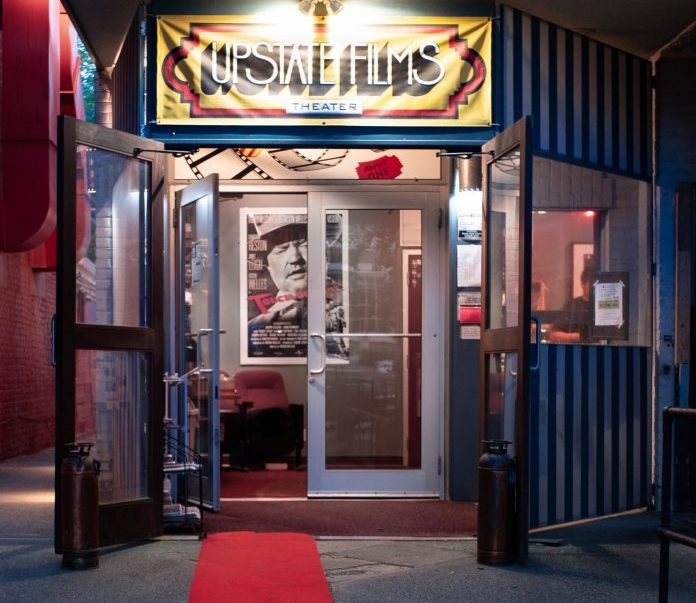
An Upstate Films screening in Ed's home state.
Fortunately, a few weeks ago, I was contacted by a nonprofit organization called Upstate Films, whose stated goal is to bring "transformative cinema experiences" to the Hudson Valley region of New York State. The group's screenings take place at a few venues, including the Starr Cinema in Rhinebeck and the Orpheum Theatre in Saugerties. Rhinebeck is in Dutchess County, just half an hour north of Ed's hometown of Poughkeepsie. It was their plan to honor their (almost) hometown boy with a screening of Tim Burton's Ed Wood (1994) on October 10, and they wanted a Wood expert on hand to offer some remarks.

I'm not sure how Upstate Films found me, but somehow they did. Even more unusually, they called me on the phone and left a voicemail. This is hardly the normal way to get in touch with me, but I'll admit that it got my attention. Eventually. See, I don't check my voicemail very often. But when I heard their message a few days after they left it, I gave Upstate Films a call back. A gentleman eventually put me in touch with the woman who was spearheading the event: a filmmaker in her own right named Katie Cokinos. We had a delightful chat that lasted about 40 minutes, and I exchanged emails with Katie and a few other folks from Upstate Films in the leadup to the show.

Katie is a big fan of the Burton biopic but admitted she wasn't all that conversant with Ed Wood's movies, not even the "famous" ones he made in the 1950s. That was where I came in. I've been studying and writing about these movies for years now and can talk about them for hours. But there are some potential pitfalls here. For many people, Ed Wood is simply a wide-eyed dreamer who made a handful of quirky low-budget movies in the 1950s. Such viewers are typically not comfortable delving into the darker, sadder, sleazier aspects of Ed's story, namely his descent into poverty and pornography, fueled by his out-of-control alcohol addiction.

On the very rare occasions when I am asked to be a podcast guest or interview subject, I try to gauge whether the host is okay with talking about the more sordid aspects of Ed Wood's life and career. If not, I know to stick to the relatively benign 1950s stuff: angora sweaters, UFOs on strings, plywood cemeteries, etc. From my discussions with Katie, I knew this was going to be one of those "keep it light and fun" kind of interviews. I explained that it would not be possible for me to travel to Rhinebeck to attend the screening in person, but I would be happy to make my presentation via Zoom. This was amenable to Upstate Films, and arrangements were soon made. Before it vanishes forever from the internet, here is a listing for the event, including my self-penned introduction.

It's wonderful to be here. It's certainly a thrill.

In addition to making some remarks and answering questions after the film, I was asked to prepare a highlight reel from Ed's 1950s movies. I wanted to focus on what I considered the "greatest hits" from this era, especially the moments that were relevant to the Tim Burton film. Below is the video presentation that I created for that night, containing my favorite moments from Glenda and Bride. (For Plan 9, I merely suggested they show the film's iconic trailer.)


On October 10, I was asked to do a soundcheck a couple of hours in advance of the screening. This was how I realized that not everyone at the Starr Cinema was as interested in Eddie and his movies as I was. Katie had been very keen to hear what I had to say, naturally, as had the Upstate Films people I'd been dealing with up to that point. For some of the other employees, however, this was just another screening, and I was just some random dude they had to deal with that day. I also learned that it was quite unusual for a guest speaker to appear via Zoom rather than in person, so I was presenting them with some unique technical challenges. The fact that I was speaking after the movie also meant that they had to stay a little longer at the end of their workday. Sorry, folks. What can I say?

I want to emphasize that no one was rude or hostile, just curt and businesslike. A tech guy asked me to start talking so he could hear how my voice sounded over the speakers. I responded by reading a passage from Ed Wood's short story "The Night the Banshee Cried." For some reason, I started hamming it up a bit for this employee, who was busy adjusting various things around the theater. I thought he'd get a kick out of it. After a few minutes, though, I noticed he had not said anything or responded in any way.

"W-was that good? I asked, tentatively.

"Mm hmm," he responded flatly. "You're coming through very clear. Maybe a half-second delay."

He sounded like a bored drive-through employee telling me to pull up to the next window. Or a traffic cop letting me off with a warning this time. I have to admit, I was a little deflated. 

My post-movie presentation, however, went swimmingly. Katie Cokinos acted as moderator and was as enthused as ever. Fielding questions from both the audience and from Katie, I talked about how I came to be an Ed Wood fan and how accurate or inaccurate the 1994 biopic is. Other topics included: the long-planned yet seemingly never-to-be statue of Ed Wood in Poughkeepsie; the fate of Ed's mortal remains; Ed's somewhat embellished war record; and whether or not Lillian Wood dressed her son in women's clothing when he was a child. Katie was kind enough to ask me about Ed's "monster nudies," which gave me an opportunity to plug Dad Made Dirty Movies (2020). The whole thing lasted about 45 minutes.

The way the Zoom call was set up, by the way, I could see the Starr Cinema auditorium from my end. As I suspected, the audience was incredibly miniscule, and a few sleepy folks shuffled out as my portion of the show began. I think, by the end, I was talking to no more than a dozen people. But that didn't bother me. It's about comparable with the stats on many of my articles, videos, and podcasts. What mattered was that I was able to spend this day doing something Woodian. I'd have felt guilty somehow if I hadn't marked the occasion.

Ed, wherever you are, I hope you appreciated the gesture.

The interior of the Starr Cinema. (And this is pretty much how it looked when I spoke.)

Tuesday, October 15, 2024

Podcast Tuesday: "Journey to the Center of the Fonz"

This week, Fonzie (Henry Winkler) goes underground on The Fonz and the Happy Days Gang.

We've all been trained by science fiction to think that outer space is mankind's ultimate goal. There's a whole universe out there, just waiting for us, and we should explore it. That make sense. When our own planet (inevitably) blows up or becomes uninhabitable, we may even have to move to outer space so that humanity can continue. The problem is that getting to outer space is currently quite expensive and difficult, and space is really not hospitable to human life anyway. That doesn't stop us from dreaming, though. 

Every once in a while, a sci-fi author will give us an alternative to exploring outer space. There's so much of our home planet that we haven't explored yet, namely the oceans. A lot could be happening down there, like talking fish people or sunken cities or whatever. That's why we have shows like Voyage to the Bottom of the Sea, SeaQuest DSV, Sealab 2020, Sealab 2021, The Man from Atlantis, and even Snorks. The sea is not quite as enticing to us as outer space, but it's (potentially) pretty darned interesting anyway. 

Another alternative to outer space is the strange, vast world that exists beneath the surface of the earth, right below our feet. I don't think there are too many stories about this topic, but some famous ones do exist. The movie The Mole People (1956) comes to mind as an example, as does Below the Earth's Surface (2008). Let's not forget The Phantom Empire (1935) and Unknown World (1951). The granddaddy of them all is Jules Verne's novel Voyage to the Center of the Earth (1864), which has been adapted to film numerous times, most notably in 1959 with James Mason.

This week on These Days Are Ours: A Happy Days Podcast, we are reviewing the episode "It's All Downhill from Here," which is the Happy Days version of a "hollow earth" story. Was it worth the trip? You can find out below.

Wednesday, October 9, 2024

Ed Wood's Warm Angora Wishes: "Appendix: The Correspondence of Ed Wood and Bela Lugosi"

Ed Wood was a man of letters. Many of them.
NOTE: This article concludes my coverage of Ed Wood's Warm Angora Wishes and Rubber Octopus Dreams (Arcane Shadows Press, 2024).
The story: "Appendix" by Frank Dello Stritto and Edward D. Wood, Jr.

Synopsis: Circa April 1973, author Frank Dello Stritto visited the Ackermansion, the Los Angeles home of Famous Monsters of Filmland editor Forrest J. Ackerman. While there, he found some old letters that had been written by Ed Wood in March 1954, most of them addressed to actor Bela Lugosi. Dello Stritto meticulously dictated them into a tape recorder, then transcribed the recordings when he got home to New Jersey. What follows are nine of those letters.

Edwin Schallert.
March 1, 1954: Ed is trying to secure work for Bela, who is headlining a revue at the Silver Slipper in Las Vegas. During a recent work trip to Vegas, Ed managed to run up a bill of $300, which amounts to over $3,000 in today's money. Bela is now obligated to pay most of this, with Ed contributing $48 of his own money. Ed disputes the bill and says it is very important to him that people know he is not trying to take advantage of Bela in any way, financially or otherwise. Eddie Fox, the publicity director for the Silver Slipper, is in Los Angeles to meet with a talent agent named Lou Sherrill. Ed says he will meet with Eddie Fox to discuss the matter personally, and he chastises Bela for mentioning the money dispute to Lou Sherrill. ("You could have come to me first.")

Meanwhile, Ed is convinced that the upcoming film The Bowery Boys Meet the Monsters (1954) will be "a hell of a lift" for Lugosi's career. He imagines the news stories it will generate, bringing attention to both Lugosi and the Silver Slipper. Furthermore, Ed says that Lou Sherrill has an idea for a new nightclub act starring Bela. Ed tells Bela that the actor's comeback is in full swing and that more triumphs lie ahead. As an example, Ed says he is talking to Los Angeles Times writer Edwin Schallert, who is planning a big article about Bela Lugosi. Schallert is headed to Vegas to review actor Howard Keel's show, and he will be swinging by the Silver Slipper to check out Bela's revue.

Ed warns Bela not to get taken by all the "sharpies" in Las Vegas. Ed says that, when he was there on business, he kept track of every expense he incurred. Bela should not pay for anything that Ed did not account for personally. He worries that he now looks bad in the eyes of Lou Sherrill. Ed stresses that Bela needs to tell Lou this was all a misunderstanding and that Ed is not a conman or a parasite.

Ed then returns to the subject of the Bowery Boys movie. Ed tells Bela not to worry about learning all the dialogue in the script. "We'll get it this time," he says. Ed claims to have a three-picture deal with Howco and declares that at least one of these films will be a star vehicle for Bela. According to Ed, horror films are enjoying newfound popularity at the moment; he points to some 3D films from Universal and Warner Bros. as examples. Bela's new film should fit right in. Eddie closes the letter by rehashing the matter of the $300 bill and emphasizing that he is being honest and scrupulous in his dealings with Bela.

March 5, 1954: Several days later, Ed responds to a "seven-point note" from Lugosi. Ed says that Schallert's story has not been printed yet. When it is, Ed will buy ten copies and send five to Lou Sherrill. Ed also thanks Bela for explaining the previous awkward situation to Lou via telegram. ("His attitude changed for the better almost immediately.")

Ed says that "the troubles on my picture [presumably 1954's Jail Bait] have ended," meaning that he will now be able to pay his previous debt to Bela. On the other hand, producer George Weiss says that Ed and Bela's previous film, Glen or Glenda (1953), has not turned a profit yet.  Ed is dubious of this, because Weiss has managed to pay off $1,000 in debts since it opened and Ed is owed 50% of the take. Ed further claims he has two more films in the works and thinks he can get Bela $5,000 for ten days of work. Ed will be producing Bela's movie for Monogram and will decide who gets paid what.

Ed mentions some press clippings that Bela has sent him. Ed says he forwarded these to Alex Gordon for preservation. Ed also congratulates Bela on extending his Vegas show another two weeks and says that it will not be difficult to line up some film work for the veteran actor now. He boasts that, between himself and Lou Sherrill, Bela now has "two good men on [his] side." Ed closes the letter by promising to write again soon. He also asks about some "collars" and some publicity photos.