Showing posts with label Stanley Kubrick. Show all posts

Friday, January 15, 2016

The book that inspired 'Taxi Driver' is actually a lot closer to 'Ziggy'

Arthur Bremer in 1972: This man thinks he's about to become famous.

Arthur Bremer's book.
Arthur Bremer, now 65, barely qualifies as famous in 2016. Start typing his name into Google, and the search engine will come up with about a dozen other, more popular autocomplete suggestions first: Arthur Bowen, Arthur Blank, Arthur Berzinsh, Arthur Brown, Arthur Boorman, etc., etc.

There is a bitter irony in all of this, since few people have gone to such drastic lengths to become well-known as Bremer did. Way back in 1972, when he was just a 21-year-old ex-busboy from Milwaukee with a high school education, Arthur Bremer shot and permanently paralyzed George Wallace, the notorious segregationist Alabama governor who was then noisily campaigning for the White House. Bremer had originally wanted to assassinate incumbent president Richard Nixon but had settled for Wallace when his preferred target proved unreachable.

None of this was done out of political malice; the mildly conservative Bremer simply thought the act would gain him historical immortality. His thinking was not unlike that displayed in Jessica Delfino’s 2006 satirical song, “I Wanna Be Famous.” Like the deluded young lady in that song, Arthur Bremer thought his name would forever be attached to that of a famous person, the way John Wilkes Booth's is to Abraham Lincoln or Lee Harvey Oswald's is to John F. Kennedy. Bremer's writings show him to be fixated on famous assassins, including Sirhan Sirhan.

"Maybe I won't be a star," go the lyrics of Delfino's song, "but I'll at least be famous."

For a few years in the mid-to-late 1970s, it looked like Arthur Bremer's extreme gamble had sort of paid off. His handwritten journal, recovered from his car after his arrest, was published by Harper's Magazine Press in 1973 under the title An Assassin's Diary, complete with a heady, sympathetic introduction by writer Harding Lemay, who largely portrays the young would-be assassin as the redheaded stepchild of our empty American culture.

Pop culture referenced him, too. Bremer was name-checked by Divine in John Waters' Female Trouble in 1974, for instance. Divine's character, Dawn Davenport, claims that she "bought the gun that Bremer used to shoot Wallace." The actual revolver was auctioned off in late 2014. Peter Gabriel wrote a song about him called "Family Snapshot," which ended up on the same self-titled album as "Biko" and "Games Without Frontiers" in 1980. And most famously, in 1976, Arthur Bremer and his diary served as the partial inspiration for Taxi Driver, written by Paul Schrader and directed by Martin Scorsese.

But that was all decades ago. The Watergate break-in, which led to the resignation of Richard Nixon from the presidency, proved to be the immortal, history-changing story to emerge from the 1972 election, not the Wallace assassination attempt.

Today, as George Wallace's own name ebbs further into the past, Arthur Bremer has been demoted to a historical footnote. By 1991, when the conversation on Mystery Science Theater 3000 briefly turned to the subject of political assassins during the Cave Dwellers episode, host Joel Hodgson had some genuine difficulty even recalling Bremer’s name, tentatively referring to him as “Arthur Bremmel.” After 35 nearly incident-free years in a Maryland prison, Arthur Herman Bremer was released to minimal fanfare and a near-total lack of outrage in 2007. An Assassin's Diary, once a hot item, has been out of print for years.

Much of this can be attributed to a total lack of charisma on Arthur Bremer's part. Scorsese nerds will be able to find numerous parallels between An Assassin's Diary and Taxi Driver, including some uncomfortable run-ins with Secret Service agents, but Arthur Bremer has very little in common with Travis Bickle, the cabbie-turned-vigilante played by Robert De Niro. Bickle is a dark, tortured anti-hero with strong, albeit misguided, principles. His stint in Vietnam gives him an intriguing backstory. And the diary he keeps during the movie has flashes of poetry within it.

Bremer, on the other hand, is just kind of a clueless, hapless dork, closer in spirit to De Niro’s fame-obsessed Rupert Pupkin character from The King of Comedy. He's an utter nobody trying to become a somebody in the worst way possible.
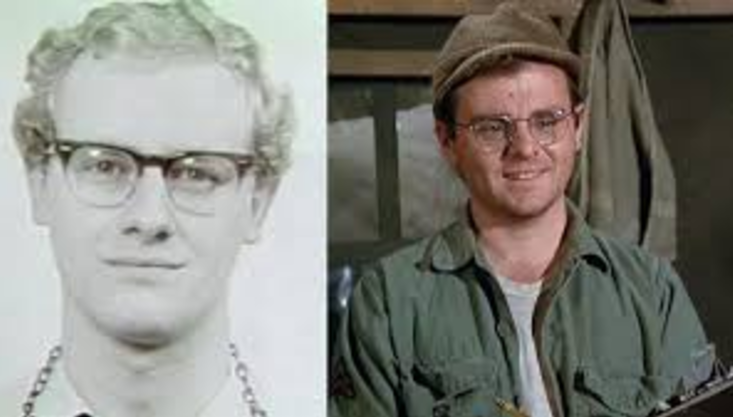
Arthur Bremer and Radar O'Reilly.
Today, despite its foreboding title, An Assassin's Diary does not provide chilling insight into the twisted mind of a would-be killer. Instead, it reads like a very, very dark comic novel about a guy who's in way over his head. The author's spelling, dialogue, grammar, and punctuation are all atrocious, making the diary seem like a kid's sloppy homework. In his mug shot from the period, Bremer strongly resembles actor Gary Burghoff as timid, mild-mannered "Radar" O'Reilly from M*A*S*H.

More than anything, the deluded young man's diary is highly reminiscent of Tom Wilson's Ziggy, a comic strip that debuted in June 1971, less than a year before the bungled assassination attempt. To put it frankly, Arthur Bremer is the Ziggy of political assassins: a luckless, ineffectual doofus who receives nothing but shabby treatment from the world. That is, when the world bothers to notice him at all.

Like Ziggy, An Assassin's Diary is largely devoted to the title character's poor customer service experiences at various sub-par businesses: hotels, restaurants, and auto mechanics. Because this is a young man's journal and not a family-oriented comic strip, Bremer's misadventures also include an unsatisfying trip to a massage parlor, which he visits after seeing an ad in Screw magazine.

Bremer followed Nixon and Wallace on the campaign trail in the unhappy spring of '72, waiting for his perfect opportunity to strike, and the miserable road trip proved to be a protracted comedy of errors. In his diary entry for April 21, 1972, for instance, Bremer talks about what happened one night when he pulled into one service station and then another to get a tire patched:
A high school kid and his girl were there talking quietly. Kid seemed disturbed that someone would pull into his station, a big name place like the first, and disburbe his romance. He didn't have the patches! 
"If a service station doesn't have the patches who does?" 
"I don't know". 
"Maybe I should try a negligy store". 
He walked back to his girl in silence.
Previously, on April 19, Bremer had written of his unmistakably Ziggy­-esque experience aboard an overcrowded airplane.
A fat boring sheltered slob of a theology student talked non-stop with an equally sheltered & fasinated (always smiling) high school student. I waited 30 minutes for dinner & when I got it, last in the whole plane, we had turbilence & the "fasten seat belts" sign went on. Impossible to do with the dinner table down. I hurreyed & drank down half my coffee before it spilled over my pants. Got away with only a tie stain and an everlasting preduice against theology students & capacity plane trips.
Like Tom Wilson's bald-headed cartoon everyman, the aspiring assassin is plenty incompetent all on his own, without any assistance from others. In those pre-Google Maps, pre-GPS days of the early 1970s, Bremer had to find campaign rallies and whistle stops by himself, and An Assassin's Diary shows him to be perhaps the world's crummiest navigator. He spends a lot of his time hopelessly lost, sometimes even having to ask his hated foes, policemen and Secret Service agents (whom he refers to as "the SS"), for help.

And the guy is all thumbs when handling firearms. Once, in preparation for a border crossing into Canada, he secrets a gun so deeply within the bowels of his car that it cannot be retrieved again. And the book's arguable comic high point occurs when, while holed up in his depressing little apartment, he accidentally fires a very noisy shot he then pathetically tries to cover by turning the television to a war movie. Only the apathy of the landlady saves him.

That's one of the great, unintentional lessons of An Assassin's Diary: Arthur Bremer, hopeless though he is, catches America napping on the job. The young man's strange, jittery behavior should have set off alarm bells and possibly gotten him arrested at any number of points along his journey, way before he got close enough to George Wallace to fire a shot. But it seems that nobody was paying this schmuck the least bit of interest.

The book's pathetic postscript reveals that virtually no one had bothered to get to know him. What did Arthur Bremer's few acquaintances recall of the suddenly famous man? "Somebody else remembered," reports the epilogue, "that his mother had refused to let him try out for the high school football team." Apparently, the only way people had to define him was by negation. He was the guy who didn't play football in high school. Some legacy.

Had anyone actually taken a few minutes to get to know Arthur Bremer, they'd have met a young fellow who, while no Rhodes scholar, was capable of some piquant commentary about the emptiness of our culture. At one point in An Assassin's Diary, apropos of nothing, he criticizes Diana Ross for selling out to please white audiences. Elsewhere, he rants about the unfairness of American vending machines not taking Canadian coins. He routinely mocks hippies for the uselessness of their protests and demonstrations. He gives politicians, policemen, and other authority figures no respect either, casually referring to Nixon as "Nixy-boy."
 
Poster for ZPG.
And he even does a little amateur movie reviewing, too, making the decision to switch his target from Nixon to Wallace while watching Stanley Kubrick’s A Clockwork Orange, "fantasizing myself as the Alek on the screen come to real life." True to Bremer’s virginal nature, he’s more concerned with “the old ultra violence” in the film than he is with “the old in out.” He praises Michael Campus' now-forgotten sci-fi film Z.P.G. as a movie that "really hit home with people playing with dolls, paste-food, super-smog, etc." But he says that Otto Preminger's Such Good Friends is "probaly the worst picture he ever made" and "as bad as Vixen by Russ Mayer. Dog shit with a plastic flower in it."

In his humbler moments, Bremer sends a few zingers in his own direction, too. His tone throughout the book swings wildly from self-aggrandizement to self-abasement. Sometimes, he thinks he’s writing a book for the ages; other times, he seems to realize that he isn’t. He knows, for instance, that downgrading his target from Richard Nixon to George Wallace means that his story is much less newsworthy and may even be ignored by the foreign press entirely. And although he considers his diary to be an important historical document, he's often unsure what to put in it. 
"Funny," he writes at one such juncture, "I've got nothing to say. Have I ever said anything?" This from a man who, at an earlier point in his manuscript, expected his words to be as carefully scrutinized as the Dead Sea Scrolls.

History, as we now know, had other ideas about that. Now retirement age and basically forgotten by the country he tried so hard to impress, Arthur Bremer is out of prison and on probation until 2025. During that time, he is expressly forbidden from venturing anywhere near an elected official. That's probably for the best, even today. Back in 2005, when John Waters reprinted the Female Trouble script as part of a book, he gave his fans a little update on Bremer's condition: "According to a friend who was in jail with him for decades, 'he's still nutty as a fruitcake.'"

Wednesday, November 19, 2014

Ed Wood's BLOOD SPLATTERS QUICKLY: 'Breasts of the Chicken' (1972)

A deceptively bland-looking businessman enjoys a meal in "Breasts of the Chicken."

NOTE: This article is part of my ongoing coverage of Blood Splatters Quickly: The Collected Stories of Edward D. Wood, Jr.

One of Ed's several Gold Diggers stories.
The story: "Breasts of the Chicken," originally published in Gold Diggers, Vol. 4, No. 2, May/June 1972, Pendulum Publishers, Inc.

Synopsis: After taking out loans on his house and car and saving his money for months, businessman Rance Wilkerson is finally able to afford a $5000 meal at an exclusive, hidden-away restaurant that specializes in extremely rare delicacies. 

After taking a limo ride through a storm to the castle-like structure, Rance is taken to an elegant dining room with just one table. There, he is given chilled champagne and treated like royalty. Then, the staff bring out a group of drugged-up young women and give the customer his choice. Rance selects a redhead, whose breast is cut off and expertly prepared for consumption, with the girl's internal organs being used as stuffing. 

The businessman thoroughly enjoys his meal, so much so that he feels he needs to go to the bathroom to masturbate in private. He is led to the men's room, only to realize too late that he has stepped into a trap. From behind a pane of glass, a wealthy old lady orders Rance's penis to be served to her "medium rare," and our hapless cannibal connoisseur is dragged away, screaming, by guards.

Wood trademarks: Yet another character named Rance (cf. this collection's "Superfruit" and "Epitaph for the Village Drunk"); breast fetish; systematic dismantling of a woman's body (cf. this collection's "Scream Your Bloody Head Off" and "The Gory Details"); thunder and lightning (a Wood staple since Glen or Glenda?); driving in a storm (cf. Night of the Ghouls); numerous Gothic trappings, including wolves howling, bats, a castle, and a forest (cf. this collection's "Dracula Revisited"); disparaging reference to "narcotics"; phrase "The whole thing was becoming an obsession with him." (compare to Glenda's "It was becoming an obsession to him."); alcohol (in this case, chilled champagne); horny man running off to a bathroom to masturbate (cf. "The Autograph").

Excerpt: "The nervous sweat was most noticeable in the crotch of his shorts than anywhere else. The chill of the night froze the sweat quickly and it was actually uncomfortable. But there were definite sexual implications in his thoughts. Sexual implications which centered around that delicacy he was about to sink his teeth into."

The mag's innocuous cover.
Reflections: First, I'd like to offer a little unsolicited business advice to all you restaurateurs out there. If you own a super-high-end, fantastically expensive restaurant that caters exclusively to cannibals, maybe—just maybe—it's not a great idea to kill off one of the few customers who actually knows your business even exists. 

In this story, Rance Wilkerson liked the joint so much he was already planning a return visit. And you killed him anyway! (Presumably, that is. Things certainly look bad for Rance at the end of "Breasts of the Chicken.") Is this how your fancy-schmancy restaurant treats its high-paying clientele? How do you expect to maintain good word of mouth? I mean, I'm sure the dowager countess at the end of this story specifically demanded a human penis with a sprig of parsley, but I doubt she demanded that said penis come from a middle-aged, middle-manager-type nonentity like Rance Wilkerson. Why was she not given her choice from a lineup, the way Rance was? Shouldn't the restaurant have rounded up a chorus line of well-endowed studs for the lady's pleasure? I think both of these customers got ripped off. I'm certain the Better Business Bureau will be hearing about this. And I wouldn't want to see the Yelp reviews for this establishment. No, wait. Scratch that. I'd love to see the Yelp reviews.

In all seriousness, "Breasts of the Chicken" is the most gruesome and disturbing story I've encountered so far in Blood Splatters Quickly. This one will stick with me, especially every time I order chicken in a restaurant. As with "Scream Your Bloody Head Off," the "two wrongs supposedly make a right" morality of the ending again seems derived from the Tales from the Crypt comics of the 1950s, where all manner of bad behavior was acceptable as long as it came with terrible consequences. (That mentality was definitely carried over to the '90s Crypt series on HBO.) In its gleeful brutality, "Breasts of the Chicken" presages such torture porn films as Bloodsucking Freaks (1976) and Hostel (2005), particularly the former, which contains a stew made of eyeballs, women used as furniture and dartboards, and the climactic severing of the protagonist's penis.

But this story also reminded me of a couple of Stanley Kubrick films, specifically The Shining (1980) and Eyes Wide Shut (1999), which both suggest that the combination of wealth, privilege, and isolation lead to toxic decadence. I was already making the Kubrick connection in my mind before Rance arrived at the "red velvet-draped gold room" where he eats his sickening supper. The Gold Room is one of the infamous locations from The Shining

Rance's journey to the restaurant, meanwhile, reminded me of Dr. Bill Harford's ominous car trip to the mansion where a super secret society is holding an orgy in Eyes Wide Shut. Both Bill and Rance arrive at their destinations in rented clothes and rented vehicles and then try—with disastrous results—to indulge in the pleasures normally only available to the incredibly wealthy elite. Leave it to the perennially cash-strapped Eddie to write a cannibal story whose hero spends nearly as much time worrying about money as he does devouring human flesh.

Next: "Never a Stupid Reflection" (1973)

Sunday, September 7, 2014

Is Stanley Kubrick selling Nissans from the Great Beyond?

Top: A banner ad for Nissan. Bottom: (left) the carpet from The Shining; (right) a scene from 2001: A Space Odyssey.

The power was restored a little after eight this morning, and I immediately got back to the hard work of mindlessly bumming around the Internet in search of entertainment. One of my first stops, of course, was YouTube. And it was there I discovered an intriguing banner ad for the Nissan Altima. Apparently, they have some new model with what they're calling "zero gravity seats" or something, and their marketing wizards have cooked up a little animation involving a floating spaceman looking at various glowing information screens. I couldn't help but notice the resemblance between the ad and a couple of Stanley Kubrick movies. The astronaut himself (or herself; it's tough to tell under those suits) looks like something from 2001: A Space Odyssey, while the background pattern seems to resemble the carpeting from the Overlook Hotel in The Shining. I wonder if the homage was intentional. Look at the images above and draw your own conclusions.

Sunday, October 6, 2013

Is "Gravity" a great movie? Depends what you mean by great, I guess.

An untethered Sandra Bullock tumbles through space in Alfonso Cuaron's Gravity.

I have now seen at least three Alfonso Cuaron movies—Y Tu Mama Tambien (2001), Harry Potter and the Prisoner of Azkaban (2004), and now Gravity (2013)—and I'll be damned if I can find any thematic connection between them. The guy gets around, that's for sure. As I'm writing this, I've just come back from the experience of seeing Gravity in IMAX 3D, mainly because this review in The AV Club told me to. (What can I say? I'm a mindless sheep sometimes and can be easily led by just about anyone who sounds even halfway convincing.) The movie couldn't be any fresher in my memory than it is now, so I figured I'd write about it sooner rather than later. As you may notice, most of the flicks I review around here are 50 years old or more, so this is a rare occasion indeed.

I suppose I wanted to write about whether or not Gravity can be truly considered a "great" movie. Matt Pais, the often-contrarian critic for Chicago's feisty Red Eye, made a special point in his three-star review to declare it "not a great film." Meanwhile, the Wall Street Journal's Joe Morgenstern has been making the rounds to discuss his review in which he declares Gravity to be unlike any movie that has ever been released before, a true landmark in cinema. Obviously, the greatness or not-greatness of Gravity will be decided by history. In our instant-oatmeal society (thanks for that analogy, Lisa Simpson), we're often too eager to rank every new movie that comes out and determine its place in the pantheon. Cuaron's picture has been out for about three or four days now. All we can do is guess. History makes monkeys of us all, so we should prepare to be wrong whenever we start prognosticating.

2001 clearly influenced Gravity.
Based on my initial impression, I can say that Gravity is indeed an impressive technical achievement and is frequently something marvelous to look at. One of my core beliefs about movies is that they should provide us with "extraordinary things to see and to hear," and Gravity accomplishes that. Offhand, I can't think of a recent film which used special effects more convincingly in service of a compelling story. 

Gravity is a very effects-heavy film that tries not to look like an effects-heavy film. Cuaron is going for realism and plausibility here rather than impossible fantasy, and I believes he succeeds at that. In that sense, his film is reminiscent of Stanley Kubrick's 2001: A Space Odyssey (1968), which was obviously one of the inspirations for Gravity. At one point, Sandra Bullock's character, stranded first-time astronaut Ryan Stone, is seen curled up in the fetal position attached to an umbilical-cord-like tether, and it's damned near impossible not to think about Kubrick's space baby. (Speaking of homages, is it possible that the scene of Bullock removing her space suit in zero gravity is a descendant of Jane Fonda's free-floating striptease in Barbarella? Just a thought.) 

A major difference, though, between Kubrick's film and Cuaron's is that 2001 is open-ended, philosophical, and abstract, while Gravity is sentimental, inspirational, and uplifting, complete with heartwarming music and a sympathy-building backstory for its lead character. Did Cuaron, who also cowrote the script with his son Jonas, add these conventional storytelling elements because he truly believed in them... or was it just to make Gravity (which must have been expensive and time-consuming to produce) more commercial? Either way, the very traditional plot of this film will probably make many viewers enjoy Gravity more, but it sort of lessened my enjoyment. I'll put it this way: Gravity didn't shake me to my core and make me re-examine life or anything. When it was over, my thought was, "Hmmm. That was pretty neat," and not, "I have just seen a masterpiece." I might not have gone in the direction Cuaron did, but then again, my version of Gravity might have lost $100 million.

I thought about Dark Star during Gravity.
The other movie that I was thinking about during Gravity was John Carpenter's Dark Star (1974), a satirical sci-fi film with a vaguely similar "we're stranded in space and what the hell are we going to do?" plot. Very briefly, Carpenter's film—set in the 22nd century—centers around the crew of a scout ship whose mission is to destroy "unstable planets" in the deepest reaches of explored space. These men have been out in space so long that they've lost all interest in each other and in the mission. Frankly, they've all gone a little crazy—in some cases, a lot crazy—from isolation and boredom. 

Without spoiling things, a life-threatening crisis arises aboard the ship, and we see how these men deal with it. Or, more accurately, how they fail to deal with it effectively. Made very cheaply (an alleged "alien" is quite obviously a beach ball), Dark Star is one of those films which did manage to rattle around in my subconscious after I saw it. That's probably why I've revisited it periodically over the years. I can't see myself doing that with Gravity. Does that mean Gravity is not a "great" movie? Hell, I don't know. Time, my dear readers, is the only true indicator of that, and I just don't have enough of it. But I wanted to record my initial impression. Let's check back in ten, maybe twenty years and see if I was right. Deal?

By the way, if you're wondering whether it's worth the extra dough to see this flick in IMAX 3D, I'd say sure. Visually, it's trippy and transportive, and it's worthwhile to see the film in the immersive surrounding that an IMAX theater can provide. But, if you're running a little light on cash this month, you can live without it. The AV Club says that, if you don't view this movie on the largest-possible screen, you're not really seeing it at all. But I don't necessarily agree with that. You can see Gravity in a regular theater, and you'd still get the film's single-best element: a career-best performance by Sandra Bullock, who spends a great deal of screen time alone and conveys a lot of her character's emotions not through words but through facial expressions. You don't need IMAX or 3D for that.

Sunday, May 12, 2013

"The Shining": Portrait of an Unholy Family

The Torrance Family Portrait by smalltownhero (source)

The head-scratchingly bizarre documentary Room 237 brought renewed attention and scrutiny to Stanley Kubrick's The Shining (1980), a loose adaptation of Stephen King's bestselling 1977 novel of the same name. For nearly 40 years, Kubrick's controversial horror movie has inspired an inordinate amount of speculation among viewers and critics, and the documentary seeks to provide several possible readings or interpretations of the film.

Among the theories floated by interviewees: it's about the Holocaust, it's about the genocide of Native Americans, it's about the faking of the Apollo 11 moon landing, etc. Like most of Kubrick's works, The Shining is chock-full of odd and arcane details that may or may not be clues to the film's true meaning or intent. Room 237 helpfully points out many of these, and the interview subjects use these tidbits to support their respective cases, almost like lawyers submitting pieces of evidence in a trial. This makes the viewer the judge and jury.

One recurring theme in Room 237 is that new details are liable to pop out at you every time you watch The Shining. Freeze the frame at any given moment, say the interviewees, and study the image. There's bound to be something out of the ordinary there. And, sure enough, I found this to be true when I revisited my favorite scene in the film: the one in which a terrified Wendy Torrance (Shelley Duvall) defends herself with a baseball bat as her husband, Jack (Jack Nicholson), now completely psychotic, follows her up a flight of stairs at the far end of the hotel's vast, airy Colorado Lounge.

There are a lot of great things about this scene, not the least of which is that it manages to work simultaneously as horror, as family drama, and as pitch-black dark comedy. (Few lines in cinema make me laugh as hard as Jack's reading of "Wendy... darling... light of my life!") Jack Nicholson and Shelley Duvall are both mesmerizing here, employing radically different acting techniques. Famous in Hollywood lore are the stories of how unequally Kubrick behaved toward these two actors during the making of The Shining. The director treated Nicholson like an old pal while sternly berating Duvall in front of the crew and scoffing at her complaints. Stanley did this supposedly to coax the desired performances from his actors. This is eerily reminiscent of the making of Orson Welles' Citizen Kane (1940), in which director/star Welles apparently treated his co-star, Dorothy Comingore, quite cruelly because she was playing a woman who was dominated by her husband and who wound up as a broken-down drunk after leaving him. Unfortunately, Comingore's own tragic life mirrored that of her character too closely, and she died of alcoholism at 58.

Some of Kubrick's on-set behavior is captured in the well-known BBC documentary, The Making of "The Shining," directed by Kubrick's daughter Vivian. Indeed, Jack prowls around the set like he owns the place, while poor Shelley looks like a kid whose parents never picked her up from summer camp. Regardless of whether you approve of Kubrick's professional ethics, his techniques seem to have paid off here. Shelley's character, Wendy Torrance, is very childlike and innocent throughout the film, and over the course of The Shining, her husband Jack erodes what's left her of self-confidence and tries to bully her into submission, first through condescension ("Wendy, let me explain something to you..."), then through profane outbursts, and finally through physical violence.

What we are witnessing here is the steady and terrifying dissolution of an already-shaky marriage. Wendy at first seems ill-equipped to handle this. She is the most gentle and naive of the Torrance family, much more of a child than her own son, the intense and withdrawn Danny. With her wide eyes and beanpole physique, Wendy is almost asexual. Even her outfits look like adult-sized versions of things a kid would wear: shapeless pinafores and turtlenecks that keep her covered from her neck to her ankles. (Little wonder, then, that her husband all but salivates at the sight of a naked woman in the infamous "room 237" scene.)

Wendy Torrance, eternal optimist.
From the moment we meet her, when she is unsuccessfully trying to convince her son how great the Overlook Hotel is going to be, Wendy Torrance is a woman in deep denial. She tries to maintain an optimistic outlook at all times despite overwhelming evidence to the contrary. 

In virtually every scene she's in, Wendy tries to minimize her problems by understating them. The staircase scene is the moment when that strategy stops working for her, forcing her to resort to violence with the bat. But even here, she makes an attempt at downplaying the situation, even taking some of the blame herself: "I'm very confused. I just need a chance to think things over."

But here, too, is where Jack's menace, which has been building for some time now, finally becomes too out-of-control to ignore. Once your husband has said, "I'm gonna bash your brains in," it's a safe bet that your marriage is beyond repair. Wendy's utter vulnerability makes her husband's brutishness all the more shocking, but "vulnerable" does not mean "defenseless." In this scene, she manages to knock her husband down the stairs. Later, she has the presence of mind to lock her unconscious husband in the Overlook's vault-like storage room and, when even that fails, slashes his hand with a kitchen knife as he uses an ax to enter the bathroom where she has barricaded herself.

While I was watching this infamous scene and thinking about all of these things, I started noticing a strange yet undeniable visual motif. While Wendy is on the staircase, Kubrick films her from angles in which there is bright light behind her, making it almost appear as if she is glowing. First, the light comes from the giant windows of the Colorado Lounge, which are reminiscent of the large stained-glass windows in churches and cathedrals. Then, when Wendy is further up the stairs, a lighting fixture on the ceiling behind her suffuses the scene with a warm glow. Meanwhile, Jack advances on her threateningly, but smiles all the while and even taunts her like a schoolyard bully, repeating her name in silly voices: "Weeenddeeeeee... Weeeenndddeeee..."

Devil or angel? Sinner or saint? Jack makes the "devil sign" and Wendy Torrance has a halo in The Shining

I could not help but notice that when Jack Nicholson delivers the famous "darling" line, he very briefly makes the sign of the horns, an offensive hand gesture sometimes associated with Satanism and the occult. Nicholson, let's not forget, played the earthly embodiment of Satan a mere seven years later in The Witches of Eastwick and famously referred to himself therein as a "horny little devil." At the time, having Jack Nicholson play the Devil struck many critics as type-casting. Meanwhile, look at that light fixture behind Shelley Duvall. Kubrick consistently composes the frame so that the chandelier is directly over her head, making it look like a halo. That's when I realized that the Torrances could be seen as a kind of grotesque parody of the Holy Family: Jack as Joseph, Wendy as the Virgin Mary, and Danny as Jesus.

Mary, Jesus, and Joseph
Jesus and Mary, of course, get all the affection and attention from our world's roughly 2 billion Christians. They have statues, paintings, songs, and numerous Holy Days of Obligation in their honor. Poor old Josephmy namesake, incidentallyseems to have gotten the fuzzy end of the lollipop in this arrangement. His young virginal wife was impregnated by the Holy Spirit and would forever after be known for her sexual purity. Despite popular belief, the term "immaculate conception" does not refer to the virgin birth of Christ; instead, it is Catholic dogma that Mary, from the moment of her own conception, was untouched by original sin. She alone among mortals got a lifetime free pass from God, and in return, she remained sexually untouched. Growing up Catholic, I could not help but wonder what effect this must have had on Joseph, a mortal man who must have had the same sexual desires as any man but who was forever doomed to a life of chastity.

Others have wondered about this, too. In his massively controversial 1985 film Hail Mary, director Jean Luc Godard updated the story of Christ's virgin birth to modern times and gave us a sexually frustrated Joseph who eventually comes to accept his fate. "I never touch you. I stay," he tells his wife. Much more fun than Godard's film, though, is "A Bad Kid," a triumphantly tasteless short story from 1999 by UK satirist Michael Kelly. Kelley's story takes the form of a monologue by Joseph and is written in the voice of a crude, working-class Britisher who loathes and resents his literally holier-than-thou son and wife and who doesn't hesitate to express these feelings through physical violence. Throughout the story, Joseph's tone is remarkably reminiscent of Jack Torrance. Jack, too, has abused his son physically on at least one occasion. Here's a representative excerpt from Kelly's story in which Joseph describes his relationship with Jesus:
In all the times I had cause to thrash my stepson during his childhood, adolescence and young manhood, he almost never stood up to me, the jessy. I suppose in fairness if he had done I would have put him in hospital, but the way he just stood there passively, as he did now, looking so bloody meek and mild and saying, "I forgive you," the superior little sod, used to enrage me even more. 
"I'll teach you to forgive me, you little bastard!" I yelled, and leathered him some more.

Later, Joseph speaks ruefully about his wife:
God, she gets on my wick at times. Sitting on her arse all day smiling and being tranquil and radiant and full of grace, and glowing a bit. I've never liked to talk about this much, but she definitely glows. Does your wife glow? No, I didn't think so. Mine does. No, you can't notice it so much in daylight, but at night you can read a book by it. Come to think of it, he never needs a candle when he gets up for a piss either. What a fucking family.

In this story, as in many paintings and mosaics, Jesus and Mary give off a kind of visible glow... a shining, if you will. As I pointed out earlier, Wendy herself seems to "glow" or "shine" during the staircase sequence. That's one detail Shining-ologists never seem to give much attention: the title. Is it possible that the extrasensory perception in King's story is called "shining" because of some religious significance?  The gift of "shining" is reminiscent of the so-called "telekinesis" in King's first full-length novel, Carrie, which is likewise fraught with religious symbolism and a specifically Christian horror of sex.

Room 237: Result of Jack's sexual frustration?
Now let us consider Jack and Wendy Torrance as Colorado's answer to Joseph and Mary. Like the famed Biblical couple, Jack and Wendy travel a great distance to an inn, The Overlook, where the inkeeper (Mr. Ullman, played by Barry Nelson) gives them modest accommodations. Since the Overlook is closed between Halloween and May Day, why is there no room at this inn? Because the other rooms are occupied by the ghosts of the hotel's past. Like Mary and Joseph, Wendy and Jack have a sexless relationship. The occasional chaste kissand never on the lipsis as much physical affection as we'll ever see from them. If the Torrances never have sex, how was Danny ever conceived? The aforementioned "room 237" scene may well be brought about by Jack's sexual frustration. Of course, like Joseph, Jack is not allowed to experience sexual pleasure even in a fantasy. The gorgeous woman he encounters in that room turns into a decomposing hag in short order, and Jack flees in terror.

Interestingly, in one of the film's ugliest lines, Jack complains about Wendy to the spectral and possibly imaginary bartender, Lloyd (Joe Turkel): "Just a little problem with the old sperm bank upstairs." Equating Wendy to a sperm bank tells us that Jack sees her as little more than a receptacle for the male seed, which is pretty much how God used Mary. Some observers think of Joseph as being cuckolded by God in this respect. The sign of the horns we saw Jack using earlier is, by some accounts, Italian in origin and meant to signify the proverbial cuckold's horns. A man whose wife is unfaithful wears horns that everyone but he can see. The Torrances' son may have been conceived through methods other than normal human reproduction.

This brings us to young Danny Torrance, the story's stand-in for Christ. Though his physical body is eminently human, Danny is possessed of a great supernatural power even he cannot comprehend. His mysterious summoning of the Overlook's handyman, Dick Halloran (Scatman Crothers), is akin to Christ being visited by the Three Kings, who were led to Bethlehem by a star. Elsewhere in the film, Jack encounters the ghostly Delbert Grady (Philip Stone) who is keenly aware of Danny's power and tries to convince Jack to kill him. This is analogous to the story of King Herod the Great, who in the Book of Matthew (Matthew 2:1-4, 7, 16) orders his soldiers to kill all male children two and under in Bethlehem and the surrounding neighborhoods because he has heard from his astrologers that the King of the Jews had been born there.

I cannot say whether Stephen King or Stanley Kubrick ever meant The Shining to mirror the story of the Nativity or depict the Holy Family in any way. However, this famous narrative is so deeply hard-wired into our minds through decades of repetition and cultural indoctrination that it may seep into our fiction whether we want it to or not. One of the great gifts of Room 237 is a belief expressed by one of the interviewees to the effect that alternate meanings may be found in works "regardless of author intent."

Amen to that.

Sunday, April 28, 2013

Time #2


In case you missed Time #1, it's here. The first one was based on a series of vacation photos taken by a group of friends. The second one, I think you can guess. I don't know why, but I've always been interested in how faces change over time. That used to be something I drew over and over again as a kid. I'd draw a character, then show him ten years, twenty years, fifty years later, etc. I suppose these little collages are my way of returning to that.

Sunday, April 7, 2013

The Eyes of Ed Wood/The Eyes of Stanley Kubrick


(from top to bottom) Ed Wood; Stanley Kubrick

Gaze, please, at the eyes of two of the most idiosyncratic, controversial and puzzled-about directors in film history, one considered to be among the best in his field, the other among the worst. Obviously, any director's greatest tools are his eyes. After all, every filmmaker is trying to get us to see the world through his eyes

What do we see in Ed Wood's eyes? What do we see in Stanley's? What do these men's eyes tell us about their films? I think insufficient attention has been paid to directors' eyes. Maybe it could be a whole new branch of film study. 

Ed Wood's eyes are those of a man who is handsome in an elegant, old-fashioned way. There is a delicacy to them and a hint of romance, perhaps a bit of femininity. See how the right eyebrow is cocked in a suave, seductive way. Eddie certainly had his share of women in his younger days, and several of them compared his appearance to that of Errol Flynn, a screen icon of the 1930s and '40s known for his swashbuckling roles and playboy lifestyle. 

Now look at Stanley's eyes -- dark, intense, serious. These are the eyes of an obsessed man. The thick black eyebrows above jut sharply downward toward his nose, forming a shadowy brow which looms over the bulging orbs. Notice, too, the dark rings which circle them and give him a menacing appearance. Many of Kubrick's lead actors would have similarly intense, formidable gazes -- Jack Nicholson in The Shining, Malcolm McDowell and Patrick Magee in A Clockwork Orange, Vincent D'Onofrio in Full Metal Jacket, and Sterling Hayden in The Killing and Dr. Strangelove -- and Kubrick liked to film these men either from below or from angles in which they stared intently under furrowed brows. Perhaps all of these were self-portraits.

Sunday, March 17, 2013

Something I'd never noticed in an old "Simpsons" episode

The Simpsons and The Shining side by side.

On the left are screenshots from "Bart to the Future," an episode of The Simpsons which aired March 19, 2000. On the right are screenshots from Stanley Kubrick's The Shining. It took me 13 years to notice this.