Showing posts with label Jesus. Show all posts

Tuesday, December 24, 2024

2024 Comics Fun Advent Calendar, Day 24: And, unto us, a Superman is born!

Yeah, he has super vision but not in the back of his head!

We all know that Superman is Jesus, right? So much has already been written about the parallels between the Lamb of God and the Man of Steel that I don't really have to rehash it all for you here. Suffice it to say, many people have seen the Superman mythos as a Christian allegory, even though the character's creators (Jerry Siegel and Joe Shuster) were Jewish. I've gotta admit, the theory makes sense. John and Martha Kent, for instance, make pretty plausible stand-ins for Joseph and Mary. Superman even died and came back to life, just like Whatshisname.

Anyway, I couldn't think of a better way of ending this 2024 Comics Fun Advent Calendar than a whole bunch of Superman parodies, again mostly drawn from Comics Outta Context. Enjoy and have a lovely holiday season!

Thursday, October 22, 2015

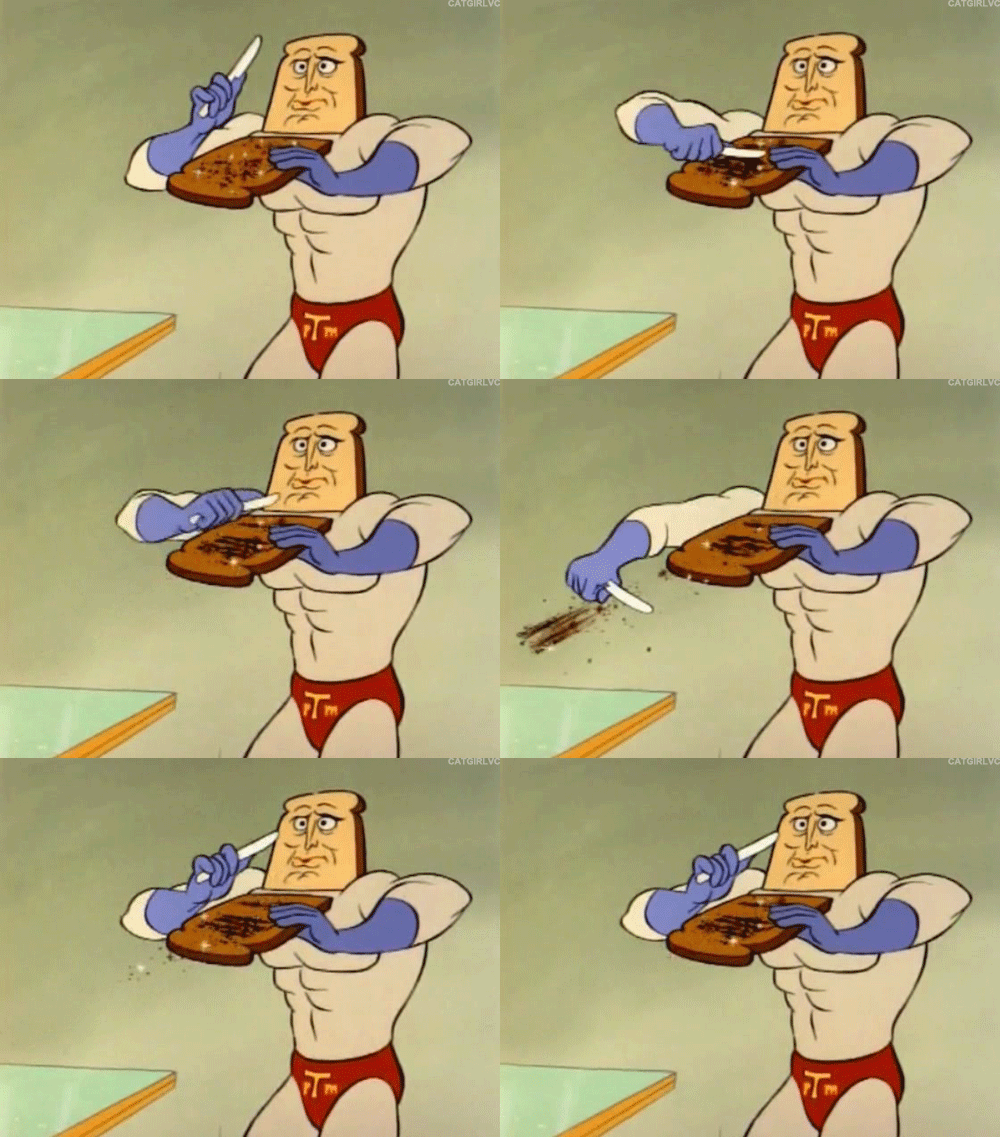
That moment when you realize Powdered Toast Man is actually Jesus

"Leave everything to me."

"And he took bread, and gave thanks, and brake it, and gave unto them, saying: This is my body which is given for you. Do this in remembrance of me." -Luke 22:19

A PTM comic book.
Writing about Nickelodeon's The Ren & Stimpy Show recently caused me to think about -- and truly consider the oddness of -- the show's colorful cast of supporting characters, including frazzled kids show star Muddy Mudskipper (a seeming first cousin to The Simpsons' jaded Krusty the Clown), textbook suburbanites Mr. and Mrs. Pipe, taciturn steed Mr. Horse, and the dinner-jacketed announcer known only as That Guy.

But perhaps no R&S costar is better remembered or more loved than Powdered Toast Man, a ridiculous superhero voiced by Laugh-In veteran Gary Owens. He is essentially a muscular, deep-voiced man with two giant slices of toast where his head ought to be, and his outfit is the usual form-fitting leotard with the underwear worn on the outside.

During the show's first season, back in 1991, PTM appeared briefly in a mock commercial for the space-age product bearing his name. The concept of Powdered Toast is simple: just shake some powder out of a Comet cleanser-type can onto your plate, and in a few seconds it transforms into warm, crispy toast! In a example of the show's proudly juvenile, absurd gross out humor, the costume-clad crime fighter always made sure to fart on every slice of powdered toast Ren and Stimpy ate. The character made such an impression on R&S viewers that he was given his own episode during the show's second season premiere in 1992. Another PTM cartoon, "Powdered Toast Man vs. Waffle Woman," appeared in 1994.

For such a strange character, Powdered Toast Man's origins are fairly obvious. Superheroes and breakfast cereal ads have both been integral to animated children's TV shows for decades, so it was natural to combine them in this fashion. On the Ren & Stimpy DVDs, furthermore, creator John Kricfalusi has stated that he was inspired by the many Hanna Barbera heroes who, like PTM, routinely shout their own names, a lineage that includes Space Ghost (also originally voiced by Owens), Birdman, and Captain Caveman. Plus, we must factor in that "toast" is just a funny word, especially when you say it repeatedly in a short span of time. PTM's name led to such memorable quotes as Stimpy's "He's toast-terrific!"

I've already written about how Ren & Stimpy was filled with hyper-masculine, strong-jawed, he-man archetypes. PTM would seem to be one of the friendlier examples.

But I started thinking about that 1992 "Powdered Toast Man" episode, and I realized that there may be something else going on with the familiar character. Maybe PTM isn't just a breakfast-based superhero. Maybe he's a stand-in for Jesus Christ, the only begotten son of God. 

Okay, it's a far-out theory, I realize. But hear me out.

Take and eat.
Powdered Toast Man actually opens his own head up and scrapes out some powder onto Ren and Stimpy's plates. This is as close a cartoon representation to the Eucharist as I can imagine on The Ren & Stimpy Show. PTM uses his body to feed a hungry cat and dog! The transformation of powder into toast may, in fact, be miraculous, like the story of the fishes and loaves in Matthew 14.

Fish and bread, it should be noted, are both important motifs on The Ren & Stimpy Show. Their hero, as I've already pointed out, is literally made of bread. In "Son of Stimpy," Stimpy's prodigal son (another biblical reference!), Stinky, even marries a rotting fish carcass before honeymooning in Ren's nose. And fish are common comedic props throughout the series, as in "Haunted House," in which one unlucky trout or halibut becomes part of a grotesque sandwich. That episode, incidentally, features another example of a character literally turning into bread, as an unlucky ghost disguises himself as a slice of bread in an attempt to trick Ren and Stimpy. Eucharistic symbolism abounds!

But getting back to Powdered Toast Man, what other Christ-like characteristics does he have? After studying the "Powdered Toast Man" episode from 1992, I've made the following observations:

  • His skimpy red shorts are monogrammed PTM, but only the cross-like T is emphasized. Throughout the episode, his catchphrase will be "Leave everything to me," which sounds like an updated version of that classic bumper sticker slogan, "Let go and let God." Like Jesus, Powdered Toast Man is voluntarily taking on the burdens of the human race. PTM knows of our fears, our weaknesses, our sins, and our frailties, and he is willing to accept them all if we only ask for his help. Truly, he wants us to leave everything to him.
  • An overly-excited announcer describes PTM as a mysterious, god-like being from another world: "Who is this stranger from another land? Why does he walk among mortal men? What is his mission? Where can we get a pair of undershorts like his? Who is this man of toast and what does he want from us? What is his dark secret?" That second query -- "Why does he walk among mortal men?" -- seems particularly applicable to Christ as well. It's one of the central mysteries of the Christian faith.
  • PTM's chosen alias is "Pastor Toastman, the cool youth deacon." His assistant  is a lovely young lady who dresses much like a Catholic schoolgirl and refers to him as "Father." The fact that the character casually tears off his priestly collar could be viewed as either deliberate sacrilege or the fact that Christ would have no use for the hierarchical structure of organized religion as it is practiced today.
  • In an outlandish parody of Christ's mercy, PTM saves a small kitten from being run over by a delivery truck by crashing a passenger plane directly into the truck. Like Christ, PTM is primarily concerned with the humblest and most helpless of God's creatures. (Never mind that he carelessly tosses the animal into the path of another vehicle moments later.)
  • PTM is, in some ways, better than God or Jesus because he directly answers prayers. He can be contacted through his Toast-omatron Communicator, his inflating and deflating red shorts, and even his tongue, which functions as a telephone. When Ren and Stimpy need toast, PTM comes quickly, as in Revelation 22:12.
FZ as the Pope.
  • Whom does PTM save in the episode's main event? The Pope, as portrayed by Frank Zappa. And from whom does he save the Pope? An angry fish villain, as portrayed by Muddy Mudskipper. There is an absolutely religious-seeming moment in which PTM floats angelically over the semi-conscious, almost-dead Muddy Mudskipper and "resurrects" him, only to tie him to a barrel full of about-to-explode gunpowder. As with the kitten incident, it plays like a parody of a miracle.
  • In the cartoon's final act, PTM becomes heavily involved in American politics, perhaps denoting how much influence the Christian right has over the United States government. After saving the hapless, unnamed president, who gets his penis caught in his zipper in the White House john, PTM assumes the role of Commander-in-Chief, vowing "to relieve the American citizens of their basic human rights."
  • As president, one of PTM's top priorities is settling the "Three Stooges stamp controversy," possibly an oblique reference to the Holy Trinity. In another example of political satire, PTM then burns the Constitution and the Bill of Rights in order to heat the Oval Office, warming himself in front of the fire with his nubile female assistant, a possible cognate for Mary Magdalene.
So as you can see, there are numerous parallels between the Man of Toast and the Lamb of God. Whether this was intentional or not is up to you to decide. And am I, the author of this piece, being sincere with the evidence presented here, or is this an intentionally over-the-top comment on far-fetched fan theories? Well, that, too, is for you to determine. Read it over, examine the evidence carefully, and come to a conclusion that suits you and your spiritual life. Me, I'm off to enjoy some delicious powdered toast.

Friday, May 1, 2015

You might be the new Jesus and not even know it

Lookin' good, Mr. J! Lookin' good.

I heard this theory once that you should treat everyone you meet as if he or she were the Messiah. I don't believe in the Messiah, but it's an interesting idea anyway, even if it's hopelessly impractical. And, hey, I'm wrong about a lot of shit. I might be wrong on the "Messiah" thing, too. Maybe another one's just around the corner, waiting to fix everything that's wrong with the world. Think of all the people you encounter on a daily basis. Think, furthermore, of all the people you've ever encountered in your whole life. That fat kid in your third grade glass. The barista who served you coffee yesterday. The homeless guy you pretend not to see on your way to work. Any of these folks could be the Messiah. Imagine if one of them turned out to be the Savior of All Mankind, and you were shitty to them, as if they didn't even matter. Then wouldn't you feel like a dope?

Perfect example: In the train station parking lot today, there was this woman -- Caucasian, late middle-age, dark hair, sort of dressed up, if you're trying to picture her --  who walked in front of my car as I was leaving. Not directly in front, I should point out, but close enough that we could see each other's faces. I slowed down, of course, but the woman must have thought I was still going to run her over because she kept waving at me with a distressed look as if I didn't see her. A guy I'm presuming was her husband was with her, and I'm sure she complained about me to him immediately afterward. ("Harry, did you see that? That guy was a maniac! He almost killed me! Good thing I waved!") In truth, I was burned out at the end of another unsatisfying work week and just wanted this lady to get the fuck out of my way so I could get out of that goddamned parking lot and go home. She got to wherever she was going, and I left, cursing her under my breath because she delayed me getting back to my shitty apartment by five seconds. What if this woman were the Messiah? Maybe she is.

But, then again, maybe I'm the Messiah and just don't know it. Wouldn't that be wild? The real Joe Christ. (Much respect to the late filmmaker who went by that name.) I don't have any magic powers, though, and I haven't as yet been inclined toward any world-saving activities. If I'm the new Jesus, I'm a crappy one. Sorry about that.

Saturday, January 24, 2015

This way lies madness: 'The Doggedly Dogs'

A dog, Muffin, is about to enjoy some secular music in "The Doggedly Dogs."

Bible Truths For Children.
What is it about religious shows for kids? Why are they always a direct gateway into a world of complete, bat-shit insanity? You tell me. These programs are generally low budget and semi-amateurish in terms of production values, so you'd expect some degree of wonkiness in the sets, costumes, props, animation, music, acting, and chroma key-style video effects. And you'll definitely find all of that stuff in these shows.

Generally, religious kids shows are labors of love, made by well-meaning people with a shortage of money, experience, and technical know-how. It's understandable that they'd be cheap, cheesy, and tonally awkward. But that's true of a lot of low-budget productions, including secular ones. None of this explains the total delirium that emanates from these particular shows. There's something else going on here.

A big factor is the religious element. All religions seem kind of nutty to me, and the further you commit to any particular faith, the further you stray from reality and science and sanity in general. And by the time you're doing a religious kids show with puppets and talking animals, you're obviously way, way off the deep end. I mean, you don't just start out dressing like a cowboy clown and singing songs about Jesus to four-year-olds. You have to progress to that mindset over time, probably many years. By the time you arrive on the other side, your brain is pretty much the equivalent of butterscotch pudding.

There is a definite element of brainwashing or indoctrination going on here. Kids don't naturally come to religion on their own, after all. It has to be sold to them and reinforced all the time until they believe.

But there's also something dark under the shiny, happy surface, since Western religions tend to center around a capricious creator God who can banish you to Hell for all eternity if you get on his nerves. I guess what makes religious kids shows so entertaining is that contrast between the relentlessly cheerful songs and skits and the more sinister undertones of their true, ultimate purpose.

All of this is my long-winded way of introducing a highlight reel from a video called called Bible Truths for Children. I have very little background on this, other than the fact that it might be a VHS compilation tape of highlights from a mid-1980s Texas-made program called The Filling Station or God's Filling Station.

I honestly don't want to over-explain or oversell what you're about to see. It's better if you go in cold. Just know that I love this video and have watched it at least a dozen times. It encapsulates everything I like about religious kids shows.

Clearly, the main event is "The Doggedly Dogs," which is definitely worth following until the very end, when... well, I don't want to spoil it, but pay attention to the voice of Muffin. The rest of the video is delightful, too: the nerdy ginger kid reading Bad magazine and proclaiming that "Reading is Seeding," the parade of "instruments for righteousness," and the Bob Duke family of Greenwood, Indiana, whose deeply creepy Sears family portrait is emblazoned on the robe of an animated Christ. Enjoy.

Sunday, November 10, 2013

Sunday, May 12, 2013

"The Shining": Portrait of an Unholy Family

The Torrance Family Portrait by smalltownhero (source)

The head-scratchingly bizarre documentary Room 237 brought renewed attention and scrutiny to Stanley Kubrick's The Shining (1980), a loose adaptation of Stephen King's bestselling 1977 novel of the same name. For nearly 40 years, Kubrick's controversial horror movie has inspired an inordinate amount of speculation among viewers and critics, and the documentary seeks to provide several possible readings or interpretations of the film.

Among the theories floated by interviewees: it's about the Holocaust, it's about the genocide of Native Americans, it's about the faking of the Apollo 11 moon landing, etc. Like most of Kubrick's works, The Shining is chock-full of odd and arcane details that may or may not be clues to the film's true meaning or intent. Room 237 helpfully points out many of these, and the interview subjects use these tidbits to support their respective cases, almost like lawyers submitting pieces of evidence in a trial. This makes the viewer the judge and jury.

One recurring theme in Room 237 is that new details are liable to pop out at you every time you watch The Shining. Freeze the frame at any given moment, say the interviewees, and study the image. There's bound to be something out of the ordinary there. And, sure enough, I found this to be true when I revisited my favorite scene in the film: the one in which a terrified Wendy Torrance (Shelley Duvall) defends herself with a baseball bat as her husband, Jack (Jack Nicholson), now completely psychotic, follows her up a flight of stairs at the far end of the hotel's vast, airy Colorado Lounge.

There are a lot of great things about this scene, not the least of which is that it manages to work simultaneously as horror, as family drama, and as pitch-black dark comedy. (Few lines in cinema make me laugh as hard as Jack's reading of "Wendy... darling... light of my life!") Jack Nicholson and Shelley Duvall are both mesmerizing here, employing radically different acting techniques. Famous in Hollywood lore are the stories of how unequally Kubrick behaved toward these two actors during the making of The Shining. The director treated Nicholson like an old pal while sternly berating Duvall in front of the crew and scoffing at her complaints. Stanley did this supposedly to coax the desired performances from his actors. This is eerily reminiscent of the making of Orson Welles' Citizen Kane (1940), in which director/star Welles apparently treated his co-star, Dorothy Comingore, quite cruelly because she was playing a woman who was dominated by her husband and who wound up as a broken-down drunk after leaving him. Unfortunately, Comingore's own tragic life mirrored that of her character too closely, and she died of alcoholism at 58.

Some of Kubrick's on-set behavior is captured in the well-known BBC documentary, The Making of "The Shining," directed by Kubrick's daughter Vivian. Indeed, Jack prowls around the set like he owns the place, while poor Shelley looks like a kid whose parents never picked her up from summer camp. Regardless of whether you approve of Kubrick's professional ethics, his techniques seem to have paid off here. Shelley's character, Wendy Torrance, is very childlike and innocent throughout the film, and over the course of The Shining, her husband Jack erodes what's left her of self-confidence and tries to bully her into submission, first through condescension ("Wendy, let me explain something to you..."), then through profane outbursts, and finally through physical violence.

What we are witnessing here is the steady and terrifying dissolution of an already-shaky marriage. Wendy at first seems ill-equipped to handle this. She is the most gentle and naive of the Torrance family, much more of a child than her own son, the intense and withdrawn Danny. With her wide eyes and beanpole physique, Wendy is almost asexual. Even her outfits look like adult-sized versions of things a kid would wear: shapeless pinafores and turtlenecks that keep her covered from her neck to her ankles. (Little wonder, then, that her husband all but salivates at the sight of a naked woman in the infamous "room 237" scene.)

Wendy Torrance, eternal optimist.
From the moment we meet her, when she is unsuccessfully trying to convince her son how great the Overlook Hotel is going to be, Wendy Torrance is a woman in deep denial. She tries to maintain an optimistic outlook at all times despite overwhelming evidence to the contrary. 

In virtually every scene she's in, Wendy tries to minimize her problems by understating them. The staircase scene is the moment when that strategy stops working for her, forcing her to resort to violence with the bat. But even here, she makes an attempt at downplaying the situation, even taking some of the blame herself: "I'm very confused. I just need a chance to think things over."

But here, too, is where Jack's menace, which has been building for some time now, finally becomes too out-of-control to ignore. Once your husband has said, "I'm gonna bash your brains in," it's a safe bet that your marriage is beyond repair. Wendy's utter vulnerability makes her husband's brutishness all the more shocking, but "vulnerable" does not mean "defenseless." In this scene, she manages to knock her husband down the stairs. Later, she has the presence of mind to lock her unconscious husband in the Overlook's vault-like storage room and, when even that fails, slashes his hand with a kitchen knife as he uses an ax to enter the bathroom where she has barricaded herself.

While I was watching this infamous scene and thinking about all of these things, I started noticing a strange yet undeniable visual motif. While Wendy is on the staircase, Kubrick films her from angles in which there is bright light behind her, making it almost appear as if she is glowing. First, the light comes from the giant windows of the Colorado Lounge, which are reminiscent of the large stained-glass windows in churches and cathedrals. Then, when Wendy is further up the stairs, a lighting fixture on the ceiling behind her suffuses the scene with a warm glow. Meanwhile, Jack advances on her threateningly, but smiles all the while and even taunts her like a schoolyard bully, repeating her name in silly voices: "Weeenddeeeeee... Weeeenndddeeee..."

Devil or angel? Sinner or saint? Jack makes the "devil sign" and Wendy Torrance has a halo in The Shining

I could not help but notice that when Jack Nicholson delivers the famous "darling" line, he very briefly makes the sign of the horns, an offensive hand gesture sometimes associated with Satanism and the occult. Nicholson, let's not forget, played the earthly embodiment of Satan a mere seven years later in The Witches of Eastwick and famously referred to himself therein as a "horny little devil." At the time, having Jack Nicholson play the Devil struck many critics as type-casting. Meanwhile, look at that light fixture behind Shelley Duvall. Kubrick consistently composes the frame so that the chandelier is directly over her head, making it look like a halo. That's when I realized that the Torrances could be seen as a kind of grotesque parody of the Holy Family: Jack as Joseph, Wendy as the Virgin Mary, and Danny as Jesus.

Mary, Jesus, and Joseph
Jesus and Mary, of course, get all the affection and attention from our world's roughly 2 billion Christians. They have statues, paintings, songs, and numerous Holy Days of Obligation in their honor. Poor old Josephmy namesake, incidentallyseems to have gotten the fuzzy end of the lollipop in this arrangement. His young virginal wife was impregnated by the Holy Spirit and would forever after be known for her sexual purity. Despite popular belief, the term "immaculate conception" does not refer to the virgin birth of Christ; instead, it is Catholic dogma that Mary, from the moment of her own conception, was untouched by original sin. She alone among mortals got a lifetime free pass from God, and in return, she remained sexually untouched. Growing up Catholic, I could not help but wonder what effect this must have had on Joseph, a mortal man who must have had the same sexual desires as any man but who was forever doomed to a life of chastity.

Others have wondered about this, too. In his massively controversial 1985 film Hail Mary, director Jean Luc Godard updated the story of Christ's virgin birth to modern times and gave us a sexually frustrated Joseph who eventually comes to accept his fate. "I never touch you. I stay," he tells his wife. Much more fun than Godard's film, though, is "A Bad Kid," a triumphantly tasteless short story from 1999 by UK satirist Michael Kelly. Kelley's story takes the form of a monologue by Joseph and is written in the voice of a crude, working-class Britisher who loathes and resents his literally holier-than-thou son and wife and who doesn't hesitate to express these feelings through physical violence. Throughout the story, Joseph's tone is remarkably reminiscent of Jack Torrance. Jack, too, has abused his son physically on at least one occasion. Here's a representative excerpt from Kelly's story in which Joseph describes his relationship with Jesus:
In all the times I had cause to thrash my stepson during his childhood, adolescence and young manhood, he almost never stood up to me, the jessy. I suppose in fairness if he had done I would have put him in hospital, but the way he just stood there passively, as he did now, looking so bloody meek and mild and saying, "I forgive you," the superior little sod, used to enrage me even more. 
"I'll teach you to forgive me, you little bastard!" I yelled, and leathered him some more.

Later, Joseph speaks ruefully about his wife:
God, she gets on my wick at times. Sitting on her arse all day smiling and being tranquil and radiant and full of grace, and glowing a bit. I've never liked to talk about this much, but she definitely glows. Does your wife glow? No, I didn't think so. Mine does. No, you can't notice it so much in daylight, but at night you can read a book by it. Come to think of it, he never needs a candle when he gets up for a piss either. What a fucking family.

In this story, as in many paintings and mosaics, Jesus and Mary give off a kind of visible glow... a shining, if you will. As I pointed out earlier, Wendy herself seems to "glow" or "shine" during the staircase sequence. That's one detail Shining-ologists never seem to give much attention: the title. Is it possible that the extrasensory perception in King's story is called "shining" because of some religious significance?  The gift of "shining" is reminiscent of the so-called "telekinesis" in King's first full-length novel, Carrie, which is likewise fraught with religious symbolism and a specifically Christian horror of sex.

Room 237: Result of Jack's sexual frustration?
Now let us consider Jack and Wendy Torrance as Colorado's answer to Joseph and Mary. Like the famed Biblical couple, Jack and Wendy travel a great distance to an inn, The Overlook, where the inkeeper (Mr. Ullman, played by Barry Nelson) gives them modest accommodations. Since the Overlook is closed between Halloween and May Day, why is there no room at this inn? Because the other rooms are occupied by the ghosts of the hotel's past. Like Mary and Joseph, Wendy and Jack have a sexless relationship. The occasional chaste kissand never on the lipsis as much physical affection as we'll ever see from them. If the Torrances never have sex, how was Danny ever conceived? The aforementioned "room 237" scene may well be brought about by Jack's sexual frustration. Of course, like Joseph, Jack is not allowed to experience sexual pleasure even in a fantasy. The gorgeous woman he encounters in that room turns into a decomposing hag in short order, and Jack flees in terror.

Interestingly, in one of the film's ugliest lines, Jack complains about Wendy to the spectral and possibly imaginary bartender, Lloyd (Joe Turkel): "Just a little problem with the old sperm bank upstairs." Equating Wendy to a sperm bank tells us that Jack sees her as little more than a receptacle for the male seed, which is pretty much how God used Mary. Some observers think of Joseph as being cuckolded by God in this respect. The sign of the horns we saw Jack using earlier is, by some accounts, Italian in origin and meant to signify the proverbial cuckold's horns. A man whose wife is unfaithful wears horns that everyone but he can see. The Torrances' son may have been conceived through methods other than normal human reproduction.

This brings us to young Danny Torrance, the story's stand-in for Christ. Though his physical body is eminently human, Danny is possessed of a great supernatural power even he cannot comprehend. His mysterious summoning of the Overlook's handyman, Dick Halloran (Scatman Crothers), is akin to Christ being visited by the Three Kings, who were led to Bethlehem by a star. Elsewhere in the film, Jack encounters the ghostly Delbert Grady (Philip Stone) who is keenly aware of Danny's power and tries to convince Jack to kill him. This is analogous to the story of King Herod the Great, who in the Book of Matthew (Matthew 2:1-4, 7, 16) orders his soldiers to kill all male children two and under in Bethlehem and the surrounding neighborhoods because he has heard from his astrologers that the King of the Jews had been born there.

I cannot say whether Stephen King or Stanley Kubrick ever meant The Shining to mirror the story of the Nativity or depict the Holy Family in any way. However, this famous narrative is so deeply hard-wired into our minds through decades of repetition and cultural indoctrination that it may seep into our fiction whether we want it to or not. One of the great gifts of Room 237 is a belief expressed by one of the interviewees to the effect that alternate meanings may be found in works "regardless of author intent."

Amen to that.

Friday, December 21, 2012

The Nativity: A Sheep Remembers

"You think I get any royalties on this stuff? HA! Don't I wish?"
 
by Larry the Sheep (as told to Joe Blevins)
  
Well, the whole thing was a huge nuisance if you ask me.

If I'm being totally honest, that's my first thought when someone brings up the subject of that particular evening. I had to laugh when I heard that song of yours, "O Holy Night." "Yeah, right," I thought. "Wholly inconvenient."

Before you churchgoers out there start judging me, try and look at this from my perspective. There I was, enjoying a nice supper out of the manger (which is just a fancy word for "trough") when all of a sudden, I'm pushed aside so that this mewling infant can have a place to sleep. I said to them, "Excuse me! Someone was already using this manger, thank you!" But apparently, they didn't speak sheep. And to top it off, the little brat was glowing like Chernobyl. How are you supposed to go about your daily business of being a sheep with something like that going on?

"It was a garage, really."
It's funny. When you humans say that someone was "born in a barn," you mean that he has no manners. And yet, the guy you all seem to like best really was born in a barn! I never understood why that was such an insult. I mean, among my kind, it's a point of pride to have been born in a barn. It's a sign of class and sophistication. When I see a really suave, well-mannered sheep, I always say to myself, "He must have been born in a barn."

Actually, to be blunt, the place was more like what you'd call a garage nowadays. People didn't have cars back then, so they'd travel around by camel if they were rich or by donkey if they weren't. The guests of the inn used the barn out back to park their vehicles, so to speak.

A few of us animals lived there on a more or less permanent basis. I say "more or less" because your time there was definitely limited. The innkeeper and his wife were raising us, to be sure, but not as pets. We sheep provided wool for clothes and the cows gave milk, naturally, but we all shared a common destiny: the dinner table. Don't get me wrong, though. I don't blame the humans. Look, it's a rough world. You do what you have to do to survive. If sheep could raise people for food, we would.

The innkeeper gets a bad rap out of this. I feel sorry for him, really, in spite of the fact that he wound up eating me. He's portrayed quite badly in the Nativity story, and it's just not fair. No, he didn't have any free rooms at the inn. But it was a goddamned census weekend! I mean, what did Mary and Joseph expect? If they'd wanted a room so badly, they could have easily made a reservation in advance like everyone else! Honestly, Joe should have known better. Bethlehem was his hometown, for Christ's sake! It's not like today, where there's a Holiday Inn every fifteen feet.

You'd think that, since he was from Bethlehem, Joseph might have had some relatives who could have put him up for the night. An uncle, a cousin... somebody! Maybe he didn't get along with this relatives. That's really none of my business.

My point is that the innkeeper wasn't the bad guy you all think he is. I mean, I knew the guy -- Irv, we called him. Maybe not a saint, but not a monster either. He was being awfully nice to let Joseph and Mary stay in his garage. It was better than being out in the cold, and he charged them exactly nothing for it. Zero. Nada. Zilch. Free lodgings for the night. Irv could have told them to hit the bricks -- I would have, if I'd been him -- but he didn't. He couldn't very well evict one of his paying customers, so he did what he could under the circumstances. And look at the thanks he gets!

The Magi: three very posh blokes.
Meanwhile, there's another one of your songs,"Silent Night," that completely and utterly misrepresents the events of that evening. It was anything but silent. And I don't just mean the baby either, though he cried like he was being paid by the decibel. No, the real commotion was caused by all those visitors. It was like Grand Central Station that night, I swear to you! It seemed like uninvited guests were falling from the sky.

First it was the shepherds. Now, I didn't have too much personal experience with shepherds, having been raised by Irv and his wife. But I've talked to sheep who'd been in flocks, and let me tell you, the word of mouth was not good. I don't want to get too graphic here, but let's just say that shepherds get lonely sometimes and look for affection wherever they can find it. So I was a little edgy when a few of those guys started showing up. I thought they might be looking for love in all the wrong places, so to speak.

And if that wasn't bad enough, then the goddamned Magi dropped by. Now those three were -- there's no delicate way to put this -- high as kites when they arrived. I don't know what they'd been smoking, but you should have heard some of the garbage they said that night. I honestly think they carried that frankincense around with them to cover up that tell-tale smell, sort of like how hippies use patchouli. But you could tell these guys were well off, just by the way they were dressed. I figured them to be the idle rich with nothing better to do than follow stars around and barge into people's garages without being asked.

Between the baby, the shepherds, and the Magi, you could barely get a bleat in edgewise that night. And to top it all off, this total psycho named Gabriel staggered in, claiming to be an angel with a message directly from God. I'd heard enough by that point, so I just found a corner, curled up, and tried to get some sleep. When I woke up, Mary, Joseph, and the baby were gone, but a few of the shepherds were still there, having passed out during the night. And I think that two of the Magi had left the third one behind. His camel was missing, so the last time I saw him he was trying to hitchhike back home. I don't know if he ever made it. Frankly, I didn't much care.

I know it sounds like I'm being very blasé about all of this, but I honestly had no idea what was going on that night. In retrospect, I wish I'd paid more attention. Lord knows I've been asked about it enough bloody times. But we sheep are a practical bunch and don't go in much for this mysticism of yours. I didn't have what you'd call a "spiritual" experience that night. I just thought of it as a perfectly good meal wasted and a night's sleep interrupted. 

I do have a bit of a chuckle every year when I see myself depicted on calendars, Christmas cards, figurines, posters, pop-up books, and every crappy piece of merchandise you can imagine. Not that I'm resentful, mind you. It's my one claim to fame in an otherwise unremarkable life. Sometimes it's a hassle, but I've actually come to enjoy the fame over the years. Still in all, I wouldn't mind getting a cut of the royalties. Fat chance of that happening.

But a sheep can dream, can't he?