Showing posts with label Taxi Driver. Show all posts

Wednesday, February 8, 2017

Ed Wood Wednesdays: The Wood/Dziawer Odyssey, Part Three by Greg Dziawer

Some alternate cover art for Hollis James' novel, Ed Wood: Taxi Driver.

Editor's Note: This is the third installment in Greg's series about his personal connection to the work of Edward D. Wood, Jr. You can read the previous installments here and here. J.B.

Chosen Paths, Part I

It occurred to me over the course of this last weekend that Ed Wood is all around me, whether I'm actively pursuing him or not. While it's true, ontologically, that Ed was all around me (and all of us) all along, it's clear that somewhere I suffered a cubistic shift in thinking. 

In this week's Ed Wood Wednesdays, we'll begin to look at the result of this shift, as I adjust to seeing a world of Wood with fresh eyes. 

On Saturday afternoon, Kitten, E.B., and I went out. I got my hair cut. We ate at Friday's. We went grocery shopping. Through the afternoon, I worked on hanging a large mirror above the couch in the living room. I had just finally subscribed to Amazon Prime a few nights prior, so I flicked on the TV while I was working. Somehow I arrived on Gangs of New York, it still remaining one of a few of Martin Scorsese's films that I had not yet seen. I turned that on in the background while I was working on the mirror.

Daniel Day Lewis in Martin Scorsese's Gangs of New York.

For context, Taxi Driver is one of my favorite films, and I consider Scorsese one of the great artists of our time. Taxi Driver has evoked Ed, specifically Glen or Glenda?, for others. The originator of Ed Wood Wednesdays, Joe Blevins, visually tied together the shared themes on a private Wood forum. Urban alienation. The albatross of "normal." Hollis James's novel Ed Wood: Taxi Driver or Plan 9 from Mau Mau Land likewise conflates the two films.

(left to right) Glen or Glenda?; a Taxi Driver poster; the cover of Hollis James' novel.

Gangs of New York grabbed my attention, despite myriad flaws, evoking A Clockwork Orange and The Warriors. Daniel Day Lewis is riveting, even quoting Travis Bickle in Taxi Driver when he self-identifies as, "God's Lonely Man."

As evening dawned, Kitten's friend Casey came over. She rescues dogs, the source of our beloved Nelby. Kitten's work husband Mark and his wife Jen adopted Lily that night, a new sister for Lucy. I was, by that time, watching Maila and Me, an affecting documentary about the person behind Vampira that I'd seen numerous times before.

Mark and Jen holding Lucy and Lily.

Fifteen minutes before the end, Kitten came home. We hung the mirror on the hardware I had executed. It was crooked.

I pulled up another movie as it got late. A documentary from 2004 listing the 50 Worst Films Ever Made. Ed made this list three times. I recollected Harry Medved's paperback on the topic. 

I went to bed.

Saturday, March 19, 2016

The many movie references of 'The Simpsons,' cheek by jowl with their inspirations

I'm always up for scenes of Mr. Burns doing sick stuff.

Note: This was an article of mine that was recently cut from The A.V. Club. It turns out, they'd already covered this topic. Whoops. Anyway, I thought I'd get some mileage out of it by posting it here. Enjoy or don't. Your call.
Very early in the run of The Simpsons, as revealed through DVD commentary tracks, the writers and animators on the show discovered that the relatively recent advent of VCRs made it possible for them to reference motion pictures in an extremely accurate and detailed way. A 1990 episode called “Itchy & Scratchy & Marge,” for instance, includes a parody of Alfred Hitchcock’s Psycho that borrows shots and angles directly from the original movie. Over the decades, The Simpsons referenced countless motion pictures with a similar or even greater level of fidelity. The writers sometimes joke that Citizen Kane and The Godfather have been spoofed so often on the Fox animated series that those movies could be reconstructed entirely out of Simpsons clips. That may or may not be true, but “ginger communicologist” Celia Gómez of Madrid, Spain has uploaded to Vimeo a highly compelling supercut called The Simpsons’ Movie References” that helpfully juxtaposes scenes from the show with the classic movie moments that inspired them.

Citizen Kane and The Godfather both show up here, as expected, but so do Pulp Fiction, Dr. Strangelove, Basic Instinct, Risky Business, Taxi Driver, The Shining, and more. It may often seem that the show prefers to spoof movies that are already decades old and well familiar to most viewers, but that’s not always the case. When trying to convey the artificially enhanced nirvana that Homer experiences while eating a Ribwich from Krusty Burger in “I’m Spelling As Fast As I Can,” the animators chose to quote Darren Aronofsky’s drug-fueled nightmare Requiem For A Dream, then only three years old and not quite a mainstream, across-the-board hit. Considering that it takes about a year to complete an episode of The Simpsons, that makes this scene almost avant garde.

Friday, January 15, 2016

The book that inspired 'Taxi Driver' is actually a lot closer to 'Ziggy'

Arthur Bremer in 1972: This man thinks he's about to become famous.

Arthur Bremer's book.
Arthur Bremer, now 65, barely qualifies as famous in 2016. Start typing his name into Google, and the search engine will come up with about a dozen other, more popular autocomplete suggestions first: Arthur Bowen, Arthur Blank, Arthur Berzinsh, Arthur Brown, Arthur Boorman, etc., etc.

There is a bitter irony in all of this, since few people have gone to such drastic lengths to become well-known as Bremer did. Way back in 1972, when he was just a 21-year-old ex-busboy from Milwaukee with a high school education, Arthur Bremer shot and permanently paralyzed George Wallace, the notorious segregationist Alabama governor who was then noisily campaigning for the White House. Bremer had originally wanted to assassinate incumbent president Richard Nixon but had settled for Wallace when his preferred target proved unreachable.

None of this was done out of political malice; the mildly conservative Bremer simply thought the act would gain him historical immortality. His thinking was not unlike that displayed in Jessica Delfino’s 2006 satirical song, “I Wanna Be Famous.” Like the deluded young lady in that song, Arthur Bremer thought his name would forever be attached to that of a famous person, the way John Wilkes Booth's is to Abraham Lincoln or Lee Harvey Oswald's is to John F. Kennedy. Bremer's writings show him to be fixated on famous assassins, including Sirhan Sirhan.

"Maybe I won't be a star," go the lyrics of Delfino's song, "but I'll at least be famous."

For a few years in the mid-to-late 1970s, it looked like Arthur Bremer's extreme gamble had sort of paid off. His handwritten journal, recovered from his car after his arrest, was published by Harper's Magazine Press in 1973 under the title An Assassin's Diary, complete with a heady, sympathetic introduction by writer Harding Lemay, who largely portrays the young would-be assassin as the redheaded stepchild of our empty American culture.

Pop culture referenced him, too. Bremer was name-checked by Divine in John Waters' Female Trouble in 1974, for instance. Divine's character, Dawn Davenport, claims that she "bought the gun that Bremer used to shoot Wallace." The actual revolver was auctioned off in late 2014. Peter Gabriel wrote a song about him called "Family Snapshot," which ended up on the same self-titled album as "Biko" and "Games Without Frontiers" in 1980. And most famously, in 1976, Arthur Bremer and his diary served as the partial inspiration for Taxi Driver, written by Paul Schrader and directed by Martin Scorsese.

But that was all decades ago. The Watergate break-in, which led to the resignation of Richard Nixon from the presidency, proved to be the immortal, history-changing story to emerge from the 1972 election, not the Wallace assassination attempt.

Today, as George Wallace's own name ebbs further into the past, Arthur Bremer has been demoted to a historical footnote. By 1991, when the conversation on Mystery Science Theater 3000 briefly turned to the subject of political assassins during the Cave Dwellers episode, host Joel Hodgson had some genuine difficulty even recalling Bremer’s name, tentatively referring to him as “Arthur Bremmel.” After 35 nearly incident-free years in a Maryland prison, Arthur Herman Bremer was released to minimal fanfare and a near-total lack of outrage in 2007. An Assassin's Diary, once a hot item, has been out of print for years.

Much of this can be attributed to a total lack of charisma on Arthur Bremer's part. Scorsese nerds will be able to find numerous parallels between An Assassin's Diary and Taxi Driver, including some uncomfortable run-ins with Secret Service agents, but Arthur Bremer has very little in common with Travis Bickle, the cabbie-turned-vigilante played by Robert De Niro. Bickle is a dark, tortured anti-hero with strong, albeit misguided, principles. His stint in Vietnam gives him an intriguing backstory. And the diary he keeps during the movie has flashes of poetry within it.

Bremer, on the other hand, is just kind of a clueless, hapless dork, closer in spirit to De Niro’s fame-obsessed Rupert Pupkin character from The King of Comedy. He's an utter nobody trying to become a somebody in the worst way possible.
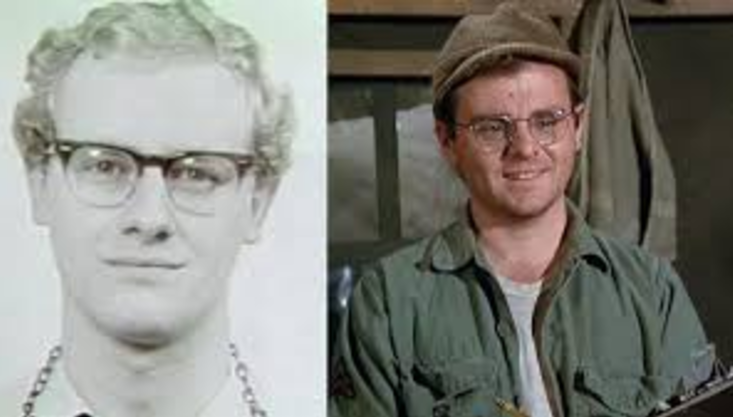
Arthur Bremer and Radar O'Reilly.
Today, despite its foreboding title, An Assassin's Diary does not provide chilling insight into the twisted mind of a would-be killer. Instead, it reads like a very, very dark comic novel about a guy who's in way over his head. The author's spelling, dialogue, grammar, and punctuation are all atrocious, making the diary seem like a kid's sloppy homework. In his mug shot from the period, Bremer strongly resembles actor Gary Burghoff as timid, mild-mannered "Radar" O'Reilly from M*A*S*H.

More than anything, the deluded young man's diary is highly reminiscent of Tom Wilson's Ziggy, a comic strip that debuted in June 1971, less than a year before the bungled assassination attempt. To put it frankly, Arthur Bremer is the Ziggy of political assassins: a luckless, ineffectual doofus who receives nothing but shabby treatment from the world. That is, when the world bothers to notice him at all.

Like Ziggy, An Assassin's Diary is largely devoted to the title character's poor customer service experiences at various sub-par businesses: hotels, restaurants, and auto mechanics. Because this is a young man's journal and not a family-oriented comic strip, Bremer's misadventures also include an unsatisfying trip to a massage parlor, which he visits after seeing an ad in Screw magazine.

Bremer followed Nixon and Wallace on the campaign trail in the unhappy spring of '72, waiting for his perfect opportunity to strike, and the miserable road trip proved to be a protracted comedy of errors. In his diary entry for April 21, 1972, for instance, Bremer talks about what happened one night when he pulled into one service station and then another to get a tire patched:
A high school kid and his girl were there talking quietly. Kid seemed disturbed that someone would pull into his station, a big name place like the first, and disburbe his romance. He didn't have the patches! 
"If a service station doesn't have the patches who does?" 
"I don't know". 
"Maybe I should try a negligy store". 
He walked back to his girl in silence.
Previously, on April 19, Bremer had written of his unmistakably Ziggy­-esque experience aboard an overcrowded airplane.
A fat boring sheltered slob of a theology student talked non-stop with an equally sheltered & fasinated (always smiling) high school student. I waited 30 minutes for dinner & when I got it, last in the whole plane, we had turbilence & the "fasten seat belts" sign went on. Impossible to do with the dinner table down. I hurreyed & drank down half my coffee before it spilled over my pants. Got away with only a tie stain and an everlasting preduice against theology students & capacity plane trips.
Like Tom Wilson's bald-headed cartoon everyman, the aspiring assassin is plenty incompetent all on his own, without any assistance from others. In those pre-Google Maps, pre-GPS days of the early 1970s, Bremer had to find campaign rallies and whistle stops by himself, and An Assassin's Diary shows him to be perhaps the world's crummiest navigator. He spends a lot of his time hopelessly lost, sometimes even having to ask his hated foes, policemen and Secret Service agents (whom he refers to as "the SS"), for help.

And the guy is all thumbs when handling firearms. Once, in preparation for a border crossing into Canada, he secrets a gun so deeply within the bowels of his car that it cannot be retrieved again. And the book's arguable comic high point occurs when, while holed up in his depressing little apartment, he accidentally fires a very noisy shot he then pathetically tries to cover by turning the television to a war movie. Only the apathy of the landlady saves him.

That's one of the great, unintentional lessons of An Assassin's Diary: Arthur Bremer, hopeless though he is, catches America napping on the job. The young man's strange, jittery behavior should have set off alarm bells and possibly gotten him arrested at any number of points along his journey, way before he got close enough to George Wallace to fire a shot. But it seems that nobody was paying this schmuck the least bit of interest.

The book's pathetic postscript reveals that virtually no one had bothered to get to know him. What did Arthur Bremer's few acquaintances recall of the suddenly famous man? "Somebody else remembered," reports the epilogue, "that his mother had refused to let him try out for the high school football team." Apparently, the only way people had to define him was by negation. He was the guy who didn't play football in high school. Some legacy.

Had anyone actually taken a few minutes to get to know Arthur Bremer, they'd have met a young fellow who, while no Rhodes scholar, was capable of some piquant commentary about the emptiness of our culture. At one point in An Assassin's Diary, apropos of nothing, he criticizes Diana Ross for selling out to please white audiences. Elsewhere, he rants about the unfairness of American vending machines not taking Canadian coins. He routinely mocks hippies for the uselessness of their protests and demonstrations. He gives politicians, policemen, and other authority figures no respect either, casually referring to Nixon as "Nixy-boy."
 
Poster for ZPG.
And he even does a little amateur movie reviewing, too, making the decision to switch his target from Nixon to Wallace while watching Stanley Kubrick’s A Clockwork Orange, "fantasizing myself as the Alek on the screen come to real life." True to Bremer’s virginal nature, he’s more concerned with “the old ultra violence” in the film than he is with “the old in out.” He praises Michael Campus' now-forgotten sci-fi film Z.P.G. as a movie that "really hit home with people playing with dolls, paste-food, super-smog, etc." But he says that Otto Preminger's Such Good Friends is "probaly the worst picture he ever made" and "as bad as Vixen by Russ Mayer. Dog shit with a plastic flower in it."

In his humbler moments, Bremer sends a few zingers in his own direction, too. His tone throughout the book swings wildly from self-aggrandizement to self-abasement. Sometimes, he thinks he’s writing a book for the ages; other times, he seems to realize that he isn’t. He knows, for instance, that downgrading his target from Richard Nixon to George Wallace means that his story is much less newsworthy and may even be ignored by the foreign press entirely. And although he considers his diary to be an important historical document, he's often unsure what to put in it. 
"Funny," he writes at one such juncture, "I've got nothing to say. Have I ever said anything?" This from a man who, at an earlier point in his manuscript, expected his words to be as carefully scrutinized as the Dead Sea Scrolls.

History, as we now know, had other ideas about that. Now retirement age and basically forgotten by the country he tried so hard to impress, Arthur Bremer is out of prison and on probation until 2025. During that time, he is expressly forbidden from venturing anywhere near an elected official. That's probably for the best, even today. Back in 2005, when John Waters reprinted the Female Trouble script as part of a book, he gave his fans a little update on Bremer's condition: "According to a friend who was in jail with him for decades, 'he's still nutty as a fruitcake.'"

Tuesday, May 27, 2014

'Taxi Driver' predicted Elliot Rodger before Seth Rogen was even born

"God's lonely man": Robert De Niro as cab driver turned vigilante/assassin Travis Bickle.

In case you haven't been following along, it turns out that the blame for Elliot Rodger's misogynistic killing spree in Santa Barbara, CA, can all be laid at the feet of Seth Rogen and Judd Apatow and their movies about schlubby guys scoring with beautiful women. Thanks for sorting that out for us, Ann Hornaday. I trust that the proper authorities, once they read your Washington Post op-ed piece, will put out a warrant for the arrests of Mr. Rogen and Mr. Apatow immediately and that these two men will be in custody soon. As sad as this information is, it's at least good to know that we've gotten to the bottom of this whole thing. And so quickly, too! Ms. Hornaday has certainly earned her Crime Stoppers Badge of Honor this week. 

How curious, though, that the movies of Seth Rogen and Judd Apatow have not inspired similar massacres in the dozens of other countries around the world where they've been released. It's almost as if Rodger's actions were guided by circumstances, both personal and social, infinitely more powerful than any fictional movie comedies.

Curiously, neither Neighbors nor Knocked Up came immediately to mind as I sifted through the horrifying news updates coming from California and tried to make sense of the twisted, tragically-misguided rhetoric of Rodger's so-called "manifesto." Instead, I was thinking about Martin Scorsese's Taxi Driver (1976), an unnerving urban fable about a profoundly alienated, deeply unbalanced cab driver, Travis Bickle (Robert De Niro) who becomes a merciless vigilante and a would-be political assassin after he is rejected by a beautiful campaign worker, Betsy (Cybill Shepherd), with whom he has become romantically infatuated. 

Throughout the film, we are made privy to Bickle's warped thought process through his chilling yet strangely poetic voice-over narration. These passages, which supposedly derive from a journal or diary which Bickle is keeping of his activities, are remarkably similar to Elliot Rodger's ravings. In particular, while reading the manifesto, I was reminded of a scene from Taxi Driver in which Travis arrives, unwanted, at Betsy's workplace, and she has him thrown out. Travis' parting words to Betsy are: "You're in a hell, and you're gonna die in a hell like the rest of them!" As if to clarify this vaguely-worded threat, we then hear a strikingly prescient quote from Travis' narration:
"I realize now how much she's just like the others. Cold and distant. And many people are like that. Women for sure. They're like a union."
This line could have come word-for-word from Rodger's manifesto, with its sullen, self-pitying paranoia and horrendous misconceptions about women. And it comes from a movie which was released six years before Seth Rogen was even born. Perhaps Martin Scorsese and his screenwriter, Paul Schrader, were giving us a warning with Taxi Driver, one we utterly failed to heed.

Monday, October 3, 2011

(today's zomby) AND TAXI DRIVER: THE MUSICAL!


And speaking of fascinating failures...

In 1994, Saturday Night Live had one of its worst-ever seasons, and as longtime viewers know, that's really saying something. The repertory cast that Lorne Michaels had built up during the late 1980s and early 1990s was disintegrating, and the producer made the ill-advised decision to prop up the show with "ringers," i.e. performers who were already well-established in films and TV rather than newcomers. Couple this with a decline in writing and general sense of malaise, and you have the formula for disaster. The show was churning out clunker after clunker, dragging the hosts down with them.

One of these unfortunate victims was the brilliant John Turturro, who hosted on November 17, 1994. Turturro was hoodwinked into participating in one of the show's more memorably misbegotten sketches, "Taxi Driver: The Musical." I can remember watching the original broadcast with members of my family and having my sister beg me to press the "MUTE" button during this skit. Nearly 17 years later, I thought it was time to revisit this bit of comedic infamy. I had forgotten that Turturro plays two roles. He is actually quite brilliant as Martin Scorsese, but his tone deaf "singing" as Robert De Niro/Travis Bickle is hopeless. The other cast members, including Michael McKean, Jay Mohr, and Janeane Garofalo make very little attempt at imitating (respectively) Peter Boyle, Harvey Keitel, and Jodie Foster. The cutaways to Scorsese are quite good and funny, but the musical segments have an odd heaviness to them. The songs are actually played pretty straight, as if Taxi Driver really had been made into a serious Broadway musical. I remembered this as playing to dead silence from the audience, but it actually gets a respectable amount of laughs. In some ways, it's a precursor to the "quotation as satire" school of comedy so prevalent today.

Anyway, here's the sketch. Watch for yourself and decide:


Friday, September 23, 2011

(today's zomby) AND THE CHILLING WORDS OF A MADMAN

With today's Zomby, I wanted to try an experiment: what if this cartoon were written by notorious would-be assassin Arthur Bremer?


Bremer's diary
A little history for those not in the know: In 1972, the emotionally-troubled Arthur Bremer (b. 1950) made an attempt on the life of controversial segregationist politician George Wallace. The former Alabama governor was not killed by Bremer's four shots at close range, but he was confined to a wheelchair for the rest of his life before dying in 1998 at the age of 79. Bremer spent the next few decades in prison but was ultimately released in 2007. Besides the assassination attempt, Bremer is most famous for his bizarre, error-filled journals which were published under the title An Assassin's Diary in 1973. (Note: The dialogue in the cartoon above comes directly from that book.) So what's the connection to this feature? Well, to me, Arthur Bremer is very much the Ziggy of assassins -- not just because he failed but also because of his almost touchingly pathetic motives. Bremer was not a political extremist but instead was a nonentity, a nobody who thought that the assassination of a famous politician like George Wallace or Richard Nixon would give his life meaning or purpose. The poor schmuck even kind of looked like Ziggy, with his bland, rounded, nonthreatening features.

Harmless-looking Arthur Bremer

Personally, I think Ziggy is a very dangerous little man. The world treats him terribly, and yet he just stands there passively absorbing it all. But each mishap, each insult, each slight pushes him closer to being the next Arthur Bremer. May god have mercy on the snotty waiters, pushy salesman, and grouchy cashiers of the Ziggyverse when that happens. Incidentally, Bremer's diary was the partial inspiration for Martin Scorsese's film Taxi Driver and for Peter Gabriel's song "Family Snapshot."


Perhaps someday, I will do a long-form mashup of Ziggy and An Assassin's Diary. For now, this cartoon will have to serve as the pilot. I wish it were Ziggy himself speaking the punchline and not that goddamned parrot of his, but I have to work with the cartoons I'm given.