Showing posts with label The Dude. Show all posts

Monday, November 18, 2013

Hot off the presses! I'm (sort of) in a new book!

I am one of the many contributors to the new book Lebowski 101, edited by Oliver Benjamin.

Here's what you need to know: Oliver Benjamin, a Los Angeles-born journalist now based in Thailand, is the founder of Dudeism, an uber-casual, non-jugmental philosophy based on the laid-back teachings of Jeffrey "The Dude" Lebowski, a fictional pot-smoking ex-hippie played by Jeff Bridges in the Coen Brothers' 1998 movie The Big Lebowski. Dudeism has its own website and an official publication called The Dudespaper. Some months ago, Oliver asked if I would contribute an essay to a Dudeism book, and I happily agreed. The resulting volume, Lebowski 101: Limber-Minded Investigation Into the Greatest Story Ever Blathered, is now available on Amazon, and it includes a piece I wrote called "A Pox on Both Your Houses, Man: The Two Very Flawed Families of The Big Lebowski." If that sounds like something which would interest you, by all means check it out.

Here's a link to the book's Amazon page.

Saturday, September 21, 2013

To achieve or not to achieve? That is, like, the question, man!

"I went out and achieved anyway!" says David Huddleston in The Big Lebowski

"Well, what have you achieved?"
-Bob Barker, talking to a Lebowski fan in an "Achiever" t-shirt
It strikes me as a bit ironic that fans of the Coen Brothers' stoner comedy The Big Lebowski (1998) refer to themselves as "Achievers." At the Lebowski Fest website, home of the annual multi-city festival devoted to the movie and its values, official merchandise includes t-shirts and hoodies with the word "Achiever" on them, and there's a section called Achiever Nation with photos of fans. I was among the interviewees in Mike Chang's documentary The Achievers: The Story of the Lebowski Fans, and I belong to a Facebook group devoted to the film called "Shit Yeah, The Achievers!" 

That's a lot of achieving for a film ostensibly devoted to the art of "takin' 'er easy." The film's hero, shambling hippie Jeffrey "The Dude" Lebowski (Jeff Bridges), is defined by his very lack of achievement. One of the most comforting lessons of this film is that a man cannot be judged solely on the basis of his worldly accomplishments. Those who are lauded and respected for their professional triumphs or grandiose acts of public philanthropy may be morally bankrupt, while an unemployed ex-roadie with a penchant for laziness, bowling, and pot may emerge as a modern-day hero, "the man for his time and place."

To properly decode one of the familiar green "Achiever" t-shirts, as Bob Barker was once famously unable to do on The Price is Right, you first need to know that an important element of the film's plot is a fictional charity called the Little Lebowski Urban Achievers. This organization is devoted to providing the underprivileged youth of Watts with college educations. 

The film's principal villain, a cranky, wheelchair-bound millionaire (David Huddleston) who shares the name "Jeffrey Lebowski" with its hero, is one of the charity's two trustees, the other being his estranged bohemian artist daughter, Maude (Julianne Moore). The elder Lebowski certainly seems to enjoy the attention and adulation that come with this high-profile position. Mr. Lebowski's office, after all, is cluttered with various trophies and certificates of recognition, and he has mounted photographs on the wall to prove that he has met with Republican politicians and conservative movie stars. 

The elder Jeffrey Lebowski is not a man who administers charity in a humble, anonymous manner. He wants these acts to be formally documented. He strikes a paternalistic pose in a portrait of himself with the underprivileged youth he thinks of as his "children," and he has eagerly participated in photo ops with such luminaries as Nancy Reagan and Charlton Heston. Mr. Lebowski's nervous and fastidious assistant, Brandt (Philip Seymour Hoffman), deems it necessary to tell the Dude that his boss met Ronald Reagan but that "unfortunately there wasn't time for a photo opportunity." In Mr. Lebowski's world, the only good deed worth doing is the kind you can thoroughly document and hang on the wall. It's a value Brandt has internalized.

They honored a scumbag.
It is the older, wealthier Lebowski, once honored as "Achiever of the Year" by Variety Clubs International, who introduces the "achievement" motif to the film. Other characters, including Maude, the Dude, and the Dude's belligerent Vietnam veteran sidekick, Walter (John Goodman), utter the word "achiever," but only in reference to the charity and its recipients. Mr. Lebowski, however, works it into his dialogue frequently. 

Commenting on the Korean War injuries that have confined him to a motorized wheelchair, the elder Lebowski tells the younger in their first meeting, "I went out and achieved anyway." After Mr. Lebowski's young wife Bunny (played by Tara Reid and pointedly called a "trophy" by both Maude and the Dude) has supposedly been kidnapped, the blustery old man says that he "can look back on a life of achievement – on challenges met, competitors bested, obstacles overcome." He refers to the kidnappers as “men who are unable to achieve on a level field of play.” 

Later in the film, when the Dude has apparently botched a ransom drop and thus doomed Bunny, Mr. Lebowski testily declares that the younger man has "failed to achieve, even in the modest task which was your charge." Clearly, Mr. Lebowski is a man who neatly divides the world into two categories: achievers and non-achievers.

How strange, then, that the film's biggest proponent of "achievement" is also its most reprehensible scumbag. As we have learned by the end film, Mr. Lebowski is a blustery fraud who pretends to be a busy tycoon and who embarks on a truly vile scheme that more or less amounts to selling his underaged wife for $1 million, embezzling from the very charity he pretends to love, and framing an innocent "sap" for the whole thing.

All of this is done, mind you, out of mere vanity. This man already lives in opulent comfort and receives a "reasonable allowance" from his daughter. What could he possibly need with a million dollars? He just wants some money to call his own, strictly as a matter of male pride. Like the title character in The Wizard of Oz, Mr. Lebowski is ultimately exposed as a humbug, but unlike that ersatz sorcerer, he is not a "very good man" underneath, merely a coward and a thief.

Jackie Treehorn: A faint hint of sulfur in the air?

There are two other characters in the film who mirror Mr. Lebowski in their desire to flaunt their status as social achievers. One is Jackie Treehorn (Ben Gazzara), the mysterious Malibu pornographer seemingly modeled after Hugh Hefner. Treehorn is the one who took Bunny Lebowski (nee Fawn Knudsen) and transformed her from a Minnesota farmgirl into a drug-addicted porn star with a “sizable debt.” Besides “treat[ing] objects like women,” Jackie employs two musclebound thugs and does not hesitate to deploy them like attack dogs when needed. 

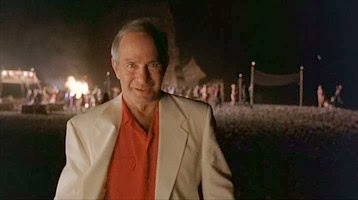
Jackie is a shady character indeed, perhaps the movie's closest stand-in for Satan incarnate. His dramatic entrance, deep into the movie, occurs at night during a beach party where the only illumination is provided by roaring bonfire. As he slowly emerges from the shadows to greet the Dude (and the audience, since this is filmed as a POV shot from the Dude's perspective), the viewer may detect a faint hint of sulfur in the air. At first, the Dude is impressed by Jackie's "completely unspoiled" home, but our hero shows a Groucho Marx-esque disrespect for Mr. Treehorn's profession.

"How's the smut business, Jackie?" the Dude casually inquires.

"I wouldn't know," responds Jackie. "I deal in publishing, entertainment, political advocacy."

"Which one's Logjammin'?" counters the Dude, cannily referring to one of Treehorn's lowest-common-denominator porn films.

Here, as at the Lebowski mansion, it is outward appearance, rather than inner truth, that seems to matter most. Instead of copping to what he really is, Jackie Treehorn rattles off his socially-acceptable achievements. I am reminded of the late author Robert Anton Wilson's satirical sci-fi book Reality Is What You Can Get Away With. In that singular work, published a mere six years before the release of The Big Lebowski, Wilson imagines a future in which lying or "bullshit" is extinct, and the earnest historians of the future are puzzled by the doublespeak of the Twentieth Century. A representative passage: "Realize that the function of Bullshit lies in concealing the facts, especially uncomfortable facts, and you begin to enter the reality-tunnel of this astounding ancient semantics."

A real reactionary: The corrupt police chief of Malibu, CA

Jackie's subterfuge appears to have worked brilliantly, at least judging by the scene in which the Dude, at the behest of the aforementioned smut peddler, is arrested on trumped-up charges by the Malibu police and taken by squad car to the station house. At the Malibu police station, we meet the bellicose and possibly corrupt chief (Leon Russom), who insults and abuses the Dude in what seems to be a comical SoCal parody of Christ's treatment by the Romans. 

The police chief of Malibu is the third prominent "achiever" in the film, and like the other two, he does not inspire our sympathy. Evoking Mr. Lebowski's ostentatious workspace, the Chief's office is decorated with a whole assortment of plaques and parchments, all attesting to his status as a guardian of law and order, endorsed by the upscale porn-funded "beach community" that bankrolls his petty, small-scale fascism. The good chief also reinforces Jackie Treehorn's vaunted place in society when he soberly tells the Dude, "Mr. Treehorn draws a lot of water in this town. You don't draw shit, Lebowski." It seems that Jackie's considerable financial resources have convinced the local law enforcement – and the community at large – to ignore his blatantly unsavory activities, while the harmless Dude is treated as a menace.

If Mr. Lebowski, Jackie Treehorn, and the Police Chief of Malibu are the pillars of your community, then your community is rotting from the inside out. These men have all “achieved” in ways that are recognized by American society. The duplicitous Lebowski and the venal Treehorn live in fancy houses, surrounded by material comfort and lauded by the world for their "success," while the thuggish police chief wears a badge which designates him as an official gatekeeper of modern civilization. 

The Dude, meanwhile, has very little in the way of extrinsically verifiable status. His wardrobe, vehicle, employment history, and living accommodations are all extremely modest. Repeatedly broken into and vandalized over the course of the film, his bungalow is far from "unspoiled." The collars of his t-shirts sag after decades of washings. He doesn't seem to have held a job in years. And that misbegotten 1973 Ford Gran Torino of his – "green with some brown rust coloration" – takes nearly as much abuse as the Dude himself. All of these factors show us that the Dude is not a man who puts much stake in "achieving."

Yet, when the movie is over, which character would we most like to emulate?

Saturday, November 17, 2012

That is a bummer, man: Depression is very un-Dude

A potential role model: Jeff Bridges as The Dude in The Big Lebowski (1998)

"Oh, man, my thinking about this case had become very uptight." - Jeffrey "The Dude" Lebowski

I like to tell people I'm in a Jeff Bridges movie. It's only technically true. He's in the movie, and I'm in the movie, but our scenes were filmed at different times in different locations. In reality, Mr. Bridges and I are both interviewees in Eddie Chung's The Achievers: The Story of the Lebowski Fans, a 2009 documentary about the fan culture surrounding the Coen Brothers' 1998 comedy, The Big Lebowski, and the phenomenon of Lebowski Fest, an annual, multi-city series of celebrations in the film's honor. Fans of the film call themselves "Achievers," a reference to the Little Lebowski Urban Achievers, a fictional charity which figures into the film's plot. These Achievers gather regularly at various theaters and bowling alleys to socialize, bowl, drink White Russians, and participate in costume and trivia contests. To date, I have attended one such event -- the first-ever Chicago Fest in early 2008. I happened to win the trivia contest on the Fest's second and final night, which led to my being interviewed by the film's director. I've gotten a bit of mileage out of my first and likely only screen appearance. I managed to wrangle an IMDb entry out of it, for instance, and look what happens when you Google the movie's title:

Even Google says I'm in a Jeff Bridges movie.


I had a lot of fun at that Lebowski Fest in 2008 and met some very nice people there, including Liz and Ben, the hosts of The Lebowski Podcast, a show whose sixteenth episode features your humble blogger as a special guest. Achievers tend to be funny, friendly, laid-back people, and virtually everyone I encountered at the Fest made me feel welcome. But I have not attended any subsequent Fests, and a lot of that is due to my depression and anxiety. (If you are new to this blog and don't know what's been happening in my life, this post will get you up to speed.)

The Dude and Walter
The film itself may contain a role model -- or "roll" model, if you will -- for my recovery. Set in 1991, the convoluted plot of The Big Lebowski revolves around Jeffrey "The Dude" Lebowski (played by Jeff Bridges), an aging, pot-smoking ex-1960s radical who now lives a slothful but contented life in Venice, CA. Because he shares his name with that of a wheelchair-bound millionaire, The Dude is improbably drawn into a Raymond Chandler-like mystery story which requires the THC-impaired slacker to act as a sort of detective. Together with his best friend, a volatile Vietnam veteran named Walter (John Goodman), The Dude must investigate the possible kidnapping of the millionaire's young porn star wife, Bunny (Tara Reid). His adventures put him in contact with a variety of eccentric Southern California characters, including the millionaire's avant garde artist daughter, Maude (Julianne Moore), a Hugh Hefner-like pornographer named Jackie Treehorn (Ben Gazzara), and a trio of German nihilists (whose leader is portrayed by Peter Stormare) who once had a techno band but are now trying to extort money from the millionaire. Meanwhile (this is a complicated film), The Dude, Walter, and a third companion, Donny (Steve Buscemi), are participating in a bowling tournament which puts them at direct odds with the film's most infamous character, a preening, profane pederast named Jesus Quintana (Jon Turturro at his creepiest) whose bowling skills are almost supernatural. All of these events are observed by a mysterious cowboy known only as "The Stranger" (Sam Elliott), who narrates the film, addresses the audience directly, and occasionally talks in a casual but reassuring way to The Dude.

Throughout all of this, The Dude maintains an admirable equanimity -- some of it attributable to his intake of marijuana and alcohol but much of it owing to his extremely casual, low-pressure approach to life. His credo, after all, is "The Dude abides" (a beloved slogan among Achievers), meaning that he simply accepts life as it comes to him. It should be noted, however, that The Dude does not always live up to this personal philosophy. Quite often throughout the film, he shows moments of stress and anxiety, and at the film's midpoint, he even has a bout of depression as he begins to take a pessimistic view of his current situation. This attitude briefly alienates him from Walter and Donny, at which point The Stranger sidles up to him at a bar to give him sort of a low-wattage halftime pep talk.

Despite his easygoing nature, The Dude also deals with some anger issues in the film. As the Coen Brothers themselves point out in a featurette on the DVD, The Dude will often lose his cool throughout the story. Usually, these episodes are triggered by Walter, whose blustery exterior masks a deep insecurity and whose unpredictable behavior only exacerbates The Dude's existing problems. The friendship between The Dude and Walter is the heart of The Big Lebowski. These men are opposites, both temperamentally and politically -- one a dove, the other a hawk -- yet they seem to have struck a balance which has lasted for years. Much of this is due to The Dude's eternal elasticity. It is true that he has negative episodes, as we all do, but he always returns to his genial, accepting nature before long. It is no wonder that The Dude has inspired his own religion, Dudeism. In our most stressful and troubling moments, wouldn't we all like to be as peaceful as he seems to be?

Poor Brandt
Frankly, I am not much like The Dude, though I am trying to be. I have much more in common with one of the film's supporting characters, Brandt (Philip Seymour Hoffman), the millionaire's nervous, glad-handing assistant. He is the one character in the film with whose life I can personally identify, perhaps because he is the only person whose job remotely resembles mine. 

The Dude is chronically unemployed, while Walter runs his own security business out of a seedy-looking strip mall, but Brandt is the one who dresses up for work every day and spends his time trying to please his boss. This must be difficult, as the millionaire Lebowski is a cantankerous, disagreeable man prone to shouting and insults. Brandt spends his days pretending to smile as he does his boss' dirty work, and the beleaguered assistant must deal with some serious denial issues as he labors to put the best possible spin on the situation at hand. He chuckles jovially, for instance, as Bunny makes a crude sexual remark about him to The Dude. If this scene weren't so funny, it would be heartbreaking. Think of poor Brandt, having to deal with this humiliation as a routine part of his job.

The road to recovery is a long one, marked by "strikes and gutters, ups and downs," as The Dude succinctly puts it in the film's final scene. Perhaps through therapy and medication, I can learn to be a little less Brandt and a little more Dude.