Showing posts with label money. Show all posts

Tuesday, June 30, 2026

Podcast Tuesday: "The Most (To Say the Least)"

Donny Most just wants you to listen to some songs, okay?

"Strike while the iron is hot." 

That's the saying, right? You've gotta take advantage of opportunities, especially financial ones, when they come along. If you wait too long, they could disappear. As a wise man named Jerry Reed once said (or half-sang), "When you're hot, you're hot. And when you're not, you're not." But what does that mean if you're an actor on a top-rated TV sitcom? Sure, the iron is hot, but how exactly do you strike it? What do you strike it with? Do you try to get a movie deal? Endorse a chain of frozen yogurt places? Start a chain of frozen yogurt places?

These were the questions facing Donny Most in 1976. A showbiz lifer who'd been performing since childhood, he was suddenly mega-famous due to his portrayal of jokester Ralph Malph on Happy Days. This was as hot as the iron was ever going to get, and Donny struck it. Specifically, he signed a deal with United Artists and recorded a mix of golden oldies and relatively recent tracks for the label. The resulting LP, cleverly titled Donny Most, was not exactly a chartbuster in its day but gained something of a following among Happy Days fans and was even reissued on CD some years ago. 

But is the darned thing even listenable to modern ears? That's what my cohost and I try to find out this week on These Days Are Ours: A Happy Days Podcast. We were both familiar with one track, the boldly-titled "Rock is Dead," but what about the other nine? I hope you will accompany us on this strange musical journey.

Tuesday, May 27, 2025

Podcast Tuesday: "Stockholm Syndrome: The Romantic Comedy!"

Kurt Russell and Goldie Hawn in Overboard.

Boy, were we obsessed with money in the 1980s! It was all we ever thought about, apart from sex, drugs, leg warmers, video games, and the music of Adam Ant. 

Admittedly, we humans have been obsessed with money ever since it was invented about five-thousand years ago, but our fixation on the topic hit a new high during the Reagan-Bush years. Or a new low, depending on your point of view. Either way, the subject dominated popular culture across all media in the '80s. On the radio, we'd hear "Money for Nothing," "Big Time," "Opportunities (Let's Make Lots of Money)," and "Material Girl." On television, we'd tune into capitalist fantasies like Dallas, Dynasty, Diff'rent Strokes, Silver Spoons, and Lifestyles of the Rich and Famous. These shows taught us that, with enough cash in your bank account, you could live as you please and make your most vulgar consumerist dreams come true. And we bought into it!

But the movies outdid them all! Year after year, Hollywood gave us silly, over-the-top comedies about the extremely wealthy, often showcasing how they reacted to being around the extremely unwealthy.  Just off the top of my head, I remember Arthur (1981), Annie (1982), Trading Places (1983), Brewster's Millions (1985), Ruthless People (1986), Down and Out in Beverly Hills (1986), Big Business (1988), Coming to America (1988), and more. This was a time when it seemed like the characters in film comedies always had maids and butlers.

Somewhere in all this mess was Garry Marshall's fourth feature film, Overboard (1987) starring Goldie Hawn as a spoiled rich woman who loses her memory and Kurt Russell as an earthy carpenter who takes advantage of that situation. Edward Herrmann, Katherine Helmond, and Roddy McDowell come along for the ride. Have you already guessed that this is the film we're covering this week on These Days Are Ours: A Happy Days Podcast? Well, it is. You can hear what we thought of Overboard by clicking the play button below.

Wednesday, January 15, 2025

Ed Wood Wednesdays, week 211: The incredible artwork of Shenandoah See (and my total failure as an Ed Wood fan)

I think this piece captures something essential about Tor Johnson.

In August 2021, I did what I had hoped never to do again: I returned to full-time office work. It seemed like my only option, since my freelance writing career was truly dead by then. I couldn't sell very many articles to editors, at least not enough to cover my monthly expenses, and Dad Made Dirty Movies: The Erotic World of Stephen C. Apostolof (2020), the book I'd authored with Jordan Todorov, wasn't exactly opening a lot of doors. Meanwhile, I needed medical insurance and a reliable source of rent money. It was time to go back to the only life I'd ever known.

Turns out, cubicle jobs like the ones I'd had in the '90s and '00s weren't as common in the 2020s—especially after the pandemic—but I found a reliable (if low-paying) position at a mortgage company and have stayed there for over three years. Since then, free time has become my most precious commodity, maybe the only thing I really treasure anymore. Every second away from that office is golden, even if I'm spending it in traffic or waiting in a checkout line.

Since time is my most/only valuable asset, I have to decide how to spend it wisely. Maintaining this blog is one of my main hobbies, but it's not the only one. Believe it or not, I have a life beyond Ed Wood. Since 2018, for instance, I have cohosted a podcast called These Days Are Ours that requires many hours of research and editing. I'm also a member of the Glenview Concert Band, an ensemble that rehearses and performs regularly. So I have at least three sirens calling out to me. But there is a fourth that outranks the others: the urge to do nothing at all. Often, when I drag myself home from work, all I want to do is stare blankly at the TV for a couple of hours and then crawl into bed without accomplishing a single thing.

I feel guilty about all this, because earnest, well-meaning people continue to email me with questions, comments, and suggestions—pretty much all of it related to Ed Wood. To be honest, I've barely skimmed most of this material. In many cases, these fine folks are working on books and documentaries of their own, and they want my input or participation. If I respond at all, it's usually something like, "Sounds interesting!" or "Keep me posted!" Some help I am, huh? 

One of the people emailing me lately is a talented writer and artist named Shenandoah See. Even though I have been shamefully lax in responding to his emails, he graciously said I could share some of his work however I see fit. This is how I see fit. Here is a little gallery of Shenandoah's work. I genuinely hope you enjoy it.

Thursday, November 15, 2018

Here are two stories I couldn't sell! Enjoy!

"Can't be a winner every time, hon." - Edith Massey

What can I say, folks? Every once in a while, even a seasoned professional writer like myself comes up with a loser. A flop. A stink bomb. A turkey. It happens. I'm sure even Jackie Collins had the occasional bad day. Not everything can be Hollywood Wives. And when it happens, you pick yourself up, dust yourself off, and move on. Jackie knew it. I know it.

Some of the stuff I write is purely for my own amusement, but most of it is written to reach an audience, either through this blog or through some online platform that actually pays me. But what is funny or interesting to me is not always funny or interesting to other people. I have learned that lesson many times in the past, and I will learn it many times in the future.

With that said, here are two articles I wrote in hopes of making a sale. Neither one sold, and since they were both time-sensitive, they are no longer relevant or salable. Past their expiration date, both of them. Still in all, I hope that you will either enjoy them or at least learn from my mistakes.

Sunday, February 1, 2015

Rod McKuen was a childhood hero of mine... only I didn't know it

Man with a turtleneck: Rod McKuen on the cover of one of his many, many, many albums.

Rod McKuen died this week at the age of 81. He is mostly remembered as the creator of very popular, very corny poetry that was loved by the general public in the 1960s and 1970s but mocked and hated by literary critics. As a songwriter, his tunes were covered by artists ranging from Frank Sinatra to Madonna. But he's best known for Terry Jacks' "Seasons in the Sun," a maudlin but catchy tune about death that occasionally turns up on lists of the worst and most detested hit songs of all time. (Once, on a long car trip, that song came on the radio, and I improvised my own alternate lyrics: "We had joy, we had fun, we had fingers up our bums.")

John Waters made sure to include McKuen's name in his article "Hatchet Piece (101 Things I Hate)." In its obituary, NPR somewhat uncharitably called Rod McKuen "the cheeseburger to poetry's haute cuisine." Clearly, for such a gentle and easygoing guy, McKuen attracted a lot of vitriol. Personally, I don't really care one way or the other about McKuen's hippy dippy poetry. It has had no real effect on my life, and if others have derived comfort from his words, well, more power to 'em. What I learned as an adult, however, is that Rod wrote and recorded two of my favorite songs of all time. And they were on opposite sides of the same 45 RPM record, no less!

I've written about this before, but my real introduction to popular music came through a stack of very worn-out vinyl records my mother had owned as a child. Her own parents had operated some bars and restaurants in northern Michigan, and she got the records from the jukeboxes when her folks were done with them. Those same 45s were eventually passed down to me and my sister. I still have them -- or most of them (kids are tough on records) -- neatly alphabetized in a shoebox in my bedroom closet.

Anyway, one of my favorite platters was a novelty number from 1959 called "The Mummy," credited to "Bob McFadden and Dor." McFadden (1923-2000) was a cartoon voice man. You may know him as Snarf from Thundercats. Dor, naturally, was the backwards-running pseudonym of Rod McKuen. "The Mummy" is a weird damn record -- not quite a song, not exactly a skit. McFadden plays a meek, neurotic mummy ("I was born one-thousand, nine-hundred, and fifty-nine years ago!") who terrifies everyone he meets... until he encounters McKuen, who portrays an unflappable and utterly unimpressed beatnik. I can still recite every word of their strangely low-key conversation. ("Aren't you afraid of me? Aren't you gonna scream?!" "Oh, yeah. Like, help.") In retrospect, this record also serves as a snapshot to late-'50s culture, with references to Dave Brubeck, George Shearing, the Modern Jazz Quartet, and "Kookie, Kookie, Lend Me Your Comb."


The flip side of "The Mummy" is maybe even better. It's called "The Beat Generation," and it's a musical manifesto for beatniks everywhere. Like the A-side, it's written by Rod McKuen and credited to Bob McFadden and Dor, but this time I can't hear McFadden anywhere. It's all Rod, man. I honestly don't know how sincere this song is. For all I know, it's meant as satire, intentionally playing up every negative stereotype about beatniks in order to exploit "square" people's fears about them. But when I was a kid, I took it 100% literally, that's for sure.

When I was four or five, this song seemed very adult to me and more than a little dangerous. Suave, confident McKuen coolly expresses disdain for everything Americans are supposed to want: a wife, a nice house, and a good nine-to-five job. I still don't want any of that stuff either, and maybe this record is to blame for my lack of material success. I certainly listened to "The Beat Generation" enough during my formative years to have it permanently affect my thinking. Give it a listen and make up your own mind.

Saturday, September 21, 2013

To achieve or not to achieve? That is, like, the question, man!

"I went out and achieved anyway!" says David Huddleston in The Big Lebowski

"Well, what have you achieved?"
-Bob Barker, talking to a Lebowski fan in an "Achiever" t-shirt
It strikes me as a bit ironic that fans of the Coen Brothers' stoner comedy The Big Lebowski (1998) refer to themselves as "Achievers." At the Lebowski Fest website, home of the annual multi-city festival devoted to the movie and its values, official merchandise includes t-shirts and hoodies with the word "Achiever" on them, and there's a section called Achiever Nation with photos of fans. I was among the interviewees in Mike Chang's documentary The Achievers: The Story of the Lebowski Fans, and I belong to a Facebook group devoted to the film called "Shit Yeah, The Achievers!" 

That's a lot of achieving for a film ostensibly devoted to the art of "takin' 'er easy." The film's hero, shambling hippie Jeffrey "The Dude" Lebowski (Jeff Bridges), is defined by his very lack of achievement. One of the most comforting lessons of this film is that a man cannot be judged solely on the basis of his worldly accomplishments. Those who are lauded and respected for their professional triumphs or grandiose acts of public philanthropy may be morally bankrupt, while an unemployed ex-roadie with a penchant for laziness, bowling, and pot may emerge as a modern-day hero, "the man for his time and place."

To properly decode one of the familiar green "Achiever" t-shirts, as Bob Barker was once famously unable to do on The Price is Right, you first need to know that an important element of the film's plot is a fictional charity called the Little Lebowski Urban Achievers. This organization is devoted to providing the underprivileged youth of Watts with college educations. 

The film's principal villain, a cranky, wheelchair-bound millionaire (David Huddleston) who shares the name "Jeffrey Lebowski" with its hero, is one of the charity's two trustees, the other being his estranged bohemian artist daughter, Maude (Julianne Moore). The elder Lebowski certainly seems to enjoy the attention and adulation that come with this high-profile position. Mr. Lebowski's office, after all, is cluttered with various trophies and certificates of recognition, and he has mounted photographs on the wall to prove that he has met with Republican politicians and conservative movie stars. 

The elder Jeffrey Lebowski is not a man who administers charity in a humble, anonymous manner. He wants these acts to be formally documented. He strikes a paternalistic pose in a portrait of himself with the underprivileged youth he thinks of as his "children," and he has eagerly participated in photo ops with such luminaries as Nancy Reagan and Charlton Heston. Mr. Lebowski's nervous and fastidious assistant, Brandt (Philip Seymour Hoffman), deems it necessary to tell the Dude that his boss met Ronald Reagan but that "unfortunately there wasn't time for a photo opportunity." In Mr. Lebowski's world, the only good deed worth doing is the kind you can thoroughly document and hang on the wall. It's a value Brandt has internalized.

They honored a scumbag.
It is the older, wealthier Lebowski, once honored as "Achiever of the Year" by Variety Clubs International, who introduces the "achievement" motif to the film. Other characters, including Maude, the Dude, and the Dude's belligerent Vietnam veteran sidekick, Walter (John Goodman), utter the word "achiever," but only in reference to the charity and its recipients. Mr. Lebowski, however, works it into his dialogue frequently. 

Commenting on the Korean War injuries that have confined him to a motorized wheelchair, the elder Lebowski tells the younger in their first meeting, "I went out and achieved anyway." After Mr. Lebowski's young wife Bunny (played by Tara Reid and pointedly called a "trophy" by both Maude and the Dude) has supposedly been kidnapped, the blustery old man says that he "can look back on a life of achievement – on challenges met, competitors bested, obstacles overcome." He refers to the kidnappers as “men who are unable to achieve on a level field of play.” 

Later in the film, when the Dude has apparently botched a ransom drop and thus doomed Bunny, Mr. Lebowski testily declares that the younger man has "failed to achieve, even in the modest task which was your charge." Clearly, Mr. Lebowski is a man who neatly divides the world into two categories: achievers and non-achievers.

How strange, then, that the film's biggest proponent of "achievement" is also its most reprehensible scumbag. As we have learned by the end film, Mr. Lebowski is a blustery fraud who pretends to be a busy tycoon and who embarks on a truly vile scheme that more or less amounts to selling his underaged wife for $1 million, embezzling from the very charity he pretends to love, and framing an innocent "sap" for the whole thing.

All of this is done, mind you, out of mere vanity. This man already lives in opulent comfort and receives a "reasonable allowance" from his daughter. What could he possibly need with a million dollars? He just wants some money to call his own, strictly as a matter of male pride. Like the title character in The Wizard of Oz, Mr. Lebowski is ultimately exposed as a humbug, but unlike that ersatz sorcerer, he is not a "very good man" underneath, merely a coward and a thief.

Jackie Treehorn: A faint hint of sulfur in the air?

There are two other characters in the film who mirror Mr. Lebowski in their desire to flaunt their status as social achievers. One is Jackie Treehorn (Ben Gazzara), the mysterious Malibu pornographer seemingly modeled after Hugh Hefner. Treehorn is the one who took Bunny Lebowski (nee Fawn Knudsen) and transformed her from a Minnesota farmgirl into a drug-addicted porn star with a “sizable debt.” Besides “treat[ing] objects like women,” Jackie employs two musclebound thugs and does not hesitate to deploy them like attack dogs when needed. 

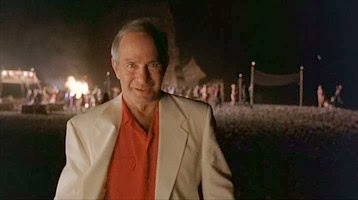
Jackie is a shady character indeed, perhaps the movie's closest stand-in for Satan incarnate. His dramatic entrance, deep into the movie, occurs at night during a beach party where the only illumination is provided by roaring bonfire. As he slowly emerges from the shadows to greet the Dude (and the audience, since this is filmed as a POV shot from the Dude's perspective), the viewer may detect a faint hint of sulfur in the air. At first, the Dude is impressed by Jackie's "completely unspoiled" home, but our hero shows a Groucho Marx-esque disrespect for Mr. Treehorn's profession.

"How's the smut business, Jackie?" the Dude casually inquires.

"I wouldn't know," responds Jackie. "I deal in publishing, entertainment, political advocacy."

"Which one's Logjammin'?" counters the Dude, cannily referring to one of Treehorn's lowest-common-denominator porn films.

Here, as at the Lebowski mansion, it is outward appearance, rather than inner truth, that seems to matter most. Instead of copping to what he really is, Jackie Treehorn rattles off his socially-acceptable achievements. I am reminded of the late author Robert Anton Wilson's satirical sci-fi book Reality Is What You Can Get Away With. In that singular work, published a mere six years before the release of The Big Lebowski, Wilson imagines a future in which lying or "bullshit" is extinct, and the earnest historians of the future are puzzled by the doublespeak of the Twentieth Century. A representative passage: "Realize that the function of Bullshit lies in concealing the facts, especially uncomfortable facts, and you begin to enter the reality-tunnel of this astounding ancient semantics."

A real reactionary: The corrupt police chief of Malibu, CA

Jackie's subterfuge appears to have worked brilliantly, at least judging by the scene in which the Dude, at the behest of the aforementioned smut peddler, is arrested on trumped-up charges by the Malibu police and taken by squad car to the station house. At the Malibu police station, we meet the bellicose and possibly corrupt chief (Leon Russom), who insults and abuses the Dude in what seems to be a comical SoCal parody of Christ's treatment by the Romans. 

The police chief of Malibu is the third prominent "achiever" in the film, and like the other two, he does not inspire our sympathy. Evoking Mr. Lebowski's ostentatious workspace, the Chief's office is decorated with a whole assortment of plaques and parchments, all attesting to his status as a guardian of law and order, endorsed by the upscale porn-funded "beach community" that bankrolls his petty, small-scale fascism. The good chief also reinforces Jackie Treehorn's vaunted place in society when he soberly tells the Dude, "Mr. Treehorn draws a lot of water in this town. You don't draw shit, Lebowski." It seems that Jackie's considerable financial resources have convinced the local law enforcement – and the community at large – to ignore his blatantly unsavory activities, while the harmless Dude is treated as a menace.

If Mr. Lebowski, Jackie Treehorn, and the Police Chief of Malibu are the pillars of your community, then your community is rotting from the inside out. These men have all “achieved” in ways that are recognized by American society. The duplicitous Lebowski and the venal Treehorn live in fancy houses, surrounded by material comfort and lauded by the world for their "success," while the thuggish police chief wears a badge which designates him as an official gatekeeper of modern civilization. 

The Dude, meanwhile, has very little in the way of extrinsically verifiable status. His wardrobe, vehicle, employment history, and living accommodations are all extremely modest. Repeatedly broken into and vandalized over the course of the film, his bungalow is far from "unspoiled." The collars of his t-shirts sag after decades of washings. He doesn't seem to have held a job in years. And that misbegotten 1973 Ford Gran Torino of his – "green with some brown rust coloration" – takes nearly as much abuse as the Dude himself. All of these factors show us that the Dude is not a man who puts much stake in "achieving."

Yet, when the movie is over, which character would we most like to emulate?

Friday, July 5, 2013

Mill Creek comedy classics #32: "Money Means Nothing" (1934)

Try telling that to a landlord or a loan shark. See how far it gets you.

The flick: Money Means Nothing (Monogram Pictures, 1934) [buy the set]

Current IMDb rating: 5.4

Director: Christy Cabanne (The Mummy's Hand; uncredited fill-in director on Ben Hur: A Tale of the Christ [1925 version]; known for being prolific rather than talented; directed Life of Villa and The Life of General Villa, both featuring the real-life Pancho Villa)

Ford as "Phroso"
Actors of note:
  • Wallace Ford (Harvey; Hitchcock's Shadow of a Doubt and Spellbound; was "Phroso the Clown" in Tod Browning's Freaks)
  • Viven Oakland (Mutiny on the Bounty; worked with Laurel & Hardy in Way Out West and A Chump at Oxford)
  • Betty Blythe (The Postman Always Rings Twice, My Fair Lady)
  • Tenen Holtz (Nothing Sacred)
  • Richard Tucker (first official member of the Screen Actors Guild; appeared in Wings, the first-ever Best Picture winner and The Jazz Singer, the first feature-length talkie)
  • Ann Brody (Three on a Match)
  • Douglas Fowley (Singin' in the Rain, The Thin Man, TV credits ranging from Gunsmoke to CHiPs, a great deal more)
  • Maidel Turner (It Happened One Night, The Raven)

The hero, heroine, and comic foil.
The gist of it: Against the wishes of her snooty family, rich party girl Julie (Shea) marries working stiff Kenny (Ford), an employee at an auto parts warehouse whose trucks have been getting hijacked an awful lot lately. Julie and Kenny move into a little Brooklyn apartment, where they are constantly being annoyed by their intrusive, overbearing neighbors, the Greens (Kennedy and Turner). Mr. Green happens to be Kenny's boss, so the couple is obliged to be nice to him.

One night, Julie's wealthy relatives show up for her birthday, and the Greens invite themselves over for dinner, only to be offended by the way the rich folks treat them. In retaliation, Mr. Green fires innocent Kenny and tells the police he thinks Kenny is the one who's been tipping off the hijackers. His professional reputation ruined, Kenny cannot find employment, and soon the newlyweds are nearly destitute and must pawn their few possessions for food and rent.

It's at this dark time when Julie discovers she's pregnant, but she still turns down an offer from her sister (Oakland) to rejoin the family and go to Europe. Kenny takes a job with an ex-coworker, Red Miller (Fowley), who turns out to be the real ringleader of the truck hijackers.

My take: Oh, goddammit. Another truck hijacking movie, Mill Creek? Wasn't The Gang's All Here enough? Money Means Nothing was made by cheapskate Monogram Pictures, so it probably always looked and sounded pretty crummy, but time has been particularly cruel to this thoroughly mediocre film, making the viewing experience even less pleasurable. The DVD version was clearly made from a clumsy VHS transfer, which in turn was mastered from a scratchy, badly faded print. The picture is so faint at times that the actors almost become invisible.

But even if this film were given a meticulous, frame-by-frame restoration, it still wouldn't be any good. Apart from one pretty neat tracking shot (all but ruined by the DVD transfer), Christy Cabanne's direction is very flat-footed and unimaginative. Some poor dubbing adds to the film's technical woes.

The script, which was "suggested" by a stage play, is very contrived and takes an unwelcome turn into melodrama about halfway through before morphing into a half-assed thriller. The leads are merely adequate. There is no reason to believe that Gloria Shea's vivacious character would fall instantly in love with an uninspiring dullard like Wallace Ford's tire salesman, simply because he makes a few limp wisecracks on the night of their first meeting. In all honesty, the rich girl is making a huge mistake by marrying this man and forsaking the family fortune, and the movie miscalculates badly by turning her into a noble martyr when she started the film as a fun-loving free spirit.

In short, this film is a chore to watch. Perhaps the best thing I can say about this movie is that at least the hero and heroine share a double bed. A lot of the married couples in these movies have had separate twin beds... and even separate bedrooms!

The Greens are especially bad neighbors.
Is it funny: Nope. To be fair, Money Means Nothing stops being a comedy for a long, long stretch in the middle of the film and gets all weepy and depressing. Even at its best, though, it never rates any higher than "kind of cute." My favorite scene occurs early on when Julie's brother-in-law (Tucker) discovers that the young lady has spent hundreds of dollars on auto accessories and that one of the family's cars now has about half a dozen horns and all sorts of other unnecessary gizmos. (Further useless car parts are stockpiled in the garage.)

The Greens should be a source of comedy in the film, but the nature of their revenge against Julie and Kenny makes them altogether too unpleasant to be amusing. The movie's best comic asset, beloved hothead Edgar Kennedy, is somewhat squandered here. If I could travel back in time and rewrite the script for this film -- and, believe me, that would be my top priority under such circumstances -- I'd completely ditch the truck hijacking angle along with any hint of melodrama and just turn Money Means Nothing into a comedy of manners.

If there's any fun to be had here, it's from watching the young lovers deal with their tacky, talkative neighbors. My take on this material would emphasize that element of the script, seasoned with a bit of "culture clash"/snobs versus slobs humor. Even then, Money Means Nothing would probably still only rate a B+, but it would at least be more entertaining than the existing version.

My grade: C-

P.S. - No negative African-American stereotypes, but there are some questionable Jewish stereotypes, the first of their kind in this set. The Silvermans (Holtz and Brody) run a pawn shop where Julie goes to pawn the fur coat she got from her family at that fateful birthday party. The film portrays the elderly couple in a (basically) positive light, which is nice, but these characters border on cartoonish in their speech and mannerisms. So this is kind of a gray area.

Tuesday, June 25, 2013

Mill Creek comedy classics #19: "False Pretenses" (1935)

The pretenses may be false but those gams are 100% genuine in 1935's False Pretenses.

The flick: False Pretenses (Chesterfield Motion Pictures, 1935) [buy the set]

Current IMDb rating: 5.3

Director: Charles Lamont (seven of the Abbott and Costello Meet... movies; five Ma and Pa Kettle movies)

Actors of note
  • Irene Ware (The Raven, Gold Diggers of 1937)
  • Edward Gargan (My Man Godfrey, Bringing Up Baby)
  • Russell Hopton ('G' Men, Zombies on Broadway)
  • Ernest Wood (San Quentin, International House)

The gist of it: Waitress Mary Beekman (Ware) has always dreamed of better things, but seems unlikely to escape her humble station in life. After her loutish ex-boyfriend Mike (Gargan) causes a scene at the restaurant where she works, Mary is fired and then has the bad luck of losing her last paycheck when it blows out of her purse. Chasing after it, she meets Kenneth Alden (Blackmer), a once-wealthy jet setter who has run out of money and is in debt up to his ascot. Seizing this opportunity, Mary convinces Kenneth to help her pull off a harebrained, high-risk scheme. She's pretty and refined, and he still knows a lot of rich folks, right? So all Ken has to do is introduce Mary to a bunch of his society friends, acting as if she's an old acquaintance who's been shut away in a convent for a few years. One of these rich suckers is bound to marry her, and after the vows are exchanged, Mary will give Ken a share of the profits.

After some training by Miss Milgrim (Beaumont), Mary has two very likely prospects: one she likes a lot (Hopton) and one she doesn't (Wood) but who will do in a pinch. Complications arise when Clarissa (Compson), who has designs on Ken, gets suspicious of this little scheme and tries to sabotage it, enlisting the services of Mike to prove who Mary really is. Meanwhile, a few of Ken's buddies find out he has some kind of surefire investment up his sleeve, and he starts selling "shares" in Miss Mary Beekman.

Zero Mostel and Gene Wilder in The Producers.
My take: A charmingly cynical romantic comedy which plays like a cross between The Producers (1968) and My Fair Lady (1964), False Pretenses is a good example of why I've generally preferred the comedies of the 1930s to those of the 1940s. The ones from the '40s have the specter of World War II looming over them and generally have a strong underpinning of sentimentality and/or patriotism. In the '30s comedies, however, the characters are just allowed to be sneaky, shallow, and greedy without suffering any moral judgment from the filmmakers. Entertainment is the only goal of these pictures.

Living up to the title of their film, the characters of False Pretenses are a cheerfully dishonest bunch. Pretty much everyone is trying to take advantage of someone else at one time or another. And they all own up to to their faults without much prompting. The most important lesson of False Pretenses is that the so-called "upper class" is just as corrupt and silly as the rest of society. Money doesn't bestow any sense of honor or virtue upon you. In recent years, of course, people like Donald Trump and Paris Hilton have been teaching us that on a regular basis, but we as a society once felt that the rich were somehow superior human beings. A clever proverb of unknown origin states that "the upper crust is a bunch of crumbs held together by dough." False Pretenses plays like a feature-length adaptation of that saying.

Is it funny: Yes, I'd say so, though I can't really remember laughing too often. I mostly smiled and chuckled quietly through this one. Ware and Blackmer are nicely congenial in the leading roles. Ware, in particular, is a cutie who has no false modesty about her assets or her talents. And why should she? As The Producers reminds us, "When you've got it, flaunt it!"

Further benefiting this slight, featherweight comedy are some standouts in the supporting cast. I particularly enjoyed Herbert Clifton as Bleven (the name, you will note, is very similar to my own), a gleefully slimy manservant who affects an attitude of great sophistication but will swipe anything not nailed down, given half a chance. And I got a kick out of big, dumb Edward Gargan as an easily-confused lug who prefers speaking with his fists. When he's dissatisfied with the beer he's served, for instance, getting into a physical altercation with the polite, reasonable waiter is Gargan's first resort, his Plan A. Characters like these (and a few other assorted cads, drunks, and phonies) make False Pretenses quite enjoyable, if not exactly essential viewing.

My grade: B+

P.S - False Pretenses is delightfully stereotype-free.