Have you been watching the second season of Fargo, Noah Hawley's vast, expansive adaptation of the 1996 Coen Brothers classic, on FX? I'll assume you have. This season, like the previous, is packed with references not only to the original movie but to other titles in the Coen canon as well. This season's UFO gimmick seems to derive from The Man Who Wasn't There, for instance, while the Waffle Hut location seems like a nod to The Ladykillers.
But the weirdest trope to emerge in the series, by far, is represented by Michael Hogan's character, Otto Gerhardt, the patriarch of a regionally-powerful North Dakota crime family. At first glance, Otto is an obvious counterpart of Harve Presnell's business tycoon Wade Gustafson from the '96 film. The two actors even look nearly identical. But a strange thing happens to Otto in the first episode: he suffers a debilitating stroke and is rendered mute and immobile thereafter. He's still very much a part of the plot, but he's doomed to sit and watch the horrible events unfolding all around him, unable to participate. If you saw the last episode, you know how difficult this can be for him.
What's really weird is that Otto is the latest in a whole string of motionless, speechless, geriatric men in the work of Joel and Ethan Coen. The boys can't get enough of this character type, it seems. But why? How has this become such a strong archetype for them? Let's trace this odd behavior back to its roots.
Harry Bugin as Pete in Barton Fink.
Way back in 1991, accomplished New York musician and actor Harry Bugin played the understated role of Pete, the seedy Hotel Earle's terminally-depressed elevator operator, in Barton Fink. Although Pete was a man of very, very few words, he was at least able to engage in some rudimentary dialogue with John Turturro. The Coens must have fallen in love with Bugin's craggy, downtrodden appearance, as they brought him back as the scheming Aloysius in The Hudsucker Proxy three years later.
Harry Bugin's real claim to pop culture immortality, however, arrived in 1998, when he portrayed Arthur Digby Sellers in The Big Lebowski. In the film's tangled plot, Sellers is a former Branded writer who is now confined to an iron lung in the living room of his modest North Hollywood home. All Bugin has to do in the movie is lie on his back, wheeze, and look miserable. Sellers is little more than a noisy piece of furniture in this film.
"Now, Harry, what we want you to do is..."
Were the Coens done with immobile old men after this sterling example? No way. In 2008, they released their "middle-age panic" comedy Burn After Reading. In it, John Malkovich plays Osborne Cox, a hard-drinking, short-tempered man who leaves his job at the CIA rather than accept a demotion. Cox is portrayed as a pretentious nitwit who has nothing of value to say yet refuses to shut up. Ever.
In one scene, Cox spends an afternoon aboard a yacht with his aged father, also apparently an ex-CIA man, and the son tells his dad about his ill-considered plan to quit his job and write his "memoir." (He insists on pronouncing it "mem-wah.") The father does not talk, move, or react in any way, and at the end of the scene, we see Malkovich pushing him along the pier in a wheelchair. One gets the sense that this unfortunate, helpless man is being held hostage by his useless, long-winded son.
John Malkovich monopolizes the time of his invalid father in Burn After Reading.
And the Coens still weren't done,even after that bravura (uncredited) performance. In 2013, they gave the world Inside Llewyn Davis, the sometimes-comic, sometimes-tragic story of a 1960s folk singer who can't seem to find a foothold in the music business or in life. Throughout the film, the constantly-struggling title character debates whether he should continue on with his music or follow his father's example and become a sailor. This being a Coen Brothers movie, Llewyn is sabotaged by bad luck, bad timing, and his own bad choices at every turn, until virtually all doors seem closed to him. At one point, perhaps out of a vague sense of filial obligation, he goes to see his father, who is now wasting away in some godforsaken rest home. As you may have guessed by now, Hugh Davis (Stan Carp), remains still and silent throughout his "meeting" with his son. His room is so dim that the man himself is almost invisible, practically a ghost.
Stan Carp is a real chatterbox in Inside Llewyn Davis.
And that brings us to the present and season 2 of Fargo, where it looks unlikely that Otto Gerhardt will make any kind of recovery. It seems like Hawley was inspired by the characters from The Big Lebowski, Burn After Reading, and Inside Llewyn Davis and wanted to create the ultimate immobile Coen Brothers geezer. Unlike his predecessors, Otto is no one-scene wonder. No, he's still in the thick of it, stationary though he is. The last episode, in fact, put poor Otto at the epicenter of the violence and mayhem. It's an interesting twist on one of the strangest tropes I can ever remember.
By the way, before we leave this topic, we must say a word or two about the mysterious, impossibly ancient Rabbi Marshak, the reclusive cleric portrayed by Alan Mandell in 2009's A Serious Man. Marshak is basically immobile and nearly speechless in that film, which he spends parked behind his impressive desk, but eventually he does open up a little in his momentous-seeming summit with the protagonist's pot-smoking son (Aaron Wolff), who has just survived his bar mitzvah. Only a man with Marshak's old school gravitas could possibly make Jefferson Airplane lyrics sound like a pronouncement from God. Behold:
I left the candles and Scrubbing Bubbles mascot as is, to preserve the sense of gentle whimsy.
The original magazine cover and the 1970 LP.
An image as instantly powerfulas the one above should not require any explanation, but I will provide one nevertheless. Back in September 1956, a now-defunct magazine called Man's Life ran a cover story with the extremely memorable headline "WEASELS RIPPED MY FLESH," accompanied by an illustration of a shirtless man actually being gnawed upon by angry weasels. The original story by Mike Kamens is available online if you'd care to read it.
Meanwhile, those four magic words made such an impression on experimental rock weirdo Frank Zappa that he used the phrase as the title of a cacophonous, mostly-live album by his band, the Mothers of Invention, in 1970. That album's gory cover, with a ghoulishly memorable painting by Neon Park, has become an icon in its own right, even being included on Rolling Stone's list of the greatest LP covers of all time.
Anyway, I thought I'd take the hapless adventurer from the original Men's Life cover and transplant him to a more domestic setting, specifically the bathtub of one Jeffrey "The Dude" Lebowski from The Big Lebowski. As Lebowski fans know, the Dude has his own memorable run-in with an angry ferret, though he famously misidentifies the creature as a marmot. Gaze upon this image, dear reader, and reflect that however badly your Monday may be going, it cannot compare to this fellow's day. Count your blessings then, scarce though they may be.
Okay, so here's how this works. I took two lyrics -- not titles, mind you but lyrics -- from famous songs and then illustrated them as crudely as possible in Microsoft Paint. Your job is to try to ID either of the songs based on the drawings. Your only hint is that both of these songs are used in the movie The Big Lebowski, though they may not necessarily be on the soundtrack album. Maybe they are, maybe they aren't. Anyway, post your guesses (if you have them) in the comment section below this article. "And report back to us as soon as it's done."
Joe Blevins and Jeff Bridges in The Achievers. Photo by Matt "Slug" Brown
Netflix knows who I am. This can only be a good thing. I feel like Steve Martin as Navin Johson in that one scene from The Jerk where he gets his name in the phone book and freaks out over what a big deal it is. Following that logic, it should only be a matter of time before M. Emmet Walsh tracks me down and starts taking shots at my carefully-stacked cans of motor oil. Seriously, thanks to Matt Brown for forwarding this photo along to me. If nothing else, it "proves" that I was in a Jeff Bridges movie. Yep, me and beloved, Oscar-winning actor Jeff Bridges, the best of buds, hanging out by the craft service table, talking about our lives and our careers. That's how it was on the set of The Achievers. We were in white terrycloth robes and had cucumber slices over our eyes. So good for removing dark circles. So good.
I am one of the many contributors to the new book Lebowski 101, edited by Oliver Benjamin.
Here's what you need to know: Oliver Benjamin, a Los Angeles-born journalist now based in Thailand, is the founder of Dudeism, an uber-casual, non-jugmental philosophy based on the laid-back teachings of Jeffrey "The Dude" Lebowski, a fictional pot-smoking ex-hippie played by Jeff Bridges in the Coen Brothers' 1998 movie The Big Lebowski. Dudeism has its own website and an official publication called The Dudespaper. Some months ago, Oliver asked if I would contribute an essay to a Dudeism book, and I happily agreed. The resulting volume, Lebowski 101: Limber-Minded Investigation Into the Greatest Story Ever Blathered, is now available on Amazon, and it includes a piece I wrote called "A Pox on Both Your Houses, Man: The Two Very Flawed Families of The Big Lebowski." If that sounds like something which would interest you, by all means check it out.
"I went out and achieved anyway!" says David Huddleston in The Big Lebowski
"Well, what have you achieved?"
-Bob Barker, talking to a Lebowski fan in an "Achiever" t-shirt
It strikes me as a bit ironicthat fans of the Coen Brothers' stoner comedy The Big Lebowski (1998) refer to themselves as "Achievers." At the Lebowski Fest website, home of the annual multi-city festival devoted to the movie and its values, official merchandise includes t-shirts and hoodies with the word "Achiever" on them, and there's a section called Achiever Nation with photos of fans. I was among the interviewees in Mike Chang's documentary The Achievers: The Story of the Lebowski Fans, and I belong to a Facebook group devoted to the film called "Shit Yeah,
The Achievers!"
That's a lot of achieving for a film
ostensibly devoted to the art of "takin' 'er easy." The film's hero, shambling hippie Jeffrey "The Dude" Lebowski (Jeff Bridges), is defined by his very lack
of achievement. One of the most comforting lessons of this
film is that a man cannot be judged solely on the basis of his
worldly accomplishments. Those who are lauded and respected
for their professional triumphs or grandiose acts of public
philanthropy may be morally bankrupt, while an unemployed ex-roadie
with a penchant for laziness, bowling, and pot may emerge as a
modern-day hero, "the man for his time and place."
To properly decode one of the familiar green "Achiever" t-shirts, as Bob Barker was once famously unable to do on The Price is Right, you first need to know that an important element of the film's plot is a fictional charity
called the Little Lebowski Urban Achievers. This organization is devoted
to providing the underprivileged youth of Watts with college
educations.
The film's principal villain, a cranky, wheelchair-bound millionaire (David Huddleston) who shares the name "Jeffrey Lebowski" with its hero, is one of the charity's two trustees, the other being
his estranged bohemian artist daughter, Maude (Julianne Moore). The elder Lebowski certainly seems to enjoy the attention
and adulation that come with this high-profile position. Mr. Lebowski's office,
after all, is cluttered with various trophies and certificates of
recognition, and he has mounted photographs on the wall to prove that he has met with Republican politicians and conservative movie stars.
The elder Jeffrey Lebowski is
not a man who administers charity in a humble, anonymous manner. He
wants these acts to be formally documented. He strikes a
paternalistic pose in a portrait of himself with the underprivileged
youth he thinks of as his "children," and he has eagerly
participated in photo ops with such luminaries as Nancy Reagan and
Charlton Heston. Mr. Lebowski's nervous and fastidious assistant, Brandt (Philip Seymour Hoffman), deems it necessary
to tell the Dude that his boss met Ronald Reagan but that "unfortunately there wasn't time for a photo opportunity." In Mr. Lebowski's world, the only good deed worth doing is the kind you can
thoroughly document and hang on the wall. It's a value Brandt has internalized.
They honored a scumbag.
It is the older, wealthier Lebowski,
once honored as "Achiever of the Year" by Variety Clubs
International, who introduces the "achievement" motif to the film. Other characters, including Maude, the Dude, and the Dude's
belligerent Vietnam veteran sidekick, Walter (John Goodman), utter the word "achiever," but only
in reference to the charity and its recipients. Mr. Lebowski,
however, works it into his dialogue frequently.
Commenting on the Korean War injuries that have confined him to a motorized wheelchair, the elder Lebowski tells the younger in their first meeting, "I went out and
achieved anyway." After Mr. Lebowski's young wife
Bunny (played by Tara Reid and pointedly called a "trophy" by both Maude and the Dude)
has supposedly been kidnapped, the blustery old man says that he "can
look back on a life of achievement – on challenges met, competitors
bested, obstacles overcome." He refers to the kidnappers as “men
who are unable to achieve on a level field of play.”
Later in the
film, when the Dude has apparently botched a ransom drop and thus doomed Bunny, Mr.
Lebowski testily declares that the younger man has "failed to achieve, even in
the modest task which was your charge." Clearly, Mr. Lebowski is a man who
neatly divides the world into two categories: achievers and
non-achievers.
How strange, then, that the film's
biggest proponent of "achievement" is also its most reprehensible
scumbag. As we have learned by the end film, Mr. Lebowski is a
blustery fraud who pretends to be a busy tycoon and who embarks on a
truly vile scheme that more or less amounts to selling his underaged
wife for $1 million, embezzling from the very charity he pretends to
love, and framing an innocent "sap" for the whole thing.
All
of this is done, mind you, out of mere vanity. This man already lives in
opulent comfort and receives a "reasonable allowance" from his
daughter. What could he possibly need with a million dollars? He just
wants some money to call his own, strictly as a matter of male pride. Like the title
character in The Wizard of Oz, Mr. Lebowski is ultimately
exposed as a humbug, but unlike that ersatz sorcerer, he is not a "very
good man" underneath, merely a coward and a thief.
Jackie Treehorn: A faint hint of sulfur in the air?
There are two other characters in the
film who mirror Mr. Lebowski in their desire to flaunt their status
as social achievers. One is Jackie Treehorn (Ben Gazzara), the mysterious Malibu
pornographer seemingly modeled after Hugh Hefner. Treehorn is the one
who took Bunny Lebowski (nee Fawn Knudsen) and transformed her from a
Minnesota farmgirl into a drug-addicted porn star with a “sizable
debt.” Besides “treat[ing] objects like women,” Jackie employs
two musclebound thugs and does not hesitate to deploy them like
attack dogs when needed.
Jackie is a shady character indeed, perhaps
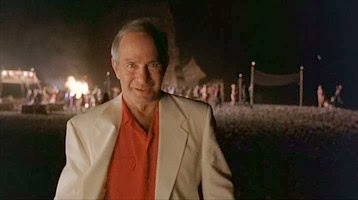
the movie's closest stand-in for Satan incarnate. His dramatic entrance, deep
into the movie, occurs at night during a beach party where the only illumination is provided by roaring bonfire. As he slowly emerges
from the shadows to greet the Dude (and the audience, since this is
filmed as a POV shot from the Dude's perspective), the viewer may detect a faint hint of sulfur
in the air. At first, the Dude is impressed by Jackie's "completely
unspoiled" home, but our hero shows a Groucho Marx-esque disrespect
for Mr. Treehorn's profession.
"How's the smut business, Jackie?" the Dude casually inquires.
"I wouldn't know," responds Jackie. "I deal in publishing, entertainment, political advocacy."
"Which one's Logjammin'?" counters the Dude, cannily referring to one of Treehorn's lowest-common-denominator porn films.
Here, as at the Lebowski mansion, it is
outward appearance, rather than inner truth, that seems to matter
most. Instead of copping to what he really is, Jackie Treehorn
rattles off his socially-acceptable achievements. I am reminded of
the late author Robert Anton Wilson's satirical sci-fi book Reality
Is What You Can Get Away With. In that singular work, published a
mere six years before the release of The Big Lebowski, Wilson
imagines a future in which lying or "bullshit" is extinct, and
the earnest historians of the future are puzzled by the doublespeak
of the Twentieth Century. A representative passage: "Realize that
the function of Bullshit lies in concealing the facts, especially
uncomfortable facts, and you begin to enter the reality-tunnel of
this astounding ancient semantics."
A real reactionary: The corrupt police chief of Malibu, CA
Jackie's subterfuge appears to have
worked brilliantly, at least judging by the scene in which the Dude,
at the behest of the aforementioned smut peddler, is arrested on
trumped-up charges by the Malibu police and taken by squad car to the
station house. At the Malibu police station, we meet the bellicose
and possibly corrupt chief (Leon Russom), who insults and abuses the Dude in what
seems to be a comical SoCal parody of Christ's treatment by the
Romans.
The police chief of Malibu is the third prominent "achiever" in the film, and like the other two, he does not inspire our
sympathy. Evoking Mr. Lebowski's ostentatious workspace, the Chief's
office is decorated with a whole assortment of plaques and
parchments, all attesting to his status as a guardian of law and
order, endorsed by the upscale porn-funded "beach community" that bankrolls
his petty, small-scale fascism. The good chief also reinforces Jackie
Treehorn's vaunted place in society when he soberly tells the Dude, "Mr. Treehorn draws a lot of water in this town. You don't draw
shit, Lebowski." It seems that Jackie's considerable financial
resources have convinced the local law enforcement – and the
community at large – to ignore his blatantly unsavory activities,
while the harmless Dude is treated as a menace.
If Mr. Lebowski, Jackie Treehorn, and
the Police Chief of Malibu are the pillars of your community, then
your community is rotting from the inside out. These men have all
“achieved” in ways that are recognized by American society. The
duplicitous Lebowski and the venal Treehorn live in fancy houses,
surrounded by material comfort and lauded by the world for their "success," while the thuggish police chief wears a badge which
designates him as an official gatekeeper of modern civilization.
The
Dude, meanwhile, has very little in the way of extrinsically
verifiable status. His wardrobe, vehicle, employment history, and
living accommodations are all extremely modest. Repeatedly broken
into and vandalized over the course of the film, his bungalow is far
from "unspoiled." The collars of his t-shirts sag after decades
of washings. He doesn't seem to have held a job in years. And that
misbegotten 1973 Ford Gran Torino of his – "green with some brown
rust coloration" – takes nearly as much abuse as the Dude
himself. All of these factors show us that the Dude is not a man who
puts much stake in "achieving."
Yet, when the movie is over, which
character would we most like to emulate?
My preliminary attempt at mapping the feature films of the Coen Brothers.
With the imminent releaseof Joel and Ethan Coen's next feature, Inside Llewyn Davis, I thought it was a good time to discuss an aspect of the brothers' career which has thus far escaped critical notice. Taken in total, their films provide a portrait of our nation from one coast to the other. Their America is a skewed, surreal and often dangerous place populated by misfits, outlaws, rebels, big shots, and fiercely independent eccentrics.
While American society becomes more and more homogeneous over time, most Coen films heavily emphasize the local customs, accents, and attitudes of the places where they are set. In a sense, the filmmakers have a vested interested in preserving the so-called "old weird America" before it's obliterated by television, the Internet, and nationwide retail and restaurant chains.
I believe that the brothers are fascinated with American iconography above all other themes and have used their movies to explore various American archetypes which loom large in our collective imagination. It goes without saying that a Coen film will be "weird" to one extent or another, but the particular flavor of "weird" depends on where the film is set and which American subculture is being satirized, venerated, or simply observed in the script.
Marge Gunderson and the Dude may be contemporaries, for example, but they do not lead similar lives and would probably not have much to say to one another if they were seated side-by-side on a long bus trip. Meanwhile, Ed Crane's America is not Norville Barnes' America. Geographically, sure, it's the same place but philosophically, it's not even close.
To better understand the Coen Brothers' attitude toward their homeland (or certain sections of it, anyway), I have organized their films geographically.
THE SOUTHWEST (Texas, Arizona, and Arkansas)
M. Emmet Walsh and Dan Hedaya in the relentless Texas heat of Blood Simple.
Films:Blood Simple, Raising Arizona, True Grit, No Country for Old Men
More than any other region of the country -- even their native Minnesota or their adoptive California -- it is the Great American Southwest where the Coen Brothers have done their most potent myth-making. For them, this is a spooky and merciless place where guns, drugs, and money hold sway and where Revenge is often the law.
Their first feature, Blood Simple, famously begins with a monologue by sleazy private eye Loren Visser (M. Emmet Walsh) who explains life in Texas to us: asking your neighbors for help is useless, he says, because "down here, you're on your own." Visser's cynical speech is accompanied by a series of eerily beautiful but foreboding shots of Texas, all composed as meticulously as a Mark Rothko canvas. We see highways, farmers' fields, oil derricks, and a drive-in theater, but not a human being in sight. This sets up a pattern the Coens will repeat in The Hudsucker Proxy and The Big Lebowski: introduce the place first, minus the people, while an off-screen character narrates, and then let the camera "find" the movie's protagonist after a few minutes. The Texas we see in this movie is a desolate, barren, and hopeless place with plenty of wide open stretches where people can commit horrible crimes without police interference.
A little over two decades later, the Cones returned to the Lone Star State for No Country for Old Men, a downbeat crime drama which makes Blood Simple look like a carefree romp in comparison. Here, the law maintains a token presence, represented by Tommy Lee Jones' grizzled Sheriff Bell, but is ultimately impotent against a new breed of pitiless super-criminals like Anton Chigurh (Javier Bardem). "The crime you see now, it's hard to even take its measure," Sheriff Bell wearily tells us.
Raising Arizona: Bounty hunter Leonard Smalls is armed and unafraid.
True Grit and Raising Arizona are rather more optimistic than the Coens' two Texas films. How could they not be? In these movies, at least, the guilty are duly punished and the heroes are (more or less) satisfied at the end. But even here, the protagonists are often at the mercy of violent, ruthless men --Randall "Tex" Cobb's Leonard Smalls in Raising Arizona and Josh Brolin's treacherous Tom Cheney in True Grit -- who are motivated solely by greed and who will gladly kill to further their own ends. These men have no permanent home and do not fear the law, so our heroes must face them and defeat them without help. One blogger, by the way, has actually written an article comparing Leonard Smalls and Anton Chigurh. Give it a read, won't you?
And while you're at it, I invite you to compare and contrast the opening scenes from No Country for Old Men and Blood Simple. Though the films were released 24 years apart, the stories in them occur only four years apart. No Country takes place principally in West Texas, along the Mexican border, while Blood Simple is set somewhere in Central Texas. Both films begin with thoughtful, contemplative monologues, but one of our narrators is an honorable man and the other an opportunistic swine. The question to consider here is: are these men being pessimistic or realistic when they describe the Texas they know?
THE SOUTHEAST (Mississippi)
George Clooney and pals seem about to be lynched in O Brother, Where Art Thou?
Films:O Brother, Where Art Thou?, The Ladykillers
When it comes to covering the American Southeast, also known as the Deep South or the Old South, the Coen Brothers' attitudes are clearly rooted in nostalgia, folklore, and Hollywood romanticism than in any sort of reality. The Coens' South is a quaint, dusty, sepia-toned place where hobos carry bindlestiffs, freshly-baked pies sit cooling on windowsills, and there is nothing more sacred than Sunday service. And music, of course, is everywhere. It's just part of the atmosphere, flowing from every home and generating itself spontaneously in nature.
The Coens have described O Brother as a "hayseed comedy," and term applies just as well to their remake of Ealing Studio's The Ladykillers. Although the former is set during the Great Depression of the 1930s and the latter in the mid-2000s, Mississippi seems not to have changed much in the ensuing seven decades.
In fact, take out the references to rap music (or "hippity hop") and a few other modern-day trappings like convenience stores, and The Ladykillers could take place simultaneously with O Brother. Both films are farces about groups of inept criminals led by motor-mouthed "gentlemen thieves" who never limit themselves to one- or two-word utterances when they could accomplish the same goal with 50 words. Like George Clooney's Ulysses Everett McGill, Tom Hanks' Professor Dorr uses his eccentric vocabulary and serpentine sentence structures to dazzle and disorient those around him. To put it simply, these fellas sure can talk.
As I said earlier, another thread which connects these films is their heavy use of traditional regional music. One group of thieves (in O Brother) actually does form a band along the way, while the other (in The Ladykillers) merely poses as one. It's possible that the Coens made these films simply for the opportunity to use old bluegrass and gospel recordings on the soundtrack. O Brother indeed created a chart-busting, Grammy-winning sensation with its companion album consisting of vintage 78s, field recordings, and songs newly recorded (most notably "Man of Constant Sorrow") in the style of days long past.
Hurt by the film's critical and commercial failure, The Ladykillers soundtrack LP did not manage to do for old-time gospel what O Brother had done for bluegrass. The album is no less astonishing, though, and the music itself manages to raise the stakes of the film's plot. The Ladykillers is a dark comedy in which inept crooks are regularly killed off, but the religious music on the soundtrack constantly reminds us that the characters' actions may have far-reaching consequences in the Next World.
THE EAST COAST (New York, Washington D.C.)
Paul Newman enjoys a Monte Cristo against a backdrop of skyscrapers in The Hudsucker Proxy.
Films:The Hudsucker Proxy, Miller's Crossing [possibly], Burn After Reading, Inside Llewyn Davis
The Coens don't often head out East, but when they do, they tend to include a few common elements: men in well-tailored suits, rapid-fire dialogue peppered with brisk comebacks, copious alcohol consumption, and winner-take-all scenarios in which no quarter is asked or given. After all, it's a jungle out there. If you study the image above, you'll notice a distinct visual change from the Coen films set in the Southwest and Southeast. This being NYC in winter, the temperature has dropped considerably, and the film's color scheme has skewed to a blueish-gray hue in sympathy.
Until Inside Llewyn Davis, which centers around the Greenwich Village folk scene of the 1960s, The Hudsucker Proxy was the Coen Brothers' one-and-only true "New York movie." Woody Allen and Martin Scorsese have basically spent their whole careers in the Big Apple, but the Coens visited the place with great hopes in the 1990s, met with financial ruin there, and didn't return for two decades. Now they're giving the place a second chance.
From what I've seen in the trailer, Llewyn Davis is considerably more realistic than the completely fantastical, dreamlike New York of Hudsucker, a highly-stylized screwball comedy which is arguably the only Coen film to employ elements of the supernatural. The magical character of Moses the Clock Man (Bill Cobbs) is very much a precursor to the Stranger, the genial cowboy portrayed by Sam Elliott in The Big Lebowski. In a way, Moses and the Stranger are East Coast and West Coast variations on the same role. Both are folksy storytellers who narrate their respective movies and watch over all the other characters like benevolent gods. (Perhaps it's telling of the difference between New York and LA that Moses intervenes when the hero, Norville Barnes, is in real trouble, but the Stranger simply watches from the sidelines.) Just as the Stranger kicks off Lebowski by giving us his personal take on Los Angeles, Moses welcomes us to The Hudsucker Proxy with a speech about the perils and pleasures of New York:
Elsewhere in the Coen filmography, we have a couple of hard-to-categorize outliers. Miller's Crossing is the duo's Prohibition-era gangster film, and it takes place in an undisclosed urban locale referred to only as "the city." I have arbitrarily placed the film in New York due to the presence of both Irish and Jewish gangsters, but the story could just as well be occurring in Chicago, Boston, or Philadelphia. It was shot in New Orleans, but no one in the film has any hint of a Louisiana accent so I have ruled it out as a setting. Wherever it takes place, Miller's Crossing is a handsome film which lends its various mob bosses, thugs, and gun molls a sense of old Hollywood glamour. It is interesting that the film, unlike most crime sagas, mixes urban and pastoral settings. The title location, for instance, is a forest clearing where bodies are dumped and executions carried out. Despite its grim function, the crossing still looks sumptuous and inviting due to the rich cinematography of Barry Sonnenfeld. Burn After Reading, on the other hand, does not portray its setting, Washington D.C., in such a flattering manner. This is a cold-blooded comedy of errors whose inept, unsympathetic characters routinely betray, threaten, and deceive one another. Fittingly, they inhabit what seems to be a godless, indifferent, and comfortless universe. This being our nation's capital, there are a number of massive government buildings which figure into the plot (including CIA headquarters and the Russian embassy), but these are portrayed in an unappetizing manner -- they're imposing rather than impressive -- and they must share screen time with such shabby, work-a-day locations as an unremarkable apartment, a blandly ugly gymnasium, and an uninspiring movie multiplex. There are some more photogenic neighborhoods in Burn After Reading, but these are inhabited by some of the movie's nastiest characters.
THE UPPER MIDWEST (Minnesota)
A storm approaches at the end of A Serious Man.
Films:Fargo, A Serious Man
It took a while for the the Coen Brothers to get back to their Minnesota roots, but when they did, they did so in a big way. Interestingly, Ethan Coen's 1998 short story collection, Gates of Eden, contains a fair amount of commentary on his family's home state. Minnesota, in fact, may be called one of the book's primary motifs. One character, for instance, uncharitably describes Minneapolis as a "strange frozen city where people's breath hovers about them, where fingers tingle and go dead, where spit snaps and freezes before it hits the ground." Another narrator is more forgiving:
The city had not much serious crime. It was dotted with scenic lakes. The people were polite. Many owned boats. In the summer they engaged in water sports; in the winter they skied. The solid northern stock seemed immune to the great miseries and grand passions upon which crime traditionally feeds.
Minnesota is the setting for two of the Coen Brothers' most accomplished and fulfilling works: Fargo and A Serious Man. As anyone who has seen these films can confirm, the characters indeed experience "great miseries and grand passions" and are nowhere near "immune" to these emotions, even though they maintain the outward stoicism for which the region is famous. (An old joke: "Did you hear bout the Norwegian who loved his wife so much he almost told her?")
The perceived nothingness of the state, the utter blankness of Minnesota, is what makes the plots of Fargo and Serious all the more shocking. "A lot can happen in the middle of nowhere" went the tagline for the former. When local police chief Marge Gunderson (Frances McDormand) arrives at the site of a grisly roadside shooting, she guesses that the suspects are not from Brainerd. She's right, of course, but Jerry Lundegaard (William H. Macy), the hapless car salesman whose kidnapping scheme is the catalyst for the whole movie, actually is from Brainerd. Evil lurks behind the blandest of facades.
The two films work as a diptych: Minnesota in winter, Minnesota in spring. Fargo gives us seemingly endless terrain blanketed in snow, while Serious lets us see what the place looks like after it's thawed out. Ironically, the lack of snow only serves to emphasize the featureless desolation of the land. A Serious Man largely takes place in a newly-built suburban community, and the lack of trees and vegetation gives the place an unsettling starkness. Struggling with the TV antenna on his roof, ineffectual college math prof Larry Gopnik (Michael Stuhlbarg) is at least as pitiful as Jerry Lundegaard, who loses his composure while scraping the ice from his car window in a dismal parking lot after a business meeting with his father-in-law doesn't go as he'd hoped. Note how the high camera angle at the beginning emphasizes Jerry's laughable insignificance.
What separates Fargo from A Serious Man is ethnicity. Fargo takes us into the world of "Swedes, Poles, and German Lutherans" (Ethan's words again) which comprise much of the population there. The film's two most-noticed details were the characters' heavy Minnesotan accents (with frequent repetitions of "yah" and "you betcha") and their unflagging, almost superhuman politeness (a tradition dubbed "Minnesota Nice").
The use of dialect was the most controversial aspect of the film upon its initial release, with some critics dismissing the film entirely based on that one aspect of the production. However, a great many more were charmed by the accent and found themselves imitating it after seeing the film. It's tough not to. The accent was certainly exaggerated for the film, a point which irked some native Minnesotans, but I feel it was done with affection. This was how the people of Minnesota must have sounded to Joel and Ethan growing up. Which brings us to that other Coen Brothers film set in their home state...
More bad news for Larry Gopnik in A Serious Man.
A Serious Man is very explicitly about the experience of being Jewish in Minnesota in the 1960s, surrounded by skeptical Midwestern Protestants on all sides. It's a world the Coens obviously knew first-hand, and it comes up again and again in Gates of Eden. Some of the details in this movie, such as the sister who spends all of her time in the bathroom, were first described in Ethan's book. Ethan also wrote with great humor about the drudgery of attending Hebrew school with its glowering, humorless rabbis and arcane lessons.
It's no surprise that A Serious Man is the brothers' most openly religious film. The plot is essentially the Book of Job translated to LBJ-era American suburbia: a decent and devout family man, the previously-mentioned Larry Gopnik, suddenly faces a series of familial, professional, legal, and financial setbacks. Towards the end, just as his fortunes seem to be improving somewhat, a whole new set of problems descend upon him and the film ends on a note of dread, with many of Larry's issues left unresolved.
Many viewers and critics intuited that God is personally and unfairly punishing Larry in this film, but that notion presupposes the very existence of God, which I don't necessarily think is a given in the Coen world. Larry might just be having a string of rotten luck. It's up to the viewer to decide whether or not these events have any theological significance. But what we can safely say is that poor Larry Gopnik is denied the solace afforded to Marge Gunderson at the end of Fargo. She can take comfort in her loving husband and soon-to-be born child, while he can only pray for the best to a God who may or may not be listening and who may not even exist.
THE WEST COAST (California)
The Big Lebowski's Tara Reid at home in the land of fruits and nuts.
Films:The Big Lebowski, Intolerable Cruelty, Barton Fink, The Man Who Wasn't There
And now, from the Land of a Thousand Lakes, we travel two-thousand miles westward to the "Land of a Thousand Flakes," as Mad magazine once put it. A mere thousand seems like an awfully low estimate, though, especially from what we see of California in the Coen Brothers' movies. The rest of the country sees the state as a place where America's most shallow, greedy, deluded, and debauched individuals have gathered to take advantage of one another.
The Coens tend to reinforce this idea through their work. Intolerable Cruelty takes place in a number of locations, including Las Vegas, but the film's main action centers around Los Angeles and gives us all the typical targets we'd expect from such a story: conniving lawyers, unfaithful husbands, gold-digging wives, bitter divorce cases, iron-clad prenuptial agreements, ridiculous reality television shows (America's Funniest Divorce Videos), and pets who are treated like spoiled children. In Gates of Eden, Ethan gives us a distinctly Jewish-American spin on the topic as he describes the fate of a Hebrew schoolmate:
For the next several months, Michael was a model student, if somewhat robotic, until his family moved to California, where (it was common knowledge) all meshuggenehs end up.
Of all the characters in the Coen canon, there are two whose lives somewhat mirror those of the brothers themselves. One is Barton Fink (John Turturro) and the other is Bunny Lebowski (Tara Reid). Both Barton and Bunny travel to the Golden State in order to work in the exciting field of motion pictures: he as a writer, she as a starlet. Like the Coens, Barton is a nerdy, socially awkward Jewish writer, while Bunny (the former Fawn Knutsen of Moorhead, MN) is another transplanted Minnesotan*. Unlike Joel and Ethan, however, these two fail to find success in Hollywood.
Having conquered Broadway, Barton is assigned to write a "Wallace Beery wrestling picture" and struggles to complete a first draft while getting embroiled in a gruesome homicide case. His move from New York to Los Angeles, a blatant cash-grab suggested by his unscrupulous agent, seems ill-advised from the start. The actual transition is suggested by an ominous shot of a wave crashing against a rock on the shore of the Pacific Ocean.
Like A Serious Man, Barton Fink can be interpreted as a biblical parable. The dilapidated hotel where Barton lives may be Hell, while his neighbor (John Goodman) and boss (Michael Lerner) make pretty good stand-ins for Satan and God. Like "Hotel California" by the Eagles, Barton Fink makes a case for Los Angeles as a kind of Inferno or Purgatory. Meanwhile, in The Big Lebowski (whose protagonist hates "the fuckin' Eagles"), the only screen work Bunny can get is in a cheaply-produced pornographic film called Logjammin'. The former high school cheerleader winds up a drug-addicted trophy wife who owes a hefty sum of money to the film's Hugh Hefner-esque producer, Jackie Treehorn (Ben Gazzara). To summarize, then, the Coen Brothers do not present Hollywood as a place where people's dreams come true.
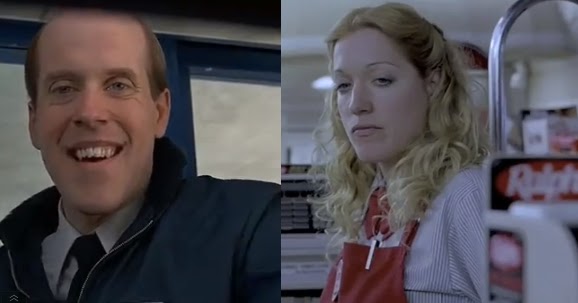
Customer service: Minnesota-style vs. California-style
The Big Lebowski is the Coen Brothers' definitive "California movie," and it serves as both a tribute to and parody of the so-called Land of Fruits and Nuts. While fans across the country and around the world have embraced the laid-back lifestyle of the film's hero, the Dude (Jeff Bridges), the film offers a panoramic view of Los Angeles and its surrounding communities. Those with an intimate knowledge of SoCal culture must experience an extra level of enjoyment when they watch this film. With the Dude as our informal tour guide, we travel to stuffy Pasadena, ultra-casual Venice, ritzy and exclusive Malibu, scuzzy Simi Valley, and humble North Hollywood, where a former television writer wheezes his days away in the iron lung which keeps him alive.
Of course, we have an assortment of California kooks on hand, too, many of whom have convinced themselves they they are somehow part of the art world, music world, or movie industry. The Dude's shy, chubby landlord, Marty, gives an interpretive dance recital and (in classic Hollywood fashion) asks his constantly-in-arrears lodger to attend and give him "notes." Then there are the Nihilists (led by Peter Stormare): three washed-up German techno musicians who, in their desperation, have cooked up a ransom scheme which they hope will net them $1 million. (It won't.)
Much higher up in the food chain is Maude Lebowski (Julianne Moore), a woman whose inheritance from her mother has allowed her to live the life of a bohemian artist in a stylishly-appointed loft where she drizzles paint onto a giant canvas while dangling nude from a harness. Her dear friend, the fey, giggling Knox Harrington (David Thewlis) is supposedly a "video artist" but seems more apt to be a trust-fund-draining layabout. And we haven't even gotten to the film's most celebrated supporting characters: belligerent Vietnam vet Walter (John Goodman), leering pedophile Jesus Quintana (John Turturro), and perpetually bewildered surfer and bowling prodigy Donny (Steve Buscemi).
Before we leave Lebowski, it's worth pointing out that it was the follow-up to the critical and commercial triumph of Fargo. Since the films had several key cast members in common (Buscemi, Goodman, Stormare, and others), the public might have been expecting a quasi-sequel or continuation. The Coens, however, let us know within the first few minutes of The Big Lebowski that we're not in Brainerd anymore. While Fargo was peopled by impossibly cheerful cashiers, waitresses, parking lot attendants, and even prostitutes, Lebowski gives us California's brand of customer service. Apart from the Dude, the first human being we see in the film is an obviously-bored Ralph's checkout girl (Robin Jones) who glares with disgust at our hero as he writes a $0.69 check for his half and half.
* The Big Lebowski's theme music is "The Man in Me" by Bob Dylan, another Minnesota-born Jew who left his home state and, like Bunny Lebowski, adopted a new name (his real moniker is Robert Zimmerman) and a new persona to go with it.
Northern California noir: Frances McDormand and Billy Bob Thornton in The Man Who Wasn't There.
We find a very different California in The Man Who Wasn't There, a James M. Cain-inspired noir tale set in 1949 and presented in gorgeous black-and-white. Our protagonist -- you'd be hard pressed to call him a hero -- is Ed Crane (Billy Bob Thornton), an impossibly reserved and tight-lipped barber who lives with his adulterous bookkeeper wife (Frances McDormand) in the quiet suburban community of Santa Rosa. We're a long way from Los Angeles -- a good 427 miles north of the Dude's slovenly bungalow. These aren't the crackpots and showbiz wannabes of the Coens' other California flicks. These are solid, practical-minded folks, much closer in spirit to the characters in Fargo and A Serious Man.
But just as with those films, the sedate setting of The Man Who Wasn't There is no deterrent to "great passions and grand miseries." Just like Jerry Lundegaard and phony millionaire Jeffrey Lebowski before him, Ed Crane tries to raise some cash through a scheme which directly endangers his own wife. In this case, he plans to blackmail Doris' lover (James Gandolfini) and use the proceeds to go in on a dry-cleaning business. This being a Coen film, the plan backfires spectacularly and the plot goes off on unexpected tangents involving Beethoven, UFOs, and Heisenberg's Uncertainty Principle. Moody and haunting, The Man Who Wasn't There ranks among my very favorite Coen films.
So there you have it folks!
We've managed to cover the United States from the Atlantic to the Pacific through the films of Joel and Ethan Coen. As the map at the beginning shows, there's still plenty more territory for the boys to cover. They've yet to do a film set in the Great Plains, the Pacific Northwest, New England, or anywhere in the Midwest besides Minnesota. Much of the Southeast and Mid-Atlantic regions remain untouched as well. Still in all, their feature films function as a kind of prism through which we can view this wonderful, terrible country of ours -- distorting some of its features and bringing others into sharper focus.
A potential role model: Jeff Bridges as The Dude in The Big Lebowski (1998)
"Oh, man, my thinking about this case had become very uptight." - Jeffrey "The Dude" Lebowski
I like to tell people I'm in a Jeff Bridges movie. It's only technically true. He's in the movie, and I'm in the movie, but our scenes were filmed at different times in different locations. In reality, Mr. Bridges and I are both interviewees in Eddie Chung's The Achievers: The Story of the Lebowski Fans, a 2009 documentary about the fan culture surrounding the Coen Brothers' 1998 comedy, The Big Lebowski, and the phenomenon of Lebowski Fest, an annual, multi-city series of celebrations in the film's honor. Fans of the film call themselves "Achievers," a reference to the Little Lebowski Urban Achievers, a fictional charity which figures into the film's plot. These Achievers gather regularly at various theaters and bowling alleys to socialize, bowl, drink White Russians, and participate in costume and trivia contests. To date, I have attended one such event -- the first-ever Chicago Fest in early 2008. I happened to win the trivia contest on the Fest's second and final night, which led to my being interviewed by the film's director. I've gotten a bit of mileage out of my first and likely only screen appearance. I managed to wrangle an IMDb entry out of it, for instance, and look what happens when you Google the movie's title:
Even Google says I'm in a Jeff Bridges movie.
I had a lot of fun at that Lebowski Fest in 2008 and met some very nice people there, including Liz and Ben, the hosts of The Lebowski Podcast, a show whose sixteenth episode features your humble blogger as a special guest. Achievers tend to be funny, friendly, laid-back people, and virtually everyone I encountered at the Fest made me feel welcome. But I have not attended any subsequent Fests, and a lot of that is due to my depression and anxiety. (If you are new to this blog and don't know what's been happening in my life, this post will get you up to speed.)
The Dude and Walter
The film itself may contain a role model -- or "roll" model, if you will -- for my recovery. Set in 1991, the convoluted plot of The Big Lebowski revolves around Jeffrey "The Dude" Lebowski (played by Jeff Bridges), an aging, pot-smoking ex-1960s radical who now lives a slothful but contented life in Venice, CA. Because he shares his name with that of a wheelchair-bound millionaire, The Dude is improbably drawn into a Raymond Chandler-like mystery story which requires the THC-impaired slacker to act as a sort of detective. Together with his best friend, a volatile Vietnam veteran named Walter (John Goodman), The Dude must investigate the possible kidnapping of the millionaire's young porn star wife, Bunny (Tara Reid). His adventures put him in contact with a variety of eccentric Southern California characters, including the millionaire's avant garde artist daughter, Maude (Julianne Moore), a Hugh Hefner-like pornographer named Jackie Treehorn (Ben Gazzara), and a trio of German nihilists (whose leader is portrayed by Peter Stormare) who once had a techno band but are now trying to extort money from the millionaire. Meanwhile (this is a complicated film), The Dude, Walter, and a third companion, Donny (Steve Buscemi), are participating in a bowling tournament which puts them at direct odds with the film's most infamous character, a preening, profane pederast named Jesus Quintana (Jon Turturro at his creepiest) whose bowling skills are almost supernatural. All of these events are observed by a mysterious cowboy known only as "The Stranger" (Sam Elliott), who narrates the film, addresses the audience directly, and occasionally talks in a casual but reassuring way to The Dude.
Throughout all of this, The Dude maintains an admirable equanimity -- some of it attributable to his intake of marijuana and alcohol but much of it owing to his extremely casual, low-pressure approach to life. His credo, after all, is "The Dude abides" (a beloved slogan among Achievers), meaning that he simply accepts life as it comes to him. It should be noted, however, that The Dude does not always live up to this personal philosophy. Quite often throughout the film, he shows moments of stress and anxiety, and at the film's midpoint, he even has a bout of depression as he begins to take a pessimistic view of his current situation. This attitude briefly alienates him from Walter and Donny, at which point The Stranger sidles up to him at a bar to give him sort of a low-wattage halftime pep talk.
Despite his easygoing nature, The Dude also deals with some anger issues in the film. As the Coen Brothers themselves point out in a featurette on the DVD, The Dude will often lose his cool throughout the story. Usually, these episodes are triggered by Walter, whose blustery exterior masks a deep insecurity and whose unpredictable behavior only exacerbates The Dude's existing problems. The friendship between The Dude and Walter is the heart of The Big Lebowski. These men are opposites, both temperamentally and politically -- one a dove, the other a hawk -- yet they seem to have struck a balance which has lasted for years. Much of this is due to The Dude's eternal elasticity. It is true that he has negative episodes, as we all do, but he always returns to his genial, accepting nature before long. It is no wonder that The Dude has inspired his own religion, Dudeism. In our most stressful and troubling moments, wouldn't we all like to be as peaceful as he seems to be?
Poor Brandt
Frankly, I am not much like The Dude, though I am trying to be. I have much more in common with one of the film's supporting characters, Brandt (Philip Seymour Hoffman), the millionaire's nervous, glad-handing assistant. He is the one character in the film with whose life I can personally identify, perhaps because he is the only person whose job remotely resembles mine.
The Dude is chronically unemployed, while Walter runs his own security business out of a seedy-looking strip mall, but Brandt is the one who dresses up for work every day and spends his time trying to please his boss. This must be difficult, as the millionaire Lebowski is a cantankerous, disagreeable man prone to shouting and insults. Brandt spends his days pretending to smile as he does his boss' dirty work, and the beleaguered assistant must deal with some serious denial issues as he labors to put the best possible spin on the situation at hand. He chuckles jovially, for instance, as Bunny makes a crude sexual remark about him to The Dude. If this scene weren't so funny, it would be heartbreaking. Think of poor Brandt, having to deal with this humiliation as a routine part of his job.
The road to recovery is a long one, marked by "strikes and gutters, ups and downs," as The Dude succinctly puts it in the film's final scene. Perhaps through therapy and medication, I can learn to be a little less Brandt and a little more Dude.