Showing posts with label The Jetsons. Show all posts

Thursday, July 4, 2013

"The Jetsons" predicted environmental disaster 51 years ago!

The Jetsons: Happy sci-fi family or harbingers of doom?

Where, exactly, does The Jetsons take place?

If your memory is a little hazy, you might have guessed that the Hanna Barbera animated series (1962-1963; 1984-1987) is set somewhere in outer space, like the vaguely similar, nearly contemporaneous Lost in Space (1965-1968). But that's not accurate.

Instead, The Jetsons takes place right here on Earth -- specifically the United States of America, judging by the characters' accents and the money they use. The titular family resides in a fictional locale called "Orbit City." Most sources claim that the events of the series occur in the year 2062, an assertion backed up by a vintage ABC network promo in which the show's main character, George Jetson (voiced by George O'Hanlon), mentions that he and his family live in "the 21st Century." The year 2062 seems logical, as it would be 100 years after the show's original premiere date.

Why so sullen, George?
So what is life like in 2062 America, according to The Jetsons? Most viewers would say that the show provides an overwhelmingly positive view of the future, with sleek architecture, clever appliances and computers that cater to every whim of the human race. Plus, there's a labor-free, nine-hour work week. What's not to like about this world? Plenty.

Though cheerful on the surface, The Jetsons contains some bleak omens for our planet and its inhabitants. When a feature-length film adaptation of the series finally appeared in 1990, that long-submerged pessimism rose to the surface.

According to the environmentally-conscious script of Jetsons: The Movie, the surface of the earth has become uninhabitable due to pollution. This development should come as no surprise to long-time Jetsons viewers. The clues are all there in the original 1960s series, which debuted only a month before the Cuban Missile Crisis.

The good news is, you don't have to watch beyond the first 60 seconds of any given episode of The Jetsons to find this. It's all right there in the opening credits. Let's examine this famous introduction carefully and consider its implications as we go. The renowned and innovative theme song by Hanna Barbera's in-house composer, Hoyt Curtain, is lyrically neutral to an almost suspicious extent. It is merely a roll call of the series' main characters.
Meet George Jetson!
His boy Elroy!
Daughter Judy!
Jane his wife!
The Jetsons was conceived, produced, and marketed as a counterpoint and companion series to The Flintsones, but that show's theme promised its viewers "a gay old time." The Jetsons makes no such promises. All its theme song  tells us is the names of four of its characters and their relationship to one another, with the father and lone breadwinner singled out as the hub or nexus of the family unit. That's it.
 
Visually, the title sequence begins by showing the vast, mysterious cosmos, but within seconds, our view settles on a familiar sight: Earth.

The vast cosmos; Earth comes into view.

We move in even closer to Earth and see a rather distorted view of North and South America. The Gulf of Mexico and the Hudson Bay are vastly expanded, while the western coast of South America, once the location of Chile, is submerged beneath the Pacific Ocean. Then, suddenly, the screen is filled with arrows and triangles in a sudden cataclysm that suggests an explosion.

A distorted North and South America, then a cataclysmic explosion

Many multicolored fragments or particles now fill the air, seemingly the debris from the explosion we just witnessed. One might almost call it "cosmic confetti." This transports us to our first view of civilization on Earth: four futuristic-looking, domed buildings built atop what seem to be very tall stilts.

Floating particles; buildings on stilts.

But this world is not unoccupied! The Jetsons, a family of four, enter the frame in their glass-domed flying "aerocar," a miniature spaceship for this world without roads.  The ship/car flies past a cluster of domed buildings on stilts, all tethered to a floating satellite. The blue sky behind them, however, seems to be the same troposphere we humans currently occupy. The Jetsons make a sharp turn and fly past the logo for their own show.

The family's spaceship/car cruises past floating buildings, the show's logo.

Inside the vehicle, the father, George Jetson, places his son, Elroy, into a small, enclosed escape pod or personal transport device. He deploys this like a bomb from the floor of the ship, and little Elroy floats happily away through what still appears to be a normal blue sky.
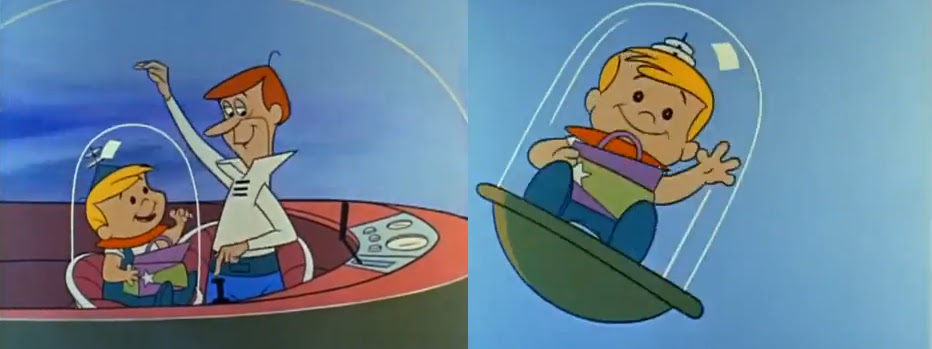
George places Elroy in an glass bubble, which is then deployed from the ship.

Elroy's pod nears its destination: Little Dipper School, an enclosed building which is on stilts. The small group of trees or shrubs on the right is the only vegetation we have seen or will see, and it appears to be well away from the school. Paint swirls in the background vaguely suggest the outer atmosphere. Meanwhile, back in the Jetsons' rocket car, George presses a button, and his daughter Judy drops through the floor of the vehicle in her own bubble.

Elroy's school is also on stilts; daughter Judy is deployed through the bay door.

Judy's destination is Orbit High School, a free-floating, cantilevered structure with an adjoining stadium. The football field, separate from the main building, is entirely under glass. Meanwhile, George and his wife Jane engage in bit of comedic pantomime in which the wife takes her husband's wallet and, with it, most of his money. This green-colored currency seems to be regular American paper money, further reinforcing the notion that The Jetsons is set in the United States.

Judy's capsule flies toward her enclosed high school; Jane, with George's wallet, is deployed.

Jane's bubble takes her to the Shopping Center. Here, we find more enclosed domes on stilts. George's car finally arrives at his destination: Spacely Space Sprockets, Inc., his place of business. This is the first structure we have seen which is built on the surface of the planet. In the background we can see that other domes on stilts are likewise attached to the surface of our Earth. The terrain is eerily smooth and featureless. There is no nature -- no animals, no trees, only man-made structures.

The Shopping Center is on stilts; Spacely Space Sprockets, inc. is attached to the surface of the planet.

George parks his spaceship on a walkway outside the building. The dome on his car opens, and the driver steps into the open air, which must be at least temporarily breathable, as we see a woman walking her poodle, then various pedestrians, including a mother with a young child. George's car folds neatly into a briefcase. There does not seem to be any room for parked vehicles in this world of elevated, man-made structures.

George exits his car/ship in the open air; the car folds neatly into a briefcase.

A moving sidewalk or conveyer belt carries George, who remains motionless, into the building. His empty, featureless desk awaits him.The actual machinery and computers appear to be built into a wall and not connected at all to George's work station. He doesn't even seem to be supervising the machines, as his desk points the wrong way for that. It appears that George's "job" is to sit at a purely decorative desk and stare stupidly into space all day.

A conveyer belt carries George into his office, where his empty desk awaits.

With no need to move even a muscle, George is carried happily right to his desk, where he puts his feet up, leans back in his chair, and falls asleep. Technology has advanced to the point that he, the human being, is redundant and obsolete. This suits George, who is lazy and without ambition, fine. Throughout this entire sequence, he and his family have been in a state of total, almost unnerving bliss. They literally cannot stop smiling. Have they been lulled into a false sense of complacency? Has there been some kind of mass brainwashing or conditioning by the government?

George reaches his desk, then promptly falls asleep.

George then freezes in this napping position. Recalling the earlier "briefcase" gag with the aerocar, the image itself now folds up neatly. A black bar covers the right half of the screen, then a second black bar approaches from left until the screen is totally blank. It is as if George has been swallowed up.


Like the car we saw before, the image of George is neatly folded until it, too, disapears.

What are we to make of all of this? Earth has succumbed, apparently, to not one but many disasters. Machines have taken over. Humans are their slaves but have been tricked into thinking that they are the masters. Technology is the real ruling party in this world, and the natural world has been utterly obliterated, erased entirely from the globe.

As we have seen, George Jetson and other inhabitants of this era have not transgressed our normal atmosphere. There is still at least some breathable air, and some (perhaps many) of the buildings are attached to the ground. But the air can't be too plentiful or too healthful, as the residents of this world spend most of their time either indoors or under glass domes.

And why are so many of the buildings attached to long stilts while others simply float? My guess is that these were two solutions for dealing with rising ocean levels. At first, architects simply tried to raise the buildings off the ground by building them on these gigantic, precarious-looking columns. But eventually, technology allowed for buildings that would simply float above the earth's surface. Judy's school, for instance, is probably a newer building than Elroy's.

In either event, the lone structure at ground level is an industrial complex that resembles a giant air filter. Perhaps Mr. Spacely, George's notoriously tightfisted boss, was too cheap to build a factory off the ground and just stayed where he was despite warnings from scientists and engineers. When the water levels rise, he'll be ruined.

So there you have it, folks! According to The Jetsons, Earth is doomed but we'll all be too artificially "blissed out" to even care. Happy viewing!

Friday, June 28, 2013

Mill Creek comedy classics #24: "Heading for Heaven" (1947)

Stuart Erwin wags his finger at Glenda Farrell in Heading for Heaven.n

The flick: Heading for Heaven (Ace Pictures, 1947; numerous distributors including PRC) [buy the set]

Current IMDb rating: 5.7

Director: Lewis D. Collins (directed an average of three or four B-movies a year for 32 years, half of them Westerns and none terribly famous)

Actors of note
  • Stuart Erwin (The Bride Came C.O.D., Son of Flubber)
  • Glenda Farrell (I Am a Fugitive from a Chain Gang, Little Caesar)
  • Russ Vincent (Gilda)
  • Milburn Stone (Invaders from Mars, Young Mr. Lincoln)
  • George O'Hanlon (voice of George Jetson for almost 30 years; also appeared in Rocky and a whole series of "Joe McDoakes" shorts)
  • Janis Wilson (Now, Voyager, The Strange Love of Martha Ivers; retired from acting as a teenager because she wasn't photogenic enough)

The climactic seance from Heading for Heaven.
The gist of it: The Elkins family has been holding onto a seemingly worthless piece of property for generations in the hope that one day it would bring a fortune. Beleaguered family man Henry Elkins (Erwin), inheritor of the property, has turned down offers to turn it into an amusement park and a garbage dump because he has his heart set on transforming it into a housing development called "Elkins Eastern Acres." But due to one of those typical 1940s movie comedy misunderstandings, Henry thinks he only has four months to live and must provide financially for his wife Nora (Farrell), daughter Janie (Janis Wilson), and no-account brother-in-law Alvin (O'Hanlon).

An airline wants to buy Henry's property and turn it into an airport, but various schemers and con artists -- including a fake swami (Vincent) with whom Nora is infatuated -- conspire to keep him from getting a fair price for the land by sending a phony telegram, supposedly from the airline, withdrawing their offer. The increasingly desperate Henry resorts to dishonesty to unload the property (which he thinks is worthless again) on a local banker but is quickly found out. Scandalized, Nora threatens to leave Harry. Instead, he voluntarily leaves home and becomes a hobo. Thinking he's dead after his pants are discovered in a river, Henry's relatives, friends, and business associates try to contact him in a laughable "seance" presided over by the pseudo swami, setting up the film's farcical conclusion.

Korla Pandit: Fake Indian..
My take: Basically a domestic sitcom in movie form, Heading for Heaven would be perfectly accentuated by prerecorded chuckles on the soundtrack. In fact, the film's cast has two patron saints of laugh-track-saturated reruns: George O'Hanlon of The Jetsons (about which I once wrote a quite brilliant article) as a layabout who claims to be an insurance salesman but sleeps 16 hours a day, and Irene Ryan of The Beverly Hillbillies as an ornery maid who does nothing but complain about her employers and make empty threats to quit. Stuart Erman is your typical harried, slightly dim TV husband and father. The plot, too, is built around the coincidences and miscommunications typically found in such shows. If you like old -- or shall we say, vintage -- sitcoms, Heading for Heaven will be an enjoyable experience. Fortunately, I do... and it was.

From a filmmaking standpoint, there's not much upon which to comment. It's a serviceable, competent job, but nothing special. The film was adapted from a stage play, For the Sake of the Family by Daniel Brown and Charles Webb, and I can imagine it working fairly well as dinner theater entertainment. (On stage, they'd have to up the energy level and the pace a bit.) If there's anything of particular interest in this plot, it's the presence of a fraudulent swami. Russ Vincent, the actor in this role, is not even remotely Indian but he has charmed the housewives of the community in this film by presenting them a vague, romanticized version of the Mysterious East. This puts him in close company with Korla Pandit, (about whom I also wrote a quite brilliant article). Like Korla, the swami in this film favors snazzy suits and bejeweled turbans.

Is it funny: I'd say so, yeah. While no masterpiece, it appealed to the rerun-loving part of my brain. I especially enjoyed the opening sequence in which generation after generation of Elkins men tell their children never to sell the family's sure-to-be-valuable property, foolishly putting their trust in Democrats, then Republicans, and finally Democrats and Republicans. At his lowest ebb, Henry has an amusing, slightly trippy scene in which he is visited by the spirits of his ancestors who, later in the film, literally turn over in their graves. Moliere it ain't, but I'll admit I laughed.

My grade: B

P.S. - Stereotype-free again, folks! Well, uh... except for the swami, who is the recipient of a couple of "towelhead" jokes.

Sunday, March 25, 2012

Fred Flintstone vs. George Jetson: Choose carefully, gentle reader

Which of these men leads a happier life?

Who would you rather be, George Jetson or Fred Flintstone?

I bet you said George Jetson. It seems like a no-brainer, right? I mean, George lives in a futuristic world of rocket cars, robots, and household appliances that do almost everything for you. Fred, meanwhile, lives in the Stone Age and doesn't even have shoes... or pants, for that matter. And George, with his cushy desk job at Spacely Sprockets, is clearly in a higher tax bracket than working-class Fred, who toils away at the quarry under the glowering eye of Mr. Slate. George is white collar, and Fred is blue collar—literally and figuratively.

But hold on, gentle reader! The choice may not be so obvious after all. You may have been so dazzled by all the sci-fi wizardry on display in The Jetsons that you failed to notice a simple truth: Fred Flintstone is a much happier man than George Jetson. Fred, in fact, is a deeply contented, untroubled man who seems wholly satisfied with his life (hence his carefree catchphrase, "Yabba Dabba Doo!"), while George frequently seems edgy and neurotic, possibly suffering from ulcers or sleep problems. 
Why might this be? Well, I have a few theories:

1. Fred has friends and a social life; George doesn't.

Barney and Fred at a meeting of the Water Buffalos. Don't they look happy?

The Flintstones is based on Jackie Gleason's classic sitcom The Honeymooners (1955-1956), while The Jetsons is modeled after Blondie, which started as a comic strip in 1930 and inspired a series of films (1938-1950). The voice of Jane Jetson was provided by actress Penny Singleton, who played the title character in the Blondie movies. But something important got lost along the way in translating Blondie from one medium to another: male friendship.

Like The Honeymooners, The Flintstones features a strong male friendship. Instead of Ralph and Ed, we have Fred and Barney. But while Blondie's suburban protagonist Dagwood Bumstead has a best friend, the uninspiring yet reliable Herb Woodley, there exists no such corresponding "best friend" character on The Jetsons. George Jetson does not seem to have a friend in the world. He has no social life away from work or home either. Again, this is in sharp contrast to Fred Flintstone, who bowls regularly with Barney (and other men his age, like Joe Rockhead) and is a member of a fraternal organization, The Loyal Order of Water Buffalos. These elements, again, were taken from The Honeymooners. Ralph, too, was a bowler and he and Ed belonged to the Raccoon Lodge.

Why has George Jetson been denied any meaningful friendships or social interaction in his life?

2. Fred has a more satisfying home life than George.

If you study the opening title sequences of The Flintstones and The Jetsons, you will see that they are mirror opposites of one another. Here, take a moment to watch both of them:


Notice that the first clip is about Fred leaving work and rejoining his family—and being overjoyed to do so—while the second is about George being separated from his family one member at a time before finally arriving at work, where he immediately falls asleep at his desk. 

In their book Harry & Wally's Favorite TV Shows (1989), TV critics Harry Castleman and Walter Podrazik pointed out that Fred "has no real problems." They meant that as a complaint, but I think it's part of what makes the character so appealing. Fred, like his clearest latter-day successor, Homer Simpson, simply loves his life and his family with abandon. Certainly, Fred and Wilma argue a lot more than George and Jane Jetson do, but I think this is just indicative of the fact that the Flintstones are passionate, vital people. They're alive, for god's sake! Meanwhile, there is something weirdly distant and cold about the Jetson marriage. Jane seems perfectly nice, but she is somewhat vacant and detached. I'm guessing a lot goes unsaid in this family.

Fred and George are both parents, but this fact causes George much more anxiety. Fred does not seem to be too hands-on in the raising of little Pebbles, but he is devoted to her and loves her unconditionally. With George and his kids, the relationships are more anxiety-plagued and complex. His daughter, Judy, is an adolescent—often a rocky time for parent/child interaction. George hates Judy's music, hates her friends (especially her boyfriends), doesn't understand her slang, and probably doesn't feel like he can communicate with her meaningfully and effectively. 

It's a mixed blessing, then, that Judy has the same pleasant but vacant temperament as her mother. George is spared from any emotional confrontations with his daughter, but over the long haul this may have a numbing effect on him. Feeling alienated from Judy, George naturally gravitates toward his son Elroy. But even here, George feels insecure. He recognizes that Elroy's intellect is quickly outstripping his own, and he worries that Elroy will soon "outgrow" his old man. This accounts for George's many ploys to win Elroy's respect, such as the sad "Nimbus the Great" fiasco (from the "Elroy's Pal" episode) in which George dresses as one of Elroy's TV idols. 

When it comes to being a husband and father, George has less in common with Fred Flintstone and much more in common with Lester Burnham, the burned-out suburbanite in American Beauty.

3. Fred feels more connected to his work and his environment than George ever will.

George Jetson at Spacely Sprockets: Just a cog in a machine.

What do we know about George Jetson's job? Well, we know he works for a company called Spacely Sprockets. Consider the humble sprocket, dear reader. It is a metal wheel with teeth, and its job is to mesh with a chain or track. It is worth noting that Spacely Sprockets' main competitor is Cogswell Cogs. Cogs, of course, have a great allegorical significance. To be a "cog in a machine" is to be merely a small part of a much larger operation. This is what George Jetson is: a human sprocket, a living cog. He's not even involved in the production of the actual, physical sprockets. Instead, he has some ill-defined position at what seems to be an isolated workstation staring at a monitor all day much like a present-day cubicle drone. 

George is not only alienated from his work, he is alienated from his own environment. Think about it. George Jetson lives in a hermetically-sealed world. He spends all his time indoors, totally cut off from nature in his sterile, artificial world of emotionless gadgets and recirculated air.

Now what about Fred Flintstone? Fred, as we have established, works at the local rock quarry in the open air. The rocks from the quarry are likely used to build the homes and structures of Bedrock, so Fred can easily see the results of his labors. More importantly, Fred can experience the natural world thriving all around him. Sunshine, rain, snow, the feel of grass, fresh air—these are luxuries enjoyed by Fred Flintstone but totally unknown to George Jetson. And Fred doesn't really seem to be hurting in the technology department. If anything, the radios, telephones, televisions, and airplanes of The Flintstones are more remarkable than any gadget seen on The Jetsons.

Which is your path, reader? The ancient past or the distant future? Select with caution.