Showing posts with label clowns. Show all posts

Sunday, April 5, 2020

A Clown, for Christ's Sake: The curious career of Rev. Floyd T. Shaffer (UPDATED AGAIN!)

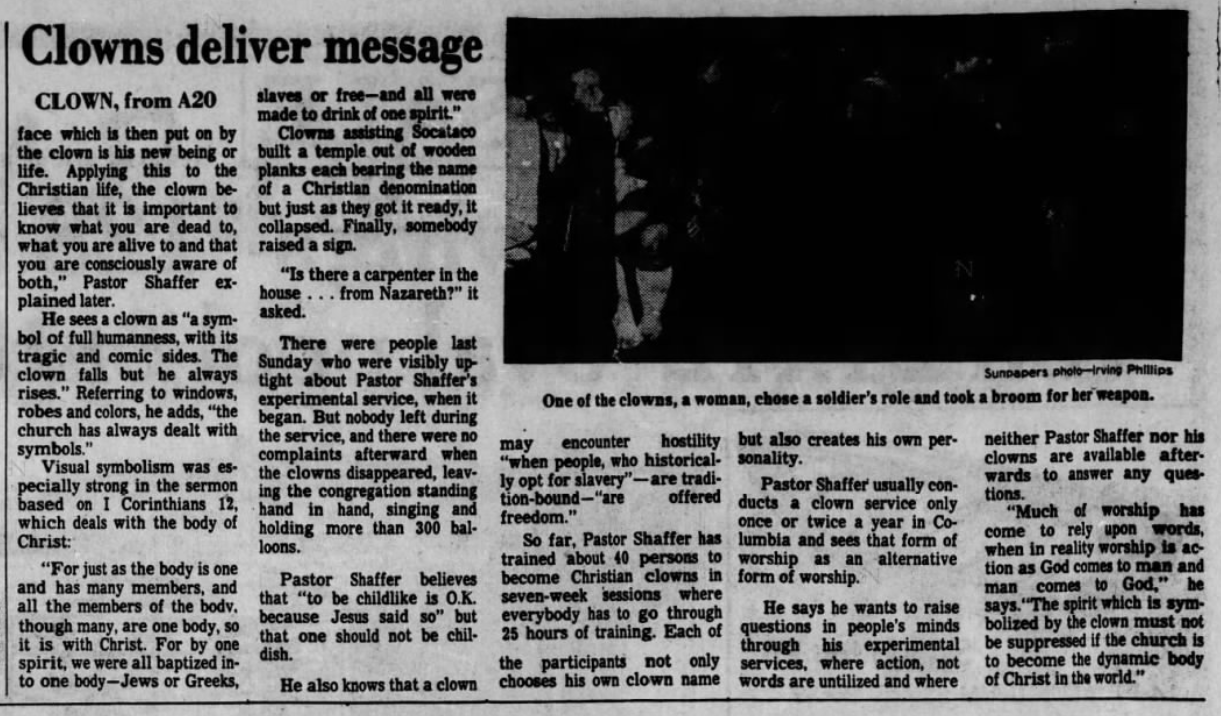
A tabloid article about Floyd Shaffer, the religious clown.

Floyd Shaffer's first book.
The Reverend Floyd T. Shaffer was looking for a new way to reach his congregation in 1969. How could he possibly get through to his practical, sensible flock during that tumultuous age of Vietnam, Woodstock, and Manson? The unlikely answer was by donning a fright wig, floppy shoes, and a round, red, rubber nose.

Though he may not have invented the form, Floyd Shaffer became, for a time, perhaps the most prominent and beloved proponent and practitioner of religious clowning in America. Born in 1930, the kindly and gentle Shaffer was a devout, deeply sincere Lutheran minister whose career trajectory took him from Michigan to Maryland to Ohio. In fact, Shaffer experienced his greatest period of productivity and prominence in the Buckeye State during the Reagan-Bush years. But to appreciate this man's story in full, we must travel back to the Age of Aquarius.

Destined to become a literal Holy Fool, Floyd Shaffer started upon his unusual path in the late 1960s in Columbia, Maryland, where he preached God's word at the still-existent Abiding Savior Lutheran Church. It was at Abiding Savior that Shaffer first introduced costumed clowning into his ministry and encouraged others to follow his example. According to fellow religious clown John Garrett, Floyd was aligning himself with a liturgical tradition stretching back to the Middle Ages, when so-called "holy interrupters" would lighten the mood of formal services with their comedic outbursts. Although a keen student of clowning history, Shaffer was more likely influenced by the counterculture of his own time. Clowning and mime were art forms beloved by hippies, who also had a penchant for face-painting and the donning of colorful, garish clothing. Back in 1969, a preacher dressed as a clown could almost be considered edgy or hip.

In those early years, Shaffer and his ilk were not always welcome among mainstream Christians. The soft-voiced pastor related to his followers the story of his disastrous appearance at a 1970s youth conference held at Houston's famed Astrodome. There, Shaffer and his fellow beneficent buffoons were regarded with extreme skepticism. Thinking the clowns were blasphemous, the other conference attendees derided and, in some cases, attacked Shaffer's troupe. Arlene Trapp, an original acolyte of Shaffer, recalled being "treated like Jesus, kicked at, hit, and mocked."

Still in all, Shaffer's tomfoolery-based evangelism must have yielded positive results in those early days, because he kept at it. In 1974, still based in Columbia, he founded Faith and Fantasy, a nondenominational clown ministry popular enough to have lasted into the 1990s, though its alumni remember it as a loosely-affiliated "non-organization" whose members were never keen on rules. During these years, determined to spread the message of Christ through the techniques of Emmett Kelly and Marcel Marceau, Shaffer and his followers performed their wordless, mime-based act at weekly Lutheran services and also visited numerous hospitals and nursing homes, where they found an appreciative, if captive, audience for their antics.

By 1981, having relocated to Ohio, Floyd Shaffer was well-known enough to attract the attention of the popular press. In August of that year, the black-and-white tabloid Weekly World News ran a profile of Shaffer with the headline "Preacher clowns for God to fill the pews." While essentially flattering to the clown minister, the article also described him as "wacky" and "bizarre."

The Christian Science Monitor followed suit in September with a slightly more dignified article by Stewart McBride headlined "Holy fools rush in." More wide-ranging than the Weekly World News piece, McBride's article looks at different examples of clown ministry from across the United States. In this context, rather than the isolated kook portrayed in the tabloid, Floyd Shaffer is part of a vital, burgeoning movement. The Monitor still recognized Shaffer as a pioneer, however, calling him "one of the first clergymen to perform a Sunday service in whiteface and clown costume" and declaring that "hundreds have followed in his suit of many colors."

The cover of the infamous video.
A few years after these articles introduced the Christian clown phenomenon to a national audience, Floyd Shaffer began writing a series of guidebooks about the topic dearest to his heart. If I Were a Clown and Clown Ministry appeared in 1984. Clown Ministry Skits for All Seasons followed in 1990. Of these, it is Clown Ministry that brought Shaffer a sort of late-blooming, ironic notoriety. The book was accompanied by a 92-minute instructional video that, decades later, was widely excerpted and mocked (shades of the unhappy Astrodome experience!) on video-sharing sites like eBaum's World, Daily Motion, and YouTube.

That was how I first became acquainted with Floyd Shaffer and Clown Ministry. In February 2011, comedians and avid thrift store scavengers Joe Pickett and Nick Prueher used clips from Shaffer's 1984 video in an episode of their web series, The Found Footage Show, which they originally produced for the A.V. Club website. They said they found the VHS tape at a church rummage sale. "This one was intended for budding Christian clowns who wanted to start their own clown ministry," explained Prueher. "I've never understood the connection between Christianity and clowning, and this video certainly didn't help." To which Pickett added: "Really, this video is the best argument against putting your grandparents into a nursing home."

For those whose curiosity has been piqued, the entire Clown Ministry video is now available for viewing on YouTube. In these 92 minutes, Floyd Shaffer walks us through the history and purpose of Christian clowning, demonstrates how to properly apply clown makeup, and even lets us tag along on a typical nursing home visit. It is this last aspect of the video that has attracted the most attention and ridicule over the years, as the elderly patients here seem bewildered and frightened, rather than delighted, by the antics of Shaffer and company.


Floyd Shaffer today
"The clown has no age," Shaffer optimistically told the Weekly World News in 1981. Mankind, however, is not immune from the ravages of time. Now 85 years old and comfortably retired since at least 2006, Floyd Shaffer has returned to his home state of Michigan, where he lives with his wife in Saginaw. The couple have two grown children. Though no longer clowning, Floyd Shaffer is still a loyal follower of the Lutheran faith.

The man's longstanding influence on the world of Christian clowning remains undeniable. In a September 2013 article on the World Clown Association website, Janet "Jellybean" Tucker recalled how seeing Shaffer changed her life; "It was in 1979 or 1980 at a Clown, Mime, Puppet, Dance Ministry Workshop in Oberlin, Ohio, and I saw Floyd Shaffer do a bit on feeding the hungry where his clown ate gobs of popcorn but offered it to a hungry person one kernel at a time. I began reading the Bible through different eyes and began to see the Bible characters as real people."

Obviously, despite the snickering of the internet, Shaffer's message got through to some viewers. As recently as April 2015, Christine Fontaine, a religious-minded mime in Northfield, Massachusetts, contacted Floyd by phone to seek his advice and counsel on how to proceed with her work. The two talked for an hour. As always, Floyd Shaffer remained committed to clowning for Christ.

UPDATE FOR 2020: Amazingly, some more vintage footage of Floyd Shaffer has surfaced! In addition to touring with their collection of offbeat videos, Joe Pickett and Nick Prueher also have a weekly YouTube series called VCR Party Live. In a recent "quarantine" edition of the show, the hosts interviewed film archivist Skip Elsheimer, who specializes in educational and industrial films. One of the clips Elsheimer showed during this visit depicts Floyd, both as himself and in costume, doing some Christian clowning.

After Pickett described the clip as "clown communion," Elsheimer responded: "That one, I can't remember. The title just suddenly left my brain. That one I got recently, and that one I have not shown online anywhere." He went on to say he didn't know where this film was originally shown. "I think this is too scary for Sunday school class." Pickett and Prueher note that the film is dour and that the clowns in it do not seem happy.

Floyd Shaffer appears as himself and as a clown in a newly-discovered film from the 1970s.

Scored with incongruous ragtime piano, the footage seems to date back to the 1970s when Shaffer was working with the Faith and Fantasy troupe in Columbia, Maryland. It may have been made as a record of what their performances were like back then. The movie begins with shots of a congregation in a mid-sized church. Floyd himself, with a full head of curly hair, enters the room in traditional vestments. A slight smile passes over Floyd's face as he stands behind the altar, and through the magic of editing, he transforms into a clown, complete with a red nose and a derby hat. The parishioners are understandably shocked and confused, though some kids giggle.

Floyd opens a gift box and retrieves a card that says FOR THE CONGREGATION. (This may be the title of the film.) The box also contains a pile of severe-looking nails. Shaffer takes one of these nails and hands it to another clown who has joined him at the front of the church. He presses it firmly into the second clown's palm, as if this is communion, and the nail is a wafer. He performs this same service for a third clown, and a title card reading "Communion" appears onscreen.

Floyd pulls a heavy wooden crucifix from a red box, then places bread and wine on the altar. After that, he fills a metal bowl with water from a jar. He takes the bowl over to a small group of clowns and has them place their hands in the water. They dry their hands. Shaffer then solemnly raises the loaf of bread and the wooden crucifix in front of him.  He places the bread on the cross as if the bread itself were Jesus being crucified, but then he breaks off a hunk of it from the bottom. Shaffer then mimes pouring invisible blood from the crucifix into a bottle already filled with wine. He and the other clowns silently, seriously eat the bread and drink the wine as the film fades to black.

The relevant portion of the video begins at about the 28:25 mark. Enjoy.


UPDATE FOR 2021: In my research on Shaffer's career, I found an elaborate article about him in the August 26, 1961 edition of the Fort Lauderdale News. Back then, he was serving as the pastor for Christ the King Lutheran Church. The article includes background details on Floyd's early life and a great picture of the man himself.

An article about Floyd's younger days.

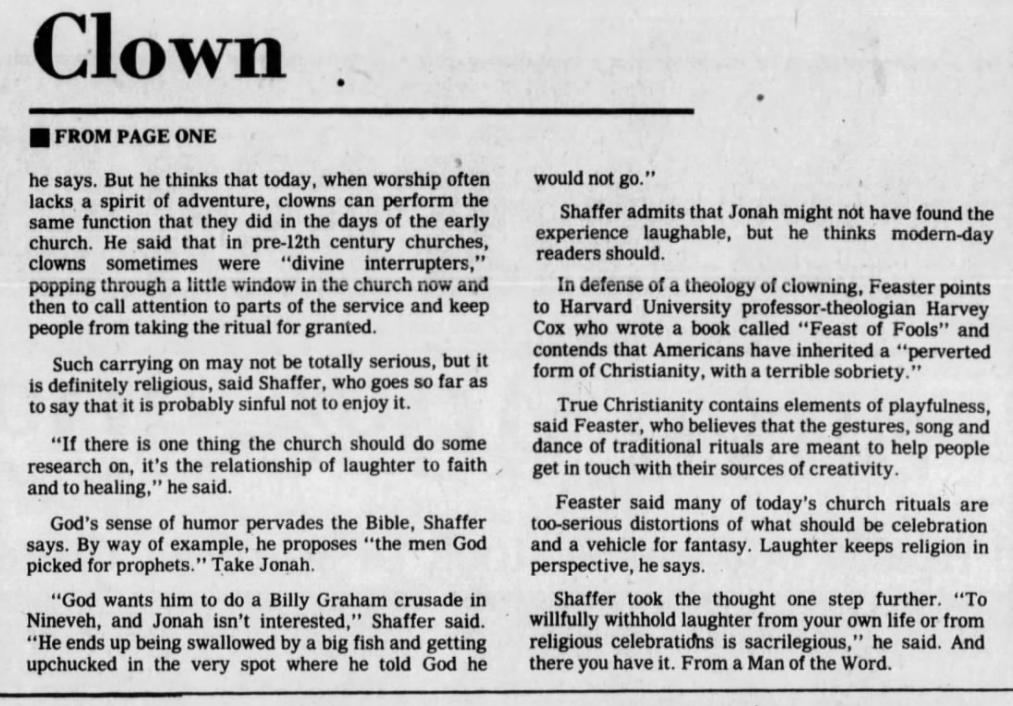
And here's an article from the June 1, 1975 edition of The Baltimore Sun.
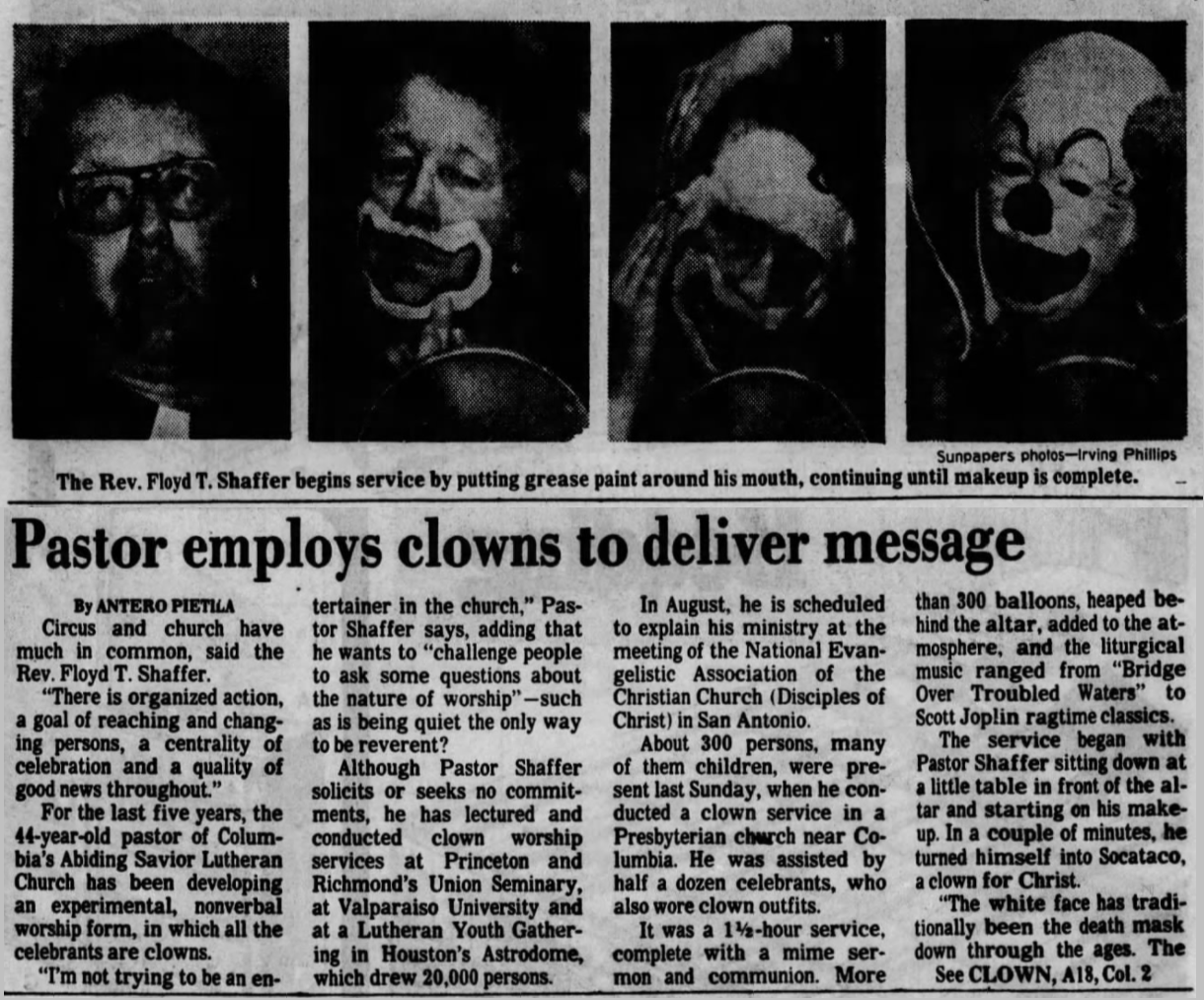
Baltimore Sun story about Floyd (part 1).
Baltimore Sun story about Floyd (part 2).

Wherever Floyd went, publicity followed. Here's a huge article from the June 10, 1981 edition of the St. Louis Post-Dispatch.

Floyd in St. Louis (part 1)

Floyd in St. Louis (part 2)

Wednesday, August 24, 2016

Time for a clown cartoon. Sorry.

Oh, Snoodles, when will you ever learn?

Credit where credit is due: I found a one-panel cartoon by Ryan Burke at this site and then decided to expand it to a full comic strip. I sincerely hope you don't enjoy it.

Thursday, May 19, 2016

The Adventures of Sarah Morgan, Child Genius

Cats are sometimes difficult to identify.

You might think that a comic strip called Rex Morgan, MD would be about a doctor named Rex Morgan and all the medical stuff he does all day. You'd be wrong. Rex is more of a supporting character in the strip that bears his name, and he's such a vacuous dimwit that you wouldn't want him doing any doctoring. Instead, the main character is Rex's precocious daughter Sarah, who has a career as an art prodigy going and who looks like a grown man in a bad wig in closeups. Sarah is the creepy heart and icky soul of Rex Morgan, MD, and eventually the strip will bear her name. Until that glorious day, here is my pilot for the reboot.

Saturday, January 24, 2015

This way lies madness: 'The Doggedly Dogs'

A dog, Muffin, is about to enjoy some secular music in "The Doggedly Dogs."

Bible Truths For Children.
What is it about religious shows for kids? Why are they always a direct gateway into a world of complete, bat-shit insanity? You tell me. These programs are generally low budget and semi-amateurish in terms of production values, so you'd expect some degree of wonkiness in the sets, costumes, props, animation, music, acting, and chroma key-style video effects. And you'll definitely find all of that stuff in these shows.

Generally, religious kids shows are labors of love, made by well-meaning people with a shortage of money, experience, and technical know-how. It's understandable that they'd be cheap, cheesy, and tonally awkward. But that's true of a lot of low-budget productions, including secular ones. None of this explains the total delirium that emanates from these particular shows. There's something else going on here.

A big factor is the religious element. All religions seem kind of nutty to me, and the further you commit to any particular faith, the further you stray from reality and science and sanity in general. And by the time you're doing a religious kids show with puppets and talking animals, you're obviously way, way off the deep end. I mean, you don't just start out dressing like a cowboy clown and singing songs about Jesus to four-year-olds. You have to progress to that mindset over time, probably many years. By the time you arrive on the other side, your brain is pretty much the equivalent of butterscotch pudding.

There is a definite element of brainwashing or indoctrination going on here. Kids don't naturally come to religion on their own, after all. It has to be sold to them and reinforced all the time until they believe.

But there's also something dark under the shiny, happy surface, since Western religions tend to center around a capricious creator God who can banish you to Hell for all eternity if you get on his nerves. I guess what makes religious kids shows so entertaining is that contrast between the relentlessly cheerful songs and skits and the more sinister undertones of their true, ultimate purpose.

All of this is my long-winded way of introducing a highlight reel from a video called called Bible Truths for Children. I have very little background on this, other than the fact that it might be a VHS compilation tape of highlights from a mid-1980s Texas-made program called The Filling Station or God's Filling Station.

I honestly don't want to over-explain or oversell what you're about to see. It's better if you go in cold. Just know that I love this video and have watched it at least a dozen times. It encapsulates everything I like about religious kids shows.

Clearly, the main event is "The Doggedly Dogs," which is definitely worth following until the very end, when... well, I don't want to spoil it, but pay attention to the voice of Muffin. The rest of the video is delightful, too: the nerdy ginger kid reading Bad magazine and proclaiming that "Reading is Seeding," the parade of "instruments for righteousness," and the Bob Duke family of Greenwood, Indiana, whose deeply creepy Sears family portrait is emblazoned on the robe of an animated Christ. Enjoy.

Friday, August 9, 2013

Mill Creek comedy classics #47: "Meet the Mayor" (1932)

Meet Frank Fay and his huge, terrifying face in Meet the Mayor... or A Fool's Advice, whatever.

The flick: A Fool's Advice (Warner Brothers, 1932); later released as Meet the Mayor (Times Exchange, 1938) [buy the set]

Current IMDb rating: 6.0

Director: Ralph Ceder (second-unit director on a couple of W.C Fields films, The Bank Dick and Never Give a Sucker an Even Break; his own directorial credits include Keep 'Em Flying and some 1920s silent shorts starring Stan Laurel for producer Hal Roach)

The delectable Ruth Hall
Actors of note:
  • Frank Fay (famously egotistical, hard-drinking vaudeville comic whose rocky four-year marriage to Barbara Stanwyck may have inspired A Star is Born; film career never amounted to much, though he made a cameo in Nothing Sacred; had Broadway comeback in the 1940s starring in Harvey)
  • Nat Pendleton (burly former Olympic wrestler who played Inspector Guild in a couple of Thin Man movies; worked onscreen with the Marx Brothers and Abbott & Costello)
  • Edward J. Nugent (42nd Street)
  • Ruth Hall (uncredited bit parts in Easter Parade and How to Marry a Millionaire; lots of 1930s "B" movies)
  • Berton Churchill (Stagecoach, I Am a Fugitive from a Chain Gang)
  • Hale Hamilton (also in I Am a Fugitive from a Chain Gang, plus The Most Dangerous Game, The Champ, and lots of forgotten '30s "B" movies)
  • George Meeker (one of Hollywood's go-to "guys you love to hate"; appeared in Gone with the Wind, Casablanca, The Ox-Bow Incident, Yankee Doodle Dandy, etc.; MST3K fans will know him as sleazeball mobster Charles Blake in I Accuse My Parents.)

The gist of it: Wisecracking Spencer Brown (Fay) is an elevator operator by day and inventor by night. He's working on a revolutionary new sound recording device with his pal Harry (Meeker, uncharacteristically playing a nice guy), and they both feel that the gadget will make them millionaires. Spencer is known and (generally) loved throughout his small hometown* for offering help and advice to all of its residents... whether he's been asked to do so or not.

One person who needs Spencer's help is kindly old Mayor Sloan (Churchill), who is seeking reelection but is facing an uphill battle against slick businessman George Diamond (Hamilton). This upstart challenger has brought in a bunch of pinstripe-suited New York thugs (led by Pendleton) to manage his campaign for him and is secretly planning to run a railroad right through the town once he's elected. The mayor's pretty niece, Norma (Hall), asks Spencer to campaign on her uncle's behalf, and Spencer is only too eager to help, since he's sweet on the lass and wants to impress her. Little does he know that she's engaged to Harry! Plus, Diamond's thugs are after Spencer because he made a speech at a rally for Mayor Sloan.

So our boy has his work cut out for him: foil the scheming Mr. Diamond, avoid getting his ass kicked, and woo the fair Norma, all while keeping that elevator going up and down. How many of these goals can he accomplish in a 63-minute movie?
*It sounds like they're saying "Culipatawney," but I wouldn't bet money on it.

Google results for "sad clown."
My take: Frank Fay once declared himself the world's greatest comedian, and he strides through Meet the Mayor like he's already earned the title just by showing up. He was about 40 when he made this flick and had been in showbiz since he was 4, so he probably figured he didn't have much left to prove. He does the very same "aggressively kooky small town eccentric" bit that Joe E. Brown was trying to put across in Riding on Air, and for about the first half of this film, he was really getting on my nerves. I was kind of rooting for Mr. Diamond's goons to take Spencer Brown in a back alley and beat the crap out of him.

The movie is clearly a vehicle for Frank Fay, and the script goes out of its way—sometimes way out of its way—to allow time for the comedian to do some of his vaudeville routines. Some work better than others, which we'll get to in the next section, and Ralph Ceder's direction is pedestrian at best and clumsy at worst. One particular plot point involving the recording device is handled in such a corny, contrived manner (and trust me, you'll know when it happens) that I was rolling my eyes in disbelief.

But Meet the Mayor takes an unexpected turn in the home stretch and becomes rather downbeat and poignant. The film's story was written by Fay, and I'm guessing he wanted to emulate Charlie Chaplin and mix comedy with pathos because he turns Spencer Brown into a tragicomic figure, the archetypal "crying clown." Actually, this does help the movie a bit. Fay's character is far too pleased with himself at the beginning of the movie, and I actually cared a little bit more about him once he'd suffered some romantic setbacks.

Speaking of which, this film's leading lady, Ruth Hall, had a pretty typical career for a second-tier starlet—big roles in little movies, little roles in big movies, then obscurity. Meet the Mayor doesn't give her much of an opportunity to showcase her comedic or dramatic talents (if any), but she has a very appealing on-camera presence and is quite sexy in that inimitable 1930s way. Honestly, neither Frank Fay nor George Meeker (who can apparently become a nice guy simply by shaving off his mustache) is good enough for her. Hollywood should have tried a little harder to make Ruth into a star.

Is it funny: I'll be honest, folks. It took me quite a while to warm up to Frank Fay's particular brand of comedy. It might have helped if I didn't have to look at him smirking and snickering all the damned time. Maybe that's why he never made it in movies but was (I guess) a hit on radio. Even so, his material is not as strong as he seems to think it is. An extended monologue about the "string savers" in his family, for instance, goes nowhere of particular interest, and when he starts pestering Mr. Diamond's chauffeur, I was completely on the chauffeur's side.

On the other hand, I did eventually come to enjoy a bit in which Spencer Brown makes a completely nonsensical, rambling campaign speech and elicits cheap applause from the befuddled audience by merely saying words like "economic conditions," "constituents," and "America." (The fact that he has to look at a cheat sheet to remember the name of his own country is a nice touch.) But some of the movie's best bits have little or nothing to do with Frank Fay. Near the beginning of the film, for instance, a group of old men comment on the fact that the mayoral challenger has just entered a hotel lobby.
First Man: (to the second man, excited) George Diamond! 
Second Man: (to the third man, more excited) George Diamond! 
Third Man: (to the fourth man, even more exited) George Diamond! 
Fourth Man: (to the third man, slightly annoyed) What of it?
And I liked a bit when Mayor Sloan gives Spencer a big introduction but doesn't mention the young man's name until the very end, so several other people on the stage think the politician is talking about them instead and begin prepping themselves to make speeches, only to be disappointed when Spencer's name is called. When two of your movie's funnier moments don't require your star, that's not a great sign.

My grade: B- (just barely)

P.S. - No overt or even hidden racism in the film. In one scene, though, a female elevator passenger asks Spencer what's playing at a local movie theater, and he replies, "Hmmmm... nothing much. Mexican picture." This elicits a disappointed "oh" from the dowager-type woman. Why these two should disparage Mexican cinema is beyond my comprehension. Maybe he means a western set in Mexico?

Wednesday, July 3, 2013

Mill Creek comedy classics #30: "Peck's Bad Boy with the Circus" (1938)

Bad boy, bad boy! What ya gonna do? What ya gonna do when the circus comes through?

The flick: Peck's Bad Boy with the Circus (Sol Lesser Productions, distributed by RKO, 1938) [buy the set]

Current IMDb rating: 5.9

Director: Edward F. Cline (a former Keystone Kop; directed several W.C. Fields films, including The Bank Dick, My Little Chickadee, You Can't Cheat an Honest Man, and Never Give a Sucker an Even Break)

Louise Beavers
Actors of note (and there are a bunch)
  • Tommy Kelly (played Tom Sawyer in The Adventures of Tom Sawyer; cameos in Gone with the Wind and Battleground)
  • Ann Gillis (Becky Thatcher in The Adventures of Tom Sawyer; appeared in Kubrick's 2001: A Space Odyssey and did voice work for Disney's Bambi)
  • Edgar Kennedy (a founding Keystone Kop; the angry lemonade vendor from the Marx Brothers' Duck Soup; starred in roughly 200 short subjects)
  • Benita Hume (Tarzan Escapes)
  • Billy Gilbert (comedian known for his exaggerated sneeze; inspired and voiced Sneezy in Snow White and the Seven Dwarfs; appeared onscreen with Charlie Chaplin, Laurel & Hardy, and the Marx Brothers)
  • Grant Mitchell (Arsenic and Old Lace, Mr. Smith Goes to Washington), Nana Bryant (Harvey, The Song of Bernadette)
  • George McFarland ("Spanky" from Our Gang/The Little Rascals, appearing in over 100 shorts from 1932-1942)
  • Louise Beavers (Imitation of Life, Mr. Blandings Builds His Dream House, The Jackie Robinson Story; played the title role in TV's Beulah)
  • Fay Helm (The Wolf Man)

The gist of it: Smartaleck Willie Peck (Kelly) pulls a stupid frog-related prank right before he's supposed to leave for summer camp, so his parents (Mitchell & Bryant) punish him by making him stay home with the maid, Cassey (Beavers), while they go on vacation. That means he won't be able to beat his rival, Herman (Rentschler), at the camp's obstacle course and bring home the coveted trophy for a third straight year. But Willie secretly gets each of his parents to relent, and both wind up giving him money for train fare to camp.

Willie and his eleven pals, including tough little Pee Wee (McFarland), have some time to kill before the train to camp, so they decide to take in the circus visiting their town. After a great deal of haggling and confusion over the entrance fee, Willie ends up spending all his money to cover the cost of admission for himself and his friends. While the other eleven head to camp on the train, Willie stays with the circus and gets involved in territorial war between bareback-riding child sensation Fleurette (Gillis) and scheming, jealous Myrna (Hume), who is the assistant to incompetent lion tamer Arthur Bailey (Kennedy) and also the wife of the circus' manager Mr. Daro (Demarest). When Myrna sabotages Fleurette, sidelining the horse-riding wunderkind before a big show, Willie has to impersonate the girl and perform in her place before making a mad dash via chariot (!) to the camp to compete in the big race.

Bart Simpson lays on the charm. 
My take: Perhaps you've heard of Peck's Bad Boy. Created by the 17th Governor of the Great State of Wisconsin, George Wilbur Peck, the mischievous young lad debuted in a series of humorous newspaper articles in the 1870s. The character caught on, and the enterprising author/politician gave the public more and more (and more!) of him for about three decades. Before, during and after his political career, G.W. Peck churned out one volume after another about his infamous proto-Bart-Simpson, finally conking out with Peck's Bad Boy in an Airship in 1908.

The fictional boy then hopscotched to plays, films, and even a gender-switched TV series, Peck's Bad Girl (1959-1960) starring Patty McCormack, the homicidal demon-child of The Bad Seed. In 1921, five years after Gov. Peck's death, our pal Jackie Coogan starred in a full-length silent film version of Peck's Bad Boy. It was remade as a talkie in 1934 with the very similar-sounding child star Jackie Cooper, a veteran of the Our Gang series. And four years after that came this quasi-sequel, based on a book of the same title that Gov. Peck published in 1905, when he was nearing the end of his Bad Boy cycle. I think you'll agree, that's a whole lotta Peck's Bad Boy.

Was there any juice left in this particular turnip by 1938? Judging by Peck's Bad Boy with the Circus, the surprising answer is yes! I'm not sure how well it works as a comedy, but it's so packed with bizarre incidents, wild characters, and completely insane plot twists that it easily holds the viewer's attention 75 years after its release!

As a diehard fan of The Simpsons, I was fascinated by the plot of this film because it so clearly presaged two of that series' most famous episodes, "Kamp Krusty" and "Itchy & Scratchy: The Movie," both from the fabled fourth season. In "Kamp Krusty," Homer threatens to keep Bart from going to Krusty the Clown's summer camp because of a dismal report card, but he then relents and lets Bart go anyway. In "Itchy & Scratchy: The Movie," just five episodes later, Homer and Marge agree that they've spoiled Bart by letting him get away with irresponsible behavior and insincere apologies, so Homer vows to truly punish Bart by preventing him from seeing the most popular movie of the year.

The parenting debate Mr. and Mrs. Simpson have in "Itchy & Scratchy: The Movie" is very much like the one Mr. and Mrs. Peck have in Peck's Bad Boy with the Circus, except the Pecks simply admit to spoiling their son and laugh it off, while Homer and Marge actually try to deal with the problem. I was further reminded of "teletherapist" Dr. Will Miller's review of the Dennis the Menace TV series (1959-1963) in his book Why We Watch: Killing the Gilligan Within (Fireside, 1996). Please note Miller's use of the term "bad boy."

Jay North as Dennis.
A smokescreen suggesting Dennis was an incorrigible child, this show is, in fact, not about a bad boy. It is, rather, a show about bad parents. The Mitchells are weak, indecisive, and unable to set appropriate boundaries. As in most of these cases, what is not understood by many parents is that permissiveness is not an excess of kindness. It is rather a cruel form of abandonment . . . Of course, parenting is wearisome! Certainly your children's boundless energy and incessant pressing exhaust you. But there is no option, you simply must endure. It is an act of love. Children need you to set the boundaries because they cannot see the fences on their own. Continuing to give in to their immature, developmentally unformed will has dire consequences for you later. You will regret it for the rest of your life! (pp. 126-127)

Even if you don't care about Dennis Mitchell or Bart Simpson, there is still plenty to hold your attention in this utterly berserk film. The modern-day viewer will likely interpret many of the scenes in Peck's Bad Boy with the Circus as examples of child abuse, animal abuse, or both. Did parents supervise their children at all in 1938? Nowadays, a kid can't even ride his bike around the block without first donning full-body armor, but standards were apparently lax during the Roosevelt years, so Willie Peck and his buddies (sort of a junior version of the East Side Kids, minus the "Noo Yawk" street slang) get to do all sorts of risky, borderline-illegal stuff.

Fleurette's dangerous horse-riding act seems like a gross misuse of both the child and the animal, dragging them from town to town so they can perform for half-empty audiences under a filthy tent. Yet we are supposed to side with the child's mother (Helm), a former circus star herself now living vicariously through her daughter/meal ticket, in the battle for circus supremacy against Myrna. Why? Watch this movie and tell me what makes Fleurette and her mother any morally superior to Myrna. There's a fine line between this mother-daughter pair and the one in TV's infamous Here Comes Honey Boo Boo.

If that's not enough, there is a major subplot in this film revolving around Mrs. Peck's sleeping pills, which (through convoluted circumstances) wind up in her son's possession. Willie feeds some of them to the circus lions, and rest are consumed by Pee Wee after Willie tells him the pills are "candy." Think about that a moment. "Spanky" from The Little Rascals is gobbling down sleeping pills like M&M's. That sounds like the setup for a tasteless cutaway joke on Family Guy, featuring its controversial "Herbert the Pervert" character. Yet, back in 1938, this was no big deal.

Edgar "Slow Burn" Kennedy
Is it funny: Yes, though not always in the manner the film intended. It's the film's audacity and oddness that made me laugh more than its jokes. The film gives plenty of screen time to the acrobatic clowns in the circus, but this only reminded me of Here Comes the Circus, an unsettling short film once featured on Mystery Science Theater 3000.

Tommy Kelly's "wise guy" characterization got on my nerves at first, but I got some laughs out of the genuinely-funny scene in which he dresses in drag as Fleurette and does a hapless, clumsy imitation of her act while dangling from a wire. Kelly spends pretty much the last third of the film in a dress, which was a bold choice for one of pop culture's most celebrated "tough kids."

Fleurette herself, though meant to be a serious and sympathetic character, made me laugh more than Willie Peck because she was such a little drama queen. When her act is given a slightly-less desirable time slot one night, she treats it like a major career setback. And there's one moment in which Willie's shenanigans somehow "cure" Fleurette's injured leg, and she throws her crutches away like she's just been blessed by a faith healer at a revival meeting.

Marx Brothers fans will dig the opportunity to see famed comedic foil Edgar Kennedy do his patented "slow burn" routine a few times, and Kennedy even participates in the ludicrous chariot scene that sets up the almost-as-ludicrous obstacle course finale. Kennedy also gets the movie's best line. When the chariot speeds around a dangerous curve, Kennedy asks Kelly, "You didn't want to live forever, did you?"

My grade: B

P.S. - As for the issue of racial stereotyping in this film, Louise Beavers plays yet another mammy-type domestic character, and the script makes her say things like "Is you is or is you ain't?" She also mispronounces "scram" as "scrum" several times. But Beavers is a very talented and accomplished actress, and her intelligence shines through even as this cliched character. Cassey seems like the most reasonable, levelheaded person in the Peck household and the only one to recognize what a brat the title character truly is.

Wednesday, October 19, 2011

(today's zomby) AND THIS COMPLETELY HORRIFYING PHOTO OF ED SULLIVAN


It figures that Zomby would be the lone mourner of NBC's recent failed exercise in nostalgia.

And speaking of nostalgia and failure, I'd like to present this horrifying and yet fascinating photograph I found on Wikipedia. Apparently, a year after his enormously influential show ended and a mere two years before his death, the stoic emcee Ed Sullivan (a.k.a. "Old Stoneface") donned clown makeup for a TV special about... you guessed it, clowns. The results speak for themselves. I mean, just feast your Vulcan squinties on this:


And here's a close-up for you:


Good luck sleeping tonight.