Showing posts with label game shows. Show all posts

Wednesday, March 13, 2024

The strange but true saga of the 'What's My Line' intruder (updated for 2025)

This pleasant young man somehow wandered onto the set of What's My Line.

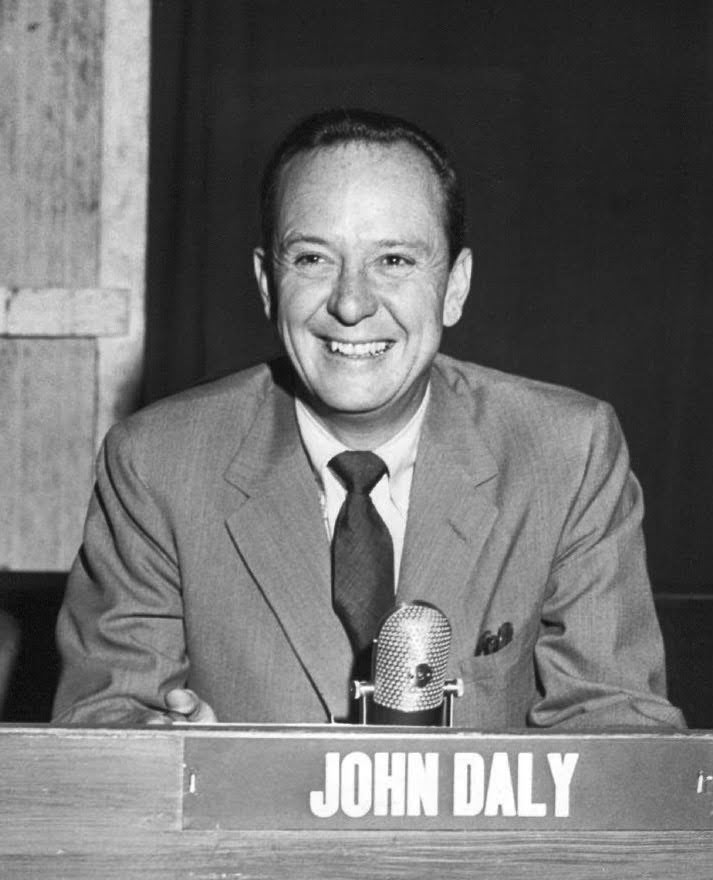
Game show host John Charles Daly
The appeal of live television has always been the possibility that something might go seriously wrong on the air in front of an audience of millions. Much of what we see on TV is carefully planned, rehearsed, and edited before it ever reaches us. It's no wonder, then, that we hunger for a little chaos amid all that control. Let's face it, this is the main justification for Saturday Night Live's continued existence. The long-running comedy-variety series could easily be pretaped, but it would lose its sense of danger and spontaneity.

We hunger for an element of risk in our entertainment. I can't help but think about Dave Chappelle's stand-up routine in which he discusses the infamous night in 2003 when magician Roy Horn was attacked by a tiger during a show in Las Vegas. "That's why we really go to the tiger show, right?" Chappelle says to the audience. "You don't go to see somebody be safe with tigers."

These days, pretaped shows are the norm and live broadcasts are considered special events. This was not so in the earliest days of the medium in the 1940s, when virtually everything on TV went out over the airwaves as it was being made and relatively little was saved for posterity via crude kinescopes. A major change arrived in 1951, when Lucille Ball and Desi Arnaz had the foresight to film their sitcom I Love Lucy on 35mm stock, thus ensuring the episodes would be preserved for future reruns.

Over the course of the 1950s, videotape technology improved and became more common in the industry, allowing shows to be shot in advance and edited. This was seen as a potential breakthrough for the medium. On his 1957 record "Tele-Vee-Shun," satirist (and stubborn TV skeptic) Stan Freberg begrudgingly admitted that "videotape may help somewhat." Freberg himself had been a puppeteer on the children's show Time for Beany (1949-1955) and had learned about the hazards of live television when he'd burned his hand during a sketch involving a clown. On a DVD commentary, Freberg recalled that the clown puppet made "a fast exit" from the scene after catching on fire.

By the 1960s, many shows were being filmed or taped in advance, but the venerable panel show What's My Line (1950-1967) was still being broadcast live every week from the CBS studio in New York City. Produced by Mark Goodson and Bill Todman, What's My Line is the kind of stately, old-fashioned program that seems inconceivable to modern day audiences. The premise is very simple. The host introduces a contestant with an unusual occupation, and then four celebrity panelists—generally culled from the theater and publishing worlds—try to determine that occupation (or "line") via a series of yes/no questions. ("Do you work with animals?") The contestant's goal is to stump the panel for as long as possible.

For me, the highlight of each What's My Line episode is the appearance of a celebrity "mystery guest." During this round, the panelists wear blindfolds and attempt to guess the identity of the famous person, again through yes/no questions. ("Are you known for your work in the theater?") This is an exceedingly polite and genteel program, making it truly seem like a relic from a bygone age. The show's stuffiness is now, at least to me, its chief selling point.

Tuesday, April 26, 2022

Podcast Tuesday: "America's Shameful Game Show Past"

Marion Ross and Lyle Waggoner on Happy Days.

I first learned of the notorious TV game show Queen for a Day (1956-1964) in a book called The Encyclopedia of Bad Taste (1990) by Jane and Michael Stern. The title of that book should give you some idea of the caliber of the show. In fact, I think I'll let the Sterns describe this truly bizarre and memorable program:
Like other game shows,
Queen for a Day gave away prizes, but the twist was that the prizes went to a contestant selected by audience applause. To earn applause, contestants had to tell what they needed and why. Some wishes were frivolous, but the one who invariably received the loudest ovation was the woman who told the most heart-rending story about the suffering in her life. 
Broadcast from Hollywood's Moulin Rouge theater-restaurant, Queen for a Day set standards of toe-curling tastelessness that have remained unequaled in game show history. In order to win, it was almost always necessary for the contestant to whimper and moan as she enumerated her miseries, and thereby made herself seem even more wretched than any of the other sad ladies hoping to be crowned. As she wailed her tale of woe, host Jack Bailey told jokes to keep the mood of the show light. (A contestant sobbed that her house was robbed on New Year's Eve. "Happy New Year," laughed Mr. Bailey.) 
Adding to Queen for a Day's stunning tactlessness were the prizes. Women whose lives had collapsed around them were awarded trips to the hairdresser and lunch at a movie studio, plus prizes to fit their particular dilemma. A woman whose husband was paralyzed and lay dying in the hospital was given a new car to go visit him and a year's supply of men's deodorant to bring him as a present. One contestant whose husband had died in bed pleaded for a new mattress. The end of each program was a dazzling coronation scene, during which the chosen Queen, always crying hysterically, was swathed in ermine and crowned, given a bouquet of red roses, and led to her velvet-covered throne by scantily clad courtiers, as Jack Bailey showered her with gifts, which were always announced by their brand names. 
In its eighth season in 1980, Happy Days gently satirized Queen for a Day with an episode called "Dreams Can Come True." The plot has Marion Cunningham (Marion Ross) competing on a Queen for a Day-type game show called Dreams Can Come True, hosted by the smarmy Bobby Burns (guest star Lyle Waggoner). She hopes to win $800 so she can send Lori Beth (Lynda Goodfriend), her future daughter-in-law, on a flight to Greenland to visit the absent Richie. Unfortunately, to win the game, Marion has to defeat two other downtrodden housewives whose problems make the Cunninghams' financial woes look trivial in comparison.

On this week's installment of These Days Are Ours: A Happy Days Podcast, we talk about "Dreams Can Come True" and the legacy of Queen for a Day. Join us, won't you?

Wednesday, June 17, 2015

Let us ponder the riddle that is Orson Bean

Orson Bean admits to having eaten the baloney.

Orson Bean on Match Game.
Orson Bean. It's very possible that this name will mean little to you if you're under 40. Cinephiles may remember him as dotty old Dr. Lester, the lecherous, carrot-juice-drinking boss from 1999's Being John Malkovich. ("My spunk is to you manna from heaven.") He was also the voice of Bilbo Baggins in the 1977 animated version of The Hobbit.

Connoisseurs of TV reruns may recall Orson from his appearances on The Twilight Zone, The Love Boat, or The Facts of Life. He did 146 episodes of Dr. Quinn, Medicine Woman back in the '90s, too, if that's what you're into. (Hey, there's no shame in it. My sister loved that show.)

If you watched Game Show Network back when they showed many of the old panel-style game shows from the 1960s and 1970s, Orson Bean should be a familiar face to you. He logged countless appearances on Match Game, To Tell the Truth, What's My Line, and more. In fact, I think of Orson Bean as a sterling example of a now-dying breed: the all-purpose professional celebrity with no particular specialty.

Bean was an actor of stage and screen as well as a comedian and author, but his real claim to fame was as a "personality." Need a familiar face for your talk or game show? Just call Orson! He possessed numerous traits that made him ideal for television: an impish sense of humor, a vast storehouse of jokes and stories, a winning smile, impeccable diction, and a flair for accents and dialects. The man was born to talk into a microphone.

The Orson Bean discography.
Like most stand-up comics of his generation, Orson Bean put his act down on wax a couple of times for posterity. He released At the Hungry I, recorded at the legendarily-hip San Francisco nightclub, in 1959. A decade later, however, Orson released the album that concerns us today: a collection of songs, poems, and "street jokes" entitled I Ate the Baloney. I first heard the title track, an irreverent religious-themed anecdote set to the tune of "Pop Goes the Weasel," on The Dr. Demento Show in the 1990s. Just this year, I found the entire LP had been uploaded to Archive.org.

For reasons I cannot adequately explain to you, I have listened to I Ate the Baloney in its entirety at least 20 times in the last few months, almost becoming able to lip sync the jokes as Bean tells them. I just like the sound of his practiced voice, especially when he slips into an Irish brogue. There's a vaudevillian old-fashionedness to the entire affair I find comforting and satisfying.

Since this LP comes to us from the 1960s, Bean can still openly acknowledge ethnicity in ways that would draw tremendous fire today. Take a conceptual bit called "The American Restaurant," in which Bean affects a broad, almost caroonish Chinese accent. One might be tempted to call the bit racist because of this, but in fact, Bean is poking fun at racism and stereotypes in a clever, insightful, and even subversive fashion. The Chinese characters in Bean's story talk about Americans in the bigoted, reductive way we Americans too often talk about the Chinese. It's a classic role reversal, as when the speaker ponders an infamous urban legend about sex. "Not look now," the man says to his giggling buddies. "American girl sit a-next table. Ooh, that's a nice lookin' girl! Built like a bamboo house! I don't know... American girl... I always wonder. I don't think so either. That's old Army story!"

But the track from I Ate the Baloney which has really captured my attention has nothing to do with religion or ethnicity. Instead, it's a brief bit of comedic doggerel about the plight of an urban commuter. The poem describes a man's experience aboard the IRT, which is what New Yorkers used to call the subway because it was run by a private operator called the Interborough Rapid Transit Company. I don't have much experience with the IRT, not being a New Yorker, but I do commute by train to and from work each day and can thus sympathize with the hero of Bean's poem. Some of the humor and pathos come from Bean's performance, but I think the words are worthy of study, too. In that spirit, the entire text of the poem is included below:

Last week, I'm ridin' in the IRT,
And this poor slob is sittin' right across from me.
So he's sittin' in the subway, kinda slumped in his seat,
Like a tired old dog, so dead, so beat.
His clothes, his face, everything looks sad,
And I'm thinking what a rotten life he must've had.
So I look in his face, and what do I see?
He looks like he's feelin' sorry for me!
But you don't know the IRT!
The windows are filthy. The lights are dim.
It was my own reflection, and I am him!

On the LP, this actually leads into entire bit about whiskey ads on the New York subways.  But I will leave that one for you to discover on your own. Bean is so convincing in delivering this particular hard-luck story that he elicited actual sympathy from the audience. Periodically throughout the recording, you can hear a tender-hearted woman in the audience say, "Awwww." Incidentally, Orson Bean is still alive at the age of 86, thanks to all that carrot juice. He worked as recently as 2014 in a parody of Dr. Quinn, Medicine Woman entitled Dr. Quinn, Morphine Woman. More intriguingly, back in 2008, he recorded a delightful little 10-part series of YouTube videos called "The Art of Joke Telling." Here is possibly my favorite of the ten:


Incidentally, that patch on Orson's shirt commemorates the Flying Goose Brew Pub & Grille in New London, NH. Sounds like a nice place.

Saturday, December 10, 2011

(today's zomby) AND WHO WANTS TO BE A COMPLETE AND UTTER FAILURE?


Cheer up, Zom. Here's something that'll put your problems into their proper perspective....


One of the rarest yet sweetest pleasures in television is to see a contestant on Who Wants to be a Millionaire? fail on the very first question. Even casual viewers of the show will know that those opening queries are very easy and are seldom missed. But occasionally, a contestant will get one wrong, and the look of utter bewilderment and slowly dawning horror on that person's face is something gorgeous to behold.

And behold we shall...


There. Now don't we all feel a little better about ourselves?