Showing posts with label book reviews. Show all posts

Friday, January 7, 2022

Ed Wood's When the Topic is Sex: "Book Reviews" (1969)

Ed Wood gets to review himself in the pages of Young Beavers magazine!

NOTE: This article continues my coverage of Ed Wood's When the Topic is Sex (BearManor Media, 2021).

The article: "Book Reviews." Originally published in Young Beavers (Pendulum Publishing), vol. 2, no. 6, February/March 1969. No author credited.

Excerpt: "Author Ed Wood, Jr. has pulled out all the stops in recreating the story in prose form which is intended for a strictly adult audience. His smooth style and machine gun action dialogue carry the reader along to a smashing climax which won't be divulged here."

Reflections: Adult magazine and book publisher Bernie Bloom was always willing to experiment with new formats in the hopes of separating horny customers from their money. Give 'em something new, something they haven't seen before. Among Bernie's most baffling and outrageous publications were the Pendulum Pictorials he began releasing in 1968. Each one boasted a cover price of $1.75 (that's fifteen bucks in today's money) and promised the reader "80 PHOTOS."

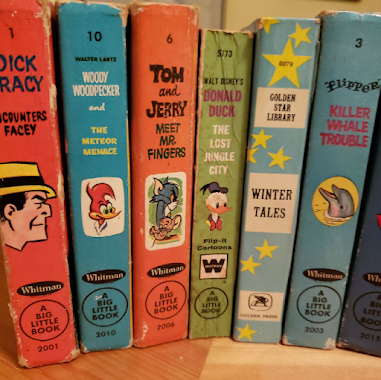
Some classic Big Little Books.
These books are real oddities, even by 1960s porn standards. They're not exactly novels, and they're not exactly magazines either. Instead, they combine photographs and text to tell very convoluted stories—sort of like fumetti, but not formatted like a comic book. Instead, think of them as the pornographic equivalent of Big Little Books. Remember those from your childhood? I wonder if that's where Bernie got the idea.

The Pendulum Pictorials of which I am aware are the following:

PP01 Bye Bye Broadie (1968) credited to Ed Wood, Jr.
PP02 Raped in the Grass (1968) credited to Ed Wood, Jr.
PP03 The Erotic Spy (1968) credited to Abbott Smith
PP04 Prison Passion (1968) credited to Harmon Wold, Jr.
PP05 The Nazi Field Whores (1968) credited to Michael Snow
PP06 The Svengali of Sex (1968) credited to Edgar Andrews

Some have speculated that Abbott Smith, Harmon Wold, Jr., Michael Snow, and Edgar Andrews are all pseudonyms for Ed Wood. Others dispute this, in whole or in part. That's another article for another time. For now, let's concentrate on the first two Pendulum Pictorials, Bye Bye Broadie and Raped in the Grass. Both of these are credited to Ed, so their place in the canon is secure.

The Pendulum Pictorials were marketed as adaptations of film scripts, but this was pure hogwash, strictly ballyhoo. No such movies exist. Apparently, the way they were made is that a photographer would shoot a series of related pictures, and then a writer would concoct a story around them. 

Having read through a few of these, I'm sure the photographs must have come first. No writer—not even Ed Wood at his booziest and most delirious—would create plots as nonsensical and far-fetched as these out of thin air. The Pendulum Pictorials also stand out for combining sex and violence in particularly depraved and extreme ways. This series brought out Ed's nastiest tendencies as a writer. If you want to wallow in filth, start here. If you're limiting yourself to just one, make it Bye Bye Broadie, whose ending is so absurd that even I was caught off-guard by it.

Naturally, Bernie Bloom wanted to promote his Pendulum Pictorials, and what better place than in the pages of Pendulum's own magazines? Therefore, the February/March 1969 issue of Young Beavers contained glowing, albeit unsigned, reviews of both Raped in the Grass and Bye Bye Broadie. Essentially, Ed Wood is reviewing himself. (And now, I'm reviewing Ed Wood reviewing himself!) 

Although presented as reviews, these are really advertisements. I'd like to think Eddie had some fun patting himself on the back. "In bringing out two titles so close to one another," he writes, "it is a distinct tribute to his not inconsiderable powers as a novelist with a demonstrated ability to handle a variety of subjects." This is the Eddie-as-huckster we see so often in Tim Burton's Ed Wood (1994), the consummate salesman shamelessly pitching projects to producers and backers.

Next: "16MM Beaver" (1971)

Wednesday, October 29, 2014

Ed Wood's BLOOD SPLATTERS QUICKLY: An introduction

Blood Splatters Quickly reintroduces America to the short fiction of Edward D. Wood, Jr.

"It got to the point where, when one of the kids got an ear infection and we needed to buy antibiotics, [my wife] Tabby would sayhalf-joking and half not'Hurry up, Steve, think of a monster.'"
-Stephen King on his short story-writing career

I have decided not to write an article about Blood Splatters Quickly: The Collected Stories of Edward D. Wood, Jr. (O/R Books, 2014), the newly-published volume that contains several dozen short stories written by Ed Wood in the late '60s and early-to-mid-'70s, most of them unseen for over 40 years. Instead, I'm going to write 33 articles about it... 34, I guess, counting this one.

After some careful consideration, I have come to the conclusion that it would be best to cover each of the stories individually. As I've been making my way through these marvelously twisted and unmistakably Wood-ian tales, one persistent thought has been gnawing away at me: "How am I ever going to condense this down into one Ed Wood Wednesdays piece without skipping a bunch of stuff?"

Well, who says I have to skip anything? So instead of my usual 5,000-plus-word behemoth (and do you realize that I've now written about a quarter of a million words about ol' Eddie at this point?), Blood Splatters Quickly will receive coverage here on a day-by-day, story-by-story basis. That way, I'll be able to discuss each entry in the book at my leisure while also providing a more steady supply of new content at Dead 2 Rights. Doesn't that sound like fun? Trust me, this is gonna work like gangbusters or my name isn't Adkon Telmig.

While the stories contained within its covers were written by Ed Wood, the omnibus Blood Splatters Quickly owes its existence to one man: Hollywood resident and tireless Ed Wood booster Bob Blackburn, whom you may remember from my coverage of I Woke Up Early the Day I Died . A lifer in the radio business himself and the son of a prominent Seattle sports announcer, Bob met Kathy Wood, Ed's widow, in 1992 and became a good friend to her in the last 14 years of her life.

Significantly, Bob assisted her in an ongoing quest to make sure that Eddie's life and work were not forgotten even though the man himself died in 1978. Besides getting I Woke Up Early made into a full-length, all-star motion picture in 1998, Bob and Kathy also arranged for a New York firm called Four Walls Eight Windows to finally publish Ed's previously-unseen Hollywood Rat Race, along with attractive new editions of Death of a Transvestite and Killer in Drag. Kathy Wood passed away in 2006 at the age of 84, and Bob became the caretaker of the Edward D. Wood, Jr. estate. His dedication to Wood's memory has not wavered in the intervening eight years.

Bob's latest accomplishment is Blood Splatters Quickly: The Collected Stories of Edward D. Wood, Jr. The 33 short stories reprinted here were originally cranked out for pornographic publications known euphemistically as "men's magazines" between roughly 1969 and 1975. Though explicitly sexual in nature, many (or most) of the tales have a horror or supernatural element as well.

Sam Yorty
Bob Blackburn himself pens an affectionate, informative introduction to the new book. He gives a thumbnail history of Ed Wood's literary career, including a retelling of Eddie's long association with Bernie Bloom at low-end Pendulum Publishing in the 1970s. The introduction also includes a biographical sketch of Ed Wood's entire colorful life, touching on his stint in the Marines during World War II and the low-budget film career that made him famous/infamous in the 1950s and beyond. Ed's work with the Autonetics aviation firm and controversial Los Angeles politician Sam Yorty are also covered.

Not ignored in all this is Eddie's decades-long struggle with alcoholism. This crucial subject is treated in a matter-of-fact way, highlighted by vivid details. (An example: "Ed would take a thermos of vodka to work with him and by the end of the day, he would be smashed.") But Kathy's life is given due attention as well; this may be the first time that her post-1978 life has ever been described at any length in a book. A little of the woman herself shines through in the process. "Kathy was a very private person," Blackburn writes, "and couldn't quite understand the growing fascination with Ed's work and the re-appraisal of his films and writings. She later told me that Ed would have loved it all, but it was too late." Those all-important words "too late" cast a pall over Eddie's entire posthumous career, including this very book.

Before we go, here's a neat video introduction that Bob recently made for an Ed Wood film festival. It's shot in front of the infamous "Yucca Flats" apartment building (6383 Yucca Street, Los Angeles, CA 90028) where Ed and Kathy spent their last few turbulent years as a couple. Just as in Ed's day, the building is still located next door to a 7-11 convenience store. The famed Capitol Records building (glimpsed in Nympho Cycler) is just a few blocks to the east. Head west on Yucca and you'll soon find another quintessential Wood location: Pla-Boy Liquor (still in operation as of this writing).


NEXT: "Scream Your Bloody Head Off" (1972)

Wednesday, August 14, 2013

Ed Wood Wednesdays, week 6: "Death of a Transvestite" (1967)

Four years after his debut novel, Ed Wood gave us a sequel, Death of a Transvestite.

"Pure determination held me by the groin."
- Edward D. Wood, Jr. (1967)

Ed Wood's standard headshot.
Ed Wood was many things, but lazy was not one of them. The man just never quit. When I think of Ed now, my image is not of a man standing behind a movie camera but rather a man hunched over a typewriter, churning out manuscripts and screenplays at a frenzied pace. In one of the innumerable documentaries about this odd auteur, actor Paul Marco ("Kelton the Cop") fondly recalled Ed typing away at a story while smoking, drinking, and carrying on conversations with friends. When asked which possessions he would save in case of an emergency, Ed selected his typewriter. What about his wife, Kathy? She could follow him, he explained. The man had ink and alcohol in his veins.

Getting the funding to make a movie is damned hard and frustrating work, and Eddie simply wasn't good at it. That's largely why his directing career evaporated after about a decade. But writing more or less eliminated the troublesome middlemen. There were no studio executives or financial backers to tell him no. It was just his brain, the typewriter, and the paper. Ed could bang out a novel and sell it to a publisher fairly quickly, and this would provide the cash he desperately needed to buy his booze and pay his rent, the former always taking precedent over the latter. But while Wood may have had a figurative gun pressed to his temple while he wrote these volumes, do not labor under the delusion that these books were soulless, mercenary endeavors.

On the contrary, there is much of the man himself in these sentences, perhaps in a form even purer or less diluted than one might find in his films. I won't say that "to read Ed Wood is to know Ed Wood," because the man was profoundly unknowable. Even his own wife, Kathy O'Hara, the woman who stayed with him for decades and was as close to him as anyone, considered her husband a "lost being on this earth" who "doesn't belong here." I will say, though, that Ed's written works give us valuable insight into this surprisingly complex man.

Fortunately, this project has finally given me an excuse to delve into the shadowy literary career of Edward D. Wood, Jr., something I've wanted to do ever since reading Rudolph Grey's Nightmare of Ecstasy: The Life and Art of Edward D. Wood, Jr., which contains an extensive Ed Wood bibliography. In fact, the image from that book which really piqued my interest was the original 1967 cover of the novel which I'm reviewing today.

How could I not be intrigued by Death of a Transvestite? After all, the book's original cover depicts a man wearing a black bra, black panties, black garters, and fishnet stockings. He would look very much like a character in The Rocky Horror Picture Show (1975) were it not for the cover's other ominous trappings. A small black rectangle, for instance, cancels out the man's eyes. And, of course, he is standing in a prison hallway which terminates in an electric chair. At the bottom of the page is the book's unforgettable tagline and tantalizing ad copy:    
LET ME DIE IN DRAG! 
The last request of a prisoner in the
death house. A revealing insight to the
"other life" of a man of action...

ADULTS ONLY
Now, at last, I get to see what was behind that arresting cover. Ah, the joys and privileges of adulthood! Incidentally, that cover photo was of actor Hugh Hooker from the movie Suburbia Confidential (1966), directed by Stephen Apostolof (aka "A.C. Stephen"), who worked with Ed many times in the 1960s and 1970s on film projects. Anyway, onto the book itself:

DEATH OF A TRANSVESTITE (1967)

Ed Wood in one of the angora sweaters over which he obsessed so fervently.

Alternate titles: Let Me Die in Drag (sometimes credited to "Woodrow Edwards"); I Want to Die in Drag (Kindle edition), Hollywood Drag; Muerte de un travesti (translated into Spanish)

Availability: The most common edition is Death of a Transvestite (Four Walls Eight Windows 1998; reprinted by Da Capo Press, 1999), but an edition with the original cover is available as well (Angora Press, 1990). Those who want the Spanish language edition can opt for Muerte de un travesti (Punto de Lectura, 2002). And those who prefer to have the novel as an e-book may purchase I Want to Die in Drag: The Transgender Classic (Amazon Digital Services, 2005).

A few of the many editions of Death of a Transvestite.
Notice how many bear Ed's own name.
The backstory: A great deal happened in America in the four years between the publication of Ed Wood's debut novel, Killer in Drag (aka Black Lace Drag), and the appearance of its bizarre sequel, Death of a Transvestite (aka Let Me Die in Drag). The country lost a whole lot of its innocence between 1963 and 1967. The president, John F. Kennedy, had been assassinated in full view of the public. His alleged killer, too, had been gunned down in full view of the cameras. Under the leadership of hawkish new president Lyndon B. Johnson, the war in Vietnam had escalated severely and was claiming the lives of many young American men who had not volunteered for military service but instead had been drafted.

Legions of so-called "baby boomers," the children born during the prosperous, optimistic years following WWII, had started to reach their teens and twenties, and they began to form their own parallel society, separate from that of their parents, which became known as the counterculture. These young people were fiercely anti-war (after all, they were the ones expected to go fight it) and protested vigorously against it, often on college campuses. Moreover, they were tired of the strict, repressive, morality-bound world in which they had been raised and were eager to experiment with sex, drugs, art, music, and fashion.

Cultural observers began to speak of a "generation gap" emerging between the older folks and their children. Ed Wood, then 43, would have been closer in age to the parents and definitely fell on the pre-war side of the generation gap. People who know of Ed's transvestism and prodigious consumption of alcohol might have guessed that he'd be sympathetic to these adventurous young folks and their newfangled ideas. Nothing doing. As Rob Craig astutely points out in his book Ed Wood, Mad Genius: A Critical Study of the Films (McFarland Press, 2009), Ed was "a unique cross between libertine and prude." Both sides are well represented in Death of a Transvestite.

The Sunset Strip in the '60s.
Those of you who have read Killer in Drag will recall that, in that book, cross-dressing New York assassin Glen Marker (aka "Glenda Satin") was falsely accused of the murder of wealthy homosexual Dalten Van Carter and had to go on the run. He got as far as Colorado, where he purchased a small carnival and began a relationship with troubled prostitute Rose Graves. Unfortunately, the carnival only brought Glen/Glenda unforeseen new problems, and he reluctantly left Rose to go to Los Angeles. In doing so, he barely escaped from a pair of crooked cops, Mac and Ernie, who died in a wild climactic car chase. While Glen/Glenda was making his way to the West Coast, his former mob bosses from "the Syndicate" back East were dispatching another drag queen to hunt him down. That's how Killer in Drag ends.

The sequel picks up with Glen Marker on death row, having apparently been convicted of murder (we never find out precisely whose, though) and about to go to the electric chair*. He has one final wish, though: to be allowed to die in drag as his "Glenda" character. In exchange for this final courtesy, Glen agrees to tell the warden his entire story. The bulk of the novel is a series of flashbacks -- Glen's memories intermingled with those of other characters in the saga and various lawmen, waitresses, bellboys, and others who just happened to witness some of the events. The overarching narrative is of Glen Marker's attempts to establish himself in Los Angeles, while constantly being pursued by the vicious, hawk-nosed Paul/Paula, a thrill-killer turned professional assassin, who once idolized Glen and now must destroy him.

Despite this unpleasantness, Glen/Glenda manages to start a romantic relationship with rising young actress Cynthia "Cindy" Harding, who is the "kept woman" of wealthy, aging, would-be lothario Ronnie Dixon. Together, Glenda and Cindy explore the nightlife of Los Angeles, including the gay and lesbian bars of the Sunset Strip. But the Strip is being infiltrated by rowdy "teenagers" and "beatniks," attracting the unwanted attention of the police. A full-scale riot breaks out one night, providing the chaotic backdrop for the final, bloody showdown between Glen/Glenda and Paul/Paula. His story told, Glenda bravely accepts her fate in the death house, clad in an angora sweater and brown skirt borrowed from the warden's daughter.
*HISTORICAL NOTE: While capital punishment was the law in California in 1967, the electric chair has never been used in that state. Capital punishment was briefly suspended in California from 1972 to 1978. In reality, Glen Marker could have opted for lethal injection or the gas chamber.

A typical scene from Jack Webb's Dragnet 1967
The reading experience: Befuddling and compelling at once. Killer in Drag was written in a third-person omniscient voice and told its eccentric story in a basically typical pulp novel style. The plot of Death of a Transvestite unfolds in a much more disorienting, fragmented way.

In a previous entry in this series, I wrote that Ed's script for The Violent Years was clearly influenced by Jack Webb's seminal radio and TV police series of the 1950s, Dragnet, with its deadpan narration by a police officer and its supposed basis in fact. Well, more than anything, reading Death of a Transvestite is like watching an episode of Jack Webb's revival series, Dragnet 1967, only told largely from the criminal's point of view and incorporating the transvestism and wild sexual experimentation which were the hallmarks of Wood's work. Perhaps you've seen Dragnet 1967 in reruns. In it, Sgt. Joe Friday (Webb), still as straightlaced and humorless as he was in the 1950s, comes face to face with the counterculture: hippies, longhairs, acid freaks, gurus, and more. This incredible contrast between old and new, the "generation gap" neatly encapsulated, has made the revival series a longstanding camp classic.

Ideologically, Ed Wood had a surprising amount in common with super-conservative Jack Webb. The policemen in this book are the same dutiful, honest lawmen you'll find in most of Ed's work. (The crooked cops of Killer in Drag are an anomaly.) Ed's utter contempt for the youth culture, whom he amusingly misidentifies as "beatniks," a term roughly a decade past its expiration date, is plain. Remember, this is a man who eagerly joined the Marines in WWII, so he would have had no sympathy whatsoever for the anti-Vietnam movement.

What seems hypocritical to me is his condemnation of the drug scene, specifically acid and marijuana. (There is one brief reference to "the white stuff," by which he means heroin, not cocaine.) I say "hypocritical" because Ed was altering his own consciousness with alcohol whenever he could, and the characters in his novels do likewise. Booze is nearly as central a motif in Death of a Transvestite as angora.

First edition of Robert Bloch's Psycho.
Beyond this consideration, Dragnet's documentary-style approach to storytelling causes Ed to treat this novel as a factual report compiled from various confessions and eyewitness reports. One is reminded of the prologue of Wood's Plan 9 from Outer Space (1959), in which Criswell insists the story is factual, "based only on the secret testimony of the miserable souls who survived this terrifying ordeal." The weirdest aspect of Death of a Transvestite is the fact that the novel, despite its supposedly "official" nature,  is written in the lurid, panting, purple-prose style of any sleazy dime novel and contains sordid details and dreamy digressions which would never, ever appear in a police document. How would waitresses and airport employees even know what the main characters were thinking, unless LA is populated by psychics? It's as if the LAPD dutifully gathered its source material then turned it over to Harold Robbins, Grace Metalious, or Jacqueline Susann (or perhaps all three, taking turns) for editing.

And maybe Robert Bloch might have taken a turn spicing this material up, too, since the Paul/Paula character bears a certain resemblance to Psycho's Norman Bates. Like Norman, Paul is a cross-dressing mama's boy who kills the women who sexually excite him. The briefly-glimpsed-yet-crucial character of Paul's indulgent mother is perhaps yet another example of Ed Wood using his writing to work through some deeply-ingrained Oedipal issues.

For such a slim, slight volume, Death of a Transvestite is surprisingly heady stuff and provides the aspiring Wood-ologist with all sorts of fodder for theories and fantasies. Copies of it are plentiful and cheap. Do yourself a favor and pick one up at the earliest convenience.

Next week: Literary month continues as I tackle another one of Ed's novels from 1967. Make plans to be back here in seven days for a review of the spicy-sounding Devil Girls.

Saturday, February 12, 2011

Woody Allen's "Mere Anarchy": a book review

Woody Allen's Mere Anarchy is his first new literary work in many years.

In addition to churning out roughly a movie a year for 40 years, director Woody Allen has also worked as a stand-up comedian, actor for hire, playwright, and author. In fact, he has written three bestselling collections of humor, Getting Even, Without Feathers and Side Effects, collecting his various short stories, essays, and plays, along with absurd lists and guides.

One of the great thrift-store finds of my life was a Book of the Month Club paperback containing all three of these books (unabridged!) in one easily-portable volume. This is a book I've taken with me on long trips many, many times. You can dip into it just about anywhere and find something entertaining, ranging from exercises in pure silliness, like Allen's highly unlikely "Slang Origins," to truly well-written fiction. In fact, I'd count "The Shallowest Man" and "The Kugelmass Episode" among the better short stories I've ever seen by anyone, anywhere.

Mere Anarchy (2007) is Allen's first collection of prose in decades, and reading it is like attending a concert by a '70s hitmaker who wants to try out some new material after a long absence from touring. Allen has given up on the plays, essays, and guides this time, so Mere Anarchy only contains short (often very short) stories -- 18 altogether, ten of which originally appeared in The New Yorker and eight of which are new to this edition.

For the most part, the eight new stories are fairly weak -- contrived, unfunny, and somehow both overwritten and undercooked -- and Allen's editor has done him no favors by running all of them in a row at the beginning of the book. For that reason, Mere Anarchy gets off to a very slow and bumpy start, and I would not blame readers for abandoning it and moving on to something else.

Allen's writing style tends to include a lot of eccentric vocabulary choices, semi-obscure cultural references, and Yiddishims, and in these early tales he tends to let his "quirks" overwhelm the weak plots. For readers unfamiliar with Allen's prose, Mere Anarchy sometimes verges on unreadable. His decision to give seemingly every character a wacky name might also grate on readers' nerves.

About the only new story that rates with Allen's best is "Glory Hallelujah, Sold!" about a prayers-for-cash scam. The nadir of this part of the book, for me at least, was "Sam, You Made the Pants Too Fragrant," an extended riff on the idea of "enhanced" clothing that stretches a lame premise far beyond its breaking point.

The good news is that the ten New Yorker stories are, on average, much stronger and funnier, so the back half of the book is a much smoother ride. Here, you'll find "Thus Ate Zarathustra," a rumination on food and philosophy that could easily have found a place in one of Allen's three classics, as well as highly amusing takes on physics ("Strung Out"), home repair ("On a Bad Day You Can See Forever"), and overly chatty dentists ("Pinchuk's Law").

The New Yorker selections aren't perfect, though. Some critics fawned over "Surprise Rocks Disney Trial," a story in which Mickey Mouse gives very un-Disney-like testimony at the trial of Michael Eisner, but for me this was a missed opportunity. Allen thinks it's funny simply that a cartoon character is talking in a very businesslike way about sex and money and is casually referring to other cartoon characters as he does so, but to really make a piece like this work you have to truly understand the characters and their careers. Specificity is what makes or breaks a pop culture spoof.

For an example of how to do this kind of thing correctly, try to find "Some Famous Couples Discuss Their Divorces" by Delia Ephron in her 1986 book, Funny Sauce. That contains brief monologues by several cartoon characters, including Mickey & Minnie (along with Popeye & Olive Oyl and Archie & Veronica), and it's funny, daring, and insightful in ways that Allen's story just isn't.

Misogyny is also a problem for Allen. I'd be curious to hear a woman's perspective on Mere Anarchy. Females do not come off terribly well in Allen's stories. In fact, they generally fall into one of two categories: curvaceous young sex kittens and nagging old harpies who spend their husbands' money too freely. If you don't have a Y chromosome, you're pretty much either a bimbo or a crone in this book, with very little middle ground.

Given Allen's advancing age and infamous sexual history, his numerous leering descriptions of attractive young women, at least two of whom are complimented on their "protoplasm," might make some readers uncomfortable. He kind of comes off as an old lech now and again.

Amazingly, you can read a lengthy excerpt of this book for free on Google Books!

Sunday, January 30, 2011

"Mr. Strangelove: A Biography of Peter Sellers" - A book review

Ed Sikov finds the man behind the characters in his Peter Sellers biography, Mr. Strangelove.
 
The last time we spoke about books, it was to discuss David Michaelis' gargantuan biography of Peanuts cartoonist Charles Schulz. That book must have gotten me on a "biography" kick because I followed it up with Mr. Strangelove, Ed Sikov's look at the life story of British comedian and actor Peter Sellers. 

Sellers first came to prominence as a cast member of an anarchic BBC radio program called The Goon Show in the 1950s before achieving international success as a motion picture star in the 1960s through his appearances in such films as Lolita, Dr. Strangelove and The Pink Panther. That last film provided him with his best-known role, that of bumbling Inspector Clouseau, whom he portrayed in a series of highly profitable sequels for pretty much the rest of his life. 

Sellers' weak heart, combined with a lifestyle of heavy drinking and drugging, led to his death at the age of 54 in 1980, not long after his triumphant Oscar-nominated performance in Hal Ashby's Being There, a personal project Sellers had been trying to get off the ground for about a decade.

It would be tempting to write a truly scathing, damning book about Peter Sellers. He had so many serious character flaws that it's almost impossible to tabulate them all. Spoiled rotten by his controlling and manipulative mother, Peg (who emerges as the second-most astounding character in Sikov's book), Peter Sellers grew up to be a temperamental and immature child-man, infamous for his tantrums and wild mood swings, marked by swift and terrible changes of heart. 

Married four times (with no success), Sellers was an alternately neglectful and abusive father to his three (possibly four) children. Materialistic and greedy to an absurd extent, Sellers used his movie money to buy cars, houses, and gadgets he simply didn't need and took roles in some truly godawful films strictly for the cash, despite the damage it was doing to his career. Sellers could be a terror during the production of a film, slowing down filming with his erratic behavior and having various cast and crew members fired for no good reason. Ed Sikov does not shy away from detailing all of Sellers' faults in this book.

However, the minor miracle of Mr. Strangelove is that the reader does not emerge from the book hating its subject. Sikov writes with genuine affection about Sellers' best screen work, and he makes the reader want to track down these films and watch them again. (I'm particularly keen to revisit A Shot in the Dark and The Party as well as Being There.

It helps that the interview subjects, i.e. Peter's friends, relatives, and coworkers, generally seemed to have liked the man despite his many, many flaws. Even after decades of inexcusable behavior (and, believe me, there's a ton of it in this book), very few of the people close to Peter Sellers seem to hold a grudge against him. They all recognize his talent, and they often speak fondly of the humor, charm, and generosity he displayed during his more-lucid moments. Instead of waiting for Sellers to get his much-deserved comeuppance, the reader will instead be rooting for the man to get his act together. (Spoiler: he never does.)

I guess since I read the Schulz book and the Sellers book back-to-back, there's a temptation to compare the two. There are several parallels between the lives of Schulz and Sellers. Both were stereotypical "mama's boys" whose relationships with their mothers defined their adult lives. Both fought in World War II, though Schulz with much more distinction than Sellers. Both had troubled and argumentative marriages that ended in divorce. Both were in the business of making people laugh but were surprisingly complex and moody men in their private lives. And both were gawky and unattractive as youths, but became rather dapper and distinguished (and, thus, more attractive to women) in middle-age. 

The two books are not much alike, though. Schulz and Peanuts is a much heavier read and offers plenty of food for thought on the nature of art and the relationship between an artist and his work. Mr. Strangelove is more of a page-turner, a well-written book with lots of splashy incidents about the life of an eccentric and well-known man. I recommend them both.

But I think I'm done with biographies for a while. One of the supporting characters in Mr. Strangelove is the American writer Terry Southern (who coauthored the screenplay for Dr. Strangelove), and I think it is high time I explored Southern's novels.

Before I go, I really must share with you this clip. Half of it was filmed during the making of Strangelove and half... well, wasn't. Either way, it includes a dazzling display of Peter Sellers' talent for regional accents. Enjoy.


Sunday, January 9, 2011

Schulz and Peanuts: a book review

A familiar zig-zag pattern appears on the cover of Schulz and Peanuts.
 
"Cartooning will destroy you. It will break your heart."
- Charles Schulz 
   
Charles M. Schulz's Peanuts is, essentially, The Beatles of comic strips. If you're into newspaper comics (or cartoons in general), you probably enjoy Peanuts, while if you're into classic 1960s rock (or popular music in general), you more than likely enjoy The Beatles. Schulz did not invent the comic strip, as The Beatles did not invent rock & roll, but they both redefined their respective media and broadened people's expectations of what could be done within them. In so doing, Peanuts attained unprecedented commercial success (as did The Beatles) and influenced generations of other writers and artists (as did The Beatles). And both have remained popular over the decades, appealing both to the widest-possible mainstream audience and over-analytical connoisseurs alike.

(Side note: If Peanuts is the Beatles of comic strips, does that make Garfield the Rolling Stones of comic strips? Hmmmm.)

David Michaelis' massive biography of the late Mr. Schulz, Schulz and Peanuts: A Biography, is a fascinating book which provides valuable insight both into the strip and the man who created it. The title has the billing right: this is a book about Schulz first and Peanuts second. Michaelis assumes, probably correctly, that anyone willing to tackle a 672-page book about Charles Schulz is already very familiar with Peanuts and its various characters, relationships, recurring storylines, and running jokes. If you can't tell Charlie Brown from Linus or Snoopy from Spike, Schulz and Peanuts is not the book for you. Maybe some other writer will have to write the definitive book about the internal history of Peanuts. Michaelis' book is much more about the strip's external life, i.e. the real-life inspirations behind the strip (Schulz's own life and his relationships with others) and its growth as a pop culture and merchandising phenomenon.

When Schulz and Peanuts came out back in 2007, the standard line from critics and reporters -- who were looking to quickly pigeonhole Michaelis' book -- was that it exposed the hidden dark side of Charles M. Schulz. To that, I would say Schulz's dark side was "hiding" in plain sight for 50 years, as his strip frequently dealt with frustration, disappointment, fear, depression, and cruelty. Even the sentimental and reassuring TV special A Charlie Brown Christmas features moments of angst, despair, and emotional brutality. In short, Schulz put his dark side on display for the entire world to see.

Michaelis presents Schulz as neither a hero nor a villain, but as a surprisingly complex human being. The life of Charles Schulz is neither a comedy nor a tragedy. It's not quite a Horatio Alger story, an allegory, an epic saga, or a cautionary example either. The cartoonist's life, therefore, did not follow any of the standard templates for a biography. I think critics painted this book as a "dark" expose because that makes for a better story. Michaelis does explore some of Schulz's various character flaws, such as his emotional withdrawal from his first wife Joyce, but I never for a moment felt that Michaelis was trying to make Schulz into an "unforgivable" monster. Instead, the author remains sensitive and sympathetic throughout the entire book -- sympathetic both to Schulz and to the people around him.

Schulz and Peanuts: A Biography is probably of interest mainly to comics junkies in general and Peanuts fans in particular, but I would recommend it to anyone who is interested in the creative process or in exploring the relationship between Art and Life. And if you just like funny cartoons, Michaelis generously includes many, many examples of Peanuts strips from all the different eras of Schulz's career. If anything, this book made me eager to explore those strips again.