Showing posts with label Los Angeles. Show all posts

Wednesday, November 7, 2018

Ed Wood Wednesdays, week 75: The Mocambo (1941-1958)

A UFO hovers ominously over the Mocambo on Sunset Blvd.

The VHS release of Look Back in Angora.
There are several fine, lovingly made documentaries about Ed Wood. The three best known examples—Look Back in Angora, Flying Saucers Over Hollywood, and The Haunted World of Edward D. Wood, Jr.—were all released in the early-to-mid 1990s. That tracks. Rudolph Grey's book about Eddie came out in '92, Tim Burton's biopic followed two years later, and several of Ed's movies were either being issued or reissued on VHS back then. It was a good time to be an Ed Wood fan.

Perhaps the best documentaries about Edward D. Wood, Jr. are the man's own films. From his crude cowboy drama Crossroads of Laredo (1948) to the formulaic porn loops he worked on in the 1970s, these motion pictures truly capture Eddie's life and times. Jean-Luc Godard famously said that "film is truth 24 times a second," and Ed Wood's movies show how true that (slightly pretentious) maxim is.

Take Plan 9 from Outer Space (1959) as an example. You want to see what Vampira, Tor Johnson, Bela Lugosi, and the rest of the Wood gang looked like back in the 1950s? They're all in Plan 9, alongside many other members of Eddie's oddball entourage. And you can't tour Quality Studios as it was during those years, but you can see the scenes Eddie filmed there, including that infamous cockpit aboard American Flight #812. You know, the one with the shower curtain and the circular slide rule.

Plan 9 is a treasure trove of detail about life in Eisenhower-era America. Here, you'll see examples of 1950s fashion, technology, social attitudes, architecture, and consumer products. Just look at the huge Fords, Dodges, and Buicks that zip across the screen. People didn't know what "fuel economy" even was back then. And check out the Coca-Cola bottles and the L&M cigarette package on the table outside Jeff and Paula's home during the scene in which the Trents are interviewed by Col. Edwards (Tom Keene) and Lt. Harper (Duke Moore). Nostalgic movies set in the 1950s, including Ed Wood (1994), scramble to get these kinds of period details correct. Plan 9 doesn't have to scramble. Eddie just used what was available in Los Angeles at the time.

Coke and cigarettes in Plan 9 from Outer Space.

One of the most remarkable passages of Plan 9 arrives at about the 17-minute mark. Much has already happened by this point in the movie. Vampira and Bela's characters have died, had their respective funerals, and risen from the dead. Pilot Jeff Trent (Gregory Walcott) has spotted a flying saucer and confessed this remarkable event to his supportive wife Paula (Mona McKinnon). Two bumbling gravediggers (J. Edward Reynolds and Hugh Thomas, Jr.) and lumbering Inspector Clay (Tor Johnson) have been killed by zombies. After all this, Reverend Lynn Lemon presides over Clay's funeral ("The bell has rung upon his great career.") with Vampira watching from the bushes and UFOs hovering overhead.

What follows is a remarkable, newsreel-esque montage lasting about a minute and a half, comprised of both stock footage and newly filmed pick-up shots, augmented with hyperbolic narration by Criswell and dramatic library music. The point of this montage is to show that the three saucers are brazenly flying over major American cities, including New York, Los Angeles, and Washington, ultimately attracting the attention of the military. What had been a series of intimate, interconnected stories about a few characters (a grieving old man, a married couple, some police officers) is now a national phenomenon.

Unsurprisingly, most of the montage focuses on Eddie's adopted hometown of Hollywood. Criswell tells us that the three saucers were spotted "high over Hollywood Blvd." as we see amazed motorists pointing at the sky. A fictional newspaper called the Hollywood Chronicle is first seen coming off the printing press, then being read by a suit-wearing man (supposedly Ed Wood himself). Its banner headline reads: SAUCERS SEEN OVER HOLLYWOOD. A slightly crumpled copy of the Chronicle is laid out on a table at a diner, surrounded by various cups and silverware. Finally, a tubby drunk staggers through an alley and picks the paper up off the sidewalk before waddling out of frame.

Meanwhile, the saucers fly over the headquarters of CBS, NBC, and ABC. But then, for reasons known only to himself, Eddie has the aliens visit Sunset Boulevard, and we get a glimpse of what the glitzy Sunset Strip—a 1.5-mile stretch of road through West Hollywood cluttered with clubs, stores, and billboards—looked like 60 years ago. There's a shot in which a saucer soars over the Crescendo, a nitery that lasted from 1954 to 1964 and played host to top jazz, folk, and comedy acts of the day. Everyone from Louis Armstrong to Bob Newhart gigged there. The joint was named after the GNP Crescendo record label and was owned by GNP honcho Gene Norman. (The club is long, long gone, but the label is carried on today by Gene's son, Neil.)

On the night this footage was shot, "cool jazz" singer June Christy was performing there. An appreciative write-up in the June 10, 1957 edition of Billboard said that the chanteuse "seems to have reached full showbiz maturity." Soon-to-be-controversial comedian Lenny Bruce was also on the bill. A banner advertising cabaret singer Frances Faye is seen in the background. Faye's 1959 album Caught in the Act was recorded at the Crescendo.

Flying saucer over the Crescendo club. Inset: a Billboard review of June Christy's act.

Eddie cuts to another drunk (production assistant and future For Love and Money director Don Davis) staggering out of a cocktail lounge, a bottle of wine still in his hand. He shields his eyes, apparently from the brightness of the UFO, then looks down skeptically at the bottle. "There comes a time in each man's life," says Criswell, "when he can't even believe his own eyes." This bar, incidentally, seems to be a real location. The address over the door is clearly visible as 4092. If this is meant to be Sunset Blvd. as well, that address now corresponds to a parking lot.

Don Davis shields his eyes from the harsh light of truth.

The Mocrumbo in Slick Hare (1947).
When the film cuts back to the UFO, it's no longer dangling over the Crescendo but over the Mocambo, a plush night club that stood at 8588 Sunset Boulevard from 1941 to 1958. The place was demolished decades ago, barely outliving its co-founder Charlie Morrison; an H&M now stands in its approximate spot. Throughout most of the 1940s and 1950s, however, it was one of West Hollywood's true hot spots, attracting movie star customers and top-flight musical and comedy talent.

(Our poor Plan 9 drunk, incidentally, is so disoriented by this that he sets the bottle of wine down. It's a classic example of the "no more for me" trope.)

Abbott & Costello, Frank Sinatra, Ella Fitzgerald, Edith Piaf, Bob Hope, and too many more to mention played the Mocambo. And the clientele? Everyone from Charlie Chaplin to Judy Garland went there. Practically every major movie star you can name from that era. Liz Taylor, Clark Gable, John Wayne. The list goes on and on. They came for the exotic, Latin-inspired decor (including many live birds!), the big band music, and the opportunity to dance the night away. This was a place to see and be seen.

Ed Wood himself visited the Mocambo at least once, according to Kathy Wood. "We went to clubs like the Brown Derby, Ciro's, Mocambo," she told Rudolph Grey in Nightmare of Ecstasy, "but not much. We sort of stayed home and got drunk."

For a club that lasted less than two decades, the Mocambo had a seismic impact on popular culture. Remember the Tropicana, where Ricky worked on I Love Lucy? Yeah, that was based on the Mocambo. Lucy and Desi were fans of the place. Elmer Fudd and Bugs Bunny spent a whole cartoon, Slick Hare (1947), at a parody of the Mocambo called "the Mocrumbo," where a flashing neon sign advises patrons that they'll have to make a "small down payment" on the $600 dinners offered within. In the cartoon, the restaurant is depicted as a star-studded but chaotic and disorganized place, where crates of vegetables are left to rot on the floor and the refrigerators are dripping with grease. This was supposedly based on writer Michael Maltese's real-life observations! But who cares when Bogey and Bacall are regulars?

Eartha Kitt is the purrrrrfect headliner for the Mocambo.

In the stock footage from Plan 9, seductive singer-actress Eartha Kitt is headlining at the Mocambo. This film might have been taken during Kitt's much-publicized 1953 stint at the club. How wonderful, then, that Ms. Kitt made a cameo in the Ed Wood-scripted I Woke Up Early the Day I Died (1998). Below is a blurb from the December 10, 1953 issue of Jet about Kitt's three-week stand at the Mocambo, plus a vintage photograph showing an alternate angle of the famous marquee. Apparently, Greece's King Paul and Queen Frederika had attended a Mocambo floor show, and Los Angeles mayor Norris Poulson was shocked by the lyrics of Miss Kitt's flirty songs like "C'est Si Bon" and "I Wanna Be Evil." The scandalous publicity only made her performances at the Mocambo more popular.

A press clipping about Eartha Kitt's appearance at the Mocambo in West Hollywood.

Broadcast pioneer Larry Finley.
You sharp-eyed viewers will have noted by now that there is another venue visible next door to the Mocambo. That's Larry Finley's Restaurant, located on the same premises and named after the New York-born radio and TV broadcaster. Larry was then appearing on radio station KFWB (980 on your AM dial). These days, KFWB plays all Mexican music, but from the 1920s to the 1950s, the station aired a variety of programming during radio's so-called "golden age." Stars like Bing Crosby and Ronald Reagan got their start on KFWB, in fact.

By the 1950s, the beefy, balding, gregarious Finley—said to have possessed "the voice with a smile"—was hosting his nightly, six-hour talk show, Larry Finley Time, from the Sunset Blvd. restaurant. That fact was advertised quite prominently on the sign outside. I guess the idea was that you could stop by for a meal or a drink and see a genuine radio show, complete with celebrity guests, being produced right in front of you. Good old Larry kept the party going until 4am every night. By the end of the 1950s, however, KFWB had switched over to playing rock & roll music and would become quite a powerhouse in that field.

Largely forgotten today, Larry Finley (1913-2000) was an interesting character in his own right. Over the course of his 86 years, he pursued a number of careers, including nightclub manager, with various degrees of success. His after-hours broadcasts made him one of the first late-night talk show hosts. He tried to start his own radio network but could never get it off the ground. On the plus side, though, he was one of the first to see the potential of video and audiotape and became a leader in that industry. When he died in April 2000, the Los Angeles Times eulogized him as such but also mentioned the radio shows and the Sunset Blvd. restaurant.

Had it not been for Plan 9 from Outer Space, I might never have heard of Finley, the Crescendo, or even the Mocambo. That's why I say that Ed Wood's movie, as outlandish as it is, serves as an incredible documentary of the 1950s.

Wednesday, August 2, 2017

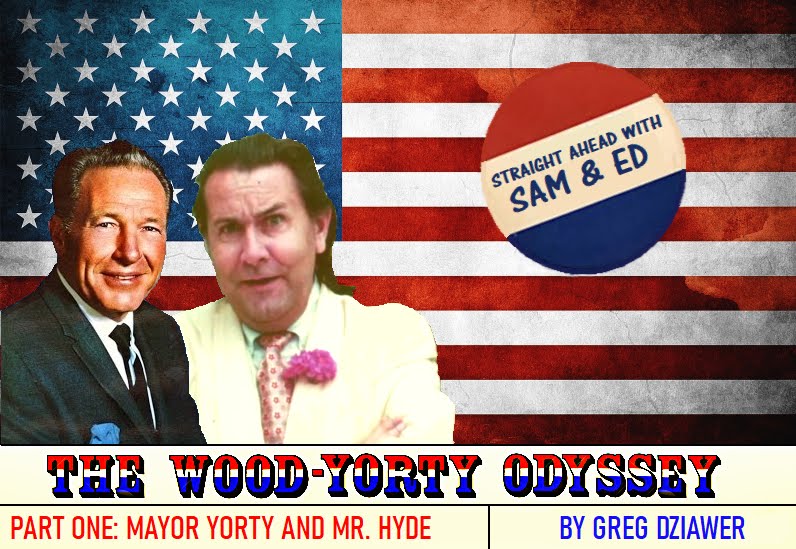
Ed Wood Wednesdays: The Wood-Yorty Odyssey, Part One by Greg Dziawer

Three-time Los Angeles mayor Sam Yorty had a connection to our own Edward D. Wood, Jr.

Logo for Yorty's local chat show.
In Rudolph Grey's Nightmare of Ecstasy: The Life and Art of Edward D. Wood, Jr. (1992), actor Conrad Brooks claims that, circa 1967, Wood "was either driving a cab or working for Sam Yorty, writing campaign speeches." In that same book, Grey states that Ed Wood worked for Sam Yorty in 1964 at KTTV Channel 11 in Los Angeles and "may well have directed segments" of Yorty's local talk show.

Mayor Sam, as he was sometimes affectionately known, endured three tumultuous terms as Mayor of Los Angeles from 1963 through 1971. Although he remained active in politics before and after this, including two terms in the House of Representatives from 1951 to 1955, his occasional appearances on The Tonight Show Starring Johnny Carson, per the IMDb, all occurred during his stint as Mayor. Yorty also helmed his own talk show in LA, on and off again, through the '60s and '70s, and even appeared on Truth or Consequences with host Bob Barker. 

As we begin to examine the connections between Wood and Yorty, consider the following pieces of evidence:

  • Buddy Hyde is a name familiar to serious Wood fans, no doubt. He is quoted a handful of times in Nightmare of Ecstasy. Buddy produced Cris' TV show Criswell Predicts. Additionally, Buddy and Cris were invited by Ed to attend the shoot of Necromania and peruse the film's two principal sets. Furthermore, Ed and John Agar stopped by to see Buddy in 1977 to borrow some cash for booze. Buddy attended Ed's funeral service, as did Cris. And Buddy, too, worked for Sam Yorty. 
  • Ed has also been credited as working on the TV series Criswell Predicts

So what does all of this mean?

I was googling a couple of weeks ago, digging into Sam Yorty, wondering if I could somehow find a clue that linked to Ed's involvement with the Mayor. Not far into it, I hit upon an article that startled me. It was about Buddy Hyde.

From a newspaper story about Hyde.
The article, published twice locally in Hyde's hometown of Hagerstown, MD (on October 5 and 7, respectively), is a treasure-trove of relevant details. Apart from painting a very reverential portrait of Hyde—deservedly so, as the article reveals a fascinating career—we learn of Hyde's close association with Mayor Sam Yorty. (And Christine Jorgensen?!?) 

If Ed did, indeed, work on shoots for Yorty's LA-market talk show as early as 1964, we have to wonder if Buddy was also there. Despite the quote in Nightmare of Ecstasy that Hyde produced Criswell Predicts in the late '60s, the show itself—originally 15 minutes of filler also sometimes repeated and scattered throughout the day's schedule—aired from 1953 through 1961, initially on LA's Channel 13 KCOP. Could Ed and Buddy have linked up that early, and with Cris? 

This is just the starting point for this Odyssey, ultimately endeavoring to identify the nature of Ed's work for Mayor Sam Yorty. As an accountant would say, we are also promised positive externalities. Namely Criswell. And a better handle on Cris' relationship with Ed, as well as a clearer understanding of the famed psychic's TV series, radio show, and syndicated newspaper column. 

As one final bit of ephemera: Criswell name-checked Buddy Hyde in that selfsame column, which by then was in its final days. (Also a common theme in Criswell Predicts: predicting that female impersonators would stage The Women in Vegas, "creating a new trend.") By 1975, Criswell's column retained the tagline "An Accurate Glimpse of Your Future," but Cris' picture had been replaced by a simple graphic image of an observatory and a few surrounding planets. 

Ed's star, too, had disappeared from the firmament, though not for long.

We'll return to the Wood Yorty Odyssey here, in future Ed Wood Wednesdays, and untangle the impossible story of Ed's involvement in the day-to-day dialogue of the national political scene during a cataclysmic time. 

And—oh yeah—while he was involved in that, he was also writing porn.

NOTE: Additional newspaper clippings related to Buddy Hyde and Criswell can be found at the Ed Wood Wednesdays Tumblr.

Wednesday, April 26, 2017

Ed Wood Wednesdays: The 'Young Marrieds' Odyssey, Part One by Greg Dziawer

Ben exits the Nude A Go Go in Ed Wood's The Young Marrieds.

Loser of the Week

Sportscaster Stu Nahan
I remember Stu Nahan (1926-2007) as one of the color commentators in the Rocky films. Not yet in my teens, I don't think it occurred to me that Stu Nahan was essentially playing himself. For the better part of 30 years, from the 1970s through the '90s, Stu was a sports anchor in the Los Angeles television market. Early on, he appears to have had a bad week in the local press, the very same week that Ed Wood and crew were shooting the exterior location of the strip club in The Young Marrieds.

In this week's Ed Wood Wednesdays, we're taking a trip down La Cienega Blvd in West Hollywood, circa spring 1971.

I'm sure many of you noticed the two moments in The Young Marrieds when Ben exits the strip club, and quickly rushing by behind him as the camera follows him, we see a sign on the building. The club, as identified by Joe Blevins previously here at Ed Wood Wednesdays, is the Nude A Go Go. We can make out part of the sign to the right of the entrance in the first shot of Ben exiting, and the sign to the left of the door reads:

LOSER OF THE WEEK
STU NAHAN
AND HIS COMPUTER

Not sure what this meant exactly, I inferred it might have something to do with Stu having made a sports prediction (or predictions) with a computer, obviously novel at the time. The prediction(s) must have been wrong, and were likely regarding an LA team, as the proprietors of the Nude A Go Go saw fit to dub Stu their Loser of the Week. Incidentally, the sign also listed Fidel Castro and Richard Nixon among its losers of the week. But what was this all about?

Monday, December 21, 2015

Did Frank Zappa somehow predict Mötley Crüe?

Frank Zappa (black tux, yellow shirt) on the cover of his Tinseltown Rebellion album.

The infamous glam metal outfit Mötley Crüe formed in 1981, the same year Frank Zappa released his mostly-live Tinseltown Rebellion album. Why is that significant? Well, the title track of Zappa's LP is a screed against the shallow, image-conscious music scene in Los Angeles. Two genres, punk and new wave, are mentioned specifically in the harsh, satirical lyrics. The song is about how musicians in L.A. were more concerned with how they looked than how they sounded, leading to a glut of crappy, amateurish music. According to "Tinseltown Rebellion," the bars and clubs in Hollywood were being besieged in the early 1980s by "record company pricks" looking for flash-in-the-pan acts to exploit and then most likely abandon after "a week or two perhaps," and there were plenty of young musicians lining up to be exploited in this way.

In his lengthy Zappa-analyzing book, The Negative Dialetics of Poodle Play, author and punk loyalist Ben Watson takes Frank to task for unfairly and inaccurately portraying punk rock here. Real punkers, he insist, did not use cocaine, as Frank alleged in "Tinseltown Rebellion." Sure, the arena rockers of the 1970s snorted plenty of the stuff, but punk was rebelling against all that. Besides, Watson argues, punk rockers couldn't have even afforded coke if they'd wanted it back then. It was an expensive drug, and punk was commercially negligible in those days. I might argue that Zappa also mentions new wave, a slicker, more commercial genre that rose from punk. Certainly by 1981, some new wavers were selling enough records, tickets, and T-shirts to afford cocaine. Whether they did or not, I don't know. But they could have if they'd wanted to, is my point.

Maybe Frank Zappa was just using the terms "punk" and "new wave" because those were the only labels available to him at the time to describe a kind of music that was cropping up in Los Angeles in the 1980s. I mentioned at the start of this article that Mötley Crüe formed in '81. They were, of course, a fixture of the Los Angeles club scene in the 1980s, but I don't think anyone would describe them as punk or new wave. Not by a long shot. Instead, they were part of a movement now known as "glam metal" or "hair metal," a subgenre that definitely did regrettably emphasize image at the expense of music. Zappa would not have known who Mötley Crüe were when he wrote "Tinseltown Rebellion," but that's nevertheless the band that comes to my mind when I hear this song. Take a listen.


Mötley Crüe at the Whisky.
So now we get into specific references in the lyrics. The song starts: "From Madame Wong's to Starwood to the Whisky on the Strip, you can hear the crashing, blasting strum of bands that come to be real hip." Okay, I can't find any documentation that the Crue ever played Madame Wong's, an establishment that catered to punk acts, but they were famous for their appearances at both Starwood and the Whisky A Go Go. So two out of three ain't bad. Here's another line from the song: "So off they go to S.I.R. to learn some stupid riffs and practice all their poses in between their powder sniffs." That's Studio Instrument Rentals, a famous rehearsal space in Los Angeles. When you go to S.I.R.'s website, one of the first things you'll see is a paragraph about the company's history: "Artists including Miley Cyrus, Queen Latifah, Snoop Dogg, Katy Perry, Jane’s Addiction, KISS, Mötley Crüe, Green Day, No Doubt, Maroon 5 and Mariah Carey all call SIR home." So another reference checks out.

And what about those "powder sniffs?" Well, Mötley Crüe is justly famous for its love of chemical intoxicants. Even the cover of their official autobiography, The Dirt, is designed to look like a Jack Daniels label. The band is most closely associated with alcohol and heroin, but they did their share of cocaine, too. In my research, I even found a cute little story about lead singer Vince Neil buying a baggie of cocaine that turned out to be baby powder. The unnamed band in the song plays music that is "real dumb" and "somewhat insincere." Check and check. (Though the Crue's masterpiece, "Girls, Girls, Girls," is probably very close to their hearts.) Zappa also mentions "leather groups and plastic groups and groups that look real queer." The Crue certainly wore plenty of leather, and their over-the-top stage makeup gave them an androgynous appearance. So, once again, the song fits them very well. Zappa did not accurately predict the Crue's longevity, however. While there probably were plenty of flash-in-the-pan groups on the glam metal scene in Los Angeles, Mötley Crüe stayed popular for decades, only recently retiring.

Again, let me emphasize that "Tinseltown Rebellion" is not about Mötley Crüe. It couldn't have been. When Frank Zappa wrote it, the band was just starting out. But what the song manages to do very well is predict where the Los Angeles music scene was heading in the 1980s. Mötley Crüe simply exemplified that era better than just about any other band.

Sunday, May 19, 2013

The Greatest Pretender: Korla Pandit, music's most magnificent fraud

A few of Korla's two dozen albums. You might notice a recurring visual motif on the LP covers. 

"For wisdom is better than rubies, and all things to be desired are not to be compared unto it. We bring you musical gems from near and far, blended into a pattern of glorious harmony, a program based on the universal language of music. It is our pleasure to present to you..."
Korla Pandit spoke not a word when he was on camera. He just wore a bejeweled turban, played the organ... and stared. That was the extent of his act. It was all he needed -- the shimmery tones of his music, the vague evocation of the Far East, and that indelible Mona Lisa countenance with its piercing dark eyes and intriguing half-smile. It was a potent combination which carried him along for nearly half a century. And yet, Korla Pandit never really existed at all. It depends, I suppose, on your definition of "existed." Either way, his story is one of the most implausible and oddly inspiring in the history of popular music.

I first encountered Korla Pandit without any clue to his identity or knowledge of his past. Portraying himself, Korla made a memorable cameo in Tim Burton's 1994 film, Ed Wood. In the scene, notorious director Edward D. Wood, Jr. (Johnny Depp) is holding a wrap party for his 1955 sci-fi/horor anti-epic, Bride of the Monster. The wild celebration, attended by Bela Lugosi and the other oddballs and grotesques who orbited Wood, is held in the meat-packing plant of the film's major backer, wealthy rancher Donald McCoy (Rance Howard). While the carcasses of slaughtered animals hang from hooks all around them, the revelers are treated to a suggestive dance routine performed by Wood himself, costumed as a harem girl. Korla Pandit, immaculately attired in a Nehru jacket and the ever-present turban, accompanies him on the organ with a composition called "Nautch Dance," referring to a seductive style of dance popularized in early-1900s India. As near as I can tell from reading about Ed Wood's life, no such party ever occurred, though Ed did like to surprise and shock people by dressing in drag and dancing wildly in public places and at parties. Still, it's a fun scene with a memorable capper as Ed removes his veil. Here's a clip.


For many years, that was my only encounter with Korla Pandit. "Nautch Dance" did appear on the Ed Wood soundtrack, though it was credited -- along with all the other tracks -- to Howard Shore, who composed the film's score. Many years later, though, I started noticing a particular LP cover which kept turning up on Internet lists of the best, worst, craziest, and "most WTF" album covers of all time. It was this one for a '50s-era Korla Pandit Christmas album:

The infamous Korla Pandit Christmas LP cover.

Something about the image stopped me in my tracks every time I saw it. Who was this odd, androgynous man sitting stiffly behind a keyboard and wearing the kind of suit a businessman would be buried in? Why did he seem to be wearing eye shadow and lipstick? And, most of all, why did he look so familiar? A quick Google search answered a few of my questions. He was, indeed, the mysterious organist from Ed Wood. Burton's film was made a mere four years before the musician died of a myocardial infarction at 77. His main claim to fame was starring in a Los Angeles-based 15-minute television show, Korla Pandit's Adventures in Music, in the late '40s and early '50s at the very dawn of the television age. He then made a series of short films which were nationally syndicated and thus made him famous across America. After that followed a series of albums and another local Los Angeles show. He remained a television fixture throughout the 1950s and 1960s. Then, after his career slowed down in the 1970s, he shifted to making public appearances and giving private lessons. He continued working steadily as a performer until the end of his life. To give you an idea of what Korla was like in his 1950s glory days, here's a clip from one of his TV shows. Supposedly, he made roughly 900 episodes like it. If something like this were to air on TV today, it would seem almost avant garde, like some weird experimental parody from Adult Swim.


Korla's story ended in 1998 in Petaluma, CA, but it began in St. Louis, Missouri in 1921, where one John Roland Redd was born, one of seven children of an African-American couple. Growing up black in Missouri in the 1920s and 1930s was exactly as uncomfortable as you might guess it would be. Instead of letting racial politics define his life, however, Redd chose to sidestep the issue altogether by completely remaking his image. In his late teens (after a brief apprenticeship at an Idaho radio station), he made his way to Los Angeles, the city which has perhaps eclipsed even New York as the reinvention capital of the world, and it was there he first donned a turban (an affectation he'd seen in a movie called Midnight Shadow) and began performing under the assumed name, Juan Rolando. As you can see, that first alias was a mere variation on his own real name. However, once he married Disney artist Beryl June DeBeeson in 1944, the complete repackaging of John Roland Redd really began. He and his wife devised the persona of "Korla Pandit," complete with a totally fictitious back story which declared that he was born in New Dehli to a Brahmin priest and a French opera singer. None of it was true, of course, but since when did "truth" and "show business" ever have anything to do with one another? Pandit kept up the ethnic charade for the next half century. The actual facts of his life were not revealed until a 2001 article in Los Angeles magazine.

The story of John Roland Redd a.k.a. Korla Pandit is unlike any I've encountered in popular culture. He presented an abstracted yet alluring version of India without even a semblance of authenticity. Korla represented the Far East as viewed through the eyes of the West. That speech comparing rubies to wisdom, for instance, comes not from anything in the Hindu religion but is a paraphrase of Proverbs 8:11 from the Old Testament. Even more obviously, the electric organ is not remotely Indian in nature. From what I can determine, the instrument was largely developed and popularized in the United States. However, the eerie and unearthly tones Pandit/Redd was able to conjure from it seemed to transport listeners to an exotic world of mystery, some indefinable place far away. That was the real magic behind what he did.

I'll leave you with one more clip of Korla Pandit. Here, he plays "Miserlou," a traditional Greek tune which you'll probably recognize as the theme from Pulp Fiction (where it was played by surf rock guitarist Dick Dale):


Sunday, January 1, 2012

The Los Angeles Way of Death!

Thirty years ago:


Incidentally, this very cartoon -- this self-same one you've just read -- led to the creation of The Simpsons. Producer James L. Brooks happened to see this cartoon and got in contact with its creator, Matt Groening, about producing some interstitial animation for The Tracey Ullman Show. Groening took him up on the offer, of course, and the result was The Simpsons, which spent a couple of seasons as a feature on Ullman before getting its own spinoff series in 1989.